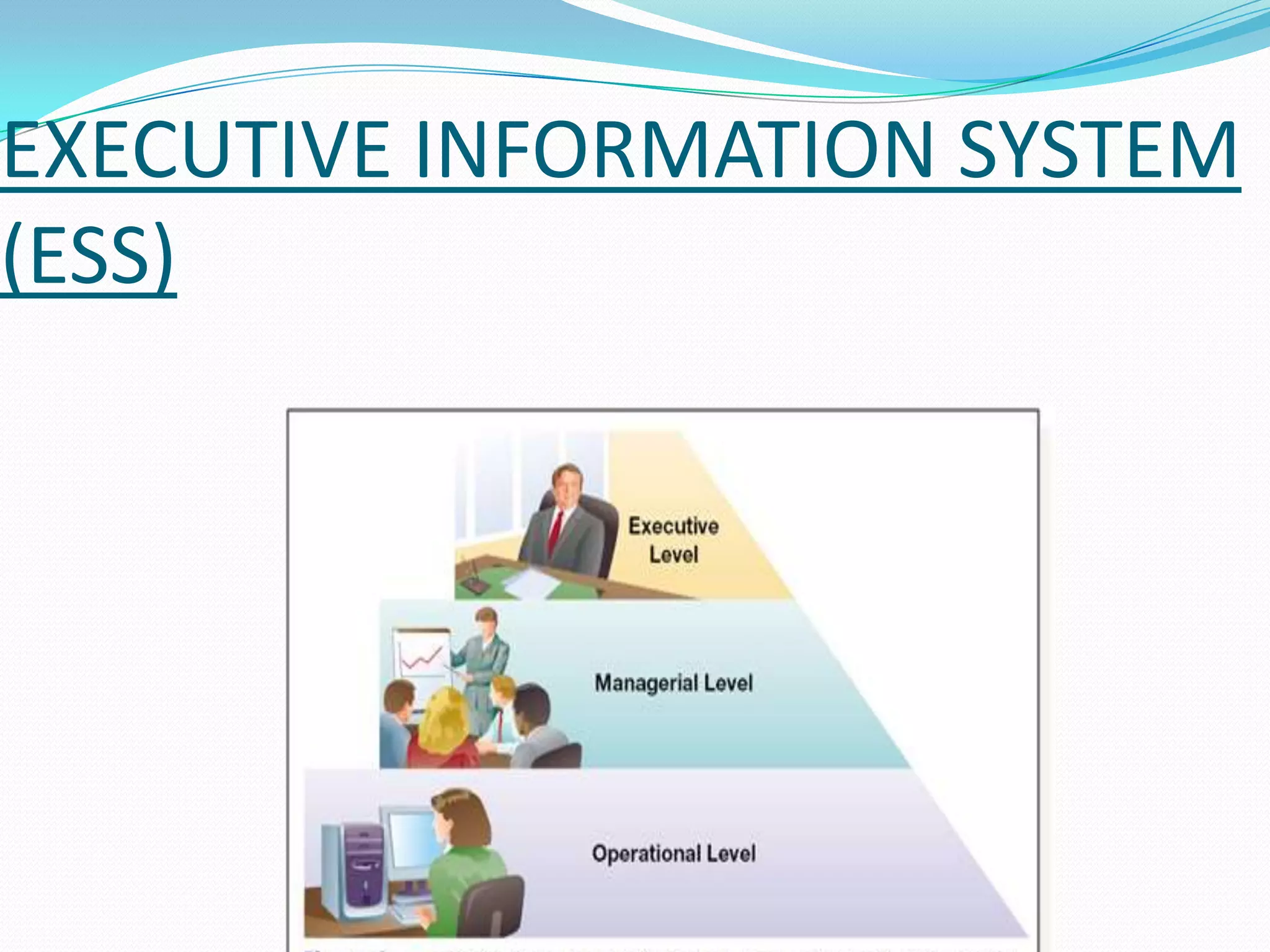
EXECUTIVE INFORMATION SYSTEM
(ESS)
What is ESS?
 A reporting tool (software)
 Also known as Executive Information System (EIS)
 Allows you to turn your organization's data into useful

summarize reports
 These reports are generally used by executive level managers

for quick access to reports coming from all company levels
and departments
 The exact reporting tools and outcome of an Executive

Support System completely depends on the ESS developer
and it's intended industry use.

 For example, Cambridge Systematics has ESS to support the

investment planning process for the Ministry of
Transportation.
Characteristics of ESS
 Computer based information system
 Enables users to extract summary data and solve complex

problem
 Provides rapid and direct access to timely information and

management reports
 Capable of both accessing both internal and external data

 Provides extensive online analysis like trend analysis,

scenario analysis, etc.

 Can easily be given DSS support for decision making
Components of ESS
 Hardware
 Software
 User interface

 Telecommunications
Hardware
The basic hardware needed for a typical EIS includes four components:
 Input data-entry devices. These devices allow the executive to enter,

verify, and update data immediately
 The central processing unit (CPU), which is the kernel because it

controls the other computer system components
 Data storage files. The executive can use this part to save useful business

information, and this part also help the executive to search historical
business information easily
 Output devices, which provide a visual or permanent record for the

executive to save or read. This device refers to the visual output device
such as monitor or printer
Software
A typical EIS includes four software components:
 Text-handling software
 Database
 Graphic base

 Model base
User interface
 An EIS must be efficient to retrieve relevant data for decision

makers, so the user interface is very important.
 Several types of interfaces can be available to the EIS

structure, such as scheduled reports, questions/answers,
menu driven, command language, natural language, and
input/output.
Telecommunication
 Transmitting data from one place to another has become

crucial for establishing a reliable network.
 In addition, telecommunications within an EIS can

accelerate the need for access to distributed data.

Executive support system (ess)

  • 1.
  • 2.
    What is ESS? A reporting tool (software)  Also known as Executive Information System (EIS)  Allows you to turn your organization's data into useful summarize reports  These reports are generally used by executive level managers for quick access to reports coming from all company levels and departments
  • 3.
     The exactreporting tools and outcome of an Executive Support System completely depends on the ESS developer and it's intended industry use.  For example, Cambridge Systematics has ESS to support the investment planning process for the Ministry of Transportation.
  • 4.
    Characteristics of ESS Computer based information system  Enables users to extract summary data and solve complex problem  Provides rapid and direct access to timely information and management reports
  • 5.
     Capable ofboth accessing both internal and external data  Provides extensive online analysis like trend analysis, scenario analysis, etc.  Can easily be given DSS support for decision making
  • 6.
    Components of ESS Hardware  Software  User interface  Telecommunications
  • 7.
    Hardware The basic hardwareneeded for a typical EIS includes four components:  Input data-entry devices. These devices allow the executive to enter, verify, and update data immediately  The central processing unit (CPU), which is the kernel because it controls the other computer system components  Data storage files. The executive can use this part to save useful business information, and this part also help the executive to search historical business information easily  Output devices, which provide a visual or permanent record for the executive to save or read. This device refers to the visual output device such as monitor or printer
  • 8.
    Software A typical EISincludes four software components:  Text-handling software  Database  Graphic base  Model base
  • 9.
    User interface  AnEIS must be efficient to retrieve relevant data for decision makers, so the user interface is very important.  Several types of interfaces can be available to the EIS structure, such as scheduled reports, questions/answers, menu driven, command language, natural language, and input/output.
  • 10.
    Telecommunication  Transmitting datafrom one place to another has become crucial for establishing a reliable network.  In addition, telecommunications within an EIS can accelerate the need for access to distributed data.