

Conditions that increases the severity
of loss :
Hazards
Putting fire to your own factory is an
example of _______ hazard.
Moral Hazard
________risk is not at all affected by the
economic conditions.
Static Risks
An uncertain event or condition that, if
it occurs, has a positive or negative
effect on a project objectives is termed
______ .
Risk
Property Risk is one of the type of
______ .
Pure Risks
Organization’s readiness to bear the risk
to achieve its objective :
Risk Tolerance
Identification, assessment and
prioritization of risks is known as :
Risk Management
One of the tools of risk handling to
reduce the probability and impact of
risk :
Mitigation of Risk
Unplanned responses to unexpected
risk :
Workaround
Acceptance of risk in an unplanned
manner if no action is feasible :
Passive Acceptance
A list of questions that address traditional
areas of uncertainty on a project is termed a
risk _______ .
Profile
Which of the following is not one of the steps
in the risk management process?
a. Risk response development
b. Risk assessment
c. Risk identification
d. Risk tracking
e. Risk response control
d. Risk Tracking
Q. A risk profile is a list of questions that
address traditional areas of uncertainty on a
project that answers developed from:
a. When the event might occur in the project
b. Chances of the event occurring
c. Interaction with other parts of the project
or with other projects
d. From previous, similar projects
e.Magnitude or severity of the event's impact
d. From previous, similar projects
The risk assessment form contains all of the
following except
a. Likelihood of the risk event occurring
b. Potential impact of the risk event
c. Who will detect the occurrence of the risk
event.
d. Difficulty of detecting the occurrence of
the risk event
e. When the risk event may occur
c. Who will detect the occurrence
of the risk event
Q. Technical risks are:
a. Often the kind that can cause the project to
be shut down.
b. Problematic
c. Imposed duration dates
d. Both A and B are correct
e. A, B, and C are all correct
d. Both A and B are correct
Detailing all identified risks, including
descriptions, category, and probability of
occurring, impact, responses,
contingency plans, owners and current
status is called:
Risk Register
Q. During which stage of risk planning are
risks prioritized based on probability and
impact?
a) Perform Qualitative Risk Analysis
b) Monitor and Control Risks
c) Plan Risk Management
d) Identify Risks
a. Perform Qualitative Risk
Analysis
Q. Your project has met with an unexpected problem.
The supply of a critical component of your final
product is delayed by 25 days. You need to show an
alpha prototype of the product in 15 days. You’ve called
a brainstorming team meeting to determine if you can
deliver this limited version without the critical
component. What are you trying to create?
a. A risk management plan
b. A risk mitigation strategy
c. A workaround
d. An updated scope baseline
c. A workaround
Q. Which of the following processes has the
Risk Register as the primary output?
a. Perform Qualitative Risk Analysis
b. Monitor and Control Risks
c. Plan Risk Management
d. Identify Risks
d. Identify Risks
Q.Why is a large number of exposure units required for a
risk to be insurable?
a. It allows the insurer to more accurately predict the
expected dollar amount of loss and calculate a pure
risk premium
b. It allows for at least some losses to occur
c. It reduces the moral hazard
d. It guarantees the insurer will make money
e. It permits cross subsidization from the lower premium
insures to those higher premium paying policyholders
with larger losses
c. It reduces the moral hazard
Q. The definition of peril is:
a. The actual cause of loss
b. The uncertainty concerning loss
c. A measure of the accuracy with which a loss
can be predicted
d. the first cause in an unbroken chain of
events
a. The actual cause of loss
Q. The moral hazard is:
a. A loss of faith in the insurer because of a
denial of claims.
b. Illustrated by the loss of a wallet to a thief.
c. The potential for the insurer to increase
premiums after loss.
d. The increase of loss caused by attempts to
defraud the insurer .
e. The insolvency of the insurance company
due to lapses in judgement from the CEO
a. A loss of faith in the insurer
because of a denial of claims.
Q. A pure risk is one where:
a. The result can only be a loss or no loss
b. The result can be a gain or loss
c. The result can be only a gain or no gain
d. The result can not be predicted
e. The result is subject to chance
a. The result can only be a loss or
no loss
Q. The criteria for ideally insurable losses
include all of the following EXCEPT:
a. Losses definite in time.
b. Accidental Losses.
c. A small carefully defined group of
exposures.
d. A large number of homogeneous risks .
e. low probability of catastrophic loss
b. Accidental Losses.
Q. A risk where the frequency of loss is low and
the severity of loss is high represents a case
where which risk management tool should be
used:
a. Risk assumption
b. Loss prevention
c. Loss control
d. Insurance or risk transfer
e. Risk avoidance
c. Loss control
Q. The most difficult and important step in the risk
management process and one that can lead to a risk
manager being terminated if it is not conducted properly is:
a. risk identification, particularly those risks that are
foreseeable
b. finding the most costly insurer to cover all the risks that
may impact an organization
c. determining the appropriate amount of premium for
pure and speculative risks
d. covering all the firm's financial risks using derivative
contracts
e. hiring a highly trained accountant to create a tax-
sheltered captive within the organization to allow
management to take vacations in Bermuda
d. covering all the firm's financial
risks using derivative contracts
Q. Risk managers can identify potential
property losses using:
a. walking tours of the facilities and operations
subject to risk
b. checklists
c. flowcharts
d. interviews with employees
e. all of the above
e. all of the above
Q. According to Maylor, what are traditionally
the core three risk categories?
a. Cost, schedule, and quality
b. Environment, cost, and legal
c. Resources, schedule, and health and safety
a. Cost, schedule, and quality
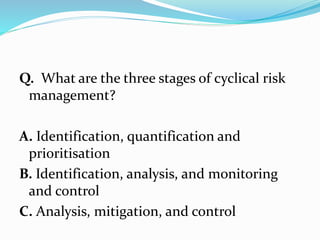
Q. What are the three stages of cyclical risk
management?
A. Identification, quantification and
prioritisation
B. Identification, analysis, and monitoring
and control
C. Analysis, mitigation, and control
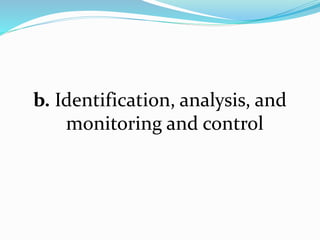
b. Identification, analysis, and
monitoring and control
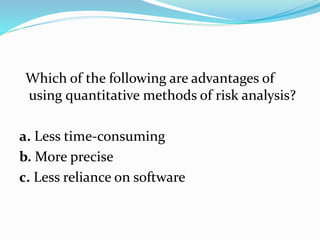
Which of the following are advantages of
using quantitative methods of risk analysis?
a. Less time-consuming
b. More precise
c. Less reliance on software
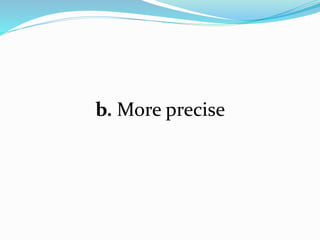
b. More precise
Q. What is Opportunities Management?
a. The management of any identified risk
once it occurs
b. The management of positive risks
c. A new school of thought that treats the
emergence of any risk as an opportunity to
re-work the project
b. The management of positive
risks
THANK YOU!!

Quiz on Risk Management (Insurance)

  • 2.
    Conditions that increasesthe severity of loss :
  • 3.
  • 4.
    Putting fire toyour own factory is an example of _______ hazard.
  • 5.
  • 6.
    ________risk is notat all affected by the economic conditions.
  • 7.
  • 8.
    An uncertain eventor condition that, if it occurs, has a positive or negative effect on a project objectives is termed ______ .
  • 9.
  • 10.
    Property Risk isone of the type of ______ .
  • 11.
  • 12.
    Organization’s readiness tobear the risk to achieve its objective :
  • 13.
  • 14.
  • 15.
  • 16.
    One of thetools of risk handling to reduce the probability and impact of risk :
  • 17.
  • 18.
    Unplanned responses tounexpected risk :
  • 19.
  • 20.
    Acceptance of riskin an unplanned manner if no action is feasible :
  • 21.
  • 22.
    A list ofquestions that address traditional areas of uncertainty on a project is termed a risk _______ .
  • 23.
  • 24.
    Which of thefollowing is not one of the steps in the risk management process? a. Risk response development b. Risk assessment c. Risk identification d. Risk tracking e. Risk response control
  • 25.
  • 26.
    Q. A riskprofile is a list of questions that address traditional areas of uncertainty on a project that answers developed from: a. When the event might occur in the project b. Chances of the event occurring c. Interaction with other parts of the project or with other projects d. From previous, similar projects e.Magnitude or severity of the event's impact
  • 27.
    d. From previous,similar projects
  • 28.
    The risk assessmentform contains all of the following except a. Likelihood of the risk event occurring b. Potential impact of the risk event c. Who will detect the occurrence of the risk event. d. Difficulty of detecting the occurrence of the risk event e. When the risk event may occur
  • 29.
    c. Who willdetect the occurrence of the risk event
  • 30.
    Q. Technical risksare: a. Often the kind that can cause the project to be shut down. b. Problematic c. Imposed duration dates d. Both A and B are correct e. A, B, and C are all correct
  • 31.
    d. Both Aand B are correct
  • 32.
    Detailing all identifiedrisks, including descriptions, category, and probability of occurring, impact, responses, contingency plans, owners and current status is called:
  • 33.
  • 34.
    Q. During whichstage of risk planning are risks prioritized based on probability and impact? a) Perform Qualitative Risk Analysis b) Monitor and Control Risks c) Plan Risk Management d) Identify Risks
  • 35.
  • 36.
    Q. Your projecthas met with an unexpected problem. The supply of a critical component of your final product is delayed by 25 days. You need to show an alpha prototype of the product in 15 days. You’ve called a brainstorming team meeting to determine if you can deliver this limited version without the critical component. What are you trying to create? a. A risk management plan b. A risk mitigation strategy c. A workaround d. An updated scope baseline
  • 37.
  • 38.
    Q. Which ofthe following processes has the Risk Register as the primary output? a. Perform Qualitative Risk Analysis b. Monitor and Control Risks c. Plan Risk Management d. Identify Risks
  • 39.
  • 40.
    Q.Why is alarge number of exposure units required for a risk to be insurable? a. It allows the insurer to more accurately predict the expected dollar amount of loss and calculate a pure risk premium b. It allows for at least some losses to occur c. It reduces the moral hazard d. It guarantees the insurer will make money e. It permits cross subsidization from the lower premium insures to those higher premium paying policyholders with larger losses
  • 41.
    c. It reducesthe moral hazard
  • 42.
    Q. The definitionof peril is: a. The actual cause of loss b. The uncertainty concerning loss c. A measure of the accuracy with which a loss can be predicted d. the first cause in an unbroken chain of events
  • 43.
    a. The actualcause of loss
  • 44.
    Q. The moralhazard is: a. A loss of faith in the insurer because of a denial of claims. b. Illustrated by the loss of a wallet to a thief. c. The potential for the insurer to increase premiums after loss. d. The increase of loss caused by attempts to defraud the insurer . e. The insolvency of the insurance company due to lapses in judgement from the CEO
  • 45.
    a. A lossof faith in the insurer because of a denial of claims.
  • 46.
    Q. A purerisk is one where: a. The result can only be a loss or no loss b. The result can be a gain or loss c. The result can be only a gain or no gain d. The result can not be predicted e. The result is subject to chance
  • 47.
    a. The resultcan only be a loss or no loss
  • 48.
    Q. The criteriafor ideally insurable losses include all of the following EXCEPT: a. Losses definite in time. b. Accidental Losses. c. A small carefully defined group of exposures. d. A large number of homogeneous risks . e. low probability of catastrophic loss
  • 49.
  • 50.
    Q. A riskwhere the frequency of loss is low and the severity of loss is high represents a case where which risk management tool should be used: a. Risk assumption b. Loss prevention c. Loss control d. Insurance or risk transfer e. Risk avoidance
  • 51.
  • 52.
    Q. The mostdifficult and important step in the risk management process and one that can lead to a risk manager being terminated if it is not conducted properly is: a. risk identification, particularly those risks that are foreseeable b. finding the most costly insurer to cover all the risks that may impact an organization c. determining the appropriate amount of premium for pure and speculative risks d. covering all the firm's financial risks using derivative contracts e. hiring a highly trained accountant to create a tax- sheltered captive within the organization to allow management to take vacations in Bermuda
  • 53.
    d. covering allthe firm's financial risks using derivative contracts
  • 54.
    Q. Risk managerscan identify potential property losses using: a. walking tours of the facilities and operations subject to risk b. checklists c. flowcharts d. interviews with employees e. all of the above
  • 55.
    e. all ofthe above
  • 56.
    Q. According toMaylor, what are traditionally the core three risk categories? a. Cost, schedule, and quality b. Environment, cost, and legal c. Resources, schedule, and health and safety
  • 57.
    a. Cost, schedule,and quality
  • 58.
    Q. What arethe three stages of cyclical risk management? A. Identification, quantification and prioritisation B. Identification, analysis, and monitoring and control C. Analysis, mitigation, and control
  • 59.
    b. Identification, analysis,and monitoring and control
  • 60.
    Which of thefollowing are advantages of using quantitative methods of risk analysis? a. Less time-consuming b. More precise c. Less reliance on software
  • 61.
  • 62.
    Q. What isOpportunities Management? a. The management of any identified risk once it occurs b. The management of positive risks c. A new school of thought that treats the emergence of any risk as an opportunity to re-work the project
  • 63.
    b. The managementof positive risks
  • 64.