
PRESENTATION ON:-
Executive Support System
(ESS)
Submitted to:-
Dr B.K JHA
Submitted by:-
ARUN KUMAR
Roll no.-01,2nd sem (2015-17)
CABM, BAU Kanke, Ranchi
Introduction:
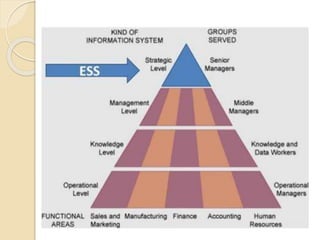
 Executive support system are intended to be use
by senior managers directly to provide support
to programmed decision in strategic
management.
 These information are external, unstructured and
even uncertain. Exact scope and context of such
information is often not known beforehand.
What is ESS ???
A Reporting tool(software)
Also known as Executive Information System
Allows you turn organization’s data into useful
summarize reports
These reports are generally used by executive
level managers for quick access to report coming
from all company levels and departments
The exact reporting tool and outcome of an
Executive support system completely depends on
ESS developer and it’s intended industry use.
Characteristics of ESS
 Computer Based Information System
 Enable user to extract summary data and solve
complex problem.
 Provide rapid and direct access to timely
information and management reports.
 Capable of both accessing both internal and
external data.
 Provide extensive online analysis like trend
analysis, scenario analysis etc.
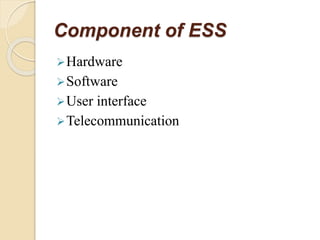
Component of ESS
Hardware
Software
User interface
Telecommunication
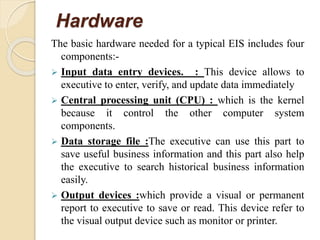
Hardware
The basic hardware needed for a typical EIS includes four
components:-
 Input data entry devices. : This device allows to
executive to enter, verify, and update data immediately
 Central processing unit (CPU) : which is the kernel
because it control the other computer system
components.
 Data storage file :The executive can use this part to
save useful business information and this part also help
the executive to search historical business information
easily.
 Output devices :which provide a visual or permanent
report to executive to save or read. This device refer to
the visual output device such as monitor or printer.
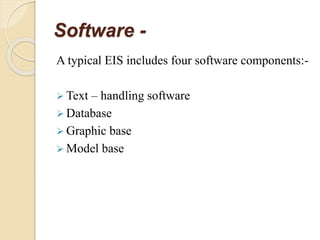
Software -
A typical EIS includes four software components:-
 Text – handling software
 Database
 Graphic base
 Model base
User interface -
 An EIS must be efficient to retrieve relevant
data for decision makers, so the user interface is
very important.
 Several types of interface can be available to the
EIS structure, such as schedule reports,
question-answers, menu driven, command
language, natural language, and input/output.
Telecommunication -
 Transmitting data from one place to another has
become crucial for establishing reliable network.
 In addition, telecommunications within an EIS
can accelerate the need for access to distribute
data.
Role of ESS in the
organization
 An ESS can be supply the summarised
information executive need and yet provide the
opportunity to drill down to more detail if
necessary.
 As technology advantages, ESS are able to link
data from various sources both in internal and
external to provide the amount and kind of
information executive find useful.
 They are turning out to be an easy way to
manipulate information.
Advantages of ESS
 Easy for upper–level executive to use, extensive
computer experience is not required in
operations.
 Provides timely delivery of company summary
information.
 Information that is provide better understood.
 Filter data for management.
 Improves to tracking information.
 Offers efficiency to decision maker.
Disadvantages of ESS
 Limited functionality, by design.
 Information overload for some managers.
 Benefits hard to quantify.
 High implementation cost.
 System may become slow, large, and hadr to
manage.
 Need good internal process for data
management.
 May lead to reliable and less secure data.
 System dependent.
Application of ESS :-
After realising it’s advantages, people had applied ESS in many areas,
especially in :- manufacturing, marketing and finance areas.
Manufacturing:
Basically manufacturing is the transformation of raw materials into
finished good for sale, or intermediate process involving the
production or finishing of semi manufactures.
Marketing:
In an organization, marketing executives roles is to create the future.
their main duty is managing available marketing resources to
create.
Financial:
A financial analysis is one of the most important step to companies
today.EIS enables executives to focus more on the long term basic
of current year and beyond.
Summary :
 ESSs meet the needs of corporate executives by
providing them with vast amount of information
quickly and in graphical form to help them make
effective decision.
 ESS must be flexible, easy to use, and contain
both internal and external source of information.
Thank You

Executive Support System (ESS)

  • 1.
    PRESENTATION ON:- Executive SupportSystem (ESS) Submitted to:- Dr B.K JHA Submitted by:- ARUN KUMAR Roll no.-01,2nd sem (2015-17) CABM, BAU Kanke, Ranchi
  • 2.
    Introduction:  Executive supportsystem are intended to be use by senior managers directly to provide support to programmed decision in strategic management.  These information are external, unstructured and even uncertain. Exact scope and context of such information is often not known beforehand.
  • 4.
    What is ESS??? A Reporting tool(software) Also known as Executive Information System Allows you turn organization’s data into useful summarize reports These reports are generally used by executive level managers for quick access to report coming from all company levels and departments The exact reporting tool and outcome of an Executive support system completely depends on ESS developer and it’s intended industry use.
  • 6.
    Characteristics of ESS Computer Based Information System  Enable user to extract summary data and solve complex problem.  Provide rapid and direct access to timely information and management reports.  Capable of both accessing both internal and external data.  Provide extensive online analysis like trend analysis, scenario analysis etc.
  • 7.
  • 8.
    Hardware The basic hardwareneeded for a typical EIS includes four components:-  Input data entry devices. : This device allows to executive to enter, verify, and update data immediately  Central processing unit (CPU) : which is the kernel because it control the other computer system components.  Data storage file :The executive can use this part to save useful business information and this part also help the executive to search historical business information easily.  Output devices :which provide a visual or permanent report to executive to save or read. This device refer to the visual output device such as monitor or printer.
  • 9.
    Software - A typicalEIS includes four software components:-  Text – handling software  Database  Graphic base  Model base
  • 10.
    User interface - An EIS must be efficient to retrieve relevant data for decision makers, so the user interface is very important.  Several types of interface can be available to the EIS structure, such as schedule reports, question-answers, menu driven, command language, natural language, and input/output.
  • 11.
    Telecommunication -  Transmittingdata from one place to another has become crucial for establishing reliable network.  In addition, telecommunications within an EIS can accelerate the need for access to distribute data.
  • 12.
    Role of ESSin the organization  An ESS can be supply the summarised information executive need and yet provide the opportunity to drill down to more detail if necessary.  As technology advantages, ESS are able to link data from various sources both in internal and external to provide the amount and kind of information executive find useful.  They are turning out to be an easy way to manipulate information.
  • 13.
    Advantages of ESS Easy for upper–level executive to use, extensive computer experience is not required in operations.  Provides timely delivery of company summary information.  Information that is provide better understood.  Filter data for management.  Improves to tracking information.  Offers efficiency to decision maker.
  • 14.
    Disadvantages of ESS Limited functionality, by design.  Information overload for some managers.  Benefits hard to quantify.  High implementation cost.  System may become slow, large, and hadr to manage.  Need good internal process for data management.  May lead to reliable and less secure data.  System dependent.
  • 15.
    Application of ESS:- After realising it’s advantages, people had applied ESS in many areas, especially in :- manufacturing, marketing and finance areas. Manufacturing: Basically manufacturing is the transformation of raw materials into finished good for sale, or intermediate process involving the production or finishing of semi manufactures. Marketing: In an organization, marketing executives roles is to create the future. their main duty is managing available marketing resources to create. Financial: A financial analysis is one of the most important step to companies today.EIS enables executives to focus more on the long term basic of current year and beyond.
  • 16.
    Summary :  ESSsmeet the needs of corporate executives by providing them with vast amount of information quickly and in graphical form to help them make effective decision.  ESS must be flexible, easy to use, and contain both internal and external source of information.
  • 17.