Information Systems


  Data vs Information
Data vs. Information
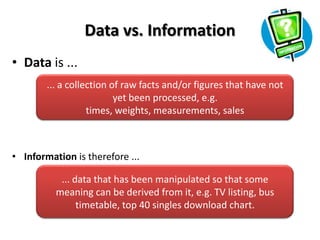
• Data is ...
        ... a collection of raw facts and/or figures that have not
                          yet been processed, e.g.
                   times, weights, measurements, sales


• Information is therefore ...

           ... data that has been manipulated so that some
          meaning can be derived from it, e.g. TV listing, bus
                timetable, top 40 singles download chart.
Data Examples

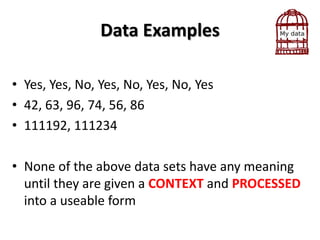
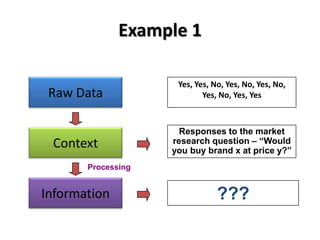
• Yes, Yes, No, Yes, No, Yes, No, Yes
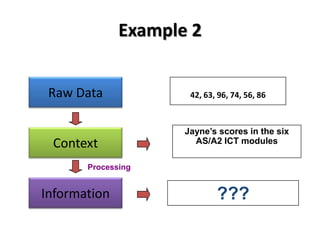
• 42, 63, 96, 74, 56, 86
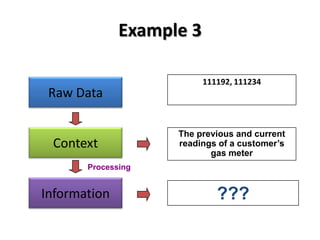
• 111192, 111234

• None of the above data sets have any meaning
  until they are given a CONTEXT and PROCESSED
  into a useable form
Data into Information
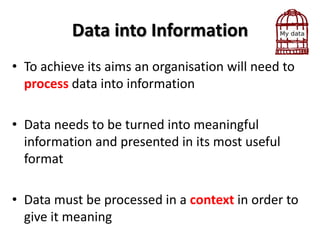
• To achieve its aims an organisation will need to
  process data into information

• Data needs to be turned into meaningful
  information and presented in its most useful
  format

• Data must be processed in a context in order to
  give it meaning
Examples

• In the next 3 examples
  explain how the data could
  be processed to give it
  meaning

• What information can then
  be derived from the data?


        Suggested answers are given at the end of this presentation
Example 1

                     Yes, Yes, No, Yes, No, Yes, No,
 Raw Data                   Yes, No, Yes, Yes


                      Responses to the market
 Context            research question – “Would
                    you buy brand x at price y?”
       Processing


Information                     ???
Example 2


 Raw Data             42, 63, 96, 74, 56, 86


                     Jayne’s scores in the six
 Context               AS/A2 ICT modules

       Processing


Information                  ???
Example 3

                          111192, 111234
 Raw Data

                    The previous and current
 Context            readings of a customer’s
                           gas meter
       Processing


Information                  ???
Suggested Answers
• Example 1
   – We could add up the yes and no responses and calculate the
     percentage of customers who would buy product X at price Y.
     The information could be presented as a chart to make it
     easier to understand.

• Example 2
   – Adding Jayne’s scores would give us a mark out of 600 that
     could then be converted to an A level grade. Alternatively we
     could convert the individual module results into grades.

• Example 3
   – By subtracting the second value from the first we can work out
     how many units of gas the consumer has used. This can then
     be multiplied by the price per unit to determine the
     customer’s gas bill.
Quantitative vs. Qualitative
• Quantitative data is ...

     ... data or information that can be measured numerically
                      and can be proven as fact.


• Qualitative data is ...

     ... data/information that cannot be measured in the usual
       way. As such, it is usually in some sort of narrative form
                           (spoken or written).
Characteristics of Good Information
Data should be:
                              Valid

                            Reliable

                             Timely

            Fit for purpose for which it was intended

                           Accessible

                   Cost-effectively gathered
Common Data Collection Techniques
These can include:
• Application form - (could be for a job or even for a library card)
• Registration form
• Questionnaire - (you might create one or you might be asked to
  complete one)
• Interview - (this could be recorded on paper or using an electronic
  device such as a tape recorder)
• Observation - (this will be where you watch something to gain
  information)
• Discussion
• Online forms
Sources of Internal Information
Information gathered and generated from various internal
   departments:

•   Finance
•   Personnel
•   Marketing Department
                                       Internal
•   Purchasing
•   Sales and customer services
•   Manufacturing
•   Distribution
•   Administration
•   Research and Development (“R&D”)
Sources of External Information
Gathered and generated from various external organisations:

•   Government
•   Trade groupings
•   Commercially provided
•   Databases
•   Research
                                   External
How Organisations use Business Information


• Give operational support (e.g. monitoring and
  controlling activity)

• Provide analysis (e.g. to identify patterns or trends)

• Assist decision making (operational, tactical, strategic)

• Gain a commercial advantage over competitors
Information Flows
• To fully understand how functional areas within an
  organisation interact and exchange information, it is
  necessary to analyse the types of information that flow
  between them.


There are two types of information flow:
• Internal information flow - information generated by
  functional areas, is shared with other functional areas within
  the organisation
• External information flow or passed to agencies outside the
  organisation
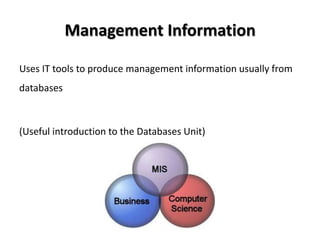
Management Information

Uses IT tools to produce management information usually from
databases


(Useful introduction to the Databases Unit)
Legal Issues
• There is significant legislation with which an organisation
  must comply.
• Some legislation not only applies to individuals as
  employees, but also to individuals in the population at
  large –
• This includes the following:
   – Sex Discrimination Act 1975
   – Race Relations Act 1976
   – Disability Discrimination Act 1995.
Legislation
Relevant data protection
• Data Protection Act 1998
• Freedom of Information Act 2000 (FOIA)


Other relevant legislation
• Computer Misuse Act 1990
• Terrorism Act 2000
• Privacy and Electronic Communications Regulations 2003
Ethical issues
• Concerns ethical issues rather than criminal acts, where the term
  ethical means a generally accepted type of behaviour.

• Ethical behaviour requirements are usually set through Codes of
  Practice or Organisational Policies set by organisations.

They may cover:
• Responsible and appropriate use of email and the Internet
• Whistle-blowing
• Information ownership
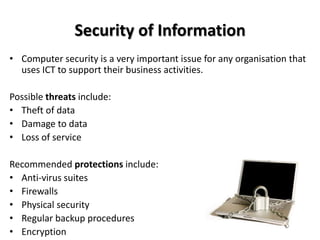
Security of Information
• Computer security is a very important issue for any organisation that
  uses ICT to support their business activities.

Possible threats include:
• Theft of data
• Damage to data
• Loss of service

Recommended protections include:
• Anti-virus suites
• Firewalls
• Physical security
• Regular backup procedures
• Encryption
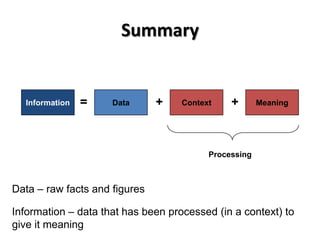
Summary


  Information   =    Data      +    Context    +       Meaning


                                          Processing


Data – raw facts and figures

Information – data that has been processed (in a context) to
give it meaning

BTEC National in ICT: Unit 3 - Data vs Information

  • 1.
    Information Systems Data vs Information
  • 2.
    Data vs. Information •Data is ... ... a collection of raw facts and/or figures that have not yet been processed, e.g. times, weights, measurements, sales • Information is therefore ... ... data that has been manipulated so that some meaning can be derived from it, e.g. TV listing, bus timetable, top 40 singles download chart.
  • 3.
    Data Examples • Yes,Yes, No, Yes, No, Yes, No, Yes • 42, 63, 96, 74, 56, 86 • 111192, 111234 • None of the above data sets have any meaning until they are given a CONTEXT and PROCESSED into a useable form
  • 4.
    Data into Information •To achieve its aims an organisation will need to process data into information • Data needs to be turned into meaningful information and presented in its most useful format • Data must be processed in a context in order to give it meaning
  • 5.
    Examples • In thenext 3 examples explain how the data could be processed to give it meaning • What information can then be derived from the data? Suggested answers are given at the end of this presentation
  • 6.
    Example 1 Yes, Yes, No, Yes, No, Yes, No, Raw Data Yes, No, Yes, Yes Responses to the market Context research question – “Would you buy brand x at price y?” Processing Information ???
  • 7.
    Example 2 RawData 42, 63, 96, 74, 56, 86 Jayne’s scores in the six Context AS/A2 ICT modules Processing Information ???
  • 8.
    Example 3 111192, 111234 Raw Data The previous and current Context readings of a customer’s gas meter Processing Information ???
  • 9.
    Suggested Answers • Example1 – We could add up the yes and no responses and calculate the percentage of customers who would buy product X at price Y. The information could be presented as a chart to make it easier to understand. • Example 2 – Adding Jayne’s scores would give us a mark out of 600 that could then be converted to an A level grade. Alternatively we could convert the individual module results into grades. • Example 3 – By subtracting the second value from the first we can work out how many units of gas the consumer has used. This can then be multiplied by the price per unit to determine the customer’s gas bill.
  • 10.
    Quantitative vs. Qualitative •Quantitative data is ... ... data or information that can be measured numerically and can be proven as fact. • Qualitative data is ... ... data/information that cannot be measured in the usual way. As such, it is usually in some sort of narrative form (spoken or written).
  • 11.
    Characteristics of GoodInformation Data should be: Valid Reliable Timely Fit for purpose for which it was intended Accessible Cost-effectively gathered
  • 12.
    Common Data CollectionTechniques These can include: • Application form - (could be for a job or even for a library card) • Registration form • Questionnaire - (you might create one or you might be asked to complete one) • Interview - (this could be recorded on paper or using an electronic device such as a tape recorder) • Observation - (this will be where you watch something to gain information) • Discussion • Online forms
  • 13.
    Sources of InternalInformation Information gathered and generated from various internal departments: • Finance • Personnel • Marketing Department Internal • Purchasing • Sales and customer services • Manufacturing • Distribution • Administration • Research and Development (“R&D”)
  • 14.
    Sources of ExternalInformation Gathered and generated from various external organisations: • Government • Trade groupings • Commercially provided • Databases • Research External
  • 15.
    How Organisations useBusiness Information • Give operational support (e.g. monitoring and controlling activity) • Provide analysis (e.g. to identify patterns or trends) • Assist decision making (operational, tactical, strategic) • Gain a commercial advantage over competitors
  • 16.
    Information Flows • Tofully understand how functional areas within an organisation interact and exchange information, it is necessary to analyse the types of information that flow between them. There are two types of information flow: • Internal information flow - information generated by functional areas, is shared with other functional areas within the organisation • External information flow or passed to agencies outside the organisation
  • 17.
    Management Information Uses ITtools to produce management information usually from databases (Useful introduction to the Databases Unit)
  • 18.
    Legal Issues • Thereis significant legislation with which an organisation must comply. • Some legislation not only applies to individuals as employees, but also to individuals in the population at large – • This includes the following: – Sex Discrimination Act 1975 – Race Relations Act 1976 – Disability Discrimination Act 1995.
  • 19.
    Legislation Relevant data protection •Data Protection Act 1998 • Freedom of Information Act 2000 (FOIA) Other relevant legislation • Computer Misuse Act 1990 • Terrorism Act 2000 • Privacy and Electronic Communications Regulations 2003
  • 20.
    Ethical issues • Concernsethical issues rather than criminal acts, where the term ethical means a generally accepted type of behaviour. • Ethical behaviour requirements are usually set through Codes of Practice or Organisational Policies set by organisations. They may cover: • Responsible and appropriate use of email and the Internet • Whistle-blowing • Information ownership
  • 21.
    Security of Information •Computer security is a very important issue for any organisation that uses ICT to support their business activities. Possible threats include: • Theft of data • Damage to data • Loss of service Recommended protections include: • Anti-virus suites • Firewalls • Physical security • Regular backup procedures • Encryption
  • 22.
    Summary Information = Data + Context + Meaning Processing Data – raw facts and figures Information – data that has been processed (in a context) to give it meaning