Executive Support System
(Executive Information System)
Scenario
How do you make
business
decisions?
Scenario
If you’re like most
executives, then you probably have
one of those enormous Excel
spreadsheets, a dozen tabs
wide, with data from various
departments.
Scenario
• It is painstaking to build and update a spreadsheet with
figures from every department of your organization.
• The data always needs to fit together nicely and there is a
high risk for human error.
• Even if all the numbers are keyed in correctly, when
analyzing the data, the sharpest CEO will often miss a
reoccurring pattern or red flag amongst their KPIs.
• The opportunity costs of this kind of manual process are also
staggering.
• Crunching numbers in spreadsheets leaves executives, or the
staff developing these reports, with very little time and
energy to then analyze that data and create forecasts that
positively influence business decisions.
Definition
• ESS is also known as Executive Information
System (EIS).
• An Executive Support System (ESS) is
software that allows users to transform
enterprise data into quickly accessible
and executive-level reports, such as those
used by billing, accounting and staffing
departments. An ESS enhances decision
making for executives.
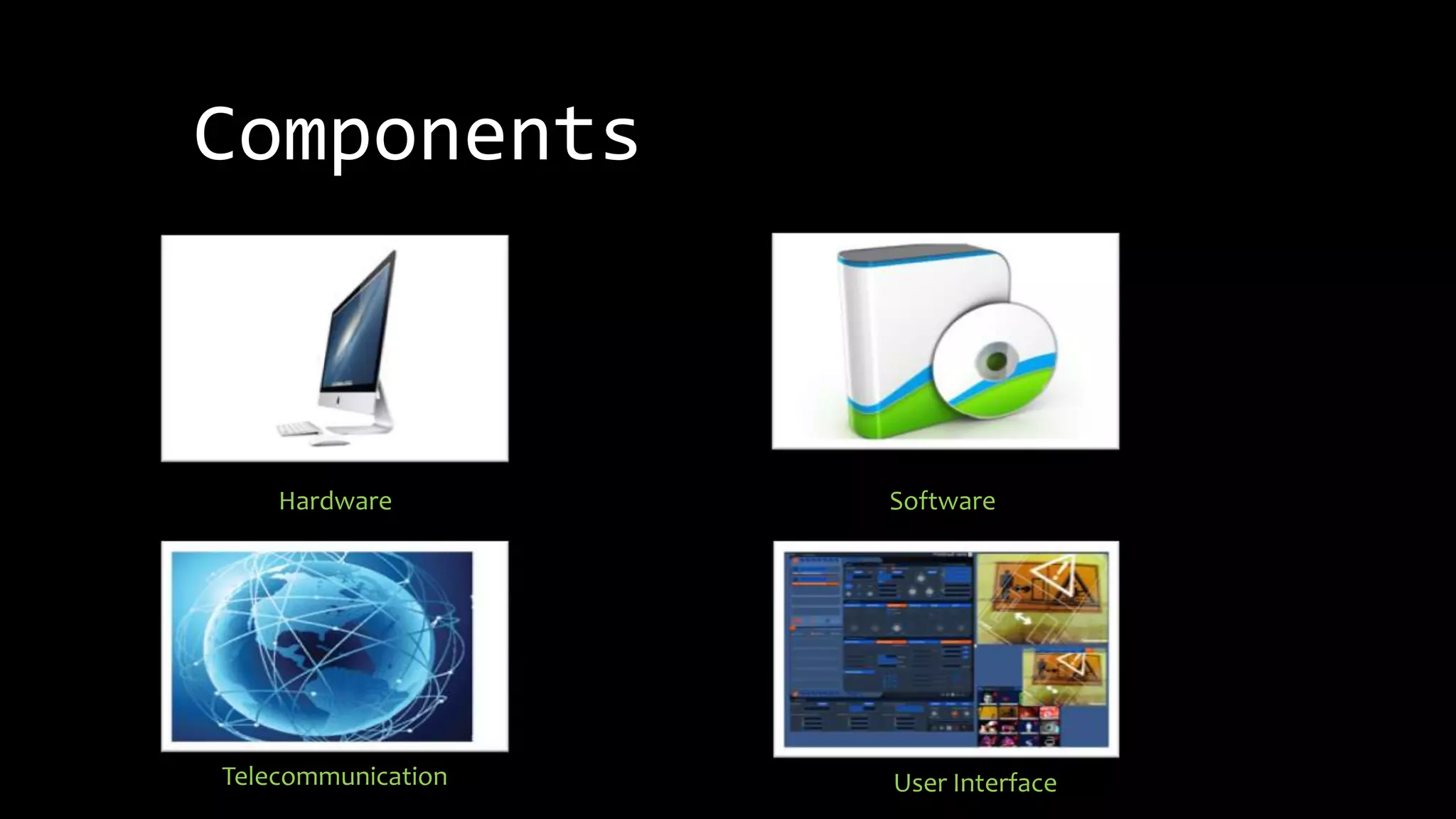
Components
Hardware Software
User InterfaceTelecommunication
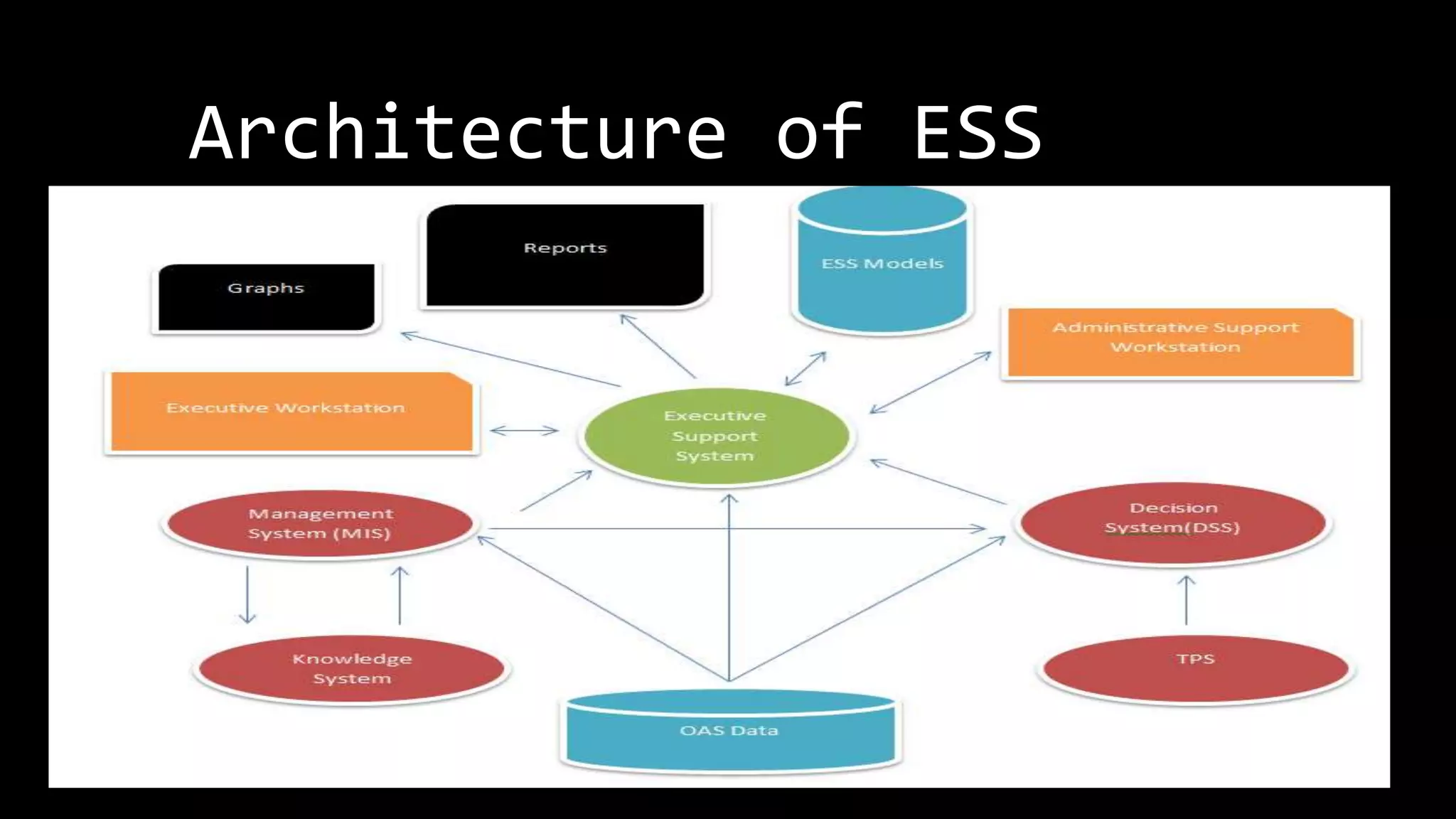
Architecture of ESS
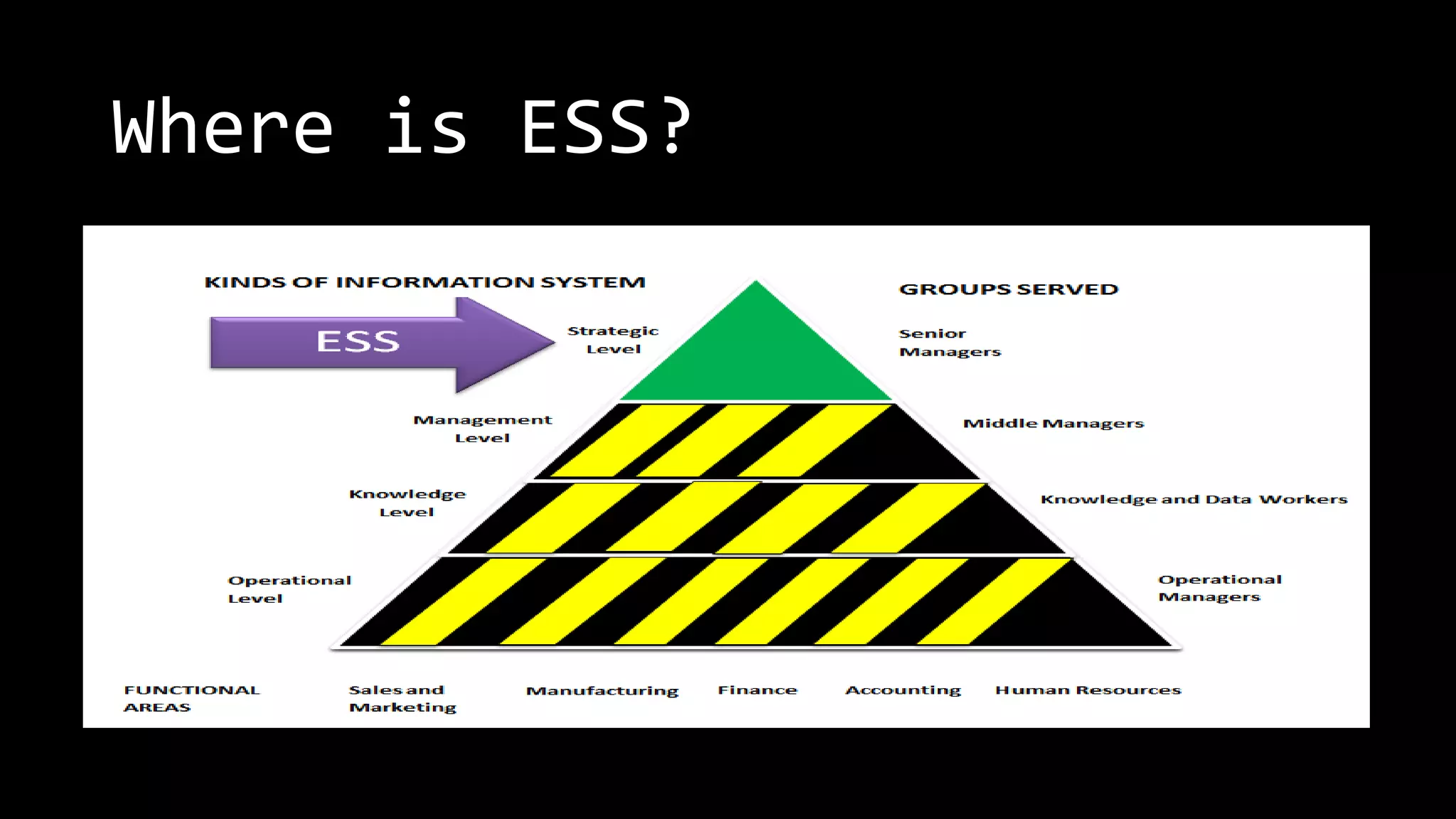
Where is ESS?
Range of ESS
ESS mainly deals with data related
to key departments like
billing, accounting, scheduling, st
affing etc. In addition to
providing quick access to the
data, ESS also acts as an analysis
tool and provides good
understanding of the various
possible outcomes depending upon
the changes in input data.
Range(Cont’d)
ESS thus saves valuable time of the
executives in digging the huge pile of
information to identify the critical
data and helps them spend more time on
brainstorming and decision making by
providing only the required data. ESS
can be used to view and analyse both the
present data and predicted future data.
(Range)Cont’d
ESS can be customized to suite the
user requirements and its
functioning is solely dependent on
the skills of the developer.
Features
• Contemporary ESS bring together data from all parts
of the firm and enable managers to
select, access, and tailor them as needed using
easy-to-use desktop analytical tools and online
data displays.
• Through their ESS, many managers have access to
public data, such as news services, financial
market databases, and economic information.
• ESS has the ability to drill down, moving from a
piece of summary data to lower and lower levels of
detail.
• Well-designed ESS also has some facility for
environmental scanning.
• A key information requirement of
managers at the strategic level is
the ability to detect signals of
problems in the organizational
environment that indicate
strategic threats and
opportunities.
• Ability to analyze, compares, and
highlight trends.
Features()Cont’d
Advantages
• Improved personal efficiency
• Increased organizational control
• Competitive advantage over
competitors
• Automation of the managerial
processes.
If there is no ESS/EIS?
Without ESS: A Re-Active Business Decision
• A CEO receives a call from an online advertising
company offering an incredible rate on pay-per-
click ads, but for a limited time.
• Now it’s up to the CEO to quickly figure out which
products will yield the most return on the
advertising investment.
• First the executive logs into an online advertising
dashboard to compare costs, response rates and
return from previous campaigns.
• Then he gets on the phone with a warehouse account
manager, or logs into an inventory management
database.
• From the warehouse, he finds out the cost to
ship each product, the list price of each
product and which products have been sitting
on the shelves the longest or accruing the
most storage fees.
• With all of this data and information in
place, the executive can figure out which
product will likely yield the highest return
and finally respond to the advertising offer
before the deadline expires.
If there is no ESS/EIS?
What will happen when we use
ESS/EIS inside an organization?
With ESS: A Pro-Active Business Decision
• The ESS sends an alert to the company CEO that product “X”
was stored for “X” number of days, or that the warehouse
storage costs for product “X” have exceeded a certain total
dollar amount.
• Working from that report, the executive alerts his sales and
marketing employees to research the most cost-effective ways
to move product “X” off the shelves.
• Here the CEO is not scrambling to reply to an outside call
from an advertising company
• The ESS alert put him in the driver’s seat and gave the sales
and marketing team lead time to find the best
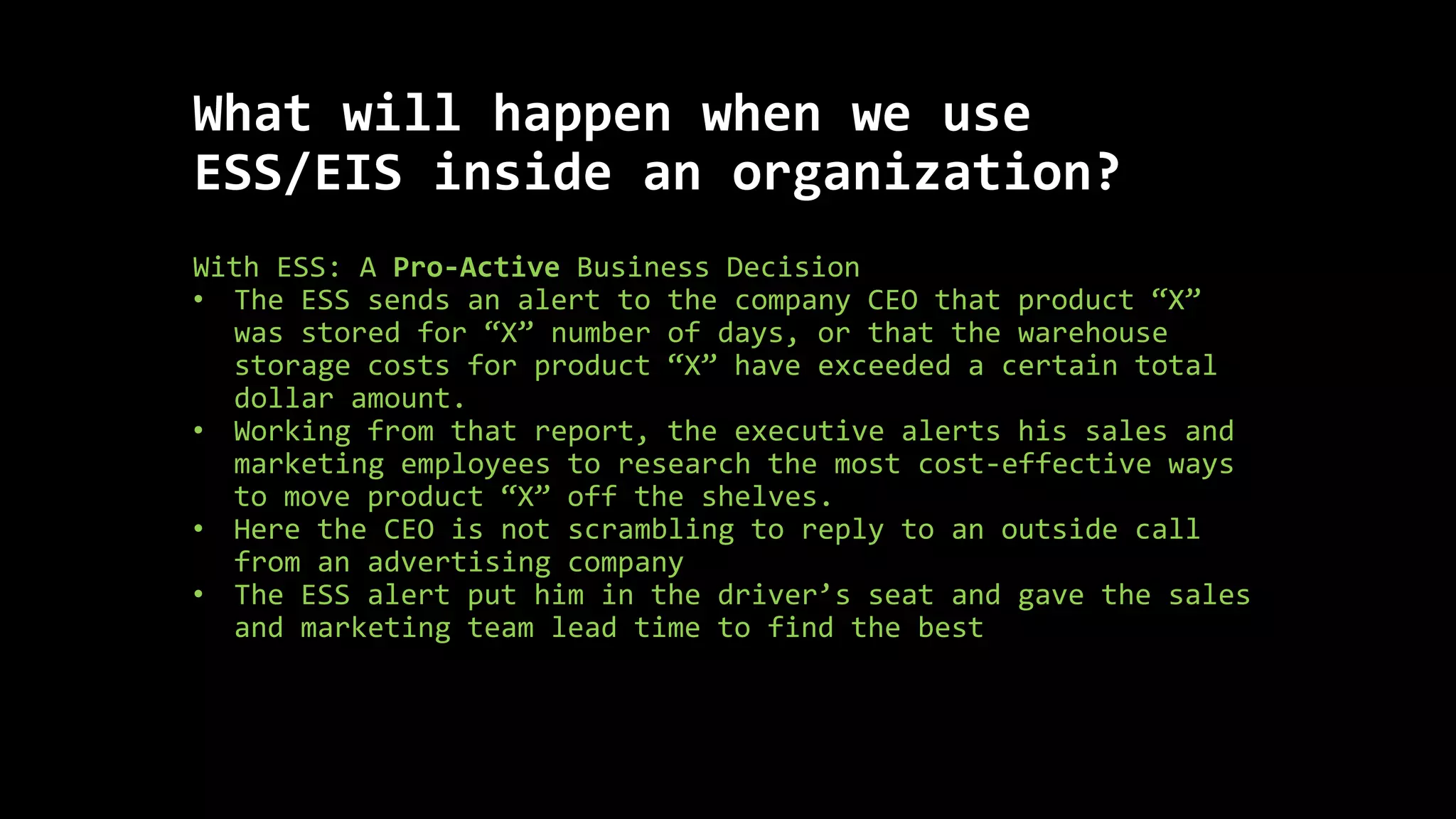
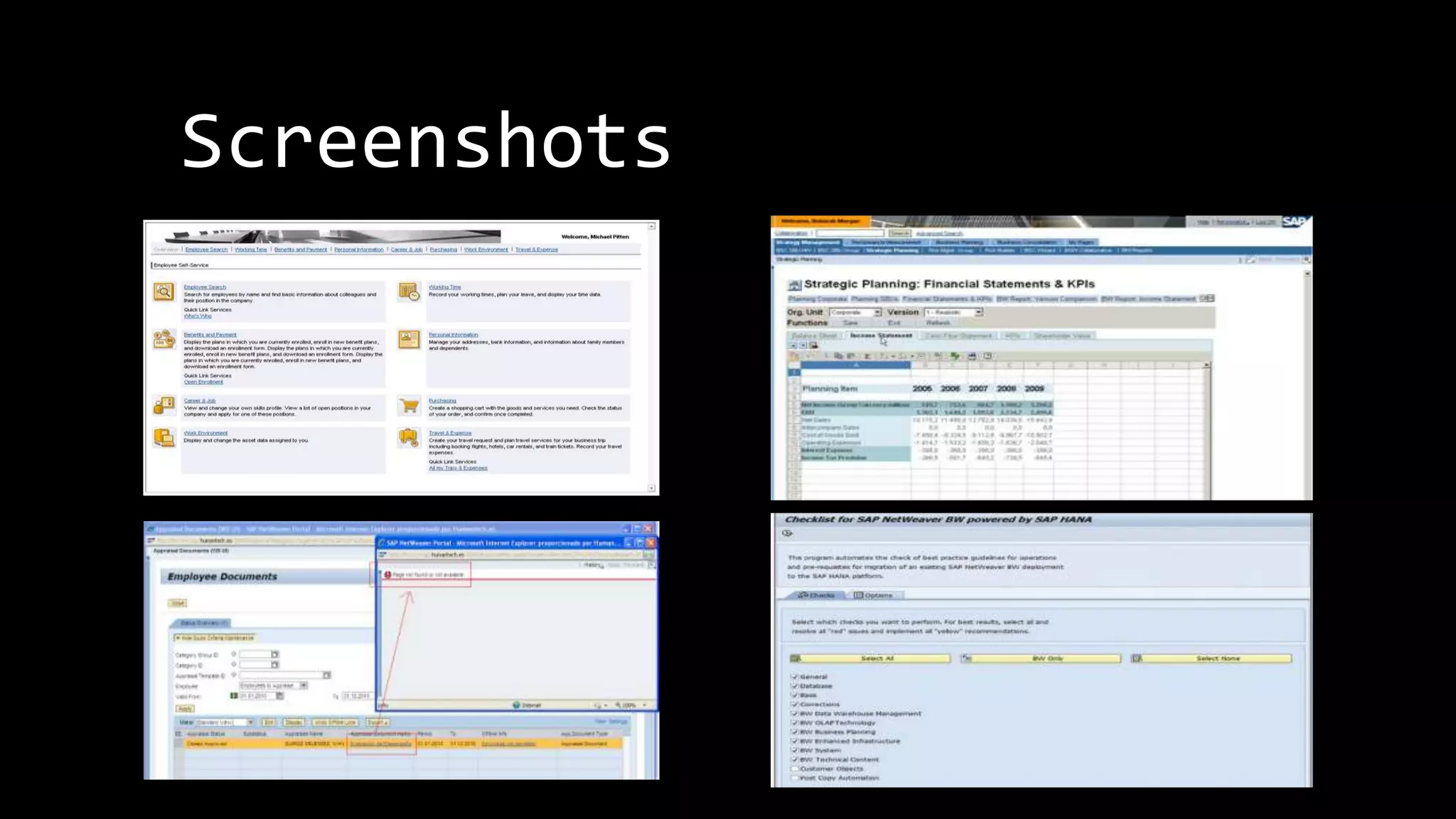
Screenshots
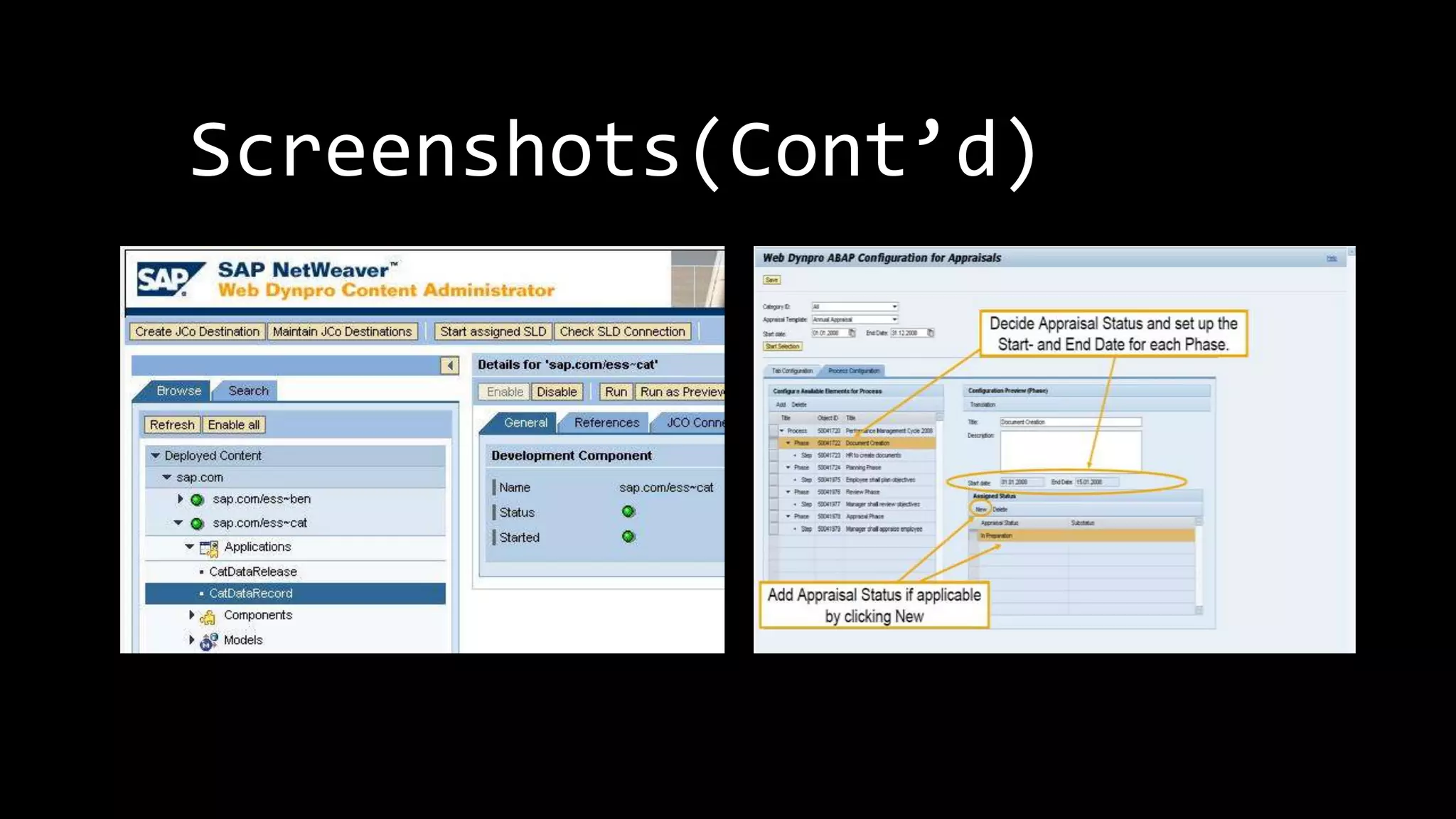
Screenshots(Cont’d)
Future of ESS
• Toolbox for customized systems
• Multimedia support
• Better access (via PDFs and cell phones)
• Virtual Reality and 3-D Image Displays
• Merging of analytical systems (OLAP /
multidimensional analysis)) with desktop publishing
• Client/server architecture
• Web-enabled EIS
• Automated support and intelligent assistance
• Integration of EIS and Group Support Systems
• Global EIS
• Integration and deployment with ERP products
Summary
• Executive Support Systems meet the needs of
corporate executives by providing them with
vast amounts of Information quickly and in
graphical form to help them make effective
decisions.
• ESS must be flexible, easy to use, and
contain both internal and external sources
of information.

Executive support system

  • 1.
  • 2.
    Scenario How do youmake business decisions?
  • 3.
    Scenario If you’re likemost executives, then you probably have one of those enormous Excel spreadsheets, a dozen tabs wide, with data from various departments.
  • 4.
    Scenario • It ispainstaking to build and update a spreadsheet with figures from every department of your organization. • The data always needs to fit together nicely and there is a high risk for human error. • Even if all the numbers are keyed in correctly, when analyzing the data, the sharpest CEO will often miss a reoccurring pattern or red flag amongst their KPIs. • The opportunity costs of this kind of manual process are also staggering. • Crunching numbers in spreadsheets leaves executives, or the staff developing these reports, with very little time and energy to then analyze that data and create forecasts that positively influence business decisions.
  • 5.
    Definition • ESS isalso known as Executive Information System (EIS). • An Executive Support System (ESS) is software that allows users to transform enterprise data into quickly accessible and executive-level reports, such as those used by billing, accounting and staffing departments. An ESS enhances decision making for executives.
  • 6.
  • 7.
  • 8.
  • 9.
    Range of ESS ESSmainly deals with data related to key departments like billing, accounting, scheduling, st affing etc. In addition to providing quick access to the data, ESS also acts as an analysis tool and provides good understanding of the various possible outcomes depending upon the changes in input data.
  • 10.
    Range(Cont’d) ESS thus savesvaluable time of the executives in digging the huge pile of information to identify the critical data and helps them spend more time on brainstorming and decision making by providing only the required data. ESS can be used to view and analyse both the present data and predicted future data.
  • 11.
    (Range)Cont’d ESS can becustomized to suite the user requirements and its functioning is solely dependent on the skills of the developer.
  • 12.
    Features • Contemporary ESSbring together data from all parts of the firm and enable managers to select, access, and tailor them as needed using easy-to-use desktop analytical tools and online data displays. • Through their ESS, many managers have access to public data, such as news services, financial market databases, and economic information. • ESS has the ability to drill down, moving from a piece of summary data to lower and lower levels of detail. • Well-designed ESS also has some facility for environmental scanning.
  • 13.
    • A keyinformation requirement of managers at the strategic level is the ability to detect signals of problems in the organizational environment that indicate strategic threats and opportunities. • Ability to analyze, compares, and highlight trends. Features()Cont’d
  • 14.
    Advantages • Improved personalefficiency • Increased organizational control • Competitive advantage over competitors • Automation of the managerial processes.
  • 15.
    If there isno ESS/EIS? Without ESS: A Re-Active Business Decision • A CEO receives a call from an online advertising company offering an incredible rate on pay-per- click ads, but for a limited time. • Now it’s up to the CEO to quickly figure out which products will yield the most return on the advertising investment. • First the executive logs into an online advertising dashboard to compare costs, response rates and return from previous campaigns. • Then he gets on the phone with a warehouse account manager, or logs into an inventory management database.
  • 16.
    • From thewarehouse, he finds out the cost to ship each product, the list price of each product and which products have been sitting on the shelves the longest or accruing the most storage fees. • With all of this data and information in place, the executive can figure out which product will likely yield the highest return and finally respond to the advertising offer before the deadline expires. If there is no ESS/EIS?
  • 17.
    What will happenwhen we use ESS/EIS inside an organization? With ESS: A Pro-Active Business Decision • The ESS sends an alert to the company CEO that product “X” was stored for “X” number of days, or that the warehouse storage costs for product “X” have exceeded a certain total dollar amount. • Working from that report, the executive alerts his sales and marketing employees to research the most cost-effective ways to move product “X” off the shelves. • Here the CEO is not scrambling to reply to an outside call from an advertising company • The ESS alert put him in the driver’s seat and gave the sales and marketing team lead time to find the best
  • 18.
  • 19.
  • 20.
    Future of ESS •Toolbox for customized systems • Multimedia support • Better access (via PDFs and cell phones) • Virtual Reality and 3-D Image Displays • Merging of analytical systems (OLAP / multidimensional analysis)) with desktop publishing • Client/server architecture • Web-enabled EIS • Automated support and intelligent assistance • Integration of EIS and Group Support Systems • Global EIS • Integration and deployment with ERP products
  • 21.
    Summary • Executive SupportSystems meet the needs of corporate executives by providing them with vast amounts of Information quickly and in graphical form to help them make effective decisions. • ESS must be flexible, easy to use, and contain both internal and external sources of information.