Bacterial cell wall
Presented by-SAUBHAGYA KIRNENDRA
SRI VENKATESWARA COLLEGE
NEW DELHI
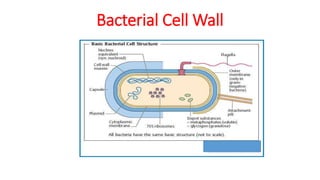
Bacterial Cell Wall
Characteristics
• Very rigid
• Give the cell shape and protect from osmotic lysis
• The strength of the wall is mainly due to peptidoglycan
• It also protects from toxic substances
• Site of action of several antibiotics
• Christan Gram (1884) proved that there are two major groups
of prokaryotes based on the composition of the cell wall
• Some bacteria such as Mycoplasma lack cell wall
Gram Positive Cell Wall
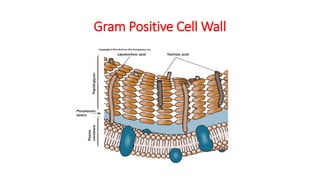
• 20-80 nm thick peptidoglycan layer
• Peptidoglycan is the major component of GPB
• Successive units of peptidoglycan are linked via peptide interbridge
• GPB cell wall is also rich in Teichoic acids
• Teichoic acids are polymer of Glyerol or Ribitol joined by phosphate
group. Amino acids such as D alanine or sugars like glucose are
attached to glycerol and ribitol groups
• Teichoic acids are connected to peptidoglycan by covalent linkage
with 6- hydroxyl of NAM or to lipids of plasma membrane
(lipoteichoic acids)
• Teichoic acids are supposed to provide strength to the cell wall
Gram Positive Cell Wall
• Staphylococcus and some other GPB have a layer of protein on the
surface of cell wall
• These proteins interact with the surrounding environment and are
non covalently attached to peptidoglycan or teichoic acids
• Some of the enzymes (proteins) involved in peptidoglycan synthesis
are also known to be covalently attached to the cell wall
• However, many proteins are covalently linked to the cell wall
• Covalently linked proteins are involved in adhesion of pathogens to
host, preventing opsonisation, blocking phagocytosis
Peptidoglycan
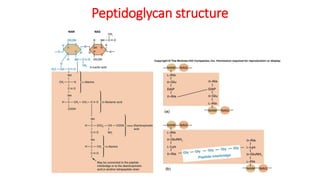
• Also known as Murein is an enormous heteropolymer
• The polymer contains two sugar derivatives, N-acetylglucosamine and
N- actelymuramic acid and several amino acids (D- glutamic acid, D-
alanine, meso-diaminopimelic acid and L-alanine)
• Out of these amino acids first three are not found in proteins hence,
they protect against the attack of peptidase
• The back bone of the polymer is composed of alternating NAG- NAM
residues
• The peptide chain of four alternating D and L amino acids is
connected to carboxy group of NAM by amino group of L- alanine
Peptidoglycan
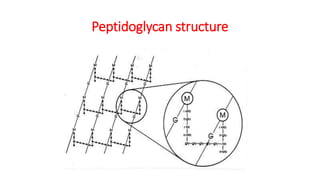
• Chains of linked peptidoglycan subunits are joined by crosslinks
between the peptide
• The carboxyl group of terminal D-alanine is connected to the amino
group of DAP of subsequent unit
• Peptide interbridge is used in GPB to connect the adjacent chains of
peptidoglycan
• Peptide interbridge is made up of five units of glycine
• The cross linkage result in a sac like structure of peptidoglycan which
is dense, highly interconnected, elastic and stretchable
Peptidoglycan structure

Bacterial cell wall

  • 1.
    Bacterial cell wall Presentedby-SAUBHAGYA KIRNENDRA SRI VENKATESWARA COLLEGE NEW DELHI
  • 2.
  • 3.
    Characteristics • Very rigid •Give the cell shape and protect from osmotic lysis • The strength of the wall is mainly due to peptidoglycan • It also protects from toxic substances • Site of action of several antibiotics • Christan Gram (1884) proved that there are two major groups of prokaryotes based on the composition of the cell wall • Some bacteria such as Mycoplasma lack cell wall
  • 4.
    Gram Positive CellWall • 20-80 nm thick peptidoglycan layer • Peptidoglycan is the major component of GPB • Successive units of peptidoglycan are linked via peptide interbridge • GPB cell wall is also rich in Teichoic acids • Teichoic acids are polymer of Glyerol or Ribitol joined by phosphate group. Amino acids such as D alanine or sugars like glucose are attached to glycerol and ribitol groups • Teichoic acids are connected to peptidoglycan by covalent linkage with 6- hydroxyl of NAM or to lipids of plasma membrane (lipoteichoic acids) • Teichoic acids are supposed to provide strength to the cell wall
  • 5.
  • 6.
    Gram Positive CellWall • Staphylococcus and some other GPB have a layer of protein on the surface of cell wall • These proteins interact with the surrounding environment and are non covalently attached to peptidoglycan or teichoic acids • Some of the enzymes (proteins) involved in peptidoglycan synthesis are also known to be covalently attached to the cell wall • However, many proteins are covalently linked to the cell wall • Covalently linked proteins are involved in adhesion of pathogens to host, preventing opsonisation, blocking phagocytosis
  • 7.
    Peptidoglycan • Also knownas Murein is an enormous heteropolymer • The polymer contains two sugar derivatives, N-acetylglucosamine and N- actelymuramic acid and several amino acids (D- glutamic acid, D- alanine, meso-diaminopimelic acid and L-alanine) • Out of these amino acids first three are not found in proteins hence, they protect against the attack of peptidase • The back bone of the polymer is composed of alternating NAG- NAM residues • The peptide chain of four alternating D and L amino acids is connected to carboxy group of NAM by amino group of L- alanine
  • 8.
    Peptidoglycan • Chains oflinked peptidoglycan subunits are joined by crosslinks between the peptide • The carboxyl group of terminal D-alanine is connected to the amino group of DAP of subsequent unit • Peptide interbridge is used in GPB to connect the adjacent chains of peptidoglycan • Peptide interbridge is made up of five units of glycine • The cross linkage result in a sac like structure of peptidoglycan which is dense, highly interconnected, elastic and stretchable
  • 9.
  • 10.