PRESENTED BY-
ABHINANDAN KUMAR
SEC- A1-T1
ROLL NO- 04
B.Sc.(Hons.) Agriculture
QUANTUM UNIVERSITY,
Roorkee
• Named by Dr. Hans Christian Gram in 1884.
• Usually thick, homogenous, composed mainly of
peptidoglycan.
• It accounts for 50-90% of the dry weight of the cell wall.
• Contain large amount of teichoic acids (polymers of
glycerol or ribitol joined by phosphate group).
• Named by Dr. Hans Christian Gram in 1884.
• He developed a staining procedure known as Gram
Staining, which divided almost all bacteria into two
large groups.
• Depending on their retention of specific basic dyes
there are:
I. Gram positive
II. Gram negative
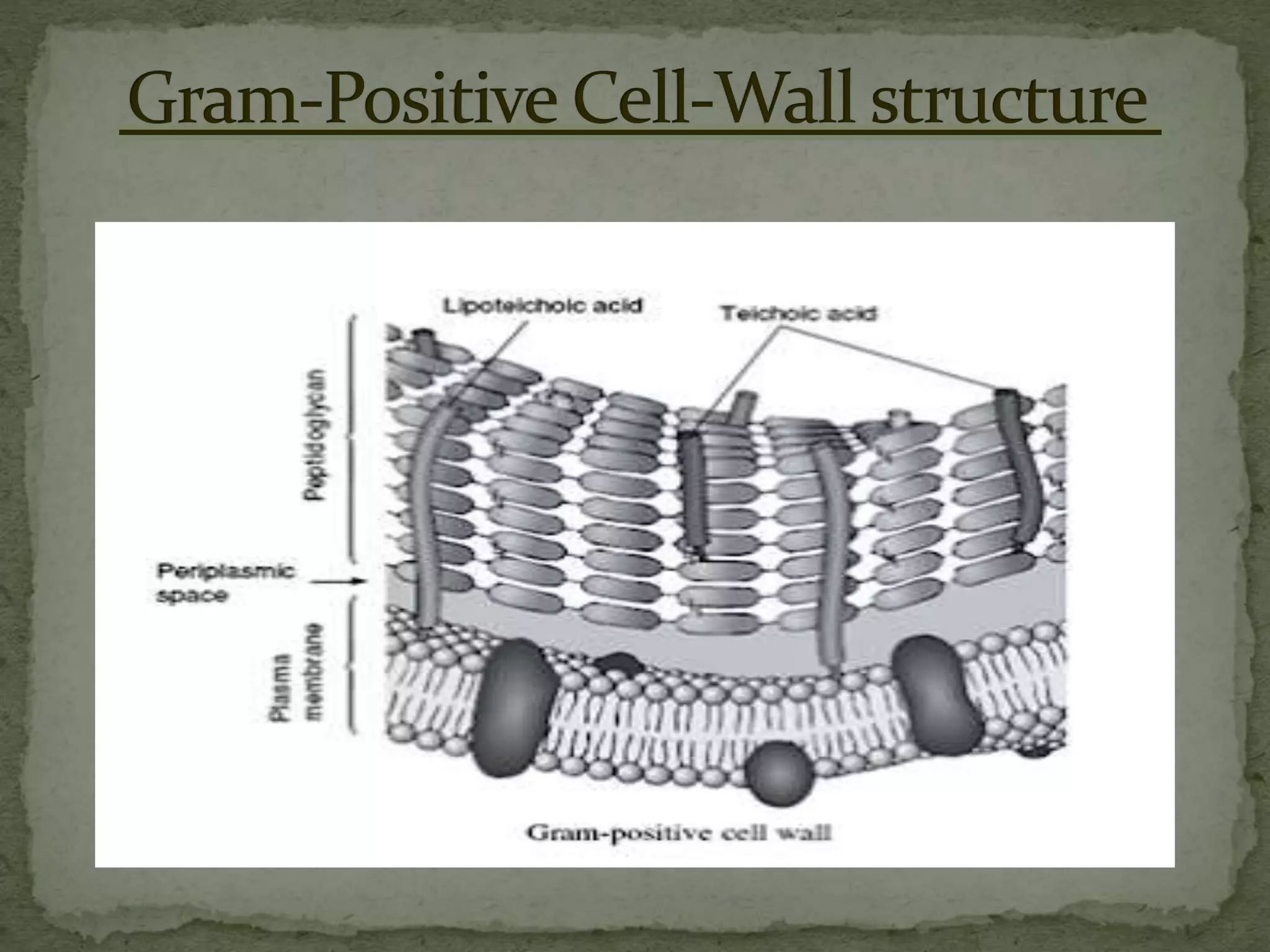
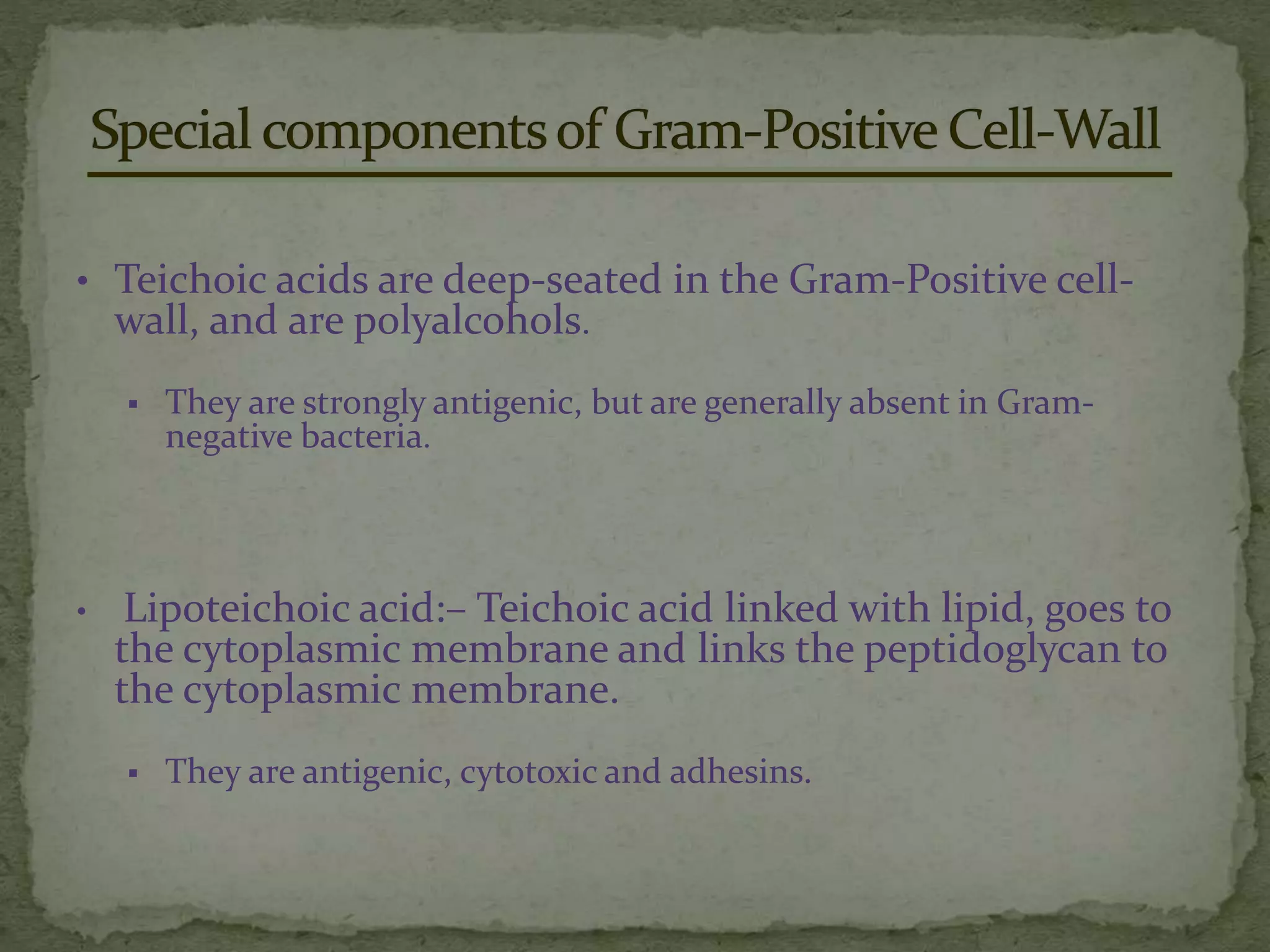
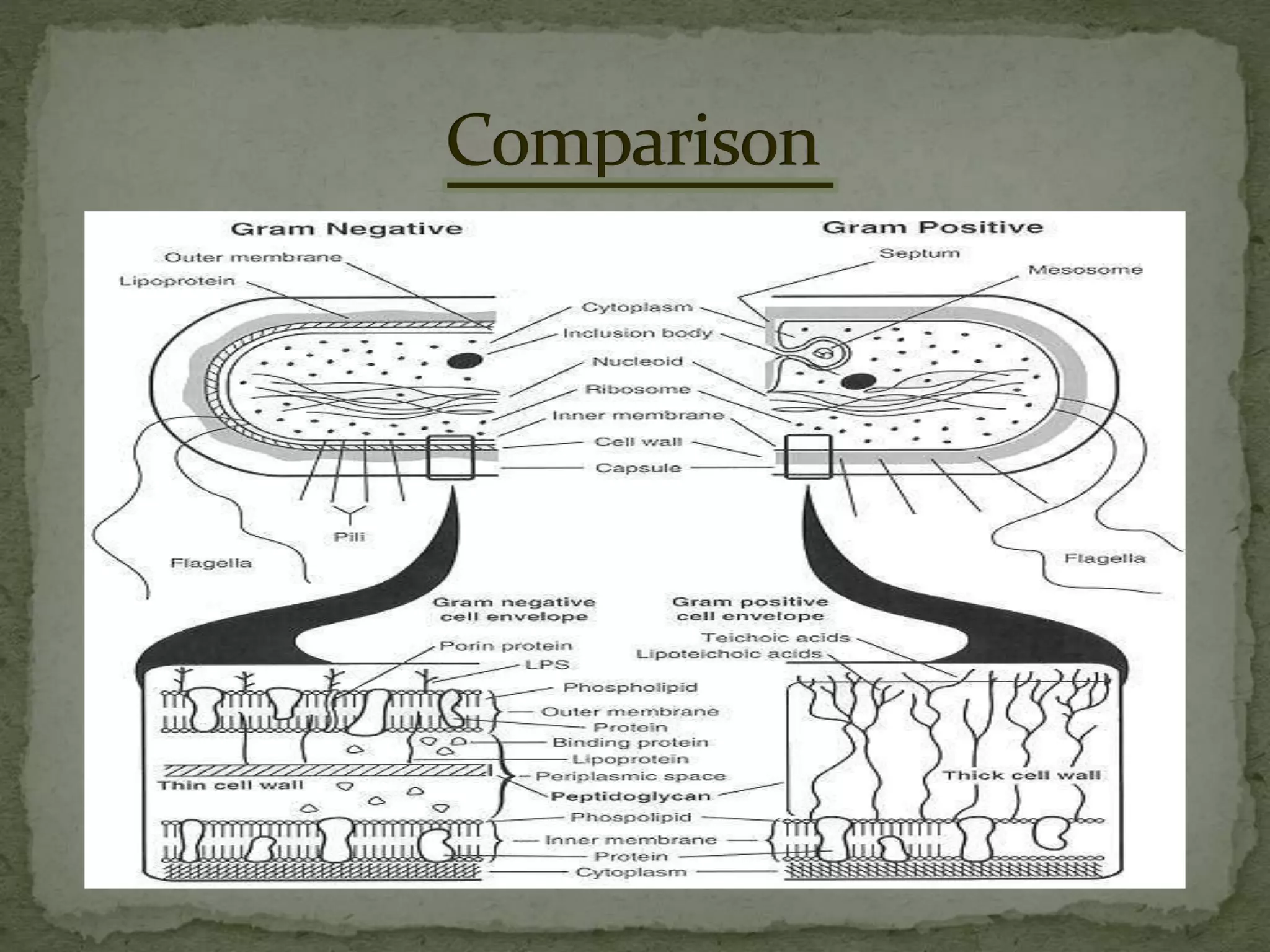
• Teichoic acids are deep-seated in the Gram-Positive cell-
wall, and are polyalcohols.
 They are strongly antigenic, but are generally absent in Gram-
negative bacteria.
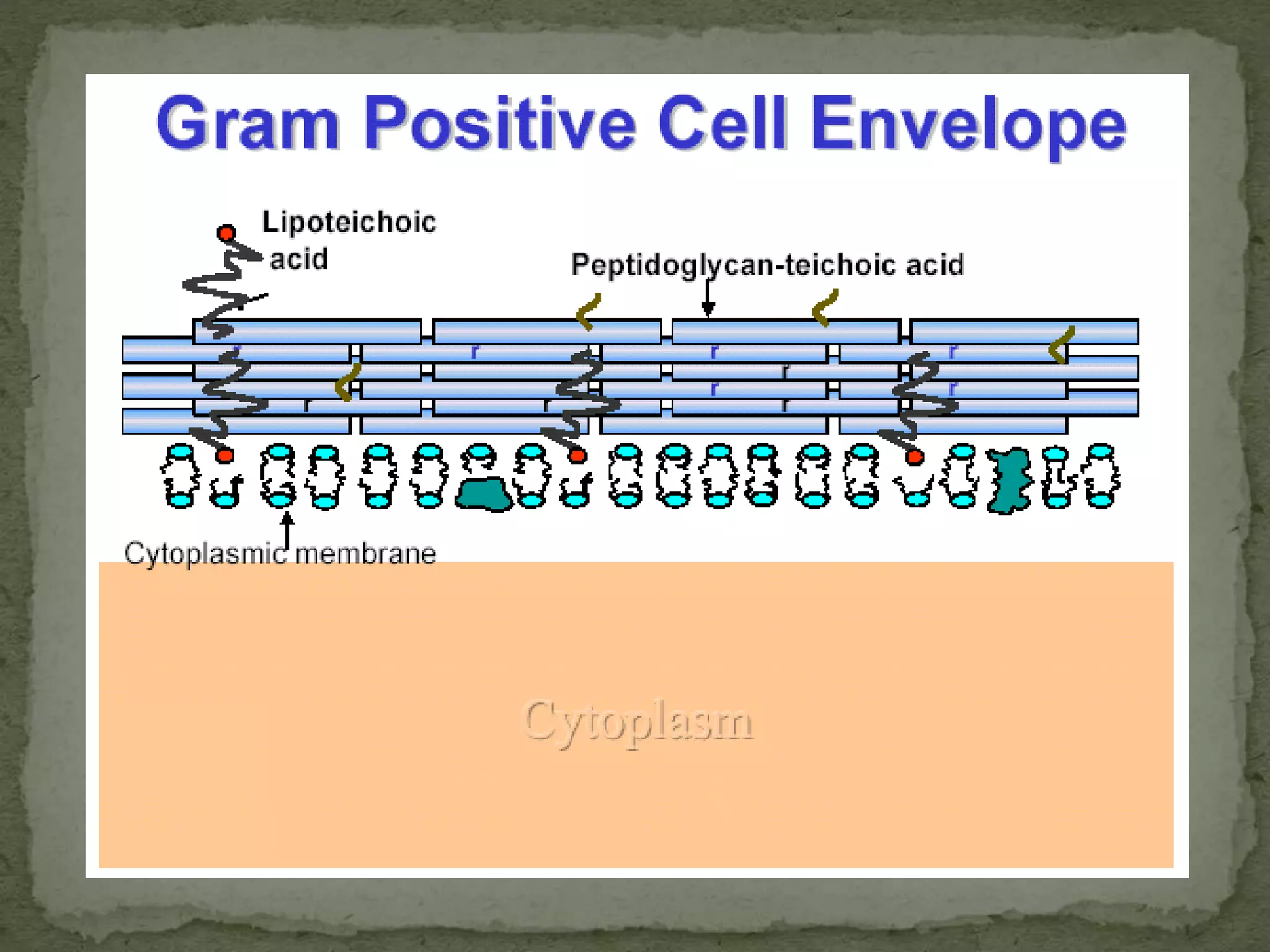
• Lipoteichoic acid:– Teichoic acid linked with lipid, goes to
the cytoplasmic membrane and links the peptidoglycan to
the cytoplasmic membrane.
 They are antigenic, cytotoxic and adhesins.
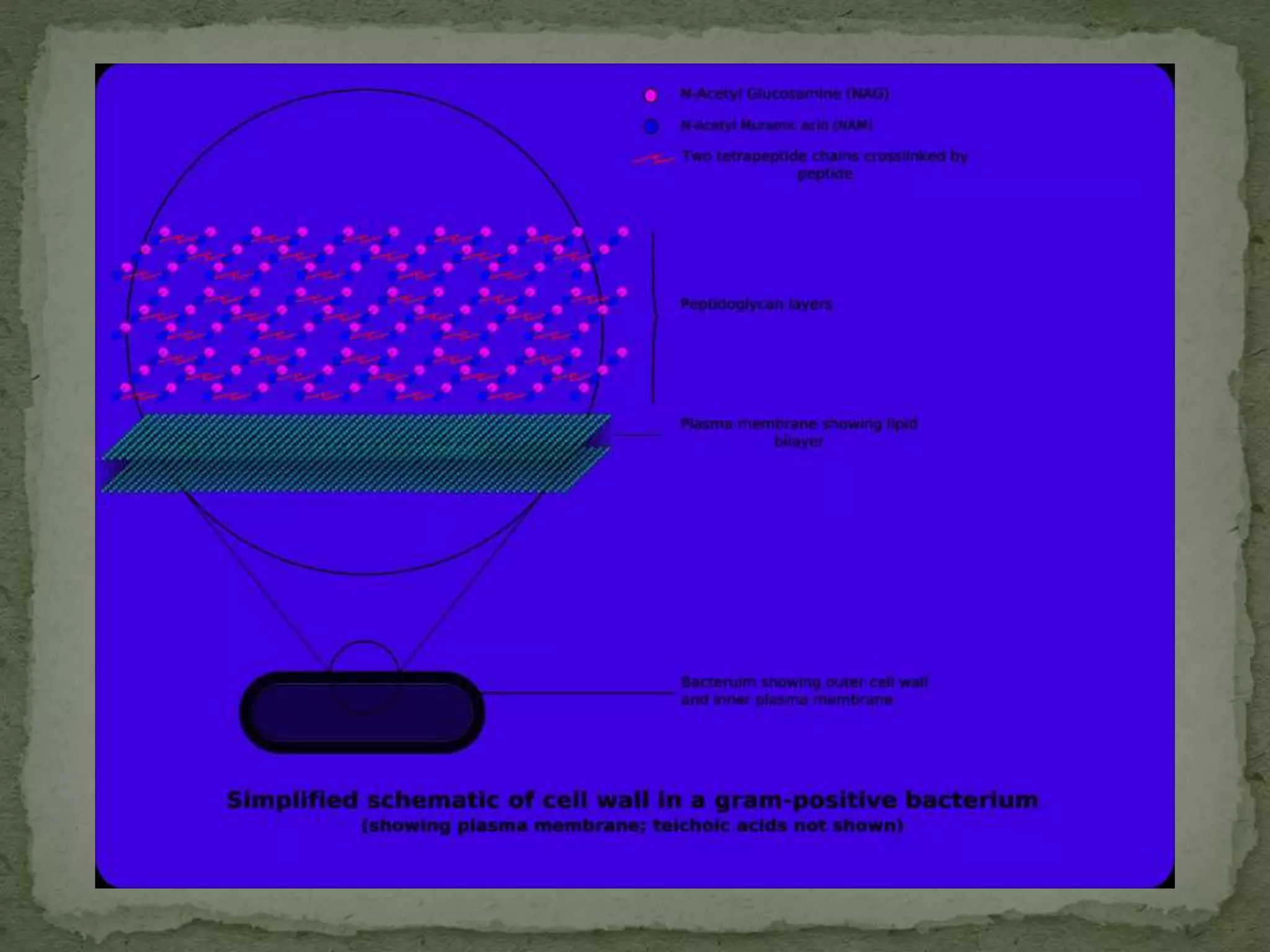
• Peptidoglycan, also known as murein, is a polymer
consisting of sugars and amino acids that forms a
mesh-like layer outside the cell membrane of most
bacteria forming the cell-wall.
• The sugar component consists of alternating residues of
β-(1,4) linked N-acetyl glucosamine acid(NAG) and
N-acetyl muramic acid(NAM).
• Attached to the N-acetyl muramic acid(NAM) is a peptide
chain of three to five amino acids. The peptide chain can
be cross-linked to the peptide chain of another strand
forming the peptidoglycan.
• These subunits which are related to glucose in their
structure are covalently joined to one-another to
form glycan chains.
• Teichoic acids are connected to either peptidoglycan or to
plasma membrane lipids.
• Absent in gram negative bacteria.
 Functions:
• Antigenic determinant (receptor molecule for bacteriophages).
• Participate in the supply of Mg to the cell by binding Mg++.
• Regulate normal cell division.
For most part, protein is not found as a constituent of the G+ cell
wall except M protein on group streptococci.
• Cytoplasmic lipid membrane.
• Thick peptidoglycan layer.
• Peptidoglycan chains are cross-linked to
form rigid cell walls by a bacterial enzyme
DD-transpeptidase.
• Teichoic acids and lipoids are present,
forming lipoteichoic acids, which serve
as chelating agents, and also for certain
types of adherence.
• A much smaller volume of periplasm than
that in gram-negative bacteria.
Cell wall of gram-positive bacteria

Cell wall of gram-positive bacteria

  • 1.
    PRESENTED BY- ABHINANDAN KUMAR SEC-A1-T1 ROLL NO- 04 B.Sc.(Hons.) Agriculture QUANTUM UNIVERSITY, Roorkee
  • 2.
    • Named byDr. Hans Christian Gram in 1884. • Usually thick, homogenous, composed mainly of peptidoglycan. • It accounts for 50-90% of the dry weight of the cell wall. • Contain large amount of teichoic acids (polymers of glycerol or ribitol joined by phosphate group).
  • 3.
    • Named byDr. Hans Christian Gram in 1884. • He developed a staining procedure known as Gram Staining, which divided almost all bacteria into two large groups. • Depending on their retention of specific basic dyes there are: I. Gram positive II. Gram negative
  • 8.
    • Teichoic acidsare deep-seated in the Gram-Positive cell- wall, and are polyalcohols.  They are strongly antigenic, but are generally absent in Gram- negative bacteria. • Lipoteichoic acid:– Teichoic acid linked with lipid, goes to the cytoplasmic membrane and links the peptidoglycan to the cytoplasmic membrane.  They are antigenic, cytotoxic and adhesins.
  • 9.
    • Peptidoglycan, alsoknown as murein, is a polymer consisting of sugars and amino acids that forms a mesh-like layer outside the cell membrane of most bacteria forming the cell-wall. • The sugar component consists of alternating residues of β-(1,4) linked N-acetyl glucosamine acid(NAG) and N-acetyl muramic acid(NAM).
  • 10.
    • Attached tothe N-acetyl muramic acid(NAM) is a peptide chain of three to five amino acids. The peptide chain can be cross-linked to the peptide chain of another strand forming the peptidoglycan. • These subunits which are related to glucose in their structure are covalently joined to one-another to form glycan chains.
  • 13.
    • Teichoic acidsare connected to either peptidoglycan or to plasma membrane lipids. • Absent in gram negative bacteria.  Functions: • Antigenic determinant (receptor molecule for bacteriophages). • Participate in the supply of Mg to the cell by binding Mg++. • Regulate normal cell division. For most part, protein is not found as a constituent of the G+ cell wall except M protein on group streptococci.
  • 15.
    • Cytoplasmic lipidmembrane. • Thick peptidoglycan layer. • Peptidoglycan chains are cross-linked to form rigid cell walls by a bacterial enzyme DD-transpeptidase.
  • 16.
    • Teichoic acidsand lipoids are present, forming lipoteichoic acids, which serve as chelating agents, and also for certain types of adherence. • A much smaller volume of periplasm than that in gram-negative bacteria.