Satellite Launching Vehicles
American Launchers
 Saturn Launchers:The Saturn family of American rocket boosters was developed
by a team of mostly German rocket scientists led by Wernher von Braun to launch
heavy payloads to Earth orbit and beyond. Originally proposed as a military satellite
launcher, they were adopted as the launch vehicles for the Apollo moon program.
Three versions were built and flown:Saturn I,Saturn IB,and Saturn V.
 Features of Saturn V
 Height : 363.0 ft (110.6 m)
 Diameter : 33.0 ft (10.1 m)
 Mass: 2,970,000 kg
 Stages : 3
 Capacity : 140,000 kg
 Most importantly It was used in first successful landing of man on moon.
Images of Saturn V
Space Shttle
The Space Shuttle was a partially reusable low Earth orbital spacecraft system operated
by the U.S. National Aeronautics and Space Administration (NASA), as part of the Space
Shuttle program.
Its official program name was Space Transportation System (STS), taken from a 1969
plan for a system of reusable spacecraft of which it was the only item funded for
development.
The first of four orbital test flights occurred in 1981, leading to operational flights
beginning in 1982. Five complete Shuttle systems were built and used on a total of 135
missions from 1981 to 2011, launched from the Kennedy Space Center (KSC) in Florida.
Operational missions launched numerous satellites, interplanetary probes, and the
Hubble Space Telescope (HST); conducted science experiments in orbit; and participated
in construction and servicing of the International Space Station.
The Shuttle fleet's total mission time was 1322 days, 19 hours, 21 minutes and 23
seconds.
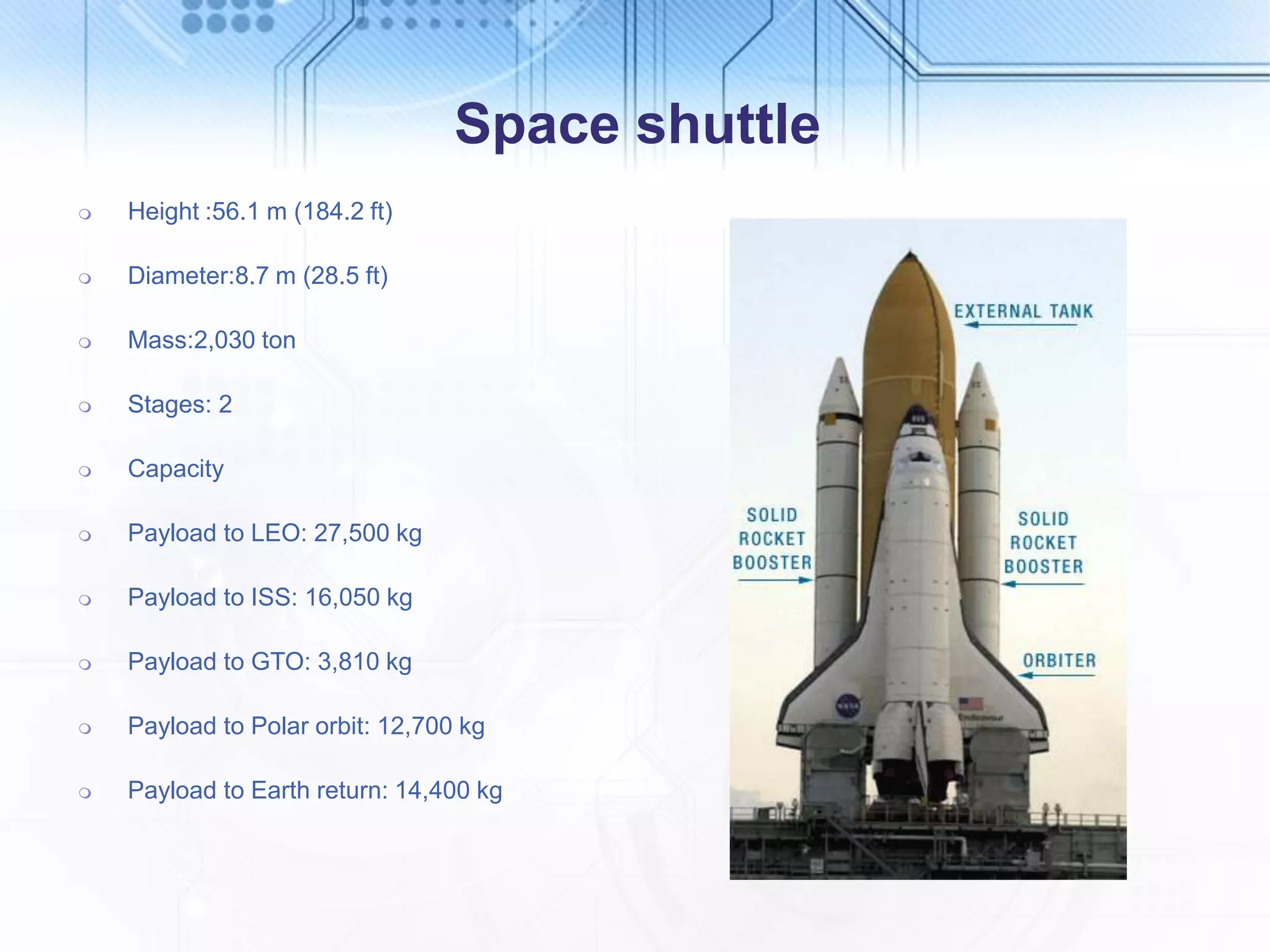
Space shuttle
 Height :56.1 m (184.2 ft)
 Diameter:8.7 m (28.5 ft)
 Mass:2,030 ton
 Stages: 2
 Capacity
 Payload to LEO: 27,500 kg
 Payload to ISS: 16,050 kg
 Payload to GTO: 3,810 kg
 Payload to Polar orbit: 12,700 kg
 Payload to Earth return: 14,400 kg
Important Launching Vehicles in US
 TITAN LAUNCHERS
DELTA LAUCHERS
EUROPEAN LAUNCHING VEHICLES
 Ariane 5 is a European heavy lift launch vehicle that is part of the Ariane rocket
family, an expendable launch system used to deliver payloads into geostationary
transfer orbit (GTO) or low Earth orbit (LEO).
 Ariane 5 rockets are manufactured under the authority of the European Space
Agency (ESA) and the Centre National d'Etudes Spatiales. Airbus Defence and
Space is the prime contractor for the vehicles, leading a consortium of sub-
contractors.
 Ariane 5 is operated and marketed by Arianespace as part of the Ariane programme.
Airbus Defence and Space builds the rockets in Europe and Arianespace launches
them from the Guiana Space Centre in French Guiana.
 Height: 46–52 m (151–171 ft) &Diameter: 5.4 m (18 ft)
 Mass: 777,000 kg
 Stages: 2
 ARIANE 4 & ARIANE 5 ARE OYHER LAUCHERS IN THIS FAMILY
VEGA LAUNCHER
It is designed to launch small
payloads — 300 to 2,500 kg
satellites for scientific and Earth
observation missions to polar and
low Earth orbits.[9] The reference
Vega mission is a polar orbit
bringing a spacecraft of 1,500
kilograms to an altitude of 700
kilometers.
Height: 30 m (98 ft)
Diameter:3 m (9.8 ft)
Mass:137,000 kg (302,000 lb)
INDIAN SATELLITE LAUNCHERS
PSLV
 The Polar Satellite Launch Vehicle, commonly known by its abbreviation PSLV, is an
expendable launch system developed and operated by the Indian Space Research
Organisation (ISRO). It was developed to allow India to launch its Indian Remote
Sensing (IRS) satellites into Sun-synchronous orbits, a service that was, until the
advent of the PSLV, commercially available only from Russia. PSLV can also launch
small size satellites into geostationary transfer orbit (GTO).
 In 2015 India successfully launched 17 foreign satellites belonging to Canada,
Indonesia, Singapore, the United Kingdom and the United States. Some notable
payloads launched by PSLV include India's first lunar probe Chandrayaan-1, India's
first interplanetary mission, Mangalyaan (Mars orbiter) and India's first space
observatory, Astrosat.
PSLV
Size
Height 44 metres (144 ft)
Diameter 2.8 metres (9 ft 2 in)
Mass PSLV-G: 295,000 kg
PSLV-CA: 230,000 kg
PSLV-XL: 320,000 kg
Stages 4
Capacity
Payload to LEO(620 km) 3,800 kg
Payload to SSO(620 km) 1,750 kg
Payload to Sub-GTO/GTO 1,425 kg
GSLV
 Geosynchronous Satellite Launch
Vehicle , abbreviated in English as
GSLV, is an expendable launch
system operated by the Indian Space
Research Organisation (ISRO)
 Height:49.13 metres (161.2 ft)
 Diameter:2.8 metres (9 ft 2 in)
 Mass 414,750 kilograms
 Stages 3
 Payload to LEO 5,000 kilograms
 Payload to GTO2,500 kilograms
IMAGES OF INDIAN LAUNCHERS
TOP LAUCHING VEHICLES
 RUSSIA
 PROTON: LARGE PAYLOAD
 SOYUZ ISS CARGO,SOYUZ ISS MANNED, SOYUZ COMMERCIAL
 ZENIT-3SL
 CHINA
 SHENZHOU:8,9,10
 LONG MARCH:3A,3B,3C
 JAPANA
 H-II,H-IIA,H-IIB
PRESENTED BY:
SANKET ZADE(57-B)
VAIBHAV GEDAM(63-B)
VAIBHAV MESHRAM(64-B)

Satellite launching vehicles

  • 1.
  • 3.
    American Launchers  SaturnLaunchers:The Saturn family of American rocket boosters was developed by a team of mostly German rocket scientists led by Wernher von Braun to launch heavy payloads to Earth orbit and beyond. Originally proposed as a military satellite launcher, they were adopted as the launch vehicles for the Apollo moon program. Three versions were built and flown:Saturn I,Saturn IB,and Saturn V.  Features of Saturn V  Height : 363.0 ft (110.6 m)  Diameter : 33.0 ft (10.1 m)  Mass: 2,970,000 kg  Stages : 3  Capacity : 140,000 kg  Most importantly It was used in first successful landing of man on moon.
  • 4.
  • 5.
    Space Shttle The SpaceShuttle was a partially reusable low Earth orbital spacecraft system operated by the U.S. National Aeronautics and Space Administration (NASA), as part of the Space Shuttle program. Its official program name was Space Transportation System (STS), taken from a 1969 plan for a system of reusable spacecraft of which it was the only item funded for development. The first of four orbital test flights occurred in 1981, leading to operational flights beginning in 1982. Five complete Shuttle systems were built and used on a total of 135 missions from 1981 to 2011, launched from the Kennedy Space Center (KSC) in Florida. Operational missions launched numerous satellites, interplanetary probes, and the Hubble Space Telescope (HST); conducted science experiments in orbit; and participated in construction and servicing of the International Space Station. The Shuttle fleet's total mission time was 1322 days, 19 hours, 21 minutes and 23 seconds.
  • 6.
    Space shuttle  Height:56.1 m (184.2 ft)  Diameter:8.7 m (28.5 ft)  Mass:2,030 ton  Stages: 2  Capacity  Payload to LEO: 27,500 kg  Payload to ISS: 16,050 kg  Payload to GTO: 3,810 kg  Payload to Polar orbit: 12,700 kg  Payload to Earth return: 14,400 kg
  • 7.
    Important Launching Vehiclesin US  TITAN LAUNCHERS
  • 8.
  • 9.
    EUROPEAN LAUNCHING VEHICLES Ariane 5 is a European heavy lift launch vehicle that is part of the Ariane rocket family, an expendable launch system used to deliver payloads into geostationary transfer orbit (GTO) or low Earth orbit (LEO).  Ariane 5 rockets are manufactured under the authority of the European Space Agency (ESA) and the Centre National d'Etudes Spatiales. Airbus Defence and Space is the prime contractor for the vehicles, leading a consortium of sub- contractors.  Ariane 5 is operated and marketed by Arianespace as part of the Ariane programme. Airbus Defence and Space builds the rockets in Europe and Arianespace launches them from the Guiana Space Centre in French Guiana.  Height: 46–52 m (151–171 ft) &Diameter: 5.4 m (18 ft)  Mass: 777,000 kg  Stages: 2  ARIANE 4 & ARIANE 5 ARE OYHER LAUCHERS IN THIS FAMILY
  • 10.
    VEGA LAUNCHER It isdesigned to launch small payloads — 300 to 2,500 kg satellites for scientific and Earth observation missions to polar and low Earth orbits.[9] The reference Vega mission is a polar orbit bringing a spacecraft of 1,500 kilograms to an altitude of 700 kilometers. Height: 30 m (98 ft) Diameter:3 m (9.8 ft) Mass:137,000 kg (302,000 lb)
  • 11.
    INDIAN SATELLITE LAUNCHERS PSLV The Polar Satellite Launch Vehicle, commonly known by its abbreviation PSLV, is an expendable launch system developed and operated by the Indian Space Research Organisation (ISRO). It was developed to allow India to launch its Indian Remote Sensing (IRS) satellites into Sun-synchronous orbits, a service that was, until the advent of the PSLV, commercially available only from Russia. PSLV can also launch small size satellites into geostationary transfer orbit (GTO).  In 2015 India successfully launched 17 foreign satellites belonging to Canada, Indonesia, Singapore, the United Kingdom and the United States. Some notable payloads launched by PSLV include India's first lunar probe Chandrayaan-1, India's first interplanetary mission, Mangalyaan (Mars orbiter) and India's first space observatory, Astrosat.
  • 12.
    PSLV Size Height 44 metres(144 ft) Diameter 2.8 metres (9 ft 2 in) Mass PSLV-G: 295,000 kg PSLV-CA: 230,000 kg PSLV-XL: 320,000 kg Stages 4 Capacity Payload to LEO(620 km) 3,800 kg Payload to SSO(620 km) 1,750 kg Payload to Sub-GTO/GTO 1,425 kg
  • 13.
    GSLV  Geosynchronous SatelliteLaunch Vehicle , abbreviated in English as GSLV, is an expendable launch system operated by the Indian Space Research Organisation (ISRO)  Height:49.13 metres (161.2 ft)  Diameter:2.8 metres (9 ft 2 in)  Mass 414,750 kilograms  Stages 3  Payload to LEO 5,000 kilograms  Payload to GTO2,500 kilograms
  • 14.
  • 15.
    TOP LAUCHING VEHICLES RUSSIA  PROTON: LARGE PAYLOAD  SOYUZ ISS CARGO,SOYUZ ISS MANNED, SOYUZ COMMERCIAL  ZENIT-3SL  CHINA  SHENZHOU:8,9,10  LONG MARCH:3A,3B,3C  JAPANA  H-II,H-IIA,H-IIB
  • 16.
    PRESENTED BY: SANKET ZADE(57-B) VAIBHAVGEDAM(63-B) VAIBHAV MESHRAM(64-B)