By:
Amjad Hassan Khan MK
Lecturer in Electronics
Kristu Jayanti College, Bengaluru
Introduction-satellite orbits, Satellite
system; Block diagram, satellite sub
systems, up link, down link, cross link,
transponders (C, band) (Space content),
ground station (simplified Block diagram
of earth station).
Multiple access methods -TDMA, FDMA,
CDMA;
GPS services like SPS and PPS.
Definitions and Terminology
• For any object to be placed in an orbit
around the Earth, it is essential for it
to have a minimum velocity of 7.9
km/ sec
• If you want to have a mission to the
moon or beyond, or if you need to go
beyond the gravitational attraction of
earth, you will need to obtain a
minimum speed of 11 km/sec
• Once you get out of Earth’s gravity,
you will continue to travel at that
speed until you enter the
gravitational attraction of another
body.
Definitions and Terminology
• When you are out in space, there
will be no atmosphere to create
any drag effects on your space
vehicle
• In order to escape Earth’s
atmospheric effects, you have to
be higher than 1000 km altitude.
• The time taken by a satellite to
execute one complete orbit is
called the period and it is shown
by τ
Period of a Satellite
• The time taken by a satellite to
execute one complete orbit is
called the period and it is
shown by τ. Hence, if a satellite
rotates one orbit in 3 hours,
then its period is 3 hours
• Elliptical orbits
1. LEO
2. MEO
3. HEO
• Polar Orbits
• Geostationary Satellite Orbit (GEO)
• LEO is Low Earth orbit and
it is considered as 160 km
to 500 km of altitude.
Technically, in Low Earth
orbit, the drag effects will
always hinder operations.
• Satellites in LEO will have
very high speeds around
18,000 miles per hour
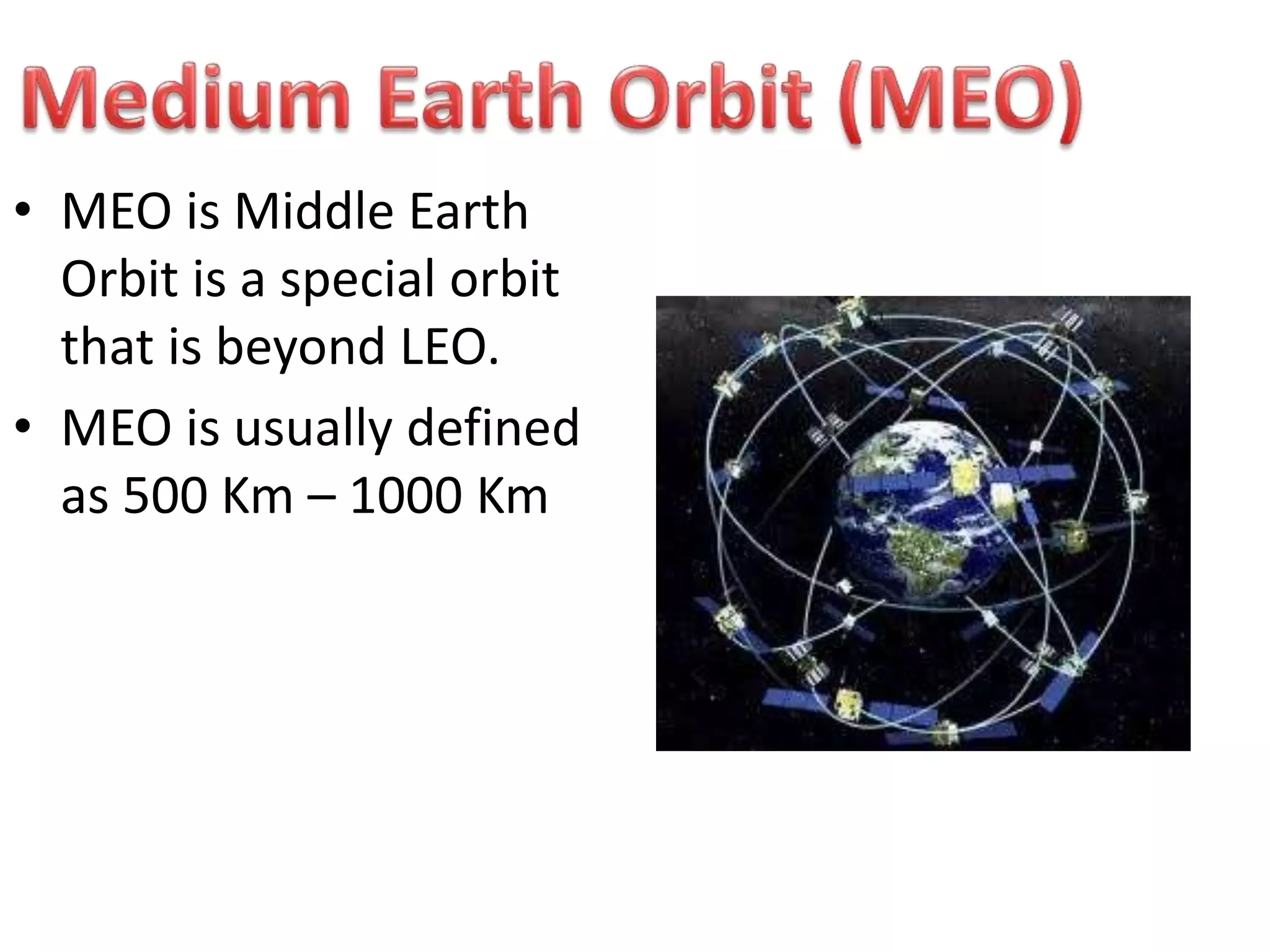
• MEO is Middle Earth
Orbit is a special orbit
that is beyond LEO.
• MEO is usually defined
as 500 Km – 1000 Km
• HEO is High Earth orbit
• HEO is defined as orbit above 1000 km in most
literature. It extends to 40,000 km altitude.
• Mostly in HEO, the drag effects would be non existent.
Hence, HEO will have a more stable orbit free from
atmospheric effects, but also it will require much more
energy to put there
• These orbits have an
inclination near 90 degrees.
This allows the satellite to
see virtually every part of
the Earth as the Earth
rotates underneath it. It
takes approximately 90
minutes for the satellite to
complete one orbit.
https://www.youtube.com/watch?v=6dISKhVdX7g
Multiple access methods
• Frequency Division Multiplexing (FDM)
• Time Division Multiplexing (TDM)
• Code Division Multiplexing (CDM)
• Wavelength Division Multiplexing (WDM)
Time Division Multiplexing Access (TDMA)
Frequency Division Multiplexing Access (FDMA)
Code Division Multiplexing Access (CDMA)
Global Positioning system (GPS)
• Space segment
• Control segment
• User segment
Space segment:
Control segment:
User Segment:

satellite communication system

  • 1.
    By: Amjad Hassan KhanMK Lecturer in Electronics Kristu Jayanti College, Bengaluru
  • 2.
    Introduction-satellite orbits, Satellite system;Block diagram, satellite sub systems, up link, down link, cross link, transponders (C, band) (Space content), ground station (simplified Block diagram of earth station). Multiple access methods -TDMA, FDMA, CDMA; GPS services like SPS and PPS.
  • 4.
    Definitions and Terminology •For any object to be placed in an orbit around the Earth, it is essential for it to have a minimum velocity of 7.9 km/ sec • If you want to have a mission to the moon or beyond, or if you need to go beyond the gravitational attraction of earth, you will need to obtain a minimum speed of 11 km/sec • Once you get out of Earth’s gravity, you will continue to travel at that speed until you enter the gravitational attraction of another body.
  • 5.
    Definitions and Terminology •When you are out in space, there will be no atmosphere to create any drag effects on your space vehicle • In order to escape Earth’s atmospheric effects, you have to be higher than 1000 km altitude. • The time taken by a satellite to execute one complete orbit is called the period and it is shown by τ
  • 6.
    Period of aSatellite • The time taken by a satellite to execute one complete orbit is called the period and it is shown by τ. Hence, if a satellite rotates one orbit in 3 hours, then its period is 3 hours
  • 7.
    • Elliptical orbits 1.LEO 2. MEO 3. HEO • Polar Orbits • Geostationary Satellite Orbit (GEO)
  • 8.
    • LEO isLow Earth orbit and it is considered as 160 km to 500 km of altitude. Technically, in Low Earth orbit, the drag effects will always hinder operations. • Satellites in LEO will have very high speeds around 18,000 miles per hour
  • 9.
    • MEO isMiddle Earth Orbit is a special orbit that is beyond LEO. • MEO is usually defined as 500 Km – 1000 Km
  • 10.
    • HEO isHigh Earth orbit • HEO is defined as orbit above 1000 km in most literature. It extends to 40,000 km altitude. • Mostly in HEO, the drag effects would be non existent. Hence, HEO will have a more stable orbit free from atmospheric effects, but also it will require much more energy to put there
  • 11.
    • These orbitshave an inclination near 90 degrees. This allows the satellite to see virtually every part of the Earth as the Earth rotates underneath it. It takes approximately 90 minutes for the satellite to complete one orbit.
  • 13.
  • 20.
    Multiple access methods •Frequency Division Multiplexing (FDM) • Time Division Multiplexing (TDM) • Code Division Multiplexing (CDM) • Wavelength Division Multiplexing (WDM)
  • 21.
  • 22.
  • 23.
  • 25.
    Global Positioning system(GPS) • Space segment • Control segment • User segment
  • 26.
  • 27.
  • 28.