Aircraft GPS
Tracking.
Submitted to:
Ma’am Sadia Zaib.
Presented By:
Yasir Abbas.
HISTORY:
 Navigating by stars (requires clear nights and careful
measurements) most widely used for centuries
 The first practical radar system was produced in 1935 by the
British physicist Sir Robert Watson-Watt.
 The first artificial satellite was Sputnik 1, launched by the Soviet
Union on 4 October 1957 under the Sputnik program.
 The GPS project was developed in 1973 to overcome the
limitations of previous navigation systems.
 GPS was created and realized by the U.S. department of defense
and was originally run with 24 satellites.
 It became fully operational in 1993. “Bradford Parkinson”, “Roger l.
Easton”, and “Ivan a. getting” are credited with inventing it.
By: Yasir Abbas.
Aircraft Positioning using
RADAR:
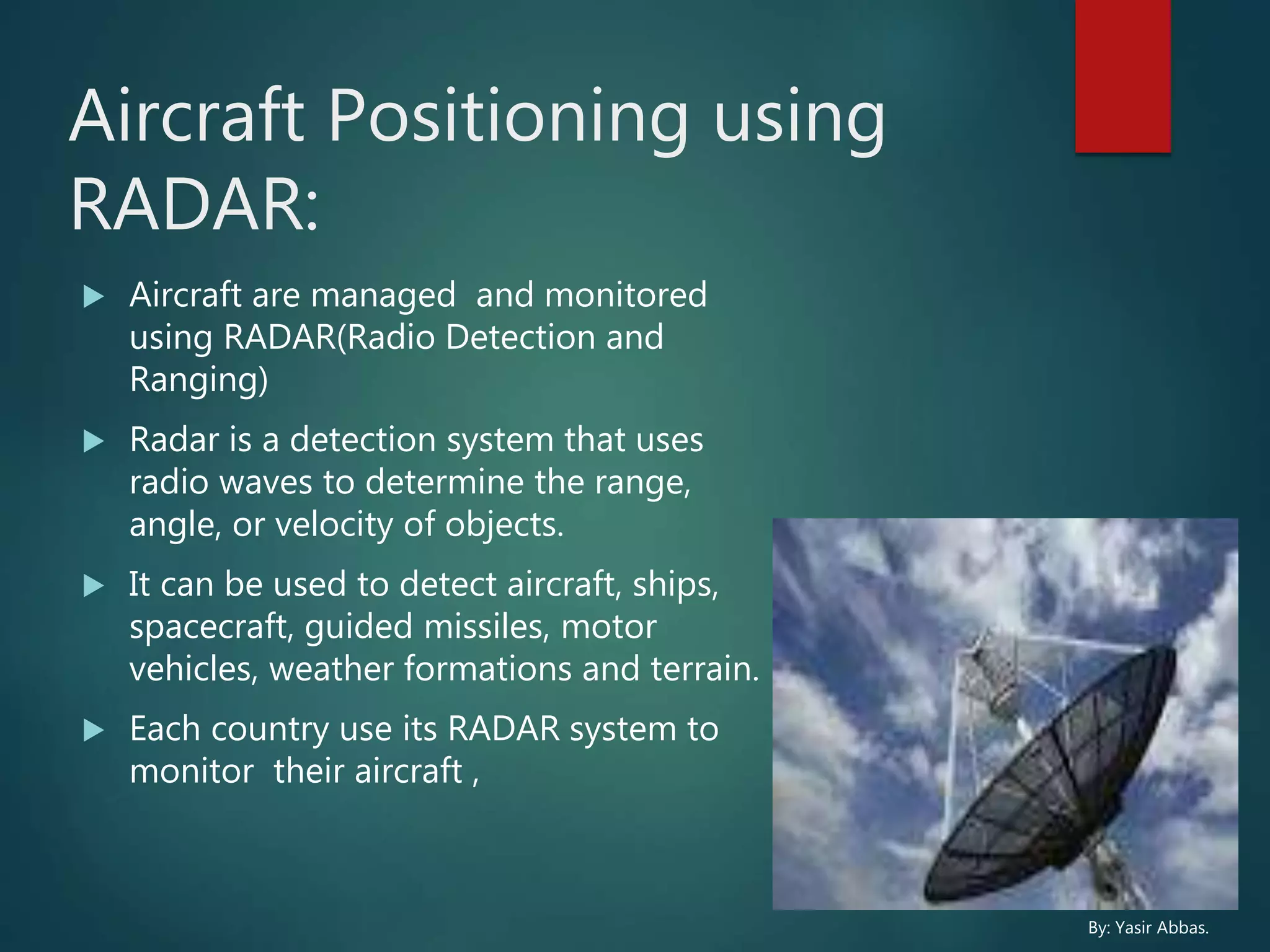
 Aircraft are managed and monitored
using RADAR(Radio Detection and
Ranging)
 Radar is a detection system that uses
radio waves to determine the range,
angle, or velocity of objects.
 It can be used to detect aircraft, ships,
spacecraft, guided missiles, motor
vehicles, weather formations and terrain.
 Each country use its RADAR system to
monitor their aircraft ,
By: Yasir Abbas.
Continue...
 when we talk about international services these metal bodies have
to pass over the oceans and across many countries then we have to
communicate with Satellites.
 RADAR are widely used during Wars and for military usage to control
fighter plans.
 RADAR are also being widely used in different application.
 Now , we are going to use the Satellites (which is our next segment)
to position object all over the world as well.
By: Yasir Abbas.
Types of satellites in the
space.
 Communications Satellite
 Remote Sensing Satellite
 Navigation Satellite
 Geocentric Orbit type satellites
- LEO, MEO, HEO
 Global Positioning System (GPS)
 Geostationary Satellites (GEOs)
 Natural satellites i.e. moon.
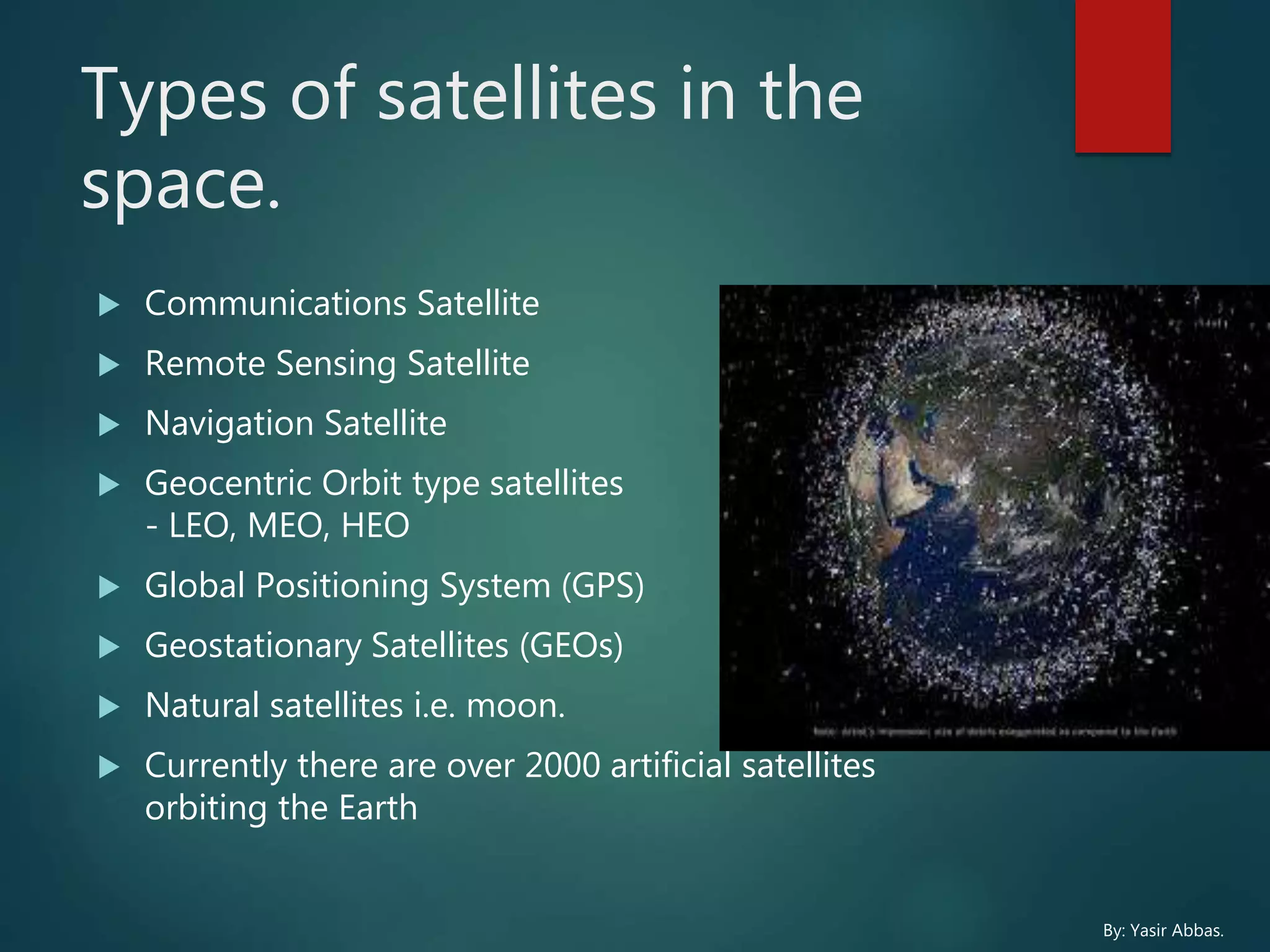
 Currently there are over 2000 artificial satellites
orbiting the Earth
By: Yasir Abbas.
WHAT IS GPS?
 A space-based satellite navigation
system provides location and time
information in all weather.
 Maintained by the United
States government and is
freely accessible by anyone
with a GPS receiver.
By: Yasir Abbas.
 Official name : “Navigational Satellite Timing And Ranging Global
Positioning
 System” (NAVSTAR GPS)
 Consists of 30+ GPS satellites in medium Earth orbit (2000km -
35,000 km).
 Made up of two dozen satellites working in harmony are known as a
satellite constellation
 Mainly used for navigation, map-making and surveying.
Official logo for
NAVSTAR GPS
By: Yasir Abbas.
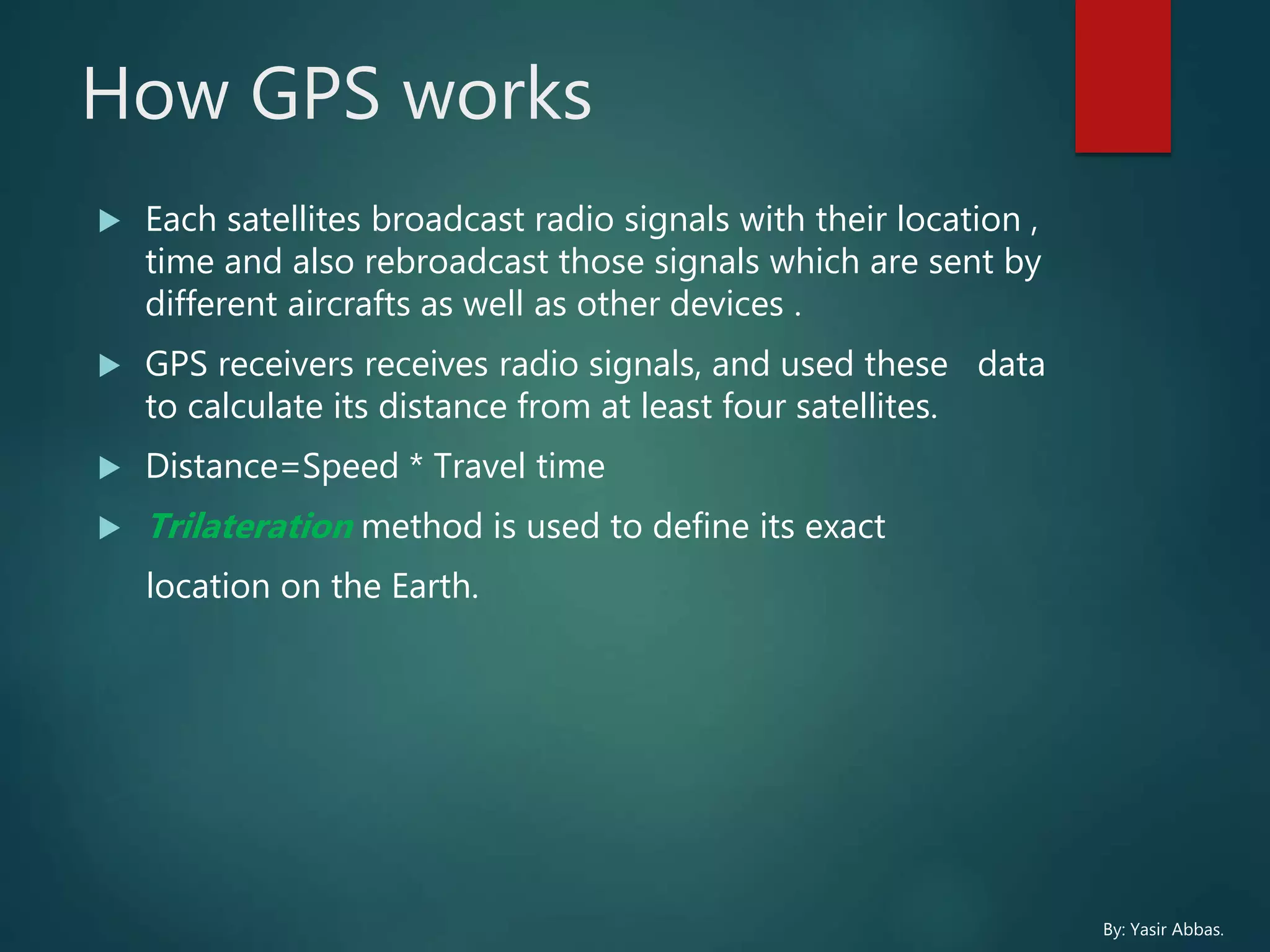
GPS ELEMENTS.
Three segments
 Space segment.
 Control segment.
 User segment.
By: Yasir Abbas.
Space Segment
 Minimum of 24 satellites
(currently 32) in orbit around
earth at altitude 20,000 km.
 It transmit radio-navigation
signals, and store and
retransmit the navigation
message sent by the control
segment.
By: Yasir Abbas.
Control Segment
 Combination of a master
control station, 12 ground
antennas, and 16 monitoring
stations responsible for the
proper functioning of all the
operation of GPS such as
changing unhealthy satellite
with a healthy one
By: Yasir Abbas.
User Segment
 Comprises of thousand of
U.S. and military users who
uses the secure GPS precise
Positioning service, and
millions of civil, commercial
and scientific users .
By: Yasir Abbas.
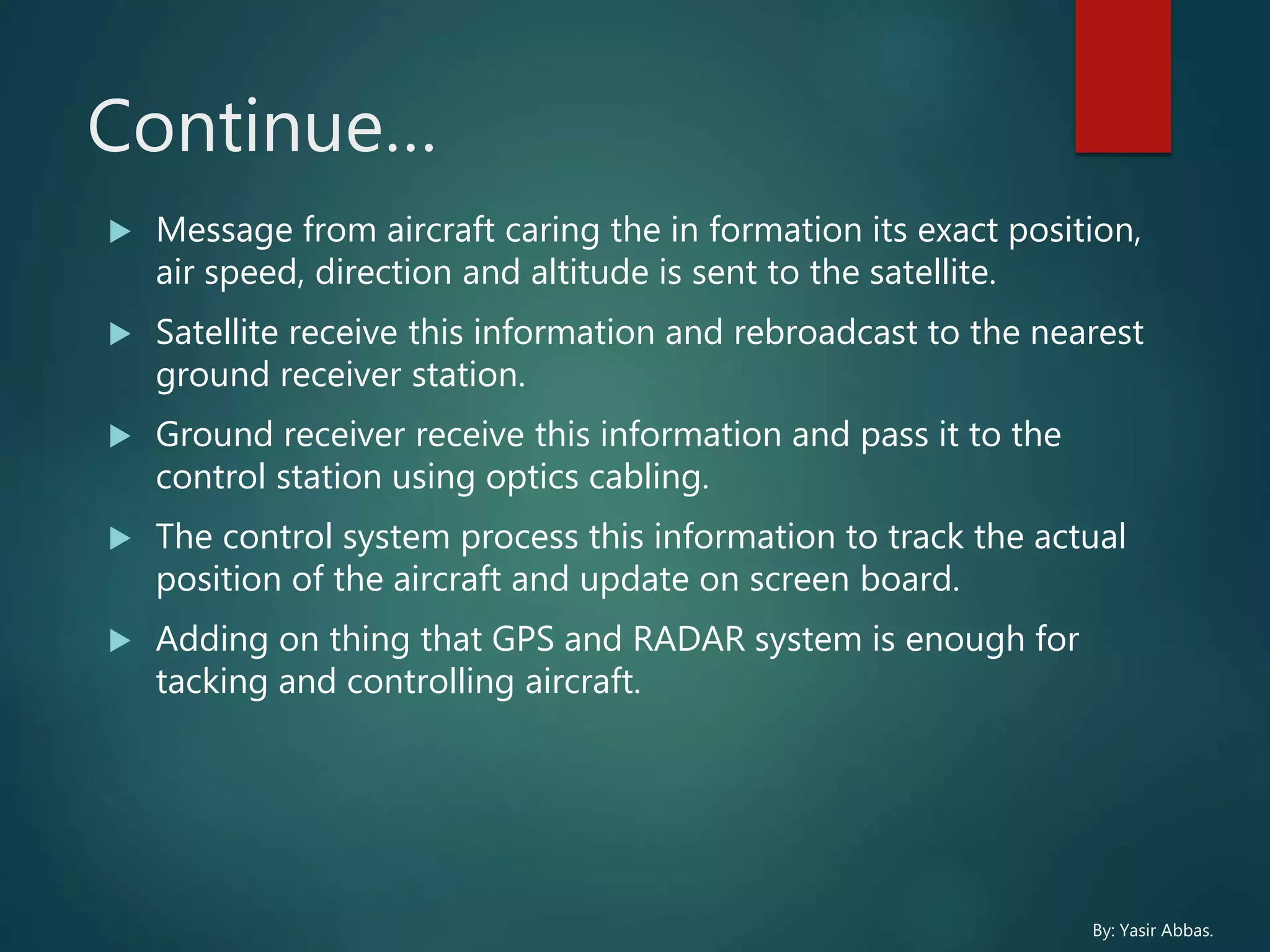
How GPS works
 Each satellites broadcast radio signals with their location ,
time and also rebroadcast those signals which are sent by
different aircrafts as well as other devices .
 GPS receivers receives radio signals, and used these data
to calculate its distance from at least four satellites.
 Distance=Speed * Travel time
 Trilateration method is used to define its exact
location on the Earth.
By: Yasir Abbas.
Trilateration:
In geometry, trilateration is defined as the process of
determining absolute or relative locations of points
by measurement of distances, using the geometry of
circles, spheres or triangles.
By: Yasir Abbas.
How trilateration Works
By: Yasir Abbas.
GPS Aircraft Tracking:
 Automatic dependent surveillance—broadcast (ADS–B) is a
surveillance technology.
 In which an aircraft determines its position via satellite navigation
and periodically broadcasts it, enabling it to be tracked.
 Aircraft ADS-B enabled sends its information to the orbiting satellites
after every 15 minutes.
 This packet of information helps airline control team to manage the
schedule of arrival and departure of aircraft.
By: Yasir Abbas.
Continue…
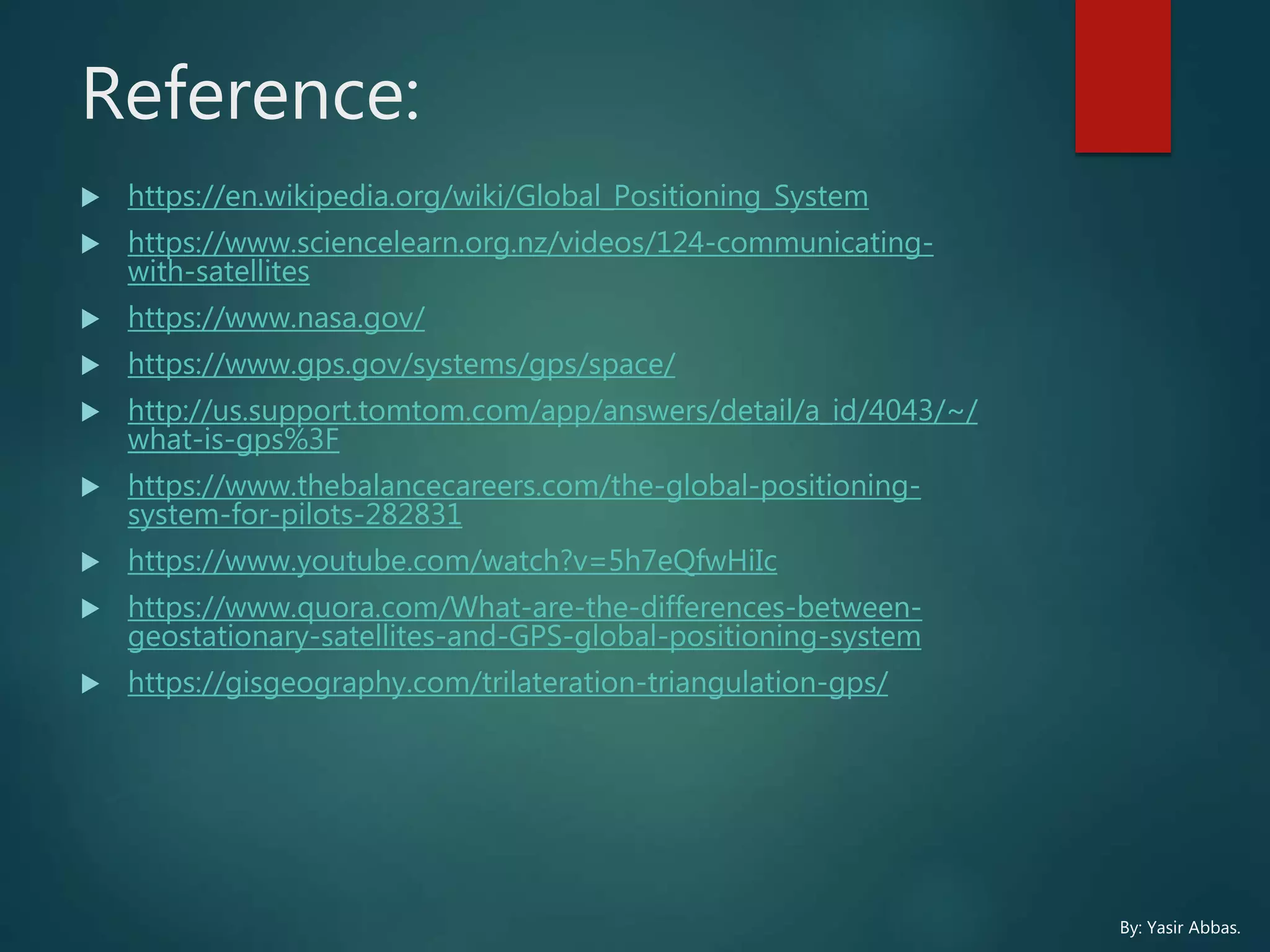
 Message from aircraft caring the in formation its exact position,
air speed, direction and altitude is sent to the satellite.
 Satellite receive this information and rebroadcast to the nearest
ground receiver station.
 Ground receiver receive this information and pass it to the
control station using optics cabling.
 The control system process this information to track the actual
position of the aircraft and update on screen board.
 Adding on thing that GPS and RADAR system is enough for
tacking and controlling aircraft.
By: Yasir Abbas.
Aircraft GPS Tracking(Information
sharing):
By: Yasir Abbas.
Wide Area Augmentation
System (WAAS)
 WAAS is used in higher precise positioning ventures.
 The WAAS is a type of satellite-based augmentation system (SBAS) that
uses widely spaced ground stations to correct small errors in Global
Positioning System (GPS) satellite data.
 The main benefit of the WAAS is a greatly improved accuracy.
Traditional GPS is accurate to 15 meters (about 50 feet). WAAS-enabled
GPS is accurate to less than 3 meters 95 percent of the time.
By: Yasir Abbas.
How the WAAS Works
 The WAAS uses 38 Wide-Area Reference Stations located on the
ground across North America to monitor GPS satellites.
 The satellite data are collected at the reference stations and sent to one
of three WAAS Master Stations.
 At a master station, the GPS-only data are corrected and used to create
WAAS augmentation messages.
 Six Ground Uplink Stations send the messages to three geostationary
communications satellites, which broadcast the improved positioning
data to WAAS-enabled GPS receivers.
 The system also includes two Operational Control Centers that monitor
and maintain it.
 We can say that WAAS is updated form of GPS in order to be more
precise.
By: Yasir Abbas.
Practical implementation.
Tracking Aircraft.
 Our discussion started from RADAR and completed at
WAAS.
 We have discussed about complete GPS composition and its
working How it is used to track the Aircraft and other metal
bodies capable to communicate wirelessly.
 And now we are going to track the aircraft over my
geographical location and worldwide also.
 Click here.
 https://www.flightradar24.com/airport/isb
By: Yasir Abbas.
Technology Management:
 There are 2000 satellites in the space launched by
different countries are being properly managed.
 GPS satellites are working in harmony in their orbits and
unhealthy satellites are being changed with healthy one’s.
 Ground station has been managed in such away each
segment knows what do and when?
 In this green planet thousands of aircraft take off and
arrives at their destinations daily.
 Technology from golden satellites to private planes are
managed in admirable way.
By: Yasir Abbas.
Reference:
 https://en.wikipedia.org/wiki/Global_Positioning_System
 https://www.sciencelearn.org.nz/videos/124-communicating-
with-satellites
 https://www.nasa.gov/
 https://www.gps.gov/systems/gps/space/
 http://us.support.tomtom.com/app/answers/detail/a_id/4043/~/
what-is-gps%3F
 https://www.thebalancecareers.com/the-global-positioning-
system-for-pilots-282831
 https://www.youtube.com/watch?v=5h7eQfwHiIc
 https://www.quora.com/What-are-the-differences-between-
geostationary-satellites-and-GPS-global-positioning-system
 https://gisgeography.com/trilateration-triangulation-gps/
By: Yasir Abbas.
Thank you respected ma’am
and adorable fellows.
By: Yasir Abbas.

GPS Aircraft Tracking

  • 1.
    Aircraft GPS Tracking. Submitted to: Ma’amSadia Zaib. Presented By: Yasir Abbas.
  • 2.
    HISTORY:  Navigating bystars (requires clear nights and careful measurements) most widely used for centuries  The first practical radar system was produced in 1935 by the British physicist Sir Robert Watson-Watt.  The first artificial satellite was Sputnik 1, launched by the Soviet Union on 4 October 1957 under the Sputnik program.  The GPS project was developed in 1973 to overcome the limitations of previous navigation systems.  GPS was created and realized by the U.S. department of defense and was originally run with 24 satellites.  It became fully operational in 1993. “Bradford Parkinson”, “Roger l. Easton”, and “Ivan a. getting” are credited with inventing it. By: Yasir Abbas.
  • 3.
    Aircraft Positioning using RADAR: Aircraft are managed and monitored using RADAR(Radio Detection and Ranging)  Radar is a detection system that uses radio waves to determine the range, angle, or velocity of objects.  It can be used to detect aircraft, ships, spacecraft, guided missiles, motor vehicles, weather formations and terrain.  Each country use its RADAR system to monitor their aircraft , By: Yasir Abbas.
  • 4.
    Continue...  when wetalk about international services these metal bodies have to pass over the oceans and across many countries then we have to communicate with Satellites.  RADAR are widely used during Wars and for military usage to control fighter plans.  RADAR are also being widely used in different application.  Now , we are going to use the Satellites (which is our next segment) to position object all over the world as well. By: Yasir Abbas.
  • 5.
    Types of satellitesin the space.  Communications Satellite  Remote Sensing Satellite  Navigation Satellite  Geocentric Orbit type satellites - LEO, MEO, HEO  Global Positioning System (GPS)  Geostationary Satellites (GEOs)  Natural satellites i.e. moon.  Currently there are over 2000 artificial satellites orbiting the Earth By: Yasir Abbas.
  • 6.
    WHAT IS GPS? A space-based satellite navigation system provides location and time information in all weather.  Maintained by the United States government and is freely accessible by anyone with a GPS receiver. By: Yasir Abbas.
  • 7.
     Official name: “Navigational Satellite Timing And Ranging Global Positioning  System” (NAVSTAR GPS)  Consists of 30+ GPS satellites in medium Earth orbit (2000km - 35,000 km).  Made up of two dozen satellites working in harmony are known as a satellite constellation  Mainly used for navigation, map-making and surveying. Official logo for NAVSTAR GPS By: Yasir Abbas.
  • 8.
    GPS ELEMENTS. Three segments Space segment.  Control segment.  User segment. By: Yasir Abbas.
  • 9.
    Space Segment  Minimumof 24 satellites (currently 32) in orbit around earth at altitude 20,000 km.  It transmit radio-navigation signals, and store and retransmit the navigation message sent by the control segment. By: Yasir Abbas.
  • 10.
    Control Segment  Combinationof a master control station, 12 ground antennas, and 16 monitoring stations responsible for the proper functioning of all the operation of GPS such as changing unhealthy satellite with a healthy one By: Yasir Abbas.
  • 11.
    User Segment  Comprisesof thousand of U.S. and military users who uses the secure GPS precise Positioning service, and millions of civil, commercial and scientific users . By: Yasir Abbas.
  • 12.
    How GPS works Each satellites broadcast radio signals with their location , time and also rebroadcast those signals which are sent by different aircrafts as well as other devices .  GPS receivers receives radio signals, and used these data to calculate its distance from at least four satellites.  Distance=Speed * Travel time  Trilateration method is used to define its exact location on the Earth. By: Yasir Abbas.
  • 13.
    Trilateration: In geometry, trilaterationis defined as the process of determining absolute or relative locations of points by measurement of distances, using the geometry of circles, spheres or triangles. By: Yasir Abbas.
  • 14.
  • 15.
    GPS Aircraft Tracking: Automatic dependent surveillance—broadcast (ADS–B) is a surveillance technology.  In which an aircraft determines its position via satellite navigation and periodically broadcasts it, enabling it to be tracked.  Aircraft ADS-B enabled sends its information to the orbiting satellites after every 15 minutes.  This packet of information helps airline control team to manage the schedule of arrival and departure of aircraft. By: Yasir Abbas.
  • 16.
    Continue…  Message fromaircraft caring the in formation its exact position, air speed, direction and altitude is sent to the satellite.  Satellite receive this information and rebroadcast to the nearest ground receiver station.  Ground receiver receive this information and pass it to the control station using optics cabling.  The control system process this information to track the actual position of the aircraft and update on screen board.  Adding on thing that GPS and RADAR system is enough for tacking and controlling aircraft. By: Yasir Abbas.
  • 17.
  • 18.
    Wide Area Augmentation System(WAAS)  WAAS is used in higher precise positioning ventures.  The WAAS is a type of satellite-based augmentation system (SBAS) that uses widely spaced ground stations to correct small errors in Global Positioning System (GPS) satellite data.  The main benefit of the WAAS is a greatly improved accuracy. Traditional GPS is accurate to 15 meters (about 50 feet). WAAS-enabled GPS is accurate to less than 3 meters 95 percent of the time. By: Yasir Abbas.
  • 19.
    How the WAASWorks  The WAAS uses 38 Wide-Area Reference Stations located on the ground across North America to monitor GPS satellites.  The satellite data are collected at the reference stations and sent to one of three WAAS Master Stations.  At a master station, the GPS-only data are corrected and used to create WAAS augmentation messages.  Six Ground Uplink Stations send the messages to three geostationary communications satellites, which broadcast the improved positioning data to WAAS-enabled GPS receivers.  The system also includes two Operational Control Centers that monitor and maintain it.  We can say that WAAS is updated form of GPS in order to be more precise. By: Yasir Abbas.
  • 20.
    Practical implementation. Tracking Aircraft. Our discussion started from RADAR and completed at WAAS.  We have discussed about complete GPS composition and its working How it is used to track the Aircraft and other metal bodies capable to communicate wirelessly.  And now we are going to track the aircraft over my geographical location and worldwide also.  Click here.  https://www.flightradar24.com/airport/isb By: Yasir Abbas.
  • 21.
    Technology Management:  Thereare 2000 satellites in the space launched by different countries are being properly managed.  GPS satellites are working in harmony in their orbits and unhealthy satellites are being changed with healthy one’s.  Ground station has been managed in such away each segment knows what do and when?  In this green planet thousands of aircraft take off and arrives at their destinations daily.  Technology from golden satellites to private planes are managed in admirable way. By: Yasir Abbas.
  • 22.
    Reference:  https://en.wikipedia.org/wiki/Global_Positioning_System  https://www.sciencelearn.org.nz/videos/124-communicating- with-satellites https://www.nasa.gov/  https://www.gps.gov/systems/gps/space/  http://us.support.tomtom.com/app/answers/detail/a_id/4043/~/ what-is-gps%3F  https://www.thebalancecareers.com/the-global-positioning- system-for-pilots-282831  https://www.youtube.com/watch?v=5h7eQfwHiIc  https://www.quora.com/What-are-the-differences-between- geostationary-satellites-and-GPS-global-positioning-system  https://gisgeography.com/trilateration-triangulation-gps/ By: Yasir Abbas.
  • 23.
    Thank you respectedma’am and adorable fellows. By: Yasir Abbas.