

SATELLITE COMMUNICATION
(Unit-1 Satellite Orbits)
LAUNCH VEHICLES AND PROPULSION
Prepared by
L.K.Balaji Vignesh,
Assistant Professor/ECE
CONTENT:
• WHAT IS LAUNCH VEHICLES AND PROPULSION
• TYPES OF LAUNCH VEHICLE
• CONCEPTS IN LAUNCHING A SATELLITE
• SOME INTERESTING FACTS ABOUT SATELLITE
COMMUNCATION
LAUNCHES
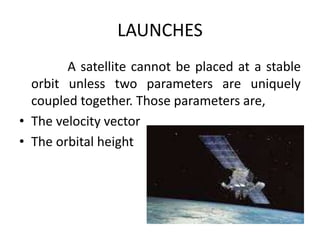
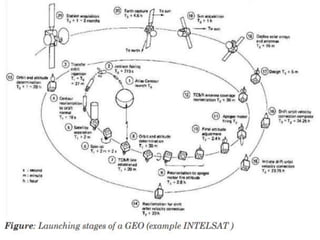
A satellite cannot be placed at a stable
orbit unless two parameters are uniquely
coupled together. Those parameters are,
• The velocity vector
• The orbital height
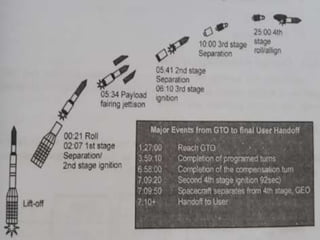
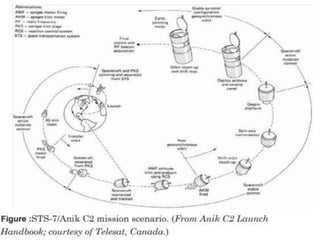
Launching Stages
(Proton Launch)
LAUNCH VEHICLES
• In space flight, a launch vehicle or carrier
rocket a is a rocket used to carry a payload
from Earth’s surface into outer space.
• A launch system includes the launch pad and
other infrastructure.
• Each orbital launch vehicles typically have
atleast two stages, often three or sometimes
four or five
Types of launch vehicles
• Expendable launch vehicles – Designed for
one time use.
• Reusable launch vehicles – Designed to be
recovered impact and launched again.
• We can classified the launch vehicle by,
- Amount of mass they can carry into
orbit.
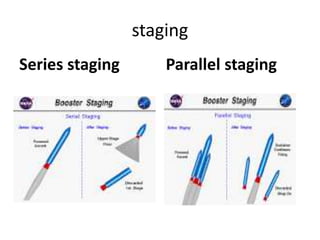
staging
Series staging Parallel staging
Propulsion
• A force that pushes something forward.
• Spacecraft propulsion is any method used to
accelerate spacecraft and artificial satellites.
• Rocket engine used in spacecraft propulsion.
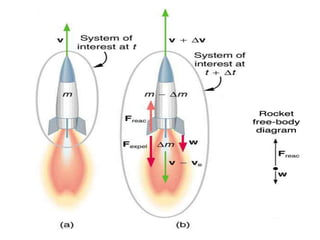
How does a rocket related to Newton’s
Third Law of motion?
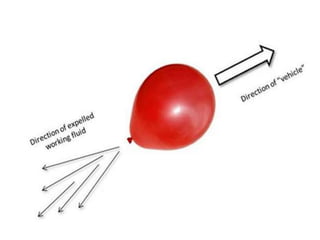
• Newton’s Third Law states that “every action
has an equal and opposite reaction”.
• This law explains the generation of thrust by a
rocket engine.
• In a rocket, burning fuel creates a push on the
front of the rocket pushing it forward.
• This creates an equal and opposite push on
the exhaust gas backward.
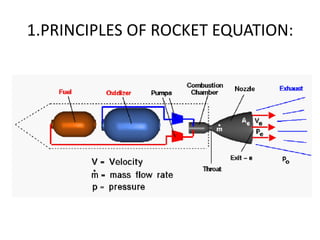
1.PRINCIPLES OF ROCKET EQUATION:
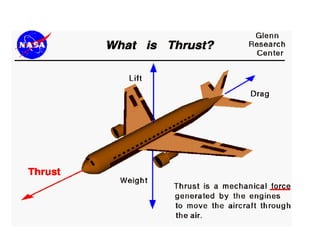
2.Thrust
• Thrust is the force which moves the
rocket through the air, and through
space.
• Thrust is generated by the propulsion
system of the rocked through the
application of Newton’s Third Law of
motion.
3.SPECIFIC IMPULSE
• The characteristic that is most
often used to describe the
propellant performance is called
specific impulse (Isp).
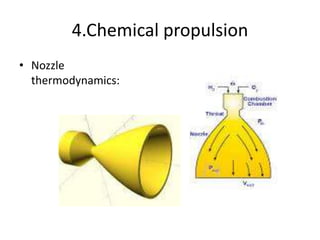
4.Chemical propulsion
• Nozzle
thermodynamics:
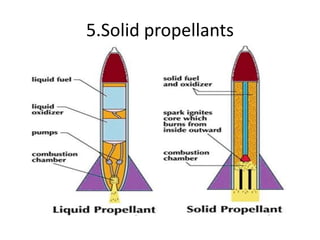
5.Solid propellants
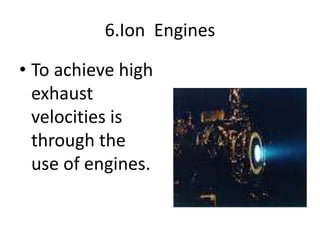
6.Ion Engines
• To achieve high
exhaust
velocities is
through the
use of engines.
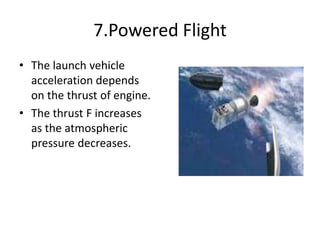
7.Powered Flight
• The launch vehicle
acceleration depends
on the thrust of engine.
• The thrust F increases
as the atmospheric
pressure decreases.
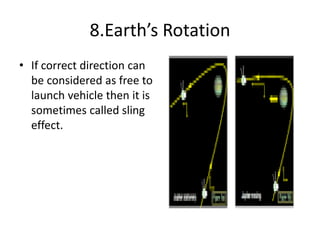
8.Earth’s Rotation
• If correct direction can
be considered as free to
launch vehicle then it is
sometimes called sling
effect.
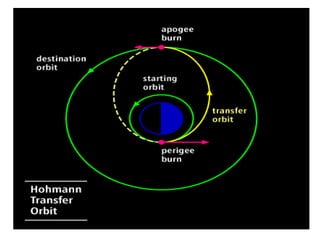
9. Injection into the final orbit
• Parking orbit
• Transfer orbit (or) Hohmann
transfer orbit.
Polar satellite launch vehicle(PSLV)
• It is an Expendable launch system developed and
operated by the Indian Space Research
Organization (ISRO).
• C38-PSLV-XL
23 June 2017- 9:29AM
• 29 Nano satellite from 14 countries…
• Total weight 955kg.
• 37 crore($5.7million)
Some interesting facts about satellite
communication:
• There are over 2500 satellites in orbit round
the earth.
• Geostationary satellite orbit the equator at
the speed of the Earth’s rotation so seem not
to move.
• In 2009 two communications satellites, from
the US and Russia, collided. This is the only
time two man-made satellites have collided by
accident.
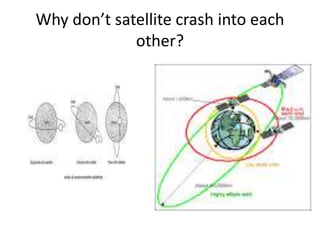
Why don’t satellite crash into each
other?
Youtube Videos:
https://www.youtube.com/watch?v=JyaYF9tpEQw
https://www.youtube.com/watch?v=Tk338VXcb24
Launch Vehicles and Propulsion_Satellite Communication

Launch Vehicles and Propulsion_Satellite Communication

  • 1.
    SATELLITE COMMUNICATION (Unit-1 SatelliteOrbits) LAUNCH VEHICLES AND PROPULSION Prepared by L.K.Balaji Vignesh, Assistant Professor/ECE
  • 2.
    CONTENT: • WHAT ISLAUNCH VEHICLES AND PROPULSION • TYPES OF LAUNCH VEHICLE • CONCEPTS IN LAUNCHING A SATELLITE • SOME INTERESTING FACTS ABOUT SATELLITE COMMUNCATION
  • 3.
    LAUNCHES A satellite cannotbe placed at a stable orbit unless two parameters are uniquely coupled together. Those parameters are, • The velocity vector • The orbital height
  • 4.
  • 6.
    LAUNCH VEHICLES • Inspace flight, a launch vehicle or carrier rocket a is a rocket used to carry a payload from Earth’s surface into outer space. • A launch system includes the launch pad and other infrastructure. • Each orbital launch vehicles typically have atleast two stages, often three or sometimes four or five
  • 7.
    Types of launchvehicles • Expendable launch vehicles – Designed for one time use. • Reusable launch vehicles – Designed to be recovered impact and launched again. • We can classified the launch vehicle by, - Amount of mass they can carry into orbit.
  • 8.
  • 9.
    Propulsion • A forcethat pushes something forward. • Spacecraft propulsion is any method used to accelerate spacecraft and artificial satellites. • Rocket engine used in spacecraft propulsion.
  • 10.
    How does arocket related to Newton’s Third Law of motion? • Newton’s Third Law states that “every action has an equal and opposite reaction”. • This law explains the generation of thrust by a rocket engine. • In a rocket, burning fuel creates a push on the front of the rocket pushing it forward. • This creates an equal and opposite push on the exhaust gas backward.
  • 11.
  • 14.
    2.Thrust • Thrust isthe force which moves the rocket through the air, and through space. • Thrust is generated by the propulsion system of the rocked through the application of Newton’s Third Law of motion.
  • 16.
    3.SPECIFIC IMPULSE • Thecharacteristic that is most often used to describe the propellant performance is called specific impulse (Isp).
  • 17.
  • 18.
  • 19.
    6.Ion Engines • Toachieve high exhaust velocities is through the use of engines.
  • 20.
    7.Powered Flight • Thelaunch vehicle acceleration depends on the thrust of engine. • The thrust F increases as the atmospheric pressure decreases.
  • 21.
    8.Earth’s Rotation • Ifcorrect direction can be considered as free to launch vehicle then it is sometimes called sling effect.
  • 22.
    9. Injection intothe final orbit • Parking orbit • Transfer orbit (or) Hohmann transfer orbit.
  • 24.
    Polar satellite launchvehicle(PSLV) • It is an Expendable launch system developed and operated by the Indian Space Research Organization (ISRO). • C38-PSLV-XL 23 June 2017- 9:29AM • 29 Nano satellite from 14 countries… • Total weight 955kg. • 37 crore($5.7million)
  • 27.
    Some interesting factsabout satellite communication: • There are over 2500 satellites in orbit round the earth. • Geostationary satellite orbit the equator at the speed of the Earth’s rotation so seem not to move. • In 2009 two communications satellites, from the US and Russia, collided. This is the only time two man-made satellites have collided by accident.
  • 28.
    Why don’t satellitecrash into each other?
  • 29.