JET PROPULSION
Presented by: Thorat Sandip Pandurang
Class:Third Year Mechanical engineering
Div: B , Roll No:54
1
Contents
• History
• Introduction
• Major components
• Working
• Types of Jet engines
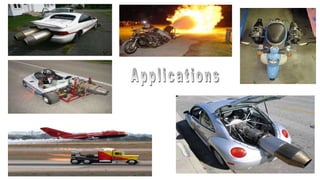
• Applications
2
3
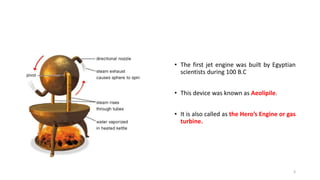
• The first jet engine was built by Egyptian
scientists during 100 B.C
• This device was known as Aeolipile.
• It is also called as the Hero’s Engine or gas
turbine.
4
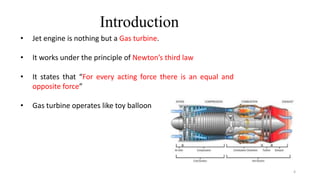
• Jet engine is nothing but a Gas turbine.
• It works under the principle of Newton’s third law
• It states that “For every acting force there is an equal and
opposite force”
• Gas turbine operates like toy balloon
Introduction
5
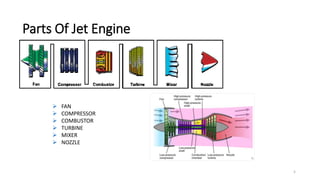
Parts Of Jet Engine
 FAN
 COMPRESSOR
 COMBUSTOR
 TURBINE
 MIXER
 NOZZLE
6
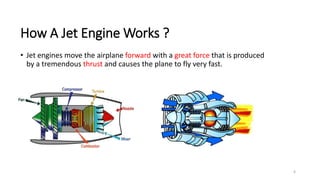
How A Jet Engine Works ?
• Jet engines move the airplane forward with a great force that is produced
by a tremendous thrust and causes the plane to fly very fast.
7
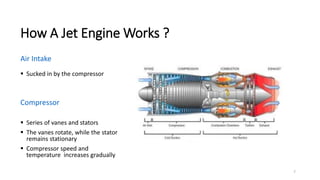
How A Jet Engine Works ?
Air Intake
 Sucked in by the compressor
Compressor
 Series of vanes and stators
 The vanes rotate, while the stator
remains stationary
 Compressor speed and
temperature increases gradually
8
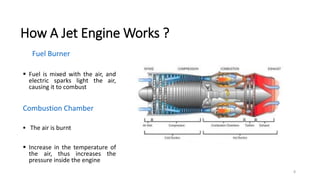
How A Jet Engine Works ?
Fuel Burner
 Fuel is mixed with the air, and
electric sparks light the air,
causing it to combust
Combustion Chamber
 The air is burnt
 Increase in the temperature of
the air, thus increases the
pressure inside the engine
9
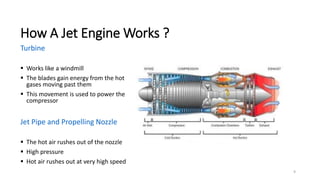
How A Jet Engine Works ?
Turbine
 Works like a windmill
 The blades gain energy from the hot
gases moving past them
 This movement is used to power the
compressor
Jet Pipe and Propelling Nozzle
 The hot air rushes out of the nozzle
 High pressure
 Hot air rushes out at very high speed
10
Types Of Jet Engines
• Ramjet
• Turbojet
• Turbofan
• Turboprop
• Turbo shaft
11
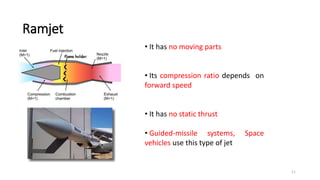
Ramjet
• It has no moving parts
• Its compression ratio depends on
forward speed
• It has no static thrust
• Guided-missile systems, Space
vehicles use this type of jet
12
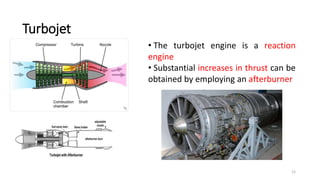
Turbojet
• The turbojet engine is a reaction
engine
• Substantial increases in thrust can be
obtained by employing an afterburner
13
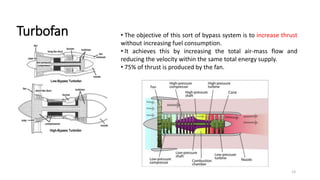
Turbofan • The objective of this sort of bypass system is to increase thrust
without increasing fuel consumption.
• It achieves this by increasing the total air-mass flow and
reducing the velocity within the same total energy supply.
• 75% of thrust is produced by the fan.
14
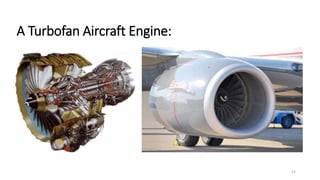
A Turbofan Aircraft Engine:
15
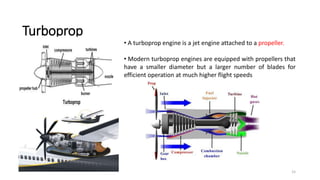
Turboprop
• A turboprop engine is a jet engine attached to a propeller.
• Modern turboprop engines are equipped with propellers that
have a smaller diameter but a larger number of blades for
efficient operation at much higher flight speeds
16
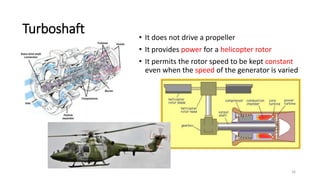
Turboshaft • It does not drive a propeller
• It provides power for a helicopter rotor
• It permits the rotor speed to be kept constant
even when the speed of the generator is varied
17
18
Any questions?
THANK YOU

Jet propulsion

  • 1.
    JET PROPULSION Presented by:Thorat Sandip Pandurang Class:Third Year Mechanical engineering Div: B , Roll No:54 1
  • 2.
    Contents • History • Introduction •Major components • Working • Types of Jet engines • Applications 2
  • 3.
    3 • The firstjet engine was built by Egyptian scientists during 100 B.C • This device was known as Aeolipile. • It is also called as the Hero’s Engine or gas turbine.
  • 4.
    4 • Jet engineis nothing but a Gas turbine. • It works under the principle of Newton’s third law • It states that “For every acting force there is an equal and opposite force” • Gas turbine operates like toy balloon Introduction
  • 5.
    5 Parts Of JetEngine  FAN  COMPRESSOR  COMBUSTOR  TURBINE  MIXER  NOZZLE
  • 6.
    6 How A JetEngine Works ? • Jet engines move the airplane forward with a great force that is produced by a tremendous thrust and causes the plane to fly very fast.
  • 7.
    7 How A JetEngine Works ? Air Intake  Sucked in by the compressor Compressor  Series of vanes and stators  The vanes rotate, while the stator remains stationary  Compressor speed and temperature increases gradually
  • 8.
    8 How A JetEngine Works ? Fuel Burner  Fuel is mixed with the air, and electric sparks light the air, causing it to combust Combustion Chamber  The air is burnt  Increase in the temperature of the air, thus increases the pressure inside the engine
  • 9.
    9 How A JetEngine Works ? Turbine  Works like a windmill  The blades gain energy from the hot gases moving past them  This movement is used to power the compressor Jet Pipe and Propelling Nozzle  The hot air rushes out of the nozzle  High pressure  Hot air rushes out at very high speed
  • 10.
    10 Types Of JetEngines • Ramjet • Turbojet • Turbofan • Turboprop • Turbo shaft
  • 11.
    11 Ramjet • It hasno moving parts • Its compression ratio depends on forward speed • It has no static thrust • Guided-missile systems, Space vehicles use this type of jet
  • 12.
    12 Turbojet • The turbojetengine is a reaction engine • Substantial increases in thrust can be obtained by employing an afterburner
  • 13.
    13 Turbofan • Theobjective of this sort of bypass system is to increase thrust without increasing fuel consumption. • It achieves this by increasing the total air-mass flow and reducing the velocity within the same total energy supply. • 75% of thrust is produced by the fan.
  • 14.
  • 15.
    15 Turboprop • A turbopropengine is a jet engine attached to a propeller. • Modern turboprop engines are equipped with propellers that have a smaller diameter but a larger number of blades for efficient operation at much higher flight speeds
  • 16.
    16 Turboshaft • Itdoes not drive a propeller • It provides power for a helicopter rotor • It permits the rotor speed to be kept constant even when the speed of the generator is varied
  • 17.
  • 18.