WINTERTemplateIntraocular pressure
and tonometry
01
Intraocular pressure
• What is intraocular pressure?
• What unit?
• Normal range
• Causes of abnormal
measurement
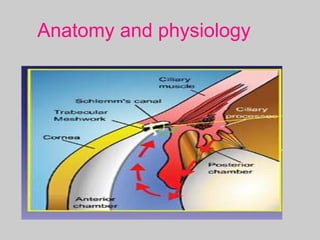
Anatomy and physiology
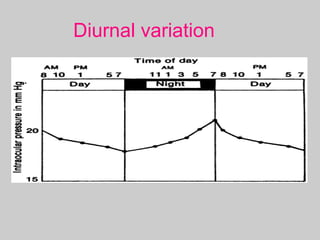
Diurnal variation
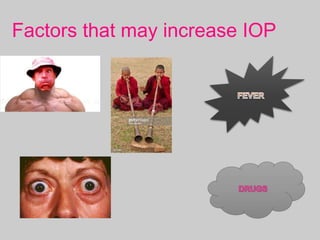
Factors that may increase IOP
Factors that may decrease IOP
Tonometry
• Definition
Tonometry is the measurement of
intraocular pressure by a tonometer
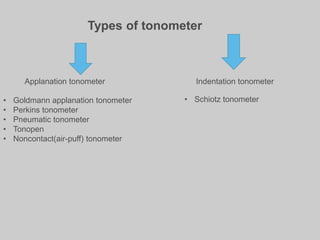
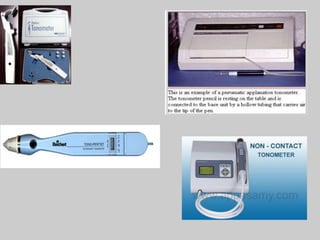
Types of tonometer
Applanation tonometer Indentation tonometer
• Goldmann applanation tonometer
• Perkins tonometer
• Pneumatic tonometer
• Tonopen
• Noncontact(air-puff) tonometer
• Schiotz tonometer
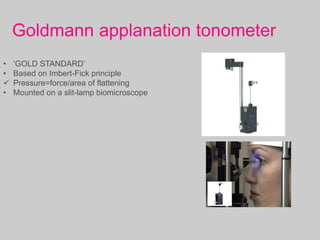
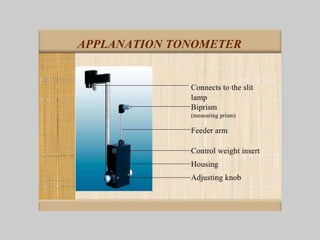
Goldmann applanation tonometer
• ‘GOLD STANDARD’
• Based on Imbert-Fick principle
 Pressure=force/area of flattening
• Mounted on a slit-lamp biomicroscope
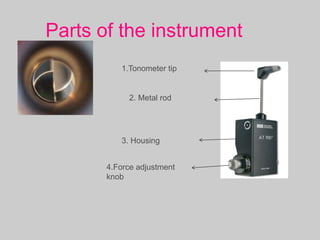
Parts of the instrument
1.Tonometer tip
2. Metal rod
3. Housing
4.Force adjustment
knob
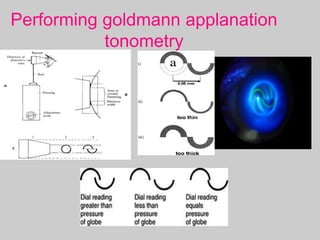
Performing goldmann applanation
tonometry
Disinfecting the applanating tip
• Remove the tonometer tip from the biprism
after each use
• Disinfect by swabbing the tip with a cotton-
tipped applicator that has been soaked in
isopropyl alcohol
• Rinse the tip with water and dry with
gauze.
Contraindications
• Active infections
• Recurrent corneal erosions
• Corneal abrasions that are not healed
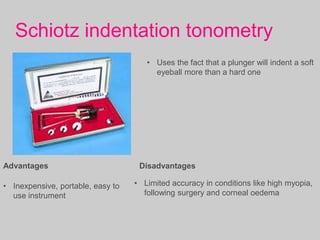
Schiotz indentation tonometry
• Inexpensive, portable, easy to
use instrument
Advantages Disadvantages
• Limited accuracy in conditions like high myopia,
following surgery and corneal oedema
• Uses the fact that a plunger will indent a soft
eyeball more than a hard one
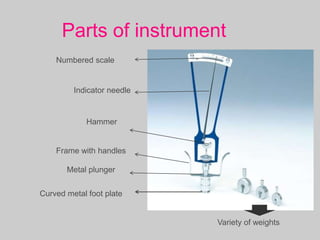
Parts of instrument
Curved metal foot plate
Metal plunger
Frame with handles
Variety of weights
Numbered scale
Indicator needle
Hammer
Performing schiotz tonometry
Disinfecting schiotz tonometer
• Remove the plunger from the cylinder
• Wipe the footplate and the plunger with
the alcohol
• Rinse the footplate and plunger with water
and wipe it with gauze
Contraindications
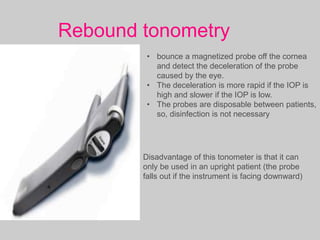
Rebound tonometry
• bounce a magnetized probe off the cornea
and detect the deceleration of the probe
caused by the eye.
• The deceleration is more rapid if the IOP is
high and slower if the IOP is low.
• The probes are disposable between patients,
so, disinfection is not necessary
Disadvantage of this tonometer is that it can
only be used in an upright patient (the probe
falls out if the instrument is facing downward)
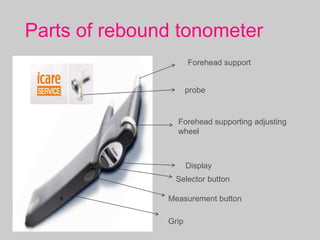
Parts of rebound tonometer
Display
Selector button
Measurement button
Grip
Forehead support
Forehead supporting adjusting
wheel
probe
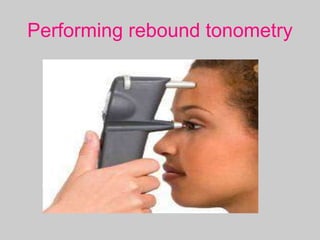
Performing rebound tonometry
Digital tonometry
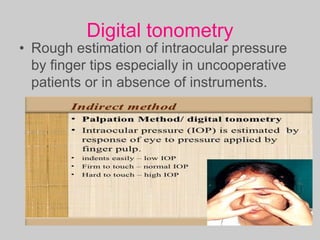
• Rough estimation of intraocular pressure
by finger tips especially in uncooperative
patients or in absence of instruments.
Recap
• Name one cause of ocular hypotony
• IOP is highest in the morning. T/F
• Name one drug which can cause increased
IOP
• What is the gold standard instrument to
measure IOP?
• Name one contraindication for schiotz
tonometer.
Thank you

Tonometry in ophthalmology