A.SHAJITHAA.SHAJITHA
B.Sc RD 3B.Sc RD 3rdrd
YEARYEAR
MR SPECTROSCOPYMR SPECTROSCOPY
MR SpectroscopyMR Spectroscopy
 Noninvasive means of assessing theNoninvasive means of assessing the
biochemical and metabolic processes inbiochemical and metabolic processes in
intracranial tissues without ionizingintracranial tissues without ionizing
radiation.radiation.
 For the brain in particular, MRS has beenFor the brain in particular, MRS has been
a powerful research tool and providea powerful research tool and provide
additional clinical information for severaladditional clinical information for several
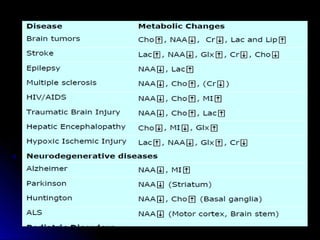
disease such as brain tumors, metabolicdisease such as brain tumors, metabolic
disorders, and systemic diseasesdisorders, and systemic diseases
 There are numerous metabolites found in theThere are numerous metabolites found in the
human brain.human brain.
 Fortunately, only several of them are useful inFortunately, only several of them are useful in
spectroscopic studies.spectroscopic studies.
 There is evidence that the normal metabolites inThere is evidence that the normal metabolites in
the brain vary with according to the patient'sthe brain vary with according to the patient's
age.age.
 The changes are most noticeable during the firstThe changes are most noticeable during the first
three years of life.three years of life.
 A spectrum of the metabolites is plotted on a twoA spectrum of the metabolites is plotted on a two
dimensional graph.dimensional graph.
 The horizontal axis represents the frequenciesThe horizontal axis represents the frequencies
(chemical shifts) and the vertical axis represents the(chemical shifts) and the vertical axis represents the
concentration of the metabolites.concentration of the metabolites.
 The frequencies are plotted with reference to aThe frequencies are plotted with reference to a
stable compound.stable compound.
 The reference compound most often used isThe reference compound most often used is
tetramethylsilanetetramethylsilane (TMS).(TMS). The chemical shifts areThe chemical shifts are
expressed as parts per million (ppm).expressed as parts per million (ppm).
NORMAL SPECTRA
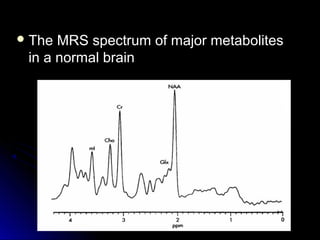
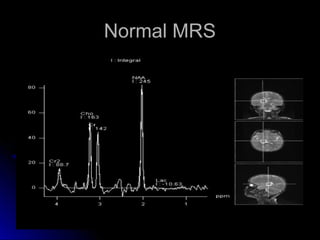
 The MRS spectrum of major metabolitesThe MRS spectrum of major metabolites
in a normal brainin a normal brain
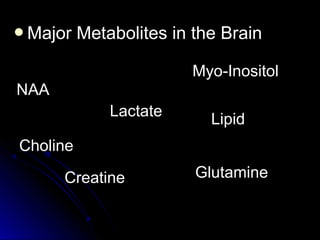
Major Metabolites in the BrainMajor Metabolites in the Brain
Choline
Creatine
Lactate
Glutamine
Lipid
Myo-Inositol
NAA
N-ACETYLASPARTATE (NAA)N-ACETYLASPARTATE (NAA)
NAA is the marker of neuronal density and viability.
• It is present in both gray and white matter and the
difference in concentration is not clinically significant.
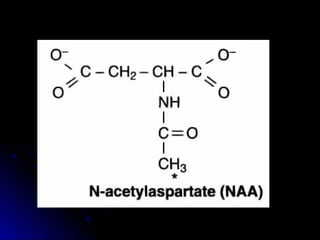
• NAA is detected by the its N-acetyl methyl group.
• Its concentration appears to decrease with any brain
insults such as infection, ischemic injury, neoplasm,
and demyelination process.
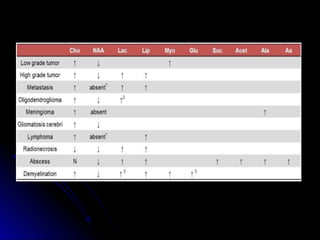
• NAA is not in found in tumors outside the central
nervous system (CNS) such as meningioma.
• NAA is the tallest peak in the proton MR spectrum and it
is assigned at 2.0ppm. Additional smaller peaks may be
seen at 2.6 and 2.5 ppm.
CholineCholine
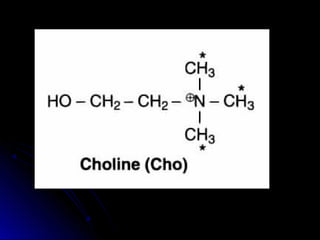
 The choline peak receives contribution fromThe choline peak receives contribution from
glycerophosphocholine, phosphocholine, andglycerophosphocholine, phosphocholine, and
phosphatidylcholine.phosphatidylcholine.
 It is the precursor of acetyl choline andIt is the precursor of acetyl choline and
phosphatidylcholine.phosphatidylcholine.
 Acetylcholine is an important neurotransmitter and theAcetylcholine is an important neurotransmitter and the
latter is an integral part of cell membrane synthesis.latter is an integral part of cell membrane synthesis.
 Disease processes affecting the cell membrane andDisease processes affecting the cell membrane and
myelin can lead to the release of phosphatidylcholine.myelin can lead to the release of phosphatidylcholine.
 Thus,Thus, elevation of choline can be seen duringelevation of choline can be seen during ischemicischemic
injury, neoplasm or acute demyelination diseases.injury, neoplasm or acute demyelination diseases.
 Choline is the second largest peak and assigned to 3.2Choline is the second largest peak and assigned to 3.2
ppm.ppm.
Creatine (Cr)Creatine (Cr)
 The Cr peak receives contribution mainly from creatine, and creatineThe Cr peak receives contribution mainly from creatine, and creatine
phosphate.phosphate.
 The phospocreatine supplies phosphate to adenosineThe phospocreatine supplies phosphate to adenosine
diphosphate (ADP) to form adenosine triphosphate (ATP) with thediphosphate (ADP) to form adenosine triphosphate (ATP) with the
release of creatine.release of creatine.
 The overall level of total creatine in normal brain is fairlyThe overall level of total creatine in normal brain is fairly
constant.constant.
 ReducedReduced Cr level may be seen in pathologic processes such asCr level may be seen in pathologic processes such as
neoplasm, ischemic injury, infection or some systemic diseases..
 Most metastatic tumors to the brain do not produce creatine sinceMost metastatic tumors to the brain do not produce creatine since
they do not possess creatine kinase.they do not possess creatine kinase.
 Cr is the third highest peak and is assigned to 3.03 ppm. It isCr is the third highest peak and is assigned to 3.03 ppm. It is
usually seenusually seen next to the right of cholinenext to the right of choline..
LactateLactate
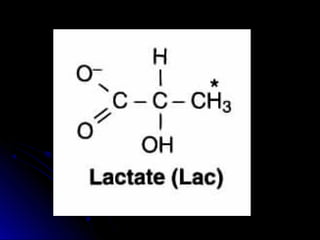
 Lactate has a molecular structure of CH3-COH2-CO2.Lactate has a molecular structure of CH3-COH2-CO2.
 Lactate levels in the brain are normally are very low orLactate levels in the brain are normally are very low or
absent. When oxygen supply is depleted, the brainabsent. When oxygen supply is depleted, the brain
switches to anaerobic respiration for which one endswitches to anaerobic respiration for which one end
product is lactate.product is lactate.
 Therefore, elevated lactate peak is a sign of hypoxicTherefore, elevated lactate peak is a sign of hypoxic
tissue.tissue.
 Low oxygen supply can result from decreased oxygenLow oxygen supply can result from decreased oxygen
supply or increased oxygen requirement.supply or increased oxygen requirement.
 The former may be seen in vascular insults, orThe former may be seen in vascular insults, or
hypoventilation and the latter may be seen in neoplastichypoventilation and the latter may be seen in neoplastic
tissue.tissue.
 Lactate peak occurs at two differentLactate peak occurs at two different
locations.locations.
The lower field peak (a doublet) occurs atThe lower field peak (a doublet) occurs at
approximately 1.32 ppm.approximately 1.32 ppm.
 The other peak (a quartet) is seen at 4.1 ppmThe other peak (a quartet) is seen at 4.1 ppm
and this is very close to the water peak.and this is very close to the water peak.
– usually suppressed during data processing.
Myo-Inositol (mI)Myo-Inositol (mI)
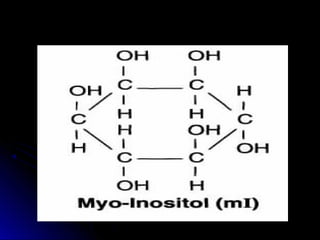
 Myo-Inositol is a glucose-like metabolite and itMyo-Inositol is a glucose-like metabolite and it
involves primarily in hormone-sensitiveinvolves primarily in hormone-sensitive
neuroreception. It is found mainly inneuroreception. It is found mainly in astrocytesastrocytes
and helps to regulate cell volume.and helps to regulate cell volume.
 Elevated level of mI would be seen where thereElevated level of mI would be seen where there
is glial cell proliferation as in gliosis.is glial cell proliferation as in gliosis.
 The main mI peak is assigned to 3.56 ppm andThe main mI peak is assigned to 3.56 ppm and
additional peak may be seen at 4.06 ppmadditional peak may be seen at 4.06 ppm
LipidsLipids
 Lipids are composition of triglycerides, phospholipids,Lipids are composition of triglycerides, phospholipids,
and fatty acids.and fatty acids.
 These substances are incorporated into cell membranesThese substances are incorporated into cell membranes
and myelin.and myelin.
 Lipid peak should not be seen unless there is destructiveLipid peak should not be seen unless there is destructive
process of the brain including necrosis, inflammation orprocess of the brain including necrosis, inflammation or
infection.infection.
 Lipids have a very short T1 relaxation time and areLipids have a very short T1 relaxation time and are
normally not seen unless short TEs are utilized.normally not seen unless short TEs are utilized.
 Lipid resonance at 1.2 ppm can sometimes obscure theLipid resonance at 1.2 ppm can sometimes obscure the
lactate peak at 1.32 ppm.lactate peak at 1.32 ppm.
 Fat in the cranium can contaminate the true diseaseFat in the cranium can contaminate the true disease
process if the voxels are placed too close the cranium.process if the voxels are placed too close the cranium.
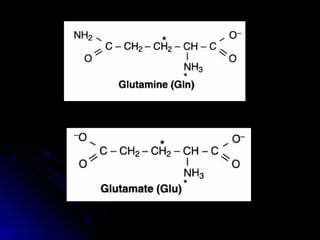
Glutamate and Glutamine (Glx)Glutamate and Glutamine (Glx)
 Glutamate is an excitatoryGlutamate is an excitatory
neurotransmitter in mitochondrialneurotransmitter in mitochondrial
metabolism.metabolism.
 Glutamine and glutamate resonate closelyGlutamine and glutamate resonate closely
together.together.
 Their sum is often designated as Glx andTheir sum is often designated as Glx and
is assigned between 2.1 and 2.5 ppm.is assigned between 2.1 and 2.5 ppm.
MRS Acquisition modesMRS Acquisition modes
 STEAM-Stimulated echo acquisition modeSTEAM-Stimulated echo acquisition mode
 Single voxelSingle voxel
 Short TEShort TE
 PRESS-Point resolved spectroscopyPRESS-Point resolved spectroscopy
 Twice the SNR of STEAMTwice the SNR of STEAM
 Short and long TE-single voxel possibleShort and long TE-single voxel possible
Single voxelSingle voxel
MULTI VOXELMULTI VOXEL
SPECTROSCOPYSPECTROSCOPY
 Multivoxel spectroscopy can be used to obtainedMultivoxel spectroscopy can be used to obtained
one, two or three dimensional localization.one, two or three dimensional localization.
 The major engine behind multi voxel isThe major engine behind multi voxel is
CHEMICAL SHIFT IMAGING (CSI).CHEMICAL SHIFT IMAGING (CSI).
 This technique is developed to obtain separateThis technique is developed to obtain separate
images from water and fat bound protons.images from water and fat bound protons.
 It is referred as Magnetic ResonanceIt is referred as Magnetic Resonance
Spectroscopic Imaging(MRSI).Spectroscopic Imaging(MRSI).
 It obtains simultaneously many voxels andIt obtains simultaneously many voxels and
spatial distrubution of the metabolities in aspatial distrubution of the metabolities in a
single sequence.single sequence.
 Large volume of coverage.Large volume of coverage.
 It is used for complex lesions.It is used for complex lesions.
 Long acquisition time (6-12 min).Long acquisition time (6-12 min).
 Time of echo:35 and 144 ms.Time of echo:35 and 144 ms.
Echo timeEcho time
 As in MR imaging, the echo time affects theAs in MR imaging, the echo time affects the
information obtained with MRS.information obtained with MRS.
 Short TE refers to a study in which it varies fromShort TE refers to a study in which it varies from
20 to 40 ms.20 to 40 ms.
 It has a higher SNR and less signal loss due toIt has a higher SNR and less signal loss due to
T2 and T1 weighting than long TE.T2 and T1 weighting than long TE.
 These short TE properties result in a spectrumThese short TE properties result in a spectrum
with more metabolites peaks, such aswith more metabolites peaks, such as
myoinositol and glutamine-glutamate which aremyoinositol and glutamine-glutamate which are
not detected with long TE .not detected with long TE .
• MRS spectra may also be obtained with long TEs,
from 135 to 288 ms.
• With a long TE of 270 msec, only metabolites with
a long T2 are seen, producing a spectrum with
primarily NAA, creatine, and choline.
• One other helpful TE is 144 msec because it
inverts lactate at 1.3 ppm.
• With TE of 270-288 ms there is a lower SNR and
the lactate peak is not inverted
Planning of MRSPlanning of MRS
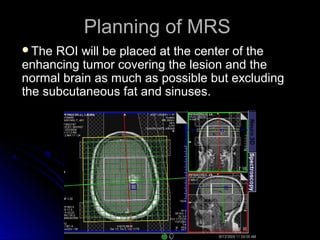
The ROI will be placed at the center of theThe ROI will be placed at the center of the
enhancing tumor covering the lesion and theenhancing tumor covering the lesion and the
normal brain as much as possible but excludingnormal brain as much as possible but excluding
the subcutaneous fat and sinuses.the subcutaneous fat and sinuses.
Normal MRSNormal MRS
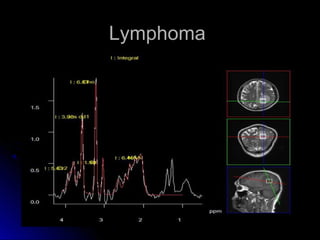
LymphomaLymphoma
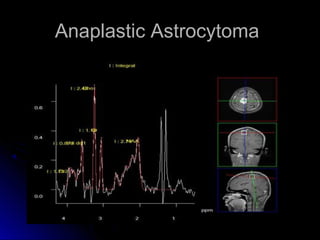
Anaplastic AstrocytomaAnaplastic Astrocytoma
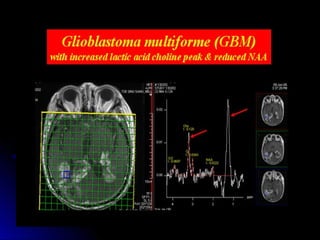
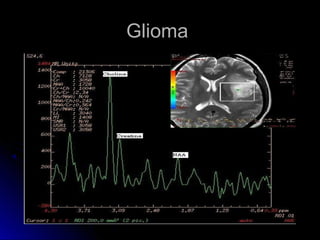
GliomaGlioma
THANK YOUTHANK YOU

Mr spectroscopy

  • 1.
    A.SHAJITHAA.SHAJITHA B.Sc RD 3B.ScRD 3rdrd YEARYEAR MR SPECTROSCOPYMR SPECTROSCOPY
  • 2.
    MR SpectroscopyMR Spectroscopy Noninvasive means of assessing theNoninvasive means of assessing the biochemical and metabolic processes inbiochemical and metabolic processes in intracranial tissues without ionizingintracranial tissues without ionizing radiation.radiation.  For the brain in particular, MRS has beenFor the brain in particular, MRS has been a powerful research tool and providea powerful research tool and provide additional clinical information for severaladditional clinical information for several disease such as brain tumors, metabolicdisease such as brain tumors, metabolic disorders, and systemic diseasesdisorders, and systemic diseases
  • 3.
     There arenumerous metabolites found in theThere are numerous metabolites found in the human brain.human brain.  Fortunately, only several of them are useful inFortunately, only several of them are useful in spectroscopic studies.spectroscopic studies.  There is evidence that the normal metabolites inThere is evidence that the normal metabolites in the brain vary with according to the patient'sthe brain vary with according to the patient's age.age.  The changes are most noticeable during the firstThe changes are most noticeable during the first three years of life.three years of life.
  • 4.
     A spectrumof the metabolites is plotted on a twoA spectrum of the metabolites is plotted on a two dimensional graph.dimensional graph.  The horizontal axis represents the frequenciesThe horizontal axis represents the frequencies (chemical shifts) and the vertical axis represents the(chemical shifts) and the vertical axis represents the concentration of the metabolites.concentration of the metabolites.  The frequencies are plotted with reference to aThe frequencies are plotted with reference to a stable compound.stable compound.  The reference compound most often used isThe reference compound most often used is tetramethylsilanetetramethylsilane (TMS).(TMS). The chemical shifts areThe chemical shifts are expressed as parts per million (ppm).expressed as parts per million (ppm). NORMAL SPECTRA
  • 5.
     The MRSspectrum of major metabolitesThe MRS spectrum of major metabolites in a normal brainin a normal brain
  • 6.
    Major Metabolites inthe BrainMajor Metabolites in the Brain Choline Creatine Lactate Glutamine Lipid Myo-Inositol NAA
  • 7.
    N-ACETYLASPARTATE (NAA)N-ACETYLASPARTATE (NAA) NAAis the marker of neuronal density and viability. • It is present in both gray and white matter and the difference in concentration is not clinically significant. • NAA is detected by the its N-acetyl methyl group. • Its concentration appears to decrease with any brain insults such as infection, ischemic injury, neoplasm, and demyelination process. • NAA is not in found in tumors outside the central nervous system (CNS) such as meningioma. • NAA is the tallest peak in the proton MR spectrum and it is assigned at 2.0ppm. Additional smaller peaks may be seen at 2.6 and 2.5 ppm.
  • 9.
    CholineCholine  The cholinepeak receives contribution fromThe choline peak receives contribution from glycerophosphocholine, phosphocholine, andglycerophosphocholine, phosphocholine, and phosphatidylcholine.phosphatidylcholine.  It is the precursor of acetyl choline andIt is the precursor of acetyl choline and phosphatidylcholine.phosphatidylcholine.  Acetylcholine is an important neurotransmitter and theAcetylcholine is an important neurotransmitter and the latter is an integral part of cell membrane synthesis.latter is an integral part of cell membrane synthesis.  Disease processes affecting the cell membrane andDisease processes affecting the cell membrane and myelin can lead to the release of phosphatidylcholine.myelin can lead to the release of phosphatidylcholine.  Thus,Thus, elevation of choline can be seen duringelevation of choline can be seen during ischemicischemic injury, neoplasm or acute demyelination diseases.injury, neoplasm or acute demyelination diseases.  Choline is the second largest peak and assigned to 3.2Choline is the second largest peak and assigned to 3.2 ppm.ppm.
  • 11.
    Creatine (Cr)Creatine (Cr) The Cr peak receives contribution mainly from creatine, and creatineThe Cr peak receives contribution mainly from creatine, and creatine phosphate.phosphate.  The phospocreatine supplies phosphate to adenosineThe phospocreatine supplies phosphate to adenosine diphosphate (ADP) to form adenosine triphosphate (ATP) with thediphosphate (ADP) to form adenosine triphosphate (ATP) with the release of creatine.release of creatine.  The overall level of total creatine in normal brain is fairlyThe overall level of total creatine in normal brain is fairly constant.constant.  ReducedReduced Cr level may be seen in pathologic processes such asCr level may be seen in pathologic processes such as neoplasm, ischemic injury, infection or some systemic diseases..  Most metastatic tumors to the brain do not produce creatine sinceMost metastatic tumors to the brain do not produce creatine since they do not possess creatine kinase.they do not possess creatine kinase.  Cr is the third highest peak and is assigned to 3.03 ppm. It isCr is the third highest peak and is assigned to 3.03 ppm. It is usually seenusually seen next to the right of cholinenext to the right of choline..
  • 13.
    LactateLactate  Lactate hasa molecular structure of CH3-COH2-CO2.Lactate has a molecular structure of CH3-COH2-CO2.  Lactate levels in the brain are normally are very low orLactate levels in the brain are normally are very low or absent. When oxygen supply is depleted, the brainabsent. When oxygen supply is depleted, the brain switches to anaerobic respiration for which one endswitches to anaerobic respiration for which one end product is lactate.product is lactate.  Therefore, elevated lactate peak is a sign of hypoxicTherefore, elevated lactate peak is a sign of hypoxic tissue.tissue.  Low oxygen supply can result from decreased oxygenLow oxygen supply can result from decreased oxygen supply or increased oxygen requirement.supply or increased oxygen requirement.  The former may be seen in vascular insults, orThe former may be seen in vascular insults, or hypoventilation and the latter may be seen in neoplastichypoventilation and the latter may be seen in neoplastic tissue.tissue.
  • 14.
     Lactate peakoccurs at two differentLactate peak occurs at two different locations.locations. The lower field peak (a doublet) occurs atThe lower field peak (a doublet) occurs at approximately 1.32 ppm.approximately 1.32 ppm.  The other peak (a quartet) is seen at 4.1 ppmThe other peak (a quartet) is seen at 4.1 ppm and this is very close to the water peak.and this is very close to the water peak. – usually suppressed during data processing.
  • 16.
    Myo-Inositol (mI)Myo-Inositol (mI) Myo-Inositol is a glucose-like metabolite and itMyo-Inositol is a glucose-like metabolite and it involves primarily in hormone-sensitiveinvolves primarily in hormone-sensitive neuroreception. It is found mainly inneuroreception. It is found mainly in astrocytesastrocytes and helps to regulate cell volume.and helps to regulate cell volume.  Elevated level of mI would be seen where thereElevated level of mI would be seen where there is glial cell proliferation as in gliosis.is glial cell proliferation as in gliosis.  The main mI peak is assigned to 3.56 ppm andThe main mI peak is assigned to 3.56 ppm and additional peak may be seen at 4.06 ppmadditional peak may be seen at 4.06 ppm
  • 18.
    LipidsLipids  Lipids arecomposition of triglycerides, phospholipids,Lipids are composition of triglycerides, phospholipids, and fatty acids.and fatty acids.  These substances are incorporated into cell membranesThese substances are incorporated into cell membranes and myelin.and myelin.  Lipid peak should not be seen unless there is destructiveLipid peak should not be seen unless there is destructive process of the brain including necrosis, inflammation orprocess of the brain including necrosis, inflammation or infection.infection.  Lipids have a very short T1 relaxation time and areLipids have a very short T1 relaxation time and are normally not seen unless short TEs are utilized.normally not seen unless short TEs are utilized.  Lipid resonance at 1.2 ppm can sometimes obscure theLipid resonance at 1.2 ppm can sometimes obscure the lactate peak at 1.32 ppm.lactate peak at 1.32 ppm.  Fat in the cranium can contaminate the true diseaseFat in the cranium can contaminate the true disease process if the voxels are placed too close the cranium.process if the voxels are placed too close the cranium.
  • 19.
    Glutamate and Glutamine(Glx)Glutamate and Glutamine (Glx)  Glutamate is an excitatoryGlutamate is an excitatory neurotransmitter in mitochondrialneurotransmitter in mitochondrial metabolism.metabolism.  Glutamine and glutamate resonate closelyGlutamine and glutamate resonate closely together.together.  Their sum is often designated as Glx andTheir sum is often designated as Glx and is assigned between 2.1 and 2.5 ppm.is assigned between 2.1 and 2.5 ppm.
  • 21.
    MRS Acquisition modesMRSAcquisition modes  STEAM-Stimulated echo acquisition modeSTEAM-Stimulated echo acquisition mode  Single voxelSingle voxel  Short TEShort TE  PRESS-Point resolved spectroscopyPRESS-Point resolved spectroscopy  Twice the SNR of STEAMTwice the SNR of STEAM  Short and long TE-single voxel possibleShort and long TE-single voxel possible Single voxelSingle voxel
  • 22.
    MULTI VOXELMULTI VOXEL SPECTROSCOPYSPECTROSCOPY Multivoxel spectroscopy can be used to obtainedMultivoxel spectroscopy can be used to obtained one, two or three dimensional localization.one, two or three dimensional localization.  The major engine behind multi voxel isThe major engine behind multi voxel is CHEMICAL SHIFT IMAGING (CSI).CHEMICAL SHIFT IMAGING (CSI).  This technique is developed to obtain separateThis technique is developed to obtain separate images from water and fat bound protons.images from water and fat bound protons.  It is referred as Magnetic ResonanceIt is referred as Magnetic Resonance Spectroscopic Imaging(MRSI).Spectroscopic Imaging(MRSI).
  • 23.
     It obtainssimultaneously many voxels andIt obtains simultaneously many voxels and spatial distrubution of the metabolities in aspatial distrubution of the metabolities in a single sequence.single sequence.  Large volume of coverage.Large volume of coverage.  It is used for complex lesions.It is used for complex lesions.  Long acquisition time (6-12 min).Long acquisition time (6-12 min).  Time of echo:35 and 144 ms.Time of echo:35 and 144 ms.
  • 24.
    Echo timeEcho time As in MR imaging, the echo time affects theAs in MR imaging, the echo time affects the information obtained with MRS.information obtained with MRS.  Short TE refers to a study in which it varies fromShort TE refers to a study in which it varies from 20 to 40 ms.20 to 40 ms.  It has a higher SNR and less signal loss due toIt has a higher SNR and less signal loss due to T2 and T1 weighting than long TE.T2 and T1 weighting than long TE.  These short TE properties result in a spectrumThese short TE properties result in a spectrum with more metabolites peaks, such aswith more metabolites peaks, such as myoinositol and glutamine-glutamate which aremyoinositol and glutamine-glutamate which are not detected with long TE .not detected with long TE .
  • 25.
    • MRS spectramay also be obtained with long TEs, from 135 to 288 ms. • With a long TE of 270 msec, only metabolites with a long T2 are seen, producing a spectrum with primarily NAA, creatine, and choline. • One other helpful TE is 144 msec because it inverts lactate at 1.3 ppm. • With TE of 270-288 ms there is a lower SNR and the lactate peak is not inverted
  • 26.
    Planning of MRSPlanningof MRS The ROI will be placed at the center of theThe ROI will be placed at the center of the enhancing tumor covering the lesion and theenhancing tumor covering the lesion and the normal brain as much as possible but excludingnormal brain as much as possible but excluding the subcutaneous fat and sinuses.the subcutaneous fat and sinuses.
  • 29.
  • 31.
  • 32.
  • 33.
  • 34.