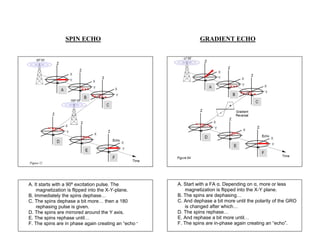
SPIN ECHO                                      GRADIENT ECHO


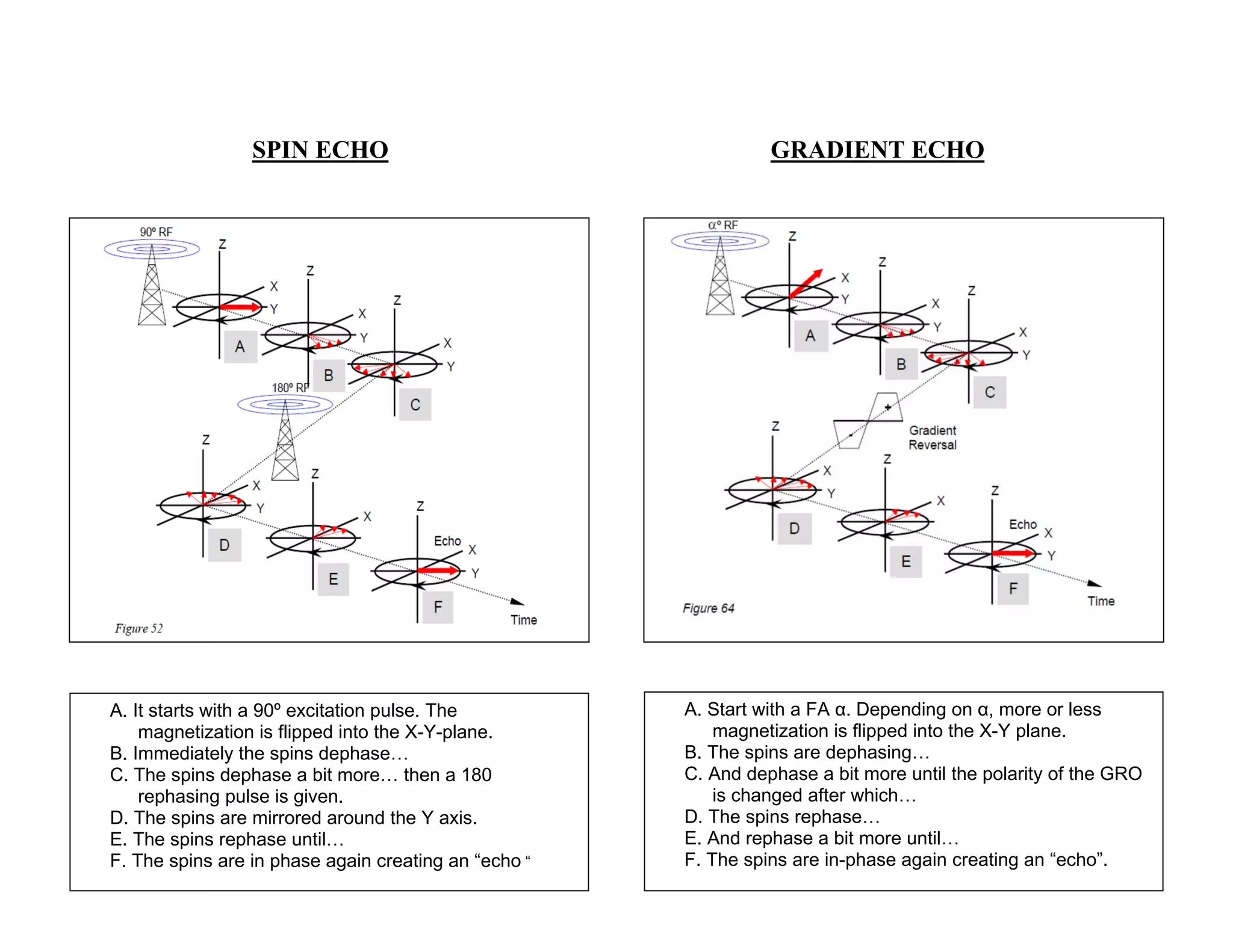
A. It starts with a 90º excitation pulse. The         A. Start with a FA α. Depending on α, more or less
    magnetization is flipped into the X-Y-plane.          magnetization is flipped into the X-Y plane.
B. Immediately the spins dephase…                     B. The spins are dephasing…
C. The spins dephase a bit more… then a 180           C. And dephase a bit more until the polarity of the GRO
    rephasing pulse is given.                             is changed after which…
D. The spins are mirrored around the Y axis.          D. The spins rephase…
E. The spins rephase until…                           E. And rephase a bit more until…
F. The spins are in phase again creating an “echo “   F. The spins are in-phase again creating an “echo”.
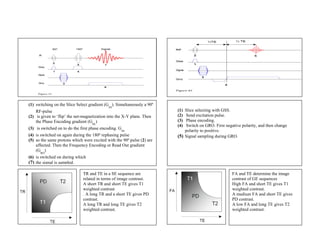
(1) switching on the Slice Select gradient (G ). Simultaneously a 90º
                                             SS
    RF-pulse                                                            (1) Slice selecting with GSS.
(2) is given to ‘flip’ the net-magnetization into the X-Y plane. Then   (2)  Send excitation pulse.
    the Phase Encoding gradient (G )                                    (3) Phase encoding.
                                   PE
                                                                        (4) Switch on GRO. First negative polarity, and then change
(3) is switched on to do the first phase encoding. G
                                                    SS                      polarity to positive.
(4) is switched on again during the 180º rephasing pulse                (5) Signal sampling during GRO.
(5) so the same protons which were excited with the 90º pulse (2) are
    affected. Then the Frequency Encoding or Read Out gradient
    (G )
      RO
(6) is switched on during which
(7) the signal is sampled.

                              TR and TE in a SE sequence are                                         FA and TE determine the image
                              related in terms of image contrast.                                    contrast of GE sequences
                              A short TR and short TE gives T1                                       High FA and short TE gives T1
                              weighted contrast                                                      weighted contrast.
                              . A long TR and a short TE gives PD                                    A medium FA and short TE gives
                              contrast.                                                              PD contrast.
                              A long TR and long TE gives T2                                         A low FA and long TE gives T2
                              weighted contrast.                                                     weighted contrast.
Created by                                Curtsy to
Arun A                                    Evert J Blink
Dr Shaji’s MRI & Research Center Kerala   Application Specialist MRI

Gre&SE

  • 1.
    SPIN ECHO GRADIENT ECHO A. It starts with a 90º excitation pulse. The A. Start with a FA α. Depending on α, more or less magnetization is flipped into the X-Y-plane. magnetization is flipped into the X-Y plane. B. Immediately the spins dephase… B. The spins are dephasing… C. The spins dephase a bit more… then a 180 C. And dephase a bit more until the polarity of the GRO rephasing pulse is given. is changed after which… D. The spins are mirrored around the Y axis. D. The spins rephase… E. The spins rephase until… E. And rephase a bit more until… F. The spins are in phase again creating an “echo “ F. The spins are in-phase again creating an “echo”.
  • 2.
    (1) switching onthe Slice Select gradient (G ). Simultaneously a 90º SS RF-pulse (1) Slice selecting with GSS. (2) is given to ‘flip’ the net-magnetization into the X-Y plane. Then (2) Send excitation pulse. the Phase Encoding gradient (G ) (3) Phase encoding. PE (4) Switch on GRO. First negative polarity, and then change (3) is switched on to do the first phase encoding. G SS polarity to positive. (4) is switched on again during the 180º rephasing pulse (5) Signal sampling during GRO. (5) so the same protons which were excited with the 90º pulse (2) are affected. Then the Frequency Encoding or Read Out gradient (G ) RO (6) is switched on during which (7) the signal is sampled. TR and TE in a SE sequence are FA and TE determine the image related in terms of image contrast. contrast of GE sequences A short TR and short TE gives T1 High FA and short TE gives T1 weighted contrast weighted contrast. . A long TR and a short TE gives PD A medium FA and short TE gives contrast. PD contrast. A long TR and long TE gives T2 A low FA and long TE gives T2 weighted contrast. weighted contrast.
  • 3.
    Created by Curtsy to Arun A Evert J Blink Dr Shaji’s MRI & Research Center Kerala Application Specialist MRI