Diffraction of Light
By: Ryan Newman and Stella Oliver
Introduction of Diffraction
● In today’s lesson we’ll be talking about the
diffraction of light and how light bends
around objects.

•

We will also discuss how diffraction
determines an object’s ability to resolve
images.
Objectives

•

•

Describe how light waves bend around
obstacles and produce bright and dark
fringes.
Describe how diffraction determines an
optical instrument’s ability to resolve images.
What is diffraction?

•

Diffraction: the bending of light around an
obstacle

Think about...
Flashlight beams
Spotlights
Light shining out from a classroom

•
•
•
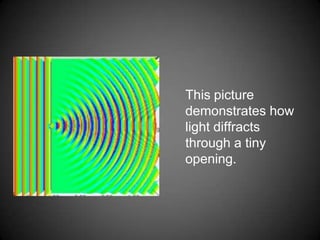
This picture
demonstrates how
light diffracts
through a tiny
opening.
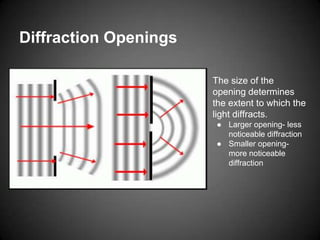
Diffraction Openings
The size of the
opening determines
the extent to which the
light diffracts.
● Larger opening- less
noticeable diffraction
● Smaller openingmore noticeable
diffraction
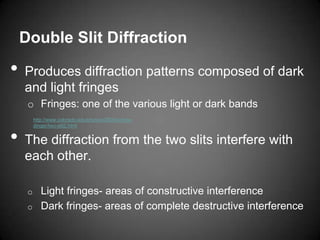
Double Slit Diffraction

•

Produces diffraction patterns composed of dark
and light fringes
o Fringes: one of the various light or dark bands

•

http://www.colorado.edu/physics/2000/schroe
dinger/two-slit2.html

The diffraction from the two slits interfere with
each other.
o
o

Light fringes- areas of constructive interference
Dark fringes- areas of complete destructive interference
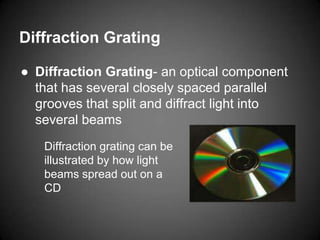
Diffraction Grating
● Diffraction Grating- an optical component
that has several closely spaced parallel
grooves that split and diffract light into
several beams
Diffraction grating can be
illustrated by how light
beams spread out on a
CD
Resolving Power of Diffraction

•
•

Diffraction is used in telescopes and
microscopes to resolve (clear up) images
Diffraction separates the blurred image into
different individual images
REVIEW QUESTIONS
1. Which of the following is NOT an example of diffraction?
a.
Taking a panoramic picture
b.
Light spreading through the hallway from an open
classroom door
c.
A projector bulb filling an entire SMART board
d.
A spotlight shining on a dancer
2. True or False: Dark fringes represent areas of constructive interference in
double slit diffraction.

3. When light diffracts through a small opening, how does it compare to the
diffraction of light through a wider opening?

4. Where is the brightest fringe located in a double slit diffraction illustration?

5. How does diffraction resolve microscopic and telescopic images?
Bibliography
Davidson, M. W. (n.d.). Molecular Expressions Microscopy Primer: Light and Color - Diffraction of
Light. Molecular Expressions Microscopy Primer: Light and Color - Diffraction of Light. Retrieved
October 28, 2013, from http://micro.magnet.fsu.edu/primer/lightandcolor/diffractionintro.html

Abramowitz, M., & Davidson, M. W. (n.d.). Diffraction of Light. Olympus Microscopy Resource
Center. Retrieved October 28, 2013, from
http://www.olympusmicro.com/primer/lightandcolor/diffraction.html

Hewitt, P. (2009). Conceptual Physics. New Jersey: Addison-Wesley and Pearson.

Classic Two-Slit Experiment. (n.d.). Classic Two-Slit Experiment. Retrieved October 23, 2013, from
http://www.colorado.edu/physics/2000/schroedinger/two-slit2.html

Diffraction Grating. (n.d.). Diffraction Grating. Retrieved October 24, 2013, from
http://www.physics.smu.edu/~scalise/emmanual/diffraction/lab.html

Diffraction of light

  • 1.
    Diffraction of Light By:Ryan Newman and Stella Oliver
  • 2.
    Introduction of Diffraction ●In today’s lesson we’ll be talking about the diffraction of light and how light bends around objects. • We will also discuss how diffraction determines an object’s ability to resolve images.
  • 3.
    Objectives • • Describe how lightwaves bend around obstacles and produce bright and dark fringes. Describe how diffraction determines an optical instrument’s ability to resolve images.
  • 4.
    What is diffraction? • Diffraction:the bending of light around an obstacle Think about... Flashlight beams Spotlights Light shining out from a classroom • • •
  • 5.
    This picture demonstrates how lightdiffracts through a tiny opening.
  • 6.
    Diffraction Openings The sizeof the opening determines the extent to which the light diffracts. ● Larger opening- less noticeable diffraction ● Smaller openingmore noticeable diffraction
  • 7.
    Double Slit Diffraction • Producesdiffraction patterns composed of dark and light fringes o Fringes: one of the various light or dark bands • http://www.colorado.edu/physics/2000/schroe dinger/two-slit2.html The diffraction from the two slits interfere with each other. o o Light fringes- areas of constructive interference Dark fringes- areas of complete destructive interference
  • 8.
    Diffraction Grating ● DiffractionGrating- an optical component that has several closely spaced parallel grooves that split and diffract light into several beams Diffraction grating can be illustrated by how light beams spread out on a CD
  • 9.
    Resolving Power ofDiffraction • • Diffraction is used in telescopes and microscopes to resolve (clear up) images Diffraction separates the blurred image into different individual images
  • 10.
    REVIEW QUESTIONS 1. Whichof the following is NOT an example of diffraction? a. Taking a panoramic picture b. Light spreading through the hallway from an open classroom door c. A projector bulb filling an entire SMART board d. A spotlight shining on a dancer 2. True or False: Dark fringes represent areas of constructive interference in double slit diffraction. 3. When light diffracts through a small opening, how does it compare to the diffraction of light through a wider opening? 4. Where is the brightest fringe located in a double slit diffraction illustration? 5. How does diffraction resolve microscopic and telescopic images?
  • 11.
    Bibliography Davidson, M. W.(n.d.). Molecular Expressions Microscopy Primer: Light and Color - Diffraction of Light. Molecular Expressions Microscopy Primer: Light and Color - Diffraction of Light. Retrieved October 28, 2013, from http://micro.magnet.fsu.edu/primer/lightandcolor/diffractionintro.html Abramowitz, M., & Davidson, M. W. (n.d.). Diffraction of Light. Olympus Microscopy Resource Center. Retrieved October 28, 2013, from http://www.olympusmicro.com/primer/lightandcolor/diffraction.html Hewitt, P. (2009). Conceptual Physics. New Jersey: Addison-Wesley and Pearson. Classic Two-Slit Experiment. (n.d.). Classic Two-Slit Experiment. Retrieved October 23, 2013, from http://www.colorado.edu/physics/2000/schroedinger/two-slit2.html Diffraction Grating. (n.d.). Diffraction Grating. Retrieved October 24, 2013, from http://www.physics.smu.edu/~scalise/emmanual/diffraction/lab.html