Thickness of Butter
Paper using air wedge
By:-
1. Nischaya Sharma (N036)
2. Anshuman Rathore (N031)
3. Devansh Ravi (N034)
4. Ujjval Nagota (N024)
Introduction
There are really thin objects in physics lab whose thickness
needs to be measured in the lab like paper, diameter of hair,
etc. Normally we do it by the screw gauge but during the
usage of the screw gauge some people apply more pressure
to hold the paper in place and some apply less pressure
leading to errors in measurement.
This problem is solved by the air wedge method.
2
Apparatus
• Thin strip of paper
• 1 rubber band
• 2 glass plates
• 1 thin glass slab
• Source of light (Sodium Lamp in our case)
• Convex lens
• Travelling microscope
3
Formation of air wedge
• There are 2 glass plates held
together at one end with a
rubber band.
• We put a piece of paper in
between them on the other
end and we create a wedge.
• Now this is the air wedge that
is created.
4
Experimental Setup
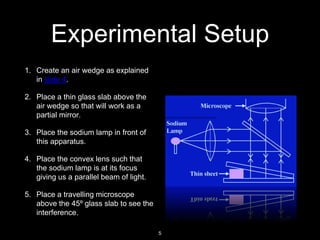
1. Create an air wedge as explained
in slide 4.
2. Place a thin glass slab above the
air wedge so that will work as a
partial mirror.
3. Place the sodium lamp in front of
this apparatus.
4. Place the convex lens such that
the sodium lamp is at its focus
giving us a parallel beam of light.
5. Place a travelling microscope
above the 45º glass slab to see the
interference.
5
Working
1. When the light from the lamp travels through the glass plate it gets refracted.
2. Then the light passes through the air-wedge into other glass plate
3. After the reflection from the bottom of the other glass plate the light follows
the same route back up.
4. Due these refractions and reflections the light is out of phase with the one
getting partially reflected from the top surface.
5. These lights in different phases cause interference and form fringes.
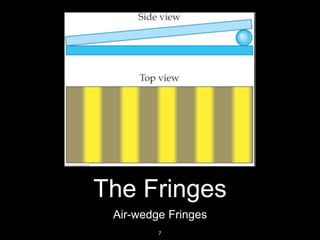
1. The fringes are alternatively dark and bright based on the path difference
as explained in slide 8.
2. The fringes are formed as the superposition of waves occur.
3. Depending on the path difference the waves in different phases overlap.
6
The Fringes
Air-wedge Fringes
7
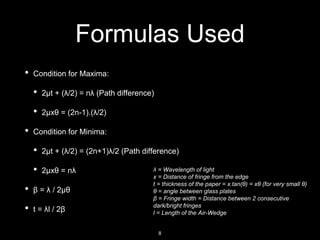
Formulas Used
• Condition for Maxima:
• 2μt + (λ/2) = nλ (Path difference)
• 2μxθ = (2n-1).(λ/2)
• Condition for Minima:
• 2μt + (λ/2) = (2n+1)λ/2 (Path difference)
• 2μxθ = nλ
• β = λ / 2μθ
• t = λl / 2β
λ = Wavelength of light
x = Distance of fringe from the edge
t = thickness of the paper = x.tan(θ) = xθ (for very small θ)
θ = angle between glass plates
β = Fringe width = Distance between 2 consecutive
dark/bright fringes
l = Length of the Air-Wedge
8
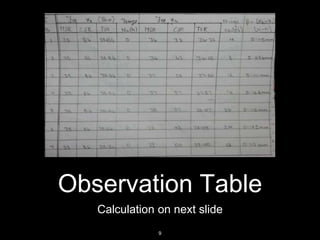
Observation Table
Calculation on next slide
9
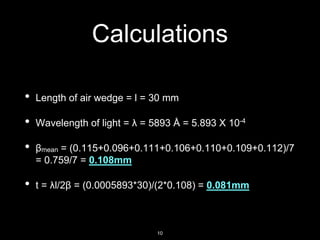
Calculations
• Length of air wedge = l = 30 mm
• Wavelength of light = λ = 5893 Å = 5.893 X 10⁻⁴
• βmean = (0.115+0.096+0.111+0.106+0.110+0.109+0.112)/7
= 0.759/7 = 0.108mm
• t = λl/2β = (0.0005893*30)/(2*0.108) = 0.081mm
10
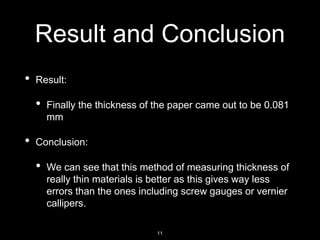
Result and Conclusion
• Result:
• Finally the thickness of the paper came out to be 0.081
mm
• Conclusion:
• We can see that this method of measuring thickness of
really thin materials is better as this gives way less
errors than the ones including screw gauges or vernier
callipers.
11
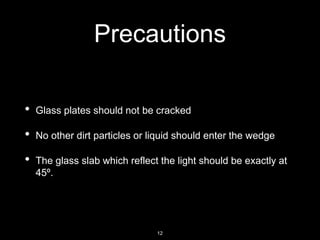
Precautions
• Glass plates should not be cracked
• No other dirt particles or liquid should enter the wedge
• The glass slab which reflect the light should be exactly at
45º.
12
Thank You
13

Air Wedge Interference

  • 1.
    Thickness of Butter Paperusing air wedge By:- 1. Nischaya Sharma (N036) 2. Anshuman Rathore (N031) 3. Devansh Ravi (N034) 4. Ujjval Nagota (N024)
  • 2.
    Introduction There are reallythin objects in physics lab whose thickness needs to be measured in the lab like paper, diameter of hair, etc. Normally we do it by the screw gauge but during the usage of the screw gauge some people apply more pressure to hold the paper in place and some apply less pressure leading to errors in measurement. This problem is solved by the air wedge method. 2
  • 3.
    Apparatus • Thin stripof paper • 1 rubber band • 2 glass plates • 1 thin glass slab • Source of light (Sodium Lamp in our case) • Convex lens • Travelling microscope 3
  • 4.
    Formation of airwedge • There are 2 glass plates held together at one end with a rubber band. • We put a piece of paper in between them on the other end and we create a wedge. • Now this is the air wedge that is created. 4
  • 5.
    Experimental Setup 1. Createan air wedge as explained in slide 4. 2. Place a thin glass slab above the air wedge so that will work as a partial mirror. 3. Place the sodium lamp in front of this apparatus. 4. Place the convex lens such that the sodium lamp is at its focus giving us a parallel beam of light. 5. Place a travelling microscope above the 45º glass slab to see the interference. 5
  • 6.
    Working 1. When thelight from the lamp travels through the glass plate it gets refracted. 2. Then the light passes through the air-wedge into other glass plate 3. After the reflection from the bottom of the other glass plate the light follows the same route back up. 4. Due these refractions and reflections the light is out of phase with the one getting partially reflected from the top surface. 5. These lights in different phases cause interference and form fringes. 1. The fringes are alternatively dark and bright based on the path difference as explained in slide 8. 2. The fringes are formed as the superposition of waves occur. 3. Depending on the path difference the waves in different phases overlap. 6
  • 7.
  • 8.
    Formulas Used • Conditionfor Maxima: • 2μt + (λ/2) = nλ (Path difference) • 2μxθ = (2n-1).(λ/2) • Condition for Minima: • 2μt + (λ/2) = (2n+1)λ/2 (Path difference) • 2μxθ = nλ • β = λ / 2μθ • t = λl / 2β λ = Wavelength of light x = Distance of fringe from the edge t = thickness of the paper = x.tan(θ) = xθ (for very small θ) θ = angle between glass plates β = Fringe width = Distance between 2 consecutive dark/bright fringes l = Length of the Air-Wedge 8
  • 9.
  • 10.
    Calculations • Length ofair wedge = l = 30 mm • Wavelength of light = λ = 5893 Å = 5.893 X 10⁻⁴ • βmean = (0.115+0.096+0.111+0.106+0.110+0.109+0.112)/7 = 0.759/7 = 0.108mm • t = λl/2β = (0.0005893*30)/(2*0.108) = 0.081mm 10
  • 11.
    Result and Conclusion •Result: • Finally the thickness of the paper came out to be 0.081 mm • Conclusion: • We can see that this method of measuring thickness of really thin materials is better as this gives way less errors than the ones including screw gauges or vernier callipers. 11
  • 12.
    Precautions • Glass platesshould not be cracked • No other dirt particles or liquid should enter the wedge • The glass slab which reflect the light should be exactly at 45º. 12
  • 13.