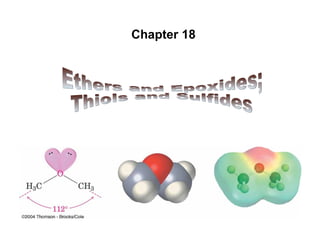
Chapter 18
Introduction

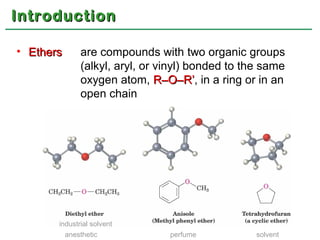
• Ethers      are compounds with two organic groups
              (alkyl, aryl, or vinyl) bonded to the same
              oxygen atom, R–O–R’, in a ring or in an
                               R–O–R’
              open chain


       industrial solvent
         anesthetic             perfume           solvent
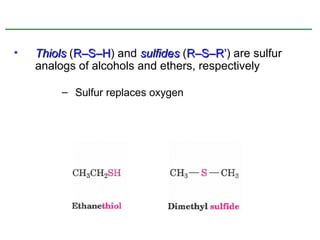
•   Thiols (R–S–H) and sulfides (R–S–R’) are sulfur
            R–S–H                R–S–R’
    analogs of alcohols and ethers, respectively

         – Sulfur replaces oxygen
1.      Naming Ethers

•    Ethers are named according to IUPAC rules:

         – Simple ethers with no other functional groups are
           named by identifying the two organic substituents
           and adding the word ether

         – If other functional groups are present, the ether
           part is considered an alkoxy substituent
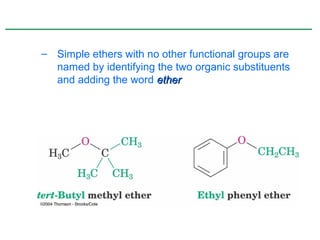
– Simple ethers with no other functional groups are
  named by identifying the two organic substituents
  and adding the word ether
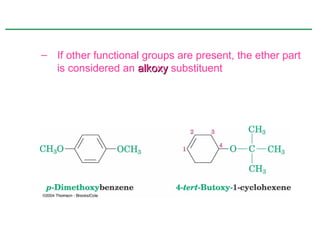
– If other functional groups are present, the ether part
  is considered an alkoxy substituent
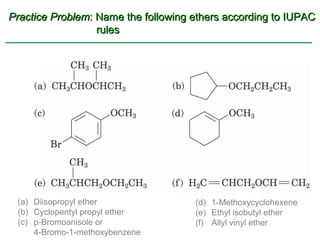
Practice Problem: Name the following ethers according to IUPAC
                  rules


 (a) Diisopropyl ether               (d) 1-Methoxycyclohexene
 (b) Cyclopentyl propyl ether        (e) Ethyl isobutyl ether
 (c) p-Bromoanisole or               (f) Allyl vinyl ether
     4-Bromo-1-methoxybenzene
2.   Structure and Properties of Ethers


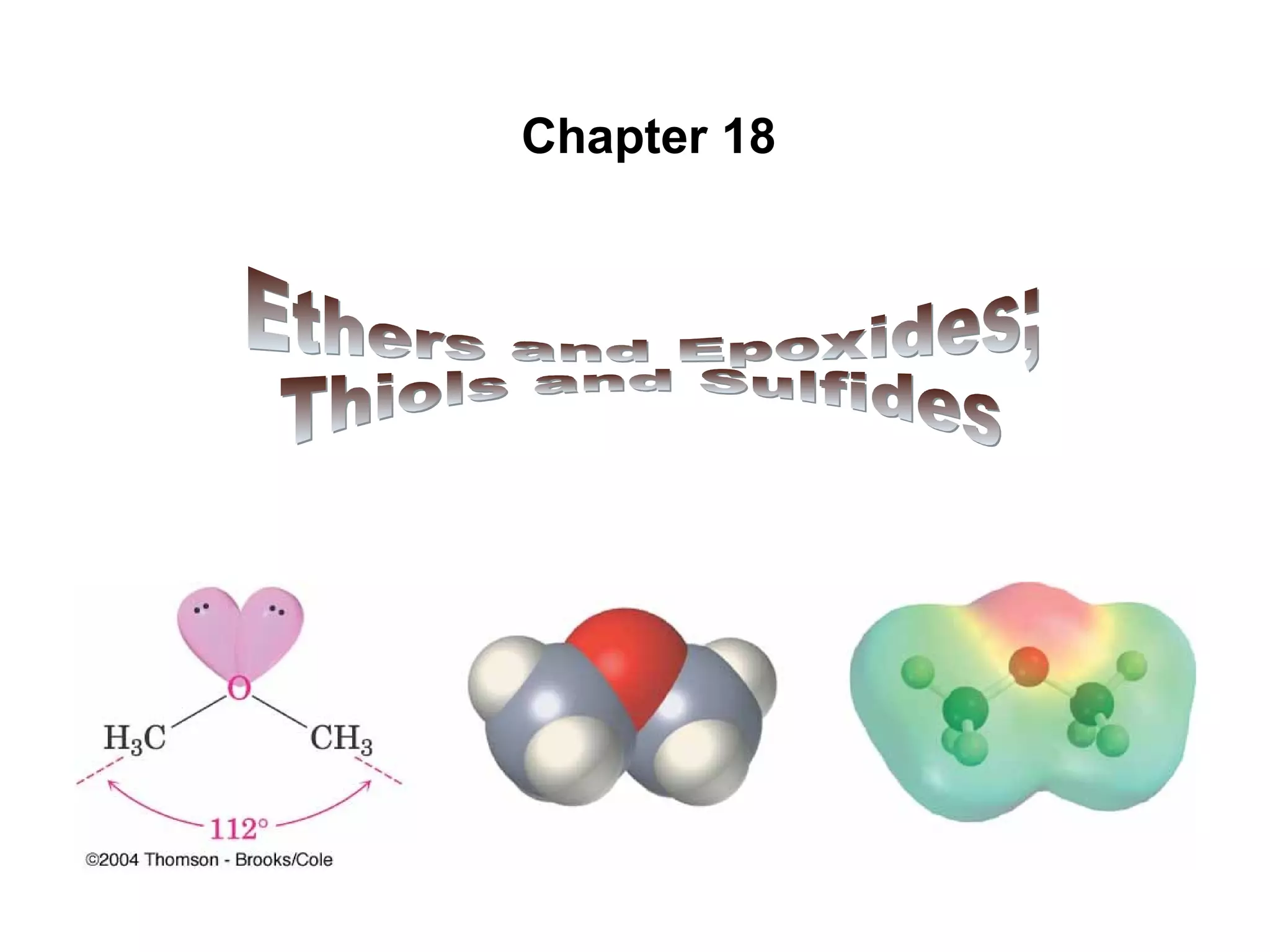
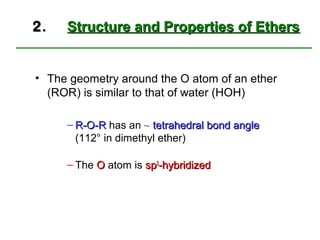
• The geometry around the O atom of an ether
  (ROR) is similar to that of water (HOH)

     – R-O-R has an ~ tetrahedral bond angle
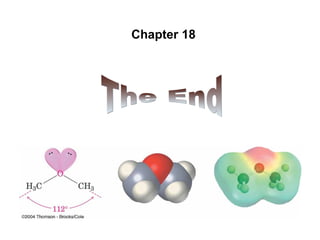
       (112° in dimethyl ether)

     – The O atom is sp3-hybridized
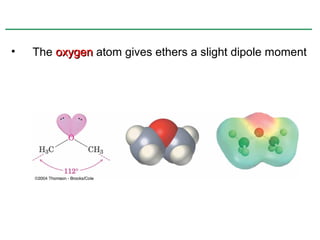
•   The oxygen atom gives ethers a slight dipole moment
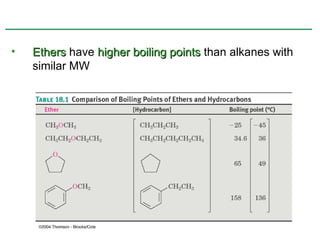
•   Ethers have higher boiling points than alkanes with
    similar MW
3.    Synthesis of Ethers


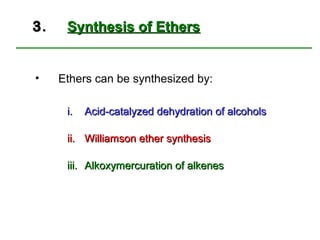
•    Ethers can be synthesized by:

      i.   Acid-catalyzed dehydration of alcohols

      ii. Williamson ether synthesis

      iii. Alkoxymercuration of alkenes
i. Acid-catalyzed dehydration of alcohols


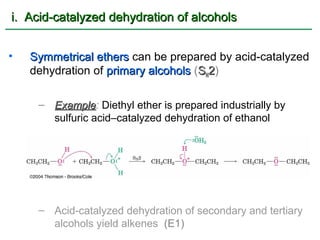
•   Symmetrical ethers can be prepared by acid-catalyzed
    dehydration of primary alcohols (SN2)

     – Example: Diethyl ether is prepared industrially by
       Example
       sulfuric acid–catalyzed dehydration of ethanol


     – Acid-catalyzed dehydration of secondary and tertiary
       alcohols yield alkenes (E1)
Practice Problem: Why do you suppose only symmetrical ethers
                  are prepared by the sulfuric acid-catalyzed
                  dehydration procedure? What product(s)
                  would you expect if ethanol and 1-propanol
                  were allowed to react together? In what ratio
                  would the products be formed if the two
                  alcohols were of equal reactivity?
ii. The Williamson Ether Synthesis


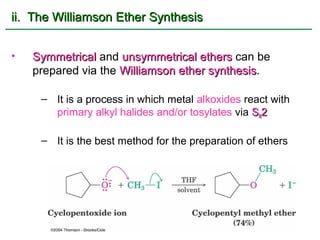
•   Symmetrical and unsymmetrical ethers can be
    prepared via the Williamson ether synthesis.
                                      synthesis

     – It is a process in which metal alkoxides react with
       primary alkyl halides and/or tosylates via SN2

     – It is the best method for the preparation of ethers
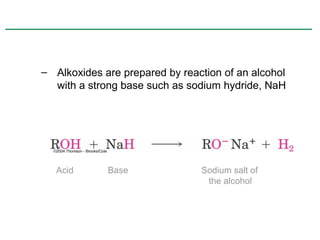
– Alkoxides are prepared by reaction of an alcohol
  with a strong base such as sodium hydride, NaH


   Acid      Base               Sodium salt of
                                 the alcohol
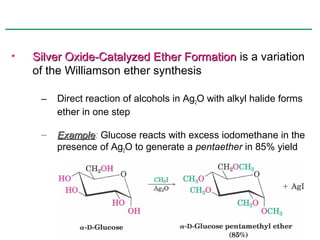
•   Silver Oxide-Catalyzed Ether Formation is a variation
    of the Williamson ether synthesis

     –   Direct reaction of alcohols in Ag2O with alkyl halide forms
         ether in one step

     –   Example: Glucose reacts with excess iodomethane in the
         Example
         presence of Ag2O to generate a pentaether in 85% yield
Mechanism of the Williamson Ether Synthesis


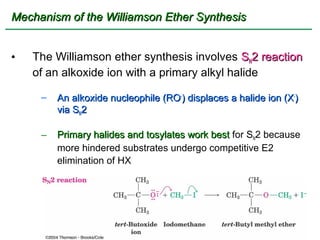
•   The Williamson ether synthesis involves SN2 reaction
    of an alkoxide ion with a primary alkyl halide

     –   An alkoxide nucleophile (RO-) displaces a halide ion (X-)
         via SN2

     –   Primary halides and tosylates work best for SN2 because
         more hindered substrates undergo competitive E2
         elimination of HX
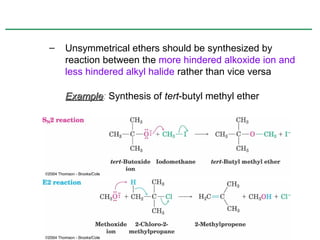
–   Unsymmetrical ethers should be synthesized by
    reaction between the more hindered alkoxide ion and
    less hindered alkyl halide rather than vice versa

    Example: Synthesis of tert-butyl methyl ether
    Example
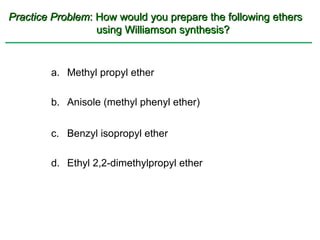
Practice Problem: How would you prepare the following ethers
                  using Williamson synthesis?


        a. Methyl propyl ether
        b. Anisole (methyl phenyl ether)


        c. Benzyl isopropyl ether

        d. Ethyl 2,2-dimethylpropyl ether
iii. Alkoxymercuration of Alkenes


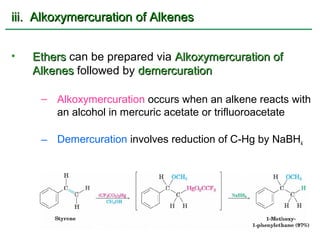
•   Ethers can be prepared via Alkoxymercuration of
    Alkenes followed by demercuration

     – Alkoxymercuration occurs when an alkene reacts with
       an alcohol in mercuric acetate or trifluoroacetate

     – Demercuration involves reduction of C-Hg by NaBH4
Mechanism of Alkoxymercuration/Demercuration

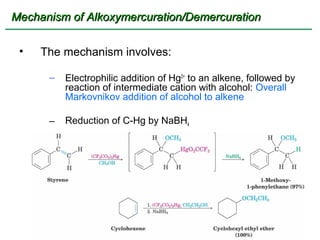
 •   The mechanism involves:

      –   Electrophilic addition of Hg2+ to an alkene, followed by
          reaction of intermediate cation with alcohol: Overall
          Markovnikov addition of alcohol to alkene

      –   Reduction of C-Hg by NaBH4
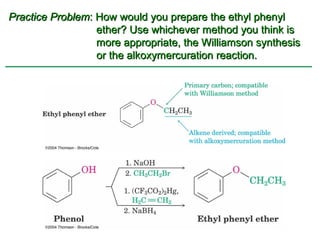
Practice Problem: How would you prepare the ethyl phenyl
                  ether? Use whichever method you think is
                  more appropriate, the Williamson synthesis
                  or the alkoxymercuration reaction.
Practice Problem: Write the mechanism of the alkoxymercuration
                  reaction of 1-methylcyclopentene with ethanol.
                  Use curved arrows to show the electron flow
in                each step.
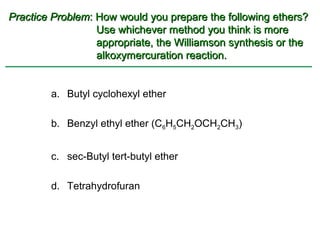
Practice Problem: How would you prepare the following ethers?
                  Use whichever method you think is more
                  appropriate, the Williamson synthesis or the
                  alkoxymercuration reaction.


        a. Butyl cyclohexyl ether

        b. Benzyl ethyl ether (C6H5CH2OCH2CH3)


        c. sec-Butyl tert-butyl ether

        d. Tetrahydrofuran
3.    Reactions of Ethers


•    Ethers undergo:

      i.   Acidic Cleavage

      ii. Claisen Rearrangement
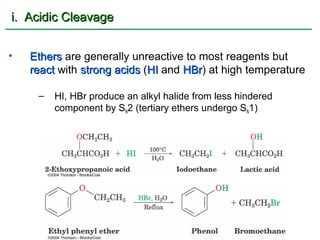
i. Acidic Cleavage


•   Ethers are generally unreactive to most reagents but
    react with strong acids (HI and HBr) at high temperature
                                    HBr

     –   HI, HBr produce an alkyl halide from less hindered
         component by SN2 (tertiary ethers undergo SN1)
Mechanism of the Acidic Cleavage


•   The acidic cleavage reaction takes place:

     – via SN2 mechanism at the less highly substituted
       site if only primary and secondary alkyl are bonded
       to the ether O

     – via SN1 or E1 mechanism if one of the alkyl groups
       bonded to the ether O is tertiary
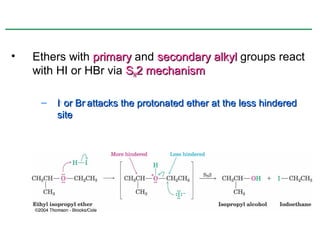
•   Ethers with primary and secondary alkyl groups react
    with HI or HBr via SN2 mechanism

     –   I- or Br- attacks the protonated ether at the less hindered
         site
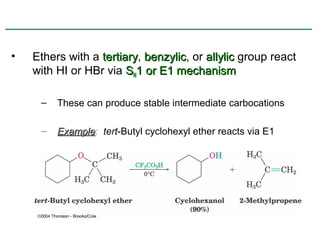
•   Ethers with a tertiary, benzylic, or allylic group react
                  tertiary benzylic
    with HI or HBr via SN1 or E1 mechanism

     –   These can produce stable intermediate carbocations

     –   Example: tert-Butyl cyclohexyl ether reacts via E1
         Example
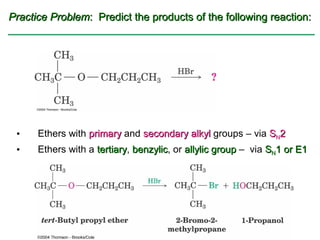
Practice Problem: Predict the products of the following reaction:


 •    Ethers with primary and secondary alkyl groups – via SN2
 •    Ethers with a tertiary, benzylic, or allylic group – via SN1 or E1
                    tertiary benzylic
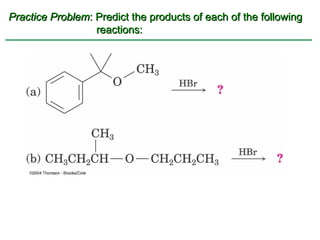
Practice Problem: Predict the products of each of the following
                  reactions:
Practice Problem: Write the mechanism of the acid-catalyzed
                  cleavage of tert-butyl cyclohexyl ether to yield
                  cyclohexanol and 2-methylpropene
Practice Problem: Why are HI and HBr more effective than HCl
                  in cleaving ethers?


     Nucleophilicity usually increases going down a column
     of the periodic table

     The halide reactivity order is I- > Br- > Cl-
ii. Claisen Rearrangement

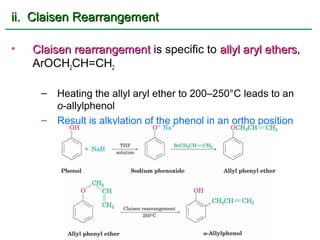
•   Claisen rearrangement is specific to allyl aryl ethers,
                                                    ethers
    ArOCH2CH=CH2

     –   Heating the allyl aryl ether to 200–250°C leads to an
         o-allylphenol
     –   Result is alkylation of the phenol in an ortho position
Mechanism of the Claisen Rearrangement

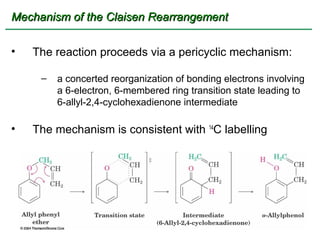
•   The reaction proceeds via a pericyclic mechanism:

     –   a concerted reorganization of bonding electrons involving
         a 6-electron, 6-membered ring transition state leading to
         6-allyl-2,4-cyclohexadienone intermediate

•   The mechanism is consistent with 14C labelling
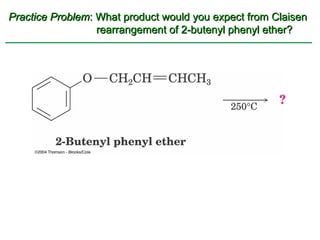
Practice Problem: What product would you expect from Claisen
                  rearrangement of 2-butenyl phenyl ether?
4.       Cyclic Ethers: Epoxides


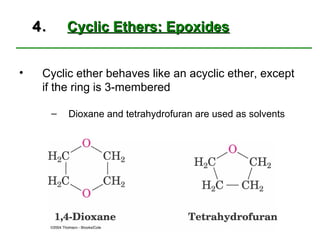
•    Cyclic ether behaves like an acyclic ether, except
     if the ring is 3-membered

         –   Dioxane and tetrahydrofuran are used as solvents
Epoxides (Oxiranes)

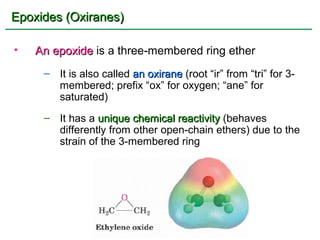
•   An epoxide is a three-membered ring ether
     – It is also called an oxirane (root “ir” from “tri” for 3-
       membered; prefix “ox” for oxygen; “ane” for
       saturated)
     – It has a unique chemical reactivity (behaves
       differently from other open-chain ethers) due to the
       strain of the 3-membered ring
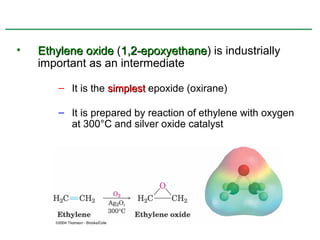
•   Ethylene oxide (1,2-epoxyethane) is industrially
                    1,2-epoxyethane
    important as an intermediate

        – It is the simplest epoxide (oxirane)

        – It is prepared by reaction of ethylene with oxygen
          at 300°C and silver oxide catalyst
•   In the laboratory, epoxides can be prepared by:

     i.   Treatment of an alkene with a peroxyacid

     ii. Treatment of a halohydrin with base
i. Preparation of Epoxides Using a Peroxyacid


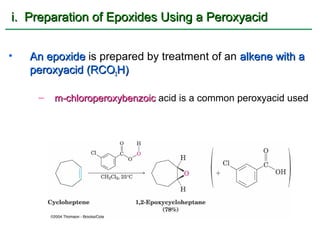
•   An epoxide is prepared by treatment of an alkene with a
    peroxyacid (RCO3H)

     –   m-chloroperoxybenzoic acid is a common peroxyacid used
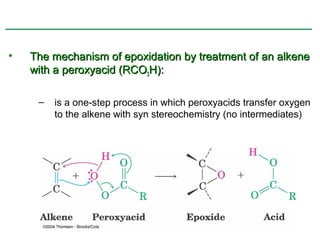
•   The mechanism of epoxidation by treatment of an alkene
    with a peroxyacid (RCO3H):

     –   is a one-step process in which peroxyacids transfer oxygen
         to the alkene with syn stereochemistry (no intermediates)
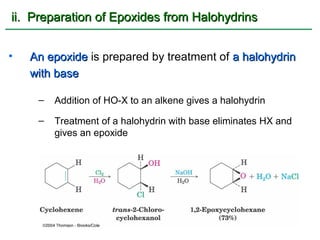
ii. Preparation of Epoxides from Halohydrins


•   An epoxide is prepared by treatment of a halohydrin
    with base

     –   Addition of HO-X to an alkene gives a halohydrin

     –   Treatment of a halohydrin with base eliminates HX and
         gives an epoxide
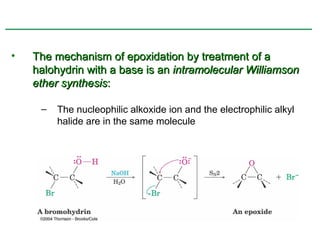
•   The mechanism of epoxidation by treatment of a
    halohydrin with a base is an intramolecular Williamson
    ether synthesis:

     –   The nucleophilic alkoxide ion and the electrophilic alkyl
         halide are in the same molecule
Practice Problem: What product would you expect from reaction
                  of cis-2-butene with m-chloroperoxybenzoic
                  acid? Show the stereochemistry
Practice Problem: Reaction of trans-2-butene with m-chloropero
                  -xybenzoic acid yields an epoxide different
                  from that obtained by reaction of the cis
                  isomer. Explain.
5.         Ring-Opening Reactions of Epoxides


•        There are two types of ring-opening reactions of
         epoxides:

          i.   Acid-Catalyzed Epoxide Opening

          ii. Base-Catalyzed Epoxide Opening
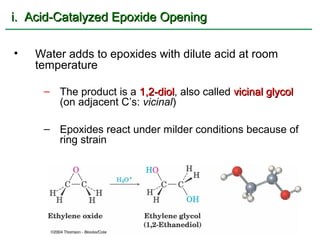
i. Acid-Catalyzed Epoxide Opening

•   Water adds to epoxides with dilute acid at room
    temperature

     – The product is a 1,2-diol, also called vicinal glycol
                        1,2-diol
       (on adjacent C’s: vicinal)

     – Epoxides react under milder conditions because of
       ring strain
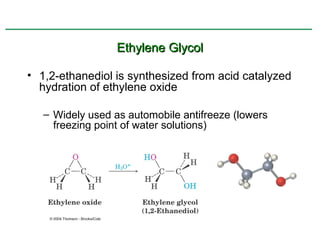
Ethylene Glycol

• 1,2-ethanediol is synthesized from acid catalyzed
  hydration of ethylene oxide

   – Widely used as automobile antifreeze (lowers
     freezing point of water solutions)
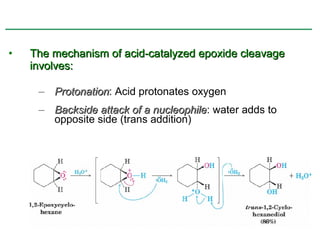
•   The mechanism of acid-catalyzed epoxide cleavage
    involves:

     – Protonation: Acid protonates oxygen
       Protonation
     – Backside attack of a nucleophile: water adds to
                            nucleophile
       opposite side (trans addition)
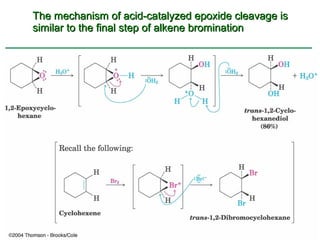
The mechanism of acid-catalyzed epoxide cleavage is
similar to the final step of alkene bromination
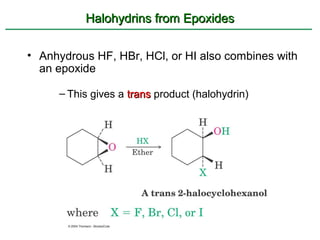
Halohydrins from Epoxides

• Anhydrous HF, HBr, HCl, or HI also combines with
  an epoxide

     – This gives a trans product (halohydrin)
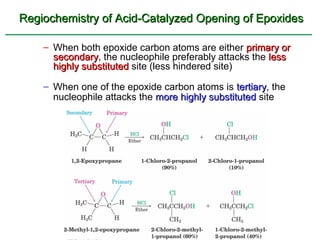
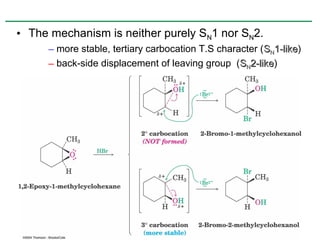
Regiochemistry of Acid-Catalyzed Opening of Epoxides

    – When both epoxide carbon atoms are either primary or
      secondary, the nucleophile preferably attacks the less
      secondary
      highly substituted site (less hindered site)

    – When one of the epoxide carbon atoms is tertiary, the
                                                 tertiary
      nucleophile attacks the more highly substituted site
• The mechanism is neither purely SN1 nor SN2.
     – more stable, tertiary carbocation T.S character (SN1-like)
                                                           1-like
     – back-side displacement of leaving group (SN2-like)
                                                    2-like
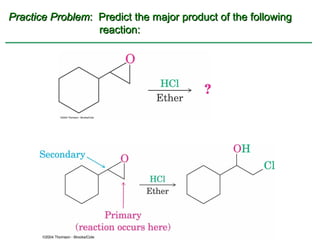
Practice Problem: Predict the major product of the following
                  reaction:
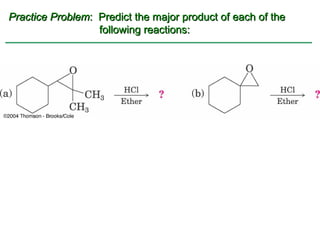
Practice Problem: Predict the major product of each of the
                  following reactions:
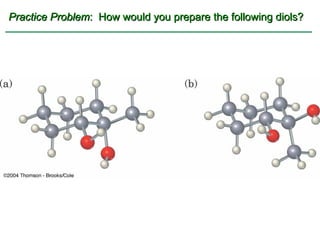
Practice Problem: How would you prepare the following diols?
ii. Base-Catalyzed Epoxide Opening

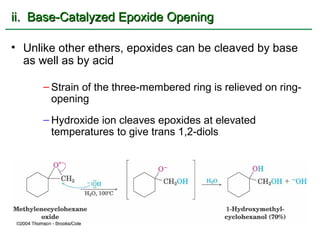
• Unlike other ethers, epoxides can be cleaved by base
  as well as by acid

      – Strain of the three-membered ring is relieved on ring-
        opening
      – Hydroxide ion cleaves epoxides at elevated
        temperatures to give trans 1,2-diols
Addition of Grignards to Ethylene Oxide


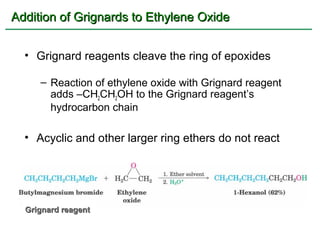
  • Grignard reagents cleave the ring of epoxides

     – Reaction of ethylene oxide with Grignard reagent
       adds –CH2CH2OH to the Grignard reagent’s
       hydrocarbon chain

  • Acyclic and other larger ring ethers do not react


  Grignard reagent
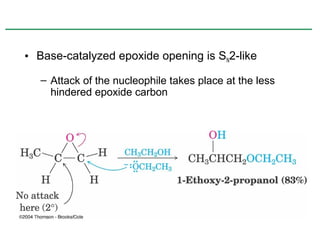
• Base-catalyzed epoxide opening is SN2-like

   – Attack of the nucleophile takes place at the less
     hindered epoxide carbon
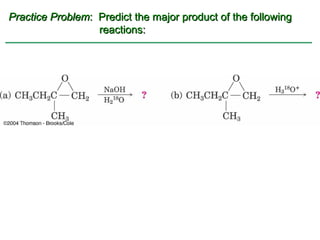
Practice Problem: Predict the major product of the following
                  reactions:
6.       Crown Ethers

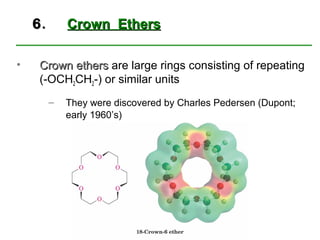
•    Crown ethers are large rings consisting of repeating
     (-OCH2CH2-) or similar units
         –   They were discovered by Charles Pedersen (Dupont;
             early 1960’s)
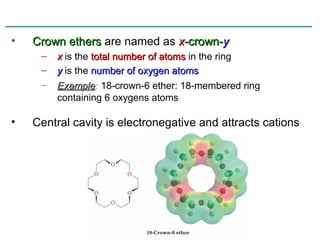
•   Crown ethers are named as x-crown-y
     –   x is the total number of atoms in the ring
     –   y is the number of oxygen atoms
     –   Example: 18-crown-6 ether: 18-membered ring
         Example
         containing 6 oxygens atoms

•   Central cavity is electronegative and attracts cations
Uses of Crown Ethers

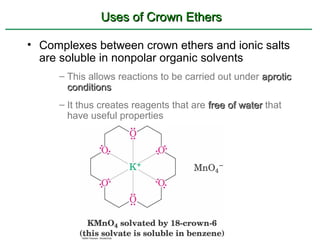
• Complexes between crown ethers and ionic salts
  are soluble in nonpolar organic solvents
     – This allows reactions to be carried out under aprotic
       conditions
     – It thus creates reagents that are free of water that
       have useful properties
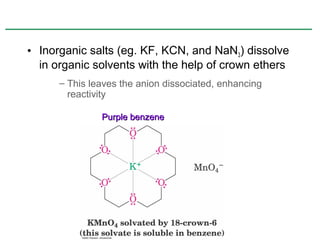
• Inorganic salts (eg. KF, KCN, and NaN3) dissolve
  in organic solvents with the help of crown ethers
      – This leaves the anion dissociated, enhancing
        reactivity

               Purple benzene
Practice Problem: 15-Crown-5 and 12-crown-4 ethers complex
                  Na+ and Li+, respectively. Make models of
                  these crown ethers, compare the sizes of the
                  cavities.
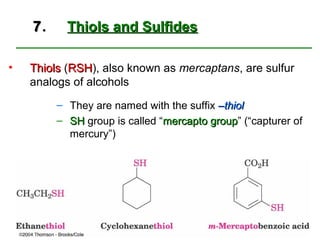
7.     Thiols and Sulfides

•   Thiols (RSH), also known as mercaptans, are sulfur
            RSH
    analogs of alcohols
         – They are named with the suffix –thiol
         – SH group is called “mercapto group” (“capturer of
                                        group
           mercury”)
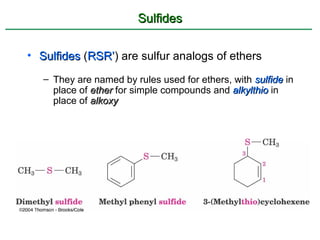
Sulfides

• Sulfides (RSR’) are sulfur analogs of ethers
            RSR’
   – They are named by rules used for ethers, with sulfide in
     place of ether for simple compounds and alkylthio in
     place of alkoxy
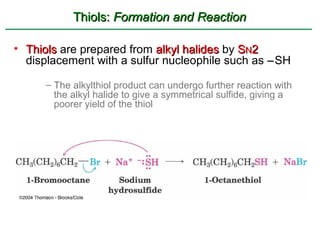
Thiols: Formation and Reaction

• Thiols are prepared from alkyl halides by SN2
  displacement with a sulfur nucleophile such as −SH

      – The alkylthiol product can undergo further reaction with
        the alkyl halide to give a symmetrical sulfide, giving a
        poorer yield of the thiol
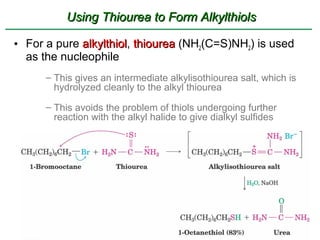
Using Thiourea to Form Alkylthiols

• For a pure alkylthiol, thiourea (NH2(C=S)NH2) is used
             alkylthiol
  as the nucleophile
      – This gives an intermediate alkylisothiourea salt, which is
        hydrolyzed cleanly to the alkyl thiourea

      – This avoids the problem of thiols undergoing further
        reaction with the alkyl halide to give dialkyl sulfides
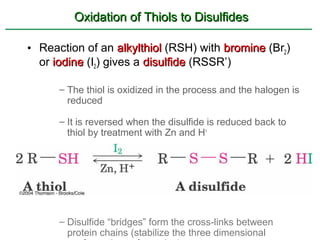
Oxidation of Thiols to Disulfides

• Reaction of an alkylthiol (RSH) with bromine (Br2)
  or iodine (I2) gives a disulfide (RSSR’)

      – The thiol is oxidized in the process and the halogen is
        reduced

      – It is reversed when the disulfide is reduced back to
        thiol by treatment with Zn and H+


      – Disulfide “bridges” form the cross-links between
        protein chains (stabilize the three dimensional
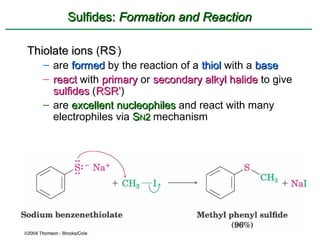
Sulfides: Formation and Reaction

Thiolate ions (RS-)
   – are formed by the reaction of a thiol with a base
   – react with primary or secondary alkyl halide to give
     sulfides (RSR’)
               RSR’
   – are excellent nucleophiles and react with many
     electrophiles via SN2 mechanism
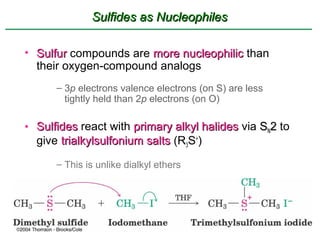
Sulfides as Nucleophiles

• Sulfur compounds are more nucleophilic than
  their oxygen-compound analogs
      – 3p electrons valence electrons (on S) are less
        tightly held than 2p electrons (on O)

• Sulfides react with primary alkyl halides via SN2 to
  give trialkylsulfonium salts (R3S+)
      – This is unlike dialkyl ethers
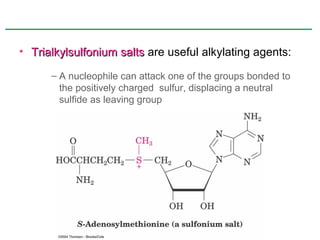
• Trialkylsulfonium salts are useful alkylating agents:

      – A nucleophile can attack one of the groups bonded to
        the positively charged sulfur, displacing a neutral
        sulfide as leaving group
Oxidation of Sulfides

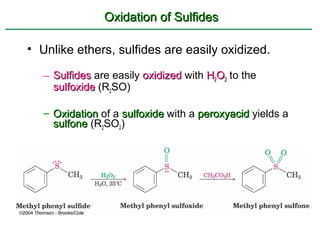
• Unlike ethers, sulfides are easily oxidized.

   – Sulfides are easily oxidized with H2O2 to the
     sulfoxide (R2SO)

   – Oxidation of a sulfoxide with a peroxyacid yields a
     sulfone (R2SO2)
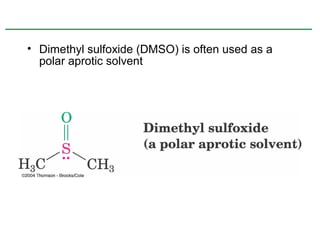
• Dimethyl sulfoxide (DMSO) is often used as a
  polar aprotic solvent
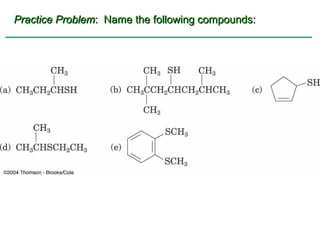
Practice Problem: Name the following compounds:
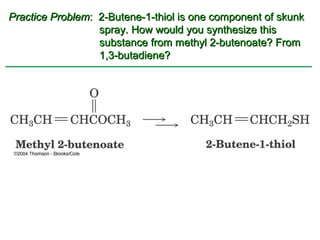
Practice Problem: 2-Butene-1-thiol is one component of skunk
                  spray. How would you synthesize this
                  substance from methyl 2-butenoate? From
                  1,3-butadiene?
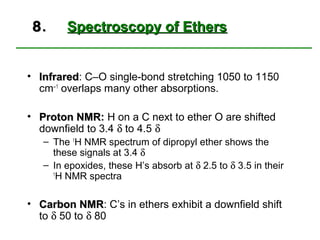
8.     Spectroscopy of Ethers


• Infrared: C–O single-bond stretching 1050 to 1150
  Infrared
  cm−1 overlaps many other absorptions.

• Proton NMR: H on a C next to ether O are shifted
         NMR
  downfield to 3.4 δ to 4.5 δ
   – The 1H NMR spectrum of dipropyl ether shows the
     these signals at 3.4 δ
   – In epoxides, these H’s absorb at δ 2.5 to δ 3.5 in their
     1
      H NMR spectra

• Carbon NMR: C’s in ethers exhibit a downfield shift
           NMR
  to δ 50 to δ 80
Infrared Spectroscopy

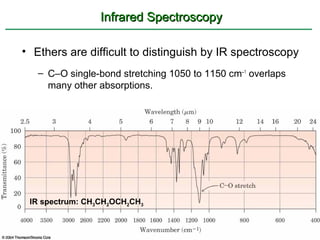
• Ethers are difficult to distinguish by IR spectroscopy
   – C–O single-bond stretching 1050 to 1150 cm−1 overlaps
     many other absorptions.


 IR spectrum: CH3CH2OCH2CH3
Nuclear Magnetic Resonance Spectroscopy

• Proton NMR: H on a C next to ether O are shifted
         NMR
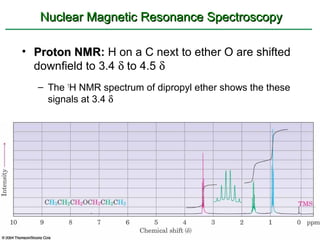
  downfield to 3.4 δ to 4.5 δ
  – The 1H NMR spectrum of dipropyl ether shows the these
    signals at 3.4 δ
• Proton NMR: H on a C next to ether O are shifted
         NMR
  downfield to 3.4 δ to 4.5 δ
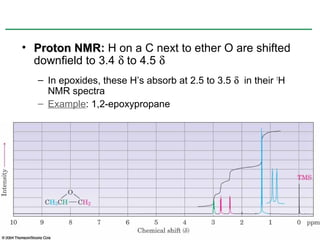
  – In epoxides, these H’s absorb at 2.5 to 3.5 δ in their 1H
    NMR spectra
  – Example: 1,2-epoxypropane
• Carbon NMR: C’s in ethers exhibit a downfield shift
           NMR
  to 50 δ to 80 δ

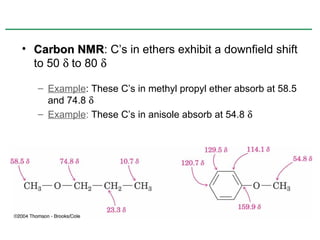
   – Example: These C’s in methyl propyl ether absorb at 58.5
     and 74.8 δ
   – Example: These C’s in anisole absorb at 54.8 δ
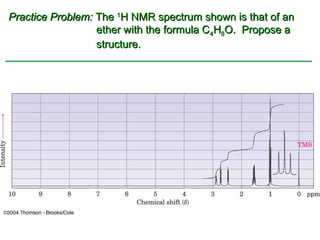
Practice Problem: The 1H NMR spectrum shown is that of an
                  ether with the formula C4H8O. Propose a
                  structure.
Chapter 18

Chem 2425 -__chap_18_(notes)

  • 1.
  • 2.
    Introduction • Ethers are compounds with two organic groups (alkyl, aryl, or vinyl) bonded to the same oxygen atom, R–O–R’, in a ring or in an R–O–R’ open chain industrial solvent anesthetic perfume solvent
  • 3.
    Thiols (R–S–H) and sulfides (R–S–R’) are sulfur R–S–H R–S–R’ analogs of alcohols and ethers, respectively – Sulfur replaces oxygen
  • 4.
    1. Naming Ethers • Ethers are named according to IUPAC rules: – Simple ethers with no other functional groups are named by identifying the two organic substituents and adding the word ether – If other functional groups are present, the ether part is considered an alkoxy substituent
  • 5.
    – Simple etherswith no other functional groups are named by identifying the two organic substituents and adding the word ether
  • 6.
    – If otherfunctional groups are present, the ether part is considered an alkoxy substituent
  • 7.
    Practice Problem: Namethe following ethers according to IUPAC rules (a) Diisopropyl ether (d) 1-Methoxycyclohexene (b) Cyclopentyl propyl ether (e) Ethyl isobutyl ether (c) p-Bromoanisole or (f) Allyl vinyl ether 4-Bromo-1-methoxybenzene
  • 8.
    2. Structure and Properties of Ethers • The geometry around the O atom of an ether (ROR) is similar to that of water (HOH) – R-O-R has an ~ tetrahedral bond angle (112° in dimethyl ether) – The O atom is sp3-hybridized
  • 9.
    The oxygen atom gives ethers a slight dipole moment
  • 10.
    Ethers have higher boiling points than alkanes with similar MW
  • 11.
    3. Synthesis of Ethers • Ethers can be synthesized by: i. Acid-catalyzed dehydration of alcohols ii. Williamson ether synthesis iii. Alkoxymercuration of alkenes
  • 12.
    i. Acid-catalyzed dehydrationof alcohols • Symmetrical ethers can be prepared by acid-catalyzed dehydration of primary alcohols (SN2) – Example: Diethyl ether is prepared industrially by Example sulfuric acid–catalyzed dehydration of ethanol – Acid-catalyzed dehydration of secondary and tertiary alcohols yield alkenes (E1)
  • 13.
    Practice Problem: Whydo you suppose only symmetrical ethers are prepared by the sulfuric acid-catalyzed dehydration procedure? What product(s) would you expect if ethanol and 1-propanol were allowed to react together? In what ratio would the products be formed if the two alcohols were of equal reactivity?
  • 14.
    ii. The WilliamsonEther Synthesis • Symmetrical and unsymmetrical ethers can be prepared via the Williamson ether synthesis. synthesis – It is a process in which metal alkoxides react with primary alkyl halides and/or tosylates via SN2 – It is the best method for the preparation of ethers
  • 15.
    – Alkoxides areprepared by reaction of an alcohol with a strong base such as sodium hydride, NaH Acid Base Sodium salt of the alcohol
  • 16.
    Silver Oxide-Catalyzed Ether Formation is a variation of the Williamson ether synthesis – Direct reaction of alcohols in Ag2O with alkyl halide forms ether in one step – Example: Glucose reacts with excess iodomethane in the Example presence of Ag2O to generate a pentaether in 85% yield
  • 17.
    Mechanism of theWilliamson Ether Synthesis • The Williamson ether synthesis involves SN2 reaction of an alkoxide ion with a primary alkyl halide – An alkoxide nucleophile (RO-) displaces a halide ion (X-) via SN2 – Primary halides and tosylates work best for SN2 because more hindered substrates undergo competitive E2 elimination of HX
  • 18.
    Unsymmetrical ethers should be synthesized by reaction between the more hindered alkoxide ion and less hindered alkyl halide rather than vice versa Example: Synthesis of tert-butyl methyl ether Example
  • 19.
    Practice Problem: Howwould you prepare the following ethers using Williamson synthesis? a. Methyl propyl ether b. Anisole (methyl phenyl ether) c. Benzyl isopropyl ether d. Ethyl 2,2-dimethylpropyl ether
  • 20.
    iii. Alkoxymercuration ofAlkenes • Ethers can be prepared via Alkoxymercuration of Alkenes followed by demercuration – Alkoxymercuration occurs when an alkene reacts with an alcohol in mercuric acetate or trifluoroacetate – Demercuration involves reduction of C-Hg by NaBH4
  • 21.
    Mechanism of Alkoxymercuration/Demercuration • The mechanism involves: – Electrophilic addition of Hg2+ to an alkene, followed by reaction of intermediate cation with alcohol: Overall Markovnikov addition of alcohol to alkene – Reduction of C-Hg by NaBH4
  • 22.
    Practice Problem: Howwould you prepare the ethyl phenyl ether? Use whichever method you think is more appropriate, the Williamson synthesis or the alkoxymercuration reaction.
  • 23.
    Practice Problem: Writethe mechanism of the alkoxymercuration reaction of 1-methylcyclopentene with ethanol. Use curved arrows to show the electron flow in each step.
  • 24.
    Practice Problem: Howwould you prepare the following ethers? Use whichever method you think is more appropriate, the Williamson synthesis or the alkoxymercuration reaction. a. Butyl cyclohexyl ether b. Benzyl ethyl ether (C6H5CH2OCH2CH3) c. sec-Butyl tert-butyl ether d. Tetrahydrofuran
  • 25.
    3. Reactions of Ethers • Ethers undergo: i. Acidic Cleavage ii. Claisen Rearrangement
  • 26.
    i. Acidic Cleavage • Ethers are generally unreactive to most reagents but react with strong acids (HI and HBr) at high temperature HBr – HI, HBr produce an alkyl halide from less hindered component by SN2 (tertiary ethers undergo SN1)
  • 27.
    Mechanism of theAcidic Cleavage • The acidic cleavage reaction takes place: – via SN2 mechanism at the less highly substituted site if only primary and secondary alkyl are bonded to the ether O – via SN1 or E1 mechanism if one of the alkyl groups bonded to the ether O is tertiary
  • 28.
    Ethers with primary and secondary alkyl groups react with HI or HBr via SN2 mechanism – I- or Br- attacks the protonated ether at the less hindered site
  • 29.
    Ethers with a tertiary, benzylic, or allylic group react tertiary benzylic with HI or HBr via SN1 or E1 mechanism – These can produce stable intermediate carbocations – Example: tert-Butyl cyclohexyl ether reacts via E1 Example
  • 30.
    Practice Problem: Predictthe products of the following reaction: • Ethers with primary and secondary alkyl groups – via SN2 • Ethers with a tertiary, benzylic, or allylic group – via SN1 or E1 tertiary benzylic
  • 31.
    Practice Problem: Predictthe products of each of the following reactions:
  • 32.
    Practice Problem: Writethe mechanism of the acid-catalyzed cleavage of tert-butyl cyclohexyl ether to yield cyclohexanol and 2-methylpropene
  • 33.
    Practice Problem: Whyare HI and HBr more effective than HCl in cleaving ethers? Nucleophilicity usually increases going down a column of the periodic table The halide reactivity order is I- > Br- > Cl-
  • 34.
    ii. Claisen Rearrangement • Claisen rearrangement is specific to allyl aryl ethers, ethers ArOCH2CH=CH2 – Heating the allyl aryl ether to 200–250°C leads to an o-allylphenol – Result is alkylation of the phenol in an ortho position
  • 35.
    Mechanism of theClaisen Rearrangement • The reaction proceeds via a pericyclic mechanism: – a concerted reorganization of bonding electrons involving a 6-electron, 6-membered ring transition state leading to 6-allyl-2,4-cyclohexadienone intermediate • The mechanism is consistent with 14C labelling
  • 36.
    Practice Problem: Whatproduct would you expect from Claisen rearrangement of 2-butenyl phenyl ether?
  • 37.
    4. Cyclic Ethers: Epoxides • Cyclic ether behaves like an acyclic ether, except if the ring is 3-membered – Dioxane and tetrahydrofuran are used as solvents
  • 38.
    Epoxides (Oxiranes) • An epoxide is a three-membered ring ether – It is also called an oxirane (root “ir” from “tri” for 3- membered; prefix “ox” for oxygen; “ane” for saturated) – It has a unique chemical reactivity (behaves differently from other open-chain ethers) due to the strain of the 3-membered ring
  • 39.
    Ethylene oxide (1,2-epoxyethane) is industrially 1,2-epoxyethane important as an intermediate – It is the simplest epoxide (oxirane) – It is prepared by reaction of ethylene with oxygen at 300°C and silver oxide catalyst
  • 40.
    In the laboratory, epoxides can be prepared by: i. Treatment of an alkene with a peroxyacid ii. Treatment of a halohydrin with base
  • 41.
    i. Preparation ofEpoxides Using a Peroxyacid • An epoxide is prepared by treatment of an alkene with a peroxyacid (RCO3H) – m-chloroperoxybenzoic acid is a common peroxyacid used
  • 42.
    The mechanism of epoxidation by treatment of an alkene with a peroxyacid (RCO3H): – is a one-step process in which peroxyacids transfer oxygen to the alkene with syn stereochemistry (no intermediates)
  • 43.
    ii. Preparation ofEpoxides from Halohydrins • An epoxide is prepared by treatment of a halohydrin with base – Addition of HO-X to an alkene gives a halohydrin – Treatment of a halohydrin with base eliminates HX and gives an epoxide
  • 44.
    The mechanism of epoxidation by treatment of a halohydrin with a base is an intramolecular Williamson ether synthesis: – The nucleophilic alkoxide ion and the electrophilic alkyl halide are in the same molecule
  • 45.
    Practice Problem: Whatproduct would you expect from reaction of cis-2-butene with m-chloroperoxybenzoic acid? Show the stereochemistry
  • 46.
    Practice Problem: Reactionof trans-2-butene with m-chloropero -xybenzoic acid yields an epoxide different from that obtained by reaction of the cis isomer. Explain.
  • 47.
    5. Ring-Opening Reactions of Epoxides • There are two types of ring-opening reactions of epoxides: i. Acid-Catalyzed Epoxide Opening ii. Base-Catalyzed Epoxide Opening
  • 48.
    i. Acid-Catalyzed EpoxideOpening • Water adds to epoxides with dilute acid at room temperature – The product is a 1,2-diol, also called vicinal glycol 1,2-diol (on adjacent C’s: vicinal) – Epoxides react under milder conditions because of ring strain
  • 49.
    Ethylene Glycol • 1,2-ethanediolis synthesized from acid catalyzed hydration of ethylene oxide – Widely used as automobile antifreeze (lowers freezing point of water solutions)
  • 50.
    The mechanism of acid-catalyzed epoxide cleavage involves: – Protonation: Acid protonates oxygen Protonation – Backside attack of a nucleophile: water adds to nucleophile opposite side (trans addition)
  • 51.
    The mechanism ofacid-catalyzed epoxide cleavage is similar to the final step of alkene bromination
  • 52.
    Halohydrins from Epoxides •Anhydrous HF, HBr, HCl, or HI also combines with an epoxide – This gives a trans product (halohydrin)
  • 53.
    Regiochemistry of Acid-CatalyzedOpening of Epoxides – When both epoxide carbon atoms are either primary or secondary, the nucleophile preferably attacks the less secondary highly substituted site (less hindered site) – When one of the epoxide carbon atoms is tertiary, the tertiary nucleophile attacks the more highly substituted site
  • 54.
    • The mechanismis neither purely SN1 nor SN2. – more stable, tertiary carbocation T.S character (SN1-like) 1-like – back-side displacement of leaving group (SN2-like) 2-like
  • 55.
    Practice Problem: Predictthe major product of the following reaction:
  • 56.
    Practice Problem: Predictthe major product of each of the following reactions:
  • 57.
    Practice Problem: Howwould you prepare the following diols?
  • 58.
    ii. Base-Catalyzed EpoxideOpening • Unlike other ethers, epoxides can be cleaved by base as well as by acid – Strain of the three-membered ring is relieved on ring- opening – Hydroxide ion cleaves epoxides at elevated temperatures to give trans 1,2-diols
  • 59.
    Addition of Grignardsto Ethylene Oxide • Grignard reagents cleave the ring of epoxides – Reaction of ethylene oxide with Grignard reagent adds –CH2CH2OH to the Grignard reagent’s hydrocarbon chain • Acyclic and other larger ring ethers do not react Grignard reagent
  • 60.
    • Base-catalyzed epoxideopening is SN2-like – Attack of the nucleophile takes place at the less hindered epoxide carbon
  • 61.
    Practice Problem: Predictthe major product of the following reactions:
  • 62.
    6. Crown Ethers • Crown ethers are large rings consisting of repeating (-OCH2CH2-) or similar units – They were discovered by Charles Pedersen (Dupont; early 1960’s)
  • 63.
    Crown ethers are named as x-crown-y – x is the total number of atoms in the ring – y is the number of oxygen atoms – Example: 18-crown-6 ether: 18-membered ring Example containing 6 oxygens atoms • Central cavity is electronegative and attracts cations
  • 64.
    Uses of CrownEthers • Complexes between crown ethers and ionic salts are soluble in nonpolar organic solvents – This allows reactions to be carried out under aprotic conditions – It thus creates reagents that are free of water that have useful properties
  • 65.
    • Inorganic salts(eg. KF, KCN, and NaN3) dissolve in organic solvents with the help of crown ethers – This leaves the anion dissociated, enhancing reactivity Purple benzene
  • 66.
    Practice Problem: 15-Crown-5and 12-crown-4 ethers complex Na+ and Li+, respectively. Make models of these crown ethers, compare the sizes of the cavities.
  • 67.
    7. Thiols and Sulfides • Thiols (RSH), also known as mercaptans, are sulfur RSH analogs of alcohols – They are named with the suffix –thiol – SH group is called “mercapto group” (“capturer of group mercury”)
  • 68.
    Sulfides • Sulfides (RSR’)are sulfur analogs of ethers RSR’ – They are named by rules used for ethers, with sulfide in place of ether for simple compounds and alkylthio in place of alkoxy
  • 69.
    Thiols: Formation andReaction • Thiols are prepared from alkyl halides by SN2 displacement with a sulfur nucleophile such as −SH – The alkylthiol product can undergo further reaction with the alkyl halide to give a symmetrical sulfide, giving a poorer yield of the thiol
  • 70.
    Using Thiourea toForm Alkylthiols • For a pure alkylthiol, thiourea (NH2(C=S)NH2) is used alkylthiol as the nucleophile – This gives an intermediate alkylisothiourea salt, which is hydrolyzed cleanly to the alkyl thiourea – This avoids the problem of thiols undergoing further reaction with the alkyl halide to give dialkyl sulfides
  • 71.
    Oxidation of Thiolsto Disulfides • Reaction of an alkylthiol (RSH) with bromine (Br2) or iodine (I2) gives a disulfide (RSSR’) – The thiol is oxidized in the process and the halogen is reduced – It is reversed when the disulfide is reduced back to thiol by treatment with Zn and H+ – Disulfide “bridges” form the cross-links between protein chains (stabilize the three dimensional
  • 72.
    Sulfides: Formation andReaction Thiolate ions (RS-) – are formed by the reaction of a thiol with a base – react with primary or secondary alkyl halide to give sulfides (RSR’) RSR’ – are excellent nucleophiles and react with many electrophiles via SN2 mechanism
  • 73.
    Sulfides as Nucleophiles •Sulfur compounds are more nucleophilic than their oxygen-compound analogs – 3p electrons valence electrons (on S) are less tightly held than 2p electrons (on O) • Sulfides react with primary alkyl halides via SN2 to give trialkylsulfonium salts (R3S+) – This is unlike dialkyl ethers
  • 74.
    • Trialkylsulfonium saltsare useful alkylating agents: – A nucleophile can attack one of the groups bonded to the positively charged sulfur, displacing a neutral sulfide as leaving group
  • 75.
    Oxidation of Sulfides •Unlike ethers, sulfides are easily oxidized. – Sulfides are easily oxidized with H2O2 to the sulfoxide (R2SO) – Oxidation of a sulfoxide with a peroxyacid yields a sulfone (R2SO2)
  • 76.
    • Dimethyl sulfoxide(DMSO) is often used as a polar aprotic solvent
  • 77.
    Practice Problem: Namethe following compounds:
  • 78.
    Practice Problem: 2-Butene-1-thiolis one component of skunk spray. How would you synthesize this substance from methyl 2-butenoate? From 1,3-butadiene?
  • 79.
    8. Spectroscopy of Ethers • Infrared: C–O single-bond stretching 1050 to 1150 Infrared cm−1 overlaps many other absorptions. • Proton NMR: H on a C next to ether O are shifted NMR downfield to 3.4 δ to 4.5 δ – The 1H NMR spectrum of dipropyl ether shows the these signals at 3.4 δ – In epoxides, these H’s absorb at δ 2.5 to δ 3.5 in their 1 H NMR spectra • Carbon NMR: C’s in ethers exhibit a downfield shift NMR to δ 50 to δ 80
  • 80.
    Infrared Spectroscopy • Ethersare difficult to distinguish by IR spectroscopy – C–O single-bond stretching 1050 to 1150 cm−1 overlaps many other absorptions. IR spectrum: CH3CH2OCH2CH3
  • 81.
    Nuclear Magnetic ResonanceSpectroscopy • Proton NMR: H on a C next to ether O are shifted NMR downfield to 3.4 δ to 4.5 δ – The 1H NMR spectrum of dipropyl ether shows the these signals at 3.4 δ
  • 82.
    • Proton NMR:H on a C next to ether O are shifted NMR downfield to 3.4 δ to 4.5 δ – In epoxides, these H’s absorb at 2.5 to 3.5 δ in their 1H NMR spectra – Example: 1,2-epoxypropane
  • 83.
    • Carbon NMR:C’s in ethers exhibit a downfield shift NMR to 50 δ to 80 δ – Example: These C’s in methyl propyl ether absorb at 58.5 and 74.8 δ – Example: These C’s in anisole absorb at 54.8 δ
  • 84.
    Practice Problem: The1H NMR spectrum shown is that of an ether with the formula C4H8O. Propose a structure.
  • 85.