Group Members
Tayyaba khalid B.s (chem,15)013
Khalil Ahmed B.s (chem, 15)001
1
 History
 Introduction
 Description
 Structure Review
 Key points
 Applications
 Effects on Human life
 Bibliography.
2
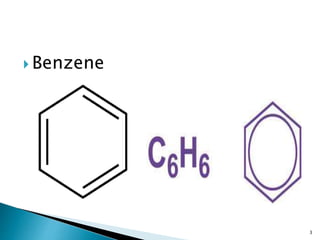
 Benzene
3
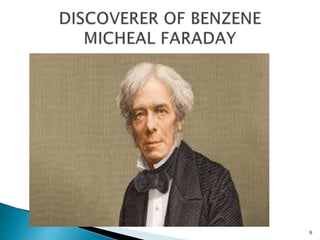
 The hydrocarbon that we now
call benzene was first isolated in 1825 by
Michael Faraday from an oily film that
deposited from the gas used for lighting.
Faraday did some experiments, and discovered
that the new compound had equal numbers of
carbons and hydrogens, and so named it
'carbureted hydrogen
4
 Nine years after its discovery, another
chemist, Mitscherlich, found he could
produce the same substance by heating a
chemical that had been isolated from gum
benzoin - so he decided to call the
compound benzin. Another suggestion was
the German name, benzol, from the German
öl, meaning oil. But in France and England the
name benzene was used instead, to avoid
the -ol ending confusing it with an alcohol.
5
6
 Benzene is an important organic chemical
compound with the chemical formula C6H6.
The benzene molecule is composed of six
carbon atoms joined in a ring with one
hydrogen atom attached to each carbon.
 benzene is classed as a hydrocarbon,
Because it contains only carbon and hydrogen
atoms.
7
 An introductory organic chemistry
definition of an aromatic compound is one
that has a planar ring with 4n + 2 pi-
electrons where n is a non-negative integer
(Hückel's Rule.
8
 Molecular formula = C6H6
 Empirical formula = C,H
 Molecular mass = 78
 Percentage of carbon = 93.6%
 Percentage of hydrogen = 6.4%
 Structural formula =
 It is an aromatic hydrocarbon.
 Physical state = liquid at room temperature.
 Melting point = 5.5oC
 Boiling point = 80oC
 It is highly inflammable.

9
 Benzene burns with smoke due to high percentage of carbon.
 It is insoluble in water.
 It is soluble in organic solvents.
 Nature of reactions:
(a) Substitution reactions
(b)Addition reactions (under special conditions)
10
 Benzene is a natural constituent of crude
oil and is one of the
elementary petrochemicals . Because of the
cyclic continuous pi bond between the carbon
atoms, benzene is classed as an aromatic
hydrocarbon, the second [n]-annulene ([6]-
annulene).
 Benzene is a colorless and highly flammable
liquid with a sweet smell, and is responsible
for the aroma around petrol stations.
11
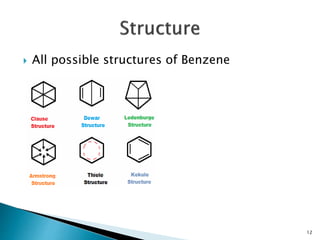
 All possible structures of Benzene
12
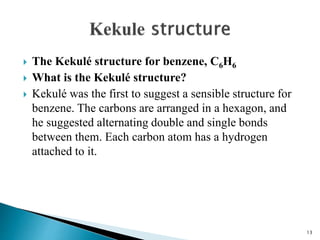
 The Kekulé structure for benzene, C6H6
 What is the Kekulé structure?
 Kekulé was the first to suggest a sensible structure for
benzene. The carbons are arranged in a hexagon, and
he suggested alternating double and single bonds
between them. Each carbon atom has a hydrogen
attached to it.
13
14
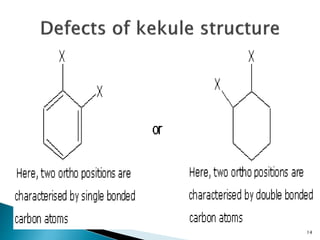
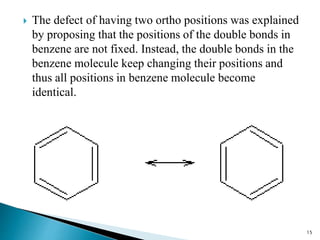
 The defect of having two ortho positions was explained
by proposing that the positions of the double bonds in
benzene are not fixed. Instead, the double bonds in the
benzene molecule keep changing their positions and
thus all positions in benzene molecule become
identical.
15
 Chemists generally used the Kekule's structure as late
as 1945. Many ring structures for benzene have been
proposed after Kekule's structure.
16
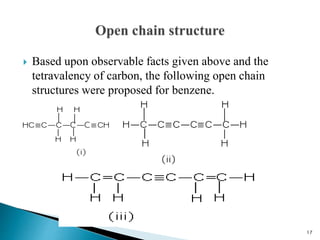
 Based upon observable facts given above and the
tetravalency of carbon, the following open chain
structures were proposed for benzene.

17
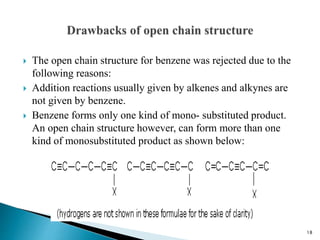
 The open chain structure for benzene was rejected due to the
following reasons:
 Addition reactions usually given by alkenes and alkynes are
not given by benzene.
 Benzene forms only one kind of mono- substituted product.
An open chain structure however, can form more than one
kind of monosubstituted product as shown below:
18
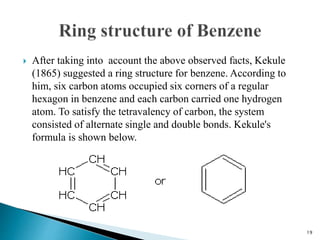
 After taking into account the above observed facts, Kekule
(1865) suggested a ring structure for benzene. According to
him, six carbon atoms occupied six corners of a regular
hexagon in benzene and each carbon carried one hydrogen
atom. To satisfy the tetravalency of carbon, the system
consisted of alternate single and double bonds. Kekule's
formula is shown below.
19
 Benzene is a colorless liquid.
 Benzene is soluble in organic solvents but immiscible in water.
 It is an aromatic compound so it has a typical aromatic odor.
(Aroma in Greek means pleasant smelling).
 Benzene is highly inflammable and burns with sooty flame.
 Benzene also shows resonance that is it can exist in different
forms based on the positioning of double bond and this
property of benzene makes it stable. That is why Benzene does
not undergo addition reactions readily but it undergoes
substitution reactions.
20
 Benzene has high melting and moderate boiling
point. (Melting point 5.5°C, boiling point 80.5°C).
For homologous series it increases with the
increasing molecular mass because of the increase in
magnitude of Vander Waal’s forces of attraction.
 All the Carbon- carbon bonds in benzene are of same
length which is equal to 140pm. And bond angle is of
120° with all Carbons having sp2 hybridization
21
 It is mainly used in the manufacture of nylon fibers,
which are processed into engineering and textiles
plastics. Furthermore, smaller amounts of benzene are
used in order to make certain types of drugs, pesticides,
dyes, rubbers, explosives, detergents, and lubricants.
Three years ago, the biggest consumer country of
benzene was China, followed by the United States of
America. Today, the production of benzene is expanded
in Africa and the Middle East.
22
 Breathing
 Benzene vapors are present in exhaust from many industries
and automobiles. People who live near highways or
industries can be exposed to benzene.
 Drinking/Eating
 People whose drinking water wells are located within half a
mile of a leaking underground storage tank, may be exposed
by drinking contaminated water.
 Touching
 Benzene can pass through the skin. Benzene exposure
through skin contact with gasoline or other solvents is
possible. People can also absorb benzene as they bathe or
shower in contaminated water
23
 https://www.dhs.wisconsin.gov/chemical/benzene.htm
 http://www.knowsumo.com/uses-of-benzene/
 https://www.google.com.pk/search?rlz=1C1NHXL_enPK719PK719&q=uses+and+applicatio
ns+of+benzene&oq=uses++of+benzene&gs_l=psy-
ab.3.2.0i67k1j0i7i30k1l3.275771.278783.0.284187.7.6.0.0.0.0.411.1939.3-
3j2.5.0....0...1.1.64.psy-ab..5.2.791.q05DGnECbz4
 http://www.chemguide.co.uk/basicorg/bonding/benzene2.html
 http://www.tutorvista.com/content/chemistry/chemistry-iii/hydrocarbons/benzene-
structure.php
 https://www.google.com.pk/search?q=points+of+kekule+structure&rlz=1C1NHXL_enPK719
PK719&oq=points+of+kekule+structure&aqs=chrome..69i57.7104j0j7&sourceid=chrome&i
e=UTF-8
 https://kekulestructureofbenzenerodg.wordpress.com/
 http://pubs.acs.org/doi/abs/10.1021/j150354a009
 https://www.slideshare.net/bejoybj/5-methods-of-preparing-benzene
 http://chemistry.tutorvista.com/organic-chemistry/benzene-reactions.html
 http://www.chemguide.co.uk/mechanisms/elsubmenu.html
24
25

Basic Introduction Of benzene

  • 1.
    Group Members Tayyaba khalidB.s (chem,15)013 Khalil Ahmed B.s (chem, 15)001 1
  • 2.
     History  Introduction Description  Structure Review  Key points  Applications  Effects on Human life  Bibliography. 2
  • 3.
  • 4.
     The hydrocarbonthat we now call benzene was first isolated in 1825 by Michael Faraday from an oily film that deposited from the gas used for lighting. Faraday did some experiments, and discovered that the new compound had equal numbers of carbons and hydrogens, and so named it 'carbureted hydrogen 4
  • 5.
     Nine yearsafter its discovery, another chemist, Mitscherlich, found he could produce the same substance by heating a chemical that had been isolated from gum benzoin - so he decided to call the compound benzin. Another suggestion was the German name, benzol, from the German öl, meaning oil. But in France and England the name benzene was used instead, to avoid the -ol ending confusing it with an alcohol. 5
  • 6.
  • 7.
     Benzene isan important organic chemical compound with the chemical formula C6H6. The benzene molecule is composed of six carbon atoms joined in a ring with one hydrogen atom attached to each carbon.  benzene is classed as a hydrocarbon, Because it contains only carbon and hydrogen atoms. 7
  • 8.
     An introductoryorganic chemistry definition of an aromatic compound is one that has a planar ring with 4n + 2 pi- electrons where n is a non-negative integer (Hückel's Rule. 8
  • 9.
     Molecular formula= C6H6  Empirical formula = C,H  Molecular mass = 78  Percentage of carbon = 93.6%  Percentage of hydrogen = 6.4%  Structural formula =  It is an aromatic hydrocarbon.  Physical state = liquid at room temperature.  Melting point = 5.5oC  Boiling point = 80oC  It is highly inflammable.  9
  • 10.
     Benzene burnswith smoke due to high percentage of carbon.  It is insoluble in water.  It is soluble in organic solvents.  Nature of reactions: (a) Substitution reactions (b)Addition reactions (under special conditions) 10
  • 11.
     Benzene isa natural constituent of crude oil and is one of the elementary petrochemicals . Because of the cyclic continuous pi bond between the carbon atoms, benzene is classed as an aromatic hydrocarbon, the second [n]-annulene ([6]- annulene).  Benzene is a colorless and highly flammable liquid with a sweet smell, and is responsible for the aroma around petrol stations. 11
  • 12.
     All possiblestructures of Benzene 12
  • 13.
     The Kekuléstructure for benzene, C6H6  What is the Kekulé structure?  Kekulé was the first to suggest a sensible structure for benzene. The carbons are arranged in a hexagon, and he suggested alternating double and single bonds between them. Each carbon atom has a hydrogen attached to it. 13
  • 14.
  • 15.
     The defectof having two ortho positions was explained by proposing that the positions of the double bonds in benzene are not fixed. Instead, the double bonds in the benzene molecule keep changing their positions and thus all positions in benzene molecule become identical. 15
  • 16.
     Chemists generallyused the Kekule's structure as late as 1945. Many ring structures for benzene have been proposed after Kekule's structure. 16
  • 17.
     Based uponobservable facts given above and the tetravalency of carbon, the following open chain structures were proposed for benzene.  17
  • 18.
     The openchain structure for benzene was rejected due to the following reasons:  Addition reactions usually given by alkenes and alkynes are not given by benzene.  Benzene forms only one kind of mono- substituted product. An open chain structure however, can form more than one kind of monosubstituted product as shown below: 18
  • 19.
     After takinginto account the above observed facts, Kekule (1865) suggested a ring structure for benzene. According to him, six carbon atoms occupied six corners of a regular hexagon in benzene and each carbon carried one hydrogen atom. To satisfy the tetravalency of carbon, the system consisted of alternate single and double bonds. Kekule's formula is shown below. 19
  • 20.
     Benzene isa colorless liquid.  Benzene is soluble in organic solvents but immiscible in water.  It is an aromatic compound so it has a typical aromatic odor. (Aroma in Greek means pleasant smelling).  Benzene is highly inflammable and burns with sooty flame.  Benzene also shows resonance that is it can exist in different forms based on the positioning of double bond and this property of benzene makes it stable. That is why Benzene does not undergo addition reactions readily but it undergoes substitution reactions. 20
  • 21.
     Benzene hashigh melting and moderate boiling point. (Melting point 5.5°C, boiling point 80.5°C). For homologous series it increases with the increasing molecular mass because of the increase in magnitude of Vander Waal’s forces of attraction.  All the Carbon- carbon bonds in benzene are of same length which is equal to 140pm. And bond angle is of 120° with all Carbons having sp2 hybridization 21
  • 22.
     It ismainly used in the manufacture of nylon fibers, which are processed into engineering and textiles plastics. Furthermore, smaller amounts of benzene are used in order to make certain types of drugs, pesticides, dyes, rubbers, explosives, detergents, and lubricants. Three years ago, the biggest consumer country of benzene was China, followed by the United States of America. Today, the production of benzene is expanded in Africa and the Middle East. 22
  • 23.
     Breathing  Benzenevapors are present in exhaust from many industries and automobiles. People who live near highways or industries can be exposed to benzene.  Drinking/Eating  People whose drinking water wells are located within half a mile of a leaking underground storage tank, may be exposed by drinking contaminated water.  Touching  Benzene can pass through the skin. Benzene exposure through skin contact with gasoline or other solvents is possible. People can also absorb benzene as they bathe or shower in contaminated water 23
  • 24.
     https://www.dhs.wisconsin.gov/chemical/benzene.htm  http://www.knowsumo.com/uses-of-benzene/ https://www.google.com.pk/search?rlz=1C1NHXL_enPK719PK719&q=uses+and+applicatio ns+of+benzene&oq=uses++of+benzene&gs_l=psy- ab.3.2.0i67k1j0i7i30k1l3.275771.278783.0.284187.7.6.0.0.0.0.411.1939.3- 3j2.5.0....0...1.1.64.psy-ab..5.2.791.q05DGnECbz4  http://www.chemguide.co.uk/basicorg/bonding/benzene2.html  http://www.tutorvista.com/content/chemistry/chemistry-iii/hydrocarbons/benzene- structure.php  https://www.google.com.pk/search?q=points+of+kekule+structure&rlz=1C1NHXL_enPK719 PK719&oq=points+of+kekule+structure&aqs=chrome..69i57.7104j0j7&sourceid=chrome&i e=UTF-8  https://kekulestructureofbenzenerodg.wordpress.com/  http://pubs.acs.org/doi/abs/10.1021/j150354a009  https://www.slideshare.net/bejoybj/5-methods-of-preparing-benzene  http://chemistry.tutorvista.com/organic-chemistry/benzene-reactions.html  http://www.chemguide.co.uk/mechanisms/elsubmenu.html 24
  • 25.