Contraception
March 10, 2016
About presentations
● Pls, avoid the use of small fonts, unless you do not want the audience to
read it (for instance, in references)
● 16 is minimum, bigger is better
● Use additional slides to continue a message
● Images and graphs are better than text only
● Black on white design is OK
HIV/AIDS addendum (obligatory testing in RF)
● donors of blood, liquids, organs, tissues,etc
● employees to be employed in certain occupations (govt decree № 877,
Sept 4,1995)
● doctors, nurses, and other personnel in contact with HIV+
● doctors, nurses, and other personnel testing for HIV
● researchers and other personnel in HIV and immunologic studies
● foregn citizens arriving in Russia for more than three months
govt decree #877, Sept 4, 1995
ПРАВИТЕЛЬСТВО РОССИЙСКОЙ ФЕДЕРАЦИИ ПОСТАНОВЛЕНИЕ от 4 сентября 1995 г. N 877
ОБ УТВЕРЖДЕНИИ ПЕРЕЧНЯ РАБОТНИКОВ ОТДЕЛЬНЫХ
ПРОФЕССИЙ, ПРОИЗВОДСТВ, ПРЕДПРИЯТИЙ, УЧРЕЖДЕНИЙ
И ОРГАНИЗАЦИЙ, КОТОРЫЕ ПРОХОДЯТ ОБЯЗАТЕЛЬНОЕ МЕДИЦИНСКОЕ
ОСВИДЕТЕЛЬСТВОВАНИЕ ДЛЯ ВЫЯВЛЕНИЯ ВИЧ-ИНФЕКЦИИ ПРИ
ПРОВЕДЕНИИ ОБЯЗАТЕЛЬНЫХ ПРЕДВАРИТЕЛЬНЫХ ПРИ
ПОСТУПЛЕНИИ НА РАБОТУ И ПЕРИОДИЧЕСКИХ
МЕДИЦИНСКИХ ОСМОТРОВ
В соответствии со статьей 9 Федерального закона "О предупреждении распространения в Российской Федерации заболевания,
вызываемого вирусом иммунодефицита человека (ВИЧ-инфекции)" (Собрание законодательства Российской Федерации, 1995, N 14, ст. 1212)
Правительство Российской Федерации постановляет:
Утвердить прилагаемый Перечень работников отдельных профессий, производств, предприятий, учреждений и организаций, которые
проходят обязательное медицинское освидетельствование для выявления ВИЧ-инфекции при проведении обязательных предварительных
при поступлении на работу и периодических медицинских осмотров.
Председатель Правительства
Российской Федерации
В.ЧЕРНОМЫРДИН
Утвержден
Постановлением Правительства
Российской Федерации
от 4 сентября 1995 г. N 877
an example of something the audience do not need to read in class
ПЕРЕЧЕНЬ
РАБОТНИКОВ ОТДЕЛЬНЫХ ПРОФЕССИЙ, ПРОИЗВОДСТВ,
ПРЕДПРИЯТИЙ, УЧРЕЖДЕНИЙ И ОРГАНИЗАЦИЙ, КОТОРЫЕ ПРОХОДЯТ
ОБЯЗАТЕЛЬНОЕ МЕДИЦИНСКОЕ ОСВИДЕТЕЛЬСТВОВАНИЕ ДЛЯ
ВЫЯВЛЕНИЯ ВИЧ-ИНФЕКЦИИ ПРИ ПРОВЕДЕНИИ ОБЯЗАТЕЛЬНЫХ
ПРЕДВАРИТЕЛЬНЫХ ПРИ ПОСТУПЛЕНИИ НА РАБОТУ И
ПЕРИОДИЧЕСКИХ МЕДИЦИНСКИХ ОСМОТРОВ
1. Обязательному медицинскому освидетельствованию для выявления ВИЧ-инфекции при поступлении на работу и при периодических
медицинских осмотрах подлежат следующие работники:
а) врачи, средний и младший медицинский персонал центров по профилактике и борьбе со СПИДом, учреждений здравоохранения,
специализированных отделений и структурных подразделений учреждений здравоохранения, занятые непосредственным обследованием,
диагностикой, лечением, обслуживанием, а также проведением судебно-медицинской экспертизы и другой работы с лицами,
инфицированными вирусом иммунодефицита человека, имеющие с ними непосредственный контакт;
б) врачи, средний и младший медицинский персонал лабораторий (группы персонала лабораторий), которые осуществляют
обследование населения на ВИЧ-инфекцию и исследование крови и биологических материалов, полученных от лиц, инфицированных
вирусом иммунодефицита человека;
в) научные работники, специалисты, служащие и рабочие научно-исследовательских учреждений, предприятий (производств) по
изготовлению медицинских иммунобиологических препаратов и других организаций, работа которых связана с материалами, содержащими
вирус иммунодефицита человека.
2. Перечень конкретных должностей и профессий работников, указанных в пункте 1, определяется руководителем учреждения,
предприятия, организации.
Contraception
Although the definition is unclear
Birth control: Birth control is the use of any practices, methods, or devices
to prevent pregnancy from occurring in a sexually active woman. Also
referred to as family planning, pregnancy prevention, fertility control, or
contraception; birth control methods are designed either to prevent
fertilization of an egg or implantation of a fertilized egg in the uterus.
Birth control methods may be reversible or irreversible.
Intuitively it is easy to understand.
Reproduction
menarche>coitus>insemination+ovulation>fertilization>pregnancy>birth
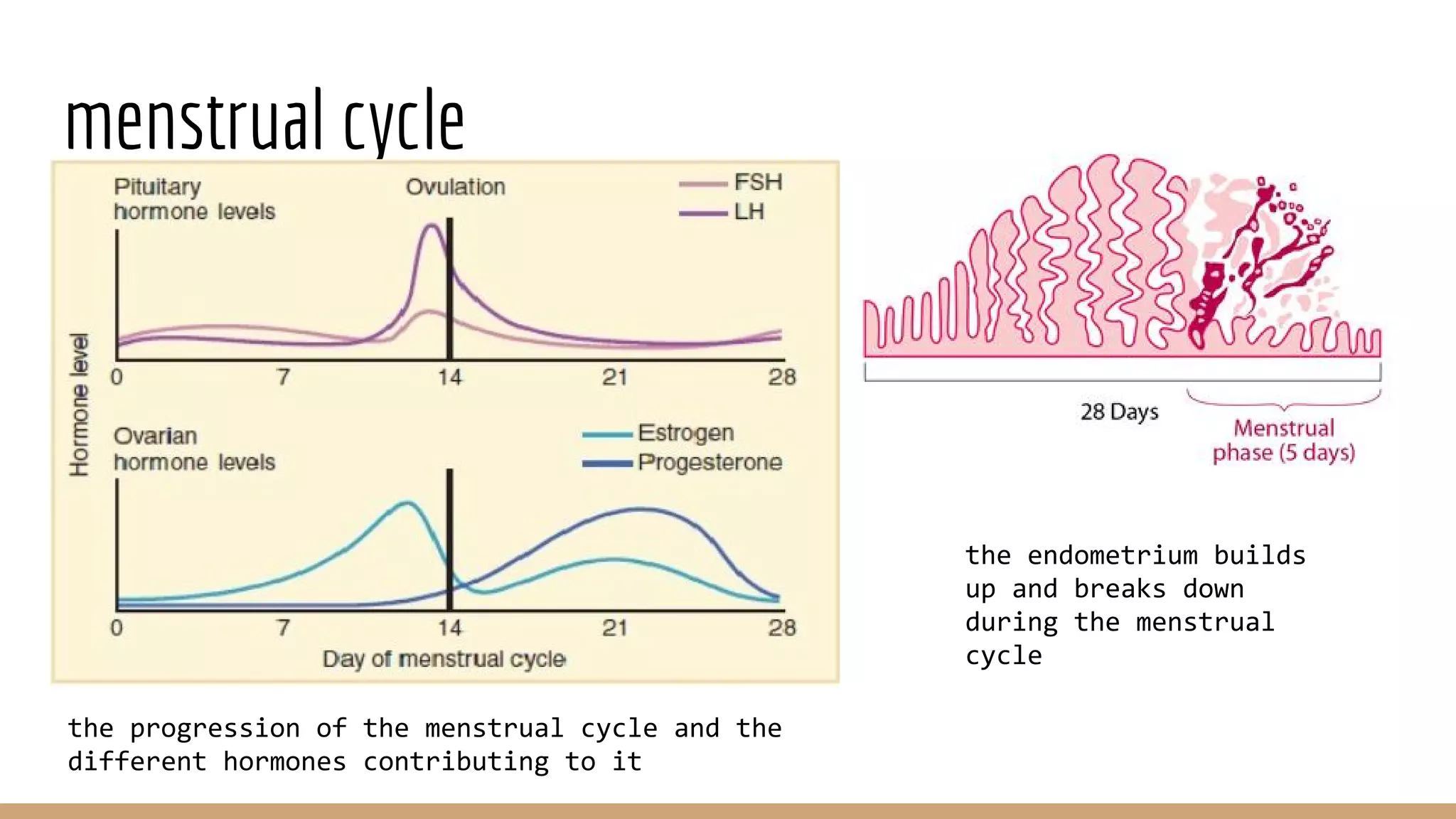
menstrual cycle
the endometrium builds
up and breaks down
during the menstrual
cycle
the progression of the menstrual cycle and the
different hormones contributing to it
ovulation
An ovum (egg)
lives about
1 day (24 hrs).
Sperm lives up to
3 days (72 hrs).
fertilization
During fertilization, the sperm and
egg unite in one of the fallopian
tubes to form a zygote. Then the
zygote travels down the fallopian
tube, where it becomes a morula.
Once it reaches the uterus, the
morula becomes a blastocyst. The
blastocyst then burrows into the
uterine wall — a process called
implantation.
Classification of methods
● Modern/Traditional
● Male/Female
○ Natural (behavioral, lactation, abstinence, withdrawal, ...)
○ Barrier/Mechanical
○ Hormonal
○ Intrauterine (also mechanical)
○ Sterilization
○ Emergency
○ Dual protection
Natural
abstinence (is not CC)
● lactational amenorrhea
● calendar methods (FA) based on
○ day count
○ temperature monitoring
○ cervical
○ hormone monitoring
● withdrawal/coitus interruptus
a FA by-product = If you want to get pregnant,
it can help you to know on which days you should have sex
Prolonged breastfeeding
the temporary postnatal infertility that occurs when a woman is amenorrheic
(not menstruating, no ovulation) and exclusively breastfeeding.
very effective during the first six months postpartum, if
● Breastfeeding must be the infant’s only (or almost only) source of
nutrition. Feeding formula, pumping instead of nursing, and feeding
solids all reduce the effectiveness of LAM.
● The infant must breastfeed at least every four hours during the day and at
least every six hours at night.
● The mother must not have had a period after 56 days post-partum (when
determining fertility, bleeding prior to 56 days post-partum can be
ignored).
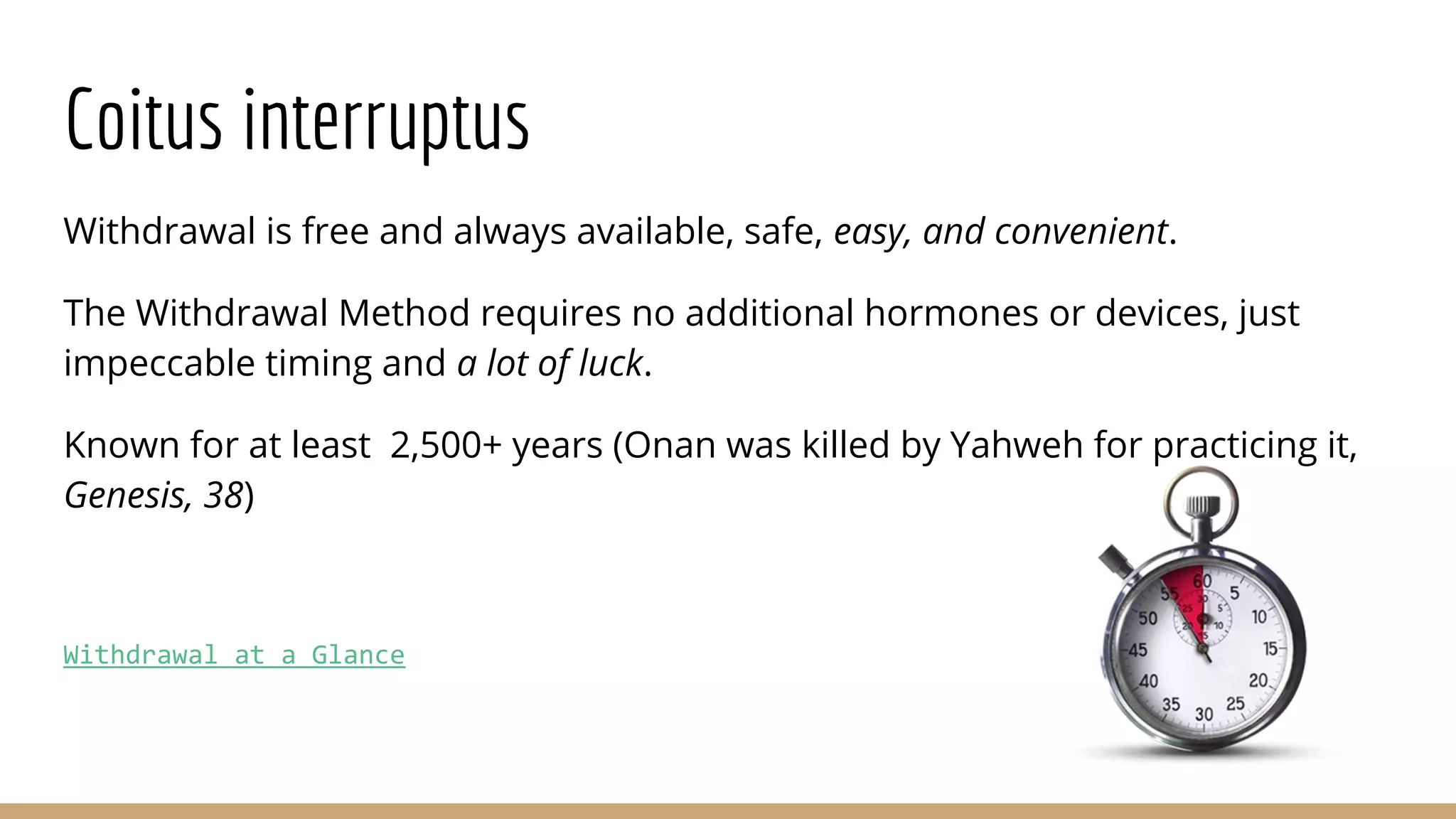
Coitus interruptus
Withdrawal is free and always available, safe, easy, and convenient.
The Withdrawal Method requires no additional hormones or devices, just
impeccable timing and a lot of luck.
Known for at least 2,500+ years (Onan was killed by Yahweh for practicing it,
Genesis, 38)
Withdrawal at a Glance
Barrier methods
● condoms
○ male,
○ female
● cervical caps, diaphragms, and
● contraceptive sponges with spermicide
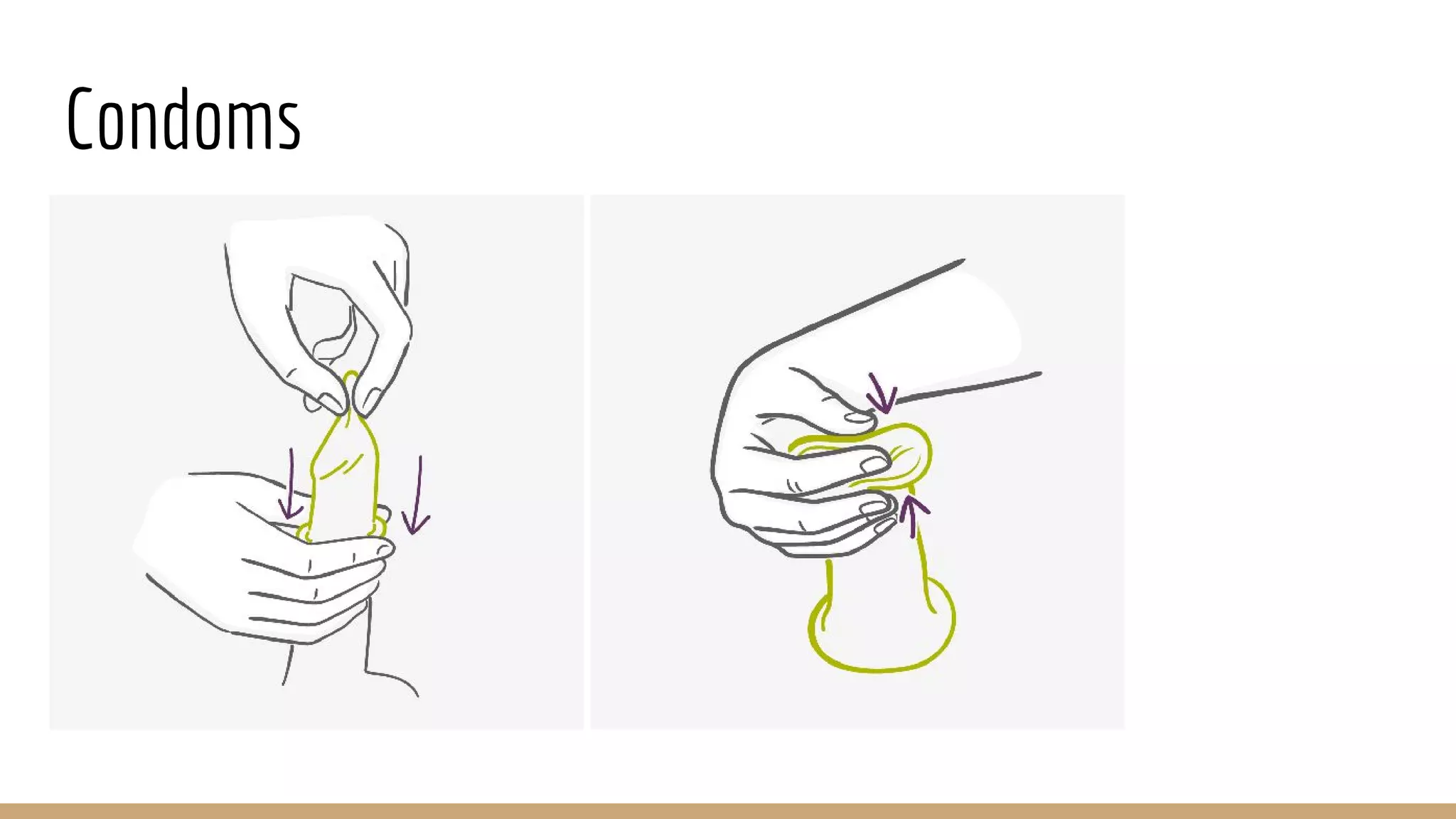
Condoms
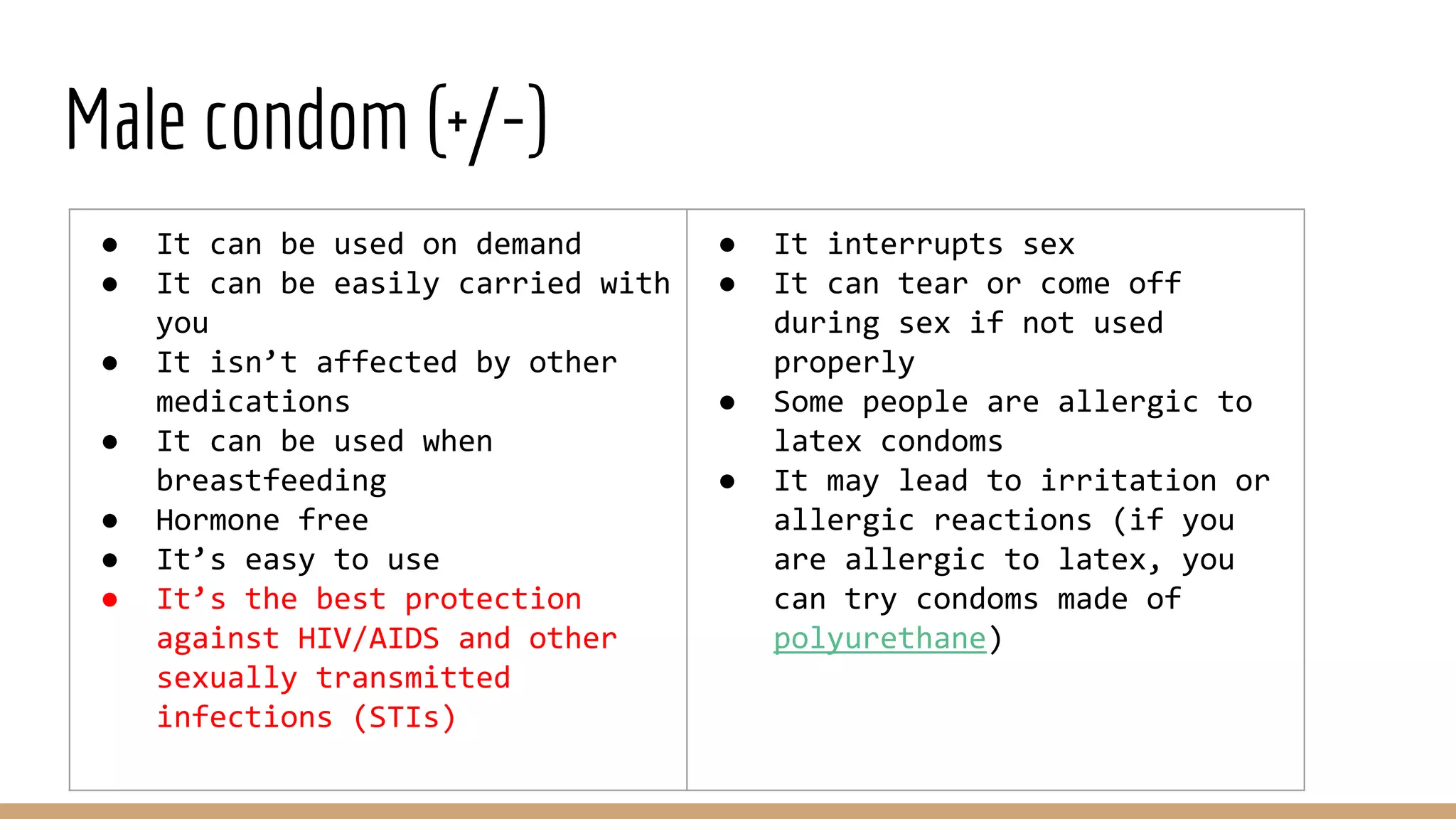
Male condom (+/-)
● It can be used on demand
● It can be easily carried with
you
● It isn’t affected by other
medications
● It can be used when
breastfeeding
● Hormone free
● It’s easy to use
● It’s the best protection
against HIV/AIDS and other
sexually transmitted
infections (STIs)
● It interrupts sex
● It can tear or come off
during sex if not used
properly
● Some people are allergic to
latex condoms
● It may lead to irritation or
allergic reactions (if you
are allergic to latex, you
can try condoms made of
polyurethane)
female condom
● It can be used on demand
● It can easily carried with
you
● It isn’t affected by other
medications
● It can be used when
breastfeeding
● Hormone free
● It protects effectively
against sexually transmitted
infections (STIs)
● It interrupts sex
● Using it can take practice
● Not as effective as male
latex condoms
● It can tear if not used
properly
● It may lead to irritation or
allergic reactions
It’s quite easy to learn:
How to use a female condom (12 steps, 4 min clip)
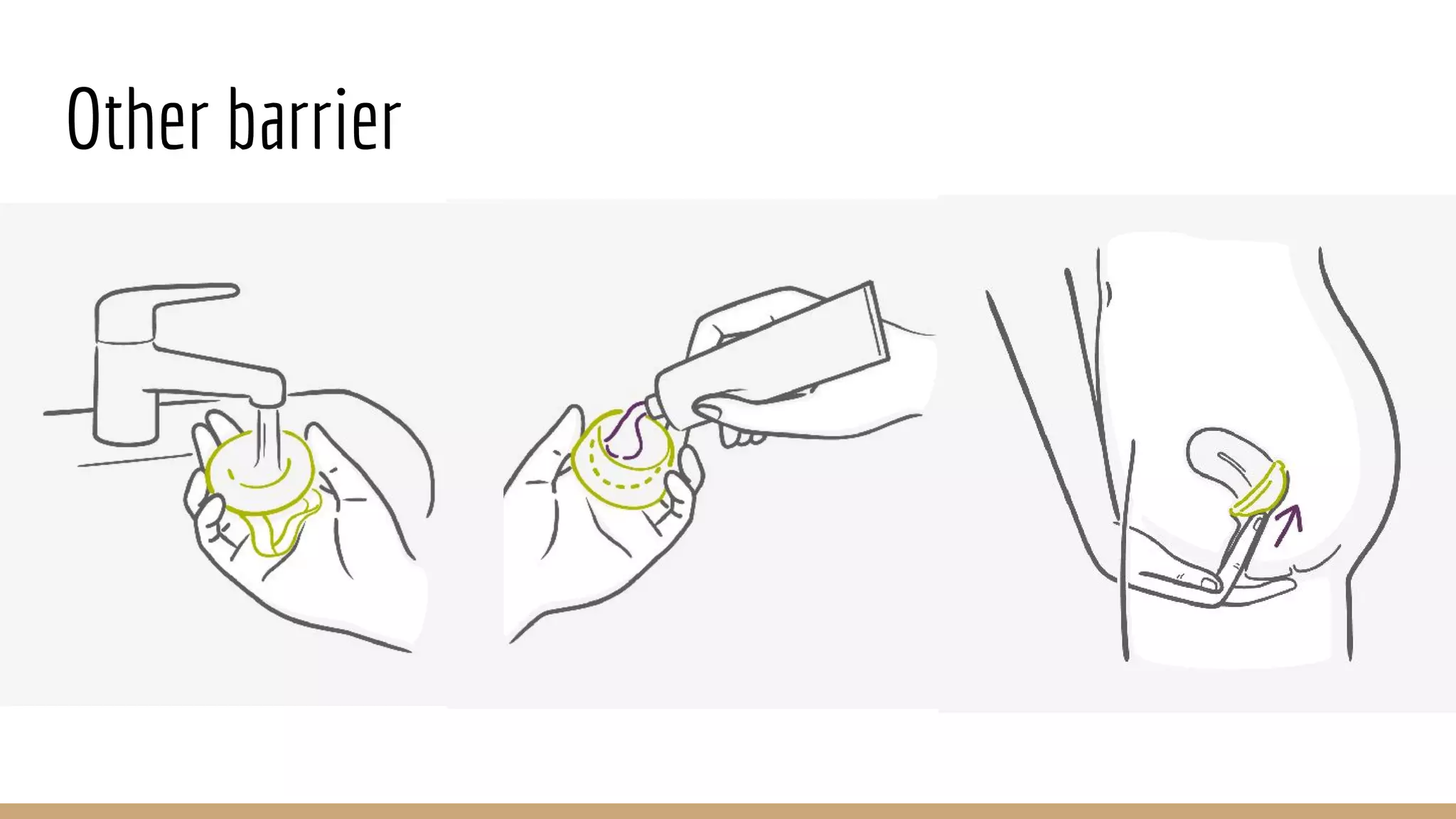
Other barrier
Hormonal methods
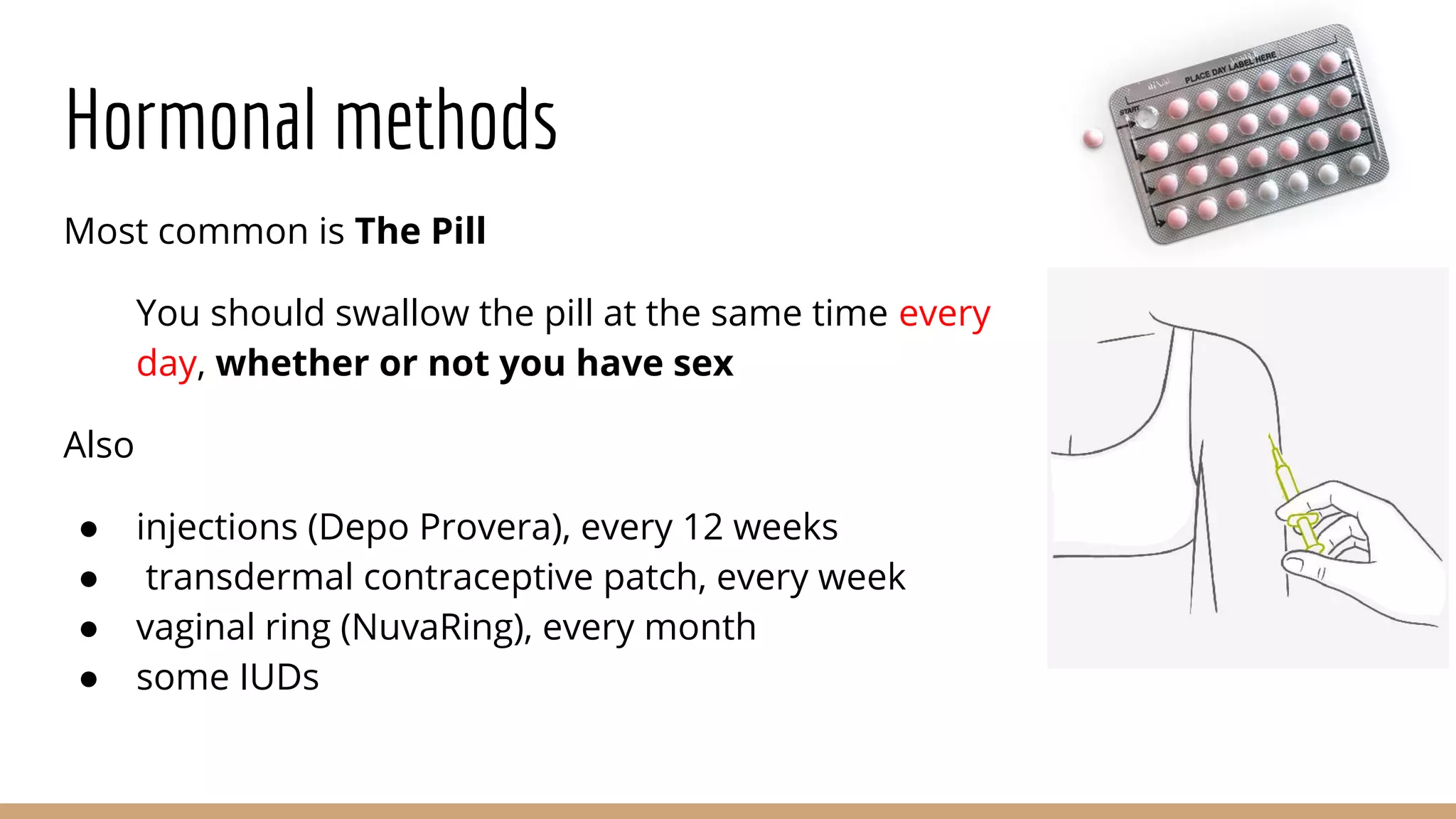
Most common is The Pill
You should swallow the pill at the same time every
day, whether or not you have sex
Also
● injections (Depo Provera), every 12 weeks
● transdermal contraceptive patch, every week
● vaginal ring (NuvaRing), every month
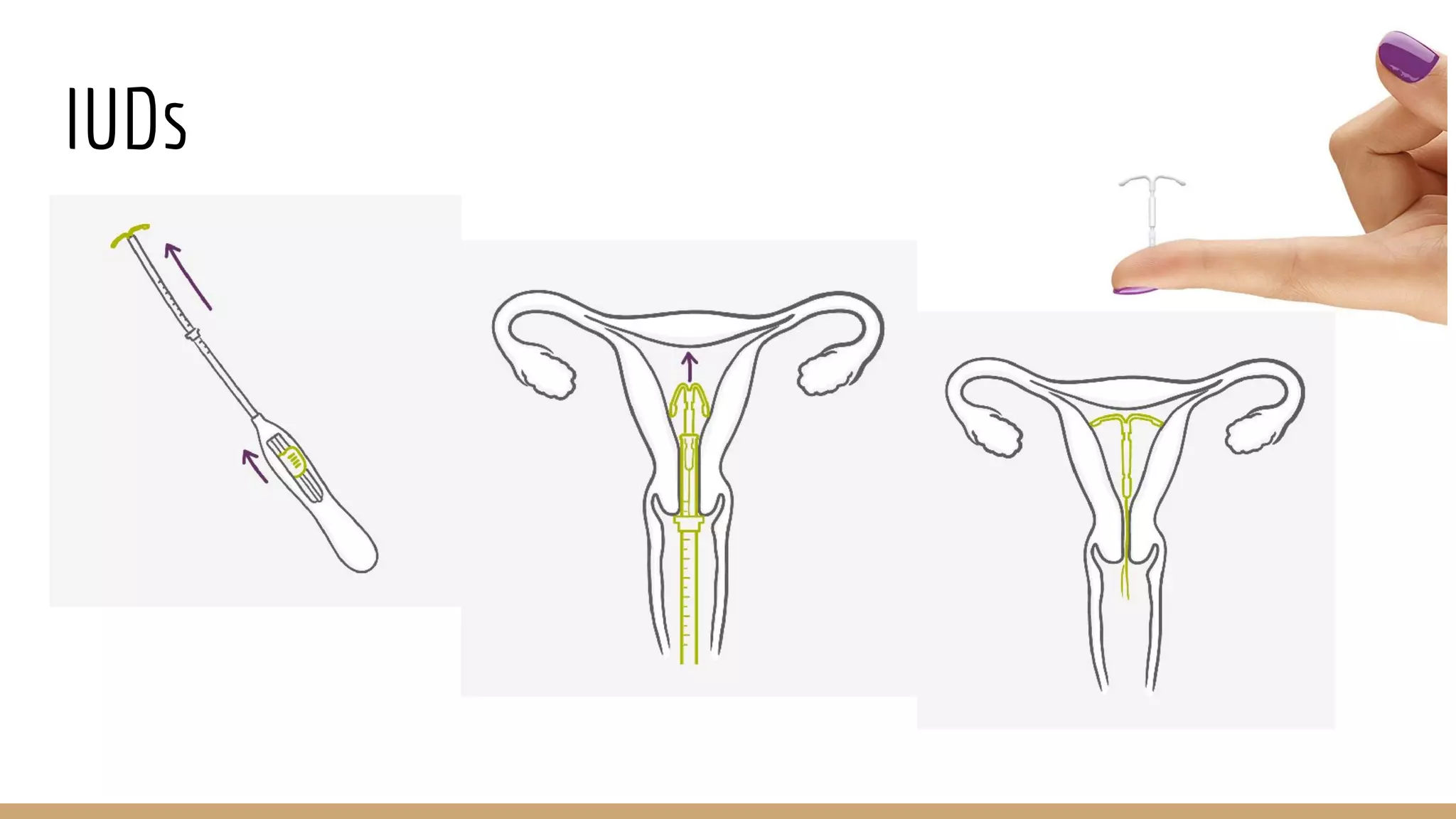
● some IUDs
The pill
1. the combined oral contraceptive pills (which contain both
estrogen and progesterone), and
2. the progestogen-only pills (sometimes called minipills).
● Both types of birth control pills prevent fertilization mainly by
inhibiting ovulation and thickening cervical mucous.
● They may also change the lining of the uterus and thus decrease
implantation.
IUDs
Sterilization
● male (vasectomy)
● female (tubal ligation)
This decision may cause regret in some men and women. Of
women aged over 30 who have undergone tubal ligation, about
5% regret their decision, as compared with 20% of women aged
under 30. By contrast, less than 5% of men are likely to regret
sterilization. Men more likely to regret sterilization are younger,
have young or no children, or have an unstable marriage.
Male
Female
Emergency contraception
medications ("morning-after pills") or devices used after unprotected
sexual intercourse with the hope of preventing pregnancy.
They work primarily by preventing ovulation or fertilization
● Mifepristone, also known as RU-486 (after sex but before ovulation,
inhibition of implantation is possible, but the knowledge of the
mechanism of action remains incomplete)
● IUDs can be inserted up to five days after intercourse and prevent
about 99% of pregnancies after an episode of unprotected sex
Dual protection
Unwanted pregnancy is one concern,
STD is another concern, especially in
case of casual sex.
How to measure
The Pearl Index, also called the Pearl rate, is the most common technique
used in clinical trials for reporting the effectiveness of a birth control method.
It is a statistical estimation of the number of unintended pregnancies in 100
woman-years of exposure
Usually two Pearl Indexes are published from studies of birth control methods:
● Actual use Pearl Index, which includes all pregnancies in a study and all months (or
cycles) of exposure
● Perfect use or Method Pearl Index, which includes only pregnancies that resulted
from correct and consistent use of the method, and only includes months or cycles
in which the method was correctly and consistently used
Effectiveness
Data sources
Major international programs:
«Demographic and Health Surveys /DHS»
http://www.measuredhs.com/
«Reproductive Health Surveys»
(Centers for disease control and prevention - CDC, http://www.cdc.
gov/reproductivehealth/)
«Multiple Indicator Cluster Surveys / MICS»
(UNICEF, http://www.childinfo.org/mics3_surveys.html)
Estimates and Projections of Family Planning Indicators 2015
The Population Division produces a systematic and comprehensive series of annual, model-based
estimates and projections of contraceptive prevalence, unmet need for family planning, total
demand for family planning and the percentage of demand for family planning that is satisfied
among married or in-union women for the period from 1970 to 2030. Median estimates with 80 per
cent and 95 per cent uncertainty intervals are provided for 195 countries or areas of the world and
for regions and development groups. A Bayesian hierarchical model combined with country-specific
time trends was used to generate the estimates, projections and uncertainty assessments. The
model advances prior work and accounts for differences by data source, sample population, and
contraceptive methods included in measures of prevalence.
The estimates and projections are based on the country-specific data compiled in World Contraceptive Use 2015.
Model results are as of March 2015.
Details on the methodology are described in Alkema, L. et al. (2013). National, regional and global rates and trends in
contraceptive prevalence and unmet need for family planning between 1990 and 2015: a systematic and
comprehensive analysis. The Lancet. Vol. 381, Issue 9878, pp. 1642–1652.
Data/Figures
● Model-based estimates and projections: Countries [Tables in Excel-Format] [Figures]
● Model-based estimates and projections: Regions [Tables in Excel-Format] [Figures]
Frejka T., J.Ross.
Paths to Subreplacement Fertility: The Empirical Evidence
Population and Developmant Review, Vol. 27 (2001)
TFR (USA, 1955)
Save the date
World Contraception Day, Sept 26
since 2007
«Contraception: It’s Your
Life, it’s your responsibility»
this year the 10th

Contraception

  • 1.
  • 2.
    About presentations ● Pls,avoid the use of small fonts, unless you do not want the audience to read it (for instance, in references) ● 16 is minimum, bigger is better ● Use additional slides to continue a message ● Images and graphs are better than text only ● Black on white design is OK
  • 3.
    HIV/AIDS addendum (obligatorytesting in RF) ● donors of blood, liquids, organs, tissues,etc ● employees to be employed in certain occupations (govt decree № 877, Sept 4,1995) ● doctors, nurses, and other personnel in contact with HIV+ ● doctors, nurses, and other personnel testing for HIV ● researchers and other personnel in HIV and immunologic studies ● foregn citizens arriving in Russia for more than three months
  • 4.
    govt decree #877,Sept 4, 1995 ПРАВИТЕЛЬСТВО РОССИЙСКОЙ ФЕДЕРАЦИИ ПОСТАНОВЛЕНИЕ от 4 сентября 1995 г. N 877 ОБ УТВЕРЖДЕНИИ ПЕРЕЧНЯ РАБОТНИКОВ ОТДЕЛЬНЫХ ПРОФЕССИЙ, ПРОИЗВОДСТВ, ПРЕДПРИЯТИЙ, УЧРЕЖДЕНИЙ И ОРГАНИЗАЦИЙ, КОТОРЫЕ ПРОХОДЯТ ОБЯЗАТЕЛЬНОЕ МЕДИЦИНСКОЕ ОСВИДЕТЕЛЬСТВОВАНИЕ ДЛЯ ВЫЯВЛЕНИЯ ВИЧ-ИНФЕКЦИИ ПРИ ПРОВЕДЕНИИ ОБЯЗАТЕЛЬНЫХ ПРЕДВАРИТЕЛЬНЫХ ПРИ ПОСТУПЛЕНИИ НА РАБОТУ И ПЕРИОДИЧЕСКИХ МЕДИЦИНСКИХ ОСМОТРОВ В соответствии со статьей 9 Федерального закона "О предупреждении распространения в Российской Федерации заболевания, вызываемого вирусом иммунодефицита человека (ВИЧ-инфекции)" (Собрание законодательства Российской Федерации, 1995, N 14, ст. 1212) Правительство Российской Федерации постановляет: Утвердить прилагаемый Перечень работников отдельных профессий, производств, предприятий, учреждений и организаций, которые проходят обязательное медицинское освидетельствование для выявления ВИЧ-инфекции при проведении обязательных предварительных при поступлении на работу и периодических медицинских осмотров. Председатель Правительства Российской Федерации В.ЧЕРНОМЫРДИН Утвержден Постановлением Правительства Российской Федерации от 4 сентября 1995 г. N 877
  • 5.
    an example ofsomething the audience do not need to read in class ПЕРЕЧЕНЬ РАБОТНИКОВ ОТДЕЛЬНЫХ ПРОФЕССИЙ, ПРОИЗВОДСТВ, ПРЕДПРИЯТИЙ, УЧРЕЖДЕНИЙ И ОРГАНИЗАЦИЙ, КОТОРЫЕ ПРОХОДЯТ ОБЯЗАТЕЛЬНОЕ МЕДИЦИНСКОЕ ОСВИДЕТЕЛЬСТВОВАНИЕ ДЛЯ ВЫЯВЛЕНИЯ ВИЧ-ИНФЕКЦИИ ПРИ ПРОВЕДЕНИИ ОБЯЗАТЕЛЬНЫХ ПРЕДВАРИТЕЛЬНЫХ ПРИ ПОСТУПЛЕНИИ НА РАБОТУ И ПЕРИОДИЧЕСКИХ МЕДИЦИНСКИХ ОСМОТРОВ 1. Обязательному медицинскому освидетельствованию для выявления ВИЧ-инфекции при поступлении на работу и при периодических медицинских осмотрах подлежат следующие работники: а) врачи, средний и младший медицинский персонал центров по профилактике и борьбе со СПИДом, учреждений здравоохранения, специализированных отделений и структурных подразделений учреждений здравоохранения, занятые непосредственным обследованием, диагностикой, лечением, обслуживанием, а также проведением судебно-медицинской экспертизы и другой работы с лицами, инфицированными вирусом иммунодефицита человека, имеющие с ними непосредственный контакт; б) врачи, средний и младший медицинский персонал лабораторий (группы персонала лабораторий), которые осуществляют обследование населения на ВИЧ-инфекцию и исследование крови и биологических материалов, полученных от лиц, инфицированных вирусом иммунодефицита человека; в) научные работники, специалисты, служащие и рабочие научно-исследовательских учреждений, предприятий (производств) по изготовлению медицинских иммунобиологических препаратов и других организаций, работа которых связана с материалами, содержащими вирус иммунодефицита человека. 2. Перечень конкретных должностей и профессий работников, указанных в пункте 1, определяется руководителем учреждения, предприятия, организации.
  • 6.
    Contraception Although the definitionis unclear Birth control: Birth control is the use of any practices, methods, or devices to prevent pregnancy from occurring in a sexually active woman. Also referred to as family planning, pregnancy prevention, fertility control, or contraception; birth control methods are designed either to prevent fertilization of an egg or implantation of a fertilized egg in the uterus. Birth control methods may be reversible or irreversible. Intuitively it is easy to understand.
  • 7.
  • 8.
    menstrual cycle the endometriumbuilds up and breaks down during the menstrual cycle the progression of the menstrual cycle and the different hormones contributing to it
  • 9.
    ovulation An ovum (egg) livesabout 1 day (24 hrs). Sperm lives up to 3 days (72 hrs).
  • 10.
    fertilization During fertilization, thesperm and egg unite in one of the fallopian tubes to form a zygote. Then the zygote travels down the fallopian tube, where it becomes a morula. Once it reaches the uterus, the morula becomes a blastocyst. The blastocyst then burrows into the uterine wall — a process called implantation.
  • 11.
    Classification of methods ●Modern/Traditional ● Male/Female ○ Natural (behavioral, lactation, abstinence, withdrawal, ...) ○ Barrier/Mechanical ○ Hormonal ○ Intrauterine (also mechanical) ○ Sterilization ○ Emergency ○ Dual protection
  • 12.
    Natural abstinence (is notCC) ● lactational amenorrhea ● calendar methods (FA) based on ○ day count ○ temperature monitoring ○ cervical ○ hormone monitoring ● withdrawal/coitus interruptus a FA by-product = If you want to get pregnant, it can help you to know on which days you should have sex
  • 13.
    Prolonged breastfeeding the temporarypostnatal infertility that occurs when a woman is amenorrheic (not menstruating, no ovulation) and exclusively breastfeeding. very effective during the first six months postpartum, if ● Breastfeeding must be the infant’s only (or almost only) source of nutrition. Feeding formula, pumping instead of nursing, and feeding solids all reduce the effectiveness of LAM. ● The infant must breastfeed at least every four hours during the day and at least every six hours at night. ● The mother must not have had a period after 56 days post-partum (when determining fertility, bleeding prior to 56 days post-partum can be ignored).
  • 14.
    Coitus interruptus Withdrawal isfree and always available, safe, easy, and convenient. The Withdrawal Method requires no additional hormones or devices, just impeccable timing and a lot of luck. Known for at least 2,500+ years (Onan was killed by Yahweh for practicing it, Genesis, 38) Withdrawal at a Glance
  • 15.
    Barrier methods ● condoms ○male, ○ female ● cervical caps, diaphragms, and ● contraceptive sponges with spermicide
  • 16.
  • 17.
    Male condom (+/-) ●It can be used on demand ● It can be easily carried with you ● It isn’t affected by other medications ● It can be used when breastfeeding ● Hormone free ● It’s easy to use ● It’s the best protection against HIV/AIDS and other sexually transmitted infections (STIs) ● It interrupts sex ● It can tear or come off during sex if not used properly ● Some people are allergic to latex condoms ● It may lead to irritation or allergic reactions (if you are allergic to latex, you can try condoms made of polyurethane)
  • 18.
    female condom ● Itcan be used on demand ● It can easily carried with you ● It isn’t affected by other medications ● It can be used when breastfeeding ● Hormone free ● It protects effectively against sexually transmitted infections (STIs) ● It interrupts sex ● Using it can take practice ● Not as effective as male latex condoms ● It can tear if not used properly ● It may lead to irritation or allergic reactions It’s quite easy to learn: How to use a female condom (12 steps, 4 min clip)
  • 19.
  • 20.
    Hormonal methods Most commonis The Pill You should swallow the pill at the same time every day, whether or not you have sex Also ● injections (Depo Provera), every 12 weeks ● transdermal contraceptive patch, every week ● vaginal ring (NuvaRing), every month ● some IUDs
  • 21.
    The pill 1. thecombined oral contraceptive pills (which contain both estrogen and progesterone), and 2. the progestogen-only pills (sometimes called minipills). ● Both types of birth control pills prevent fertilization mainly by inhibiting ovulation and thickening cervical mucous. ● They may also change the lining of the uterus and thus decrease implantation.
  • 22.
  • 23.
    Sterilization ● male (vasectomy) ●female (tubal ligation) This decision may cause regret in some men and women. Of women aged over 30 who have undergone tubal ligation, about 5% regret their decision, as compared with 20% of women aged under 30. By contrast, less than 5% of men are likely to regret sterilization. Men more likely to regret sterilization are younger, have young or no children, or have an unstable marriage.
  • 24.
  • 25.
  • 26.
    Emergency contraception medications ("morning-afterpills") or devices used after unprotected sexual intercourse with the hope of preventing pregnancy. They work primarily by preventing ovulation or fertilization ● Mifepristone, also known as RU-486 (after sex but before ovulation, inhibition of implantation is possible, but the knowledge of the mechanism of action remains incomplete) ● IUDs can be inserted up to five days after intercourse and prevent about 99% of pregnancies after an episode of unprotected sex
  • 27.
    Dual protection Unwanted pregnancyis one concern, STD is another concern, especially in case of casual sex.
  • 28.
    How to measure ThePearl Index, also called the Pearl rate, is the most common technique used in clinical trials for reporting the effectiveness of a birth control method. It is a statistical estimation of the number of unintended pregnancies in 100 woman-years of exposure Usually two Pearl Indexes are published from studies of birth control methods: ● Actual use Pearl Index, which includes all pregnancies in a study and all months (or cycles) of exposure ● Perfect use or Method Pearl Index, which includes only pregnancies that resulted from correct and consistent use of the method, and only includes months or cycles in which the method was correctly and consistently used
  • 29.
  • 30.
    Data sources Major internationalprograms: «Demographic and Health Surveys /DHS» http://www.measuredhs.com/ «Reproductive Health Surveys» (Centers for disease control and prevention - CDC, http://www.cdc. gov/reproductivehealth/) «Multiple Indicator Cluster Surveys / MICS» (UNICEF, http://www.childinfo.org/mics3_surveys.html)
  • 32.
    Estimates and Projectionsof Family Planning Indicators 2015 The Population Division produces a systematic and comprehensive series of annual, model-based estimates and projections of contraceptive prevalence, unmet need for family planning, total demand for family planning and the percentage of demand for family planning that is satisfied among married or in-union women for the period from 1970 to 2030. Median estimates with 80 per cent and 95 per cent uncertainty intervals are provided for 195 countries or areas of the world and for regions and development groups. A Bayesian hierarchical model combined with country-specific time trends was used to generate the estimates, projections and uncertainty assessments. The model advances prior work and accounts for differences by data source, sample population, and contraceptive methods included in measures of prevalence. The estimates and projections are based on the country-specific data compiled in World Contraceptive Use 2015. Model results are as of March 2015. Details on the methodology are described in Alkema, L. et al. (2013). National, regional and global rates and trends in contraceptive prevalence and unmet need for family planning between 1990 and 2015: a systematic and comprehensive analysis. The Lancet. Vol. 381, Issue 9878, pp. 1642–1652. Data/Figures ● Model-based estimates and projections: Countries [Tables in Excel-Format] [Figures] ● Model-based estimates and projections: Regions [Tables in Excel-Format] [Figures]
  • 33.
    Frejka T., J.Ross. Pathsto Subreplacement Fertility: The Empirical Evidence Population and Developmant Review, Vol. 27 (2001) TFR (USA, 1955)
  • 34.
    Save the date WorldContraception Day, Sept 26 since 2007 «Contraception: It’s Your Life, it’s your responsibility» this year the 10th