REPRODUCTIVE HEALTH
&
LIFE CYCLE APPROACH
-VIDDYANSH SRIVASTAVA
viddyanshsrivastava223@gmail.com
What is Reproductive health ?
• Reproductive health is “a state of complete
physical, mental and social well-being and not
merely the absence of disease or infirmity, in all
matters related to the reproductive system and
to its functions and processes...”
• “The ability to reproduce and to regulate fertility,
to go safely through reproductive events and to
have sexual relations without the fear of disease
or unwanted pregnancy”
CONT…
• The capacity to determine the number and
spacing of births through the use of safe,
effective, and acceptable contraceptive methods
• The capacity to terminate an unwanted
pregnancy safely, legally and affordably;
• The capacity to conceive or to cause conception
when a pregnancy is desired;
• The capacity to carry a wanted pregnancy to term
and to deliver a healthy baby under safe
conditions, including the postpartum period
CONT…
• •Freedom from reproductive tract infections
(RTIs), including cancers of the reproductive tract,
sexually transmitted diseases (STDs) and
HIV/AIDS;
• •The capacity to breastfeed and to ensure the
health and wellbeing of the new-born;
• •Freedom from physical damage to the
reproductive tract caused by childbirth, abortion
or harmful traditional practices such as genital
cutting
CONT…
• •Freedom from unwanted sexual relations and
harmful or unwanted sexual practices, including
violence and coercion within sexual relationships;
• •The capacity to enjoy and sustain sexual
relations in a spirit of affection and partnership;
• •A basic understanding of sexual and
reproductive processes of both sexes and how
they change throughout the life cycle, including
physical and emotional aspects;
• •Full access to appropriate and high quality
reproductive health services.
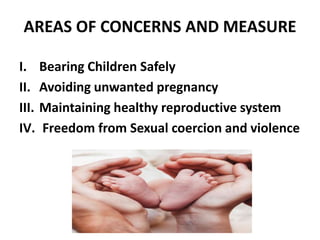
AREAS OF CONCERNS AND MEASURE
I. Bearing Children Safely
II. Avoiding unwanted pregnancy
III. Maintaining healthy reproductive system
IV. Freedom from Sexual coercion and violence
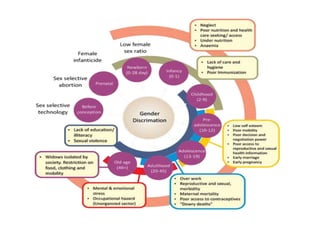
LIFE CYCLE APPROACH
LIFE CYCLE
• Human beings are born as infants and slowly
go through stages before reaching adulthood.
These stages are called a life cycle.
“A life cycle is defined as the developmental
stages that occur during an organism's
lifetime. A life cycle ends when an organism
dies”
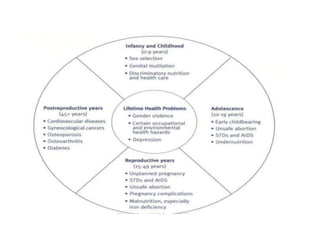
STAGES IN LIFE CYCLE
•Infancy and childhood (0-9 years)
•Adolescence (10-19 years)
•Reproductive age/period (15-45/49 years)
•Post-reproductive age (45+ years, including old
age-60+ years)
Infancy & childhood (0-9 yrs)
•Sex selection (abortion…)
•Education
•Genital mutilation (FGM)
•Discriminatory nutrition, grooming…
•Discriminatory health care
•Etc……
Adolescents (10-19 yrs)
•Physiological changes in the body
•Child labour/work
•Early marriage
•Early child bearing
•Abortion
•Infection (disease, STIs/AIDs)
•Under nutrition (anaemic….)
•Aggression, sexual preference….
•Violence/abuse
•Gender discrimination
Reproductive period/age (15-44 yrs)
• •Marriage –forced ……
• •Unplanned pregnancy
• •Diseases, STIs/AIDs
• •Abortion, infertility……
• •Pregnancy complications
• •Malnutrition, growth
• •Child bearing and rearing
• •Contraception
• •Abuse and violence (domestic, outside home…)
• •Etc, etc……
Post-Reproductive years (45+ yrs)
•Cardio-vascular diseases
•Gynecological cancers
•Osteoporosis/Osteoarthritis
•Diabetes
•Cancers
•Sexual dysfunction
•Sub-fertility/infertility
•STD/HIV
•Menopause etc
•Abuse, violence etc,
THANKYOU..!!!

Reproductive health lifecycle approach

  • 1.
    REPRODUCTIVE HEALTH & LIFE CYCLEAPPROACH -VIDDYANSH SRIVASTAVA viddyanshsrivastava223@gmail.com
  • 3.
    What is Reproductivehealth ? • Reproductive health is “a state of complete physical, mental and social well-being and not merely the absence of disease or infirmity, in all matters related to the reproductive system and to its functions and processes...” • “The ability to reproduce and to regulate fertility, to go safely through reproductive events and to have sexual relations without the fear of disease or unwanted pregnancy”
  • 4.
    CONT… • The capacityto determine the number and spacing of births through the use of safe, effective, and acceptable contraceptive methods • The capacity to terminate an unwanted pregnancy safely, legally and affordably; • The capacity to conceive or to cause conception when a pregnancy is desired; • The capacity to carry a wanted pregnancy to term and to deliver a healthy baby under safe conditions, including the postpartum period
  • 5.
    CONT… • •Freedom fromreproductive tract infections (RTIs), including cancers of the reproductive tract, sexually transmitted diseases (STDs) and HIV/AIDS; • •The capacity to breastfeed and to ensure the health and wellbeing of the new-born; • •Freedom from physical damage to the reproductive tract caused by childbirth, abortion or harmful traditional practices such as genital cutting
  • 6.
    CONT… • •Freedom fromunwanted sexual relations and harmful or unwanted sexual practices, including violence and coercion within sexual relationships; • •The capacity to enjoy and sustain sexual relations in a spirit of affection and partnership; • •A basic understanding of sexual and reproductive processes of both sexes and how they change throughout the life cycle, including physical and emotional aspects; • •Full access to appropriate and high quality reproductive health services.
  • 8.
    AREAS OF CONCERNSAND MEASURE I. Bearing Children Safely II. Avoiding unwanted pregnancy III. Maintaining healthy reproductive system IV. Freedom from Sexual coercion and violence
  • 9.
  • 10.
    LIFE CYCLE • Humanbeings are born as infants and slowly go through stages before reaching adulthood. These stages are called a life cycle. “A life cycle is defined as the developmental stages that occur during an organism's lifetime. A life cycle ends when an organism dies”
  • 11.
    STAGES IN LIFECYCLE •Infancy and childhood (0-9 years) •Adolescence (10-19 years) •Reproductive age/period (15-45/49 years) •Post-reproductive age (45+ years, including old age-60+ years)
  • 13.
    Infancy & childhood(0-9 yrs) •Sex selection (abortion…) •Education •Genital mutilation (FGM) •Discriminatory nutrition, grooming… •Discriminatory health care •Etc……
  • 14.
    Adolescents (10-19 yrs) •Physiologicalchanges in the body •Child labour/work •Early marriage •Early child bearing •Abortion •Infection (disease, STIs/AIDs) •Under nutrition (anaemic….) •Aggression, sexual preference…. •Violence/abuse •Gender discrimination
  • 15.
    Reproductive period/age (15-44yrs) • •Marriage –forced …… • •Unplanned pregnancy • •Diseases, STIs/AIDs • •Abortion, infertility…… • •Pregnancy complications • •Malnutrition, growth • •Child bearing and rearing • •Contraception • •Abuse and violence (domestic, outside home…) • •Etc, etc……
  • 16.
    Post-Reproductive years (45+yrs) •Cardio-vascular diseases •Gynecological cancers •Osteoporosis/Osteoarthritis •Diabetes •Cancers •Sexual dysfunction •Sub-fertility/infertility •STD/HIV •Menopause etc •Abuse, violence etc,
  • 18.