METHODS OF
CONTRACEPTION
& EMERGENCY
CONTRACEPTION
SDPS COLLEGE OF NURSING INDORE (M.P.)
SUBJECT: MIDWIFERY & OBESTETRIC NURSING
SUBMITTED TO :
Mrs. PINKI THAKUR
(PROFESSOR)
SEMINAR ON : METHODS OF CONTRACEPTION & EMERGENCY CONTRACEPTION
SUBMITTED BY: Ms. JAYA
CHOUDHARY
& KIRAN LACHHETA
(B.sc. NURSING 4th
YEAR)
 SEMINAR ON: METHODS OF CONTRACEPTION & EMERGENCY
CONTRACEPTION
Name of evaluator: Mrs . Pinki Thakur
Name of student: Ms. Jaya choudhary & Ms. Kiran lacHheta
Subject : midwifery & obstetric nursing
Class : B.sc. Nursing 4th
year
Date & Time:
Venue :online class on zoom app
Language: English
Method of teaching: lecture cum discussion
A.V. Aids: power point presentation
Review of previous knowledge: student have less knowledge about
methods of contraception & emergency contraception.
General objective: at the and of the class student will be able to explain
about methods of contraception & emergency contraception.
 At the end of the seminar students will be able to -
. Introduce the contraception.
. Define the contraception.
. Enlist the aims of contraception.
. Enumerate the characteristics of ideal contraception.
. Describe the all methods of contraception.
. Role of nurse in family planning and contraception.
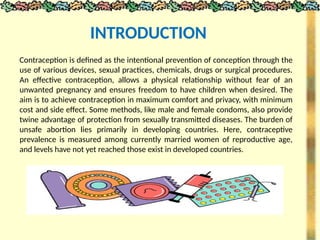
Contraception is defined as the intentional prevention of conception through the
use of various devices, sexual practices, chemicals, drugs or surgical procedures.
An effective contraception, allows a physical relationship without fear of an
unwanted pregnancy and ensures freedom to have children when desired. The
aim is to achieve contraception in maximum comfort and privacy, with minimum
cost and side effect. Some methods, like male and female condoms, also provide
twine advantage of protection from sexually transmitted diseases. The burden of
unsafe abortion lies primarily in developing countries. Here, contraceptive
prevalence is measured among currently married women of reproductive age,
and levels have not yet reached those exist in developed countries.
INTRODUCTION
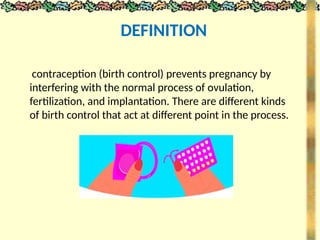
contraception (birth control) prevents pregnancy by
interfering with the normal process of ovulation,
fertilization, and implantation. There are different kinds
of birth control that act at different point in the process.
DEFINITION
or
Birth control is the use of any practice, methods, or devices to
prevent pregnancy from occurring in a sexually active women.
Also referred to as family planning , pregnancy prevention,
fertility control, or contraception; birth control methods are
designed either to prevent fertilization of an egg or implantation
of a fertilization egg in the uterus.
AIMS FOR CONTRACEPTION METHODS
To avoid unwanted birth.
To bring about wanted births.
To regulate the intervals between the pregnancy.
To control the time at which birth occur in relation to
the ages of the parent .
 To determine the number of children in the family.
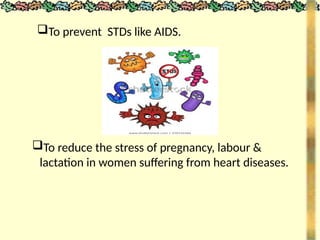
To reduce the stress of pregnancy, labour &
lactation in women suffering from heart diseases.
To prevent STDs like AIDS.
CHARACTERISTICS OF IDEAL
CONTRACEPTIVES
1. Ideal contraceptive method should be highly (100%)
effective.
2. Acceptive
3. Safe
4. Reversible
5. Cheap
6. Having non contraceptive benefits.
7. Simple to use
8. Requiring minimal motivation.
9. Maintenance and supervision
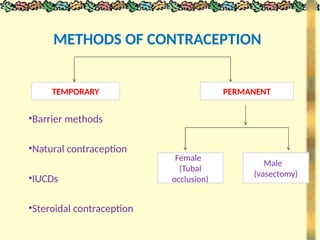
METHODS OF CONTRACEPTION
•Barrier methods
•Natural contraception
•IUCDs
•Steroidal contraception
TEMPORARY PERMANENT
Female
(Tubal
occlusion)
Male
(vasectomy)
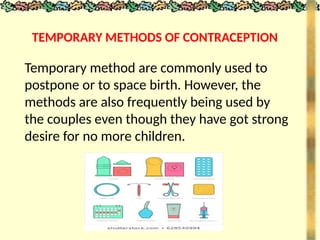
TEMPORARY METHODS OF CONTRACEPTION
Temporary method are commonly used to
postpone or to space birth. However, the
methods are also frequently being used by
the couples even though they have got strong
desire for no more children.
 BARRIER METHOD
These method prevent sperm deposition in the vagina or
prevent sperm penetration through the cervical canal. The
objective is achieved by mechanical device or by
combined means. The following are used.
•Mechanical
Male – condom
Female - condom, diaphragm, cervical cap.
•Chemical (vaginal contraceptives)
Creams – delfen (nonoxynol-9, 12.5%)
Jelly – koromex, volpar paste
Foam tablets – aerrosol foams, chlorimin T or contab, sponge (today)
•Combination
Combined use of mechanical and chemical.
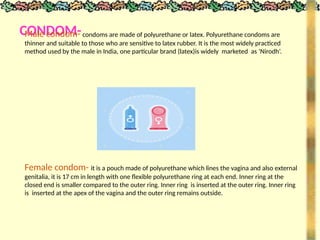
CONDOM-
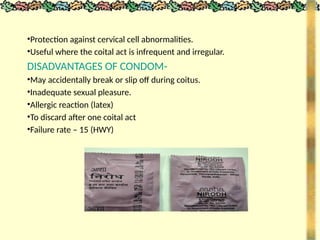
Male condom- condoms are made of polyurethane or latex. Polyurethane condoms are
thinner and suitable to those who are sensitive to latex rubber. It is the most widely practiced
method used by the male in India, one particular brand (latex)is widely marketed as ‘Nirodh’.
Female condom- it is a pouch made of polyurethane which lines the vagina and also external
genitalia, it is 17 cm in length with one flexible polyurethane ring at each end. Inner ring at the
closed end is smaller compared to the outer ring. Inner ring is inserted at the outer ring. Inner ring
is inserted at the apex of the vagina and the outer ring remains outside.
USE OF CONDOM-
1. as an elective contraception method.
2. As an interim form of contraception during pill use, following
vasectomy operation and if an IUD can be fitted.
3. During the treatment of trichomonal vaginitis of the wife, the
husband should use it during the course of treatment irrespective of
contraceptive practice.
4. Immunological infertility – male partner to use for 3 months. For
other non contraceptive benefits.
ADVANTAGES OF CONDOM-
• Cheaper with no contraindication
• No side effects
• Easy to carry, simple to use and disposable
• Protection against sexually transmitted disease, e.g. Gonorrhea,
chlamydia, HPV and HIV.
• Protection against pelvic inflammatory disease.
• Reduces the incidence of tubal infertillity and ectopic pregnancy.
•Protection against cervical cell abnormalities.
•Useful where the coital act is infrequent and irregular.
DISADVANTAGES OF CONDOM-
•May accidentally break or slip off during coitus.
•Inadequate sexual pleasure.
•Allergic reaction (latex)
•To discard after one coital act
•Failure rate – 15 (HWY)
DIAPHRAGM-
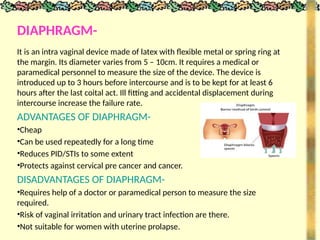
It is an intra vaginal device made of latex with flexible metal or spring ring at
the margin. Its diameter varies from 5 – 10cm. It requires a medical or
paramedical personnel to measure the size of the device. The device is
introduced up to 3 hours before intercourse and is to be kept for at least 6
hours after the last coital act. Ill fitting and accidental displacement during
intercourse increase the failure rate.
ADVANTAGES OF DIAPHRAGM-
•Cheap
•Can be used repeatedly for a long time
•Reduces PID/STIs to some extent
•Protects against cervical pre cancer and cancer.
DISADVANTAGES OF DIAPHRAGM-
•Requires help of a doctor or paramedical person to measure the size
required.
•Risk of vaginal irritation and urinary tract infection are there.
•Not suitable for women with uterine prolapse.
VAGINAL CONTRACEPTIVE
SPERMICIDES -
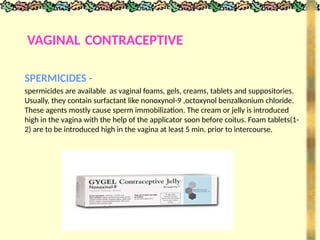
spermicides are available as vaginal foams, gels, creams, tablets and suppositories.
Usually, they contain surfactant like nonoxynol-9 ,octoxynol benzalkonium chloride.
These agents mostly cause sperm immobilization. The cream or jelly is introduced
high in the vagina with the help of the applicator soon before coitus. Foam tablets(1-
2) are to be introduced high in the vagina at least 5 min. prior to intercourse.
VAGINAL CONTRACEPTIVE SPONGE (TODAY)-
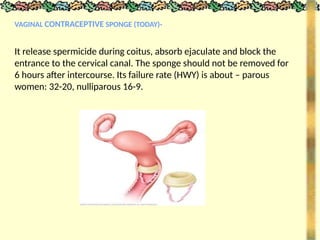
It release spermicide during coitus, absorb ejaculate and block the
entrance to the cervical canal. The sponge should not be removed for
6 hours after intercourse. Its failure rate (HWY) is about – parous
women: 32-20, nulliparous 16-9.
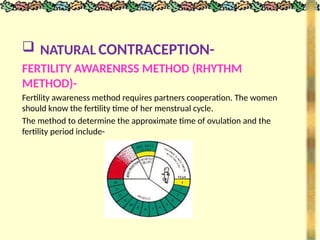
 NATURAL CONTRACEPTION-
FERTILITY AWARENRSS METHOD (RHYTHM
METHOD)-
Fertility awareness method requires partners cooperation. The women
should know the fertility time of her menstrual cycle.
The method to determine the approximate time of ovulation and the
fertility period include-
a) Recording of previous menstrual cycle (calendar rhythm)
b) Noting the basal body temperature chart (temperature rhythm)
c) Noting excessive mucoid vaginal discharge (mucus rhythm)
The user of the calendar method obtain the period of abstinence from
calculation based on the previous twelve menstrual cycle record. The first
unsafe day obtain by subtracting 20 days from the length of the shortest
cycle and last unsafe day by deducting 10 days from the longest cycle.
Users of temperature rhythm require abstinence until the third day of the rise of
temperature.
Users of mucus rhythm require abstinence on all days of noticeable mucus and
for 3 days thereafter.
ADVANTAGES OF RHYTHM METHOD-
• No cost
• No side effects
• Failure rate- 20-30 (HWY)
DISADVANTAGES OF RHYTHM METHOD-
•Difficult to calculate the safe period reliably.
•Needs several months training to use these method.
•Compulsory abstinence from sexual act during certain periods.
•Not applicable during lactation amenorrhea or when the periods are
irregular.
COITUS INTERRUPTUS (WITHDRAWAL) -
it is the oldest and probably the most widely accepted contraceptive
method used by man. It necessitates withdrawal of penis shortly before
ejaculation. It requires sufficient self-control by the man so that withdrawal
of penis precedes ejaculation.
ADVANTAGES OF COITUS INTERRUPTUS-
•No appliance is required.
•No cost.
•Failure rate-27 (HWY)
DISADVANTAGES OF COITUS INTERRUPTUS-
•Requires sufficient self control by the man.
•The women may develop anxiety neurosis, vaginismus or pelvic congestion
•Chance of pregnancy is more
percoital secretion may contain sperm.
accidental chance of sperm deposition into the vagina.
LACTATION AMENORRHEA METHOD (LAM)-
Prolonged and sustained breastfeeding offers a natural protection of
pregnancy. This is more effective in women who are amenorrheic than
those who are menstruating. The risk of pregnancy to women who is
fully breastfeeding and amenorrheic is less than 2 percent in the first 6
months. Otherwise, the failure rate is high (1-10 percent). Thus during
breastfeeding, additional contraceptive support should be given by,
condom, IUCD or injectable steroids where available to provide
complete contraception.
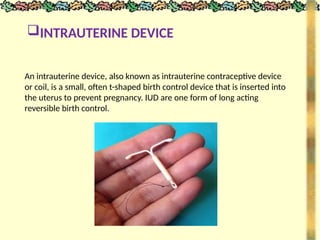
INTRAUTERINE DEVICE
An intrauterine device, also known as intrauterine contraceptive device
or coil, is a small, often t-shaped birth control device that is inserted into
the uterus to prevent pregnancy. IUD are one form of long acting
reversible birth control.
THE FOLLOWING MEDICATED INTRAUTERINE
CONTRACEPTIVE DEVICE ARE IN USE-
1. Cu T 200
2. Multiload Cu 250
3. Multiload 375
4. Cu T 380 A
5. LNG – IUS
6. gynefix
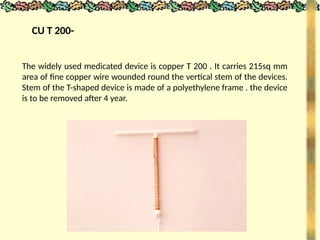
CU T 200-
The widely used medicated device is copper T 200 . It carries 215sq mm
area of fine copper wire wounded round the vertical stem of the devices.
Stem of the T-shaped device is made of a polyethylene frame . the device
is to be removed after 4 year.
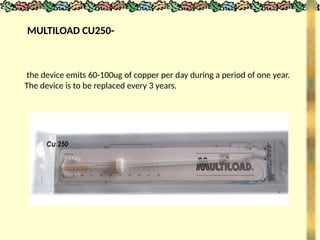
MULTILOAD CU250-
the device emits 60-100ug of copper per day during a period of one year.
The device is to be replaced every 3 years.
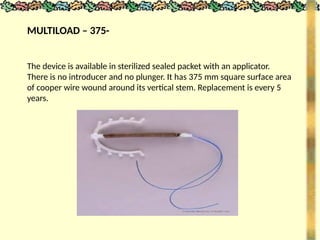
MULTILOAD – 375-
The device is available in sterilized sealed packet with an applicator.
There is no introducer and no plunger. It has 375 mm square surface area
of cooper wire wound around its vertical stem. Replacement is every 5
years.
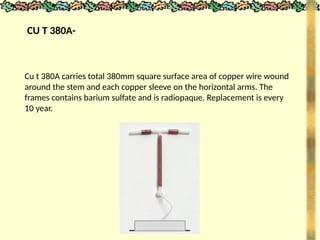
CU T 380A-
Cu t 380A carries total 380mm square surface area of copper wire wound
around the stem and each copper sleeve on the horizontal arms. The
frames contains barium sulfate and is radiopaque. Replacement is every
10 year.
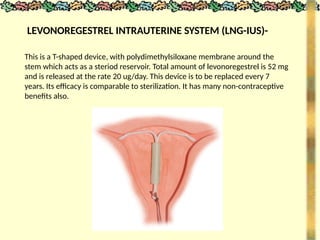
LEVONOREGESTREL INTRAUTERINE SYSTEM (LNG-IUS)-
This is a T-shaped device, with polydimethylsiloxane membrane around the
stem which acts as a steriod reservoir. Total amount of levonoregestrel is 52 mg
and is released at the rate 20 ug/day. This device is to be replaced every 7
years. Its efficacy is comparable to sterilization. It has many non-contraceptive
benefits also.
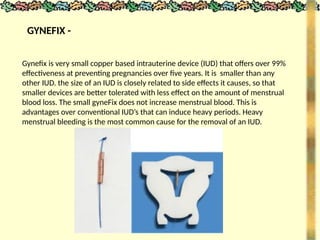
GYNEFIX -
Gynefix is very small copper based intrauterine device (IUD) that offers over 99%
effectiveness at preventing pregnancies over five years. It is smaller than any
other IUD. the size of an IUD is closely related to side effects it causes, so that
smaller devices are better tolerated with less effect on the amount of menstrual
blood loss. The small gyneFix does not increase menstrual blood. This is
advantages over conventional IUD’s that can induce heavy periods. Heavy
menstrual bleeding is the most common cause for the removal of an IUD.
CONTRAINDICATIONS FOR INSERTION OF IUCD-
1. Presence of pelvic infection current or within 3 months.
2. Undiagnosed genital tract bleeding.
3. Suspected pregnancy.
4. Distortion of the shape of the uterine cavity as in fibroid congenital
uterine – malformation.
5. Severe dysmenorrhea.
6. Past history of ectopic pregnancy.
7. within 6 weeks following cesarean section.
8. STIs – current or within 3 months.
9. Trophoblastic diseases.
10. Significant immunosuppression.
11. Wilson disease
12. Hepatic tumar
13. Copper allergy
14. Current breast cancer
15. Severe arterial diseases
METHOD OF INSERTION OF IUCD -
1. The patient empties her bladder and is placed in lithotomy position.
Uterine size and position are ascertained by pelvic examination.
2. Postrior vaginal speculum is introduced and the vagina and cervix
are cleansed by antiseptic lotion.
3. The anterior lip of the cervix is grasped by allis forceps. A sound is
passed through the cervical cannal to note the position of the uterus
and length of the uterine cavity the appropriate length of the
inserter is adjusted depending on the lenght of the uterine cavity.
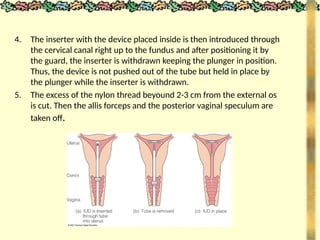
4. The inserter with the device placed inside is then introduced through
the cervical canal right up to the fundus and after positioning it by
the guard, the inserter is withdrawn keeping the plunger in position.
Thus, the device is not pushed out of the tube but held in place by
the plunger while the inserter is withdrawn.
5. The excess of the nylon thread beyound 2-3 cm from the external os
is cut. Then the allis forceps and the posterior vaginal speculum are
taken off.
‘’NO TOUCH’’ INSERTION TECHNIQUE INCLUDE-
I. Loading the IUD in the insertion without opening the sterile package. The
loaded inserter is now taken out of the package without touching the
distal end.
II. Not to touch the vaginal wall and the speculum while introducing the
loaded IUD inserter through the cervical canal.
COMPLICATIONS OF IUDS –
IMMEDIATE- 1. Cramp like pain- It is transient but at time, severe and usually
lasts for ½ to 1 hour. It is relieved by analgesic or antispasmodic drug.
2. Syncopal attack – Pain and syncopal attack are more often found in
nulliparous or when the device is large enough to distend the uterine
cavity.
3.partial or complete perforation – it is due to faulty technique of insertion
but liable to be met within lactational period when the uterus remain
small and soft.
REMOTE- 1. pain – the pain is more or less proportionate to the degree of
myometrial distension. A proper size of the device may minimize the
pain.
2. abnormal menstrual bleeding – the excessive bleeding involves
increased menstrual blood loss, menstrual loss is much less with use of
third generation IUDs.
3. pelvic infection – the risk of developing PID is 2-10 time greater
amongst IUD users. Infection with chlamydia and rarely with
actinomyces are seen. Newer IUDs reduce the risk.
4.spontneous expulsion – usually occurs within a few months following
insertion, more commonly during the period. The newer IUDs have got
less expulsion rate.
5. perforation of uterus - the incidence of uterine perforation is about 1
in 1000. it is however less common when the device is introduced by the
withdrawal technique.
6. pregnancy – the pregnancy rate with the device in situ is about 2 per
100 women year of use.
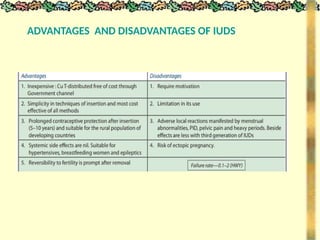
ADVANTAGES AND DISADVANTAGES OF IUDS
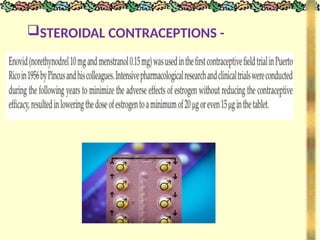
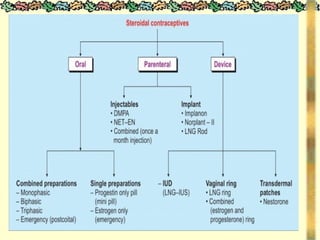
STEROIDAL CONTRACEPTIONS -
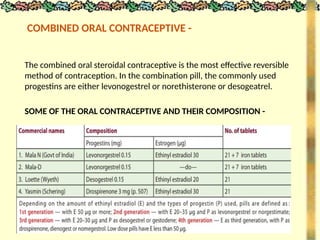
COMBINED ORAL CONTRACEPTIVE -
The combined oral steroidal contraceptive is the most effective reversible
method of contraception. In the combination pill, the commonly used
progestins are either levonogestrel or norethisterone or desogeatrel.
SOME OF THE ORAL CONTRACEPTIVE AND THEIR COMPOSITION -
MODE OF ACTION
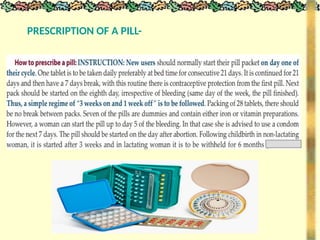
PRESCRIPTION OF A PILL-
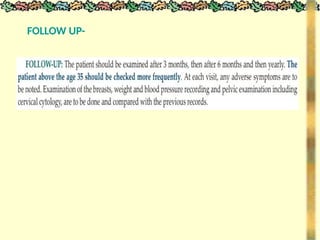
FOLLOW UP-
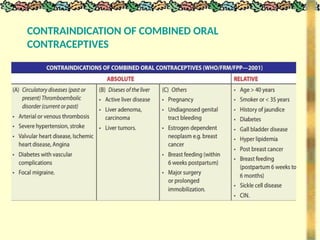
CONTRAINDICATION OF COMBINED ORAL
CONTRACEPTIVES
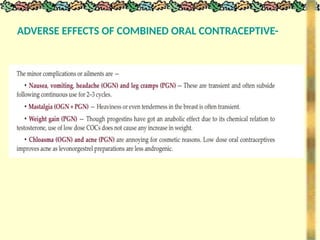
ADVERSE EFFECTS OF COMBINED ORAL CONTRACEPTIVE-
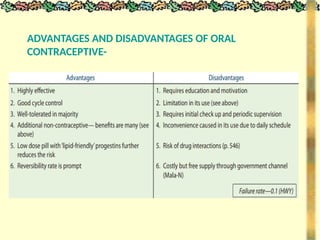
ADVANTAGES AND DISADVANTAGES OF ORAL
CONTRACEPTIVE-
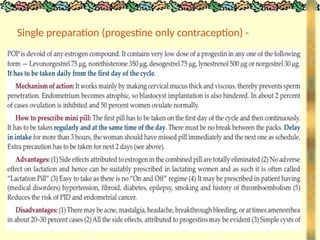
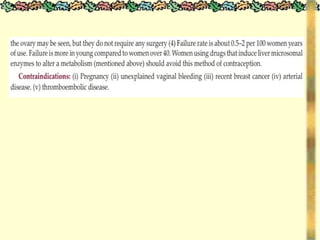
Single preparation (progestine only contraception) -
INJECTABLE PROGESTINS -
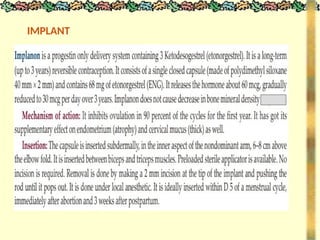
IMPLANT
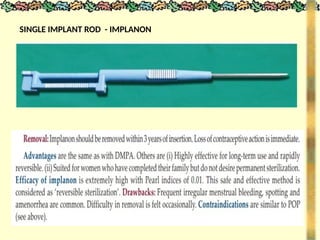
SINGLE IMPLANT ROD - IMPLANON
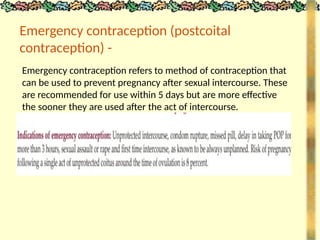
Emergency contraception (postcoital
contraception) -
Emergency contraception refers to method of contraception that
can be used to prevent pregnancy after sexual intercourse. These
are recommended for use within 5 days but are more effective
the sooner they are used after the act of intercourse.
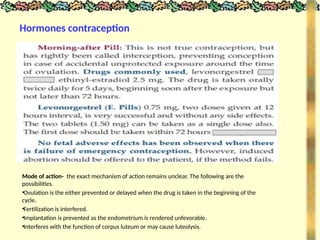
Hormones contraception
Mode of action- the exact mechanism of action remains unclear. The following are the
possibilities.
•Ovulation is the either prevented or delayed when the drug is taken in the beginning of the
cycle.
•Fertilization is interfered.
•Implantation is prevented as the endometrium is rendered unfevorable.
•Interferes with the function of corpus luteum or may cause luteolysis.
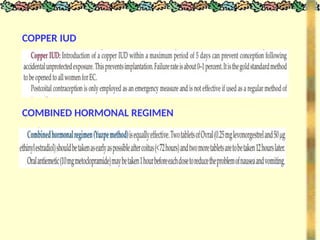
COPPER IUD
COMBINED HORMONAL REGIMEN
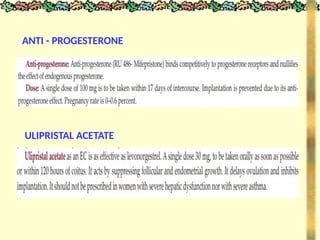
ANTI - PROGESTERONE
ULIPRISTAL ACETATE
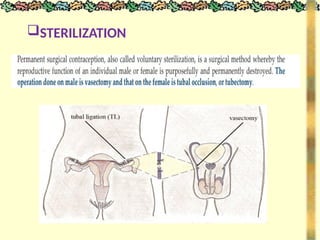
STERILIZATION
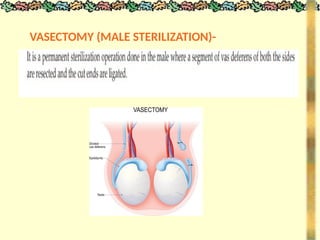
VASECTOMY (MALE STERILIZATION)-
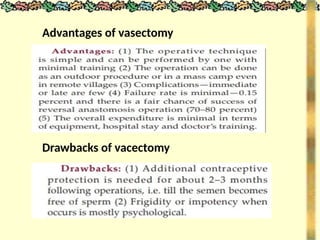
Advantages of vasectomy
Drawbacks of vacectomy
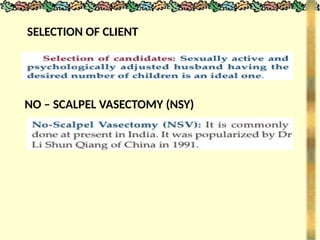
SELECTION OF CLIENT
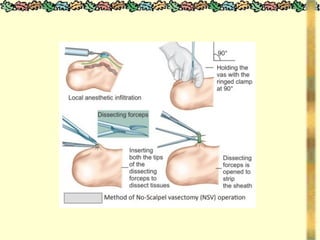
NO – SCALPEL VASECTOMY (NSY)
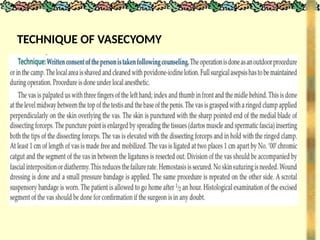
TECHNIQUE OF VASECYOMY
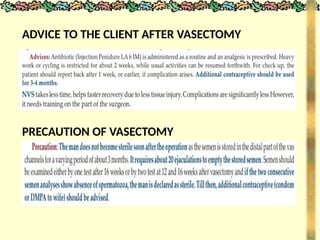
ADVICE TO THE CLIENT AFTER VASECTOMY
PRECAUTION OF VASECTOMY
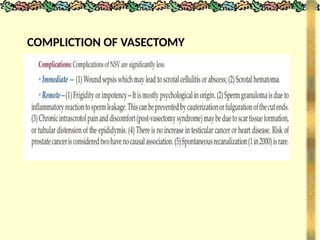
COMPLICTION OF VASECTOMY
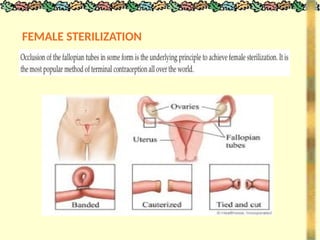
FEMALE STERILIZATION
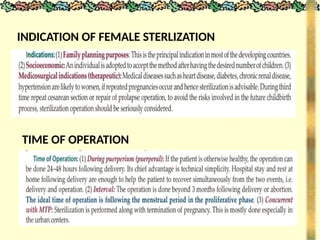
INDICATION OF FEMALE STERLIZATION
TIME OF OPERATION
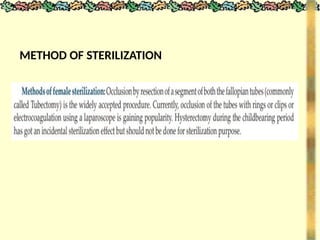
METHOD OF STERILIZATION
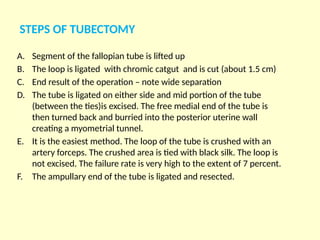
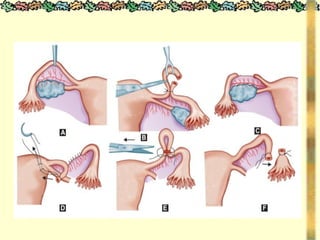
STEPS OF TUBECTOMY
A. Segment of the fallopian tube is lifted up
B. The loop is ligated with chromic catgut and is cut (about 1.5 cm)
C. End result of the operation – note wide separation
D. The tube is ligated on either side and mid portion of the tube
(between the ties)is excised. The free medial end of the tube is
then turned back and burried into the posterior uterine wall
creating a myometrial tunnel.
E. It is the easiest method. The loop of the tube is crushed with an
artery forceps. The crushed area is tied with black silk. The loop is
not excised. The failure rate is very high to the extent of 7 percent.
F. The ampullary end of the tube is ligated and resected.
ROLE OF NURSE IN FAMILY PLANNING AND CONTRACEPTION
Education of client in various methods of available, their effectiveness and
their side effects.
Help the client explore their feeling regarding birth control.
Create open relaxed atmosphere allowing cliients to express concerns &
feeling about birth control.
Thorough explanation of how methods works.
Instruction of client in possible complications and side effects.
Assess contraceptive knowledge attitudes and plans for pregnancy, need
for family planning, and preferred methods.
Provide non- judgemental, sensitive counselling.
METHODS_OF_CONTRACEPTION_&_EMERGENCY_CONTRACEPTION[1].pptx

METHODS_OF_CONTRACEPTION_&_EMERGENCY_CONTRACEPTION[1].pptx

  • 1.
  • 2.
    SDPS COLLEGE OFNURSING INDORE (M.P.) SUBJECT: MIDWIFERY & OBESTETRIC NURSING SUBMITTED TO : Mrs. PINKI THAKUR (PROFESSOR) SEMINAR ON : METHODS OF CONTRACEPTION & EMERGENCY CONTRACEPTION SUBMITTED BY: Ms. JAYA CHOUDHARY & KIRAN LACHHETA (B.sc. NURSING 4th YEAR)
  • 3.
     SEMINAR ON:METHODS OF CONTRACEPTION & EMERGENCY CONTRACEPTION Name of evaluator: Mrs . Pinki Thakur Name of student: Ms. Jaya choudhary & Ms. Kiran lacHheta Subject : midwifery & obstetric nursing Class : B.sc. Nursing 4th year Date & Time: Venue :online class on zoom app Language: English Method of teaching: lecture cum discussion A.V. Aids: power point presentation Review of previous knowledge: student have less knowledge about methods of contraception & emergency contraception. General objective: at the and of the class student will be able to explain about methods of contraception & emergency contraception.
  • 4.
     At theend of the seminar students will be able to - . Introduce the contraception. . Define the contraception. . Enlist the aims of contraception. . Enumerate the characteristics of ideal contraception. . Describe the all methods of contraception. . Role of nurse in family planning and contraception.
  • 5.
    Contraception is definedas the intentional prevention of conception through the use of various devices, sexual practices, chemicals, drugs or surgical procedures. An effective contraception, allows a physical relationship without fear of an unwanted pregnancy and ensures freedom to have children when desired. The aim is to achieve contraception in maximum comfort and privacy, with minimum cost and side effect. Some methods, like male and female condoms, also provide twine advantage of protection from sexually transmitted diseases. The burden of unsafe abortion lies primarily in developing countries. Here, contraceptive prevalence is measured among currently married women of reproductive age, and levels have not yet reached those exist in developed countries. INTRODUCTION
  • 6.
    contraception (birth control)prevents pregnancy by interfering with the normal process of ovulation, fertilization, and implantation. There are different kinds of birth control that act at different point in the process. DEFINITION
  • 7.
    or Birth control isthe use of any practice, methods, or devices to prevent pregnancy from occurring in a sexually active women. Also referred to as family planning , pregnancy prevention, fertility control, or contraception; birth control methods are designed either to prevent fertilization of an egg or implantation of a fertilization egg in the uterus.
  • 8.
    AIMS FOR CONTRACEPTIONMETHODS To avoid unwanted birth. To bring about wanted births.
  • 9.
    To regulate theintervals between the pregnancy. To control the time at which birth occur in relation to the ages of the parent .  To determine the number of children in the family.
  • 10.
    To reduce thestress of pregnancy, labour & lactation in women suffering from heart diseases. To prevent STDs like AIDS.
  • 11.
    CHARACTERISTICS OF IDEAL CONTRACEPTIVES 1.Ideal contraceptive method should be highly (100%) effective. 2. Acceptive 3. Safe 4. Reversible 5. Cheap 6. Having non contraceptive benefits. 7. Simple to use 8. Requiring minimal motivation. 9. Maintenance and supervision
  • 12.
    METHODS OF CONTRACEPTION •Barriermethods •Natural contraception •IUCDs •Steroidal contraception TEMPORARY PERMANENT Female (Tubal occlusion) Male (vasectomy)
  • 13.
    TEMPORARY METHODS OFCONTRACEPTION Temporary method are commonly used to postpone or to space birth. However, the methods are also frequently being used by the couples even though they have got strong desire for no more children.
  • 14.
     BARRIER METHOD Thesemethod prevent sperm deposition in the vagina or prevent sperm penetration through the cervical canal. The objective is achieved by mechanical device or by combined means. The following are used. •Mechanical Male – condom Female - condom, diaphragm, cervical cap. •Chemical (vaginal contraceptives) Creams – delfen (nonoxynol-9, 12.5%) Jelly – koromex, volpar paste Foam tablets – aerrosol foams, chlorimin T or contab, sponge (today) •Combination Combined use of mechanical and chemical.
  • 15.
    CONDOM- Male condom- condomsare made of polyurethane or latex. Polyurethane condoms are thinner and suitable to those who are sensitive to latex rubber. It is the most widely practiced method used by the male in India, one particular brand (latex)is widely marketed as ‘Nirodh’. Female condom- it is a pouch made of polyurethane which lines the vagina and also external genitalia, it is 17 cm in length with one flexible polyurethane ring at each end. Inner ring at the closed end is smaller compared to the outer ring. Inner ring is inserted at the outer ring. Inner ring is inserted at the apex of the vagina and the outer ring remains outside.
  • 16.
    USE OF CONDOM- 1.as an elective contraception method. 2. As an interim form of contraception during pill use, following vasectomy operation and if an IUD can be fitted. 3. During the treatment of trichomonal vaginitis of the wife, the husband should use it during the course of treatment irrespective of contraceptive practice. 4. Immunological infertility – male partner to use for 3 months. For other non contraceptive benefits. ADVANTAGES OF CONDOM- • Cheaper with no contraindication • No side effects • Easy to carry, simple to use and disposable • Protection against sexually transmitted disease, e.g. Gonorrhea, chlamydia, HPV and HIV. • Protection against pelvic inflammatory disease. • Reduces the incidence of tubal infertillity and ectopic pregnancy.
  • 17.
    •Protection against cervicalcell abnormalities. •Useful where the coital act is infrequent and irregular. DISADVANTAGES OF CONDOM- •May accidentally break or slip off during coitus. •Inadequate sexual pleasure. •Allergic reaction (latex) •To discard after one coital act •Failure rate – 15 (HWY)
  • 18.
    DIAPHRAGM- It is anintra vaginal device made of latex with flexible metal or spring ring at the margin. Its diameter varies from 5 – 10cm. It requires a medical or paramedical personnel to measure the size of the device. The device is introduced up to 3 hours before intercourse and is to be kept for at least 6 hours after the last coital act. Ill fitting and accidental displacement during intercourse increase the failure rate. ADVANTAGES OF DIAPHRAGM- •Cheap •Can be used repeatedly for a long time •Reduces PID/STIs to some extent •Protects against cervical pre cancer and cancer. DISADVANTAGES OF DIAPHRAGM- •Requires help of a doctor or paramedical person to measure the size required. •Risk of vaginal irritation and urinary tract infection are there. •Not suitable for women with uterine prolapse.
  • 19.
    VAGINAL CONTRACEPTIVE SPERMICIDES - spermicidesare available as vaginal foams, gels, creams, tablets and suppositories. Usually, they contain surfactant like nonoxynol-9 ,octoxynol benzalkonium chloride. These agents mostly cause sperm immobilization. The cream or jelly is introduced high in the vagina with the help of the applicator soon before coitus. Foam tablets(1- 2) are to be introduced high in the vagina at least 5 min. prior to intercourse.
  • 20.
    VAGINAL CONTRACEPTIVE SPONGE(TODAY)- It release spermicide during coitus, absorb ejaculate and block the entrance to the cervical canal. The sponge should not be removed for 6 hours after intercourse. Its failure rate (HWY) is about – parous women: 32-20, nulliparous 16-9.
  • 21.
     NATURAL CONTRACEPTION- FERTILITYAWARENRSS METHOD (RHYTHM METHOD)- Fertility awareness method requires partners cooperation. The women should know the fertility time of her menstrual cycle. The method to determine the approximate time of ovulation and the fertility period include-
  • 22.
    a) Recording ofprevious menstrual cycle (calendar rhythm) b) Noting the basal body temperature chart (temperature rhythm) c) Noting excessive mucoid vaginal discharge (mucus rhythm) The user of the calendar method obtain the period of abstinence from calculation based on the previous twelve menstrual cycle record. The first unsafe day obtain by subtracting 20 days from the length of the shortest cycle and last unsafe day by deducting 10 days from the longest cycle. Users of temperature rhythm require abstinence until the third day of the rise of temperature. Users of mucus rhythm require abstinence on all days of noticeable mucus and for 3 days thereafter. ADVANTAGES OF RHYTHM METHOD- • No cost • No side effects • Failure rate- 20-30 (HWY)
  • 23.
    DISADVANTAGES OF RHYTHMMETHOD- •Difficult to calculate the safe period reliably. •Needs several months training to use these method. •Compulsory abstinence from sexual act during certain periods. •Not applicable during lactation amenorrhea or when the periods are irregular.
  • 24.
    COITUS INTERRUPTUS (WITHDRAWAL)- it is the oldest and probably the most widely accepted contraceptive method used by man. It necessitates withdrawal of penis shortly before ejaculation. It requires sufficient self-control by the man so that withdrawal of penis precedes ejaculation. ADVANTAGES OF COITUS INTERRUPTUS- •No appliance is required. •No cost. •Failure rate-27 (HWY) DISADVANTAGES OF COITUS INTERRUPTUS- •Requires sufficient self control by the man. •The women may develop anxiety neurosis, vaginismus or pelvic congestion •Chance of pregnancy is more percoital secretion may contain sperm. accidental chance of sperm deposition into the vagina.
  • 25.
    LACTATION AMENORRHEA METHOD(LAM)- Prolonged and sustained breastfeeding offers a natural protection of pregnancy. This is more effective in women who are amenorrheic than those who are menstruating. The risk of pregnancy to women who is fully breastfeeding and amenorrheic is less than 2 percent in the first 6 months. Otherwise, the failure rate is high (1-10 percent). Thus during breastfeeding, additional contraceptive support should be given by, condom, IUCD or injectable steroids where available to provide complete contraception.
  • 26.
    INTRAUTERINE DEVICE An intrauterinedevice, also known as intrauterine contraceptive device or coil, is a small, often t-shaped birth control device that is inserted into the uterus to prevent pregnancy. IUD are one form of long acting reversible birth control.
  • 27.
    THE FOLLOWING MEDICATEDINTRAUTERINE CONTRACEPTIVE DEVICE ARE IN USE- 1. Cu T 200 2. Multiload Cu 250 3. Multiload 375 4. Cu T 380 A 5. LNG – IUS 6. gynefix
  • 28.
    CU T 200- Thewidely used medicated device is copper T 200 . It carries 215sq mm area of fine copper wire wounded round the vertical stem of the devices. Stem of the T-shaped device is made of a polyethylene frame . the device is to be removed after 4 year.
  • 29.
    MULTILOAD CU250- the deviceemits 60-100ug of copper per day during a period of one year. The device is to be replaced every 3 years.
  • 30.
    MULTILOAD – 375- Thedevice is available in sterilized sealed packet with an applicator. There is no introducer and no plunger. It has 375 mm square surface area of cooper wire wound around its vertical stem. Replacement is every 5 years.
  • 31.
    CU T 380A- Cut 380A carries total 380mm square surface area of copper wire wound around the stem and each copper sleeve on the horizontal arms. The frames contains barium sulfate and is radiopaque. Replacement is every 10 year.
  • 32.
    LEVONOREGESTREL INTRAUTERINE SYSTEM(LNG-IUS)- This is a T-shaped device, with polydimethylsiloxane membrane around the stem which acts as a steriod reservoir. Total amount of levonoregestrel is 52 mg and is released at the rate 20 ug/day. This device is to be replaced every 7 years. Its efficacy is comparable to sterilization. It has many non-contraceptive benefits also.
  • 33.
    GYNEFIX - Gynefix isvery small copper based intrauterine device (IUD) that offers over 99% effectiveness at preventing pregnancies over five years. It is smaller than any other IUD. the size of an IUD is closely related to side effects it causes, so that smaller devices are better tolerated with less effect on the amount of menstrual blood loss. The small gyneFix does not increase menstrual blood. This is advantages over conventional IUD’s that can induce heavy periods. Heavy menstrual bleeding is the most common cause for the removal of an IUD.
  • 34.
    CONTRAINDICATIONS FOR INSERTIONOF IUCD- 1. Presence of pelvic infection current or within 3 months. 2. Undiagnosed genital tract bleeding. 3. Suspected pregnancy. 4. Distortion of the shape of the uterine cavity as in fibroid congenital uterine – malformation. 5. Severe dysmenorrhea. 6. Past history of ectopic pregnancy. 7. within 6 weeks following cesarean section. 8. STIs – current or within 3 months. 9. Trophoblastic diseases. 10. Significant immunosuppression. 11. Wilson disease 12. Hepatic tumar 13. Copper allergy 14. Current breast cancer 15. Severe arterial diseases
  • 35.
    METHOD OF INSERTIONOF IUCD - 1. The patient empties her bladder and is placed in lithotomy position. Uterine size and position are ascertained by pelvic examination. 2. Postrior vaginal speculum is introduced and the vagina and cervix are cleansed by antiseptic lotion. 3. The anterior lip of the cervix is grasped by allis forceps. A sound is passed through the cervical cannal to note the position of the uterus and length of the uterine cavity the appropriate length of the inserter is adjusted depending on the lenght of the uterine cavity.
  • 36.
    4. The inserterwith the device placed inside is then introduced through the cervical canal right up to the fundus and after positioning it by the guard, the inserter is withdrawn keeping the plunger in position. Thus, the device is not pushed out of the tube but held in place by the plunger while the inserter is withdrawn. 5. The excess of the nylon thread beyound 2-3 cm from the external os is cut. Then the allis forceps and the posterior vaginal speculum are taken off.
  • 37.
    ‘’NO TOUCH’’ INSERTIONTECHNIQUE INCLUDE- I. Loading the IUD in the insertion without opening the sterile package. The loaded inserter is now taken out of the package without touching the distal end. II. Not to touch the vaginal wall and the speculum while introducing the loaded IUD inserter through the cervical canal. COMPLICATIONS OF IUDS – IMMEDIATE- 1. Cramp like pain- It is transient but at time, severe and usually lasts for ½ to 1 hour. It is relieved by analgesic or antispasmodic drug. 2. Syncopal attack – Pain and syncopal attack are more often found in nulliparous or when the device is large enough to distend the uterine cavity. 3.partial or complete perforation – it is due to faulty technique of insertion but liable to be met within lactational period when the uterus remain small and soft.
  • 38.
    REMOTE- 1. pain– the pain is more or less proportionate to the degree of myometrial distension. A proper size of the device may minimize the pain. 2. abnormal menstrual bleeding – the excessive bleeding involves increased menstrual blood loss, menstrual loss is much less with use of third generation IUDs. 3. pelvic infection – the risk of developing PID is 2-10 time greater amongst IUD users. Infection with chlamydia and rarely with actinomyces are seen. Newer IUDs reduce the risk. 4.spontneous expulsion – usually occurs within a few months following insertion, more commonly during the period. The newer IUDs have got less expulsion rate. 5. perforation of uterus - the incidence of uterine perforation is about 1 in 1000. it is however less common when the device is introduced by the withdrawal technique. 6. pregnancy – the pregnancy rate with the device in situ is about 2 per 100 women year of use.
  • 39.
  • 40.
  • 42.
    COMBINED ORAL CONTRACEPTIVE- The combined oral steroidal contraceptive is the most effective reversible method of contraception. In the combination pill, the commonly used progestins are either levonogestrel or norethisterone or desogeatrel. SOME OF THE ORAL CONTRACEPTIVE AND THEIR COMPOSITION -
  • 43.
  • 44.
  • 45.
  • 46.
    CONTRAINDICATION OF COMBINEDORAL CONTRACEPTIVES
  • 47.
    ADVERSE EFFECTS OFCOMBINED ORAL CONTRACEPTIVE-
  • 48.
    ADVANTAGES AND DISADVANTAGESOF ORAL CONTRACEPTIVE-
  • 49.
    Single preparation (progestineonly contraception) -
  • 51.
  • 52.
  • 53.
  • 54.
    Emergency contraception (postcoital contraception)- Emergency contraception refers to method of contraception that can be used to prevent pregnancy after sexual intercourse. These are recommended for use within 5 days but are more effective the sooner they are used after the act of intercourse.
  • 55.
    Hormones contraception Mode ofaction- the exact mechanism of action remains unclear. The following are the possibilities. •Ovulation is the either prevented or delayed when the drug is taken in the beginning of the cycle. •Fertilization is interfered. •Implantation is prevented as the endometrium is rendered unfevorable. •Interferes with the function of corpus luteum or may cause luteolysis.
  • 56.
  • 57.
  • 58.
  • 59.
  • 60.
  • 61.
    SELECTION OF CLIENT NO– SCALPEL VASECTOMY (NSY)
  • 62.
  • 64.
    ADVICE TO THECLIENT AFTER VASECTOMY PRECAUTION OF VASECTOMY
  • 65.
  • 66.
  • 67.
    INDICATION OF FEMALESTERLIZATION TIME OF OPERATION
  • 68.
  • 69.
    STEPS OF TUBECTOMY A.Segment of the fallopian tube is lifted up B. The loop is ligated with chromic catgut and is cut (about 1.5 cm) C. End result of the operation – note wide separation D. The tube is ligated on either side and mid portion of the tube (between the ties)is excised. The free medial end of the tube is then turned back and burried into the posterior uterine wall creating a myometrial tunnel. E. It is the easiest method. The loop of the tube is crushed with an artery forceps. The crushed area is tied with black silk. The loop is not excised. The failure rate is very high to the extent of 7 percent. F. The ampullary end of the tube is ligated and resected.
  • 73.
    ROLE OF NURSEIN FAMILY PLANNING AND CONTRACEPTION Education of client in various methods of available, their effectiveness and their side effects. Help the client explore their feeling regarding birth control. Create open relaxed atmosphere allowing cliients to express concerns & feeling about birth control. Thorough explanation of how methods works. Instruction of client in possible complications and side effects. Assess contraceptive knowledge attitudes and plans for pregnancy, need for family planning, and preferred methods. Provide non- judgemental, sensitive counselling.