Various MRI Sequences
How to identify and its
Clinical significance
Co-Ordinator: Dr.U.Meenakshisundaram
Presenter: Dr.M.Ramesh Babu
Apollo Main Hospital
SYMPOSIUM ON NEURO IMAGING
• MRI - an imaging modality that uses non-ionising
radiation to create useful diagnostic images.
• MRI pulse sequence - a programmed set of
changing magnetic gradients.
• Number of parameters: TE, TR, flip angle,
diffusion weighting
• Multiple sequences are grouped together into an
MRI protocol.
• Different combinations of these parameters affect
tissue contrast and spatial resolution.
• NMR - discovered just after the end of the Second
World War.
INTRODUCTION
MRI Principle
• MRI is based on the principle of nuclear magnetic
resonance (NMR)
• Two basic principles of NM
• Atoms with an odd number of protons or neutrons
have spin
• A moving electric charge, be it positive or negative,
produces a magnetic field
• Body has many such atoms that can act as good MR
nuclei (1H,13C, 19F, 23Na)
• Hydrogen nuclei is one of them which is not only
positively charged, but also has magnetic spin
• MRI utilizes this magnetic spin property of protons of
hydrogen to elicit images
• MRI- the use of NMR to produce 2D
images in 1976.
• Human images a year later in 1977
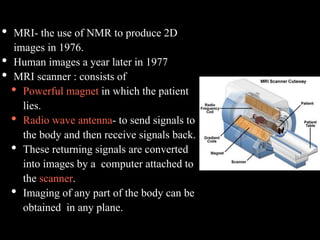
• MRI scanner : consists of
• Powerful magnet in which the patient
lies.
• Radio wave antenna- to send signals to
the body and then receive signals back.
• These returning signals are converted
into images by a computer attached to
the scanner.
• Imaging of any part of the body can be
obtained in any plane.
TR & TE
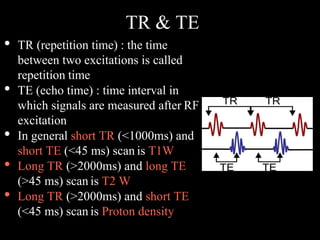
• TR (repetition time) : the time
between two excitations is called
repetition time
• TE (echo time) : time interval in
which signals are measured after RF
excitation
• In general short TR (<1000ms) and
short TE (<45 ms) scan is T1W
• Long TR (>2000ms) and long TE
(>45 ms) scan is T2 W
• Long TR (>2000ms) and short TE
(<45 ms) scan is Proton density
Why MRI?
• No ionising radiation
• Image aquisition in multiple planes
• Superior soft tissue contrast
• Some angiographic images can be obtained without
the use of contrast material
• Advanced techniques such as diffusion, spectroscopy
and perfusion allow for precise tissue characterisation
rather than merely 'macroscopic' imaging
• Functional MRI allows visualisation of both active
parts of the brain during certain activities and
understanding of the underlying networks
• Risk of iodinated contrast allergy alleviated
Disadvantages
• More expensive
• Not easily available
• Longer scan time
• Patient comfort can be an issue - Noisy ,
Claustrophobia
• Subject to unique artefacts
• Not safe patients with some metal implants,
pacemaker and foreign bodies
• MR contrast posses risk
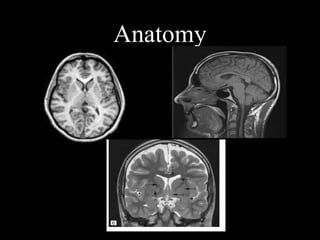
Anatomy
Descriptive Terminology
• High signal intensity/ hyperintense = White
• Intermediate signal intensity/ isointense = Grey
• Lowsignal intensity/ hypointense = Black
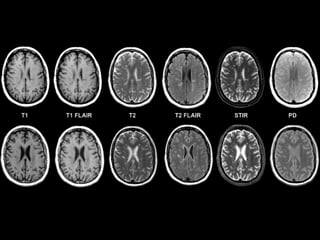
Variety of Sequences
•T1WI
•T2WI
•POST GD
•FLAIR
•STIR
•DW1/ADC
•GRE/SWI
•PDWI
•MRS
•MRA
•MRV
•CSFFLOWSTUDY
•MR PERFUSION
•DTI
•PET
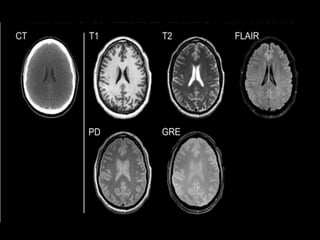
T1 & T2 W IMAGING
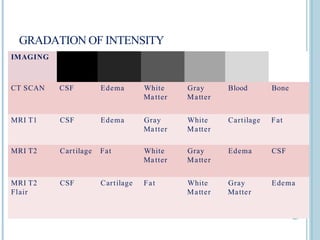
GRADATION OF INTENSITY
IMAGING
CT SCAN CSF Edema White
Matter
Gray
Matter
Blood Bone
MRI T1 CSF Edema Gray
Matter
White
Matter
Cartilage Fat
MRI T2 Cartilage Fat White
Matter
Gray
Matter
Edema CSF
MRI T2
Flair
CSF Cartilage Fat White
Matter
Gray
Matter
Edema
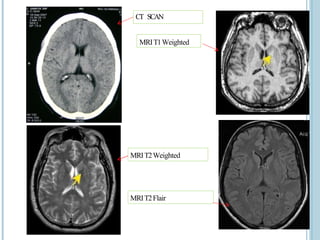
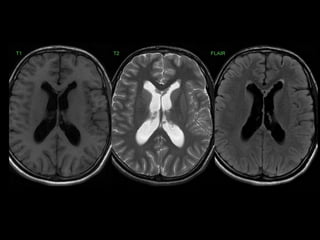
CT SCAN
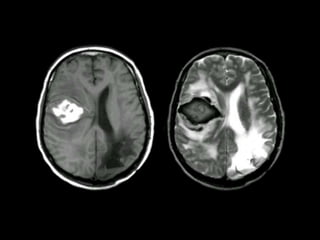
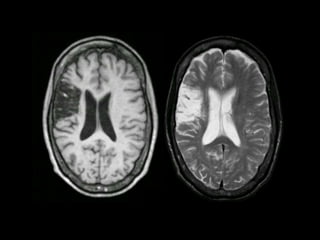
MRIT1Weighted
MRIT2Weighted
MRIT2Flair
Dark On T1
• Edema
• Tumor
• Infection
• Inflammation
• Hemorrhage( hyperacute, chronic)
• Low proton density,
• Calcification
• Flow void
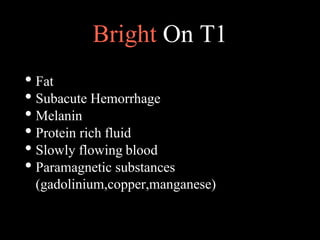
Bright On T1
• Fat
• Subacute Hemorrhage
• Melanin
• Protein rich fluid
• Slowly flowing blood
• Paramagnetic substances
(gadolinium,copper,manganese)
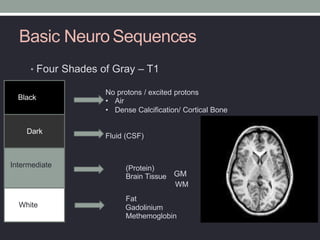
Basic Neuro Sequences
• Four Shades of Gray – T1
No protons / excited protons
• Air
• Dense Calcification/ Cortical Bone
Fluid (CSF)
(Protein)
Brain Tissue GM
WM
Fat
Gadolinium
Methemoglobin
Black
Dark
Intermediate
White
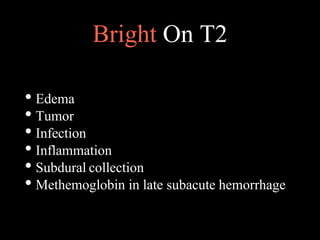
Bright On T2
• Edema
• Tumor
• Infection
• Inflammation
• Subdural collection
• Methemoglobin in late subacute hemorrhage
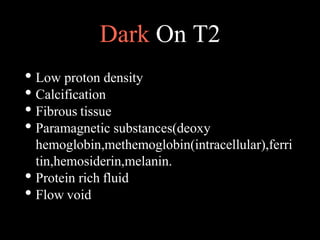
Dark On T2
• Low proton density
• Calcification
• Fibrous tissue
• Paramagnetic substances(deoxy
hemoglobin,methemoglobin(intracellular),ferri
tin,hemosiderin,melanin.
• Protein rich fluid
• Flow void
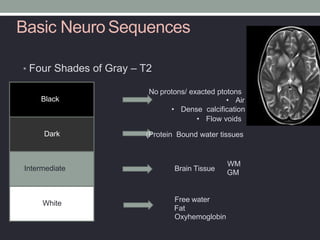
Basic Neuro Sequences
• Four Shades of Gray – T2
No protons/ exacted ptotons
• Air
• Dense calcification
• Flow voids
(Protein Bound water tissues
WM
GM
Brain Tissue
Free water
Fat
Oxyhemoglobin
Black
Dark
Intermediate
White
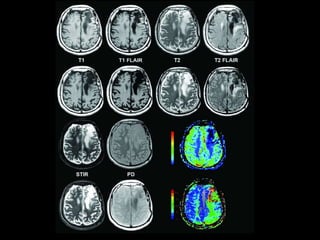
Which Scan Best Defines the
Abnormality
T1 W Images:
Subacute Hemorrhage, Fat-containing
structures, Anatomical Details
T2 W Images:
Edema, Demyelination, Infarction,
Chronic Hemorrhage
FLAIR Images:
Edema, Demyelination,
Infarction esp. in Periventricular location
FLAIR & STIR
Conventional Inversion
Recovery
• Two important clinical implementations of the
inversion recovery concept are:
• Short Time to inversion-recovery (STIR)
sequence
• Fluid-attenuated inversion-recovery (FLAIR)
sequence.
Short Time to Invertion
Recovery
STIR
• It is transverse magnetization that induces an electric
current in the receiver coilsono signal is generated from
fat.
• STIR sequences provide excellent depiction of bone
marrow edema which may be the only indication of an
occult fracture.
• Unlike conventional fat-saturation sequences STIR
sequences are not affected by magnetic field
inhomogeneities, so they are more efficient for nulling the
signal from fat
FLAIR
• First described in 1992 and has become one of the
corner stones of brain MR imaging protocols.
• A sequence with a long TR and TE and an inversion time
(TI) that is tailored to null the signal from CSF
• In contrast to real image reconstruction, negative signals
are recorded as positive signals of the same strength so that
the nulled tissue remains dark and all other tissues have
higher signal intensities.
• Most pathologic processes show increased SI on T2-
WI, and the conspicuity of lesions that are located
close to interfaces b/w brain parenchyma and CSF
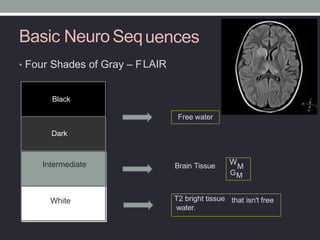
• FLAIR images are heavily T2-weighted with CSF
signal suppression, highlights hyperintense lesions
and improves their conspicuity and detection,
especially when located adjacent to CSF containing
spaces
Basic Neuro Seq
• Four Shades of Gray – F
that isn't free
uences
LAIR
M
M
Black
Free water
Dark
Intermediate Brain Tissue
W
G
White T2 bright tissue
water.
Clinical Implications
• It is used to evaluate diseases affecting the brain parenchyma
neighboring the CSF- containing spaces for eg: MS & other
demyelinating disorders.
• Unfortunately, less sensitive for lesions involving the brainstem &
cerebellum, owing to CSF pulsation artifacts
• Helpful in evaluation of neonates with perinatal HIE.
• Useful in evaluation of gliomatosis cerebri owing to its superior
delineation of neoplastic spread
• Useful for differentiating extra-axial masses eg. epidermoid cysts
from arachnoid cysts. However, distinction is more easier &
reliable with DWI.
• Mesial temporal sclerosis: m/c pathology in pts. with
partial complex seizures.Thin-section coronal FLAIR is
the standard sequence in these patients & seen as a bright
small hippocampus on dark background of suppressed CSF
containing spaces. However, normally also mesial
temporal lobes have mildly increased SI on FLAIR
images.
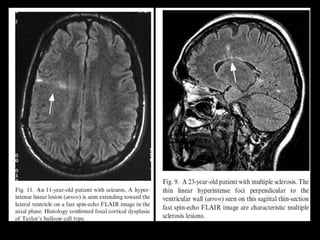
• Focal cortical dysplasia of Taylor’s balloon cell type-
markedly hyperintense funnel- shaped subcortical zone
tapering toward the lateral ventricle is the characteristic
FLAIR imaging finding
• In Tuberous Sclerosis- detection of hamartomatous lesions,
is easier with FLAIR than with PD or T2-W sequences
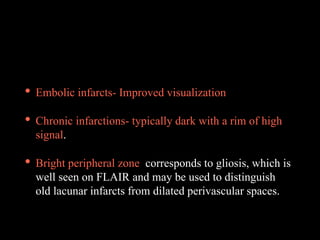
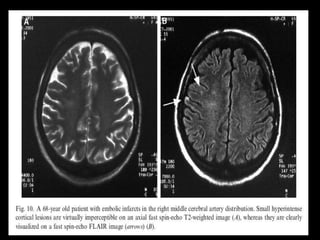
• Embolic infarcts- Improved visualization
• Chronic infarctions- typically dark with a rim of high
signal.
• Bright peripheral zone corresponds to gliosis, which is
well seen on FLAIR and may be used to distinguish
old lacunar infarcts from dilated perivascular spaces.
Subarachnoid Hemorrhage (SAH):
• FLAIR imaging surpasses even CT in the detection of
traumatic supratentorial SAH.
• It has been proposed that MR imaging with FLAIR,
gradient-echo T2*-weighted, and rapid high-spatial
resolution MR angiography could be used to evaluate
patients with suspected acute SAH, possibly obviating
the need for CT and intra-arterial angiography.
• With the availability of high-quality CT angiography,
this approach may not be necessary.
DWI & ADC
DWI
• Diffusion-weighted MRI is a example of endogenous contrast,
using the motion of protons to produce signal changes.
• DWI images is obtained by applying pairs of opposing and
balanced magnetic field gradients (but of differing durations
and amplitudes) around a spin-echo refocusing pulse of a T2
weighted sequence.
• Stationary water molecules are unaffected by the paired
gradients, and thus retain their signal. Nonstationary water
molecules acquire phase information from the first gradient,
but are not rephased by the second gradient, leading to an
overall loss of the MR signal.
• The normal motion of water molecules within living tissues
is random (brownian motion).
• In acute stroke, there is an alteration of homeostasis.
• Acute stroke causes excess intracellular water accumulation,
or cytotoxic edema, with an overall decreased rate of water
molecular diffusion within the affected tissue.
• Reduction of extracellular space - Tissues with a higher
rate of diffusion undergo a greater loss of signal in a given
period of time than do tissues with a lower diffusion rate.
• Therefore, areas of cytotoxic edema, in which the motion of
water molecules is restricted, appear brighter on diffusion-
weighted images because of lesser signal losses.
• Restriction of DWI is not specific for stroke
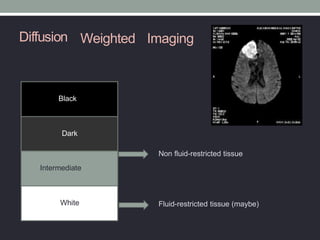
Diffusion Weighted Imaging
Non fluid-restricted tissue
Fluid-restricted tissue (maybe)
Black
Dark
Intermediate
White
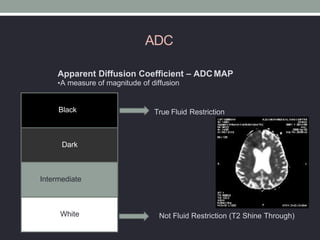
ADC
Apparent Diffusion Coefficient – ADC MAP
•A measure of magnitude of diffusion
True Fluid Restriction
Not Fluid Restriction (T2 Shine Through)
Black
Dark
Intermediate
White
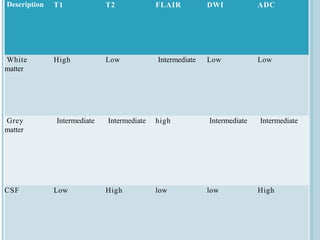
Description T1 T2 FLAIR DWI ADC
White
matter
High Low Intermediate Low Low
Grey
matter
Intermediate Intermediate high Intermediate Intermediate
CSF Low High low low High
• The primary application of DW MR imaging has
been in brain imaging, mainly because of its
exquisite sensitivity to early detection of ischemic
stroke.
• The increased sensitivity of diffusion-weighted
MRI in detecting acute ischemia is thought to be
the result of the water shift intracellularly
restricting motion of water protons (cytotoxic
edema), whereas the conventional T2 weighted
images show signal alteration mostly as a result of
vasogenic edema.
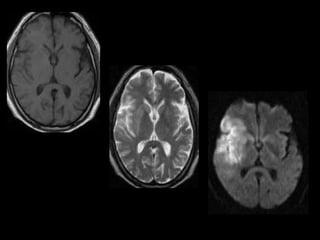
• Core of infarct = irreversible damage
• Surrounding ischemic area ◊ may be salvaged
• Regions of high mobility “rapid diffusion” ◊ dark
• Regions of low mobility “slow diffusion” ◊ bright
• Difficulty: DWI is highly sensitive to all of types of
motion (blood flow, pulsatility, patient motion).
DWI useful in Diagnosing
• Ischemic Stroke
• Extra axial masses: arachnoid cyst versus
epidermoid tumor, Intracranial Infections
Pyogenic infection, Herpes encephalitis,
Creutzfeldt-Jakob disease
• Trauma
• Demyelination
Apparent Diffusion Coefficient
• It is a measure of diffusion
• Calculated by acquiring two or more images with a
different gradient duration and amplitude
(b-values)
• To differentiate T2 shine through effects or
artifacts from real ischemic lesions.
• The lower ADC measurements seen with early
ischemia,
• An ADC map shows parametric images containing
the apparent diffusion coefficients of diffusion
weighted images. Also called diffusion map
ADC
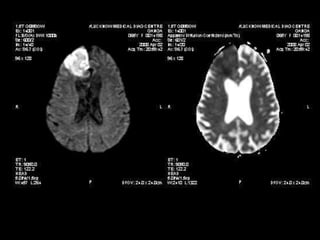
• The ADC may be useful for estimating the lesion age
and distinguishing acute from subacute DWI lesions.
• Acute ischemic lesions can be divided into hyperacute
lesions (low ADC and DWI-positive)
• Chronic lesions can be differentiated from acute lesions
by normalization of ADC and DWI.
• A tumour would exhibit more restricted apparent
diffusion compared with a cyst because intact cellular
membranes in a tumour would hinder the free
movement of water molecules
Non Ischemic Causes For Decreased ADC
• Abscess
• Lymphoma and other tumors
• Multiple sclerosis
• Seizures
• Metabolic (Canavans )
DW MRI characteristics of Various
Disease Entities
MR Signal Intensity
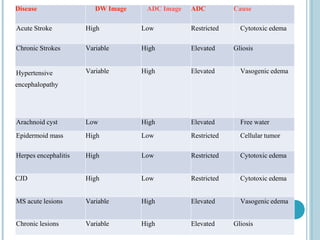
Disease DW Image ADC Image ADC Cause
Acute Stroke High Low Restricted Cytotoxic edema
Chronic Strokes Variable High Elevated Gliosis
Hypertensive
encephalopathy
Variable High Elevated Vasogenic edema
Arachnoid cyst Low High Elevated Free water
Epidermoid mass High Low Restricted Cellular tumor
Herpes encephalitis High Low Restricted Cytotoxic edema
CJD High Low Restricted Cytotoxic edema
MS acute lesions Variable High Elevated Vasogenic edema
Chronic lesions Variable High Elevated Gliosis
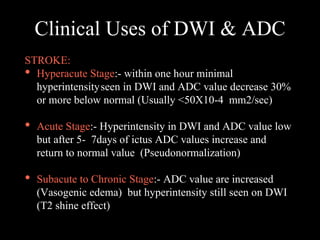
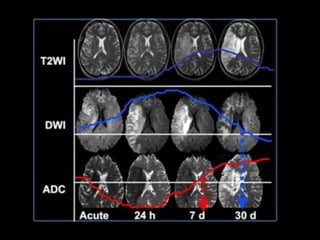
Clinical Uses of DWI & ADC
STROKE:
• Hyperacute Stage:- within one hour minimal
hyperintensityseen in DWI and ADC value decrease 30%
or more below normal (Usually <50X10-4 mm2/sec)
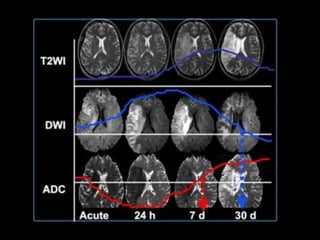
• Acute Stage:- Hyperintensity in DWI and ADC value low
but after 5- 7days of ictus ADC values increase and
return to normal value (Pseudonormalization)
• Subacute to Chronic Stage:- ADC value are increased
(Vasogenic edema) but hyperintensity still seen on DWI
(T2 shine effect)
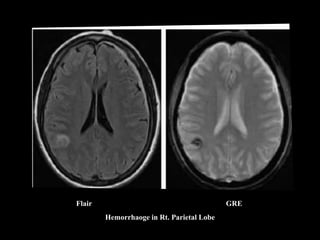
GRE
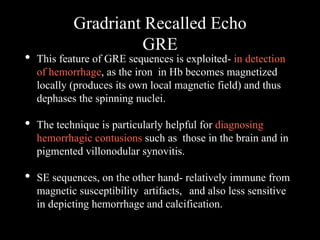
Gradriant Recalled Echo
GRE
• This feature of GRE sequences is exploited- in detection
of hemorrhage, as the iron in Hb becomes magnetized
locally (produces its own local magnetic field) and thus
dephases the spinning nuclei.
• The technique is particularly helpful for diagnosing
hemorrhagic contusions such as those in the brain and in
pigmented villonodular synovitis.
• SE sequences, on the other hand- relatively immune from
magnetic susceptibility artifacts, and also less sensitive
in depicting hemorrhage and calcification.
Flair GRE
Hemorrhaoge in Rt. Parietal Lobe
Gradiant Echo
• Prons : Fast Technique
• Cons :
• More sensitivity to magnetic susceptibility
artefacts
• Clinical Use: Eg: Haemorrhage or Calcification
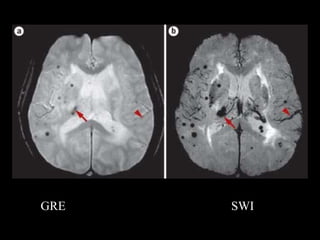
GRE SWI
Susceptibility Weighted Imaging
• SWI is a very sensitive type of gradient echo MR
sequence.
• SWI is for the identification of small amounts of
hemorrhage/blood product or calcium, both of which
may be inapparent on other MR sequences.
• Compounds that have paramagnetic, diamagnetic, and
ferromagnetic properties all interact with the local
magnetic field and result in loss of signal.
• SWI is more sensitive than GRE for cerebral
microbleeds.
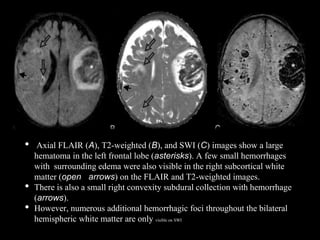
• Axial FLAIR (A), T2-weighted (B), and SWI (C) images show a large
hematoma in the left frontal lobe (asterisks). A few small hemorrhages
with surrounding edema were also visible in the right subcortical white
matter (open arrows) on the FLAIR and T2-weighted images.
• There is also a small right convexity subdural collection with hemorrhage
(arrows).
• However, numerous additional hemorrhagic foci throughout the bilateral
hemispheric white matter are only visible on SWI
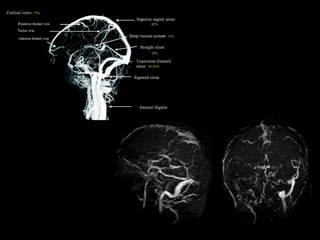
MRA & MRV
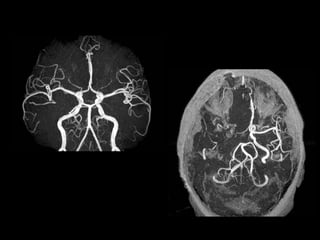
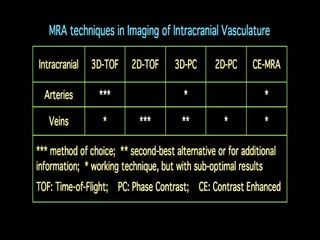
• MRA Time-of-flight (TOF) imaging is most commonly
used for MRA.
• Signal in intracranial arteries is related to flow
phenomenon, and thus no IV gadolinium is needed.
• TOF MRA can be performed by both 2D and 3D
techniques.
• Contrast-enhanced MRA is often used to evaluate the
neck vasculature. Contrast-enhanced intracranial MRA is
useful in patients with stent and/or coils.
• MRV can be performed with 2D/3D TOF techniques,
which do not need administration of IV gadolinium.
• Contrast-enhanced MRV is, however, more robust and is
less susceptible to artifacts compared with the TOF
techniques.
• In 2DFT technique, multiple thin sections of body are
studied individually and even slow flow is identified
• In 3DFT technique , a large volume of tissue is studied
,which can be subsequently partitioned into individual
slices, hence high resolution can be obtained and flow
artifacts are minimised, and less likely to be affected by
loops and tortusity of vessels
• MOTSA (multiple overlapping thin slab acquisition):
prevents proton saturation across the slab. This technique
have advantage of both 2D and 3D studies. It is better than
3D TOF MRA in correctly identifying vascular loops and
tortusity, and have lesser chances of overestimating carotid
stenosis.
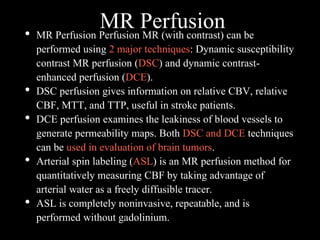
MR Perfusion• MR Perfusion Perfusion MR (with contrast) can be
performed using 2 major techniques: Dynamic susceptibility
contrast MR perfusion (DSC) and dynamic contrast-
enhanced perfusion (DCE).
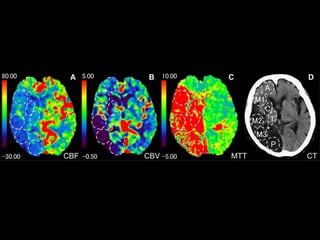
• DSC perfusion gives information on relative CBV, relative
CBF, MTT, and TTP, useful in stroke patients.
• DCE perfusion examines the leakiness of blood vessels to
generate permeability maps. Both DSC and DCE techniques
can be used in evaluation of brain tumors.
• Arterial spin labeling (ASL) is an MR perfusion method for
quantitatively measuring CBF by taking advantage of
arterial water as a freely diffusible tracer.
• ASL is completely noninvasive, repeatable, and is
performed without gadolinium.
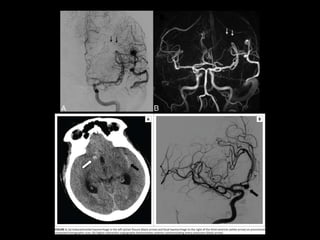
Digital Subtraction Angiography (DSA)
• DSA is still considered the "gold standard" in
vascular imaging.
• However, DSA is an invasive procedure associated
with risk of complications, 1% overall incidence of
neurologic deficit and 0.5% incidence of persistent
deficit.
• Diagnostic indications for DSA include assessing for
aneurysms in subarachnoid hemorrhage when
CTA/MR are negative, accurate assessment of
arteriovenous malformations, and intracerebral
hemorrhage of unknown etiology.
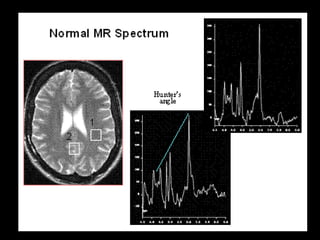
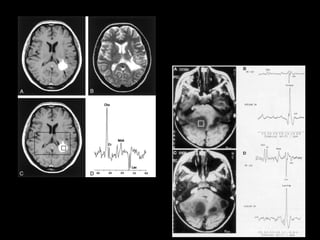
MRS
MR Spectroscopy
• Means of noninvasive physiologic imaging of the
brain that measures relative levels of various tissue
metabolites.
• Wide clinical application
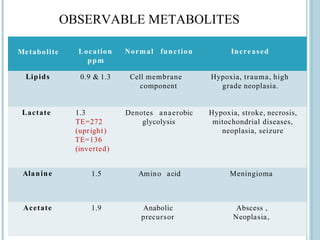
OBSERVABLE METABOLITES
Metabolite Location Normal function Increased
ppm
Lipids 0.9 & 1.3 Cell membrane
component
Hypoxia, trauma, high
grade neoplasia.
Lactate 1.3
TE=272
(upright)
TE=136
(inverted)
Denotes anaerobic
glycolysis
Hypoxia, stroke, necrosis,
mitochondrial diseases,
neoplasia, seizure
Alanine 1.5 Amino acid Meningioma
Acetate 1.9 Anabolic
precursor
Abscess ,
Neoplasia,
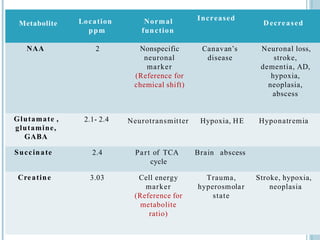
PRI CIPLE METABOL TESMetabolite Location
ppm
Normal
function
Increased
Decreased
NAA 2 Nonspecific
neuronal
marker
(Reference for
chemical shift)
Canavan’s
disease
Neuronal loss,
stroke,
dementia, AD,
hypoxia,
neoplasia,
abscess
Glutamate ,
glutamine,
GABA
2.1- 2.4 Neurotransmitter Hypoxia, HE Hyponatremia
Succinate 2.4 Part of TCA
cycle
Brain abscess
Creatine 3.03 Cell energy
marker
(Reference for
metabolite
ratio)
Trauma,
hyperosmolar
state
Stroke, hypoxia,
neoplasia
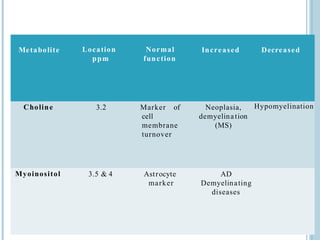
Metabolite Location
ppm
Normal
function
Increased Decreased
Choline 3.2 Marker of
cell
membrane
turnover
Neoplasia,
demyelination
(MS)
Hypomyelination
Myoinositol 3.5 & 4 Astrocyte
marker
AD
Demyelinating
diseases
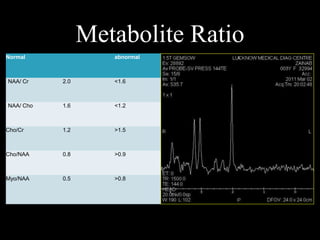
Metabolite Ratio
Normal abnormal
NAA/ Cr 2.0 <1.6
NAA/ Cho 1.6 <1.2
Cho/Cr 1.2 >1.5
Cho/NAA 0.8 >0.9
Myo/NAA 0.5 >0.8
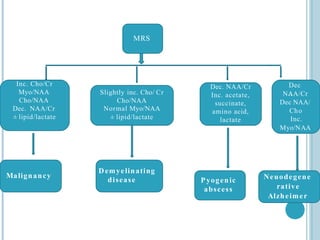
MRS
Dec. NAA/Cr
Inc. acetate,
succinate,
amino acid,
lactate
Neuodegene
rative
Alzheimer
Dec
..NAA/Cr
Dec NAA/
Cho
Inc.
Myo/NAA
Slightly inc. Cho/ Cr
Cho/NAA
Normal Myo/NAA
± lipid/lactate
Inc. Cho/Cr
Myo/NAA
Cho/NAA
Dec. NAA/Cr
± lipid/lactate
Malignancy
Demyelinating
disease Pyogenic
abscess
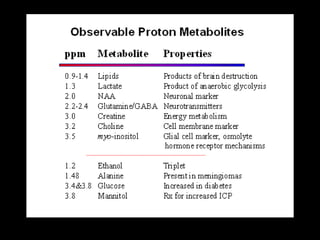
• Lactate :Lactate is generally seen as a doublet (two
peaks close together) at a frequency of 1.33 ppm.
• Healthy tissue does not have sufficient lactate to
be detectable with MRS.
• Lactate, as a product of anaerobic glycolysis, is
detected in diseased brain when oxygen starved.
• It is of great diagnostic value in cases of hypoxia,
brain injury, and stroke.
• It is also elevated in some tumors where it is
suggestive of aggressiveness as well as abscesses.
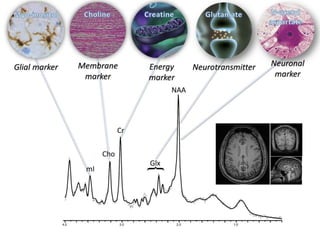
• N- Acetyl Aspartate : At 2.0 ppm, NAA is an amino-acid
derivative synthesized in neurons and transported along
axons.
• It is therefore a "marker" of viable neurons, axons, and
dendrites.
• The diagnostic value of NAA lies in the ability to quantify
neuronal injury or loss on a regional basis and therefore,
decreased NAA plays a diagnostic role in brain tumors, head
injury, dementias, and many other neurological disorders in
which neuronal loss is expected.
• Increased NAA is observed only in recovery and in Canavan
disease that is due to a specific genetic disorder that reduces
NAA-deacyclase activity resulting in net accumulation of
NAA.
• Glutamate—Glutamine—Gamma-amino Butyrate
(Glx): A mixture of closely related amino acids,
amines and derivatives involved in excitatory
neurotransmission lie between 2.1 and 2.4ppm.
• Glx is a vital marker(s) in MRS of stroke,
lymphoma, hypoxia, and many metabolic brain
disorders.
• Creatinine Cr: The primary resonance of creatine
lies at 3.0ppm.
• It is the central energy marker of both neurons and
astrocytes and remains relatively constant.
• For that reason, it is often used as an internal reference
for comparison to other metabolites.
• While some studies have found Cr reduced, it is only
in inborn errors of metabolism that significant
reductions of Cr occur.
• Choline: Choline includes several soluble
components of brain myelin and fluid-cell
membranes that resonate at 3.2ppm.
• Because by far the majority of choline-containing
brain constituents are not normally soluble,
pathological alterations in membrane turnover
(tumor, leukodystrophy, multiple sclerosis) result
in a massive increase in MRS-visible Cho.
• Myo- Inositol ml : A little known polyol (sugar-
like molecules) that resonates at 3.6ppm
• mI is mostly a diagnostic “modifier” in those
diseases that affect Cho (tumor, MS, etc).
• As an astrocyte marker and osmolyte, mI
contributes specificity in dementia diagnoses, and
an almost absolute specificity to hepatic
encephalopathy and hyponatremic brain syndromes.
Clinical Application MRS
• MRS of brain masses:
• Distinguish neoplastic from non neoplastic masses
• Primary from metastatic masses
• Tumor recurrence vs radiation necrosis
• Prognostication of the disease
• Mark region for stereotacticbiopsy
• Monitoring response to treatment
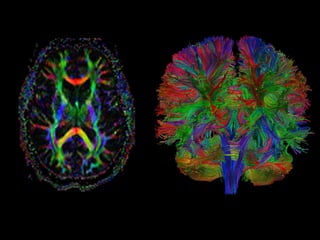
Diffusion Tensor Imaging
• DTI is an interesting application of diffusion
imaging, which assesses diffusion in at least 6
different directions and yields a more complete
diffusivity information compared with standard
DWI.
• This information can be used to deduce axonal
fiber orientation and create 3D color-encoded
maps of white matter tracts in the brain.
• Red indicates right to left, green encodes anterior
to posterior, and blue denotes superior to inferior
tract orientation
• Clinical application
• Assess the deformation of white matter by
tumours - deviation, infiltration, destruction of
white matter
• Delineate the anatomy of immature brains
• Pre-surgical planning
• Alzheimer disease - detection of early disease
• Multiple Sclerosis- plaque assessment
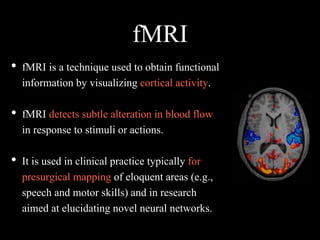
fMRI
• fMRI is a technique used to obtain functional
information by visualizing cortical activity.
• fMRI detects subtle alteration in blood flow
in response to stimuli or actions.
• It is used in clinical practice typically for
presurgical mapping of eloquent areas (e.g.,
speech and motor skills) and in research
aimed at elucidating novel neural networks.
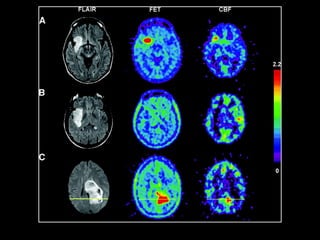
Positron Emission Tomography
• PET involves injection of a radioactive tracer ( isotope, such as
11C, 18F, and 15O ).
• PET enables in vivo examination of brain functions and
quantification of CBF, metabolism, and receptor binding.
• PET tracers used to study neurological disorders include 18F- 2-
deoxyglucose (F-18 FDG) for glucose metabolism, 11C- raclopride
for dopamine D2 receptors, 11C-methionine for cellular amino
acid uptake, and 11C-flumazenil for central benzodiazepine
binding.
• 18F-6-fluorodopa (18F-dopa) is 1 of the most commonly used
ligands for studying the dopaminergic system in movement
disorders.
• Differentiating various types of parkinsonian syndromes clinically,
especially in the early stages of the disease, can be difficult, and
PET may be employed as an adjunct to clinical diagnosis in
equivocal cases.
• Main clinical use of PET in epilepsy is localization of
epileptogenic foci in potential surgical candidates with partial
seizures.
• F-18 FDG PET can provide important prognostic information,
as increased glucose metabolism of gliomas correlates with
higher histological grades (III and IV) and shorter survival
period.
• Similarly, increased uptake of 11C-methionine, which reflects
cellular amino acid uptake, is indicative of high-grade glioma
and poorer survival.
• F-18 FDG PET has been used extensively to study dementia,
and it may be an effective tool for early diagnosis and
differentiation of various types of dementia. Amyloid PET
imaging using 11C-Pittsburg compound (PiB) and 18F-AV-45
(florbetapir) have high sensitivity in detecting amyloid plaques.
MRI Protocols
• Combination of multiple sequences- to adequately
evaluate a tissue - MRI protocol.
• The radiologist tailors the pulse sequences to try to best
answer the clinical question posed by referring
physician.
• The implementation of a protocols has 3 chief purposes:
-maximising diagnostic quality
-delivery of consistency in scan quality
-efficient and effective radiology service delivery
Standard Protocol
• T1W: saggital
• purpose: anatomical overview, which includes
the soft tissues below the base of skull
• T2W:axial
• purpose: evaluation of basal cisterns,
ventricular system and subdural spaces, and
good visualisation of flow voids in vessels
• FLAIR:axial - purpose: assessment of white-
matter disorders (e.g. chronic small vessel
disease and demyelination diseases)
• DWI:axial - purpose: multiple possible
purposes (from the identification of
ischemic stroke to the assessment of active
demyelination
• SWIORT2*:axial - purpose: identify blood
products or calcification
Stroke Protocol
• CT -till the choice as the first imaging modality in
acute stroke
• Availability and the easy and fast access to a CT
scanner
• Better sensitivity for intracerebral haemorrhage
(ICH) diagnosis .
• Some institutions -a quick MRI stroke protocol for
code stroke patients assessment within the narrow
time window for thrombolytic therapy.
Stroke Protocol MRI
• T1W axial - purpose: an anatomical evaluation.
Cortical laminar necrosis or pseudolaminar necrosis
may be seen as a ribbon of intrinsic high T1 signal,
usually after 2 weeks (although it can be seen earlier)
• T2W axial - purpose: loss of normal signal void in
large arteries may be visible immediately
• after 6-12 hours infarcted tissue becomes high
signal
• sulcal effacement and mass effect develop and
become maximal in the first few days
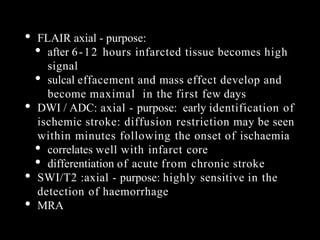
• FLAIR axial - purpose:
• after 6-12 hours infarcted tissue becomes high
signal
• sulcal effacement and mass effect develop and
become maximal in the first few days
• DWI / ADC: axial - purpose: early identification of
ischemic stroke: diffusion restriction may be seen
within minutes following the onset of ischaemia
• correlates well with infarct core
• differentiation of acute from chronic stroke
• SWI/T2 :axial - purpose: highly sensitive in the
detection of haemorrhage
• MRA
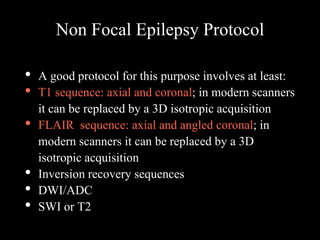
Non Focal Epilepsy Protocol
• A good protocol for this purpose involves at least:
• T1 sequence: axial and coronal; in modern scanners
it can be replaced by a 3D isotropic acquisition
• FLAIR sequence: axial and angled coronal; in
modern scanners it can be replaced by a 3D
isotropic acquisition
• Inversion recovery sequences
• DWI/ADC
• SWI or T2
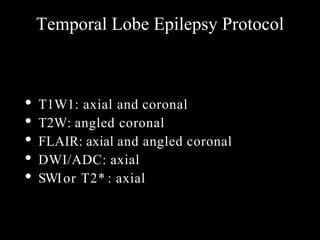
Temporal Lobe Epilepsy Protocol
• T1W1: axial and coronal
• T2W: angled coronal
• FLAIR: axial and angled coronal
• DWI/ADC: axial
• SWIor T2* : axial
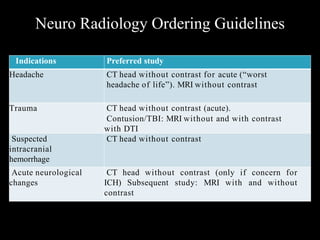
Neuro Radiology Ordering Guidelines
Indications Preferred study
Headache CT head without contrast for acute (“worst
headache of life”). MRI without contrast
Trauma CT head without contrast (acute).
Contusion/TBI: MRI without and with contrast
with DTI
Suspected
intracranial
hemorrhage
CT head without contrast
Acute neurological
changes
CT head without contrast (only if concern for
ICH) Subsequent study: MRI with and without
contrast
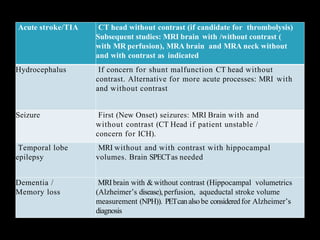
Acute stroke/TIA CT head without contrast (if candidate for thrombolysis)
Subsequent studies: MRI brain with /without contrast (
with MR perfusion), MRA brain and MRA neck without
and with contrast as indicated
Hydrocephalus If concern for shunt malfunction CT head without
contrast. Alternative for more acute processes: MRI with
and without contrast
Seizure First (New Onset) seizures: MRI Brain with and
without contrast (CT Head if patient unstable /
concern for ICH).
Temporal lobe
epilepsy
MRI without and with contrast with hippocampal
volumes. Brain SPECTas needed
Dementia /
Memory loss
MRIbrain with &without contrast (Hippocampal volumetrics
(Alzheimer’s disease),perfusion, aqueductal stroke volume
measurement (NPH)). PETcanalsobe consideredfor Alzheimer’s
diagnosis
MRI basics - How to read and understand MRI sequences

MRI basics - How to read and understand MRI sequences

  • 1.
    Various MRI Sequences Howto identify and its Clinical significance Co-Ordinator: Dr.U.Meenakshisundaram Presenter: Dr.M.Ramesh Babu Apollo Main Hospital SYMPOSIUM ON NEURO IMAGING
  • 2.
    • MRI -an imaging modality that uses non-ionising radiation to create useful diagnostic images. • MRI pulse sequence - a programmed set of changing magnetic gradients. • Number of parameters: TE, TR, flip angle, diffusion weighting • Multiple sequences are grouped together into an MRI protocol. • Different combinations of these parameters affect tissue contrast and spatial resolution. • NMR - discovered just after the end of the Second World War. INTRODUCTION
  • 3.
    MRI Principle • MRIis based on the principle of nuclear magnetic resonance (NMR) • Two basic principles of NM • Atoms with an odd number of protons or neutrons have spin • A moving electric charge, be it positive or negative, produces a magnetic field • Body has many such atoms that can act as good MR nuclei (1H,13C, 19F, 23Na) • Hydrogen nuclei is one of them which is not only positively charged, but also has magnetic spin • MRI utilizes this magnetic spin property of protons of hydrogen to elicit images
  • 4.
    • MRI- theuse of NMR to produce 2D images in 1976. • Human images a year later in 1977 • MRI scanner : consists of • Powerful magnet in which the patient lies. • Radio wave antenna- to send signals to the body and then receive signals back. • These returning signals are converted into images by a computer attached to the scanner. • Imaging of any part of the body can be obtained in any plane.
  • 5.
    TR & TE •TR (repetition time) : the time between two excitations is called repetition time • TE (echo time) : time interval in which signals are measured after RF excitation • In general short TR (<1000ms) and short TE (<45 ms) scan is T1W • Long TR (>2000ms) and long TE (>45 ms) scan is T2 W • Long TR (>2000ms) and short TE (<45 ms) scan is Proton density
  • 6.
    Why MRI? • Noionising radiation • Image aquisition in multiple planes • Superior soft tissue contrast • Some angiographic images can be obtained without the use of contrast material • Advanced techniques such as diffusion, spectroscopy and perfusion allow for precise tissue characterisation rather than merely 'macroscopic' imaging • Functional MRI allows visualisation of both active parts of the brain during certain activities and understanding of the underlying networks • Risk of iodinated contrast allergy alleviated
  • 7.
    Disadvantages • More expensive •Not easily available • Longer scan time • Patient comfort can be an issue - Noisy , Claustrophobia • Subject to unique artefacts • Not safe patients with some metal implants, pacemaker and foreign bodies • MR contrast posses risk
  • 8.
  • 9.
    Descriptive Terminology • Highsignal intensity/ hyperintense = White • Intermediate signal intensity/ isointense = Grey • Lowsignal intensity/ hypointense = Black
  • 10.
    Variety of Sequences •T1WI •T2WI •POSTGD •FLAIR •STIR •DW1/ADC •GRE/SWI •PDWI •MRS •MRA •MRV •CSFFLOWSTUDY •MR PERFUSION •DTI •PET
  • 12.
    T1 & T2W IMAGING
  • 13.
    GRADATION OF INTENSITY IMAGING CTSCAN CSF Edema White Matter Gray Matter Blood Bone MRI T1 CSF Edema Gray Matter White Matter Cartilage Fat MRI T2 Cartilage Fat White Matter Gray Matter Edema CSF MRI T2 Flair CSF Cartilage Fat White Matter Gray Matter Edema
  • 14.
  • 15.
    Dark On T1 •Edema • Tumor • Infection • Inflammation • Hemorrhage( hyperacute, chronic) • Low proton density, • Calcification • Flow void
  • 19.
    Bright On T1 •Fat • Subacute Hemorrhage • Melanin • Protein rich fluid • Slowly flowing blood • Paramagnetic substances (gadolinium,copper,manganese)
  • 20.
    Basic Neuro Sequences •Four Shades of Gray – T1 No protons / excited protons • Air • Dense Calcification/ Cortical Bone Fluid (CSF) (Protein) Brain Tissue GM WM Fat Gadolinium Methemoglobin Black Dark Intermediate White
  • 21.
    Bright On T2 •Edema • Tumor • Infection • Inflammation • Subdural collection • Methemoglobin in late subacute hemorrhage
  • 22.
    Dark On T2 •Low proton density • Calcification • Fibrous tissue • Paramagnetic substances(deoxy hemoglobin,methemoglobin(intracellular),ferri tin,hemosiderin,melanin. • Protein rich fluid • Flow void
  • 23.
    Basic Neuro Sequences •Four Shades of Gray – T2 No protons/ exacted ptotons • Air • Dense calcification • Flow voids (Protein Bound water tissues WM GM Brain Tissue Free water Fat Oxyhemoglobin Black Dark Intermediate White
  • 25.
    Which Scan BestDefines the Abnormality T1 W Images: Subacute Hemorrhage, Fat-containing structures, Anatomical Details T2 W Images: Edema, Demyelination, Infarction, Chronic Hemorrhage FLAIR Images: Edema, Demyelination, Infarction esp. in Periventricular location
  • 26.
  • 27.
    Conventional Inversion Recovery • Twoimportant clinical implementations of the inversion recovery concept are: • Short Time to inversion-recovery (STIR) sequence • Fluid-attenuated inversion-recovery (FLAIR) sequence.
  • 28.
    Short Time toInvertion Recovery STIR • It is transverse magnetization that induces an electric current in the receiver coilsono signal is generated from fat. • STIR sequences provide excellent depiction of bone marrow edema which may be the only indication of an occult fracture. • Unlike conventional fat-saturation sequences STIR sequences are not affected by magnetic field inhomogeneities, so they are more efficient for nulling the signal from fat
  • 30.
    FLAIR • First describedin 1992 and has become one of the corner stones of brain MR imaging protocols. • A sequence with a long TR and TE and an inversion time (TI) that is tailored to null the signal from CSF • In contrast to real image reconstruction, negative signals are recorded as positive signals of the same strength so that the nulled tissue remains dark and all other tissues have higher signal intensities.
  • 31.
    • Most pathologicprocesses show increased SI on T2- WI, and the conspicuity of lesions that are located close to interfaces b/w brain parenchyma and CSF • FLAIR images are heavily T2-weighted with CSF signal suppression, highlights hyperintense lesions and improves their conspicuity and detection, especially when located adjacent to CSF containing spaces
  • 32.
    Basic Neuro Seq •Four Shades of Gray – F that isn't free uences LAIR M M Black Free water Dark Intermediate Brain Tissue W G White T2 bright tissue water.
  • 34.
    Clinical Implications • Itis used to evaluate diseases affecting the brain parenchyma neighboring the CSF- containing spaces for eg: MS & other demyelinating disorders. • Unfortunately, less sensitive for lesions involving the brainstem & cerebellum, owing to CSF pulsation artifacts • Helpful in evaluation of neonates with perinatal HIE. • Useful in evaluation of gliomatosis cerebri owing to its superior delineation of neoplastic spread • Useful for differentiating extra-axial masses eg. epidermoid cysts from arachnoid cysts. However, distinction is more easier & reliable with DWI.
  • 35.
    • Mesial temporalsclerosis: m/c pathology in pts. with partial complex seizures.Thin-section coronal FLAIR is the standard sequence in these patients & seen as a bright small hippocampus on dark background of suppressed CSF containing spaces. However, normally also mesial temporal lobes have mildly increased SI on FLAIR images. • Focal cortical dysplasia of Taylor’s balloon cell type- markedly hyperintense funnel- shaped subcortical zone tapering toward the lateral ventricle is the characteristic FLAIR imaging finding • In Tuberous Sclerosis- detection of hamartomatous lesions, is easier with FLAIR than with PD or T2-W sequences
  • 37.
    • Embolic infarcts-Improved visualization • Chronic infarctions- typically dark with a rim of high signal. • Bright peripheral zone corresponds to gliosis, which is well seen on FLAIR and may be used to distinguish old lacunar infarcts from dilated perivascular spaces.
  • 39.
    Subarachnoid Hemorrhage (SAH): •FLAIR imaging surpasses even CT in the detection of traumatic supratentorial SAH. • It has been proposed that MR imaging with FLAIR, gradient-echo T2*-weighted, and rapid high-spatial resolution MR angiography could be used to evaluate patients with suspected acute SAH, possibly obviating the need for CT and intra-arterial angiography. • With the availability of high-quality CT angiography, this approach may not be necessary.
  • 40.
  • 41.
    DWI • Diffusion-weighted MRIis a example of endogenous contrast, using the motion of protons to produce signal changes. • DWI images is obtained by applying pairs of opposing and balanced magnetic field gradients (but of differing durations and amplitudes) around a spin-echo refocusing pulse of a T2 weighted sequence. • Stationary water molecules are unaffected by the paired gradients, and thus retain their signal. Nonstationary water molecules acquire phase information from the first gradient, but are not rephased by the second gradient, leading to an overall loss of the MR signal.
  • 42.
    • The normalmotion of water molecules within living tissues is random (brownian motion). • In acute stroke, there is an alteration of homeostasis. • Acute stroke causes excess intracellular water accumulation, or cytotoxic edema, with an overall decreased rate of water molecular diffusion within the affected tissue. • Reduction of extracellular space - Tissues with a higher rate of diffusion undergo a greater loss of signal in a given period of time than do tissues with a lower diffusion rate. • Therefore, areas of cytotoxic edema, in which the motion of water molecules is restricted, appear brighter on diffusion- weighted images because of lesser signal losses. • Restriction of DWI is not specific for stroke
  • 43.
    Diffusion Weighted Imaging Nonfluid-restricted tissue Fluid-restricted tissue (maybe) Black Dark Intermediate White
  • 44.
    ADC Apparent Diffusion Coefficient– ADC MAP •A measure of magnitude of diffusion True Fluid Restriction Not Fluid Restriction (T2 Shine Through) Black Dark Intermediate White
  • 45.
    Description T1 T2FLAIR DWI ADC White matter High Low Intermediate Low Low Grey matter Intermediate Intermediate high Intermediate Intermediate CSF Low High low low High
  • 46.
    • The primaryapplication of DW MR imaging has been in brain imaging, mainly because of its exquisite sensitivity to early detection of ischemic stroke. • The increased sensitivity of diffusion-weighted MRI in detecting acute ischemia is thought to be the result of the water shift intracellularly restricting motion of water protons (cytotoxic edema), whereas the conventional T2 weighted images show signal alteration mostly as a result of vasogenic edema.
  • 48.
    • Core ofinfarct = irreversible damage • Surrounding ischemic area ◊ may be salvaged • Regions of high mobility “rapid diffusion” ◊ dark • Regions of low mobility “slow diffusion” ◊ bright • Difficulty: DWI is highly sensitive to all of types of motion (blood flow, pulsatility, patient motion).
  • 50.
    DWI useful inDiagnosing • Ischemic Stroke • Extra axial masses: arachnoid cyst versus epidermoid tumor, Intracranial Infections Pyogenic infection, Herpes encephalitis, Creutzfeldt-Jakob disease • Trauma • Demyelination
  • 51.
    Apparent Diffusion Coefficient •It is a measure of diffusion • Calculated by acquiring two or more images with a different gradient duration and amplitude (b-values) • To differentiate T2 shine through effects or artifacts from real ischemic lesions. • The lower ADC measurements seen with early ischemia, • An ADC map shows parametric images containing the apparent diffusion coefficients of diffusion weighted images. Also called diffusion map
  • 52.
    ADC • The ADCmay be useful for estimating the lesion age and distinguishing acute from subacute DWI lesions. • Acute ischemic lesions can be divided into hyperacute lesions (low ADC and DWI-positive) • Chronic lesions can be differentiated from acute lesions by normalization of ADC and DWI. • A tumour would exhibit more restricted apparent diffusion compared with a cyst because intact cellular membranes in a tumour would hinder the free movement of water molecules
  • 53.
    Non Ischemic CausesFor Decreased ADC • Abscess • Lymphoma and other tumors • Multiple sclerosis • Seizures • Metabolic (Canavans )
  • 55.
    DW MRI characteristicsof Various Disease Entities MR Signal Intensity
  • 56.
    Disease DW ImageADC Image ADC Cause Acute Stroke High Low Restricted Cytotoxic edema Chronic Strokes Variable High Elevated Gliosis Hypertensive encephalopathy Variable High Elevated Vasogenic edema Arachnoid cyst Low High Elevated Free water Epidermoid mass High Low Restricted Cellular tumor Herpes encephalitis High Low Restricted Cytotoxic edema CJD High Low Restricted Cytotoxic edema MS acute lesions Variable High Elevated Vasogenic edema Chronic lesions Variable High Elevated Gliosis
  • 57.
    Clinical Uses ofDWI & ADC STROKE: • Hyperacute Stage:- within one hour minimal hyperintensityseen in DWI and ADC value decrease 30% or more below normal (Usually <50X10-4 mm2/sec) • Acute Stage:- Hyperintensity in DWI and ADC value low but after 5- 7days of ictus ADC values increase and return to normal value (Pseudonormalization) • Subacute to Chronic Stage:- ADC value are increased (Vasogenic edema) but hyperintensity still seen on DWI (T2 shine effect)
  • 59.
  • 60.
    Gradriant Recalled Echo GRE •This feature of GRE sequences is exploited- in detection of hemorrhage, as the iron in Hb becomes magnetized locally (produces its own local magnetic field) and thus dephases the spinning nuclei. • The technique is particularly helpful for diagnosing hemorrhagic contusions such as those in the brain and in pigmented villonodular synovitis. • SE sequences, on the other hand- relatively immune from magnetic susceptibility artifacts, and also less sensitive in depicting hemorrhage and calcification.
  • 61.
    Flair GRE Hemorrhaoge inRt. Parietal Lobe
  • 62.
    Gradiant Echo • Prons: Fast Technique • Cons : • More sensitivity to magnetic susceptibility artefacts • Clinical Use: Eg: Haemorrhage or Calcification
  • 63.
  • 64.
    Susceptibility Weighted Imaging •SWI is a very sensitive type of gradient echo MR sequence. • SWI is for the identification of small amounts of hemorrhage/blood product or calcium, both of which may be inapparent on other MR sequences. • Compounds that have paramagnetic, diamagnetic, and ferromagnetic properties all interact with the local magnetic field and result in loss of signal. • SWI is more sensitive than GRE for cerebral microbleeds.
  • 65.
    • Axial FLAIR(A), T2-weighted (B), and SWI (C) images show a large hematoma in the left frontal lobe (asterisks). A few small hemorrhages with surrounding edema were also visible in the right subcortical white matter (open arrows) on the FLAIR and T2-weighted images. • There is also a small right convexity subdural collection with hemorrhage (arrows). • However, numerous additional hemorrhagic foci throughout the bilateral hemispheric white matter are only visible on SWI
  • 66.
    MRA & MRV •MRA Time-of-flight (TOF) imaging is most commonly used for MRA. • Signal in intracranial arteries is related to flow phenomenon, and thus no IV gadolinium is needed. • TOF MRA can be performed by both 2D and 3D techniques. • Contrast-enhanced MRA is often used to evaluate the neck vasculature. Contrast-enhanced intracranial MRA is useful in patients with stent and/or coils. • MRV can be performed with 2D/3D TOF techniques, which do not need administration of IV gadolinium. • Contrast-enhanced MRV is, however, more robust and is less susceptible to artifacts compared with the TOF techniques.
  • 67.
    • In 2DFTtechnique, multiple thin sections of body are studied individually and even slow flow is identified • In 3DFT technique , a large volume of tissue is studied ,which can be subsequently partitioned into individual slices, hence high resolution can be obtained and flow artifacts are minimised, and less likely to be affected by loops and tortusity of vessels • MOTSA (multiple overlapping thin slab acquisition): prevents proton saturation across the slab. This technique have advantage of both 2D and 3D studies. It is better than 3D TOF MRA in correctly identifying vascular loops and tortusity, and have lesser chances of overestimating carotid stenosis.
  • 71.
    MR Perfusion• MRPerfusion Perfusion MR (with contrast) can be performed using 2 major techniques: Dynamic susceptibility contrast MR perfusion (DSC) and dynamic contrast- enhanced perfusion (DCE). • DSC perfusion gives information on relative CBV, relative CBF, MTT, and TTP, useful in stroke patients. • DCE perfusion examines the leakiness of blood vessels to generate permeability maps. Both DSC and DCE techniques can be used in evaluation of brain tumors. • Arterial spin labeling (ASL) is an MR perfusion method for quantitatively measuring CBF by taking advantage of arterial water as a freely diffusible tracer. • ASL is completely noninvasive, repeatable, and is performed without gadolinium.
  • 73.
    Digital Subtraction Angiography(DSA) • DSA is still considered the "gold standard" in vascular imaging. • However, DSA is an invasive procedure associated with risk of complications, 1% overall incidence of neurologic deficit and 0.5% incidence of persistent deficit. • Diagnostic indications for DSA include assessing for aneurysms in subarachnoid hemorrhage when CTA/MR are negative, accurate assessment of arteriovenous malformations, and intracerebral hemorrhage of unknown etiology.
  • 75.
  • 76.
    MR Spectroscopy • Meansof noninvasive physiologic imaging of the brain that measures relative levels of various tissue metabolites. • Wide clinical application
  • 80.
    OBSERVABLE METABOLITES Metabolite LocationNormal function Increased ppm Lipids 0.9 & 1.3 Cell membrane component Hypoxia, trauma, high grade neoplasia. Lactate 1.3 TE=272 (upright) TE=136 (inverted) Denotes anaerobic glycolysis Hypoxia, stroke, necrosis, mitochondrial diseases, neoplasia, seizure Alanine 1.5 Amino acid Meningioma Acetate 1.9 Anabolic precursor Abscess , Neoplasia,
  • 81.
    PRI CIPLE METABOLTESMetabolite Location ppm Normal function Increased Decreased NAA 2 Nonspecific neuronal marker (Reference for chemical shift) Canavan’s disease Neuronal loss, stroke, dementia, AD, hypoxia, neoplasia, abscess Glutamate , glutamine, GABA 2.1- 2.4 Neurotransmitter Hypoxia, HE Hyponatremia Succinate 2.4 Part of TCA cycle Brain abscess Creatine 3.03 Cell energy marker (Reference for metabolite ratio) Trauma, hyperosmolar state Stroke, hypoxia, neoplasia
  • 82.
    Metabolite Location ppm Normal function Increased Decreased Choline3.2 Marker of cell membrane turnover Neoplasia, demyelination (MS) Hypomyelination Myoinositol 3.5 & 4 Astrocyte marker AD Demyelinating diseases
  • 83.
    Metabolite Ratio Normal abnormal NAA/Cr 2.0 <1.6 NAA/ Cho 1.6 <1.2 Cho/Cr 1.2 >1.5 Cho/NAA 0.8 >0.9 Myo/NAA 0.5 >0.8
  • 84.
    MRS Dec. NAA/Cr Inc. acetate, succinate, aminoacid, lactate Neuodegene rative Alzheimer Dec ..NAA/Cr Dec NAA/ Cho Inc. Myo/NAA Slightly inc. Cho/ Cr Cho/NAA Normal Myo/NAA ± lipid/lactate Inc. Cho/Cr Myo/NAA Cho/NAA Dec. NAA/Cr ± lipid/lactate Malignancy Demyelinating disease Pyogenic abscess
  • 86.
    • Lactate :Lactateis generally seen as a doublet (two peaks close together) at a frequency of 1.33 ppm. • Healthy tissue does not have sufficient lactate to be detectable with MRS. • Lactate, as a product of anaerobic glycolysis, is detected in diseased brain when oxygen starved. • It is of great diagnostic value in cases of hypoxia, brain injury, and stroke. • It is also elevated in some tumors where it is suggestive of aggressiveness as well as abscesses.
  • 87.
    • N- AcetylAspartate : At 2.0 ppm, NAA is an amino-acid derivative synthesized in neurons and transported along axons. • It is therefore a "marker" of viable neurons, axons, and dendrites. • The diagnostic value of NAA lies in the ability to quantify neuronal injury or loss on a regional basis and therefore, decreased NAA plays a diagnostic role in brain tumors, head injury, dementias, and many other neurological disorders in which neuronal loss is expected. • Increased NAA is observed only in recovery and in Canavan disease that is due to a specific genetic disorder that reduces NAA-deacyclase activity resulting in net accumulation of NAA.
  • 88.
    • Glutamate—Glutamine—Gamma-amino Butyrate (Glx):A mixture of closely related amino acids, amines and derivatives involved in excitatory neurotransmission lie between 2.1 and 2.4ppm. • Glx is a vital marker(s) in MRS of stroke, lymphoma, hypoxia, and many metabolic brain disorders.
  • 89.
    • Creatinine Cr:The primary resonance of creatine lies at 3.0ppm. • It is the central energy marker of both neurons and astrocytes and remains relatively constant. • For that reason, it is often used as an internal reference for comparison to other metabolites. • While some studies have found Cr reduced, it is only in inborn errors of metabolism that significant reductions of Cr occur.
  • 90.
    • Choline: Cholineincludes several soluble components of brain myelin and fluid-cell membranes that resonate at 3.2ppm. • Because by far the majority of choline-containing brain constituents are not normally soluble, pathological alterations in membrane turnover (tumor, leukodystrophy, multiple sclerosis) result in a massive increase in MRS-visible Cho.
  • 91.
    • Myo- Inositolml : A little known polyol (sugar- like molecules) that resonates at 3.6ppm • mI is mostly a diagnostic “modifier” in those diseases that affect Cho (tumor, MS, etc). • As an astrocyte marker and osmolyte, mI contributes specificity in dementia diagnoses, and an almost absolute specificity to hepatic encephalopathy and hyponatremic brain syndromes.
  • 92.
    Clinical Application MRS •MRS of brain masses: • Distinguish neoplastic from non neoplastic masses • Primary from metastatic masses • Tumor recurrence vs radiation necrosis • Prognostication of the disease • Mark region for stereotacticbiopsy • Monitoring response to treatment
  • 93.
    Diffusion Tensor Imaging •DTI is an interesting application of diffusion imaging, which assesses diffusion in at least 6 different directions and yields a more complete diffusivity information compared with standard DWI. • This information can be used to deduce axonal fiber orientation and create 3D color-encoded maps of white matter tracts in the brain. • Red indicates right to left, green encodes anterior to posterior, and blue denotes superior to inferior tract orientation
  • 95.
    • Clinical application •Assess the deformation of white matter by tumours - deviation, infiltration, destruction of white matter • Delineate the anatomy of immature brains • Pre-surgical planning • Alzheimer disease - detection of early disease • Multiple Sclerosis- plaque assessment
  • 96.
    fMRI • fMRI isa technique used to obtain functional information by visualizing cortical activity. • fMRI detects subtle alteration in blood flow in response to stimuli or actions. • It is used in clinical practice typically for presurgical mapping of eloquent areas (e.g., speech and motor skills) and in research aimed at elucidating novel neural networks.
  • 97.
    Positron Emission Tomography •PET involves injection of a radioactive tracer ( isotope, such as 11C, 18F, and 15O ). • PET enables in vivo examination of brain functions and quantification of CBF, metabolism, and receptor binding. • PET tracers used to study neurological disorders include 18F- 2- deoxyglucose (F-18 FDG) for glucose metabolism, 11C- raclopride for dopamine D2 receptors, 11C-methionine for cellular amino acid uptake, and 11C-flumazenil for central benzodiazepine binding. • 18F-6-fluorodopa (18F-dopa) is 1 of the most commonly used ligands for studying the dopaminergic system in movement disorders. • Differentiating various types of parkinsonian syndromes clinically, especially in the early stages of the disease, can be difficult, and PET may be employed as an adjunct to clinical diagnosis in equivocal cases.
  • 98.
    • Main clinicaluse of PET in epilepsy is localization of epileptogenic foci in potential surgical candidates with partial seizures. • F-18 FDG PET can provide important prognostic information, as increased glucose metabolism of gliomas correlates with higher histological grades (III and IV) and shorter survival period. • Similarly, increased uptake of 11C-methionine, which reflects cellular amino acid uptake, is indicative of high-grade glioma and poorer survival. • F-18 FDG PET has been used extensively to study dementia, and it may be an effective tool for early diagnosis and differentiation of various types of dementia. Amyloid PET imaging using 11C-Pittsburg compound (PiB) and 18F-AV-45 (florbetapir) have high sensitivity in detecting amyloid plaques.
  • 100.
    MRI Protocols • Combinationof multiple sequences- to adequately evaluate a tissue - MRI protocol. • The radiologist tailors the pulse sequences to try to best answer the clinical question posed by referring physician. • The implementation of a protocols has 3 chief purposes: -maximising diagnostic quality -delivery of consistency in scan quality -efficient and effective radiology service delivery
  • 101.
    Standard Protocol • T1W:saggital • purpose: anatomical overview, which includes the soft tissues below the base of skull • T2W:axial • purpose: evaluation of basal cisterns, ventricular system and subdural spaces, and good visualisation of flow voids in vessels
  • 102.
    • FLAIR:axial -purpose: assessment of white- matter disorders (e.g. chronic small vessel disease and demyelination diseases) • DWI:axial - purpose: multiple possible purposes (from the identification of ischemic stroke to the assessment of active demyelination • SWIORT2*:axial - purpose: identify blood products or calcification
  • 103.
    Stroke Protocol • CT-till the choice as the first imaging modality in acute stroke • Availability and the easy and fast access to a CT scanner • Better sensitivity for intracerebral haemorrhage (ICH) diagnosis . • Some institutions -a quick MRI stroke protocol for code stroke patients assessment within the narrow time window for thrombolytic therapy.
  • 104.
    Stroke Protocol MRI •T1W axial - purpose: an anatomical evaluation. Cortical laminar necrosis or pseudolaminar necrosis may be seen as a ribbon of intrinsic high T1 signal, usually after 2 weeks (although it can be seen earlier) • T2W axial - purpose: loss of normal signal void in large arteries may be visible immediately • after 6-12 hours infarcted tissue becomes high signal • sulcal effacement and mass effect develop and become maximal in the first few days
  • 105.
    • FLAIR axial- purpose: • after 6-12 hours infarcted tissue becomes high signal • sulcal effacement and mass effect develop and become maximal in the first few days • DWI / ADC: axial - purpose: early identification of ischemic stroke: diffusion restriction may be seen within minutes following the onset of ischaemia • correlates well with infarct core • differentiation of acute from chronic stroke • SWI/T2 :axial - purpose: highly sensitive in the detection of haemorrhage • MRA
  • 106.
    Non Focal EpilepsyProtocol • A good protocol for this purpose involves at least: • T1 sequence: axial and coronal; in modern scanners it can be replaced by a 3D isotropic acquisition • FLAIR sequence: axial and angled coronal; in modern scanners it can be replaced by a 3D isotropic acquisition • Inversion recovery sequences • DWI/ADC • SWI or T2
  • 107.
    Temporal Lobe EpilepsyProtocol • T1W1: axial and coronal • T2W: angled coronal • FLAIR: axial and angled coronal • DWI/ADC: axial • SWIor T2* : axial
  • 108.
    Neuro Radiology OrderingGuidelines Indications Preferred study Headache CT head without contrast for acute (“worst headache of life”). MRI without contrast Trauma CT head without contrast (acute). Contusion/TBI: MRI without and with contrast with DTI Suspected intracranial hemorrhage CT head without contrast Acute neurological changes CT head without contrast (only if concern for ICH) Subsequent study: MRI with and without contrast
  • 109.
    Acute stroke/TIA CThead without contrast (if candidate for thrombolysis) Subsequent studies: MRI brain with /without contrast ( with MR perfusion), MRA brain and MRA neck without and with contrast as indicated Hydrocephalus If concern for shunt malfunction CT head without contrast. Alternative for more acute processes: MRI with and without contrast Seizure First (New Onset) seizures: MRI Brain with and without contrast (CT Head if patient unstable / concern for ICH). Temporal lobe epilepsy MRI without and with contrast with hippocampal volumes. Brain SPECTas needed Dementia / Memory loss MRIbrain with &without contrast (Hippocampal volumetrics (Alzheimer’s disease),perfusion, aqueductal stroke volume measurement (NPH)). PETcanalsobe consideredfor Alzheimer’s diagnosis