MRI Brain Sequences
Dr. MD SHAH JALALUR RAHMAN SHAHI
Junior Consultant, Oncology
Ahsania Mission Cancer & General Hospital
Basic Mechanism of MRI Machine
Each pulse sequence of MRI comprises of Radiofrequence sequence
and Acquisition of that result.
First step: MRI machine delivers energy which will excite proton spin
and align Hydrogen atom by the strong Magnet of the machine
Second step: Turn off the magnet.
Third step: Observe as the atom realign due to entropy.
Common MRI Sequences for MRI Brain
• T1
• T2
• Flair
• DWI
• GRE
• MRS (this is not a sequence, rather an addition to the original MRI)
T1 weighted MRI Scans
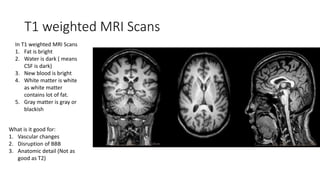
In T1 weighted MRI Scans
1. Fat is bright
2. Water is dark ( means
CSF is dark)
3. New blood is bright
4. White matter is white
as white matter
contains lot of fat.
5. Gray matter is gray or
blackish
What is it good for:
1. Vascular changes
2. Disruption of BBB
3. Anatomic detail (Not as
good as T2)
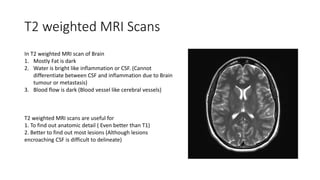
T2 weighted MRI Scans
In T2 weighted MRI scan of Brain
1. Mostly Fat is dark
2. Water is bright like inflammation or CSF. (Cannot
differentiate between CSF and inflammation due to Brain
tumour or metastasis)
3. Blood flow is dark (Blood vessel like cerebral vessels)
T2 weighted MRI scans are useful for
1. To find out anatomic detail ( Even better than T1)
2. Better to find out most lesions (Although lesions
encroaching CSF is difficult to delineate)
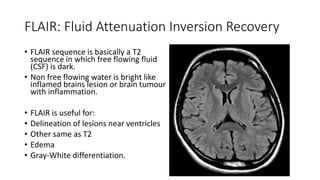
FLAIR: Fluid Attenuation Inversion Recovery
• FLAIR sequence is basically a T2
sequence in which free flowing fluid
(CSF) is dark.
• Non free flowing water is bright like
inflamed brains lesion or brain tumour
with inflammation.
• FLAIR is useful for:
• Delineation of lesions near ventricles
• Other same as T2
• Edema
• Gray-White differentiation.
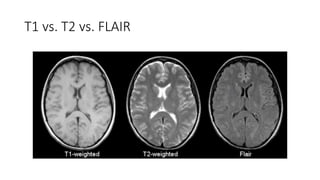
T1 vs. T2 vs. FLAIR
MRS
• An analytical system in
chemistry that helps in
identification and quantification
of metabolite in sample.
• MRS spectra provides
physiological and chemical
information instead of anatomy.
• When MRI + MRS are at the
same time, Anatomical,
chemical information can be
gathered increasing precision.
THANK YOU

Mri brain sequences

  • 1.
    MRI Brain Sequences Dr.MD SHAH JALALUR RAHMAN SHAHI Junior Consultant, Oncology Ahsania Mission Cancer & General Hospital
  • 2.
    Basic Mechanism ofMRI Machine Each pulse sequence of MRI comprises of Radiofrequence sequence and Acquisition of that result. First step: MRI machine delivers energy which will excite proton spin and align Hydrogen atom by the strong Magnet of the machine Second step: Turn off the magnet. Third step: Observe as the atom realign due to entropy.
  • 3.
    Common MRI Sequencesfor MRI Brain • T1 • T2 • Flair • DWI • GRE • MRS (this is not a sequence, rather an addition to the original MRI)
  • 4.
    T1 weighted MRIScans In T1 weighted MRI Scans 1. Fat is bright 2. Water is dark ( means CSF is dark) 3. New blood is bright 4. White matter is white as white matter contains lot of fat. 5. Gray matter is gray or blackish What is it good for: 1. Vascular changes 2. Disruption of BBB 3. Anatomic detail (Not as good as T2)
  • 5.
    T2 weighted MRIScans In T2 weighted MRI scan of Brain 1. Mostly Fat is dark 2. Water is bright like inflammation or CSF. (Cannot differentiate between CSF and inflammation due to Brain tumour or metastasis) 3. Blood flow is dark (Blood vessel like cerebral vessels) T2 weighted MRI scans are useful for 1. To find out anatomic detail ( Even better than T1) 2. Better to find out most lesions (Although lesions encroaching CSF is difficult to delineate)
  • 6.
    FLAIR: Fluid AttenuationInversion Recovery • FLAIR sequence is basically a T2 sequence in which free flowing fluid (CSF) is dark. • Non free flowing water is bright like inflamed brains lesion or brain tumour with inflammation. • FLAIR is useful for: • Delineation of lesions near ventricles • Other same as T2 • Edema • Gray-White differentiation.
  • 7.
    T1 vs. T2vs. FLAIR
  • 8.
    MRS • An analyticalsystem in chemistry that helps in identification and quantification of metabolite in sample. • MRS spectra provides physiological and chemical information instead of anatomy. • When MRI + MRS are at the same time, Anatomical, chemical information can be gathered increasing precision.
  • 9.