Analysis of Algorithms
CS 477/677
Recurrences
Instructor: George Bebis
(Appendix A, Chapter 4)
2
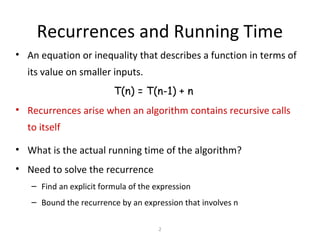
Recurrences and Running Time
• An equation or inequality that describes a function in terms of
its value on smaller inputs.
T(n) = T(n-1) + n
• Recurrences arise when an algorithm contains recursive calls
to itself
• What is the actual running time of the algorithm?
• Need to solve the recurrence
– Find an explicit formula of the expression
– Bound the recurrence by an expression that involves n
3
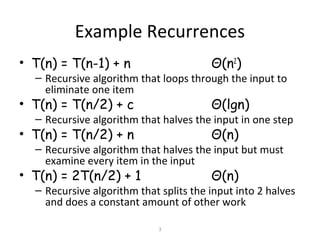
Example Recurrences
• T(n) = T(n-1) + n Θ(n2
)
– Recursive algorithm that loops through the input to
eliminate one item
• T(n) = T(n/2) + c Θ(lgn)
– Recursive algorithm that halves the input in one step
• T(n) = T(n/2) + n Θ(n)
– Recursive algorithm that halves the input but must
examine every item in the input
• T(n) = 2T(n/2) + 1 Θ(n)
– Recursive algorithm that splits the input into 2 halves
and does a constant amount of other work
4
Recurrent Algorithms
BINARY-SEARCH
• for an ordered array A, finds if x is in the array A[lo…hi]
Alg.: BINARY-SEARCH (A, lo, hi, x)
if (lo > hi)
return FALSE
mid ← (lo+hi)/2
if x = A[mid]
return TRUE
if ( x < A[mid] )
BINARY-SEARCH (A, lo, mid-1, x)
if ( x > A[mid] )
BINARY-SEARCH (A, mid+1, hi, x)
12111097532
1 2 3 4 5 6 7 8
mid
lo hi
5
Example
• A[8] = {1, 2, 3, 4, 5, 7, 9, 11}
– lo = 1 hi = 8 x = 7
mid = 4, lo = 5, hi = 8
mid = 6, A[mid] = x Found!119754321
119754321
1 2 3 4 5 6 7 8
8765
6
Another Example
• A[8] = {1, 2, 3, 4, 5, 7, 9, 11}
– lo = 1 hi = 8 x = 6
mid = 4, lo = 5, hi = 8
mid = 6, A[6] = 7, lo = 5, hi = 5119754321
119754321
1 2 3 4 5 6 7 8
119754321 mid = 5, A[5] = 5, lo = 6, hi = 5
NOT FOUND!
119754321
low high
low
lowhigh
high
7
Analysis of BINARY-SEARCH
Alg.: BINARY-SEARCH (A, lo, hi, x)
if (lo > hi)
return FALSE
mid ← (lo+hi)/2
if x = A[mid]
return TRUE
if ( x < A[mid] )
BINARY-SEARCH (A, lo, mid-1, x)
if ( x > A[mid] )
BINARY-SEARCH (A, mid+1, hi, x)
• T(n) = c +
– T(n) – running time for an array of size n
constant time: c2
same problem of size n/2
constant time: c1
constant time: c3
T(n/2)
8
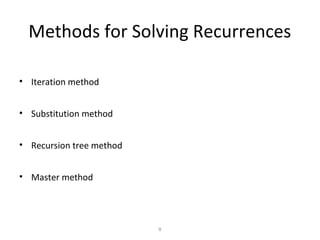
Methods for Solving Recurrences
• Iteration method
• Substitution method
• Recursion tree method
• Master method
9
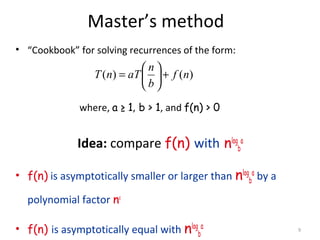
Master’s method
• “Cookbook” for solving recurrences of the form:
where, a ≥ 1, b > 1, and f(n) > 0
Idea: compare f(n) with nlog
b
a
• f(n) is asymptotically smaller or larger than nlog
b
a
by a
polynomial factor nε
• f(n) is asymptotically equal with nlog
b
a
)()( nf
b
n
aTnT +





=
10
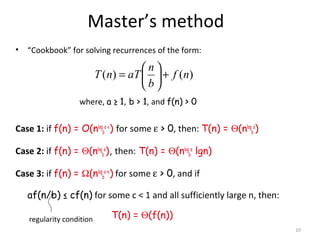
Master’s method
• “Cookbook” for solving recurrences of the form:
where, a ≥ 1, b > 1, and f(n) > 0
Case 1: if f(n) = O(nlog
b
a-ε
) for some ε > 0, then: T(n) = Θ(nlog
b
a
)
Case 2: if f(n) = Θ(nlog
b
a
), then: T(n) = Θ(nlog
b
a
lgn)
Case 3: if f(n) = Ω(nlog
b
a+ε
) for some ε > 0, and if
af(n/b) ≤ cf(n) for some c < 1 and all sufficiently large n, then:
T(n) = Θ(f(n))
)()( nf
b
n
aTnT +





=
regularity condition
12
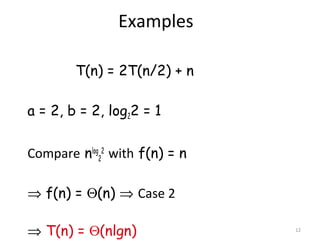
Examples
T(n) = 2T(n/2) + n
a = 2, b = 2, log22 = 1
Compare nlog
2
2
with f(n) = n
⇒ f(n) = Θ(n) ⇒ Case 2
⇒ T(n) = Θ(nlgn)
13
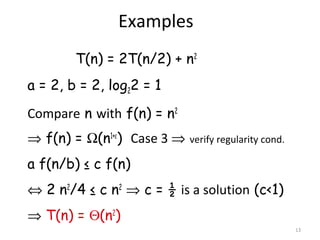
Examples
T(n) = 2T(n/2) + n2
a = 2, b = 2, log22 = 1
Compare n with f(n) = n2
⇒ f(n) = Ω(n1+ε
) Case 3 ⇒ verify regularity cond.
a f(n/b) ≤ c f(n)
⇔ 2 n2
/4 ≤ c n2
⇒ c = ½ is a solution (c<1)
⇒ T(n) = Θ(n2
)
14
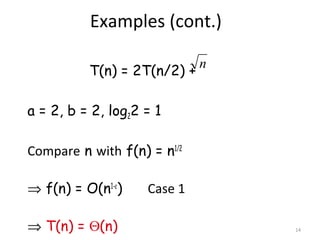
Examples (cont.)
T(n) = 2T(n/2) +
a = 2, b = 2, log22 = 1
Compare n with f(n) = n1/2
⇒ f(n) = O(n1-ε
) Case 1
⇒ T(n) = Θ(n)
n
15
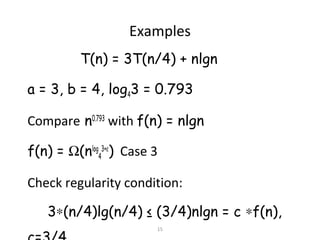
Examples
T(n) = 3T(n/4) + nlgn
a = 3, b = 4, log43 = 0.793
Compare n0.793
with f(n) = nlgn
f(n) = Ω(nlog
4
3+ε
) Case 3
Check regularity condition:
3∗(n/4)lg(n/4) ≤ (3/4)nlgn = c ∗f(n),
16
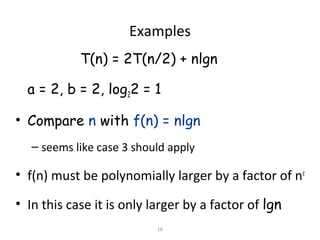
Examples
T(n) = 2T(n/2) + nlgn
a = 2, b = 2, log22 = 1
• Compare n with f(n) = nlgn
– seems like case 3 should apply
• f(n) must be polynomially larger by a factor of nε
• In this case it is only larger by a factor of lgn
17
Readings

Master method

  • 1.
    Analysis of Algorithms CS477/677 Recurrences Instructor: George Bebis (Appendix A, Chapter 4)
  • 2.
    2 Recurrences and RunningTime • An equation or inequality that describes a function in terms of its value on smaller inputs. T(n) = T(n-1) + n • Recurrences arise when an algorithm contains recursive calls to itself • What is the actual running time of the algorithm? • Need to solve the recurrence – Find an explicit formula of the expression – Bound the recurrence by an expression that involves n
  • 3.
    3 Example Recurrences • T(n)= T(n-1) + n Θ(n2 ) – Recursive algorithm that loops through the input to eliminate one item • T(n) = T(n/2) + c Θ(lgn) – Recursive algorithm that halves the input in one step • T(n) = T(n/2) + n Θ(n) – Recursive algorithm that halves the input but must examine every item in the input • T(n) = 2T(n/2) + 1 Θ(n) – Recursive algorithm that splits the input into 2 halves and does a constant amount of other work
  • 4.
    4 Recurrent Algorithms BINARY-SEARCH • foran ordered array A, finds if x is in the array A[lo…hi] Alg.: BINARY-SEARCH (A, lo, hi, x) if (lo > hi) return FALSE mid ← (lo+hi)/2 if x = A[mid] return TRUE if ( x < A[mid] ) BINARY-SEARCH (A, lo, mid-1, x) if ( x > A[mid] ) BINARY-SEARCH (A, mid+1, hi, x) 12111097532 1 2 3 4 5 6 7 8 mid lo hi
  • 5.
    5 Example • A[8] ={1, 2, 3, 4, 5, 7, 9, 11} – lo = 1 hi = 8 x = 7 mid = 4, lo = 5, hi = 8 mid = 6, A[mid] = x Found!119754321 119754321 1 2 3 4 5 6 7 8 8765
  • 6.
    6 Another Example • A[8]= {1, 2, 3, 4, 5, 7, 9, 11} – lo = 1 hi = 8 x = 6 mid = 4, lo = 5, hi = 8 mid = 6, A[6] = 7, lo = 5, hi = 5119754321 119754321 1 2 3 4 5 6 7 8 119754321 mid = 5, A[5] = 5, lo = 6, hi = 5 NOT FOUND! 119754321 low high low lowhigh high
  • 7.
    7 Analysis of BINARY-SEARCH Alg.:BINARY-SEARCH (A, lo, hi, x) if (lo > hi) return FALSE mid ← (lo+hi)/2 if x = A[mid] return TRUE if ( x < A[mid] ) BINARY-SEARCH (A, lo, mid-1, x) if ( x > A[mid] ) BINARY-SEARCH (A, mid+1, hi, x) • T(n) = c + – T(n) – running time for an array of size n constant time: c2 same problem of size n/2 same problem of size n/2 constant time: c1 constant time: c3 T(n/2)
  • 8.
    8 Methods for SolvingRecurrences • Iteration method • Substitution method • Recursion tree method • Master method
  • 9.
    9 Master’s method • “Cookbook”for solving recurrences of the form: where, a ≥ 1, b > 1, and f(n) > 0 Idea: compare f(n) with nlog b a • f(n) is asymptotically smaller or larger than nlog b a by a polynomial factor nε • f(n) is asymptotically equal with nlog b a )()( nf b n aTnT +      =
  • 10.
    10 Master’s method • “Cookbook”for solving recurrences of the form: where, a ≥ 1, b > 1, and f(n) > 0 Case 1: if f(n) = O(nlog b a-ε ) for some ε > 0, then: T(n) = Θ(nlog b a ) Case 2: if f(n) = Θ(nlog b a ), then: T(n) = Θ(nlog b a lgn) Case 3: if f(n) = Ω(nlog b a+ε ) for some ε > 0, and if af(n/b) ≤ cf(n) for some c < 1 and all sufficiently large n, then: T(n) = Θ(f(n)) )()( nf b n aTnT +      = regularity condition
  • 11.
    12 Examples T(n) = 2T(n/2)+ n a = 2, b = 2, log22 = 1 Compare nlog 2 2 with f(n) = n ⇒ f(n) = Θ(n) ⇒ Case 2 ⇒ T(n) = Θ(nlgn)
  • 12.
    13 Examples T(n) = 2T(n/2)+ n2 a = 2, b = 2, log22 = 1 Compare n with f(n) = n2 ⇒ f(n) = Ω(n1+ε ) Case 3 ⇒ verify regularity cond. a f(n/b) ≤ c f(n) ⇔ 2 n2 /4 ≤ c n2 ⇒ c = ½ is a solution (c<1) ⇒ T(n) = Θ(n2 )
  • 13.
    14 Examples (cont.) T(n) =2T(n/2) + a = 2, b = 2, log22 = 1 Compare n with f(n) = n1/2 ⇒ f(n) = O(n1-ε ) Case 1 ⇒ T(n) = Θ(n) n
  • 14.
    15 Examples T(n) = 3T(n/4)+ nlgn a = 3, b = 4, log43 = 0.793 Compare n0.793 with f(n) = nlgn f(n) = Ω(nlog 4 3+ε ) Case 3 Check regularity condition: 3∗(n/4)lg(n/4) ≤ (3/4)nlgn = c ∗f(n),
  • 15.
    16 Examples T(n) = 2T(n/2)+ nlgn a = 2, b = 2, log22 = 1 • Compare n with f(n) = nlgn – seems like case 3 should apply • f(n) must be polynomially larger by a factor of nε • In this case it is only larger by a factor of lgn
  • 16.