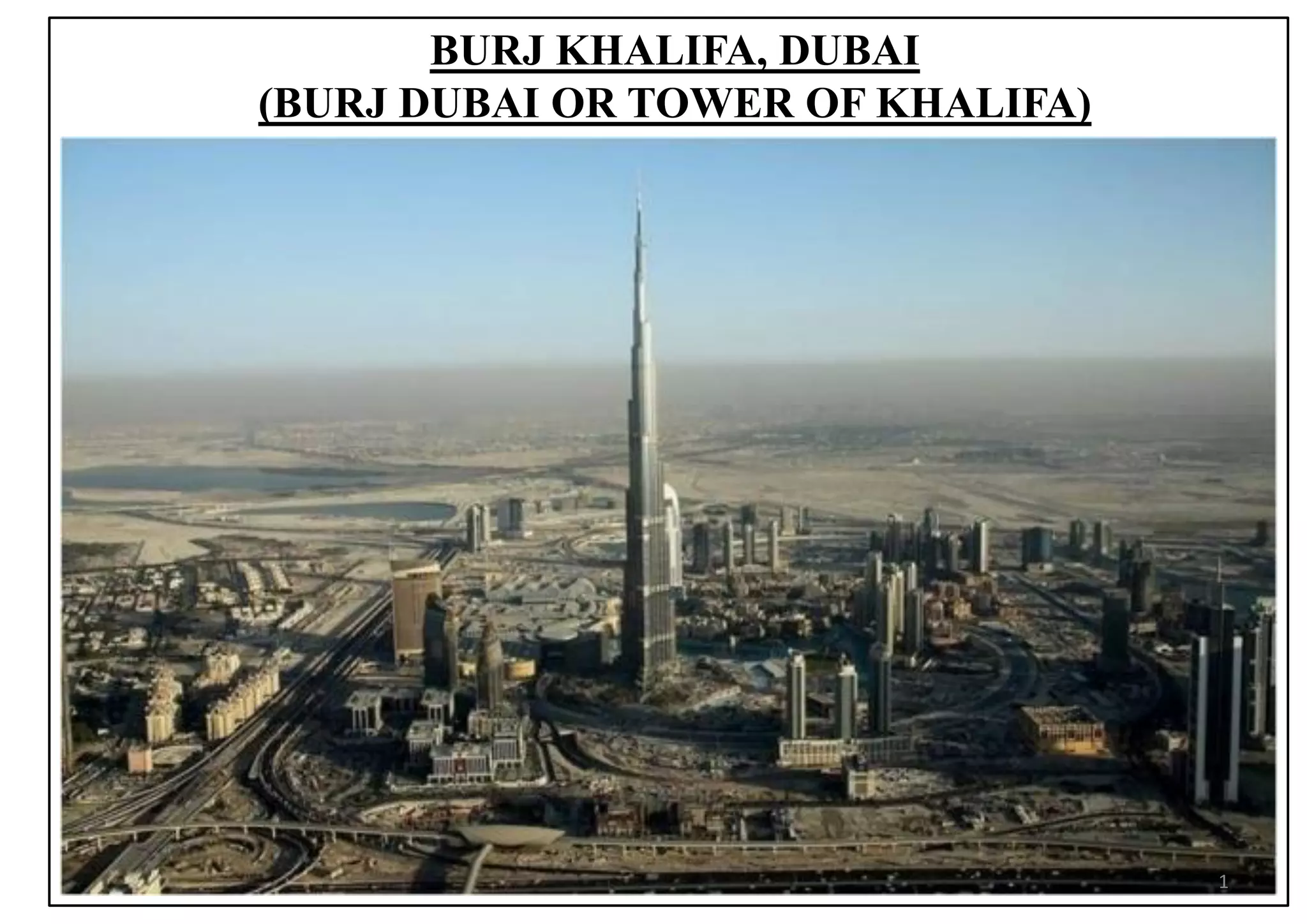
BURJ KHALIFA, DUBAI
(BURJ DUBAI OR TOWER OF KHALIFA)
1
2
CONTENTS
S. NO. TITLE PAGE NO.
1. INTRODUCTION 3
2. PURPOSE 4
3. PLAN SHOWING LOCATION OF BURJ KHALIIFA 5
4. SITE PLAN 6
5. STRUCTURE 7-8
6. CONSTRUCTION TIMELINE 9-10
7. INTERESTING FACTS ABOUT BURJ DUBAI 11-14
8. COMPARISION WITH OTHER TALL BILDINGS 15
9. DISTRIBUTION OF FLOORS 16
10. ARCHITECTURE OF BURJ KHALIFA 17
11. FOUNDATION 18
12. PODIUM 19
13. STRUCTURAL SYSTEM 20-22
14. R.C.C. STRUCTURE 23-24
15. COMPARISION BETWEEN CROSS SECTION OF TALL STRUCTURES 25
16. SPIRE 26
17. EXTERNAL CLADDING 27
18. WINDOW WASHING 28
19. WIND TUNNEL TEST 29
20. SERVICING THE BURJ KHALIFA 30
21. ELEVATORS AND LIFTS 31
22. INTERIORS 32
23. LANDSCAPING THE KHALIFA PARK 33-37
24. PROJECT SITE, SCOPE, AND CHALLENGES 38-41
25. SUSTAINABILITY, WATER CONSERVATION AND CULTURAL REFERENCE 42-46
26. REFERENCES 47
Official Name: Burj Khalifa Bin Zayed
Also Known As: Burj Dubai
Also Known As: Tower Of Khalifa
Formerly: Burj Dubai
Built: 2004-2010
Cost: $4,100,000,000
Designed By: Skidmore, Owings & Merrill
Type: Skyscraper
Stories: 206
Maximum Height: 2,717 Feet / 828 Meters
Location: No. 1, Burj Dubai Boulevard, Dubai, United Arab
3
PURPOSE
▪ Burj Dubai has been designed to be the centerpiece of a large-scale, mixed-use development that will include
30,000 homes, nine hotels such as the Burj Dubai Lake Hotel & Serviced Apartments, 0.03 km² (0.01 sq mi) of
parkland, at least 19 residential towers, the Dubai Mall, and the 0.12 km² (0.05 sq mi) man-made Burj Dubai lake.
▪ Burj Dubai cost US$ 800 million to build and the entire 2 km² (0.77 sq mi) development cost around US$ 20
billion.
▪ The silvery glass-sheathed concrete building gives the title of earth's tallest free-standing structure to the Middle
East — a title not held by the region since 1311 AD when Lincoln Cathedral in England surpassed the height of the
Great Pyramid of Giza, which had held the title for almost four millennia.
▪ The decision to build Burj Dubai is reportedly based on the government's decision to diversify from a trade-based
economy to one that is service- and tourism-oriented.
▪ According to officials, it is necessary for projects like Burj Dubai to be built in the city to garner more
international recognition, and hence investment. "He [Sheikh Mohammed Bin Rashid Al Maktoum] wanted to put
Dubai on the map with something really sensational," said Jacqui Josephson, a Tourism and VIP Delegations
Executive at Nakheel Properties.
“BURJ KHALIFA IS THE ARAB WORLD’S TRIBUTE TO THE ART AND SCIENCE OF MODERN
ENGINEERING AND DESIGN. BURJ KHALIFA SYMBOLIZES THE AESTHETIC UNISON OF MANY
CULTURES – FROM ARABIAAND THE REST OF THE WORLD.” - Mohamed Alabbar(Chairman, Emaar)4
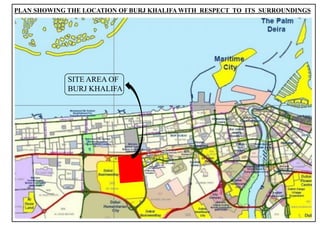
PLAN SHOWING THE LOCATION OF BURJ KHALIFA WITH RESPECT TO ITS SURROUNDINGS
SITE AREA OF
BURJ KHALIFA
5
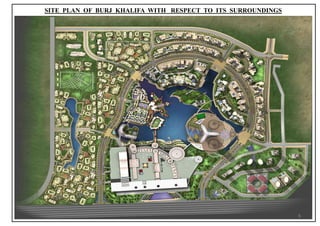
SITE PLAN OF BURJ KHALIFA WITH RESPECT TO ITS SURROUNDINGS
6
STRUCTURE IN GENERAL
Construction Type: Skyscraper
Current Status: Existing [Completed]
Structural System: Buttressed Core
Structural Material: Concrete, Steel
Facade Material: Stainless Steel
Facade System: Curtain Wall
Architectural Style: Modernism
Floor Plan: 517,240m2
KEY DATA
Order Year: 2003
Construction Start: 2004
Project Type: Mall, Residential And Retail Facilities And World's Tallest Skyscraper
Location: Dubai, United Arab Emirates
Estimated Investment: Aed800m (Mall, Residential And Retail Facilities); Aed3.9bn
(Tower); Overall Development $8bn
Completion: 2008 (Mall); 2008 (Tower), Mall Opening On 31st August 2008, Tower
Officially Opened 4 January 2010
Retail Space: 9 Million Square Feet 7
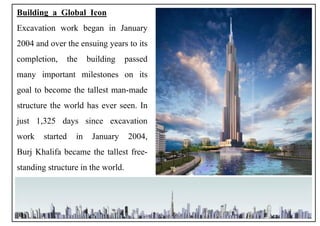
Building a Global Icon
Excavation work began in January
2004 and over the ensuing years to its
completion, the building passed
many important milestones on its
goal to become the tallest man-made
structure the world has ever seen. In
just 1,325 days since excavation
work started in January 2004,
Burj Khalifa became the tallest free-
standing structure in the world.
8
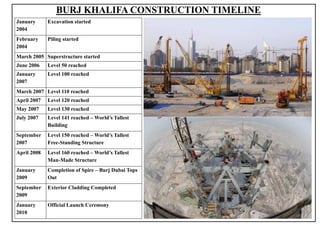
BURJ KHALIFA CONSTRUCTION TIMELINE
January
2004
Excavation started
February
2004
Piling started
March 2005 Superstructure started
June 2006 Level 50 reached
January
2007
Level 100 reached
March 2007 Level 110 reached
April 2007 Level 120 reached
May 2007 Level 130 reached
July 2007 Level 141 reached – World’s Tallest
Building
September
2007
Level 150 reached – World’s Tallest
Free-Standing Structure
April 2008 Level 160 reached – World’s Tallest
Man-Made Structure
January
2009
Completion of Spire – Burj Dubai Tops
Out
September
2009
Exterior Cladding Completed
January
2010
Official Launch Ceremony
9
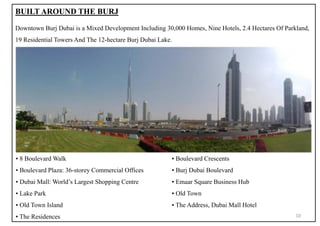
BUILT AROUND THE BURJ
Downtown Burj Dubai is a Mixed Development Including 30,000 Homes, Nine Hotels, 2.4 Hectares Of Parkland,
19 Residential Towers And The 12-hectare Burj Dubai Lake.
▪ 8 Boulevard Walk ▪ Boulevard Crescents
▪ Boulevard Plaza: 36-storey Commercial Offices ▪ Burj Dubai Boulevard
▪ Dubai Mall: World’s Largest Shopping Centre ▪ Emaar Square Business Hub
▪ Lake Park ▪ Old Town
▪ Old Town Island ▪ The Address, Dubai Mall Hotel
▪ The Residences 10
SOME INTERESTING FACTS ABOUT THE BURJ DUBAI
▪ Although the building's shape resembles the bundled tube concept of the Willis Tower, it is structurally very
different and is technically not a tube structure.
▪ The tower is situated on a man-made lake which is designed to wrap around the tower and to provide dramatic
views of it.
▪ The elevators have the world’s longest travel distance from lowest to highest stop.
▪ Hot air on the outside condense due to the large cooling needs of the building. The condensation is collected and
used to water the buildings flora and fauna. 20 Olympic-sized swimming pools per year of water.
▪ There are 1,210 fire extinguishers on the site.
▪ At the peak cooling times, the tower require approximately 10,000 tons of cooling per hour.
▪ Condensation on the building is collected and drained down to a holding tank located in the basement from
where it is pumped into the site irrigation system for use on the tower’s landscaped gardens. This system provide
about 15 million gallons of supplemental water per year, equivalent to nearly 20 olympic-sized swimming pools.
▪ Over 330,000 cubic meters of concrete was used at the completion of the tower.
11
▪ Dubai has set a new world record for vertical concrete pumping for a building, by pumping to over 460 metres.
▪ The previous record was held by Taipei 101 for pumping concrete up to a height of 448 metres.
▪ Burj Dubai break the world record for altitude transportation of concrete.
▪ The total area of cladding used to cover the Burj Dubai is equivalent to 17 football fields.
▪ The concrete used for the Burj Dubai is equivalent to: a solid cube of concrete 61 metres on a side, a sidewalk
1,900 kilometres long, the weight of 100,000 elephants.
▪ The tower’s peak electricity demand is estimated at 36mva, equivalent to roughly 360,000 100-watt light bulbs.
▪ There are 200 metres of dancing fountains at the foot of the Burj Dubai.
SOME INTERESTING FACTS ABOUT THE BURJ DUBAI (Cont…)
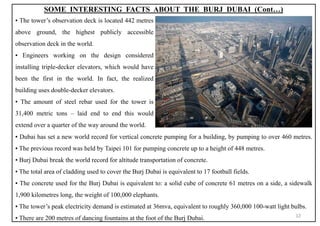
▪ The tower’s observation deck is located 442 metres
above ground, the highest publicly accessible
observation deck in the world.
▪ Engineers working on the design considered
installing triple-decker elevators, which would have
been the first in the world. In fact, the realized
building uses double-decker elevators.
▪ The amount of steel rebar used for the tower is
31,400 metric tons – laid end to end this would
extend over a quarter of the way around the world.
12
▪ The Burj Dubai feature the world’s first Armani Hotel.
▪ Burj Dubai derives its design inspiration from the
desert flower, hymenocalis, and incorporates patterning
systems that are embodied in Islamic architecture.
▪ At 5,500 kg capacity, the firemen/service elevator is the
world’s tallest service elevator.
▪ First mega-rise to have elevators with specially
programmed, permit-controlled evacuation procedures.
▪ The total glass requirement is 142k sq/m
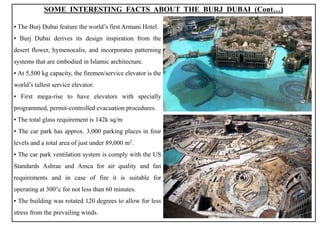
▪ The car park has approx. 3,000 parking places in four
levels and a total area of just under 89,000 m2.
▪ The car park ventilation system is comply with the US
Standards Ashrae and Amca for air quality and fan
requirements and in case of fire it is suitable for
operating at 300°c for not less than 60 minutes.
▪ The building was rotated 120 degrees to allow for less
stress from the prevailing winds.
SOME INTERESTING FACTS ABOUT THE BURJ DUBAI (Cont…)
13
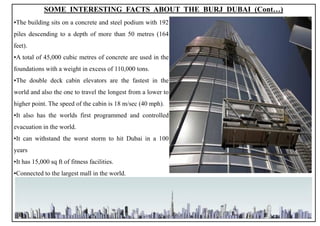
▪The building sits on a concrete and steel podium with 192
piles descending to a depth of more than 50 metres (164
feet).
▪A total of 45,000 cubic metres of concrete are used in the
foundations with a weight in excess of 110,000 tons.
▪The double deck cabin elevators are the fastest in the
world and also the one to travel the longest from a lower to
higher point. The speed of the cabin is 18 m/sec (40 mph).
▪It also has the worlds first programmed and controlled
evacuation in the world.
▪It can withstand the worst storm to hit Dubai in a 100
years
▪It has 15,000 sq ft of fitness facilities.
▪Connected to the largest mall in the world.
SOME INTERESTING FACTS ABOUT THE BURJ DUBAI (Cont…)
14
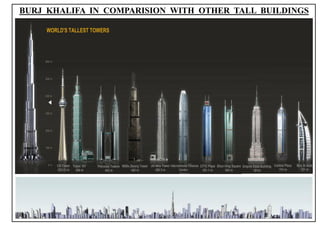
BURJ KHALIFA IN COMPARISION WITH OTHER TALL BUILDINGS
15
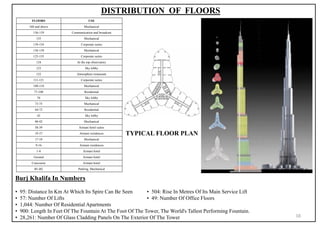
DISTRIBUTION OF FLOORS
Burj Khalifa In Numbers
▪ 95: Distance In Km At Which Its Spire Can Be Seen ▪ 504: Rise In Metres Of Its Main Service Lift
▪ 57: Number Of Lifts ▪ 49: Number Of Office Floors
▪ 1,044: Number Of Residential Apartments
▪ 900: Length In Feet Of The Fountain At The Foot Of The Tower, The World's Tallest Performing Fountain.
▪ 28,261: Number Of Glass Cladding Panels On The Exterior Of The Tower
FLOORS USE
160 and above Mechanical
156-159 Communication and broadcast
155 Mechanical
139-154 Corporate suites
136-138 Mechanical
125-135 Corporate suites
124 At the top observatory
123 Sky lobby
122 Atmosphere restaurant
111-121 Corporate suites
109-110 Mechanical
77-108 Residential
76 Sky lobby
73-75 Mechanical
44-72 Residential
43 Sky lobby
40-42 Mechanical
38-39 Armani hotel suites
19-37 Armani residences
17-18 Mechanical
9-16 Armani residences
1-8 Armani hotel
Ground Armani hotel
Concourse Armani hotel
B1-B2 Parking, Mechanical
TYPICAL FLOOR PLAN
16
ARCHITECTURE
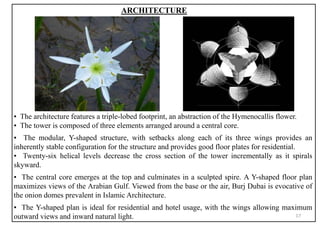
▪ The architecture features a triple-lobed footprint, an abstraction of the Hymenocallis flower.
▪ The tower is composed of three elements arranged around a central core.
▪ The modular, Y-shaped structure, with setbacks along each of its three wings provides an
inherently stable configuration for the structure and provides good floor plates for residential.
▪ Twenty-six helical levels decrease the cross section of the tower incrementally as it spirals
skyward.
▪ The central core emerges at the top and culminates in a sculpted spire. A Y-shaped floor plan
maximizes views of the Arabian Gulf. Viewed from the base or the air, Burj Dubai is evocative of
the onion domes prevalent in Islamic Architecture.
▪ The Y-shaped plan is ideal for residential and hotel usage, with the wings allowing maximum
outward views and inward natural light. 17
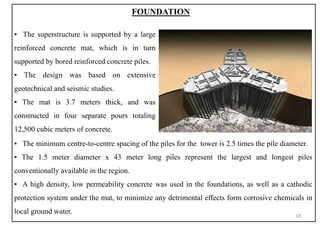
▪ The minimum centre-to-centre spacing of the piles for the tower is 2.5 times the pile diameter.
▪ The 1.5 meter diameter x 43 meter long piles represent the largest and longest piles
conventionally available in the region.
▪ A high density, low permeability concrete was used in the foundations, as well as a cathodic
protection system under the mat, to minimize any detrimental effects form corrosive chemicals in
local ground water.
FOUNDATION
▪ The superstructure is supported by a large
reinforced concrete mat, which is in turn
supported by bored reinforced concrete piles.
▪ The design was based on extensive
geotechnical and seismic studies.
▪ The mat is 3.7 meters thick, and was
constructed in four separate pours totaling
12,500 cubic meters of concrete.
18
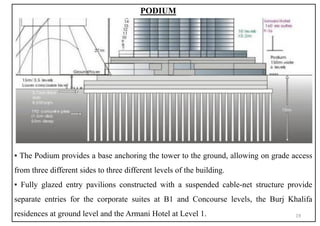
▪ The Podium provides a base anchoring the tower to the ground, allowing on grade access
from three different sides to three different levels of the building.
▪ Fully glazed entry pavilions constructed with a suspended cable-net structure provide
separate entries for the corporate suites at B1 and Concourse levels, the Burj Khalifa
residences at ground level and the Armani Hotel at Level 1.
PODIUM
19
STRUCTURAL SYSTEM
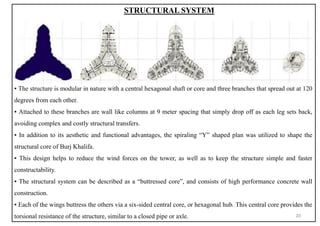
▪ The structure is modular in nature with a central hexagonal shaft or core and three branches that spread out at 120
degrees from each other.
▪ Attached to these branches are wall like columns at 9 meter spacing that simply drop off as each leg sets back,
avoiding complex and costly structural transfers.
▪ In addition to its aesthetic and functional advantages, the spiraling “Y” shaped plan was utilized to shape the
structural core of Burj Khalifa.
▪ This design helps to reduce the wind forces on the tower, as well as to keep the structure simple and faster
constructability.
▪ The structural system can be described as a “buttressed core”, and consists of high performance concrete wall
construction.
▪ Each of the wings buttress the others via a six-sided central core, or hexagonal hub. This central core provides the
torsional resistance of the structure, similar to a closed pipe or axle. 20
STRUCTURAL SYSTEM ( Cont… )
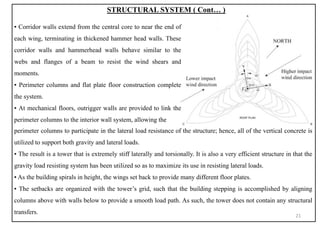
perimeter columns to participate in the lateral load resistance of the structure; hence, all of the vertical concrete is
utilized to support both gravity and lateral loads.
▪ The result is a tower that is extremely stiff laterally and torsionally. It is also a very efficient structure in that the
gravity load resisting system has been utilized so as to maximize its use in resisting lateral loads.
▪ As the building spirals in height, the wings set back to provide many different floor plates.
▪ The setbacks are organized with the tower’s grid, such that the building stepping is accomplished by aligning
columns above with walls below to provide a smooth load path. As such, the tower does not contain any structural
transfers.
▪ Corridor walls extend from the central core to near the end of
each wing, terminating in thickened hammer head walls. These
corridor walls and hammerhead walls behave similar to the
webs and flanges of a beam to resist the wind shears and
moments.
▪ Perimeter columns and flat plate floor construction complete
the system.
▪ At mechanical floors, outrigger walls are provided to link the
perimeter columns to the interior wall system, allowing the
21
STRUCTURAL SYSTEM ( Cont… )
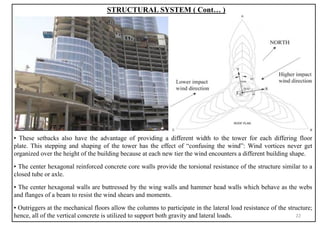
▪ These setbacks also have the advantage of providing a different width to the tower for each differing floor
plate. This stepping and shaping of the tower has the effect of “confusing the wind”: Wind vortices never get
organized over the height of the building because at each new tier the wind encounters a different building shape.
▪ The center hexagonal reinforced concrete core walls provide the torsional resistance of the structure similar to a
closed tube or axle.
▪ The center hexagonal walls are buttressed by the wing walls and hammer head walls which behave as the webs
and flanges of a beam to resist the wind shears and moments.
▪ Outriggers at the mechanical floors allow the columns to participate in the lateral load resistance of the structure;
hence, all of the vertical concrete is utilized to support both gravity and lateral loads. 22
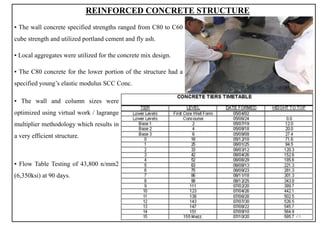
▪ The wall and column sizes were
optimized using virtual work / lagrange
multiplier methodology which results in
a very efficient structure.
▪ Flow Table Testing of 43,800 n/mm2
(6,350ksi) at 90 days.
REINFORCED CONCRETE STRUCTURE
▪ The wall concrete specified strengths ranged from C80 to C60
cube strength and utilized portland cement and fly ash.
▪ Local aggregates were utilized for the concrete mix design.
▪ The C80 concrete for the lower portion of the structure had a
specified young’s elastic modulus SCC Conc.
23
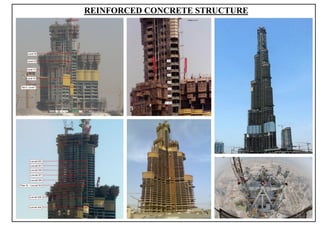
REINFORCED CONCRETE STRUCTURE
24
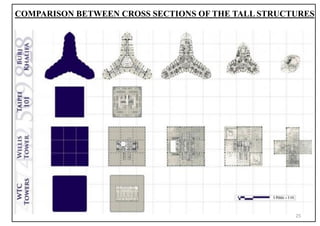
COMPARISON BETWEEN CROSS SECTIONS OF THE TALL STRUCTURES
25
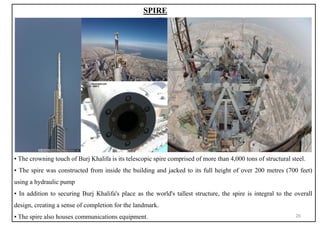
▪ The crowning touch of Burj Khalifa is its telescopic spire comprised of more than 4,000 tons of structural steel.
▪ The spire was constructed from inside the building and jacked to its full height of over 200 metres (700 feet)
using a hydraulic pump
▪ In addition to securing Burj Khalifa's place as the world's tallest structure, the spire is integral to the overall
design, creating a sense of completion for the landmark.
▪ The spire also houses communications equipment.
SPIRE
26
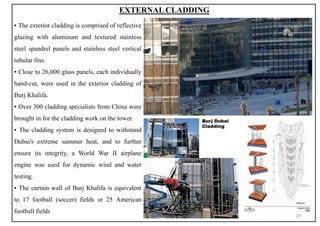
▪ The exterior cladding is comprised of reflective
glazing with aluminum and textured stainless
steel spandrel panels and stainless steel vertical
tubular fins.
▪ Close to 26,000 glass panels, each individually
hand-cut, were used in the exterior cladding of
Burj Khalifa.
▪ Over 300 cladding specialists from China were
brought in for the cladding work on the tower.
▪ The cladding system is designed to withstand
Dubai's extreme summer heat, and to further
ensure its integrity, a World War II airplane
engine was used for dynamic wind and water
testing.
▪ The curtain wall of Burj Khalifa is equivalent
to 17 football (soccer) fields or 25 American
football fields
EXTERNAL CLADDING
27
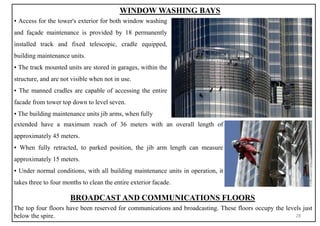
▪ Access for the tower's exterior for both window washing
and façade maintenance is provided by 18 permanently
installed track and fixed telescopic, cradle equipped,
building maintenance units.
▪ The track mounted units are stored in garages, within the
structure, and are not visible when not in use.
▪ The manned cradles are capable of accessing the entire
facade from tower top down to level seven.
▪ The building maintenance units jib arms, when fully
WINDOW WASHING BAYS
extended have a maximum reach of 36 meters with an overall length of
approximately 45 meters.
▪ When fully retracted, to parked position, the jib arm length can measure
approximately 15 meters.
▪ Under normal conditions, with all building maintenance units in operation, it
takes three to four months to clean the entire exterior facade.
BROADCAST AND COMMUNICATIONS FLOORS
The top four floors have been reserved for communications and broadcasting. These floors occupy the levels just
below the spire. 28
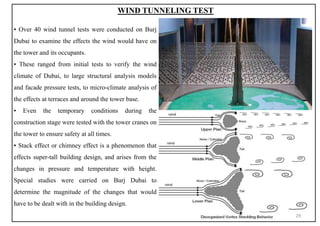
▪ Over 40 wind tunnel tests were conducted on Burj
Dubai to examine the effects the wind would have on
the tower and its occupants.
▪ These ranged from initial tests to verify the wind
climate of Dubai, to large structural analysis models
and facade pressure tests, to micro-climate analysis of
the effects at terraces and around the tower base.
▪ Even the temporary conditions during the
construction stage were tested with the tower cranes on
the tower to ensure safety at all times.
▪ Stack effect or chimney effect is a phenomenon that
effects super-tall building design, and arises from the
changes in pressure and temperature with height.
Special studies were carried on Burj Dubai to
determine the magnitude of the changes that would
have to be dealt with in the building design.
WIND TUNNELING TEST
29
SERVICING THE BURJ KHALIFA
▪ With services risers running the full 600 m+ height of the building, designing MEP systems to serve the Burj
Dubai has taken great care.
▪ Billed as the tallest building in the world, the task of providing MEP services to the Burj Dubai was always going
to be a challenge.
▪ The world records made by the Emaar Properties' project stretch to the services themselves, with the longest lift
shaft in the world and mechanical operating pressures that would send some MEP consultants into a cold sweat.
▪ Despite this, the mission of providing reliable and efficient MEP services for the tower has involved the use of
proven technologies and off-the-shelf products - albeit under a very close and detailed design and installation
process and a major logistics programme.
MECHANICAL, ELECTRICAL & PLUMBING
To achieve the greatest efficiencies, the mechanical, electrical and plumbing services for Burj Khalifa were
developed in coordination during the design phase with cooperation of the architect, structural engineer and other
consultant.
FIRE SAFETY
▪ Fire safety and speed of evacuation were prime factors in the design of Burj Khalifa.
▪ Concrete surrounds all stairwells and the building service and fireman's elevator have a capacity of 5,500 kg and
is the world's tallest service elevator.
▪ Since people can't reasonably be expected to walk down 160 floors, there are pressurized, air-conditioned refuge
areas located approximately every 25 floors.
30
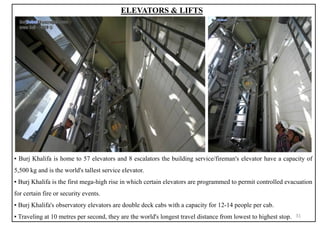
ELEVATORS & LIFTS
▪ Burj Khalifa is home to 57 elevators and 8 escalators the building service/fireman's elevator have a capacity of
5,500 kg and is the world's tallest service elevator.
▪ Burj Khalifa is the first mega-high rise in which certain elevators are programmed to permit controlled evacuation
for certain fire or security events.
▪ Burj Khalifa's observatory elevators are double deck cabs with a capacity for 12-14 people per cab.
▪ Traveling at 10 metres per second, they are the world's longest travel distance from lowest to highest stop. 31
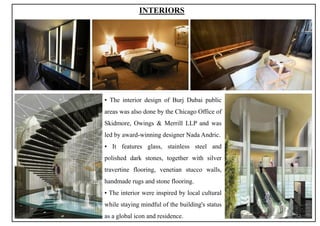
INTERIORS
▪ The interior design of Burj Dubai public
areas was also done by the Chicago Office of
Skidmore, Owings & Merrill LLP and was
led by award-winning designer Nada Andric.
▪ It features glass, stainless steel and
polished dark stones, together with silver
travertine flooring, venetian stucco walls,
handmade rugs and stone flooring.
▪ The interior were inspired by local cultural
while staying mindful of the building's status
as a global icon and residence. 32
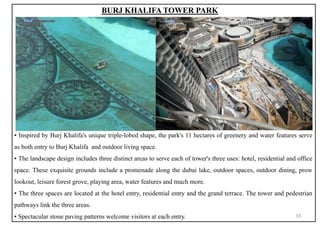
▪ Inspired by Burj Khalifa's unique triple-lobed shape, the park's 11 hectares of greenery and water features serve
as both entry to Burj Khalifa and outdoor living space.
▪ The landscape design includes three distinct areas to serve each of tower's three uses: hotel, residential and office
space. These exquisite grounds include a promenade along the dubai lake, outdoor spaces, outdoor dining, prow
lookout, leisure forest grove, playing area, water features and much more.
▪ The three spaces are located at the hotel entry, residential entry and the grand terrace. The tower and pedestrian
pathways link the three areas.
▪ Spectacular stone paving patterns welcome visitors at each entry.
BURJ KHALIFA TOWER PARK
33
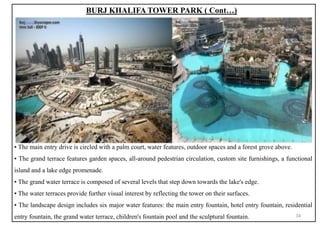
▪ The main entry drive is circled with a palm court, water features, outdoor spaces and a forest grove above.
▪ The grand terrace features garden spaces, all-around pedestrian circulation, custom site furnishings, a functional
island and a lake edge promenade.
▪ The grand water terrace is composed of several levels that step down towards the lake's edge.
▪ The water terraces provide further visual interest by reflecting the tower on their surfaces.
▪ The landscape design includes six major water features: the main entry fountain, hotel entry fountain, residential
entry fountain, the grand water terrace, children's fountain pool and the sculptural fountain.
BURJ KHALIFA TOWER PARK ( Cont…)
34
BURJ KHALIFA TOWER PARK
LANDSCAPED BY SWA LANDSCAPE ARCHITECTURE GROUP
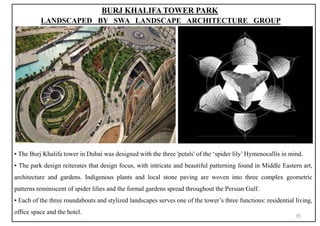
▪ The Burj Khalifa tower in Dubai was designed with the three 'petals' of the ‘spider lily’ Hymenocallis in mind.
▪ The park design reiterates that design focus, with intricate and beautiful patterning found in Middle Eastern art,
architecture and gardens. Indigenous plants and local stone paving are woven into three complex geometric
patterns reminiscent of spider lilies and the formal gardens spread throughout the Persian Gulf.
▪ Each of the three roundabouts and stylized landscapes serves one of the tower’s three functions: residential living,
office space and the hotel.
35
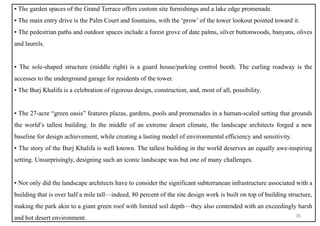
▪ The garden spaces of the Grand Terrace offers custom site furnishings and a lake edge promenade.
▪ The main entry drive is the Palm Court and fountains, with the ‘prow’ of the tower lookout pointed toward it.
▪ The pedestrian paths and outdoor spaces include a forest grove of date palms, silver buttonwoods, banyans, olives
and laurels.
▪ The sole-shaped structure (middle right) is a guard house/parking control booth. The curling roadway is the
accesses to the underground garage for residents of the tower.
▪ The Burj Khalifa is a celebration of rigorous design, construction, and, most of all, possibility.
▪ The 27-acre “green oasis” features plazas, gardens, pools and promenades in a human-scaled setting that grounds
the world’s tallest building. In the middle of an extreme desert climate, the landscape architects forged a new
baseline for design achievement, while creating a lasting model of environmental efficiency and sensitivity.
▪ The story of the Burj Khalifa is well known. The tallest building in the world deserves an equally awe-inspiring
setting. Unsurprisingly, designing such an iconic landscape was but one of many challenges.
▪ Not only did the landscape architects have to consider the significant subterranean infrastructure associated with a
building that is over half a mile tall—indeed, 80 percent of the site design work is built on top of building structure,
making the park akin to a giant green roof with limited soil depth—they also contended with an exceedingly harsh
and hot desert environment. 36
▪ Rather than being seen as restrictions, however, these constraints enabled the designers to develop many
innovative solutions that placed equal emphasis on aesthetic and technical achievement—a singular solution for
this tremendously unique structure.
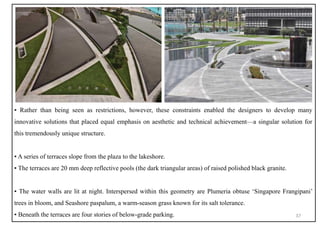
▪ A series of terraces slope from the plaza to the lakeshore.
▪ The terraces are 20 mm deep reflective pools (the dark triangular areas) of raised polished black granite.
▪ The water walls are lit at night. Interspersed within this geometry are Plumeria obtuse ‘Singapore Frangipani’
trees in bloom, and Seashore paspalum, a warm-season grass known for its salt tolerance.
▪ Beneath the terraces are four stories of below-grade parking. 37
PROJECT SITE, SCOPE, AND CHALLENGES
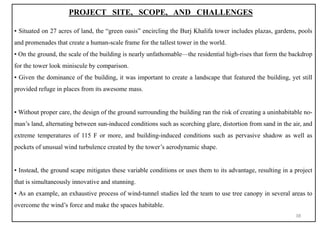
▪ Situated on 27 acres of land, the “green oasis” encircling the Burj Khalifa tower includes plazas, gardens, pools
and promenades that create a human-scale frame for the tallest tower in the world.
▪ On the ground, the scale of the building is nearly unfathomable—the residential high-rises that form the backdrop
for the tower look miniscule by comparison.
▪ Given the dominance of the building, it was important to create a landscape that featured the building, yet still
provided refuge in places from its awesome mass.
▪ Without proper care, the design of the ground surrounding the building ran the risk of creating a uninhabitable no-
man’s land, alternating between sun-induced conditions such as scorching glare, distortion from sand in the air, and
extreme temperatures of 115 F or more, and building-induced conditions such as pervasive shadow as well as
pockets of unusual wind turbulence created by the tower’s aerodynamic shape.
▪ Instead, the ground scape mitigates these variable conditions or uses them to its advantage, resulting in a project
that is simultaneously innovative and stunning.
▪ As an example, an exhaustive process of wind-tunnel studies led the team to use tree canopy in several areas to
overcome the wind’s force and make the spaces habitable.
38
▪ Creating this landscape required a thorough understanding of the building’s multiple functions and inherent
mixed-use nature, as well as the multi-model traffic coordination entailed by its adjacency to a bustling urban
center.
▪ Multiple entries and drop-offs, service access points, garage and structural considerations, and public versus
private entrances were just some of the many circulation nodes considered on the ground level, prompting the
design of clear navigation and wayfinding graphics to direct visitors towards building entrances as well as public
oasis, cooling, and garden areas.
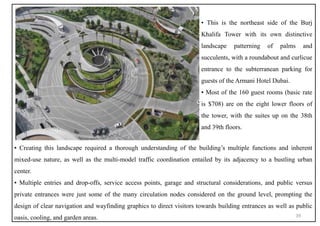
▪ This is the northeast side of the Burj
Khalifa Tower with its own distinctive
landscape patterning of palms and
succulents, with a roundabout and curlicue
entrance to the subterranean parking for
guests of the Armani Hotel Dubai.
▪ Most of the 160 guest rooms (basic rate
is $708) are on the eight lower floors of
the tower, with the suites up on the 38th
and 39th floors.
39
▪ Beyond the choreography of various circulation and access paths, there were coordination complexities induced
by fixed design elements, such as emergency exits, intake and exhaust vents, and structural beams and girders, as
well as the sequencing challenge of designing the surface landscape while subterranean parking structures were in
the midst of construction.
▪ The solution to all of these concerns was to stay mindful of locality. Cultural and social customs yielded
interwoven circulation and outdoor rooms; local artistic traditions showed up in the use of Islamic patterning as a
recurring motif; and finally, an indigenous plant palette maximized scarce water resources and minimized the need
for deep soil.
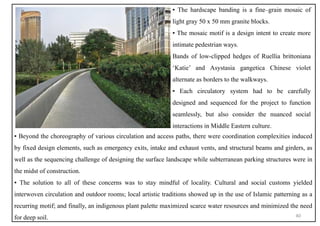
▪ The hardscape banding is a fine–grain mosaic of
light gray 50 x 50 mm granite blocks.
▪ The mosaic motif is a design intent to create more
intimate pedestrian ways.
Bands of low-clipped hedges of Ruellia brittoniana
‘Katie’ and Asystasia gangetica Chinese violet
alternate as borders to the walkways.
▪ Each circulatory system had to be carefully
designed and sequenced for the project to function
seamlessly, but also consider the nuanced social
interactions in Middle Eastern culture.
40
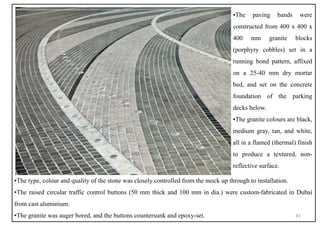
▪The paving bands were
constructed from 400 x 400 x
400 mm granite blocks
(porphyry cobbles) set in a
running bond pattern, affixed
on a 25-40 mm dry mortar
bed, and set on the concrete
foundation of the parking
decks below.
▪The granite colours are black,
medium gray, tan, and white,
all in a flamed (thermal) finish
to produce a textured, non-
reflective surface.
▪The type, colour and quality of the stone was closely controlled from the mock up through to installation.
▪The raised circular traffic control buttons (50 mm thick and 100 mm in dia.) were custom-fabricated in Dubai
from cast aluminium.
▪The granite was auger bored, and the buttons countersunk and epoxy-set. 41
INDIGENOUS PLANTING FOR SUSTAINABILITY, WATER CONVERSATION
AND CULTURAL REFERENCE
▪ The inspiration for the Burj Khalifa groundscape was the intricate and beautiful patterning found in the region’s
art, architecture and gardens.
▪ Indigenous plant materials and local stone paving are woven across the ground plane in complex geometric
patterns reminiscent of the region’s spider lilies, as well as the formal gardens that spread throughout the Persian
Gulf.
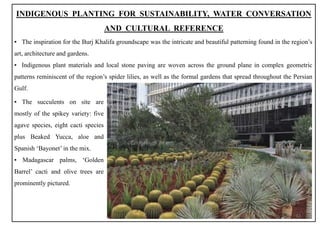
▪ The succulents on site are
mostly of the spikey variety: five
agave species, eight cacti species
plus Beaked Yucca, aloe and
Spanish ‘Bayonet’ in the mix.
▪ Madagascar palms, ‘Golden
Barrel’ cacti and olive trees are
prominently pictured.
42
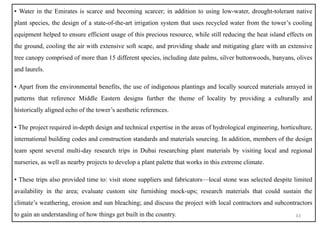
▪ Water in the Emirates is scarce and becoming scarcer; in addition to using low-water, drought-tolerant native
plant species, the design of a state-of-the-art irrigation system that uses recycled water from the tower’s cooling
equipment helped to ensure efficient usage of this precious resource, while still reducing the heat island effects on
the ground, cooling the air with extensive soft scape, and providing shade and mitigating glare with an extensive
tree canopy comprised of more than 15 different species, including date palms, silver buttonwoods, banyans, olives
and laurels.
▪ Apart from the environmental benefits, the use of indigenous plantings and locally sourced materials arrayed in
patterns that reference Middle Eastern designs further the theme of locality by providing a culturally and
historically aligned echo of the tower’s aesthetic references.
▪ The project required in-depth design and technical expertise in the areas of hydrological engineering, horticulture,
international building codes and construction standards and materials sourcing. In addition, members of the design
team spent several multi-day research trips in Dubai researching plant materials by visiting local and regional
nurseries, as well as nearby projects to develop a plant palette that works in this extreme climate.
▪ These trips also provided time to: visit stone suppliers and fabricators—local stone was selected despite limited
availability in the area; evaluate custom site furnishing mock-ups; research materials that could sustain the
climate’s weathering, erosion and sun bleaching; and discuss the project with local contractors and subcontractors
to gain an understanding of how things get built in the country. 43
▪ By using native plantings and sustainable water features for cooling and comfort, the project aims to improve the
microclimates surrounding the building and provide respite from an exceedingly hot desert climate.
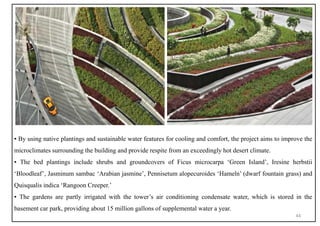
▪ The bed plantings include shrubs and groundcovers of Ficus microcarpa ‘Green Island’, Iresine herbstii
‘Bloodleaf’, Jasminum sambac ‘Arabian jasmine’, Pennisetum alopecuroides ‘Hameln’ (dwarf fountain grass) and
Quisqualis indica ‘Rangoon Creeper.’
▪ The gardens are partly irrigated with the tower’s air conditioning condensate water, which is stored in the
basement car park, providing about 15 million gallons of supplemental water a year.
44
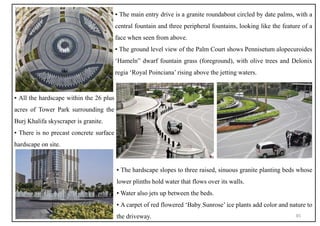
▪ The hardscape slopes to three raised, sinuous granite planting beds whose
lower plinths hold water that flows over its walls.
▪ Water also jets up between the beds.
▪ A carpet of red flowered ‘Baby Sunrose’ ice plants add color and nature to
the driveway.
▪ The main entry drive is a granite roundabout circled by date palms, with a
central fountain and three peripheral fountains, looking like the feature of a
face when seen from above.
▪ The ground level view of the Palm Court shows Pennisetum alopecuroides
‘Hameln” dwarf fountain grass (foreground), with olive trees and Delonix
regia ‘Royal Poinciana’ rising above the jetting waters.
▪ All the hardscape within the 26 plus
acres of Tower Park surrounding the
Burj Khalifa skyscraper is granite.
▪ There is no precast concrete surface
hardscape on site.
45
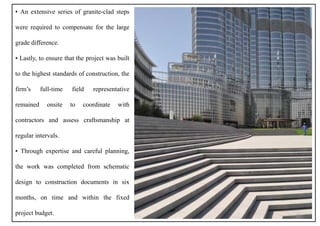
▪ An extensive series of granite-clad steps
were required to compensate for the large
grade difference.
▪ Lastly, to ensure that the project was built
to the highest standards of construction, the
firm’s full-time field representative
remained onsite to coordinate with
contractors and assess craftsmanship at
regular intervals.
▪ Through expertise and careful planning,
the work was completed from schematic
design to construction documents in six
months, on time and within the fixed
project budget. 46
47
REFERENCES
www.swalandscape.com
www.google.com
www.slideshare.net
www.burjdubai.com
www.burjkhalifa.world.com
www.travellngtheworld.net/burjkhalifa
American Concrete Institute (ACI) (2002), Building Code Requirements for Structural Concrete (ACI 318-02) and
Commentary, Reported by ACI Committee.
Baker, Korista, Novak, Pawlikowski & Young (2007), “Creep & Shrinkage and the Design of Supertall Buildings – A Case
Study: The Burj Dubai Tower”, ACI SP-246: Structural Implications of Shrinkage and Creep of Concrete.
Baker, Novak, Sinn & Viise (2000), “Structural Optimization of 2000-Foot Tall 7 South Dearborn Building”, Proceedings
of the ASCE Structures Congress 2000 – Advanced Technology in Structural Engineering and 14th Analysis &
Computational Conference.
Gardner (2004), “Comparison of prediction provisions for drying shrinkage and creep of normal strength concretes”,
Canadian Journal of Civil Engineering, Vol.30, No.5, pp 767-775.
Irwin, Baker, Korista, Weismantle & Novak (2006), “The Burj Dubai Tower: Wind Tunnel Testing of Cladding and
Pedestrian Level”, Structure Magazine, published by NCSEA, November 2006, pp 47-50.
Kuchma, Lee, Baker, & Novak (2007), “Design and Analysis of Heavily Loaded Reinforced Concrete Link Beams for Burj
Dubai”, accepted for publication by ACI (MS #S-2007-030).
Novak & Sprenger (2002), “Deep Beam with Opening”, ACI SP-208: Examples for the Design of Structural Concrete with
Strut-and-tie Models, Karl-Heinz Reineck Editor, pp129-143.

Burj Khalifa

  • 1.
    BURJ KHALIFA, DUBAI (BURJDUBAI OR TOWER OF KHALIFA) 1
  • 2.
    2 CONTENTS S. NO. TITLEPAGE NO. 1. INTRODUCTION 3 2. PURPOSE 4 3. PLAN SHOWING LOCATION OF BURJ KHALIIFA 5 4. SITE PLAN 6 5. STRUCTURE 7-8 6. CONSTRUCTION TIMELINE 9-10 7. INTERESTING FACTS ABOUT BURJ DUBAI 11-14 8. COMPARISION WITH OTHER TALL BILDINGS 15 9. DISTRIBUTION OF FLOORS 16 10. ARCHITECTURE OF BURJ KHALIFA 17 11. FOUNDATION 18 12. PODIUM 19 13. STRUCTURAL SYSTEM 20-22 14. R.C.C. STRUCTURE 23-24 15. COMPARISION BETWEEN CROSS SECTION OF TALL STRUCTURES 25 16. SPIRE 26 17. EXTERNAL CLADDING 27 18. WINDOW WASHING 28 19. WIND TUNNEL TEST 29 20. SERVICING THE BURJ KHALIFA 30 21. ELEVATORS AND LIFTS 31 22. INTERIORS 32 23. LANDSCAPING THE KHALIFA PARK 33-37 24. PROJECT SITE, SCOPE, AND CHALLENGES 38-41 25. SUSTAINABILITY, WATER CONSERVATION AND CULTURAL REFERENCE 42-46 26. REFERENCES 47
  • 3.
    Official Name: BurjKhalifa Bin Zayed Also Known As: Burj Dubai Also Known As: Tower Of Khalifa Formerly: Burj Dubai Built: 2004-2010 Cost: $4,100,000,000 Designed By: Skidmore, Owings & Merrill Type: Skyscraper Stories: 206 Maximum Height: 2,717 Feet / 828 Meters Location: No. 1, Burj Dubai Boulevard, Dubai, United Arab 3
  • 4.
    PURPOSE ▪ Burj Dubaihas been designed to be the centerpiece of a large-scale, mixed-use development that will include 30,000 homes, nine hotels such as the Burj Dubai Lake Hotel & Serviced Apartments, 0.03 km² (0.01 sq mi) of parkland, at least 19 residential towers, the Dubai Mall, and the 0.12 km² (0.05 sq mi) man-made Burj Dubai lake. ▪ Burj Dubai cost US$ 800 million to build and the entire 2 km² (0.77 sq mi) development cost around US$ 20 billion. ▪ The silvery glass-sheathed concrete building gives the title of earth's tallest free-standing structure to the Middle East — a title not held by the region since 1311 AD when Lincoln Cathedral in England surpassed the height of the Great Pyramid of Giza, which had held the title for almost four millennia. ▪ The decision to build Burj Dubai is reportedly based on the government's decision to diversify from a trade-based economy to one that is service- and tourism-oriented. ▪ According to officials, it is necessary for projects like Burj Dubai to be built in the city to garner more international recognition, and hence investment. "He [Sheikh Mohammed Bin Rashid Al Maktoum] wanted to put Dubai on the map with something really sensational," said Jacqui Josephson, a Tourism and VIP Delegations Executive at Nakheel Properties. “BURJ KHALIFA IS THE ARAB WORLD’S TRIBUTE TO THE ART AND SCIENCE OF MODERN ENGINEERING AND DESIGN. BURJ KHALIFA SYMBOLIZES THE AESTHETIC UNISON OF MANY CULTURES – FROM ARABIAAND THE REST OF THE WORLD.” - Mohamed Alabbar(Chairman, Emaar)4
  • 5.
    PLAN SHOWING THELOCATION OF BURJ KHALIFA WITH RESPECT TO ITS SURROUNDINGS SITE AREA OF BURJ KHALIFA 5
  • 6.
    SITE PLAN OFBURJ KHALIFA WITH RESPECT TO ITS SURROUNDINGS 6
  • 7.
    STRUCTURE IN GENERAL ConstructionType: Skyscraper Current Status: Existing [Completed] Structural System: Buttressed Core Structural Material: Concrete, Steel Facade Material: Stainless Steel Facade System: Curtain Wall Architectural Style: Modernism Floor Plan: 517,240m2 KEY DATA Order Year: 2003 Construction Start: 2004 Project Type: Mall, Residential And Retail Facilities And World's Tallest Skyscraper Location: Dubai, United Arab Emirates Estimated Investment: Aed800m (Mall, Residential And Retail Facilities); Aed3.9bn (Tower); Overall Development $8bn Completion: 2008 (Mall); 2008 (Tower), Mall Opening On 31st August 2008, Tower Officially Opened 4 January 2010 Retail Space: 9 Million Square Feet 7
  • 8.
    Building a GlobalIcon Excavation work began in January 2004 and over the ensuing years to its completion, the building passed many important milestones on its goal to become the tallest man-made structure the world has ever seen. In just 1,325 days since excavation work started in January 2004, Burj Khalifa became the tallest free- standing structure in the world. 8
  • 9.
    BURJ KHALIFA CONSTRUCTIONTIMELINE January 2004 Excavation started February 2004 Piling started March 2005 Superstructure started June 2006 Level 50 reached January 2007 Level 100 reached March 2007 Level 110 reached April 2007 Level 120 reached May 2007 Level 130 reached July 2007 Level 141 reached – World’s Tallest Building September 2007 Level 150 reached – World’s Tallest Free-Standing Structure April 2008 Level 160 reached – World’s Tallest Man-Made Structure January 2009 Completion of Spire – Burj Dubai Tops Out September 2009 Exterior Cladding Completed January 2010 Official Launch Ceremony 9
  • 10.
    BUILT AROUND THEBURJ Downtown Burj Dubai is a Mixed Development Including 30,000 Homes, Nine Hotels, 2.4 Hectares Of Parkland, 19 Residential Towers And The 12-hectare Burj Dubai Lake. ▪ 8 Boulevard Walk ▪ Boulevard Crescents ▪ Boulevard Plaza: 36-storey Commercial Offices ▪ Burj Dubai Boulevard ▪ Dubai Mall: World’s Largest Shopping Centre ▪ Emaar Square Business Hub ▪ Lake Park ▪ Old Town ▪ Old Town Island ▪ The Address, Dubai Mall Hotel ▪ The Residences 10
  • 11.
    SOME INTERESTING FACTSABOUT THE BURJ DUBAI ▪ Although the building's shape resembles the bundled tube concept of the Willis Tower, it is structurally very different and is technically not a tube structure. ▪ The tower is situated on a man-made lake which is designed to wrap around the tower and to provide dramatic views of it. ▪ The elevators have the world’s longest travel distance from lowest to highest stop. ▪ Hot air on the outside condense due to the large cooling needs of the building. The condensation is collected and used to water the buildings flora and fauna. 20 Olympic-sized swimming pools per year of water. ▪ There are 1,210 fire extinguishers on the site. ▪ At the peak cooling times, the tower require approximately 10,000 tons of cooling per hour. ▪ Condensation on the building is collected and drained down to a holding tank located in the basement from where it is pumped into the site irrigation system for use on the tower’s landscaped gardens. This system provide about 15 million gallons of supplemental water per year, equivalent to nearly 20 olympic-sized swimming pools. ▪ Over 330,000 cubic meters of concrete was used at the completion of the tower. 11
  • 12.
    ▪ Dubai hasset a new world record for vertical concrete pumping for a building, by pumping to over 460 metres. ▪ The previous record was held by Taipei 101 for pumping concrete up to a height of 448 metres. ▪ Burj Dubai break the world record for altitude transportation of concrete. ▪ The total area of cladding used to cover the Burj Dubai is equivalent to 17 football fields. ▪ The concrete used for the Burj Dubai is equivalent to: a solid cube of concrete 61 metres on a side, a sidewalk 1,900 kilometres long, the weight of 100,000 elephants. ▪ The tower’s peak electricity demand is estimated at 36mva, equivalent to roughly 360,000 100-watt light bulbs. ▪ There are 200 metres of dancing fountains at the foot of the Burj Dubai. SOME INTERESTING FACTS ABOUT THE BURJ DUBAI (Cont…) ▪ The tower’s observation deck is located 442 metres above ground, the highest publicly accessible observation deck in the world. ▪ Engineers working on the design considered installing triple-decker elevators, which would have been the first in the world. In fact, the realized building uses double-decker elevators. ▪ The amount of steel rebar used for the tower is 31,400 metric tons – laid end to end this would extend over a quarter of the way around the world. 12
  • 13.
    ▪ The BurjDubai feature the world’s first Armani Hotel. ▪ Burj Dubai derives its design inspiration from the desert flower, hymenocalis, and incorporates patterning systems that are embodied in Islamic architecture. ▪ At 5,500 kg capacity, the firemen/service elevator is the world’s tallest service elevator. ▪ First mega-rise to have elevators with specially programmed, permit-controlled evacuation procedures. ▪ The total glass requirement is 142k sq/m ▪ The car park has approx. 3,000 parking places in four levels and a total area of just under 89,000 m2. ▪ The car park ventilation system is comply with the US Standards Ashrae and Amca for air quality and fan requirements and in case of fire it is suitable for operating at 300°c for not less than 60 minutes. ▪ The building was rotated 120 degrees to allow for less stress from the prevailing winds. SOME INTERESTING FACTS ABOUT THE BURJ DUBAI (Cont…) 13
  • 14.
    ▪The building sitson a concrete and steel podium with 192 piles descending to a depth of more than 50 metres (164 feet). ▪A total of 45,000 cubic metres of concrete are used in the foundations with a weight in excess of 110,000 tons. ▪The double deck cabin elevators are the fastest in the world and also the one to travel the longest from a lower to higher point. The speed of the cabin is 18 m/sec (40 mph). ▪It also has the worlds first programmed and controlled evacuation in the world. ▪It can withstand the worst storm to hit Dubai in a 100 years ▪It has 15,000 sq ft of fitness facilities. ▪Connected to the largest mall in the world. SOME INTERESTING FACTS ABOUT THE BURJ DUBAI (Cont…) 14
  • 15.
    BURJ KHALIFA INCOMPARISION WITH OTHER TALL BUILDINGS 15
  • 16.
    DISTRIBUTION OF FLOORS BurjKhalifa In Numbers ▪ 95: Distance In Km At Which Its Spire Can Be Seen ▪ 504: Rise In Metres Of Its Main Service Lift ▪ 57: Number Of Lifts ▪ 49: Number Of Office Floors ▪ 1,044: Number Of Residential Apartments ▪ 900: Length In Feet Of The Fountain At The Foot Of The Tower, The World's Tallest Performing Fountain. ▪ 28,261: Number Of Glass Cladding Panels On The Exterior Of The Tower FLOORS USE 160 and above Mechanical 156-159 Communication and broadcast 155 Mechanical 139-154 Corporate suites 136-138 Mechanical 125-135 Corporate suites 124 At the top observatory 123 Sky lobby 122 Atmosphere restaurant 111-121 Corporate suites 109-110 Mechanical 77-108 Residential 76 Sky lobby 73-75 Mechanical 44-72 Residential 43 Sky lobby 40-42 Mechanical 38-39 Armani hotel suites 19-37 Armani residences 17-18 Mechanical 9-16 Armani residences 1-8 Armani hotel Ground Armani hotel Concourse Armani hotel B1-B2 Parking, Mechanical TYPICAL FLOOR PLAN 16
  • 17.
    ARCHITECTURE ▪ The architecturefeatures a triple-lobed footprint, an abstraction of the Hymenocallis flower. ▪ The tower is composed of three elements arranged around a central core. ▪ The modular, Y-shaped structure, with setbacks along each of its three wings provides an inherently stable configuration for the structure and provides good floor plates for residential. ▪ Twenty-six helical levels decrease the cross section of the tower incrementally as it spirals skyward. ▪ The central core emerges at the top and culminates in a sculpted spire. A Y-shaped floor plan maximizes views of the Arabian Gulf. Viewed from the base or the air, Burj Dubai is evocative of the onion domes prevalent in Islamic Architecture. ▪ The Y-shaped plan is ideal for residential and hotel usage, with the wings allowing maximum outward views and inward natural light. 17
  • 18.
    ▪ The minimumcentre-to-centre spacing of the piles for the tower is 2.5 times the pile diameter. ▪ The 1.5 meter diameter x 43 meter long piles represent the largest and longest piles conventionally available in the region. ▪ A high density, low permeability concrete was used in the foundations, as well as a cathodic protection system under the mat, to minimize any detrimental effects form corrosive chemicals in local ground water. FOUNDATION ▪ The superstructure is supported by a large reinforced concrete mat, which is in turn supported by bored reinforced concrete piles. ▪ The design was based on extensive geotechnical and seismic studies. ▪ The mat is 3.7 meters thick, and was constructed in four separate pours totaling 12,500 cubic meters of concrete. 18
  • 19.
    ▪ The Podiumprovides a base anchoring the tower to the ground, allowing on grade access from three different sides to three different levels of the building. ▪ Fully glazed entry pavilions constructed with a suspended cable-net structure provide separate entries for the corporate suites at B1 and Concourse levels, the Burj Khalifa residences at ground level and the Armani Hotel at Level 1. PODIUM 19
  • 20.
    STRUCTURAL SYSTEM ▪ Thestructure is modular in nature with a central hexagonal shaft or core and three branches that spread out at 120 degrees from each other. ▪ Attached to these branches are wall like columns at 9 meter spacing that simply drop off as each leg sets back, avoiding complex and costly structural transfers. ▪ In addition to its aesthetic and functional advantages, the spiraling “Y” shaped plan was utilized to shape the structural core of Burj Khalifa. ▪ This design helps to reduce the wind forces on the tower, as well as to keep the structure simple and faster constructability. ▪ The structural system can be described as a “buttressed core”, and consists of high performance concrete wall construction. ▪ Each of the wings buttress the others via a six-sided central core, or hexagonal hub. This central core provides the torsional resistance of the structure, similar to a closed pipe or axle. 20
  • 21.
    STRUCTURAL SYSTEM (Cont… ) perimeter columns to participate in the lateral load resistance of the structure; hence, all of the vertical concrete is utilized to support both gravity and lateral loads. ▪ The result is a tower that is extremely stiff laterally and torsionally. It is also a very efficient structure in that the gravity load resisting system has been utilized so as to maximize its use in resisting lateral loads. ▪ As the building spirals in height, the wings set back to provide many different floor plates. ▪ The setbacks are organized with the tower’s grid, such that the building stepping is accomplished by aligning columns above with walls below to provide a smooth load path. As such, the tower does not contain any structural transfers. ▪ Corridor walls extend from the central core to near the end of each wing, terminating in thickened hammer head walls. These corridor walls and hammerhead walls behave similar to the webs and flanges of a beam to resist the wind shears and moments. ▪ Perimeter columns and flat plate floor construction complete the system. ▪ At mechanical floors, outrigger walls are provided to link the perimeter columns to the interior wall system, allowing the 21
  • 22.
    STRUCTURAL SYSTEM (Cont… ) ▪ These setbacks also have the advantage of providing a different width to the tower for each differing floor plate. This stepping and shaping of the tower has the effect of “confusing the wind”: Wind vortices never get organized over the height of the building because at each new tier the wind encounters a different building shape. ▪ The center hexagonal reinforced concrete core walls provide the torsional resistance of the structure similar to a closed tube or axle. ▪ The center hexagonal walls are buttressed by the wing walls and hammer head walls which behave as the webs and flanges of a beam to resist the wind shears and moments. ▪ Outriggers at the mechanical floors allow the columns to participate in the lateral load resistance of the structure; hence, all of the vertical concrete is utilized to support both gravity and lateral loads. 22
  • 23.
    ▪ The walland column sizes were optimized using virtual work / lagrange multiplier methodology which results in a very efficient structure. ▪ Flow Table Testing of 43,800 n/mm2 (6,350ksi) at 90 days. REINFORCED CONCRETE STRUCTURE ▪ The wall concrete specified strengths ranged from C80 to C60 cube strength and utilized portland cement and fly ash. ▪ Local aggregates were utilized for the concrete mix design. ▪ The C80 concrete for the lower portion of the structure had a specified young’s elastic modulus SCC Conc. 23
  • 24.
  • 25.
    COMPARISON BETWEEN CROSSSECTIONS OF THE TALL STRUCTURES 25
  • 26.
    ▪ The crowningtouch of Burj Khalifa is its telescopic spire comprised of more than 4,000 tons of structural steel. ▪ The spire was constructed from inside the building and jacked to its full height of over 200 metres (700 feet) using a hydraulic pump ▪ In addition to securing Burj Khalifa's place as the world's tallest structure, the spire is integral to the overall design, creating a sense of completion for the landmark. ▪ The spire also houses communications equipment. SPIRE 26
  • 27.
    ▪ The exteriorcladding is comprised of reflective glazing with aluminum and textured stainless steel spandrel panels and stainless steel vertical tubular fins. ▪ Close to 26,000 glass panels, each individually hand-cut, were used in the exterior cladding of Burj Khalifa. ▪ Over 300 cladding specialists from China were brought in for the cladding work on the tower. ▪ The cladding system is designed to withstand Dubai's extreme summer heat, and to further ensure its integrity, a World War II airplane engine was used for dynamic wind and water testing. ▪ The curtain wall of Burj Khalifa is equivalent to 17 football (soccer) fields or 25 American football fields EXTERNAL CLADDING 27
  • 28.
    ▪ Access forthe tower's exterior for both window washing and façade maintenance is provided by 18 permanently installed track and fixed telescopic, cradle equipped, building maintenance units. ▪ The track mounted units are stored in garages, within the structure, and are not visible when not in use. ▪ The manned cradles are capable of accessing the entire facade from tower top down to level seven. ▪ The building maintenance units jib arms, when fully WINDOW WASHING BAYS extended have a maximum reach of 36 meters with an overall length of approximately 45 meters. ▪ When fully retracted, to parked position, the jib arm length can measure approximately 15 meters. ▪ Under normal conditions, with all building maintenance units in operation, it takes three to four months to clean the entire exterior facade. BROADCAST AND COMMUNICATIONS FLOORS The top four floors have been reserved for communications and broadcasting. These floors occupy the levels just below the spire. 28
  • 29.
    ▪ Over 40wind tunnel tests were conducted on Burj Dubai to examine the effects the wind would have on the tower and its occupants. ▪ These ranged from initial tests to verify the wind climate of Dubai, to large structural analysis models and facade pressure tests, to micro-climate analysis of the effects at terraces and around the tower base. ▪ Even the temporary conditions during the construction stage were tested with the tower cranes on the tower to ensure safety at all times. ▪ Stack effect or chimney effect is a phenomenon that effects super-tall building design, and arises from the changes in pressure and temperature with height. Special studies were carried on Burj Dubai to determine the magnitude of the changes that would have to be dealt with in the building design. WIND TUNNELING TEST 29
  • 30.
    SERVICING THE BURJKHALIFA ▪ With services risers running the full 600 m+ height of the building, designing MEP systems to serve the Burj Dubai has taken great care. ▪ Billed as the tallest building in the world, the task of providing MEP services to the Burj Dubai was always going to be a challenge. ▪ The world records made by the Emaar Properties' project stretch to the services themselves, with the longest lift shaft in the world and mechanical operating pressures that would send some MEP consultants into a cold sweat. ▪ Despite this, the mission of providing reliable and efficient MEP services for the tower has involved the use of proven technologies and off-the-shelf products - albeit under a very close and detailed design and installation process and a major logistics programme. MECHANICAL, ELECTRICAL & PLUMBING To achieve the greatest efficiencies, the mechanical, electrical and plumbing services for Burj Khalifa were developed in coordination during the design phase with cooperation of the architect, structural engineer and other consultant. FIRE SAFETY ▪ Fire safety and speed of evacuation were prime factors in the design of Burj Khalifa. ▪ Concrete surrounds all stairwells and the building service and fireman's elevator have a capacity of 5,500 kg and is the world's tallest service elevator. ▪ Since people can't reasonably be expected to walk down 160 floors, there are pressurized, air-conditioned refuge areas located approximately every 25 floors. 30
  • 31.
    ELEVATORS & LIFTS ▪Burj Khalifa is home to 57 elevators and 8 escalators the building service/fireman's elevator have a capacity of 5,500 kg and is the world's tallest service elevator. ▪ Burj Khalifa is the first mega-high rise in which certain elevators are programmed to permit controlled evacuation for certain fire or security events. ▪ Burj Khalifa's observatory elevators are double deck cabs with a capacity for 12-14 people per cab. ▪ Traveling at 10 metres per second, they are the world's longest travel distance from lowest to highest stop. 31
  • 32.
    INTERIORS ▪ The interiordesign of Burj Dubai public areas was also done by the Chicago Office of Skidmore, Owings & Merrill LLP and was led by award-winning designer Nada Andric. ▪ It features glass, stainless steel and polished dark stones, together with silver travertine flooring, venetian stucco walls, handmade rugs and stone flooring. ▪ The interior were inspired by local cultural while staying mindful of the building's status as a global icon and residence. 32
  • 33.
    ▪ Inspired byBurj Khalifa's unique triple-lobed shape, the park's 11 hectares of greenery and water features serve as both entry to Burj Khalifa and outdoor living space. ▪ The landscape design includes three distinct areas to serve each of tower's three uses: hotel, residential and office space. These exquisite grounds include a promenade along the dubai lake, outdoor spaces, outdoor dining, prow lookout, leisure forest grove, playing area, water features and much more. ▪ The three spaces are located at the hotel entry, residential entry and the grand terrace. The tower and pedestrian pathways link the three areas. ▪ Spectacular stone paving patterns welcome visitors at each entry. BURJ KHALIFA TOWER PARK 33
  • 34.
    ▪ The mainentry drive is circled with a palm court, water features, outdoor spaces and a forest grove above. ▪ The grand terrace features garden spaces, all-around pedestrian circulation, custom site furnishings, a functional island and a lake edge promenade. ▪ The grand water terrace is composed of several levels that step down towards the lake's edge. ▪ The water terraces provide further visual interest by reflecting the tower on their surfaces. ▪ The landscape design includes six major water features: the main entry fountain, hotel entry fountain, residential entry fountain, the grand water terrace, children's fountain pool and the sculptural fountain. BURJ KHALIFA TOWER PARK ( Cont…) 34
  • 35.
    BURJ KHALIFA TOWERPARK LANDSCAPED BY SWA LANDSCAPE ARCHITECTURE GROUP ▪ The Burj Khalifa tower in Dubai was designed with the three 'petals' of the ‘spider lily’ Hymenocallis in mind. ▪ The park design reiterates that design focus, with intricate and beautiful patterning found in Middle Eastern art, architecture and gardens. Indigenous plants and local stone paving are woven into three complex geometric patterns reminiscent of spider lilies and the formal gardens spread throughout the Persian Gulf. ▪ Each of the three roundabouts and stylized landscapes serves one of the tower’s three functions: residential living, office space and the hotel. 35
  • 36.
    ▪ The gardenspaces of the Grand Terrace offers custom site furnishings and a lake edge promenade. ▪ The main entry drive is the Palm Court and fountains, with the ‘prow’ of the tower lookout pointed toward it. ▪ The pedestrian paths and outdoor spaces include a forest grove of date palms, silver buttonwoods, banyans, olives and laurels. ▪ The sole-shaped structure (middle right) is a guard house/parking control booth. The curling roadway is the accesses to the underground garage for residents of the tower. ▪ The Burj Khalifa is a celebration of rigorous design, construction, and, most of all, possibility. ▪ The 27-acre “green oasis” features plazas, gardens, pools and promenades in a human-scaled setting that grounds the world’s tallest building. In the middle of an extreme desert climate, the landscape architects forged a new baseline for design achievement, while creating a lasting model of environmental efficiency and sensitivity. ▪ The story of the Burj Khalifa is well known. The tallest building in the world deserves an equally awe-inspiring setting. Unsurprisingly, designing such an iconic landscape was but one of many challenges. ▪ Not only did the landscape architects have to consider the significant subterranean infrastructure associated with a building that is over half a mile tall—indeed, 80 percent of the site design work is built on top of building structure, making the park akin to a giant green roof with limited soil depth—they also contended with an exceedingly harsh and hot desert environment. 36
  • 37.
    ▪ Rather thanbeing seen as restrictions, however, these constraints enabled the designers to develop many innovative solutions that placed equal emphasis on aesthetic and technical achievement—a singular solution for this tremendously unique structure. ▪ A series of terraces slope from the plaza to the lakeshore. ▪ The terraces are 20 mm deep reflective pools (the dark triangular areas) of raised polished black granite. ▪ The water walls are lit at night. Interspersed within this geometry are Plumeria obtuse ‘Singapore Frangipani’ trees in bloom, and Seashore paspalum, a warm-season grass known for its salt tolerance. ▪ Beneath the terraces are four stories of below-grade parking. 37
  • 38.
    PROJECT SITE, SCOPE,AND CHALLENGES ▪ Situated on 27 acres of land, the “green oasis” encircling the Burj Khalifa tower includes plazas, gardens, pools and promenades that create a human-scale frame for the tallest tower in the world. ▪ On the ground, the scale of the building is nearly unfathomable—the residential high-rises that form the backdrop for the tower look miniscule by comparison. ▪ Given the dominance of the building, it was important to create a landscape that featured the building, yet still provided refuge in places from its awesome mass. ▪ Without proper care, the design of the ground surrounding the building ran the risk of creating a uninhabitable no- man’s land, alternating between sun-induced conditions such as scorching glare, distortion from sand in the air, and extreme temperatures of 115 F or more, and building-induced conditions such as pervasive shadow as well as pockets of unusual wind turbulence created by the tower’s aerodynamic shape. ▪ Instead, the ground scape mitigates these variable conditions or uses them to its advantage, resulting in a project that is simultaneously innovative and stunning. ▪ As an example, an exhaustive process of wind-tunnel studies led the team to use tree canopy in several areas to overcome the wind’s force and make the spaces habitable. 38
  • 39.
    ▪ Creating thislandscape required a thorough understanding of the building’s multiple functions and inherent mixed-use nature, as well as the multi-model traffic coordination entailed by its adjacency to a bustling urban center. ▪ Multiple entries and drop-offs, service access points, garage and structural considerations, and public versus private entrances were just some of the many circulation nodes considered on the ground level, prompting the design of clear navigation and wayfinding graphics to direct visitors towards building entrances as well as public oasis, cooling, and garden areas. ▪ This is the northeast side of the Burj Khalifa Tower with its own distinctive landscape patterning of palms and succulents, with a roundabout and curlicue entrance to the subterranean parking for guests of the Armani Hotel Dubai. ▪ Most of the 160 guest rooms (basic rate is $708) are on the eight lower floors of the tower, with the suites up on the 38th and 39th floors. 39
  • 40.
    ▪ Beyond thechoreography of various circulation and access paths, there were coordination complexities induced by fixed design elements, such as emergency exits, intake and exhaust vents, and structural beams and girders, as well as the sequencing challenge of designing the surface landscape while subterranean parking structures were in the midst of construction. ▪ The solution to all of these concerns was to stay mindful of locality. Cultural and social customs yielded interwoven circulation and outdoor rooms; local artistic traditions showed up in the use of Islamic patterning as a recurring motif; and finally, an indigenous plant palette maximized scarce water resources and minimized the need for deep soil. ▪ The hardscape banding is a fine–grain mosaic of light gray 50 x 50 mm granite blocks. ▪ The mosaic motif is a design intent to create more intimate pedestrian ways. Bands of low-clipped hedges of Ruellia brittoniana ‘Katie’ and Asystasia gangetica Chinese violet alternate as borders to the walkways. ▪ Each circulatory system had to be carefully designed and sequenced for the project to function seamlessly, but also consider the nuanced social interactions in Middle Eastern culture. 40
  • 41.
    ▪The paving bandswere constructed from 400 x 400 x 400 mm granite blocks (porphyry cobbles) set in a running bond pattern, affixed on a 25-40 mm dry mortar bed, and set on the concrete foundation of the parking decks below. ▪The granite colours are black, medium gray, tan, and white, all in a flamed (thermal) finish to produce a textured, non- reflective surface. ▪The type, colour and quality of the stone was closely controlled from the mock up through to installation. ▪The raised circular traffic control buttons (50 mm thick and 100 mm in dia.) were custom-fabricated in Dubai from cast aluminium. ▪The granite was auger bored, and the buttons countersunk and epoxy-set. 41
  • 42.
    INDIGENOUS PLANTING FORSUSTAINABILITY, WATER CONVERSATION AND CULTURAL REFERENCE ▪ The inspiration for the Burj Khalifa groundscape was the intricate and beautiful patterning found in the region’s art, architecture and gardens. ▪ Indigenous plant materials and local stone paving are woven across the ground plane in complex geometric patterns reminiscent of the region’s spider lilies, as well as the formal gardens that spread throughout the Persian Gulf. ▪ The succulents on site are mostly of the spikey variety: five agave species, eight cacti species plus Beaked Yucca, aloe and Spanish ‘Bayonet’ in the mix. ▪ Madagascar palms, ‘Golden Barrel’ cacti and olive trees are prominently pictured. 42
  • 43.
    ▪ Water inthe Emirates is scarce and becoming scarcer; in addition to using low-water, drought-tolerant native plant species, the design of a state-of-the-art irrigation system that uses recycled water from the tower’s cooling equipment helped to ensure efficient usage of this precious resource, while still reducing the heat island effects on the ground, cooling the air with extensive soft scape, and providing shade and mitigating glare with an extensive tree canopy comprised of more than 15 different species, including date palms, silver buttonwoods, banyans, olives and laurels. ▪ Apart from the environmental benefits, the use of indigenous plantings and locally sourced materials arrayed in patterns that reference Middle Eastern designs further the theme of locality by providing a culturally and historically aligned echo of the tower’s aesthetic references. ▪ The project required in-depth design and technical expertise in the areas of hydrological engineering, horticulture, international building codes and construction standards and materials sourcing. In addition, members of the design team spent several multi-day research trips in Dubai researching plant materials by visiting local and regional nurseries, as well as nearby projects to develop a plant palette that works in this extreme climate. ▪ These trips also provided time to: visit stone suppliers and fabricators—local stone was selected despite limited availability in the area; evaluate custom site furnishing mock-ups; research materials that could sustain the climate’s weathering, erosion and sun bleaching; and discuss the project with local contractors and subcontractors to gain an understanding of how things get built in the country. 43
  • 44.
    ▪ By usingnative plantings and sustainable water features for cooling and comfort, the project aims to improve the microclimates surrounding the building and provide respite from an exceedingly hot desert climate. ▪ The bed plantings include shrubs and groundcovers of Ficus microcarpa ‘Green Island’, Iresine herbstii ‘Bloodleaf’, Jasminum sambac ‘Arabian jasmine’, Pennisetum alopecuroides ‘Hameln’ (dwarf fountain grass) and Quisqualis indica ‘Rangoon Creeper.’ ▪ The gardens are partly irrigated with the tower’s air conditioning condensate water, which is stored in the basement car park, providing about 15 million gallons of supplemental water a year. 44
  • 45.
    ▪ The hardscapeslopes to three raised, sinuous granite planting beds whose lower plinths hold water that flows over its walls. ▪ Water also jets up between the beds. ▪ A carpet of red flowered ‘Baby Sunrose’ ice plants add color and nature to the driveway. ▪ The main entry drive is a granite roundabout circled by date palms, with a central fountain and three peripheral fountains, looking like the feature of a face when seen from above. ▪ The ground level view of the Palm Court shows Pennisetum alopecuroides ‘Hameln” dwarf fountain grass (foreground), with olive trees and Delonix regia ‘Royal Poinciana’ rising above the jetting waters. ▪ All the hardscape within the 26 plus acres of Tower Park surrounding the Burj Khalifa skyscraper is granite. ▪ There is no precast concrete surface hardscape on site. 45
  • 46.
    ▪ An extensiveseries of granite-clad steps were required to compensate for the large grade difference. ▪ Lastly, to ensure that the project was built to the highest standards of construction, the firm’s full-time field representative remained onsite to coordinate with contractors and assess craftsmanship at regular intervals. ▪ Through expertise and careful planning, the work was completed from schematic design to construction documents in six months, on time and within the fixed project budget. 46
  • 47.
    47 REFERENCES www.swalandscape.com www.google.com www.slideshare.net www.burjdubai.com www.burjkhalifa.world.com www.travellngtheworld.net/burjkhalifa American Concrete Institute(ACI) (2002), Building Code Requirements for Structural Concrete (ACI 318-02) and Commentary, Reported by ACI Committee. Baker, Korista, Novak, Pawlikowski & Young (2007), “Creep & Shrinkage and the Design of Supertall Buildings – A Case Study: The Burj Dubai Tower”, ACI SP-246: Structural Implications of Shrinkage and Creep of Concrete. Baker, Novak, Sinn & Viise (2000), “Structural Optimization of 2000-Foot Tall 7 South Dearborn Building”, Proceedings of the ASCE Structures Congress 2000 – Advanced Technology in Structural Engineering and 14th Analysis & Computational Conference. Gardner (2004), “Comparison of prediction provisions for drying shrinkage and creep of normal strength concretes”, Canadian Journal of Civil Engineering, Vol.30, No.5, pp 767-775. Irwin, Baker, Korista, Weismantle & Novak (2006), “The Burj Dubai Tower: Wind Tunnel Testing of Cladding and Pedestrian Level”, Structure Magazine, published by NCSEA, November 2006, pp 47-50. Kuchma, Lee, Baker, & Novak (2007), “Design and Analysis of Heavily Loaded Reinforced Concrete Link Beams for Burj Dubai”, accepted for publication by ACI (MS #S-2007-030). Novak & Sprenger (2002), “Deep Beam with Opening”, ACI SP-208: Examples for the Design of Structural Concrete with Strut-and-tie Models, Karl-Heinz Reineck Editor, pp129-143.