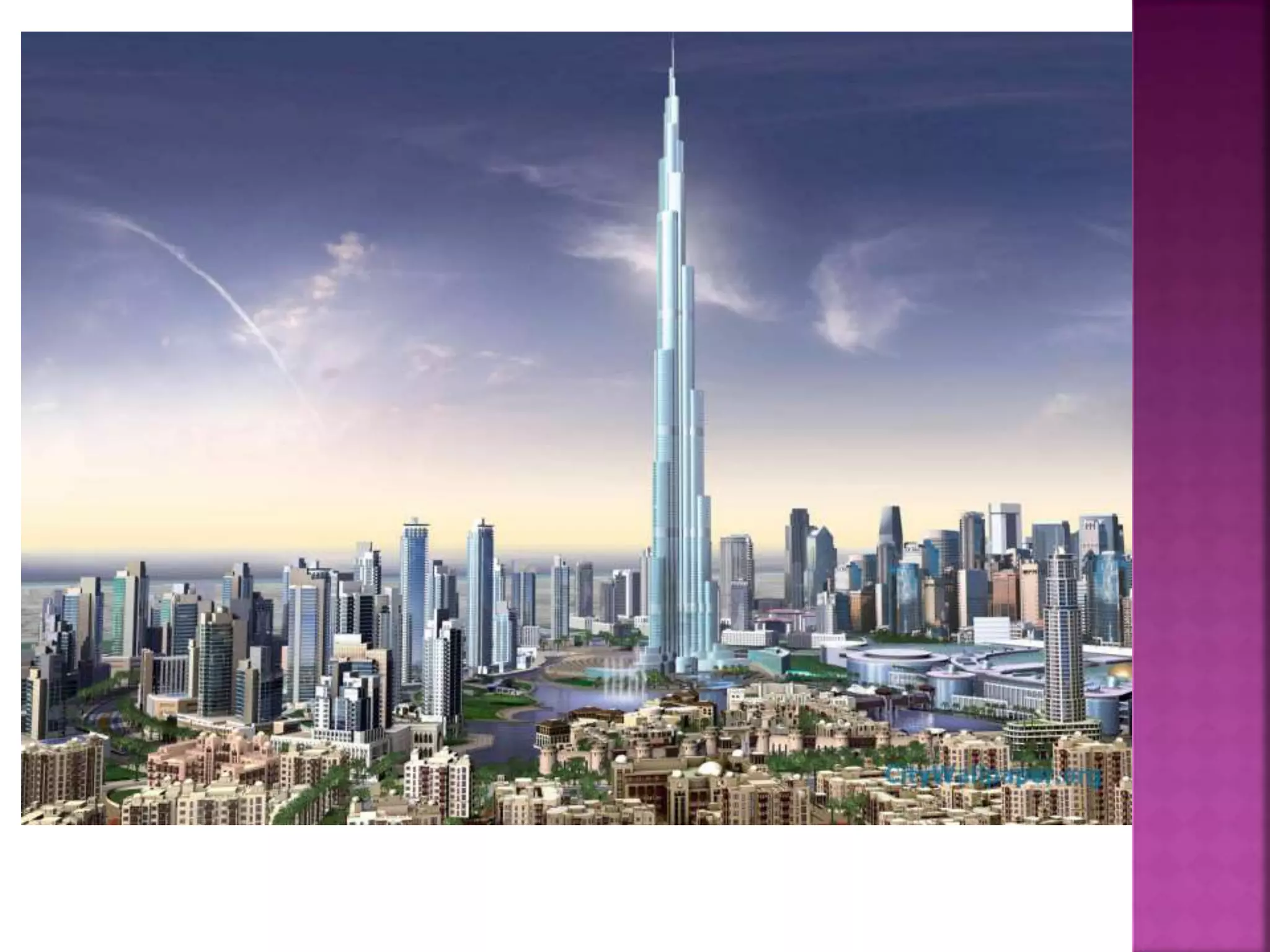
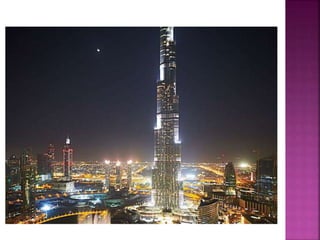
world’s tallest building
Certified by : Council on Tall Buildings
and Urban Habitat ( CTBUH)
Location : 1 Sheikh Mohammed bin
Rashid Boulevard, Dubai
United Arab Emirates
project manager : Greg Sang
Construction started : 6th January 2004
Completed : 30th December 2009
Opening : 4th January 2010
Cost : USD$ 1.5 billion
Architectural style : Neo-futurism
Website : www.burjkhalifa.ae
Height and technical details
Architectural : 828m [2717 ft ]
Tip : 829.8m [2722 ft ]
Roof : 828m [2717 ft ]
Top floor : 584.5m [1918 ft ]
Observatory : 555.7m [1823 ft ]
Floor count : 154 usable floors,
9 maintenance levels,
46 spire levels, and 2 below
ground parking levels.
Floor area : 3,09,473m [3,331,100 sq ft]
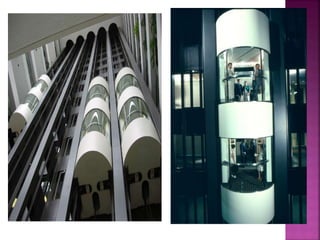
Lifts/ elevators : 57 [ 55 single deck and 2
double deck]
DESIGN AND CONSTRUCTION
Architect : Adrian Smith
Developer : Emaar properties
Structural engineer : Bill Baker
Main contractors : Samsung Engineering and
Construction Company,Besix
and Arabtec.
construction project manager
Turner construction Grocon,
Planning Middle East
Foundation, Lift contractor
Otis
objectives
 World’s tallest structure that includes residential space
 World’s highest observation deck ( 148th floor)
 World’s highest outdoor observation deck ( 124th floor)
 World’s highest installation of aluminium and glass
façade
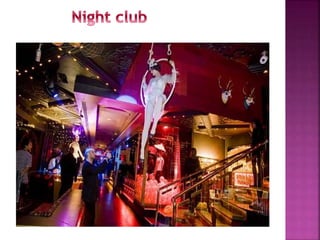
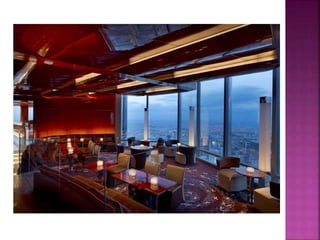
 World’s highest night club (144th floor)
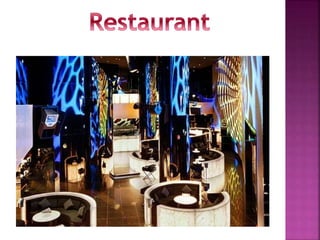
 World’s highest restaurant (122th floor)
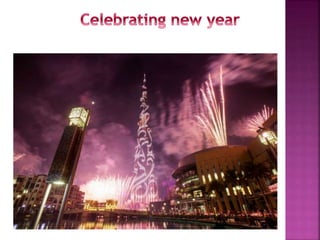
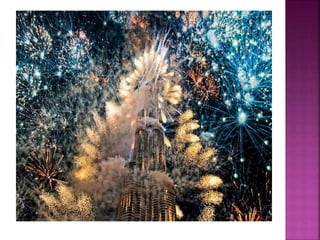
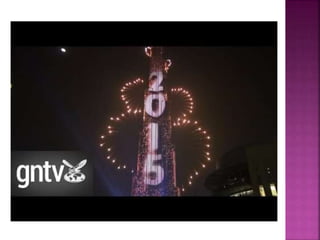
 World’s highest new year display of fireworks
 Tallest skyscraper
 Building with most floors :163
 World’s longest travel distance elevators
 Building with world’s highest occupied floor
 Highest vertical concrete pumping
Budget
In March 2009 , Mohammed Ali Alabbar ,
chairman of the project’s developer ,Emaar
Properties ,said office space pricing at Burj
Khalifa reached US$4000 per sq.ft and the
Armani Residences ,also in Burj Khalifa sold
For US$3500 per sq.ft .
He estimated the total cost for the project
to be about US$1.5 billion
periodof construction
January 2004 : Excavation commences
February 2004 : Piling starts
21 September 2004 : Emaar contractors began
construction
March 2005 : Structure of Burj Khalifa
starts rising.
June 2006 : Level 50 is reached
February 2007 : passes the Sears Tower as
the building with the
most floors.
13th May 2007 : Reached 130th floors
1st September 2008 : Height tops 688m,surpassing
the previous record holder
Warsaw Radio Mast , Poland.
1st October 2009 : Exterior of the building
completed.
4th January 2010 : Burj Khalifa’s official launch
ceremony and it opened.
4th january 2010 : Burj Dubai was renamed as
Burj Khalifa in the honour
of president of UAE and the
ruler of Abu Dhabi , Sheik
Khalifa bin Zayed al Nahyan
10th March 2010 : Certifies Burj Khalifa as
world’s Tallest Building.
RESOURCES
 The primary structure is reinforced concrete .
 Super high pressure trailer concrete pump .
 Used 330,000m cube,55000 tones of steel rebar.
 22 million man-hours .
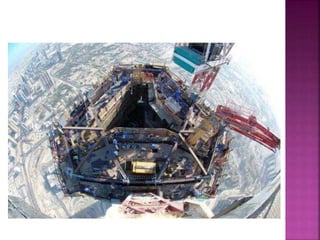
 3 tower cranes were used during the construction of upper most
levels ,each capable of lifting 25 tonne load.
 The remaining structure is constructed of lighter steel .
 A high density , low permeability concrete was used in the
foundation
 A cathodic protection system is used to minimize any
detrimental effects from corrosive chemicals in local ground
water.
 It is highly compartmentalised with air –conditioned floors
Construction methodand technology
 The Burj Dubai Tower utilizes the latest advancements
in construction techniques and material technology.
 The walls are formed using Doka’s SKE 100 automatic
self climbing formwork system.
 The cranes have been specially modified to be able to
lift the extreme lengths of cable required.
 High speed ,high capacity construction hoists were
used to transport the workers and materials to the
working place.
 An extensive program of wind tunnel tests and other
studies were under taken by the wind tunnel
consultant.
 A specialized GPS monitoring system has been
developed to monitor the verticality of the structure.
Presentation on burj khalifa

Presentation on burj khalifa

  • 2.
    world’s tallest building Certifiedby : Council on Tall Buildings and Urban Habitat ( CTBUH) Location : 1 Sheikh Mohammed bin Rashid Boulevard, Dubai United Arab Emirates project manager : Greg Sang Construction started : 6th January 2004 Completed : 30th December 2009 Opening : 4th January 2010 Cost : USD$ 1.5 billion Architectural style : Neo-futurism Website : www.burjkhalifa.ae
  • 4.
    Height and technicaldetails Architectural : 828m [2717 ft ] Tip : 829.8m [2722 ft ] Roof : 828m [2717 ft ] Top floor : 584.5m [1918 ft ] Observatory : 555.7m [1823 ft ] Floor count : 154 usable floors, 9 maintenance levels, 46 spire levels, and 2 below ground parking levels. Floor area : 3,09,473m [3,331,100 sq ft] Lifts/ elevators : 57 [ 55 single deck and 2 double deck]
  • 6.
    DESIGN AND CONSTRUCTION Architect: Adrian Smith Developer : Emaar properties Structural engineer : Bill Baker Main contractors : Samsung Engineering and Construction Company,Besix and Arabtec. construction project manager Turner construction Grocon, Planning Middle East Foundation, Lift contractor Otis
  • 7.
    objectives  World’s talleststructure that includes residential space  World’s highest observation deck ( 148th floor)  World’s highest outdoor observation deck ( 124th floor)  World’s highest installation of aluminium and glass façade  World’s highest night club (144th floor)  World’s highest restaurant (122th floor)  World’s highest new year display of fireworks  Tallest skyscraper  Building with most floors :163  World’s longest travel distance elevators  Building with world’s highest occupied floor  Highest vertical concrete pumping
  • 12.
    Budget In March 2009, Mohammed Ali Alabbar , chairman of the project’s developer ,Emaar Properties ,said office space pricing at Burj Khalifa reached US$4000 per sq.ft and the Armani Residences ,also in Burj Khalifa sold For US$3500 per sq.ft . He estimated the total cost for the project to be about US$1.5 billion
  • 13.
    periodof construction January 2004: Excavation commences February 2004 : Piling starts 21 September 2004 : Emaar contractors began construction March 2005 : Structure of Burj Khalifa starts rising. June 2006 : Level 50 is reached February 2007 : passes the Sears Tower as the building with the most floors. 13th May 2007 : Reached 130th floors
  • 14.
    1st September 2008: Height tops 688m,surpassing the previous record holder Warsaw Radio Mast , Poland. 1st October 2009 : Exterior of the building completed. 4th January 2010 : Burj Khalifa’s official launch ceremony and it opened. 4th january 2010 : Burj Dubai was renamed as Burj Khalifa in the honour of president of UAE and the ruler of Abu Dhabi , Sheik Khalifa bin Zayed al Nahyan 10th March 2010 : Certifies Burj Khalifa as world’s Tallest Building.
  • 16.
    RESOURCES  The primarystructure is reinforced concrete .  Super high pressure trailer concrete pump .  Used 330,000m cube,55000 tones of steel rebar.  22 million man-hours .  3 tower cranes were used during the construction of upper most levels ,each capable of lifting 25 tonne load.  The remaining structure is constructed of lighter steel .  A high density , low permeability concrete was used in the foundation  A cathodic protection system is used to minimize any detrimental effects from corrosive chemicals in local ground water.  It is highly compartmentalised with air –conditioned floors
  • 17.
    Construction methodand technology The Burj Dubai Tower utilizes the latest advancements in construction techniques and material technology.  The walls are formed using Doka’s SKE 100 automatic self climbing formwork system.  The cranes have been specially modified to be able to lift the extreme lengths of cable required.  High speed ,high capacity construction hoists were used to transport the workers and materials to the working place.  An extensive program of wind tunnel tests and other studies were under taken by the wind tunnel consultant.  A specialized GPS monitoring system has been developed to monitor the verticality of the structure.