Monday, April 3, 2017 Pranabjyoti Das 1
ARUNODOI JUNIOR COLLEGE
Where The Sun Never Sets !
Author
Protein
Structure & Functions
What is Protein ?
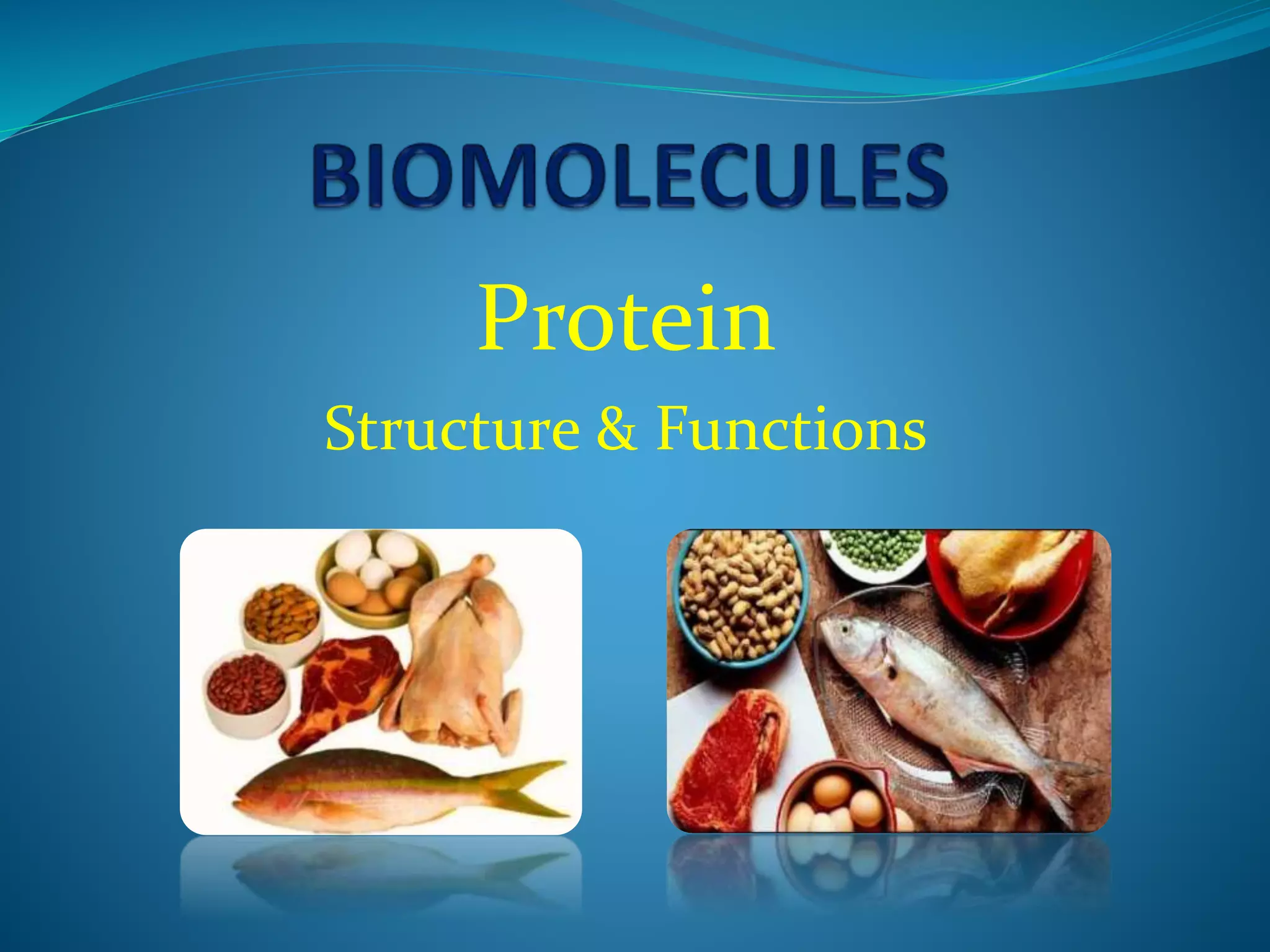
 Proteins are some important biomolecules found in
all living cells.
 Proteins are some polymers of Amino Acids.
 Proteins are found in our body as Muscles, Enzymes,
Hormones, Antibodies and many more.
 We get some proteins into our body as food like Meat,
Fish, Eggs, Soya etc.
 Some proteins can be synthesized by the Ribosome
of our cells.
Monday, April 3, 2017 Pranabjyoti Das 3
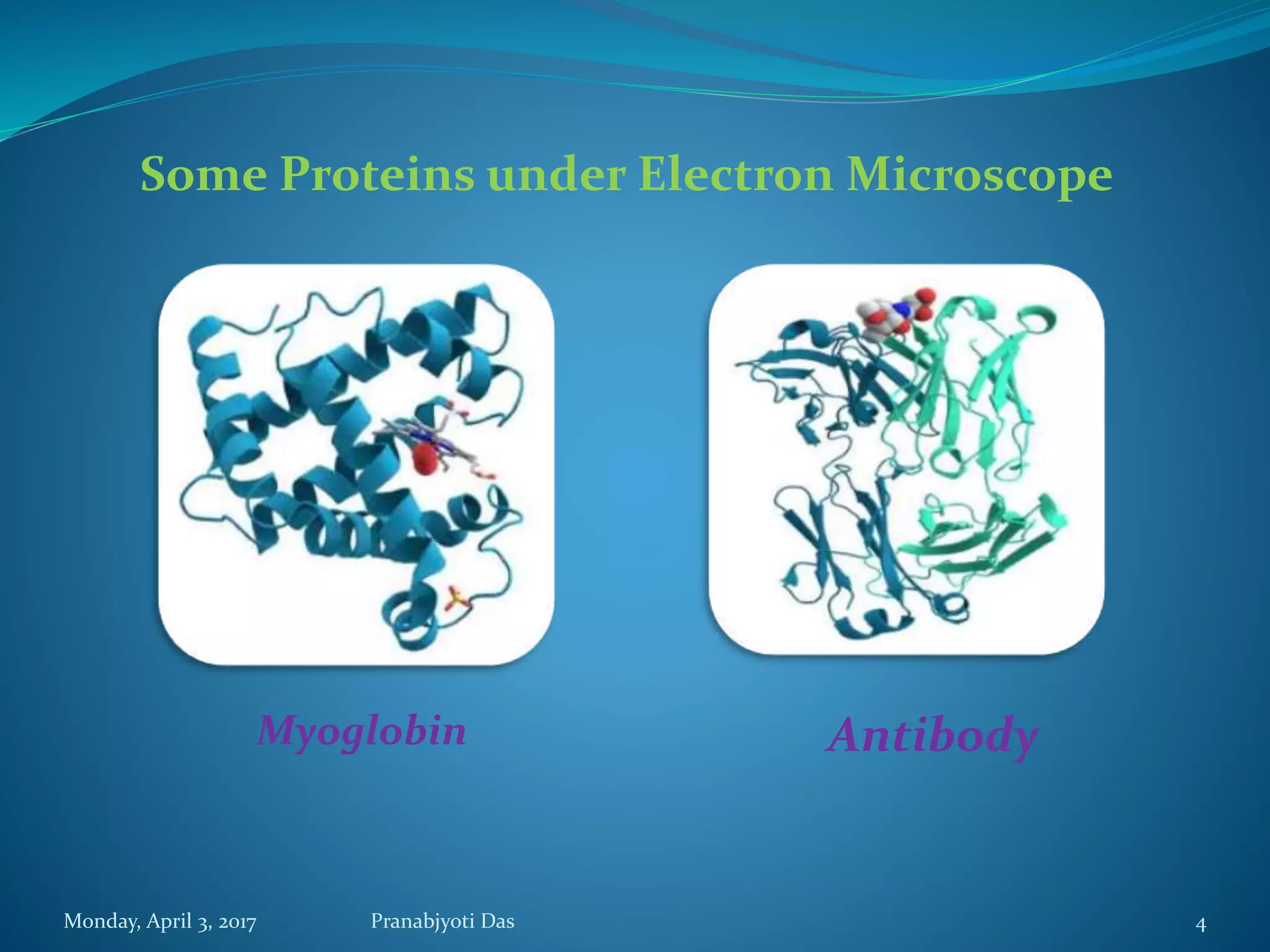
Some Proteins under Electron Microscope
AntibodyMyoglobin
Monday, April 3, 2017 Pranabjyoti Das 4
Monday, April 3, 2017 Pranabjyoti Das 5
Give examples of proteins that are important to
the structure of organisms….
Some proteins are important to the
structure of organisms
Question For You:
Our hair
Spider silk
Fibers of Tendons and Ligaments
Our Muscles etc.
Name some Proteins that serve the following
specific functions….
Monday, April 3, 2017 Pranabjyoti Das 6
Name a Protein that carry oxygen in our body.
Ans : Haemoglobin
Name a Protein that provides us with immunity.
Ans : Antibody
Name a Protein that serves as enzyme.
Ans : Pepsin, Renin, Trypsin etc
An α-amino acid. The CαH
atom is omitted in the diagram.
CO-R-N rule
Two amino acids Bond angles for ψ and ω
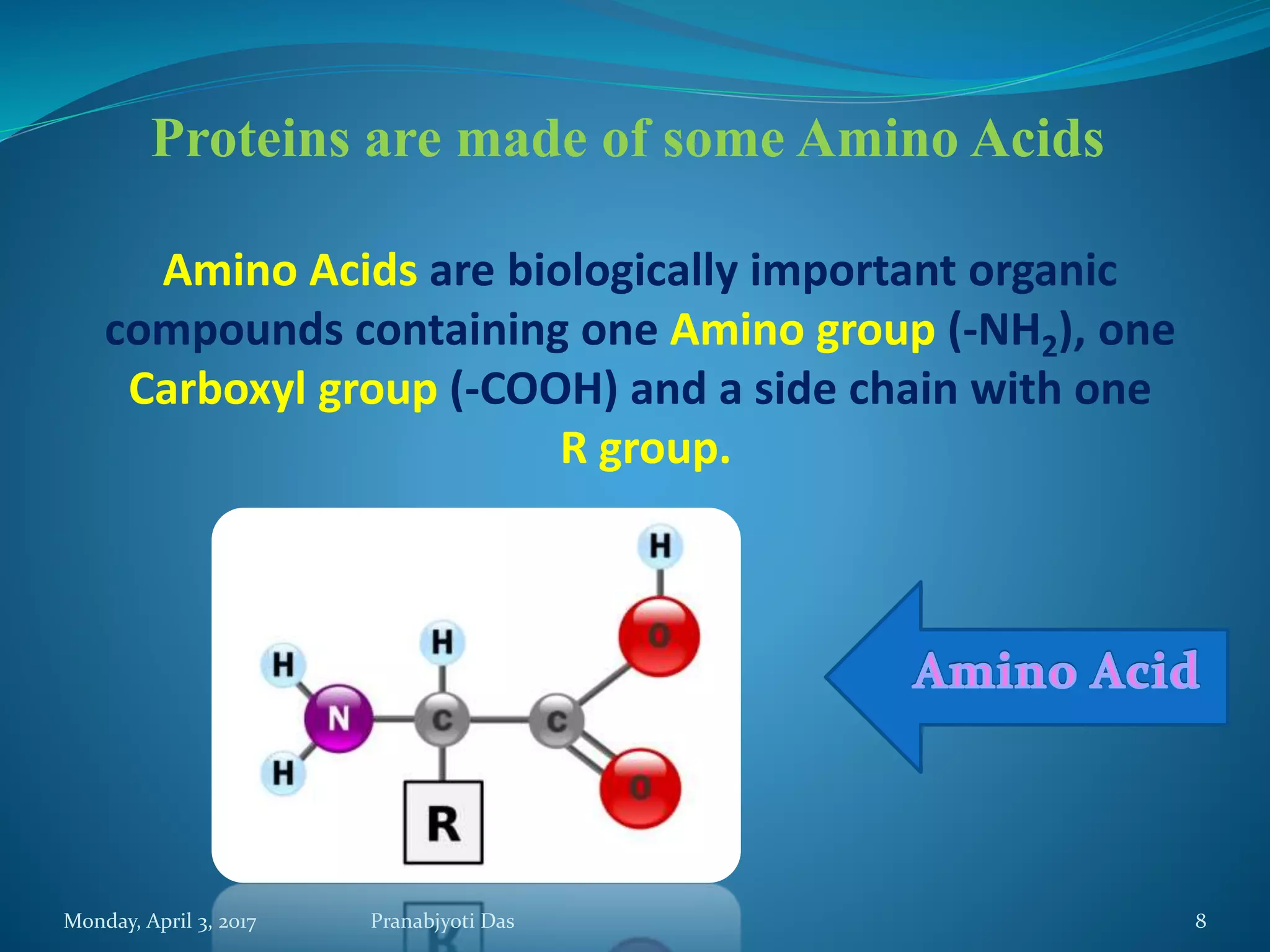
Proteins are made of some Amino Acids
Amino Acids are biologically important organic
compounds containing one Amino group (-NH2), one
Carboxyl group (-COOH) and a side chain with one
R group.
Monday, April 3, 2017 Pranabjyoti Das 8
An Amino Acid Has…
20 different Amino
Acids make up all our
Proteins
Central carbon atom
An amino group
A carboxyl group
An R-group
The R-group varies
from one amino acid to
another
A hydrogen atom
Monday, April 3, 2017 Pranabjyoti Das 10
Amino Acids Are Of Two Types
Non-Essential Amino Acids :
The Amino Acids which can be synthesized in our body
by Ribosomes. Example: Alanine, Glutamate, Proline etc.
Essential Amino Acids:
The Amino Acids which are never synthesuzed in our body
and we need to get them in our food. Example:
Methionine, Valine, Leucine etc.
There are only 20 Amino Acids which link together with each
other by Peptide Bond to form Protein
Structure of Amino Acid
 Amino acids have an amino group and a carboxyl
group
 Both groups are covalently bonded to the center
carbon atom, called the alpha carbon.
 Bonded to the alpha carbon is a hydrogen atom and a
chemical group called the ‘R group’.
 The amino acid type differs depending on the structure
of the R group.
Monday, April 3, 2017 Pranabjyoti Das 12
Amino Acids are linked to
form Peptide Bond
Two amino acids join together by a condensation reaction
Water molecule removed is removed when a carboxyl
group binds to the nearby amino-group
Resulting covalent linkage is called a peptide bond.
Formation of Peptide Bond
Monday, April 3, 2017 Pranabjyoti Das 13
Monday, April 3, 2017 Pranabjyoti Das 14
Proteins are
biochemical compounds consisting of one or
more polypeptide chains typically folded into
a globular or fibrous form in a biologically
functional way.
Proteins were first described by
the Dutch chemist Gerardus Johannes Mulder and named
by the Swedish chemist Jöns Jacob Berzelius in 1838. Early
nutritional scientists such as the German Carl von Voit said
that protein was the most important nutrient for
maintaining the structure of the body, because it was
generally believed that "flesh makes flesh.
More About Proteins..
Monday, April 3, 2017 Pranabjyoti Das 15
The primary structure refers to amino acid
sequence of the polypeptide chain. The
primary structure is held together
by covalent or peptide bonds, which are
made during the process of protein
biosynthesis or translation. The two ends of
the polypeptide chain are referred to as the
carboxyl terminus (C-terminus) and the
amino terminus (N-terminus) based on the
nature of the free group on each extremity.
Counting of residues always starts at the N-
terminal end (NH2-group), which is the end
where the amino group is not involved in a
peptide bond.
Monday, April 3, 2017 Pranabjyoti Das 16
These secondary structures are
defined by patterns of hydrogen
bonds between the main-chain
peptide groups. They have a
regular geometry, being
constrained to specific values of
the dihedral angles ψ and φ on
the Ramachandran plot. Both
the alpha helix and the beta-
sheet represent a way of
saturating all the hydrogen
bond donors and acceptors in
the peptide backbone.
Monday, April 3, 2017 Pranabjyoti Das 17
Protein tertiary structure is the 3D shape of a protein. The tertiary
structure will have a single polypeptide chain as "backbone" with
one or more protein secondary structures. Amino acid side
chains may interact and bond in a number of ways. The
interactions and bonds of side chains within a particular protein
determine its tertiary structure.
Monday, April 3, 2017 Pranabjyoti Das 18
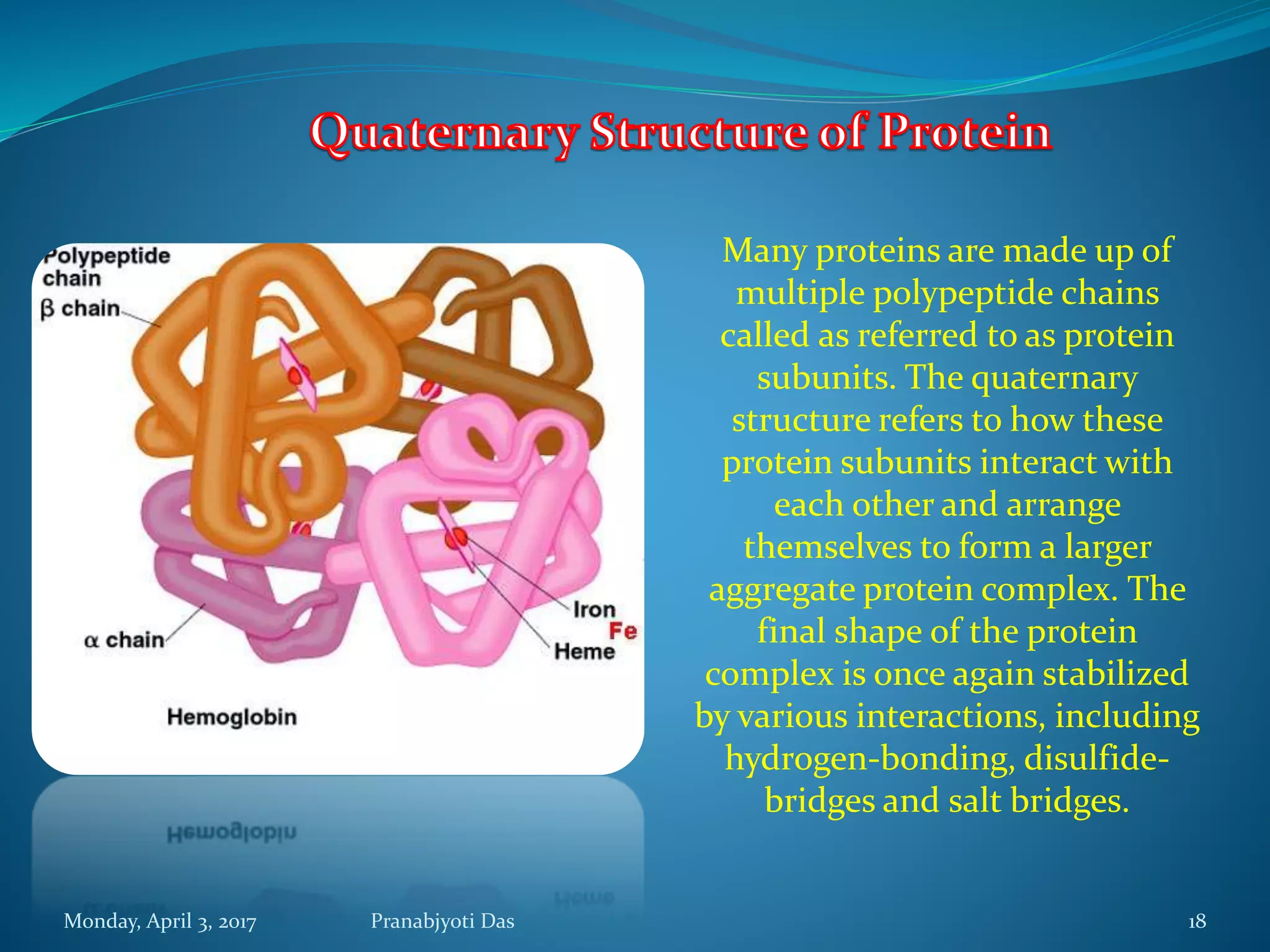
Many proteins are made up of
multiple polypeptide chains
called as referred to as protein
subunits. The quaternary
structure refers to how these
protein subunits interact with
each other and arrange
themselves to form a larger
aggregate protein complex. The
final shape of the protein
complex is once again stabilized
by various interactions, including
hydrogen-bonding, disulfide-
bridges and salt bridges.
Monday, April 3, 2017 Pranabjyoti Das 19
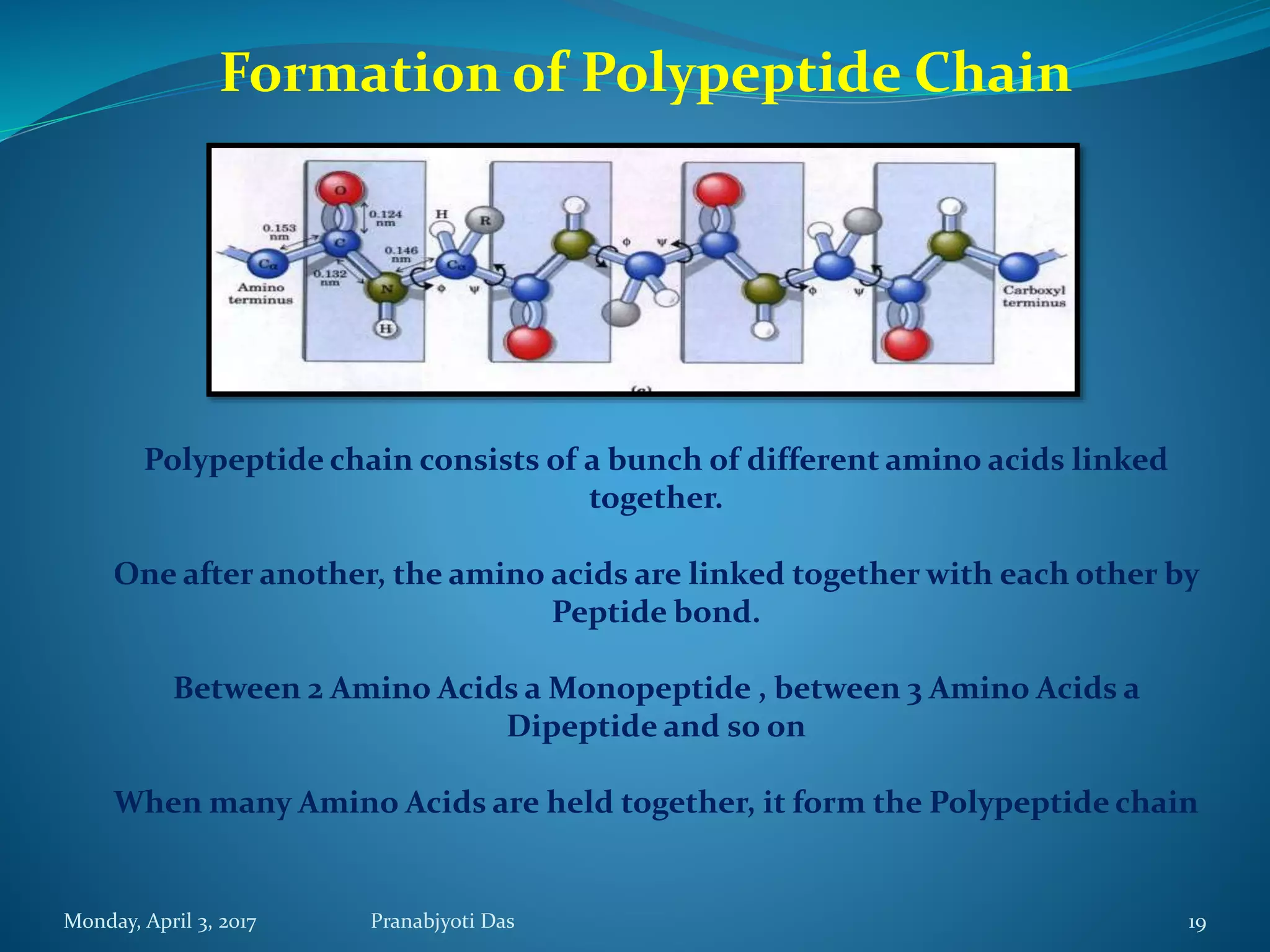
Formation of Polypeptide Chain
Polypeptide chain consists of a bunch of different amino acids linked
together.
One after another, the amino acids are linked together with each other by
Peptide bond.
Between 2 Amino Acids a Monopeptide , between 3 Amino Acids a
Dipeptide and so on
When many Amino Acids are held together, it form the Polypeptide chain
Function of Proteins
Functions of proteins can be
interchangeable with
functions of polypeptides
Type of Protein Function
Structural Proteins Support
Storage Proteins Storage of AA
Transport Proteins Transport
substances
Hormonal Proteins Coordination
Receptor Proteins Response to stimuli
Contractile Movement
Defensive Proteins Disease protection
Enzymatic Proteins Catalytic action
Monday, April 3, 2017 Pranabjyoti Das 21
What are the importance of proteins ?
They have a structural function and serve as cell membrane
protein, cytoskeleton protein, connective tissue proteins etc
They have an enzymatic function to catalyze biochemical reactions
They carry out a transportation function to carry oxygen in our body
They provide us immunity in the form of Antibody
They help us in our movement by contractile function of muscles
Protein is a body building food for us
And many more…
Monday, April 3, 2017 Pranabjyoti Das 22
Questions For You
1. What unit are proteins composed of ?
2. How many amino acids are known to form proteins?
3. What is the bond between two amino acids called ?
4. What is the primary structure of a protein ?
5. What are Non-essential Amino Acids ?
6. Who coined the term Protein ?
7. What is a polypeptide chain ?
Monday, April 3, 2017 Pranabjyoti Das 23

Protein as a Biomolecule

  • 1.
    Monday, April 3,2017 Pranabjyoti Das 1 ARUNODOI JUNIOR COLLEGE Where The Sun Never Sets ! Author
  • 2.
  • 3.
    What is Protein?  Proteins are some important biomolecules found in all living cells.  Proteins are some polymers of Amino Acids.  Proteins are found in our body as Muscles, Enzymes, Hormones, Antibodies and many more.  We get some proteins into our body as food like Meat, Fish, Eggs, Soya etc.  Some proteins can be synthesized by the Ribosome of our cells. Monday, April 3, 2017 Pranabjyoti Das 3
  • 4.
    Some Proteins underElectron Microscope AntibodyMyoglobin Monday, April 3, 2017 Pranabjyoti Das 4
  • 5.
    Monday, April 3,2017 Pranabjyoti Das 5 Give examples of proteins that are important to the structure of organisms…. Some proteins are important to the structure of organisms Question For You: Our hair Spider silk Fibers of Tendons and Ligaments Our Muscles etc.
  • 6.
    Name some Proteinsthat serve the following specific functions…. Monday, April 3, 2017 Pranabjyoti Das 6 Name a Protein that carry oxygen in our body. Ans : Haemoglobin Name a Protein that provides us with immunity. Ans : Antibody Name a Protein that serves as enzyme. Ans : Pepsin, Renin, Trypsin etc
  • 7.
    An α-amino acid.The CαH atom is omitted in the diagram. CO-R-N rule Two amino acids Bond angles for ψ and ω
  • 8.
    Proteins are madeof some Amino Acids Amino Acids are biologically important organic compounds containing one Amino group (-NH2), one Carboxyl group (-COOH) and a side chain with one R group. Monday, April 3, 2017 Pranabjyoti Das 8
  • 9.
    An Amino AcidHas… 20 different Amino Acids make up all our Proteins Central carbon atom An amino group A carboxyl group An R-group The R-group varies from one amino acid to another A hydrogen atom
  • 10.
    Monday, April 3,2017 Pranabjyoti Das 10 Amino Acids Are Of Two Types Non-Essential Amino Acids : The Amino Acids which can be synthesized in our body by Ribosomes. Example: Alanine, Glutamate, Proline etc. Essential Amino Acids: The Amino Acids which are never synthesuzed in our body and we need to get them in our food. Example: Methionine, Valine, Leucine etc. There are only 20 Amino Acids which link together with each other by Peptide Bond to form Protein
  • 11.
    Structure of AminoAcid  Amino acids have an amino group and a carboxyl group  Both groups are covalently bonded to the center carbon atom, called the alpha carbon.  Bonded to the alpha carbon is a hydrogen atom and a chemical group called the ‘R group’.  The amino acid type differs depending on the structure of the R group.
  • 12.
    Monday, April 3,2017 Pranabjyoti Das 12 Amino Acids are linked to form Peptide Bond Two amino acids join together by a condensation reaction Water molecule removed is removed when a carboxyl group binds to the nearby amino-group Resulting covalent linkage is called a peptide bond.
  • 13.
    Formation of PeptideBond Monday, April 3, 2017 Pranabjyoti Das 13
  • 14.
    Monday, April 3,2017 Pranabjyoti Das 14 Proteins are biochemical compounds consisting of one or more polypeptide chains typically folded into a globular or fibrous form in a biologically functional way. Proteins were first described by the Dutch chemist Gerardus Johannes Mulder and named by the Swedish chemist Jöns Jacob Berzelius in 1838. Early nutritional scientists such as the German Carl von Voit said that protein was the most important nutrient for maintaining the structure of the body, because it was generally believed that "flesh makes flesh. More About Proteins..
  • 15.
    Monday, April 3,2017 Pranabjyoti Das 15 The primary structure refers to amino acid sequence of the polypeptide chain. The primary structure is held together by covalent or peptide bonds, which are made during the process of protein biosynthesis or translation. The two ends of the polypeptide chain are referred to as the carboxyl terminus (C-terminus) and the amino terminus (N-terminus) based on the nature of the free group on each extremity. Counting of residues always starts at the N- terminal end (NH2-group), which is the end where the amino group is not involved in a peptide bond.
  • 16.
    Monday, April 3,2017 Pranabjyoti Das 16 These secondary structures are defined by patterns of hydrogen bonds between the main-chain peptide groups. They have a regular geometry, being constrained to specific values of the dihedral angles ψ and φ on the Ramachandran plot. Both the alpha helix and the beta- sheet represent a way of saturating all the hydrogen bond donors and acceptors in the peptide backbone.
  • 17.
    Monday, April 3,2017 Pranabjyoti Das 17 Protein tertiary structure is the 3D shape of a protein. The tertiary structure will have a single polypeptide chain as "backbone" with one or more protein secondary structures. Amino acid side chains may interact and bond in a number of ways. The interactions and bonds of side chains within a particular protein determine its tertiary structure.
  • 18.
    Monday, April 3,2017 Pranabjyoti Das 18 Many proteins are made up of multiple polypeptide chains called as referred to as protein subunits. The quaternary structure refers to how these protein subunits interact with each other and arrange themselves to form a larger aggregate protein complex. The final shape of the protein complex is once again stabilized by various interactions, including hydrogen-bonding, disulfide- bridges and salt bridges.
  • 19.
    Monday, April 3,2017 Pranabjyoti Das 19 Formation of Polypeptide Chain Polypeptide chain consists of a bunch of different amino acids linked together. One after another, the amino acids are linked together with each other by Peptide bond. Between 2 Amino Acids a Monopeptide , between 3 Amino Acids a Dipeptide and so on When many Amino Acids are held together, it form the Polypeptide chain
  • 20.
    Function of Proteins Functionsof proteins can be interchangeable with functions of polypeptides Type of Protein Function Structural Proteins Support Storage Proteins Storage of AA Transport Proteins Transport substances Hormonal Proteins Coordination Receptor Proteins Response to stimuli Contractile Movement Defensive Proteins Disease protection Enzymatic Proteins Catalytic action
  • 21.
    Monday, April 3,2017 Pranabjyoti Das 21 What are the importance of proteins ? They have a structural function and serve as cell membrane protein, cytoskeleton protein, connective tissue proteins etc They have an enzymatic function to catalyze biochemical reactions They carry out a transportation function to carry oxygen in our body They provide us immunity in the form of Antibody They help us in our movement by contractile function of muscles Protein is a body building food for us And many more…
  • 22.
    Monday, April 3,2017 Pranabjyoti Das 22 Questions For You 1. What unit are proteins composed of ? 2. How many amino acids are known to form proteins? 3. What is the bond between two amino acids called ? 4. What is the primary structure of a protein ? 5. What are Non-essential Amino Acids ? 6. Who coined the term Protein ? 7. What is a polypeptide chain ?
  • 23.
    Monday, April 3,2017 Pranabjyoti Das 23