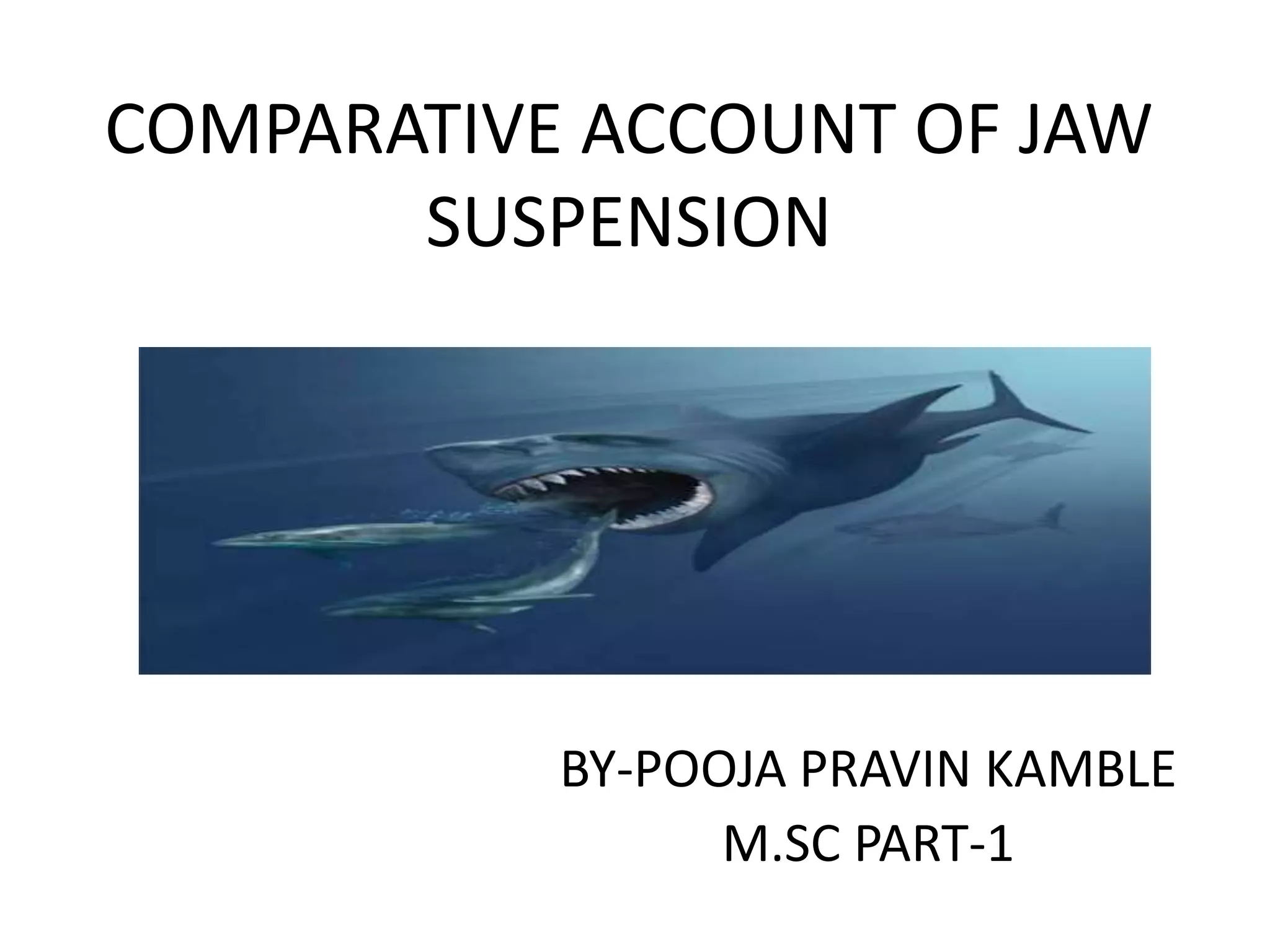
COMPARATIVE ACCOUNT OF JAW
SUSPENSION

BY-POOJA PRAVIN KAMBLE
M.SC PART-1
PSZO101:NONCHORDATES,CHORDATES AND THEIR
PHYLOGENY

UNIT4:COMPARATIVE VERTEBRATE
OSTEOLOGY-1
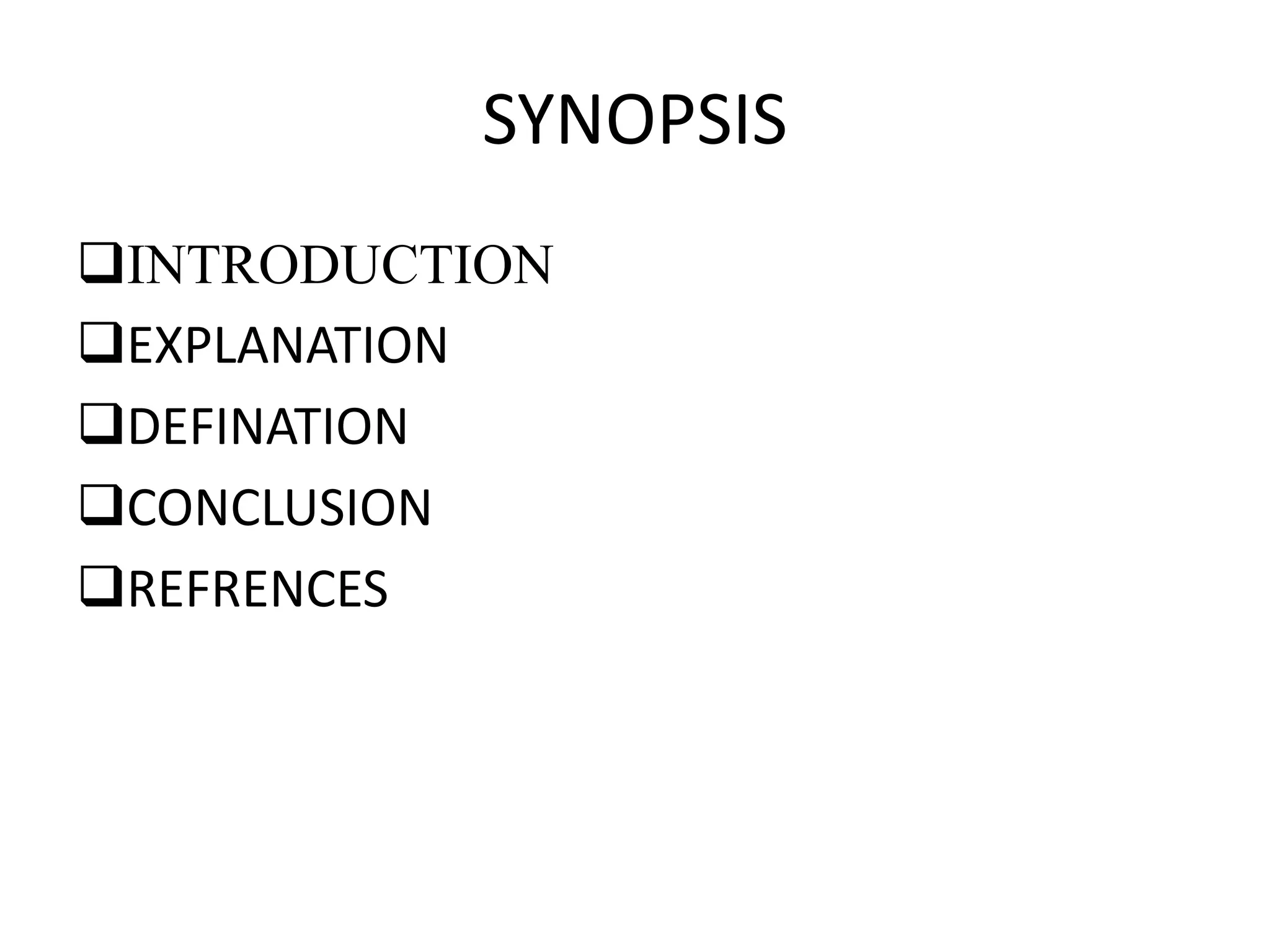
4.2:COMPARATIVE ACCOUNT OF JAW
SUSPENSION
SYNOPSIS
INTRODUCTION
EXPLANATION
DEFINATION
CONCLUSION
REFRENCES
INTRODUCTION OF JAW
 Each

of the upper and lower bony structure

in vertebrates forming the framework of the
mouth and containing the teeth.

.

EXPLANATION OF
JAW SUSPENSION
Jaw suspension means attachment of the lower jaw with
upper jaw or skull for efficient bitting and chewing .

There are different ways in which these attachments are attained
depending upon the modification in visceral arches .
Evolution of jaw
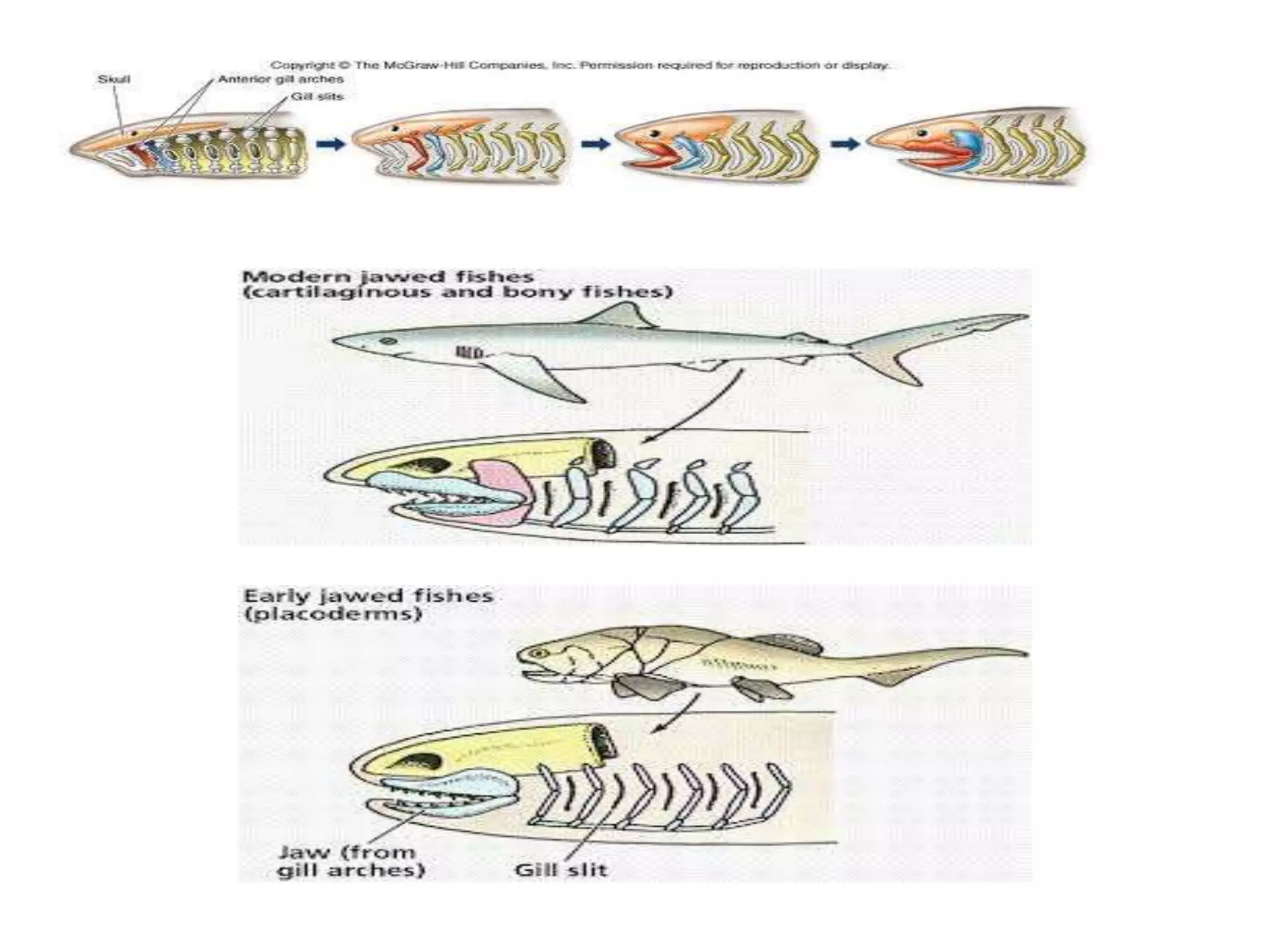
The prevertebrates had a ciliary pump therefore they were depended on the
suspended matter in sea water .In larger fish (agnathan) the ciliary pump

became less effective and was replaced by muscular pharynx pump.as
agnathans were deposit feeders,mud grobbers that pushed their mouth into
loose organic or siltmud and drew sediment rich organic particles.then
transition from agnathan to gnathostomes involved switch in feeding method
.therefore they became raptorial feeders.so sudden expansion of pharynx
developed to close the mouth to prevent escape of capture and ingestion.so
the jaws develop powered by muscle action.so the mouth could shut quickly
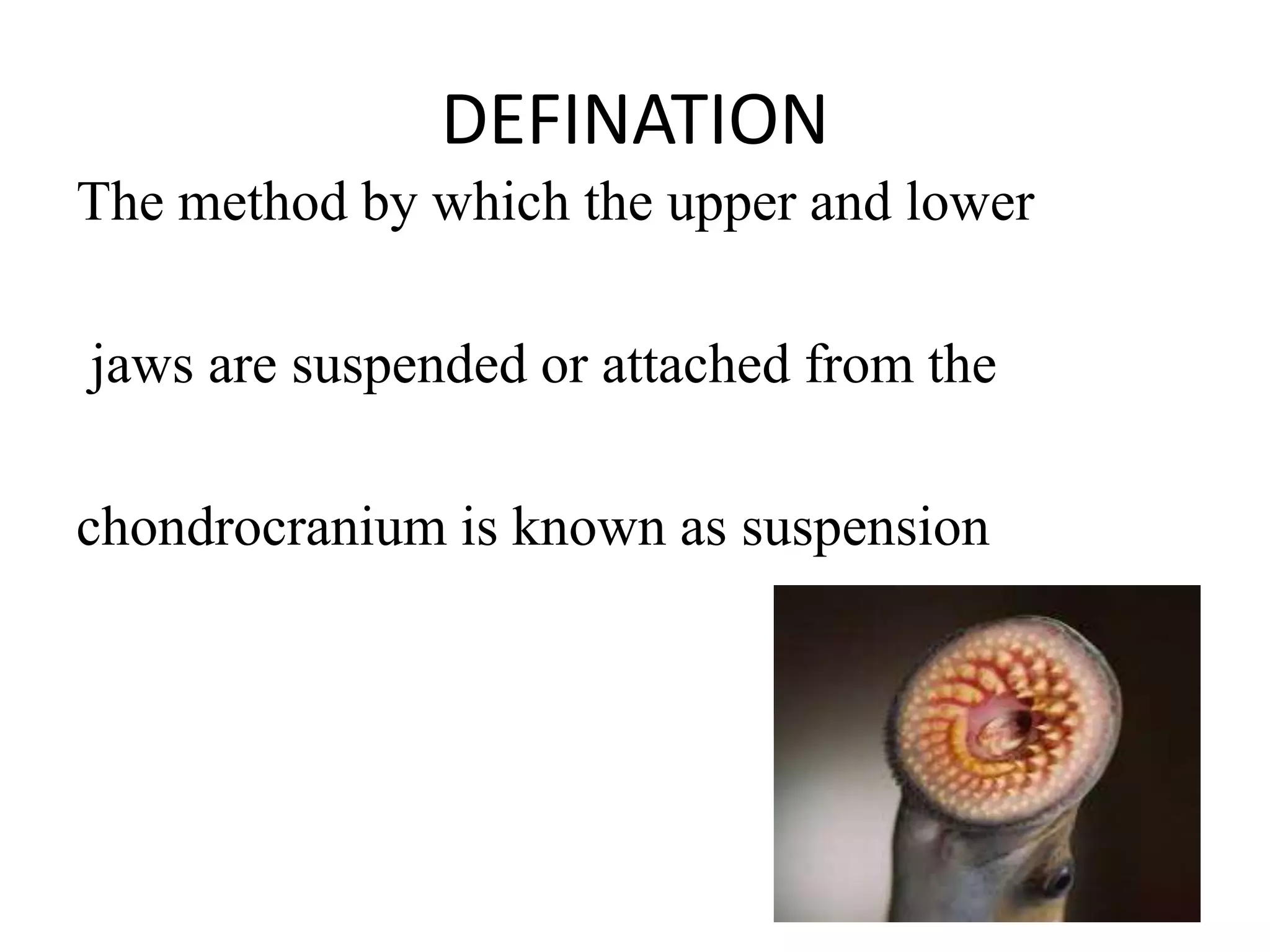
DEFINATION
The method by which the upper and lower
jaws are suspended or attached from the
chondrocranium is known as suspension
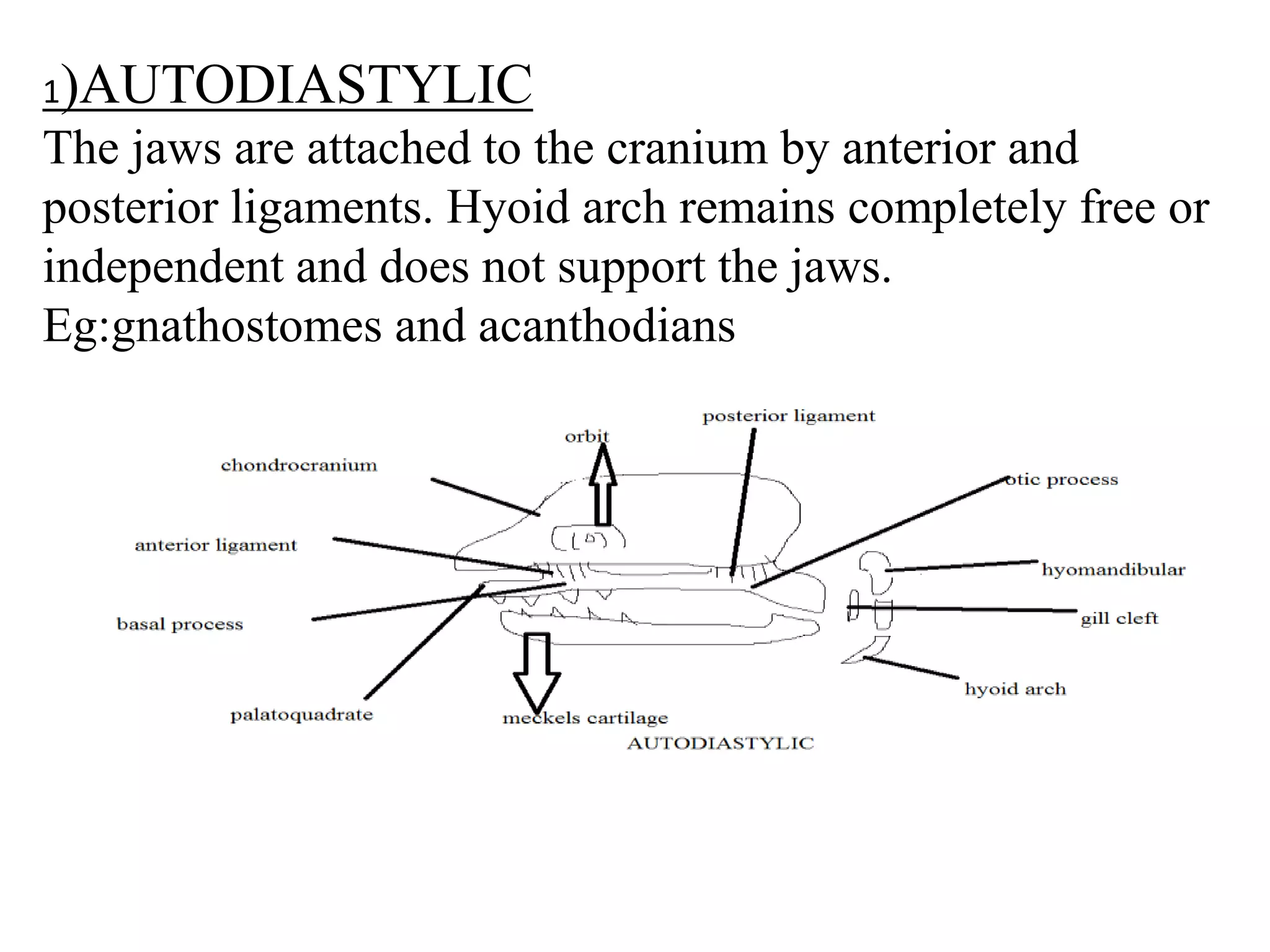
1)AUTODIASTYLIC

The jaws are attached to the cranium by anterior and
posterior ligaments. Hyoid arch remains completely free or
independent and does not support the jaws.
Eg:gnathostomes and acanthodians
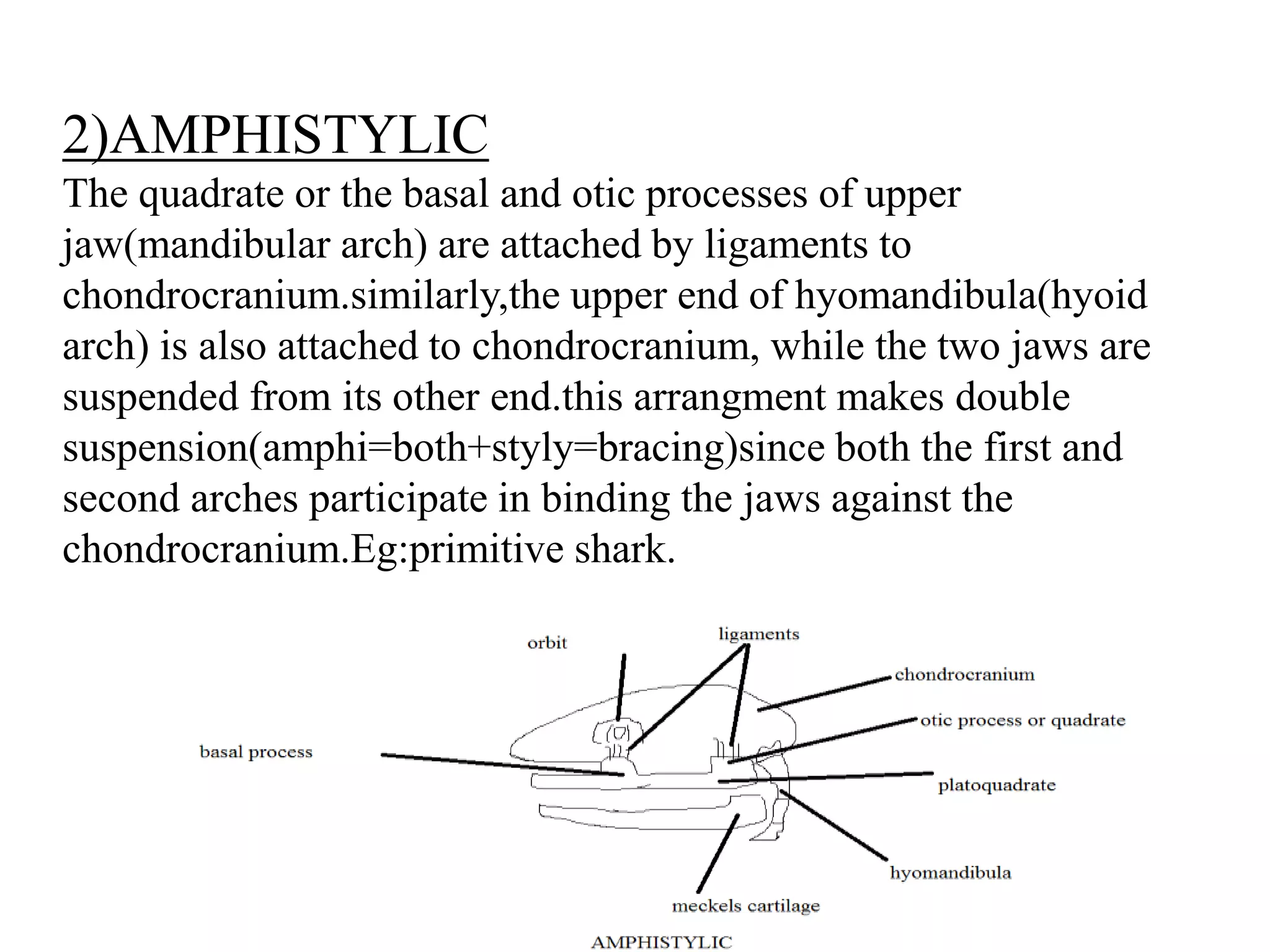
2)AMPHISTYLIC
The quadrate or the basal and otic processes of upper
jaw(mandibular arch) are attached by ligaments to
chondrocranium.similarly,the upper end of hyomandibula(hyoid
arch) is also attached to chondrocranium, while the two jaws are
suspended from its other end.this arrangment makes double
suspension(amphi=both+styly=bracing)since both the first and
second arches participate in binding the jaws against the
chondrocranium.Eg:primitive shark.
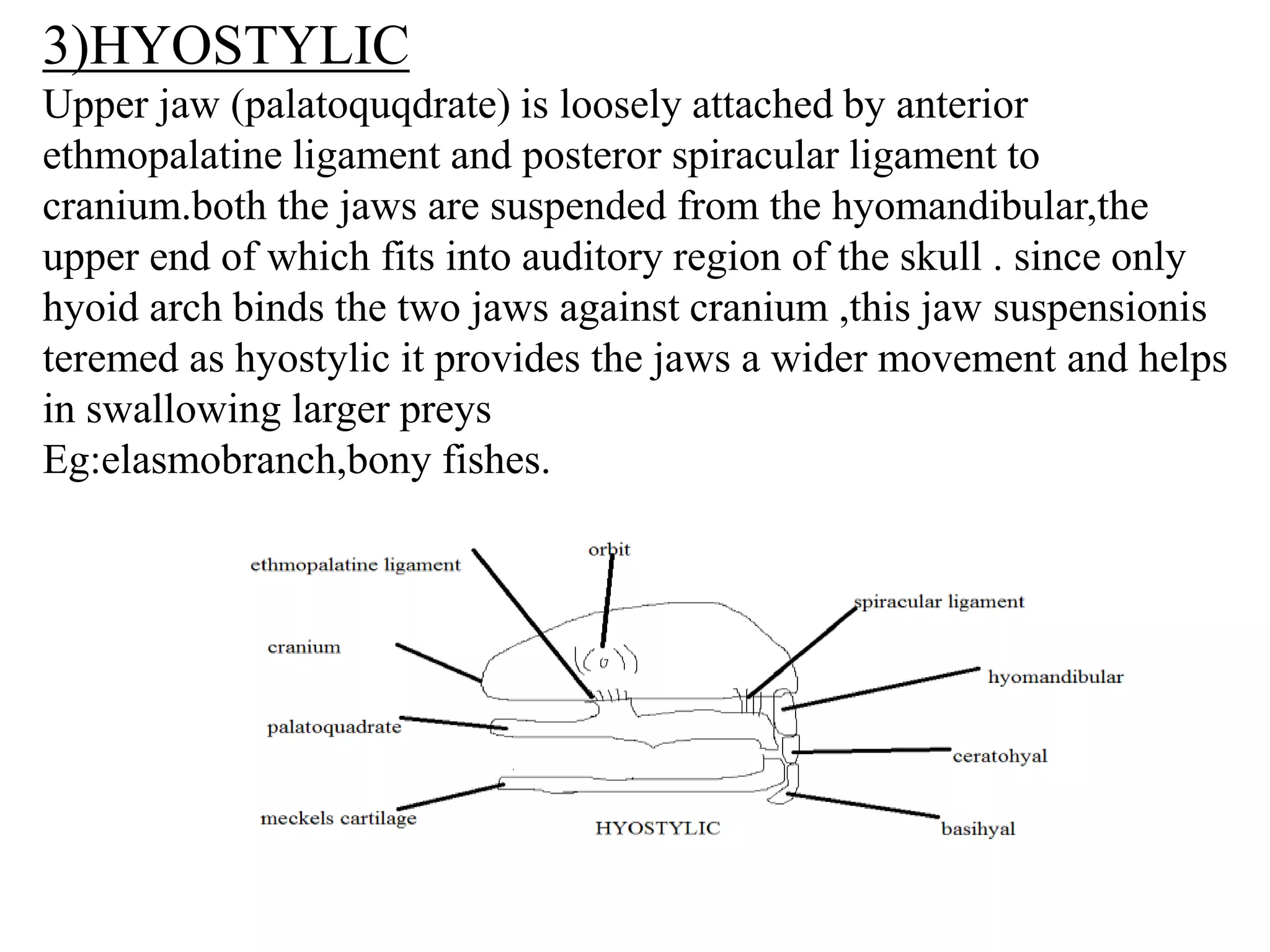
3)HYOSTYLIC
Upper jaw (palatoquqdrate) is loosely attached by anterior
ethmopalatine ligament and posteror spiracular ligament to
cranium.both the jaws are suspended from the hyomandibular,the
upper end of which fits into auditory region of the skull . since only
hyoid arch binds the two jaws against cranium ,this jaw suspensionis
teremed as hyostylic it provides the jaws a wider movement and helps
in swallowing larger preys
Eg:elasmobranch,bony fishes.
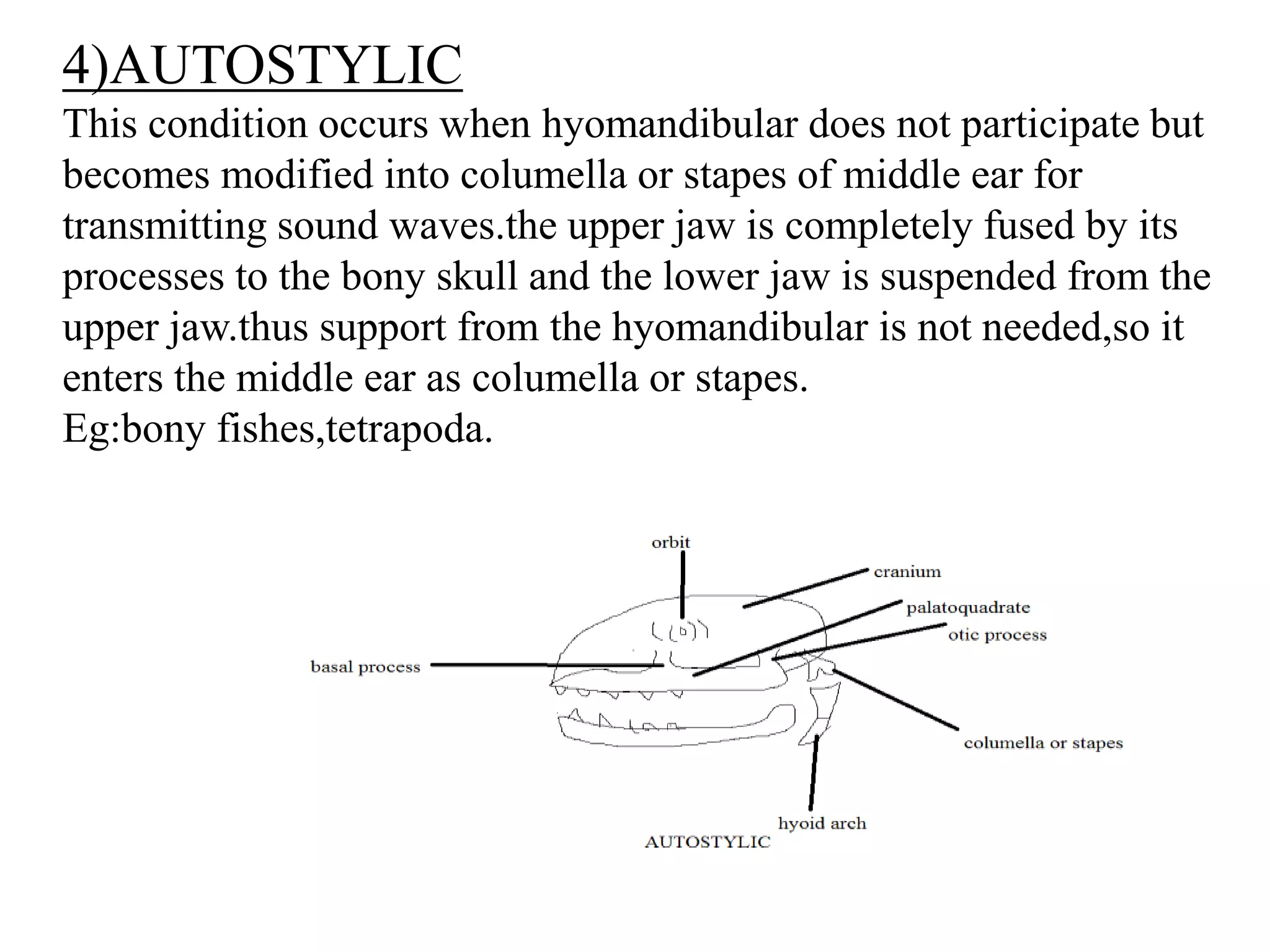
4)AUTOSTYLIC
This condition occurs when hyomandibular does not participate but
becomes modified into columella or stapes of middle ear for
transmitting sound waves.the upper jaw is completely fused by its
processes to the bony skull and the lower jaw is suspended from the
upper jaw.thus support from the hyomandibular is not needed,so it
enters the middle ear as columella or stapes.
Eg:bony fishes,tetrapoda.
Autostylic jaw suspension is divided into 3 subtypes

a)HOLOSTYLIC
In this upper jaw is firmly fused with skull and lower jaw
suspended from it.hyoid arch is complete ,independent and not
attached to skull;
Eg:chimaeras

b)MONIMOSTYLIC
In many tetrapods , hyomandibular forms columella and articular
articulates with quadrate. However ,the quadrate remains
immovably attached with skull.

c)STREPTOSTYLIC
Quadrate is loosely attached and is movable at both ends a
condition known as streptostylic.Eg:reptiles (lizzard,snakes)and
birds.
5)CRANIOSTYLIC
This type of jaw suspension is characteristic of mammals
and some consider it as a modification of autostylic
suspension .upper jaw fuses throughout its length with
cranium and hyomandibular forms the ear ossicles
malleus and incus consequently two dermal bones
,dentary of lower jaw and squamosal of skull provide the
articulation between jaws.
COMPARATIVE ACCOUNT OF JAW
SUSPENSION
1)In agnathans the jaw suspension is in paleostylic stage in
which none of the arches attach themselves directly to the
skull.
2)In ganathostomes and acanthodians jaw suspension is
autodiastylic in which jaws are attached to the cranium by
anterior and the posterior ligaments. Hyoid arch remains
completely free and does not support the jaws.
3)In primitive sharks the jaw suspension is amphistylic in
which the quadrate or the basal and otic processes of upper
jaw (mandibular arch) are attached by ligaments to
chondrocranium.similarly the upper end of hyomandibula is
also attached to chondrocranium.
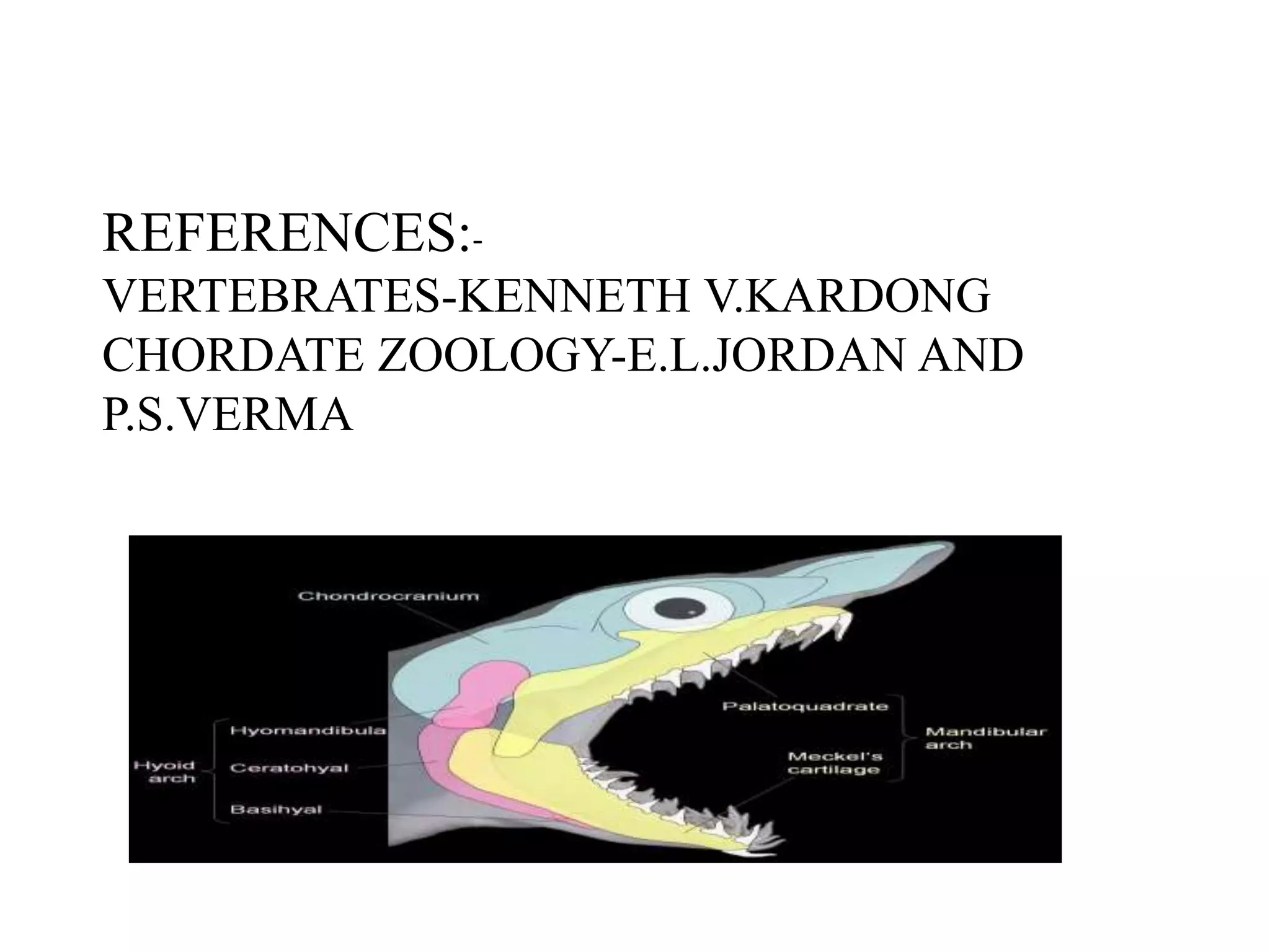
4)In modern sharks and all bony fishes the type of jaw suspension is
hyostylic,in which the upper jaw (palatoquadrate) is loosely attached by
anterior ligament to cranium.both the jaws are suspended from the
hyomandibular.since only hyoid arch binds the two jaws against cranium
it is called hyostylic jaw
5)In most tetrapods like amphibians,reptiles and birds hyomandibular
does not participate but becomes modified into columella or stapes of
middle ear for transmitting sound waves.
6)in most lung fishes upper jaw is firmly fused with skull and lower jaw
suspended from it .hyoid arch is complete ,independent and not attached
to the skull; this is holostylic type of jaw suspension.
7)In many tetrapods monimostylic jaw suspension is seen
ie.hyomandibular forms columella and articlar articulates with
quadrates.however the quadrate remains immovably attached
with skull.
8)In some reptiles(lizard,snakes)ann birds the type of jaw
suspension is streptostylic ie.quadrate is loosely attached and
is movable at both the ends a condition known as
streptostylism
9)in mammals craniostylic type of jaw suspension is seen it is
modification of the autostylic suspension.upper jaw fuses
throughout its length with cranium,and hyomandibular forms
the ear , ossicle,stapes.but articular and quadrate also become
modified into ear ossicles malleus and incus
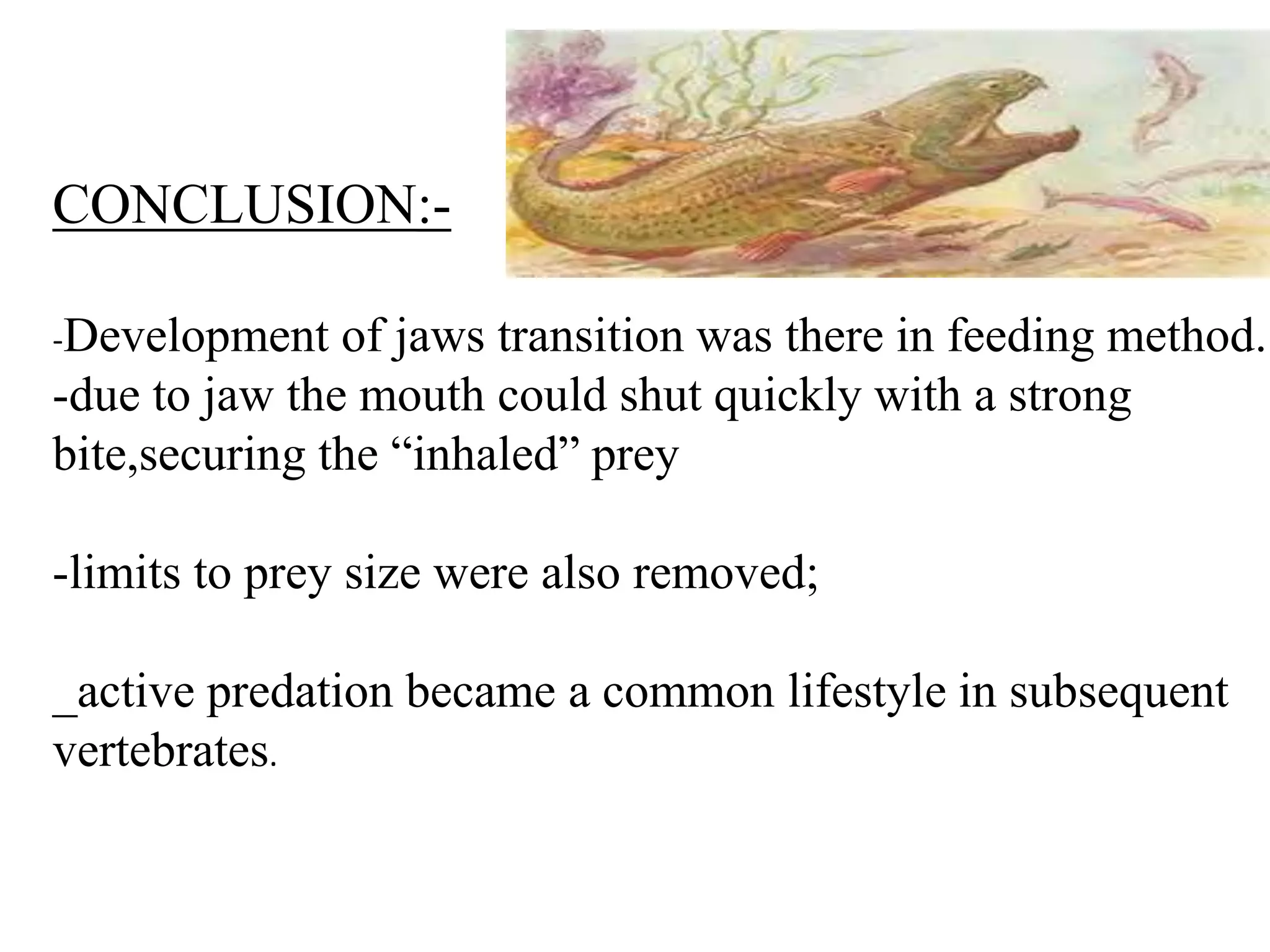
CONCLUSION:-Development

of jaws transition was there in feeding method.
-due to jaw the mouth could shut quickly with a strong
bite,securing the “inhaled” prey
-limits to prey size were also removed;
_active predation became a common lifestyle in subsequent
vertebrates.
REFERENCES:VERTEBRATES-KENNETH V.KARDONG
CHORDATE ZOOLOGY-E.L.JORDAN AND
P.S.VERMA
THANK YOU
CONCLUSION
•
•
•
•
•
•
•

•

-Development of jaws transition was there in feeding method.
-due to jaw the mouth could shut quickly with a strong bite,securing the “inhaled”
prey
-limits to prey size were also removed;
_active predation became a common lifestyle in subsequent vertebrates.
_After studying jaw suspension it can be concluded that branchial arches
phylogenetically gave rise to jaw.
_From serial theory theory we came to know that first or perhaps second branchial
arch gave rise to hyoid arch and rest to the branchial arches.
_-But Jarvik concluded about the composite theory according to him the
mandibular arch of gnathostomes is formed by the fusion of premandibular
arch.The palatoquadrate forms the epibranchial arch of premandibula,the meckels
cartilage is formed from an expanded ceratobranchial arch,and the hyoid arch is
formed from the epibranchial,hypobranchial and ceratobranchial arches of the
primitive gill arches.
-so study of oesteology became vital for studying jaw suspension.

Comparative account of jaw suspension

  • 1.
    COMPARATIVE ACCOUNT OFJAW SUSPENSION BY-POOJA PRAVIN KAMBLE M.SC PART-1
  • 2.
    PSZO101:NONCHORDATES,CHORDATES AND THEIR PHYLOGENY UNIT4:COMPARATIVEVERTEBRATE OSTEOLOGY-1 4.2:COMPARATIVE ACCOUNT OF JAW SUSPENSION
  • 3.
  • 4.
    INTRODUCTION OF JAW Each of the upper and lower bony structure in vertebrates forming the framework of the mouth and containing the teeth. . 
  • 5.
    EXPLANATION OF JAW SUSPENSION Jawsuspension means attachment of the lower jaw with upper jaw or skull for efficient bitting and chewing . There are different ways in which these attachments are attained depending upon the modification in visceral arches .
  • 7.
    Evolution of jaw Theprevertebrates had a ciliary pump therefore they were depended on the suspended matter in sea water .In larger fish (agnathan) the ciliary pump became less effective and was replaced by muscular pharynx pump.as agnathans were deposit feeders,mud grobbers that pushed their mouth into loose organic or siltmud and drew sediment rich organic particles.then transition from agnathan to gnathostomes involved switch in feeding method .therefore they became raptorial feeders.so sudden expansion of pharynx developed to close the mouth to prevent escape of capture and ingestion.so the jaws develop powered by muscle action.so the mouth could shut quickly
  • 9.
    DEFINATION The method bywhich the upper and lower jaws are suspended or attached from the chondrocranium is known as suspension
  • 10.
    1)AUTODIASTYLIC The jaws areattached to the cranium by anterior and posterior ligaments. Hyoid arch remains completely free or independent and does not support the jaws. Eg:gnathostomes and acanthodians
  • 11.
    2)AMPHISTYLIC The quadrate orthe basal and otic processes of upper jaw(mandibular arch) are attached by ligaments to chondrocranium.similarly,the upper end of hyomandibula(hyoid arch) is also attached to chondrocranium, while the two jaws are suspended from its other end.this arrangment makes double suspension(amphi=both+styly=bracing)since both the first and second arches participate in binding the jaws against the chondrocranium.Eg:primitive shark.
  • 12.
    3)HYOSTYLIC Upper jaw (palatoquqdrate)is loosely attached by anterior ethmopalatine ligament and posteror spiracular ligament to cranium.both the jaws are suspended from the hyomandibular,the upper end of which fits into auditory region of the skull . since only hyoid arch binds the two jaws against cranium ,this jaw suspensionis teremed as hyostylic it provides the jaws a wider movement and helps in swallowing larger preys Eg:elasmobranch,bony fishes.
  • 13.
    4)AUTOSTYLIC This condition occurswhen hyomandibular does not participate but becomes modified into columella or stapes of middle ear for transmitting sound waves.the upper jaw is completely fused by its processes to the bony skull and the lower jaw is suspended from the upper jaw.thus support from the hyomandibular is not needed,so it enters the middle ear as columella or stapes. Eg:bony fishes,tetrapoda.
  • 14.
    Autostylic jaw suspensionis divided into 3 subtypes a)HOLOSTYLIC In this upper jaw is firmly fused with skull and lower jaw suspended from it.hyoid arch is complete ,independent and not attached to skull; Eg:chimaeras b)MONIMOSTYLIC In many tetrapods , hyomandibular forms columella and articular articulates with quadrate. However ,the quadrate remains immovably attached with skull. c)STREPTOSTYLIC Quadrate is loosely attached and is movable at both ends a condition known as streptostylic.Eg:reptiles (lizzard,snakes)and birds.
  • 15.
    5)CRANIOSTYLIC This type ofjaw suspension is characteristic of mammals and some consider it as a modification of autostylic suspension .upper jaw fuses throughout its length with cranium and hyomandibular forms the ear ossicles malleus and incus consequently two dermal bones ,dentary of lower jaw and squamosal of skull provide the articulation between jaws.
  • 16.
    COMPARATIVE ACCOUNT OFJAW SUSPENSION 1)In agnathans the jaw suspension is in paleostylic stage in which none of the arches attach themselves directly to the skull. 2)In ganathostomes and acanthodians jaw suspension is autodiastylic in which jaws are attached to the cranium by anterior and the posterior ligaments. Hyoid arch remains completely free and does not support the jaws. 3)In primitive sharks the jaw suspension is amphistylic in which the quadrate or the basal and otic processes of upper jaw (mandibular arch) are attached by ligaments to chondrocranium.similarly the upper end of hyomandibula is also attached to chondrocranium.
  • 17.
    4)In modern sharksand all bony fishes the type of jaw suspension is hyostylic,in which the upper jaw (palatoquadrate) is loosely attached by anterior ligament to cranium.both the jaws are suspended from the hyomandibular.since only hyoid arch binds the two jaws against cranium it is called hyostylic jaw 5)In most tetrapods like amphibians,reptiles and birds hyomandibular does not participate but becomes modified into columella or stapes of middle ear for transmitting sound waves. 6)in most lung fishes upper jaw is firmly fused with skull and lower jaw suspended from it .hyoid arch is complete ,independent and not attached to the skull; this is holostylic type of jaw suspension.
  • 18.
    7)In many tetrapodsmonimostylic jaw suspension is seen ie.hyomandibular forms columella and articlar articulates with quadrates.however the quadrate remains immovably attached with skull. 8)In some reptiles(lizard,snakes)ann birds the type of jaw suspension is streptostylic ie.quadrate is loosely attached and is movable at both the ends a condition known as streptostylism 9)in mammals craniostylic type of jaw suspension is seen it is modification of the autostylic suspension.upper jaw fuses throughout its length with cranium,and hyomandibular forms the ear , ossicle,stapes.but articular and quadrate also become modified into ear ossicles malleus and incus
  • 19.
    CONCLUSION:-Development of jaws transitionwas there in feeding method. -due to jaw the mouth could shut quickly with a strong bite,securing the “inhaled” prey -limits to prey size were also removed; _active predation became a common lifestyle in subsequent vertebrates.
  • 20.
  • 21.
  • 23.
    CONCLUSION • • • • • • • • -Development of jawstransition was there in feeding method. -due to jaw the mouth could shut quickly with a strong bite,securing the “inhaled” prey -limits to prey size were also removed; _active predation became a common lifestyle in subsequent vertebrates. _After studying jaw suspension it can be concluded that branchial arches phylogenetically gave rise to jaw. _From serial theory theory we came to know that first or perhaps second branchial arch gave rise to hyoid arch and rest to the branchial arches. _-But Jarvik concluded about the composite theory according to him the mandibular arch of gnathostomes is formed by the fusion of premandibular arch.The palatoquadrate forms the epibranchial arch of premandibula,the meckels cartilage is formed from an expanded ceratobranchial arch,and the hyoid arch is formed from the epibranchial,hypobranchial and ceratobranchial arches of the primitive gill arches. -so study of oesteology became vital for studying jaw suspension.