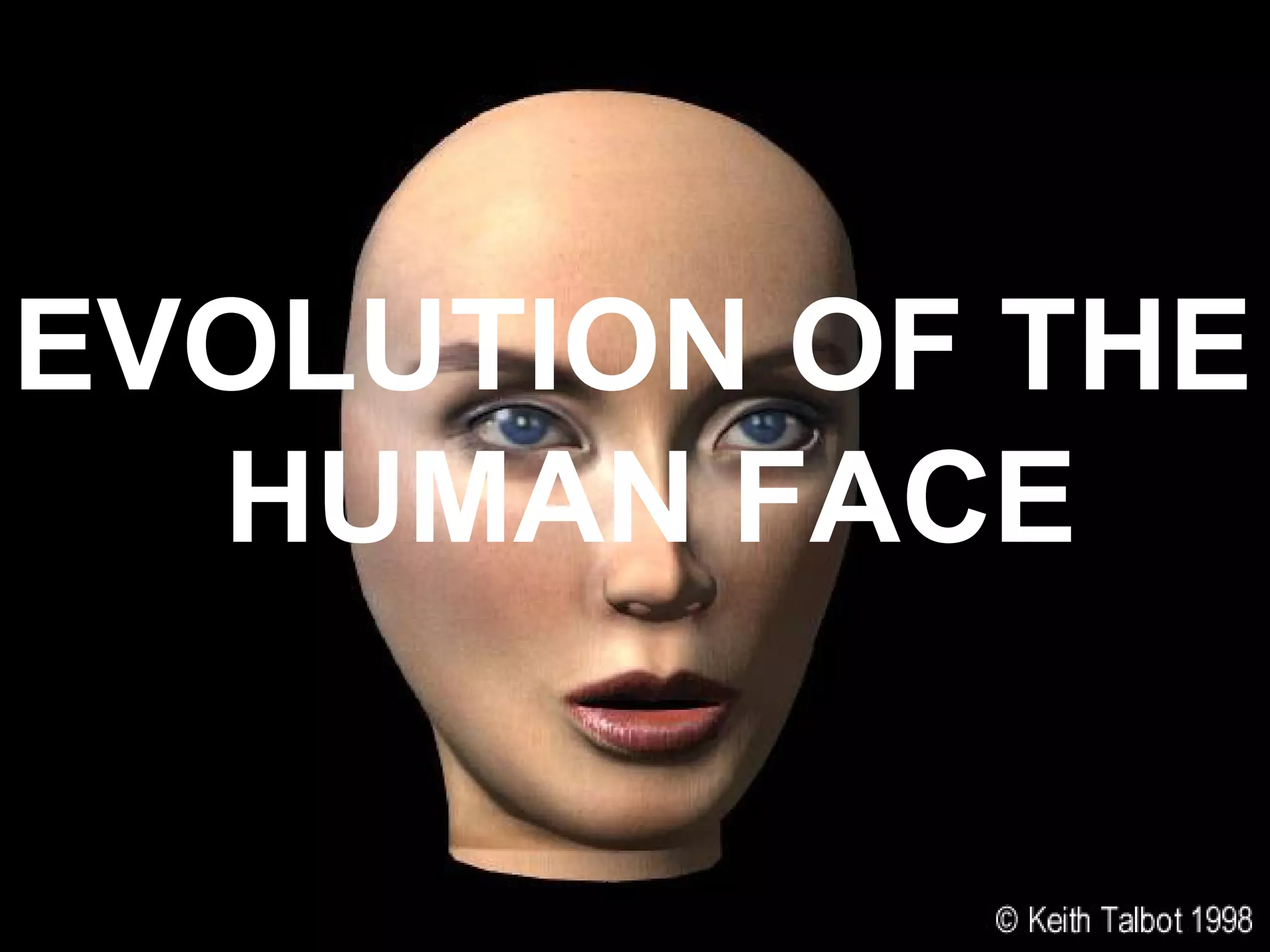
EVOLUTION OF THE
HUMAN FACE
www.indiandentalacademy.com
Contents
• Cranial base changes
• Orbital changes
• Nasal changes
• Maxilla changes
• Evolution of the
mandible
• Evolution of the TMJ
• Dentition changes
• Summation of
changes
• Application to
orthodontics
www.indiandentalacademy.com
“The human face is a
living mirror held out to
the living world”….
www.indiandentalacademy.com
Introduction
• Facial patterns have changed throughout
evolution, and these evolutionary changes
have some definite hidden causes that has
resulted in the facial patterns we see today.
• Human face- unusual-lacks elongated
graceful snout and muzzle flowing back into
a streamlined neurocranium
www.indiandentalacademy.com
• They possess-large round head with
combinations of facial patterns so bizzare
• Has broad,vertical flattened face
enveloped by an enormous balloon shaped
cranium with a bulbous forehead above a
small ,razor thin,fleshy proboscis and a
chin below with owl like orbits and a tiny
mouth that rests between muzzleless
jaws….
www.indiandentalacademy.com
What initiated the
evolutionary chain??
 Number of hypothesis-set forth
 Possible factors-Brachiation and the development
of a huge brain
 Precise evolutionary changes-speculative,the
anatomic consequences and the functional and
developmental relationships involved-well
understood
 This Knowledge important-malocclusion and
developmental abnormalitieswww.indiandentalacademy.com
Changes in the cranial base
• Man –few truly bipedal mammal that exists today
• The human body has made many adaptations to its
upright stance,some of which are reflected in the skull
and the face…
www.indiandentalacademy.com
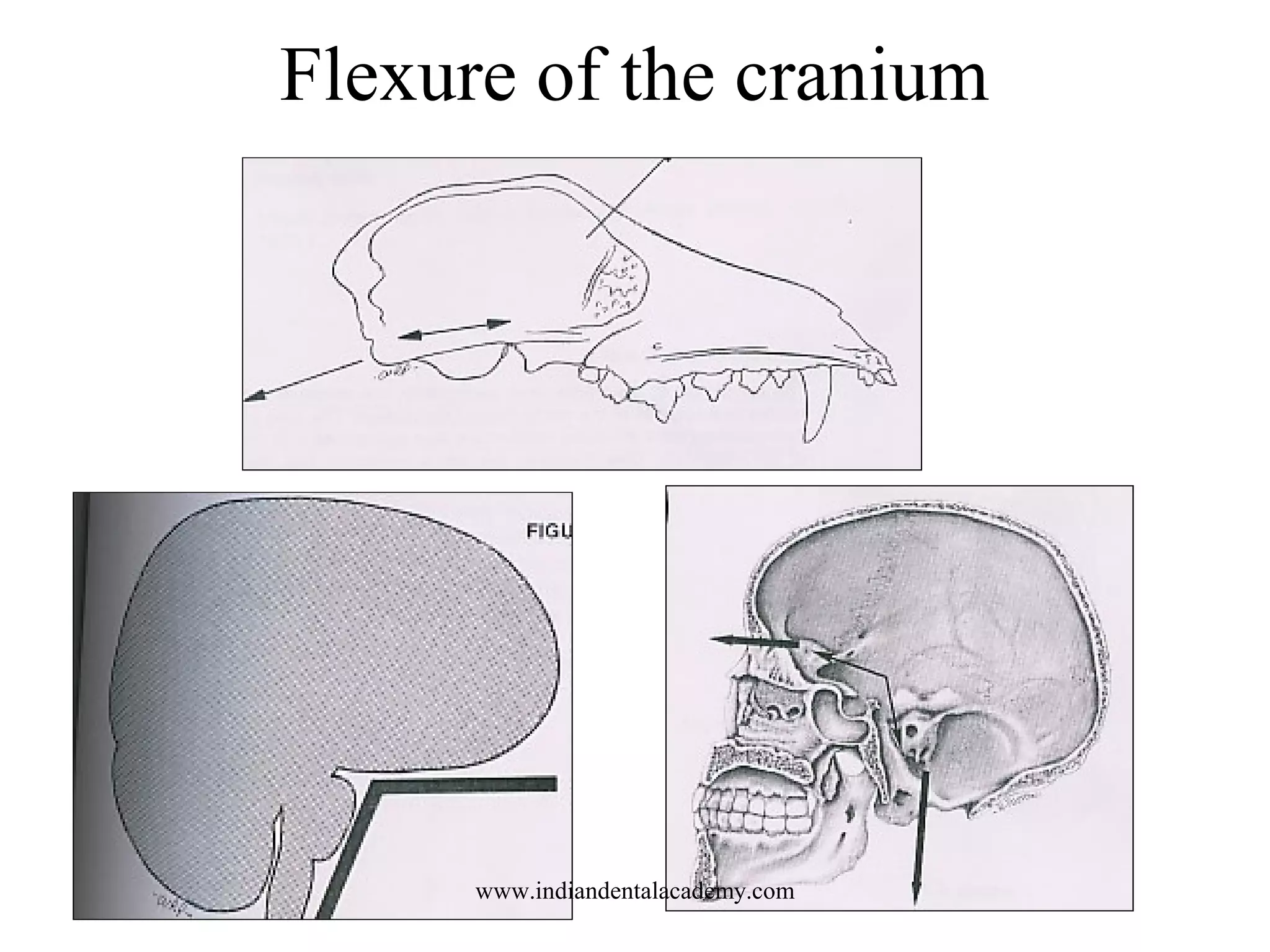
 Mammals showed a “FLAT” basal cranium..
 With evolution–enormous enlargement of the cerebrum
around a much lesser enlarging mid ventral segment
 Causing the bending of the whole underside of the brain
 Resulted in “FLEXURE” of the human cranial base
 Shift in position of FORAMEN MAGNUM-ultimately
resulted in an “upright head posture” on a vertical
spine
www.indiandentalacademy.com
Flexure of the cranium
www.indiandentalacademy.com
Changes in the frontal boneChanges in the frontal bone
 Expansion of the frontal lobes-frontal bone
displaces upward and outward
 Results in distinctive,bulbous,upright “forehead”
 Frontal lobes relate to rotation of human orbit into
new position
 As forehead is rotated into a vertical plane by the
brain behind it,the superior orbital rims is carried
with it resulting in the eyes to point at right angles
to the spinal cord.
www.indiandentalacademy.com
Frontal bone changes
www.indiandentalacademy.com
BRAIN ENLARGEMENT
FLEXURE OF CRANIUM
SPINAL CORD-
vertical
ROTATION OF
ORBIT
UPRIGHT STANCEUPRIGHT STANCE FORWARD DIRECTIONFORWARD DIRECTION
www.indiandentalacademy.com
Changes in the orbit
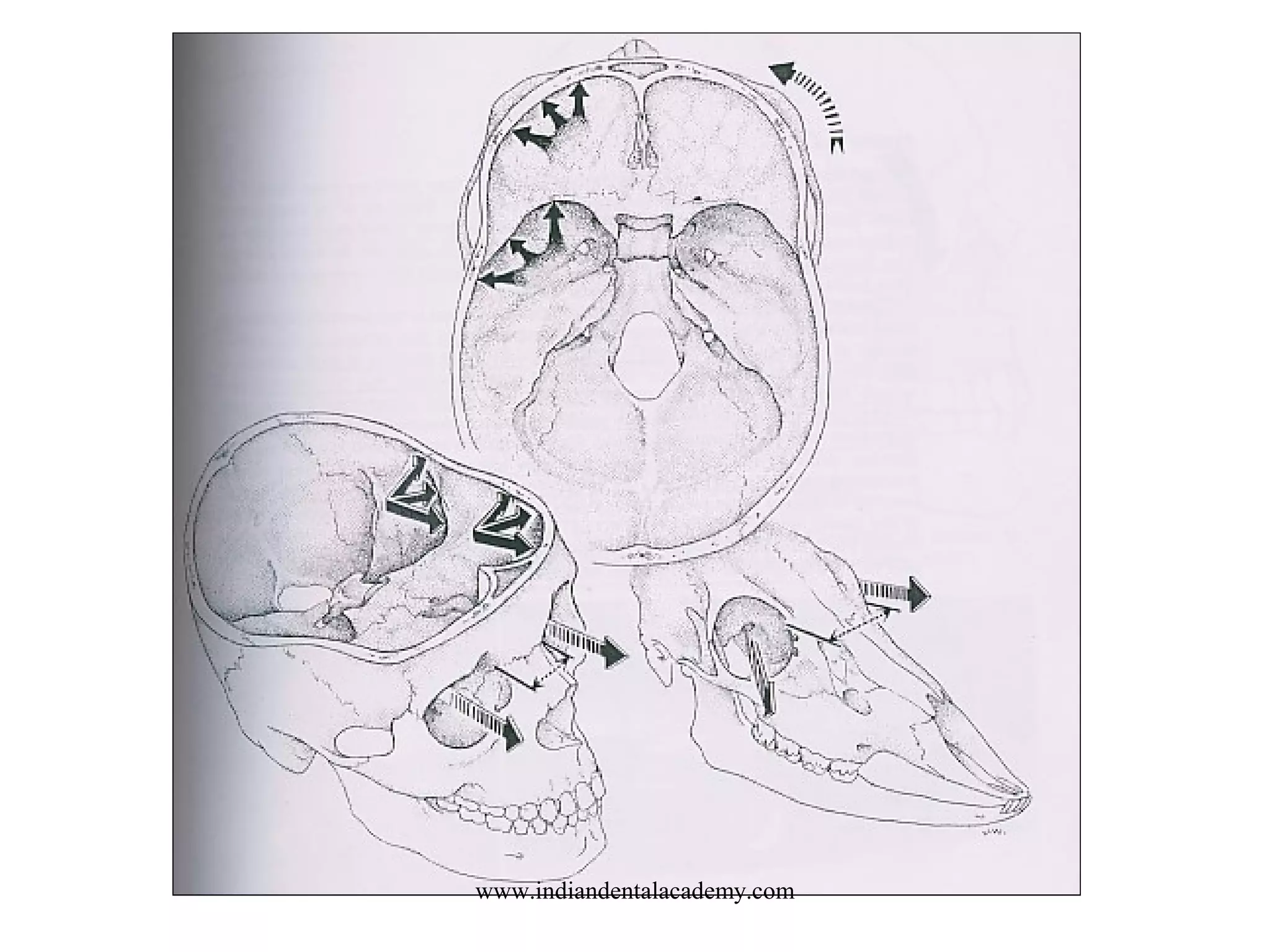
 Early mammals generally had the orbits pointed in an oblique
direction
 Massive Expansion of the cerebrum-two separate axis of orbital
rotation
 Frontal lobe expansion displaces the orbit vertically
 Temporal lobe expansion displaces orbit horizontally in
medial directions into a “binocular vision”
www.indiandentalacademy.com
Orbital convergence
www.indiandentalacademy.com
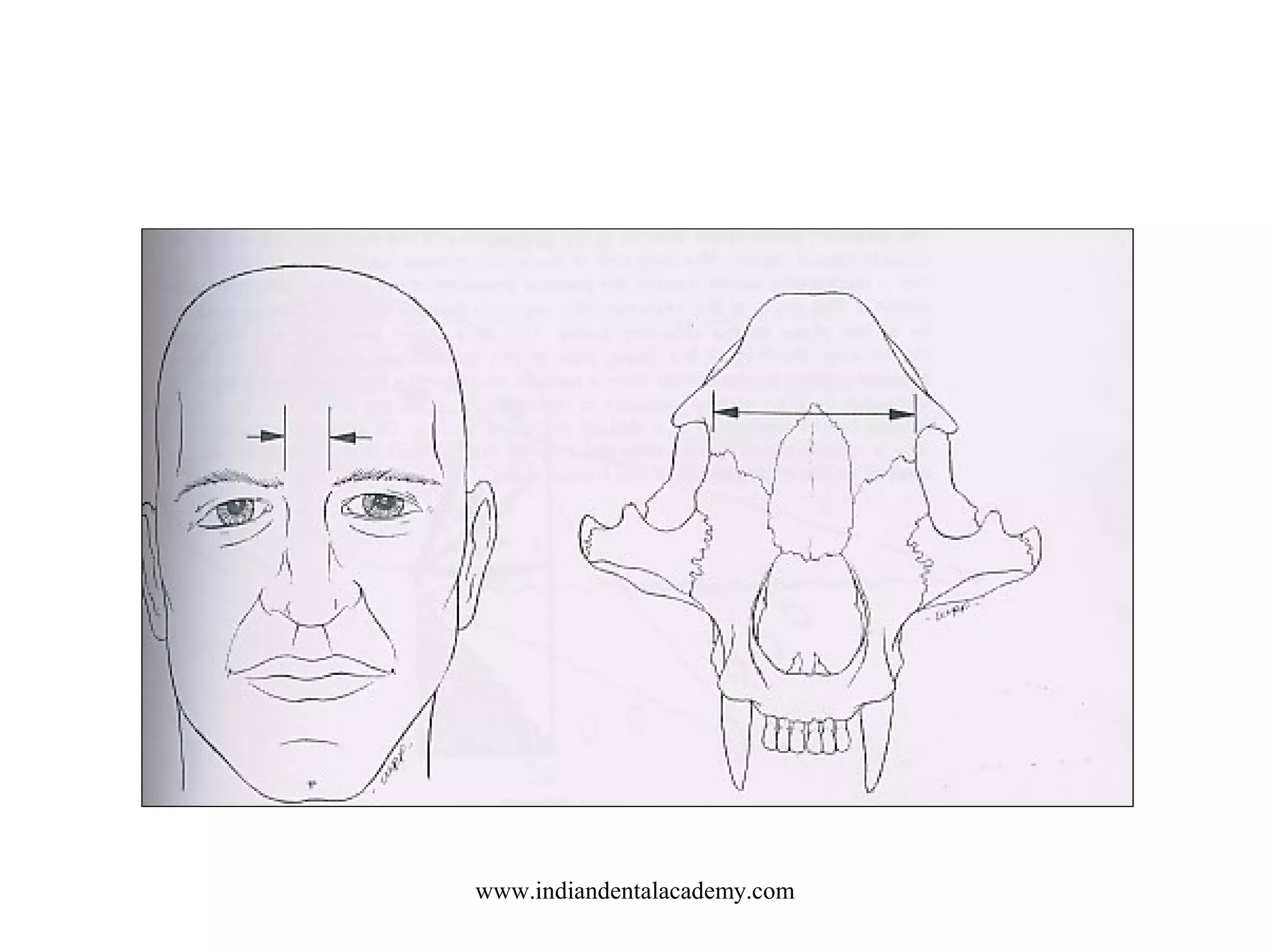
Significance of orbital rotation
• Change to a binocular vision
• Reduced the dimension of the inter orbital space
• This was one of the factor that resulted in the reduction
in the “extent of snout protrusion”
• Decrease in the interorbital segment reduces the
structural and the physiologic base of the bony nose
and hence results in a “shorter snout”
www.indiandentalacademy.com
Changes in the nasal region
 The nasal region above and
the oral region below are two
sides of the same coin –palate
 Reduction in the nasal
protrusion is accompanied by
a more or less equivalent
reduction of the jaw.
 Reduction of facial length
horizontally, however there is
a vertical rotation of the face-
due to the enlargement of the
brain and the flexure of the
cranial base www.indiandentalacademy.com
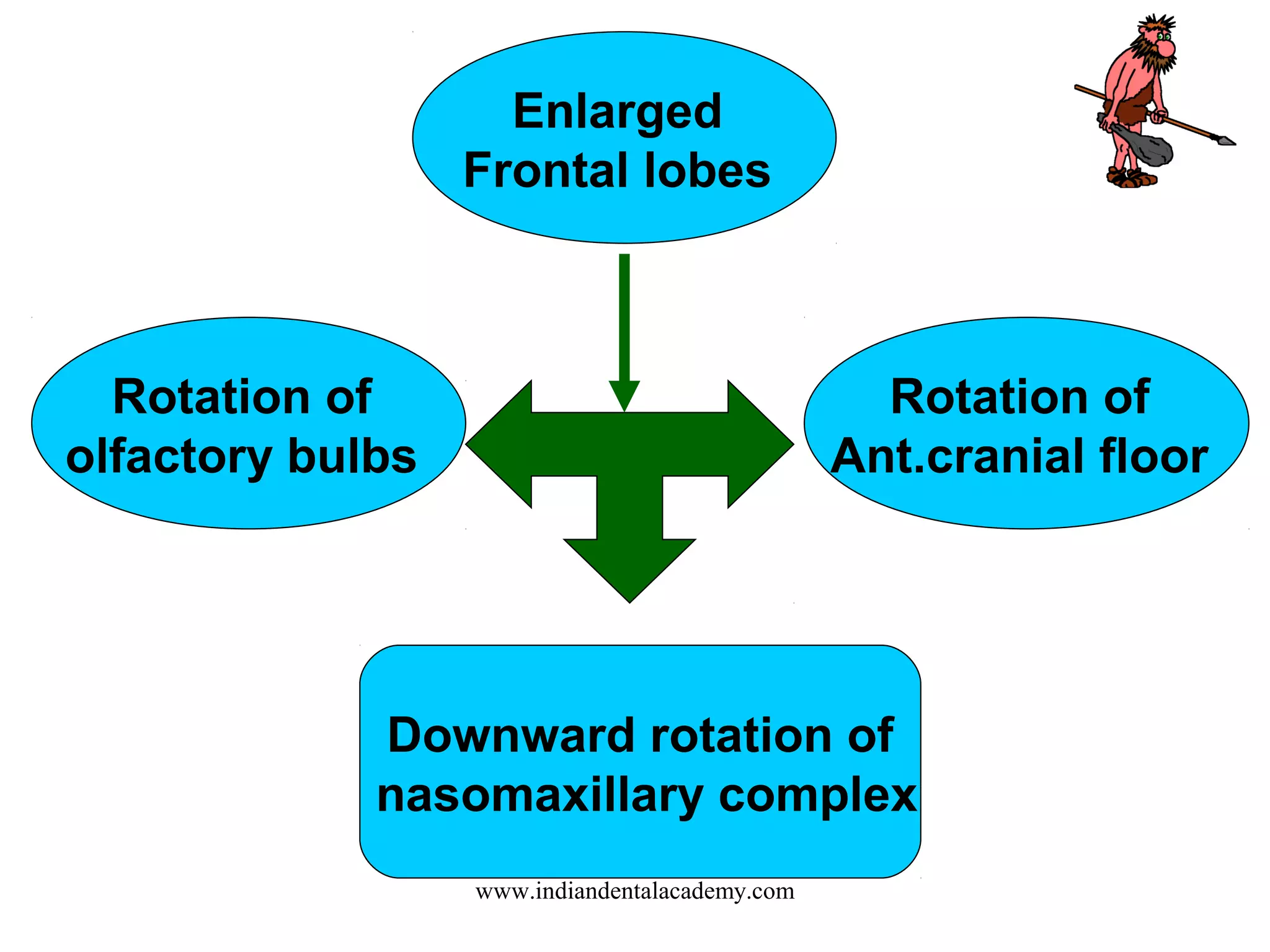
Enlarged
Frontal lobes
Rotation of
olfactory bulbs
Rotation of
Ant.cranial floor
Downward rotation of
nasomaxillary complex
www.indiandentalacademy.com
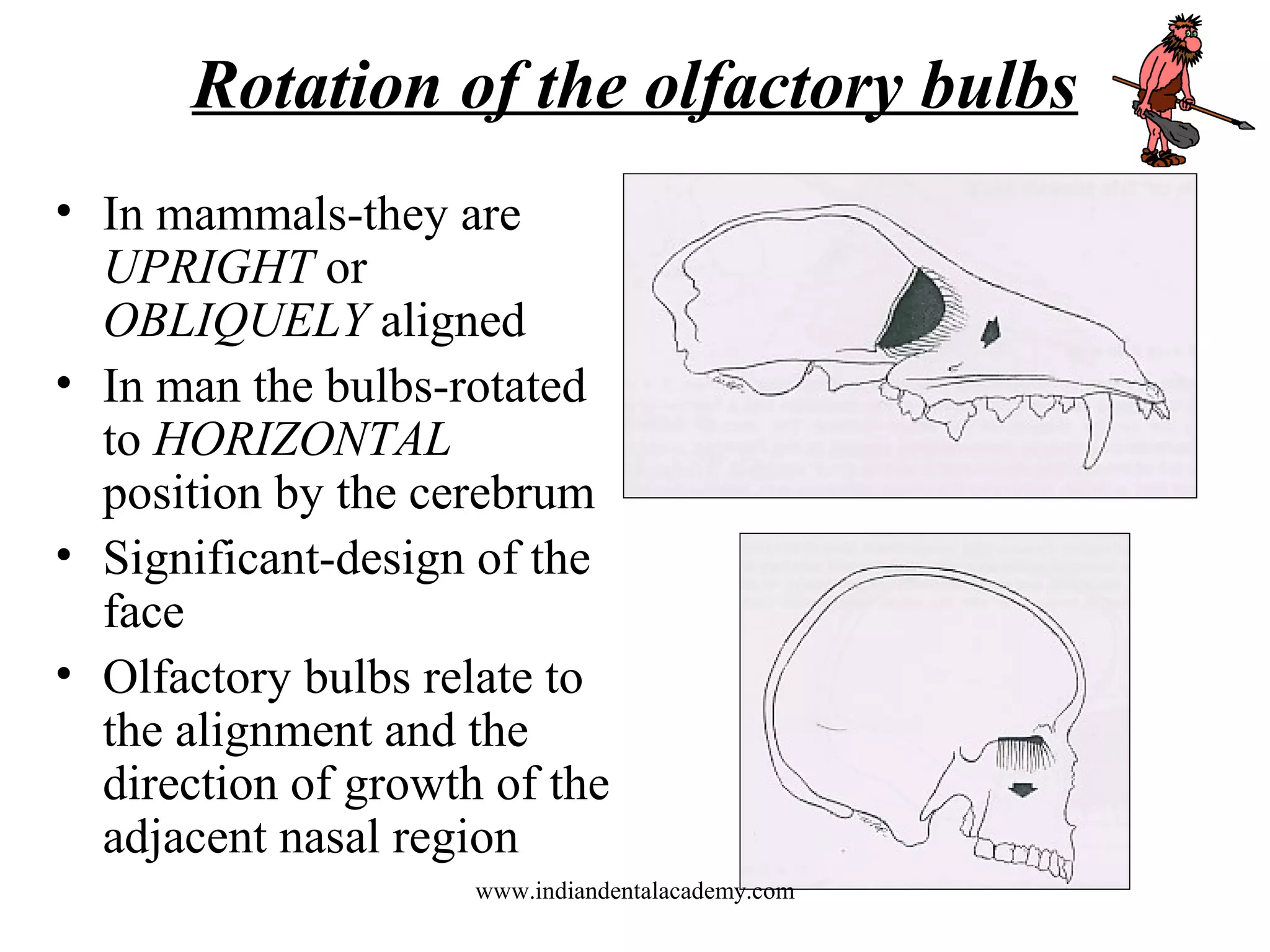
Rotation of the olfactory bulbs
• In mammals-they are
UPRIGHT or
OBLIQUELY aligned
• In man the bulbs-rotated
to HORIZONTAL
position by the cerebrum
• Significant-design of the
face
• Olfactory bulbs relate to
the alignment and the
direction of growth of the
adjacent nasal region
www.indiandentalacademy.com
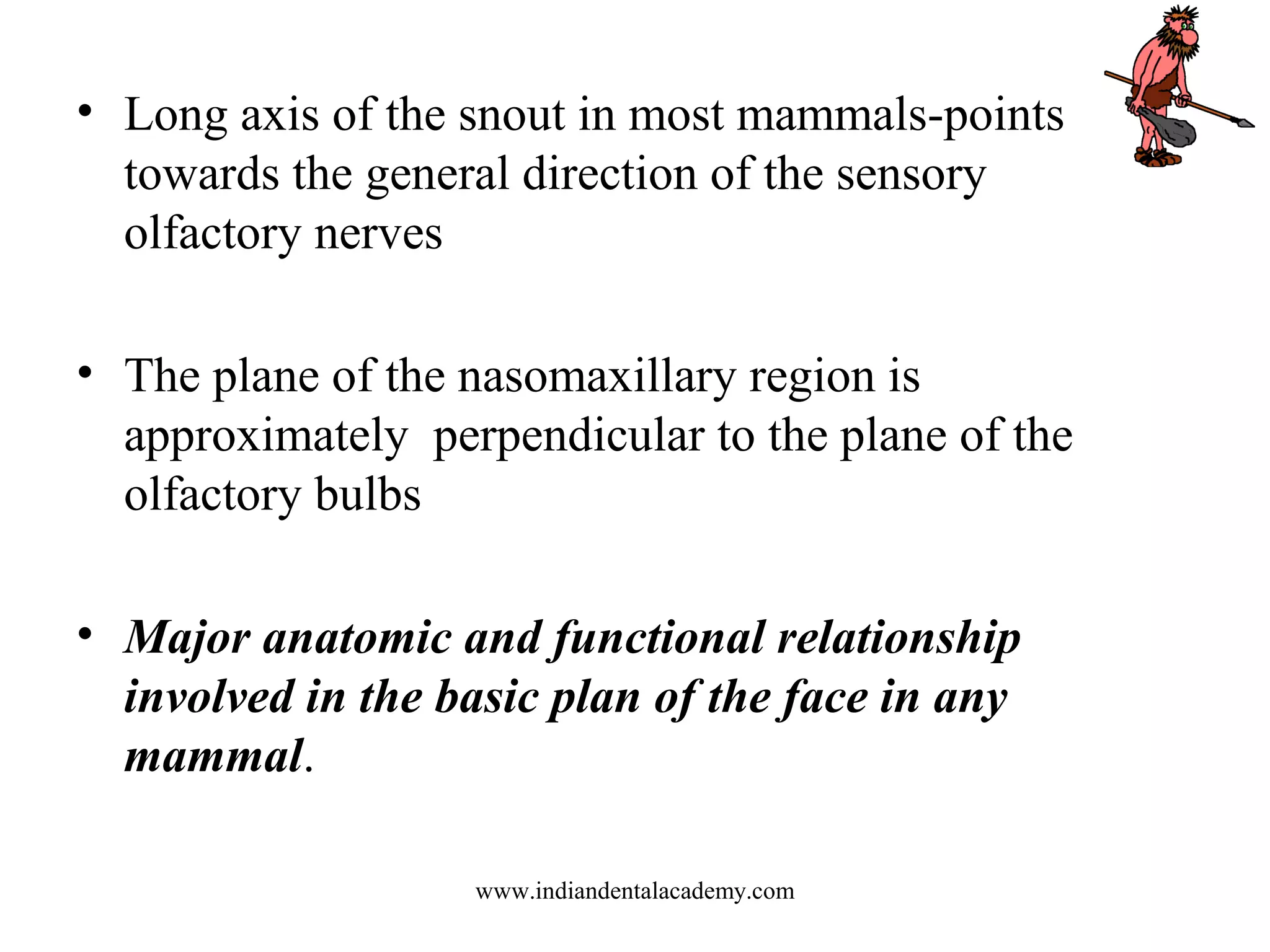
• Long axis of the snout in most mammals-points
towards the general direction of the sensory
olfactory nerves
• The plane of the nasomaxillary region is
approximately perpendicular to the plane of the
olfactory bulbs
• Major anatomic and functional relationship
involved in the basic plan of the face in any
mammal.
www.indiandentalacademy.com
Rotation of olfactory bulb
www.indiandentalacademy.com
Relationship between olfactory bulb and
naso maxillary alignment
www.indiandentalacademy.com
Changes in the maxilla
 Maxilla in most
mammals-triangular
configuartion
 In man-rectangular in
shape.
 Caused by rotation of the
occlusion into a
horizontal plane to adapt
to the vertical rotation of
the midface
www.indiandentalacademy.com
• Facial rotation-development
of the maxillary sinus beneath
the orbital floor and above the
shortened maxillary arch
• Human maxilla is a
distinctively shaped upper
jaw,uniquely rectangular
rather than triangular like
other mammals
• An orbital floor added to the
maxilla because middle and
lower parts of the face have
been rotated to a position
beneath the eyes
www.indiandentalacademy.com
• Reduction in the nasal
region along with
orbital
convergence,olfactory-
ant.cranial fossa
rotation will also
accompany an equal
reduction in the
maxillary arch length
• Palate is shared in
common.
www.indiandentalacademy.com
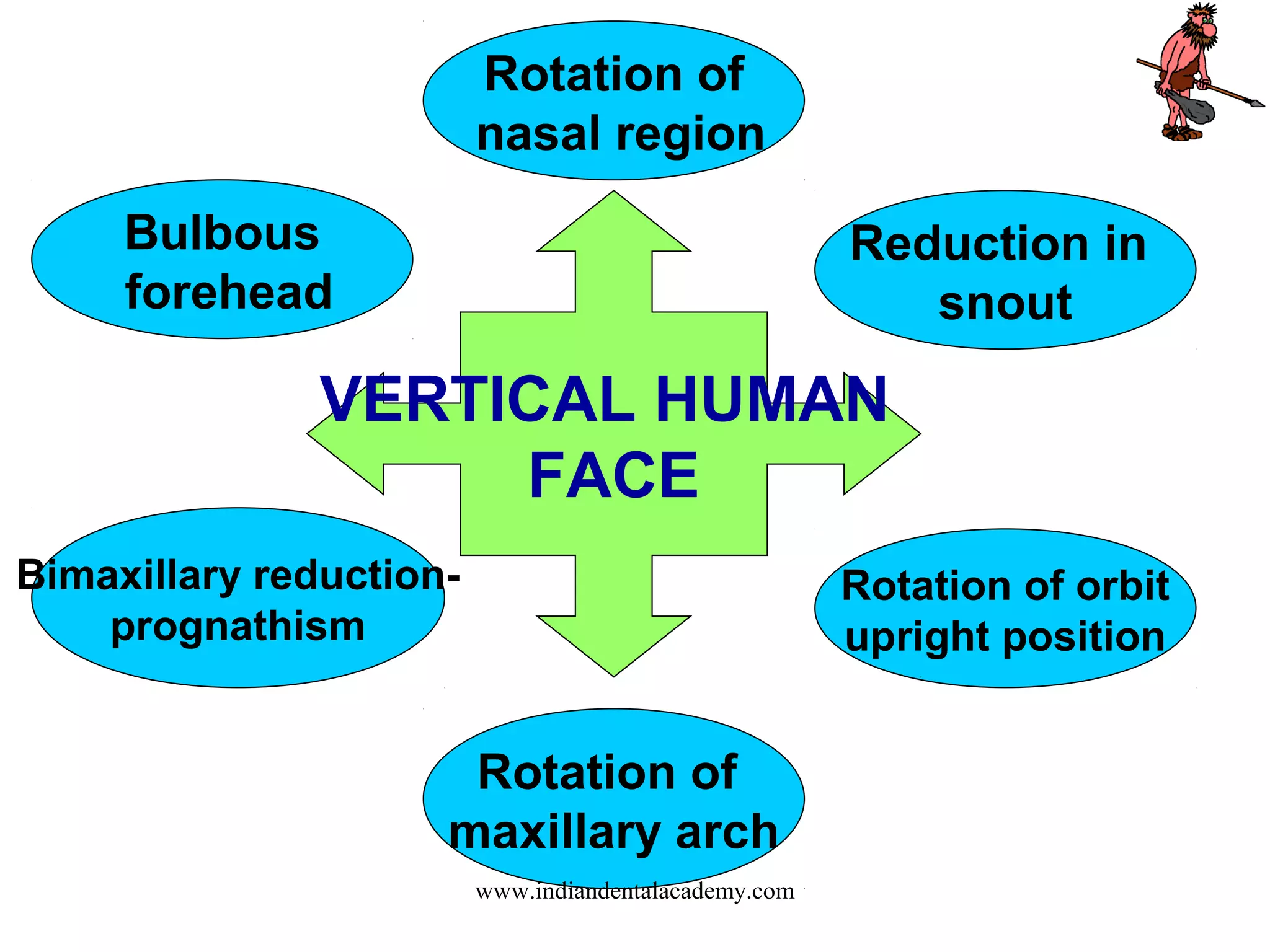
Bulbous
forehead
Rotation of orbit
upright position
Bimaxillary reduction-
prognathism
Reduction in
snout
Rotation of
maxillary arch
Rotation of
nasal region
VERTICAL HUMAN
FACE
www.indiandentalacademy.com
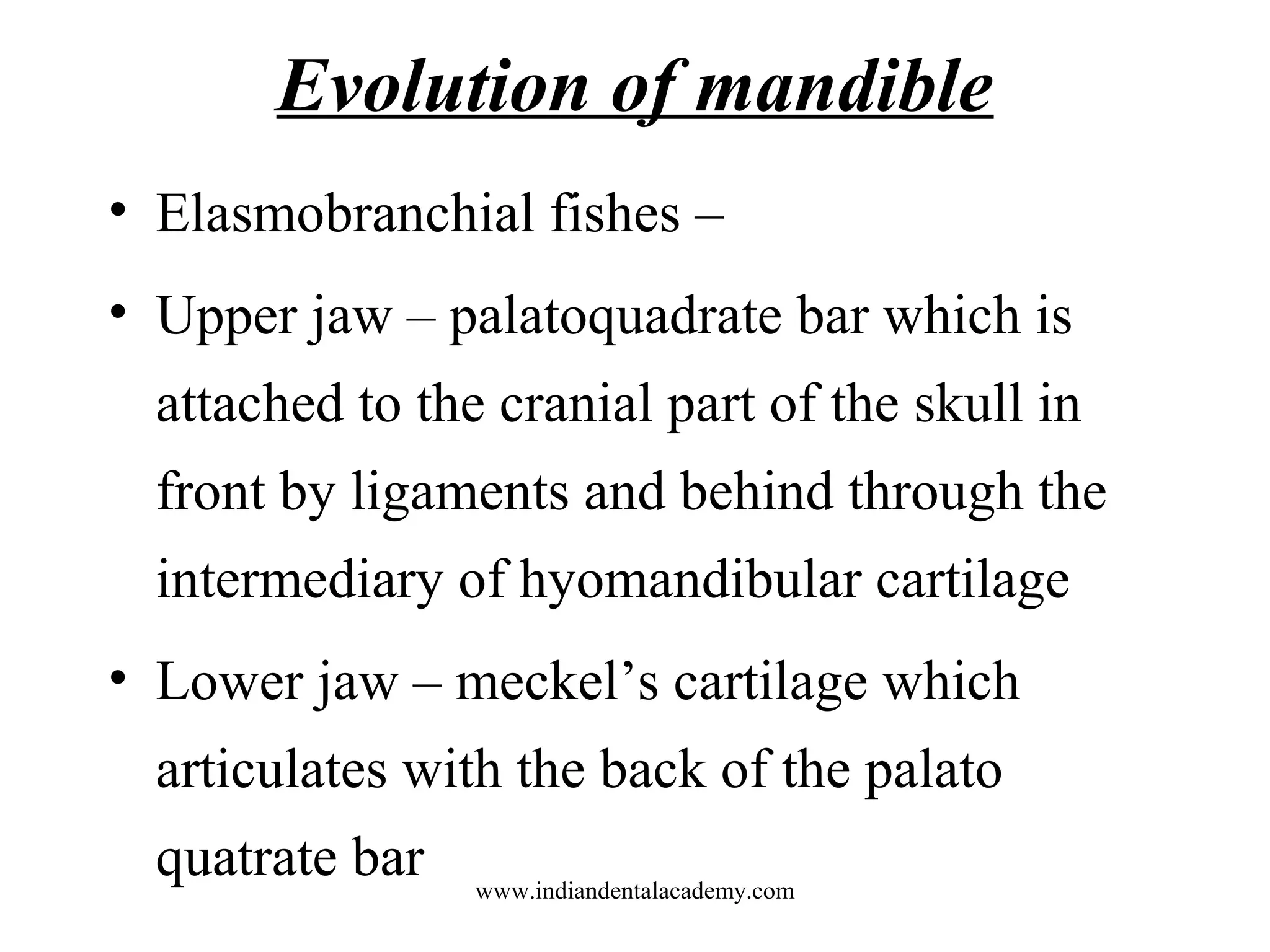
Evolution of mandible
• Elasmobranchial fishes –
• Upper jaw – palatoquadrate bar which is
attached to the cranial part of the skull in
front by ligaments and behind through the
intermediary of hyomandibular cartilage
• Lower jaw – meckel’s cartilage which
articulates with the back of the palato
quatrate bar www.indiandentalacademy.com
Amphibians
• Dermal bones are laid down in the region of the
primary jaw elements
• Some of the imp. Bones are dentary, splenial,
angular, sur angular, coronoid and angular
• Dentary and splenial contain the teeth
www.indiandentalacademy.com
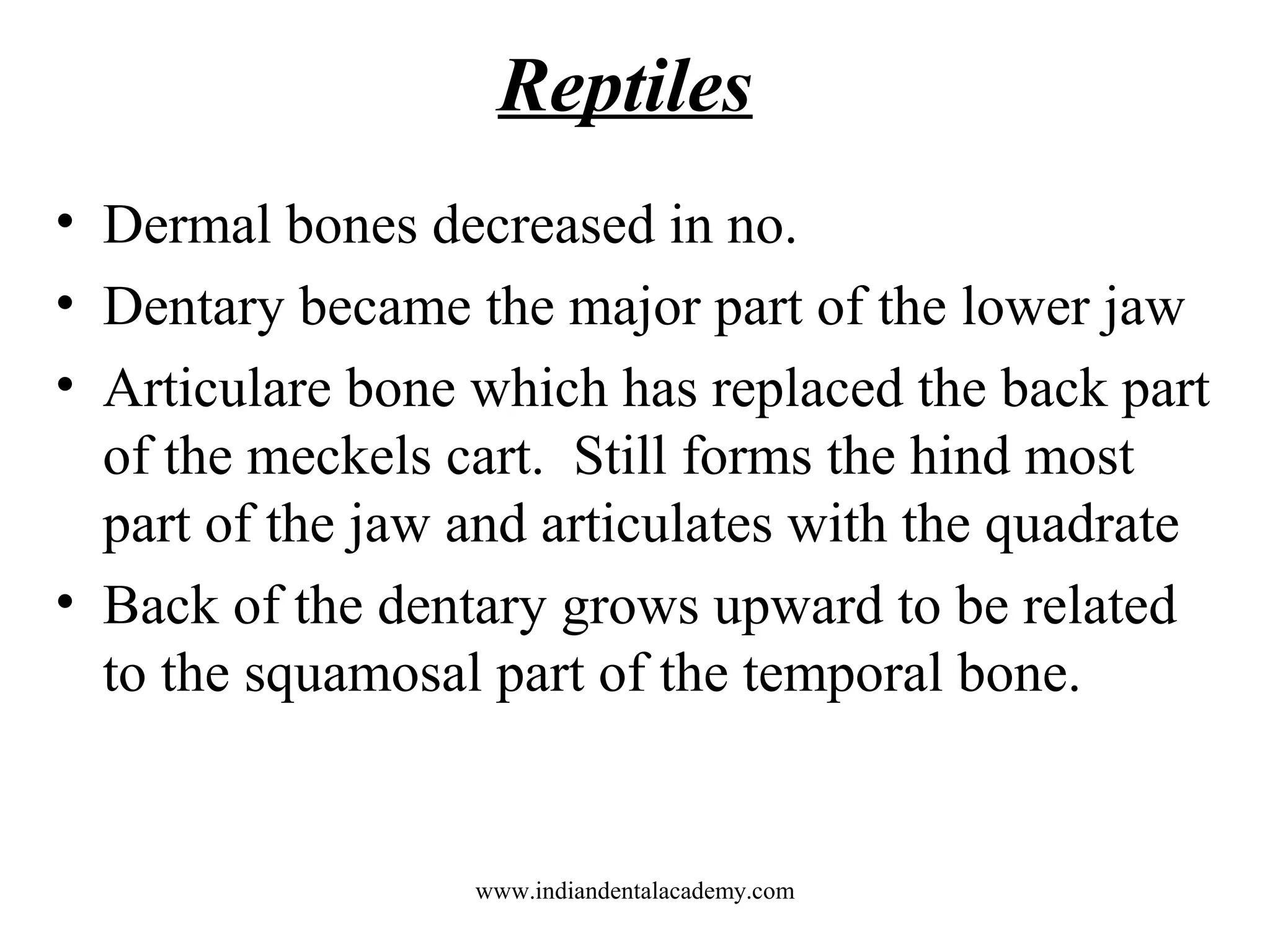
Reptiles
• Dermal bones decreased in no.
• Dentary became the major part of the lower jaw
• Articulare bone which has replaced the back part
of the meckels cart. Still forms the hind most
part of the jaw and articulates with the quadrate
• Back of the dentary grows upward to be related
to the squamosal part of the temporal bone.
www.indiandentalacademy.com
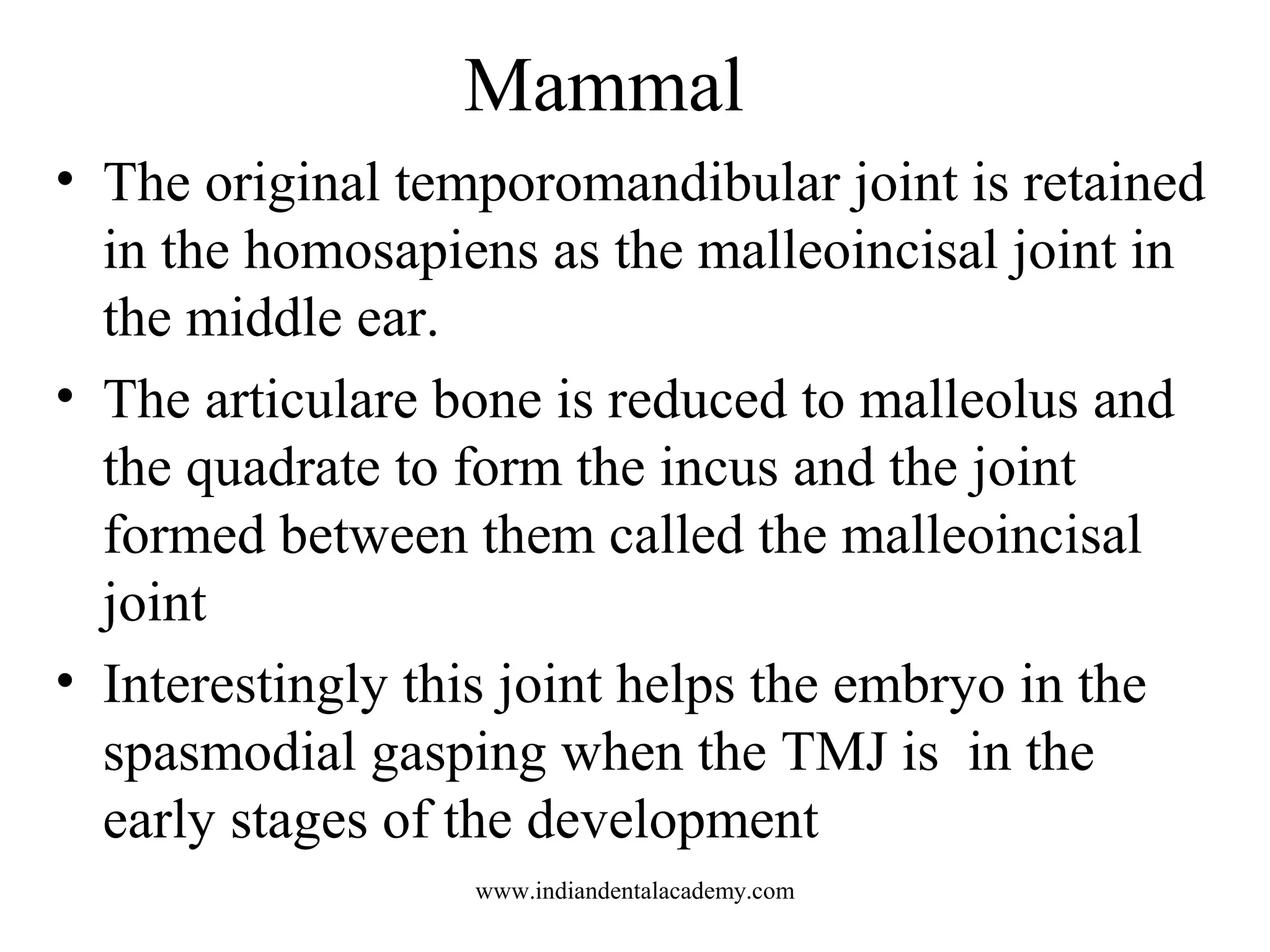
Mammal
• The original temporomandibular joint is retained
in the homosapiens as the malleoincisal joint in
the middle ear.
• The articulare bone is reduced to malleolus and
the quadrate to form the incus and the joint
formed between them called the malleoincisal
joint
• Interestingly this joint helps the embryo in the
spasmodial gasping when the TMJ is in the
early stages of the development
www.indiandentalacademy.com
• The meckels cartilage that forms a scaffold for
the formation of the mandible is reduced to the
sphenomandibular ligament
• The primitive joint and the established joint
functions together for some time and as the new
joint is developed the original joint is retained to
the middle ear to take over other function which
is a classic feature of the phylogenetic
development
www.indiandentalacademy.com
Changes in the dentition
[ Fred.F.Crutcher AO 1998]
Evolution of dentition found as early in the
primates
“Megazostrodon”-oldest known mammal… first
fossil evidence uncovered some 200 million yrs
ago.
“Tree shrews” –the most primitive of primates.a
variation of megazostrodon
www.indiandentalacademy.com
Tree shrews
The dental formula for this primate was
UPPER- I-2, C-1, P-3, M-3
LOWER-I-3, C-1, P-3,M-3
All the teeth were generally more cone shaped
than other primates
www.indiandentalacademy.com
Lemurs
Next step up the primate ladder.
Dental formula was
UPPER AND LOWER-I-2, C-1, P-3, M-3
Central and lateral incisors are cone shaped
Wide diastema b/w both the centrals
www.indiandentalacademy.com
In some lemurs,upper anteriors are
entirely missing
Lower centrals and laterals form a specialized
comb
They are elongated and procumbent and are joined
by adjacent similarly formed canines
 lower premolar develops into a canine form
The anterior comb was used for groomong and also
to scoop fresh gums and juice from trees
www.indiandentalacademy.com
Aye-aye
Lemur genus
Dental formula was
upper-I-0, C-1, P-1, M-3
lower-I-O, C-1,P-0,M-3
Upper and lower canines are inclined labially and
are in contact right with the left.
Teeth erupt throughout the lifetime which
maintains the length
www.indiandentalacademy.com
Tarsier
Combination of primitive and advanced
features
Dental formula is
upper-I-2, C-1, P-3, M-3
lower-I-1, C-1, P-3, M-3
All the incisors and the canines are cone shaped
They are mainly insectivorouswww.indiandentalacademy.com
Monkeys
2 types- old world and new world monkeys
Dental formula in the old world
upper and lower- I-2, C-1, P-2, M-3
For the new world monkeys
upper and lower –I-2, C-1, P-3, M-3
Canines were used mainly for fighting or are
displayed as a threatwww.indiandentalacademy.com
Anthropoid apes
Four living types:
Gorilla
Gibbon
Orangutan
chimpanzee
Gorilla
Strong incisors with chisel like edges
central is larger than lateral and slopes gingivally
on the distal
Labial surface concave
www.indiandentalacademy.com
Diastema b/w canine and the laterals
Maxillary pre molars have a definite buccal and
lingual cusp
Mandibular premolars show a subdued lingual
cusp
Sexual dimorphism in the canines is well defined
females-strong curved upper canines
males-canines are like fangs,long curved and
sharp.
www.indiandentalacademy.com
Gibbon
Central incisors are broad,laterals are pointed
Labially they are convex
Lingually concave mesiodistally
Lower incisors are equal in shape and have sharp
chisel like edges
Upper canines are long and curved,lower canines
are large and conical with the tips standing well
above the occlusal plane
Premolars are bicuspid
www.indiandentalacademy.com
Oranguttan
Dentition similar to gorrila except that the
jaws are narrower
Canines show sexual dimorphism
Chimpanzee
Dentition similar to oranguttan
Wider dental arch
www.indiandentalacademy.com
Homosapiens
The dental formula is
upper and lower-I-2, C-1, P-2, M-3
The chief changes are reduction in the size of the
teeth
little changes occurred in the shape of the teeth
except for the reduction in the number of the cusp
Greater reduction in the alveolar process
increasing the tendency for dental crowding in the
jaws
Development of a characteristic prominent chin-its
significance! www.indiandentalacademy.com
Changes in the nasal mucosa - function
Nasal mucosa –active site temperature regulation
in most mammals
Vasoconstriction and dilatation of the vessels in
the massive spread of mucosa covering the
turbinates control the amount of heat retention
and the loss
Because of nasal reduction in man,function
taken over by the relatively hairless and sweat
gland loaded integument…
www.indiandentalacademy.com
Changes in the diet
Refined food habits
Decreased jaw size
Decrease in the
function of the
masticatory muscle unit
Reduced mesio
occlusal attrition
Increase in the tooth size
Malocclusion
www.indiandentalacademy.com
Aye Aye- incisor absent
mesial migration of the canine
palatal canine Impaction
Tarsier – coniform incisor
pegged lateral
I 3 incisor pattern
diastema and supernumerary
?
www.indiandentalacademy.com
Summation
• Erect posture
• Increased cranial capacity
• Regression of the snout
• Naso maxillary rotation
• Decreased bulk of the musculature
• Increased tooth material
• Decreased jaw size
www.indiandentalacademy.com
Is it possible to link these evolutionary changes to
malocclusion????
Though a number of studies in Aboriginals have
been done to relate the changes to malocclusion.
The role of environmental factors and the genetic
factors still remain a unsolved mystery.
To be aware of all the possibilities responsible into
developing a malocclusion is essential to achieve a
neuromuscular balance in spite of the racial and
esthetic values that may differ in different ethnic
groups.
www.indiandentalacademy.com
• Identify the mutually dependent changes and if
the changes have failed to occur to maintain the
balance then there is an imbalance in the system
leading to the development of an abnormality
• To recognize this abnormality, relate to the
absence of the mutually dependent changes and
treat to achieve the balance is the duty of the
functioning anthropologists.
www.indiandentalacademy.com
Thank you!
www.indiandentalacademy.com

Evolution of human face..

  • 1.
    EVOLUTION OF THE HUMANFACE www.indiandentalacademy.com
  • 2.
    Contents • Cranial basechanges • Orbital changes • Nasal changes • Maxilla changes • Evolution of the mandible • Evolution of the TMJ • Dentition changes • Summation of changes • Application to orthodontics www.indiandentalacademy.com
  • 3.
    “The human faceis a living mirror held out to the living world”…. www.indiandentalacademy.com
  • 4.
    Introduction • Facial patternshave changed throughout evolution, and these evolutionary changes have some definite hidden causes that has resulted in the facial patterns we see today. • Human face- unusual-lacks elongated graceful snout and muzzle flowing back into a streamlined neurocranium www.indiandentalacademy.com
  • 5.
    • They possess-largeround head with combinations of facial patterns so bizzare • Has broad,vertical flattened face enveloped by an enormous balloon shaped cranium with a bulbous forehead above a small ,razor thin,fleshy proboscis and a chin below with owl like orbits and a tiny mouth that rests between muzzleless jaws…. www.indiandentalacademy.com
  • 6.
    What initiated the evolutionarychain??  Number of hypothesis-set forth  Possible factors-Brachiation and the development of a huge brain  Precise evolutionary changes-speculative,the anatomic consequences and the functional and developmental relationships involved-well understood  This Knowledge important-malocclusion and developmental abnormalitieswww.indiandentalacademy.com
  • 7.
    Changes in thecranial base • Man –few truly bipedal mammal that exists today • The human body has made many adaptations to its upright stance,some of which are reflected in the skull and the face… www.indiandentalacademy.com
  • 8.
     Mammals showeda “FLAT” basal cranium..  With evolution–enormous enlargement of the cerebrum around a much lesser enlarging mid ventral segment  Causing the bending of the whole underside of the brain  Resulted in “FLEXURE” of the human cranial base  Shift in position of FORAMEN MAGNUM-ultimately resulted in an “upright head posture” on a vertical spine www.indiandentalacademy.com
  • 9.
    Flexure of thecranium www.indiandentalacademy.com
  • 10.
    Changes in thefrontal boneChanges in the frontal bone  Expansion of the frontal lobes-frontal bone displaces upward and outward  Results in distinctive,bulbous,upright “forehead”  Frontal lobes relate to rotation of human orbit into new position  As forehead is rotated into a vertical plane by the brain behind it,the superior orbital rims is carried with it resulting in the eyes to point at right angles to the spinal cord. www.indiandentalacademy.com
  • 11.
  • 12.
    BRAIN ENLARGEMENT FLEXURE OFCRANIUM SPINAL CORD- vertical ROTATION OF ORBIT UPRIGHT STANCEUPRIGHT STANCE FORWARD DIRECTIONFORWARD DIRECTION www.indiandentalacademy.com
  • 13.
    Changes in theorbit  Early mammals generally had the orbits pointed in an oblique direction  Massive Expansion of the cerebrum-two separate axis of orbital rotation  Frontal lobe expansion displaces the orbit vertically  Temporal lobe expansion displaces orbit horizontally in medial directions into a “binocular vision” www.indiandentalacademy.com
  • 14.
  • 15.
  • 16.
    Significance of orbitalrotation • Change to a binocular vision • Reduced the dimension of the inter orbital space • This was one of the factor that resulted in the reduction in the “extent of snout protrusion” • Decrease in the interorbital segment reduces the structural and the physiologic base of the bony nose and hence results in a “shorter snout” www.indiandentalacademy.com
  • 17.
  • 18.
    Changes in thenasal region  The nasal region above and the oral region below are two sides of the same coin –palate  Reduction in the nasal protrusion is accompanied by a more or less equivalent reduction of the jaw.  Reduction of facial length horizontally, however there is a vertical rotation of the face- due to the enlargement of the brain and the flexure of the cranial base www.indiandentalacademy.com
  • 19.
    Enlarged Frontal lobes Rotation of olfactorybulbs Rotation of Ant.cranial floor Downward rotation of nasomaxillary complex www.indiandentalacademy.com
  • 20.
    Rotation of theolfactory bulbs • In mammals-they are UPRIGHT or OBLIQUELY aligned • In man the bulbs-rotated to HORIZONTAL position by the cerebrum • Significant-design of the face • Olfactory bulbs relate to the alignment and the direction of growth of the adjacent nasal region www.indiandentalacademy.com
  • 21.
    • Long axisof the snout in most mammals-points towards the general direction of the sensory olfactory nerves • The plane of the nasomaxillary region is approximately perpendicular to the plane of the olfactory bulbs • Major anatomic and functional relationship involved in the basic plan of the face in any mammal. www.indiandentalacademy.com
  • 22.
    Rotation of olfactorybulb www.indiandentalacademy.com
  • 23.
    Relationship between olfactorybulb and naso maxillary alignment www.indiandentalacademy.com
  • 24.
    Changes in themaxilla  Maxilla in most mammals-triangular configuartion  In man-rectangular in shape.  Caused by rotation of the occlusion into a horizontal plane to adapt to the vertical rotation of the midface www.indiandentalacademy.com
  • 25.
    • Facial rotation-development ofthe maxillary sinus beneath the orbital floor and above the shortened maxillary arch • Human maxilla is a distinctively shaped upper jaw,uniquely rectangular rather than triangular like other mammals • An orbital floor added to the maxilla because middle and lower parts of the face have been rotated to a position beneath the eyes www.indiandentalacademy.com
  • 26.
    • Reduction inthe nasal region along with orbital convergence,olfactory- ant.cranial fossa rotation will also accompany an equal reduction in the maxillary arch length • Palate is shared in common. www.indiandentalacademy.com
  • 27.
    Bulbous forehead Rotation of orbit uprightposition Bimaxillary reduction- prognathism Reduction in snout Rotation of maxillary arch Rotation of nasal region VERTICAL HUMAN FACE www.indiandentalacademy.com
  • 28.
    Evolution of mandible •Elasmobranchial fishes – • Upper jaw – palatoquadrate bar which is attached to the cranial part of the skull in front by ligaments and behind through the intermediary of hyomandibular cartilage • Lower jaw – meckel’s cartilage which articulates with the back of the palato quatrate bar www.indiandentalacademy.com
  • 29.
    Amphibians • Dermal bonesare laid down in the region of the primary jaw elements • Some of the imp. Bones are dentary, splenial, angular, sur angular, coronoid and angular • Dentary and splenial contain the teeth www.indiandentalacademy.com
  • 30.
    Reptiles • Dermal bonesdecreased in no. • Dentary became the major part of the lower jaw • Articulare bone which has replaced the back part of the meckels cart. Still forms the hind most part of the jaw and articulates with the quadrate • Back of the dentary grows upward to be related to the squamosal part of the temporal bone. www.indiandentalacademy.com
  • 31.
    Mammal • The originaltemporomandibular joint is retained in the homosapiens as the malleoincisal joint in the middle ear. • The articulare bone is reduced to malleolus and the quadrate to form the incus and the joint formed between them called the malleoincisal joint • Interestingly this joint helps the embryo in the spasmodial gasping when the TMJ is in the early stages of the development www.indiandentalacademy.com
  • 32.
    • The meckelscartilage that forms a scaffold for the formation of the mandible is reduced to the sphenomandibular ligament • The primitive joint and the established joint functions together for some time and as the new joint is developed the original joint is retained to the middle ear to take over other function which is a classic feature of the phylogenetic development www.indiandentalacademy.com
  • 33.
    Changes in thedentition [ Fred.F.Crutcher AO 1998] Evolution of dentition found as early in the primates “Megazostrodon”-oldest known mammal… first fossil evidence uncovered some 200 million yrs ago. “Tree shrews” –the most primitive of primates.a variation of megazostrodon www.indiandentalacademy.com
  • 34.
    Tree shrews The dentalformula for this primate was UPPER- I-2, C-1, P-3, M-3 LOWER-I-3, C-1, P-3,M-3 All the teeth were generally more cone shaped than other primates www.indiandentalacademy.com
  • 35.
    Lemurs Next step upthe primate ladder. Dental formula was UPPER AND LOWER-I-2, C-1, P-3, M-3 Central and lateral incisors are cone shaped Wide diastema b/w both the centrals www.indiandentalacademy.com
  • 36.
    In some lemurs,upperanteriors are entirely missing Lower centrals and laterals form a specialized comb They are elongated and procumbent and are joined by adjacent similarly formed canines  lower premolar develops into a canine form The anterior comb was used for groomong and also to scoop fresh gums and juice from trees www.indiandentalacademy.com
  • 37.
    Aye-aye Lemur genus Dental formulawas upper-I-0, C-1, P-1, M-3 lower-I-O, C-1,P-0,M-3 Upper and lower canines are inclined labially and are in contact right with the left. Teeth erupt throughout the lifetime which maintains the length www.indiandentalacademy.com
  • 38.
    Tarsier Combination of primitiveand advanced features Dental formula is upper-I-2, C-1, P-3, M-3 lower-I-1, C-1, P-3, M-3 All the incisors and the canines are cone shaped They are mainly insectivorouswww.indiandentalacademy.com
  • 39.
    Monkeys 2 types- oldworld and new world monkeys Dental formula in the old world upper and lower- I-2, C-1, P-2, M-3 For the new world monkeys upper and lower –I-2, C-1, P-3, M-3 Canines were used mainly for fighting or are displayed as a threatwww.indiandentalacademy.com
  • 40.
    Anthropoid apes Four livingtypes: Gorilla Gibbon Orangutan chimpanzee Gorilla Strong incisors with chisel like edges central is larger than lateral and slopes gingivally on the distal Labial surface concave www.indiandentalacademy.com
  • 41.
    Diastema b/w canineand the laterals Maxillary pre molars have a definite buccal and lingual cusp Mandibular premolars show a subdued lingual cusp Sexual dimorphism in the canines is well defined females-strong curved upper canines males-canines are like fangs,long curved and sharp. www.indiandentalacademy.com
  • 42.
    Gibbon Central incisors arebroad,laterals are pointed Labially they are convex Lingually concave mesiodistally Lower incisors are equal in shape and have sharp chisel like edges Upper canines are long and curved,lower canines are large and conical with the tips standing well above the occlusal plane Premolars are bicuspid www.indiandentalacademy.com
  • 43.
    Oranguttan Dentition similar togorrila except that the jaws are narrower Canines show sexual dimorphism Chimpanzee Dentition similar to oranguttan Wider dental arch www.indiandentalacademy.com
  • 44.
    Homosapiens The dental formulais upper and lower-I-2, C-1, P-2, M-3 The chief changes are reduction in the size of the teeth little changes occurred in the shape of the teeth except for the reduction in the number of the cusp Greater reduction in the alveolar process increasing the tendency for dental crowding in the jaws Development of a characteristic prominent chin-its significance! www.indiandentalacademy.com
  • 45.
    Changes in thenasal mucosa - function Nasal mucosa –active site temperature regulation in most mammals Vasoconstriction and dilatation of the vessels in the massive spread of mucosa covering the turbinates control the amount of heat retention and the loss Because of nasal reduction in man,function taken over by the relatively hairless and sweat gland loaded integument… www.indiandentalacademy.com
  • 46.
    Changes in thediet Refined food habits Decreased jaw size Decrease in the function of the masticatory muscle unit Reduced mesio occlusal attrition Increase in the tooth size Malocclusion www.indiandentalacademy.com
  • 47.
    Aye Aye- incisorabsent mesial migration of the canine palatal canine Impaction Tarsier – coniform incisor pegged lateral I 3 incisor pattern diastema and supernumerary ? www.indiandentalacademy.com
  • 48.
    Summation • Erect posture •Increased cranial capacity • Regression of the snout • Naso maxillary rotation • Decreased bulk of the musculature • Increased tooth material • Decreased jaw size www.indiandentalacademy.com
  • 49.
    Is it possibleto link these evolutionary changes to malocclusion???? Though a number of studies in Aboriginals have been done to relate the changes to malocclusion. The role of environmental factors and the genetic factors still remain a unsolved mystery. To be aware of all the possibilities responsible into developing a malocclusion is essential to achieve a neuromuscular balance in spite of the racial and esthetic values that may differ in different ethnic groups. www.indiandentalacademy.com
  • 50.
    • Identify themutually dependent changes and if the changes have failed to occur to maintain the balance then there is an imbalance in the system leading to the development of an abnormality • To recognize this abnormality, relate to the absence of the mutually dependent changes and treat to achieve the balance is the duty of the functioning anthropologists. www.indiandentalacademy.com
  • 51.