EVOLUTIONARY SIGNIFICANCE OF
AMMOCOETES LARVA
• The larva stage formation of the primitive lamprey is
known as Ammocoete Larva. It has many properties of
ancient chordates and has some properties of the
vertebrates like a dorsal nerve chord, primitive form of
nervous system, gills slits , notochord and a brain with
eyes. This larva is actually Petromyzon fish.
• Petromyzon is a rather unpleasant animal. Its life cycle
includes two quite different phases. The larval phase
called ammoceote is a freshwater, sedentary, filter
feeding and microphagus creature remiscent of the
lancelet or Branchiostomata. The adult fish live in the sea
and is parasitic on fishes.
• The eggs hatch in about three weeks into minute
transparant larva called Ammocoetes.
• They are so radically different from their parents
that they were originally described as a distinct
genus, Ammocoetes.
• At first, they are about 7mm in length and stay in the
nest, when about 15mm long, they quite the nest and
burrow in mud and sand in quite water.
• Each larva constructs and inhabits a V or U shaped
tunnel.
• The larval period last from 3-7 years, according to
species during which they grow to about 170mm in
length and become opaque.
• The Ammocoete larva is of great importance as it
probably represent the most primitive and
generalised vertebrate from intermediate between
Cephalochordates and vertebrates.
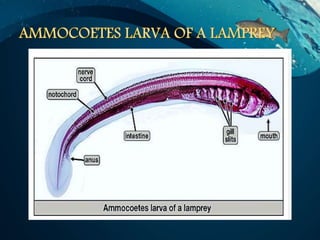
• Its body is eel like but it differs from the adult in
several respects.
1. It has a continuous single median dorsal fin.
2. It is a blind, toothless and non parasitic filter
feeder.
3. Feeding and respiration are like those of
Branchiostoma.
4. It has no suctorial buccal funnel but a semi
circular upper lip or oral hood around the
mouth, similar to that of branchiostoma.
5. Mouth also has a transverse lower lip.
• It emerges at night, from its burrow to feed on
the burrow to feed on the button organic.
• Ooze, containing unicellular algae and bacteria,
which are caught on the floor of pharynx in
mucous strings secreted by a tubular endostyle.
• A velum made of a pair of muscular flaps,
regulates the entry of water current into the
pharynx which is continued posterior into the
oesophagus.
• Seven pairs of gills pouches are present, each
with its internal gill slit into pharynx and
external gill slit to the exterior.
• Branchial basket supporting the pharyngeal
wall alternately expands and contracts,
drawing water through mouth into pharynx
and pumping out through external gill slits.
• Thus, water circulation is by muscular activity
and not by cilliary activity, as in
branchiostoma, this is probably a necessary
evolutionary development for engulfing larger
pieces of food.
• Liver, bile duct, gall bladder and protonephros
(kidney) are present. Pericardial cavity
enclosing heart connects with coelom.
• Paired eyes remain hidden under thick skin
and muscles.
• Unpaired median pineal eye is well developed
but hypophysial and nasal sacs are poorly
developed.
 It is a dramatic changes in habit, habitat,
morphology, physiology and behavior of larva so
that it is transform into an adult entirely different
habit and structure.
 After a prolonged larval life of 3-7 years,
ammocoetes undergo several radial structure
changes to metamorphose into the semiparasitic
adult form.
 Oral hood is replaced by a suctorial buccal
funnel with strong and sharp teeth, tongue,
rounded mouth and complex musculature.
 Endostyle changes into a thyroid gland below
pharynx.
 Velum becomes reduced to guard the
opening of respiration pharynx only.
 Oesophagus seperates from respiration
pharynx which becomes a blind sac.
 Gall bladder and bile duct disappear.
 Gills develop into gill pouches.
 Pronephros is replaced by a mesonephros.
 Paired eyes become uncovered and functional.
 Single median nostril shifts to top of head.
 Naso-hypophyseal sac grows backwards.
 Nasal sac becomes folded iternally.
 Continuous dorsal fin becomes divided into
two.
 Pericardial cavity becomes completely cut off
from coelom.
 Spinal cord becomes dorso-vertrally, flattened.
 Skin colour changes from yellow-brown to
mottled greenish brown.
• After metamorphosis, the young
lampreys swim down to the sea where they
remain for 3 or 4 years before reaching
maturity, when they once again migrate to
streams or rivers to spawn and die. Gonads
become mature at that time when adults
return river for spawning.
• At last but not the least, we have come to the
conclusion that, In the life history of Petromyzon a
larval form is seen. It is called Ammocoetes larva.
The Ammocoetes larva exhibits striking similarities
with Amphioxus. It is a very primitive and
generalised vertebrate. It may be regarded as the
connection link between Amphioxus and
Cyclostomes.

Ammoceate larva

  • 1.
  • 2.
    • The larvastage formation of the primitive lamprey is known as Ammocoete Larva. It has many properties of ancient chordates and has some properties of the vertebrates like a dorsal nerve chord, primitive form of nervous system, gills slits , notochord and a brain with eyes. This larva is actually Petromyzon fish. • Petromyzon is a rather unpleasant animal. Its life cycle includes two quite different phases. The larval phase called ammoceote is a freshwater, sedentary, filter feeding and microphagus creature remiscent of the lancelet or Branchiostomata. The adult fish live in the sea and is parasitic on fishes.
  • 3.
    • The eggshatch in about three weeks into minute transparant larva called Ammocoetes. • They are so radically different from their parents that they were originally described as a distinct genus, Ammocoetes. • At first, they are about 7mm in length and stay in the nest, when about 15mm long, they quite the nest and burrow in mud and sand in quite water. • Each larva constructs and inhabits a V or U shaped tunnel.
  • 4.
    • The larvalperiod last from 3-7 years, according to species during which they grow to about 170mm in length and become opaque. • The Ammocoete larva is of great importance as it probably represent the most primitive and generalised vertebrate from intermediate between Cephalochordates and vertebrates.
  • 7.
    • Its bodyis eel like but it differs from the adult in several respects. 1. It has a continuous single median dorsal fin. 2. It is a blind, toothless and non parasitic filter feeder. 3. Feeding and respiration are like those of Branchiostoma. 4. It has no suctorial buccal funnel but a semi circular upper lip or oral hood around the mouth, similar to that of branchiostoma. 5. Mouth also has a transverse lower lip.
  • 8.
    • It emergesat night, from its burrow to feed on the burrow to feed on the button organic. • Ooze, containing unicellular algae and bacteria, which are caught on the floor of pharynx in mucous strings secreted by a tubular endostyle. • A velum made of a pair of muscular flaps, regulates the entry of water current into the pharynx which is continued posterior into the oesophagus.
  • 9.
    • Seven pairsof gills pouches are present, each with its internal gill slit into pharynx and external gill slit to the exterior. • Branchial basket supporting the pharyngeal wall alternately expands and contracts, drawing water through mouth into pharynx and pumping out through external gill slits. • Thus, water circulation is by muscular activity and not by cilliary activity, as in branchiostoma, this is probably a necessary evolutionary development for engulfing larger pieces of food.
  • 10.
    • Liver, bileduct, gall bladder and protonephros (kidney) are present. Pericardial cavity enclosing heart connects with coelom. • Paired eyes remain hidden under thick skin and muscles. • Unpaired median pineal eye is well developed but hypophysial and nasal sacs are poorly developed.
  • 11.
     It isa dramatic changes in habit, habitat, morphology, physiology and behavior of larva so that it is transform into an adult entirely different habit and structure.  After a prolonged larval life of 3-7 years, ammocoetes undergo several radial structure changes to metamorphose into the semiparasitic adult form.
  • 12.
     Oral hoodis replaced by a suctorial buccal funnel with strong and sharp teeth, tongue, rounded mouth and complex musculature.  Endostyle changes into a thyroid gland below pharynx.  Velum becomes reduced to guard the opening of respiration pharynx only.  Oesophagus seperates from respiration pharynx which becomes a blind sac.  Gall bladder and bile duct disappear.
  • 13.
     Gills developinto gill pouches.  Pronephros is replaced by a mesonephros.  Paired eyes become uncovered and functional.  Single median nostril shifts to top of head.  Naso-hypophyseal sac grows backwards.  Nasal sac becomes folded iternally.
  • 14.
     Continuous dorsalfin becomes divided into two.  Pericardial cavity becomes completely cut off from coelom.  Spinal cord becomes dorso-vertrally, flattened.  Skin colour changes from yellow-brown to mottled greenish brown.
  • 15.
    • After metamorphosis,the young lampreys swim down to the sea where they remain for 3 or 4 years before reaching maturity, when they once again migrate to streams or rivers to spawn and die. Gonads become mature at that time when adults return river for spawning.
  • 16.
    • At lastbut not the least, we have come to the conclusion that, In the life history of Petromyzon a larval form is seen. It is called Ammocoetes larva. The Ammocoetes larva exhibits striking similarities with Amphioxus. It is a very primitive and generalised vertebrate. It may be regarded as the connection link between Amphioxus and Cyclostomes.