Unit 1: The Nature
of Life
Chapter 1: The
Science of Biology
Ms. Petrucci
Biology
Chapter 1: The Science of
Biology
• Vocabulary
• 1-1
– Science
– Observation
– Data
– Inference
– Hypothesis
• 1-2
– Spontaneous generation
– Controlled experiment
– Manipulated (Independent) Variable
– Responding (Dependant) Variable
– Theory
• 1-3
– Biology
– Cell
– Sexual Reproduction
– Asexual Reproduction
– Stimuli
– Metabolism
• 1-4
– Metric system
– Microscopes
• Compound Light Microscopes
• Electron Microscopes
– SEM
– TEM
– Cell Culture
– Cell Fractionation
1-1 What is Science?
Tell whether the following
statements are scientific:
• Why it rains:
– It rains because the clouds are crying.
– Enough water vapor must be available to a cloud
for precipitation to form.
• Where Babies come from:
– Fertilization can occur outside of an organism.
– Storks bring babies to the new parents.
• The sun:
– The sun is a really big bonfire.
– You can walk on the sun in the winter
because it is not as hot.
The Goal of Science
• The goal of science is to understand the natural
world. To achieve this goal, scientists make certain
assumptions. They assume that:
– Nature can be understood through systematic study.
– Scientific ideas are open to revision.
– Sound scientific ideas withstand the test of time.
– Science cannot provide answers to all questions.
The Goals of Science
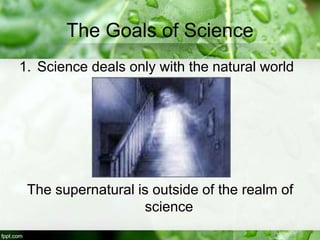
1. Science deals only with the natural world
The supernatural is outside of the realm of
science
The Goals of Science
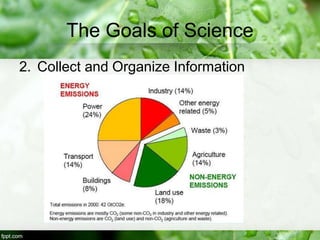
2. Collect and Organize Information
The Goals of Science
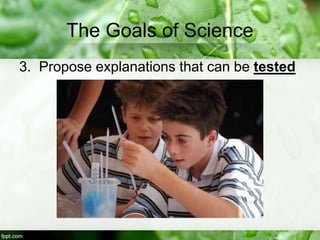
3. Propose explanations that can be tested
The Scientific Method
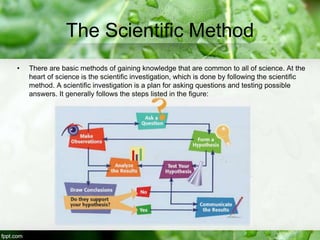
• There are basic methods of gaining knowledge that are common to all of science. At the
heart of science is the scientific investigation, which is done by following the scientific
method. A scientific investigation is a plan for asking questions and testing possible
answers. It generally follows the steps listed in the figure:
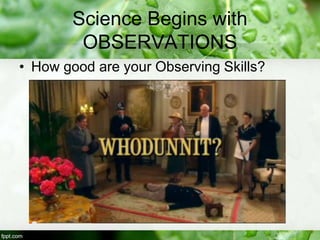
Science Begins with
OBSERVATIONS
• How good are your Observing Skills?
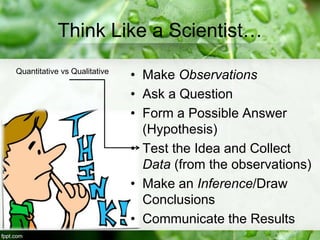
Think Like a Scientist…
• Make Observations
• Ask a Question
• Form a Possible Answer
(Hypothesis)
• Test the Idea and Collect
Data (from the observations)
• Make an Inference/Draw
Conclusions
• Communicate the Results
Quantitative vs Qualitative
Explaining and Interpreting
Evidence
• How Scientists develop a Hypothesis
– Use prior knowledge
– Make a logical inference
– Informed, creative imagination
• Accept or reject? (Support or Refute)
– Evaluating experimental results
– Gathering more data
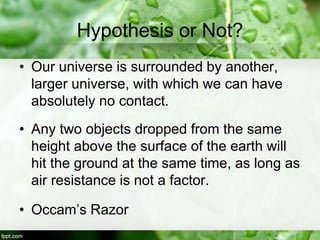
Hypothesis or Not?
• Our universe is surrounded by another,
larger universe, with which we can have
absolutely no contact.
• Any two objects dropped from the same
height above the surface of the earth will
hit the ground at the same time, as long as
air resistance is not a factor.
• Occam’s Razor
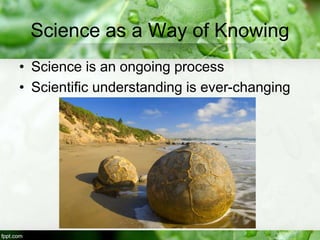
Science as a Way of Knowing
• Science is an ongoing process
• Scientific understanding is ever-changing
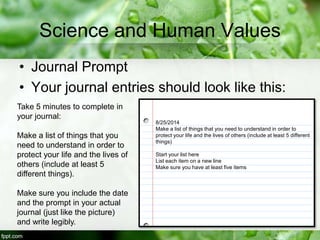
Science and Human Values
• Journal Prompt
• Your journal entries should look like this:
8/25/2014
Make a list of things that you need to understand in order to
protect your life and the lives of others (include at least 5 different
things)
Start your list here
List each item on a new line
Make sure you have at least five items
Take 5 minutes to complete in
your journal:
Make a list of things that you
need to understand in order to
protect your life and the lives of
others (include at least 5
different things).
Make sure you include the date
and the prompt in your actual
journal (just like the picture)
and write legibly.
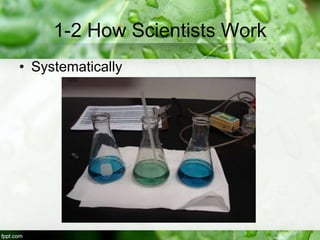
1-2 How Scientists Work
• Systematically
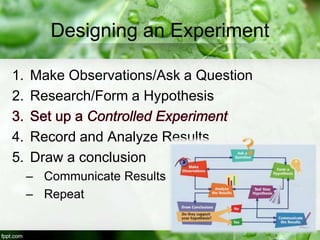
Designing an Experiment
1. Make Observations/Ask a Question
2. Research/Form a Hypothesis
4. Record and Analyze Results
5. Draw a conclusion
– Communicate Results
– Repeat
Set up a Controlled Experiment
– Use only one variable
– Control (keep unchanged) all others
– Manipulated variable is changed
– Responding variable is observed
• Francesco Redi (1668)
• Needham (1748)
• Lazzaro Spallanzini (1765)
• Louis Pasteur (1800's)
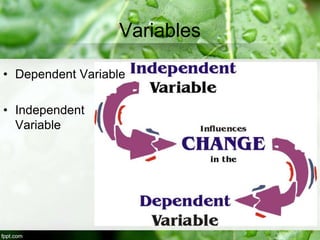
Variables
• Dependent Variable
• Independent
Variable
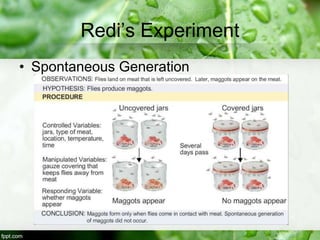
Redi’s Experiment
• Spontaneous Generation
Needham’s Experiment
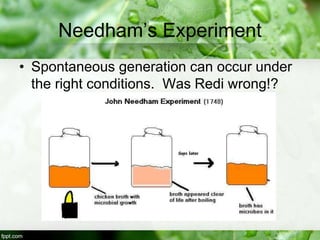
• Spontaneous generation can occur under
the right conditions. Was Redi wrong!?
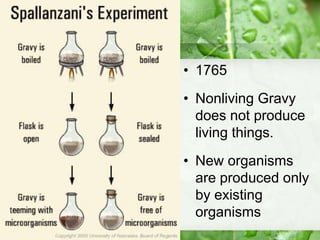
• 1765
• Nonliving Gravy
does not produce
living things.
• New organisms
are produced only
by existing
organisms
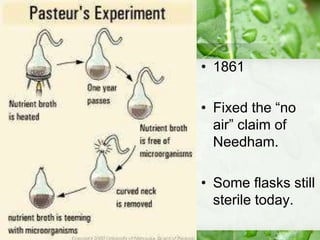
• 1861
• Fixed the “no
air” claim of
Needham.
• Some flasks still
sterile today.
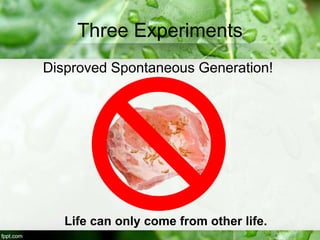
Disproved Spontaneous Generation!
Life can only come from other life.
Three Experiments
Practice the Scientific Method
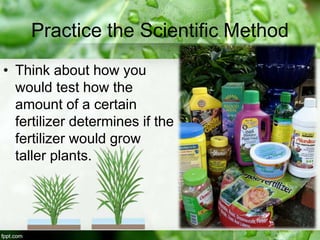
• Think about how you
would test how the
amount of a certain
fertilizer determines if the
fertilizer would grow
taller plants.
Brainstorm
• Decide how you would go about
conducting an experiment or investigation
to study this.
• Identify the Dependant Variable and the
Independent Variable
• I will provide you results
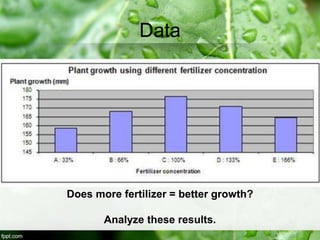
Data
Does more fertilizer = better growth?
Analyze these results.
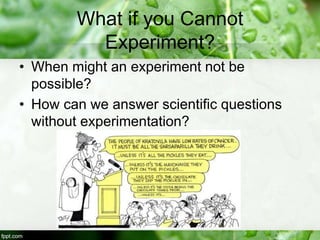
What if you Cannot
Experiment?
• When might an experiment not be
possible?
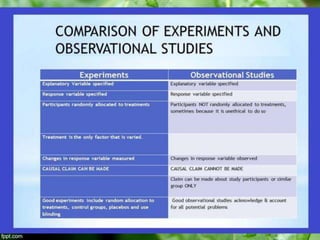
• How can we answer scientific questions
without experimentation?
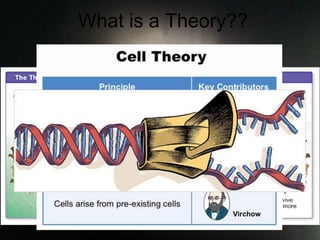
What is a Theory??
1-3 Studying Life
• What are the
Characteristics of living
things?
• How can live be studies
at different levels?
• Define Biology
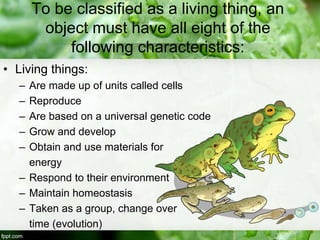
To be classified as a living thing, an
object must have all eight of the
following characteristics:
• Living things:
– Are made up of units called cells
– Reproduce
– Are based on a universal genetic code
– Grow and develop
– Obtain and use materials for
energy
– Respond to their environment
– Maintain homeostasis
– Taken as a group, change over
time (evolution)
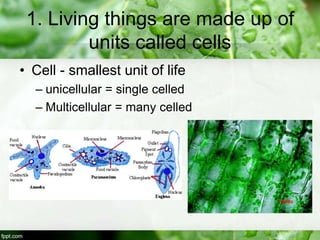
1. Living things are made up of
units called cells
• Cell - smallest unit of life
– unicellular = single celled
– Multicellular = many celled
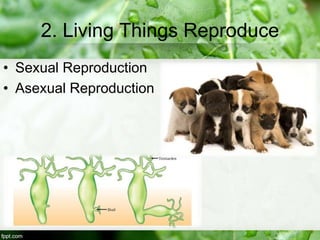
2. Living Things Reproduce
• Sexual Reproduction
• Asexual Reproduction
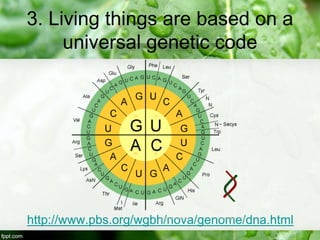
3. Living things are based on a
universal genetic code
http://www.pbs.org/wgbh/nova/genome/dna.html
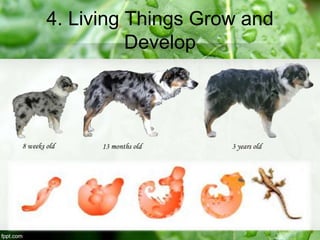
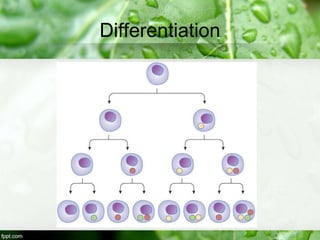
4. Living Things Grow and
Develop
Differentiation
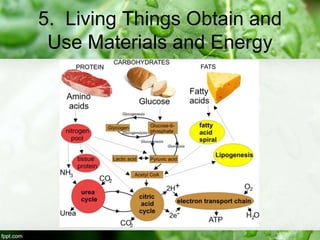
5. Living Things Obtain and
Use Materials and Energy
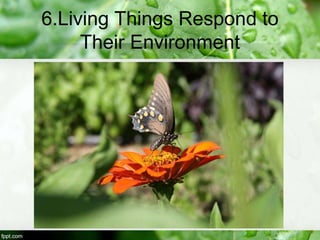
6.Living Things Respond to
Their Environment
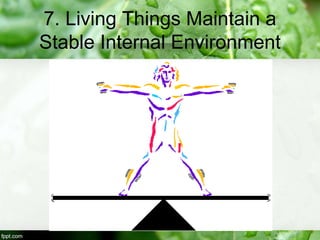
7. Living Things Maintain a
Stable Internal Environment
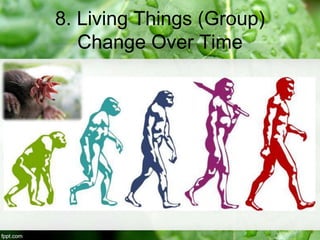
8. Living Things (Group)
Change Over Time
Big Ideas in Biology
• Science as a Way of Knowing
• Interdependence in Nature
• Matter & Energy
• Cellular Basis of Life
• Information and Heredity
• Unity & Diversity of Life
• Evolution
• Structure & Function
• Homeostasis
• Science, Technology & Society
Branches of Biology
• Zoology = animals
• Paleontology = ancient life
• Cytology = cells
• Botany = plants
• Entomology = insects
• Microbiology =
• Ecology =
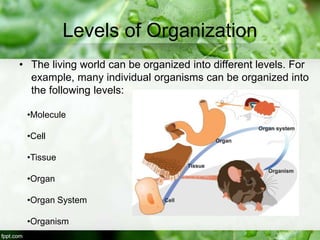
Levels of Organization
• The living world can be organized into different levels. For
example, many individual organisms can be organized into
the following levels:
•Molecule
•Cell
•Tissue
•Organ
•Organ System
•Organism
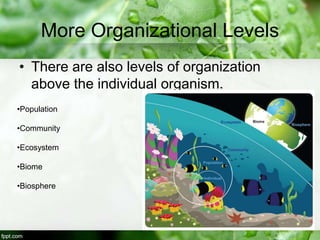
More Organizational Levels
• There are also levels of organization
above the individual organism.
•Population
•Community
•Ecosystem
•Biome
•Biosphere
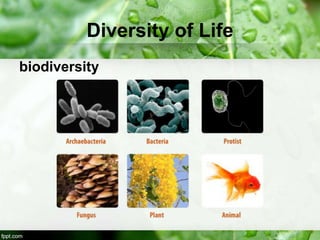
Diversity of Life
biodiversity
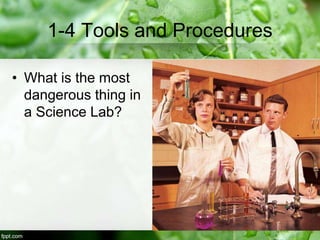
1-4 Tools and Procedures
• What is the most
dangerous thing in
a Science Lab?
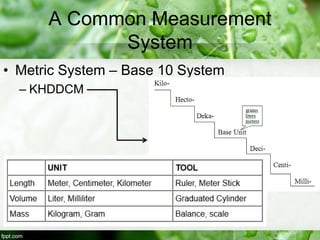
A Common Measurement
System
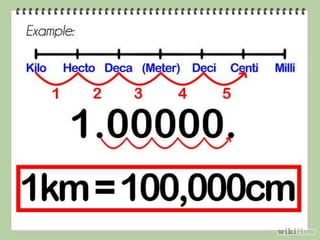
• Metric System – Base 10 System
– KHDDCM
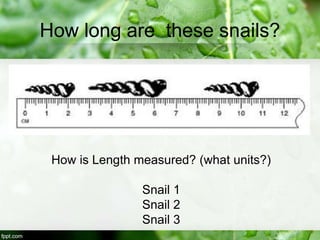
How long are these snails?
How is Length measured? (what units?)
Snail 1
Snail 2
Snail 3
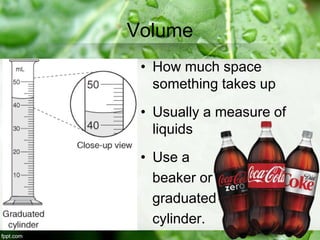
Volume
• How much space
something takes up
• Usually a measure of
liquids
• Use a
beaker or
graduated
cylinder.
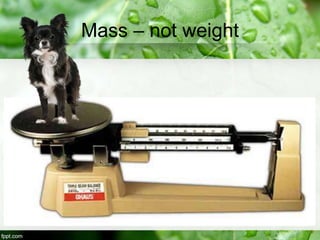
Mass – not weight
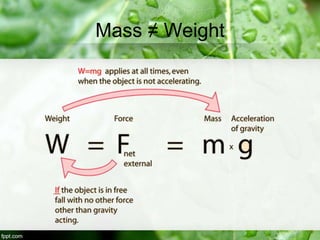
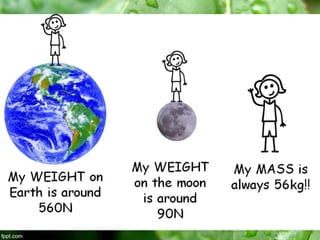
Mass ≠ Weight
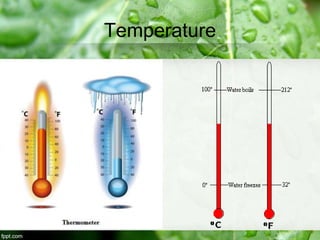
Temperature
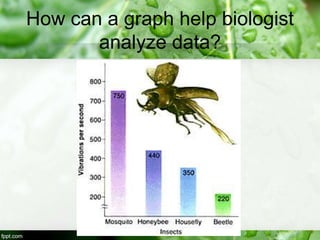
How can a graph help biologist
analyze data?
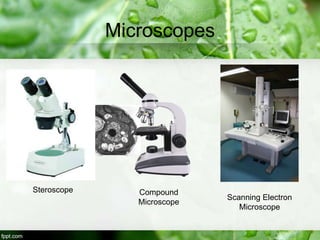
Microscopes
Steroscope Compound
Microscope
Scanning Electron
Microscope
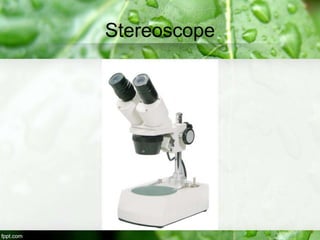
Stereoscope
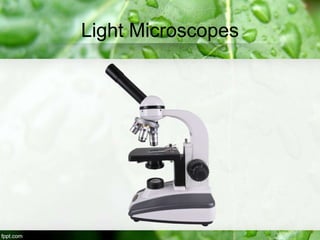
Light Microscopes
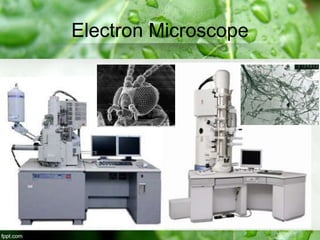
Electron Microscope
Laboratory Techniques
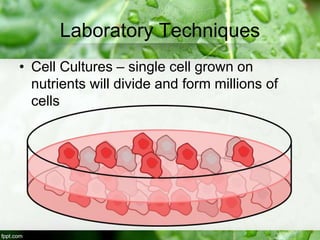
• Cell Cultures – single cell grown on
nutrients will divide and form millions of
cells
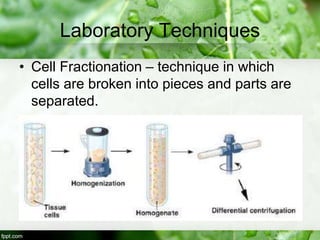
• Cell Fractionation – technique in which
cells are broken into pieces and parts are
separated.
Laboratory Techniques
Working Safely in Biology
• Lab Safety Handout
• Lab One – Using a Compound Microscope
• Chapter Test Next Week!

Biology Unit 1 Chapter 1 Lecture

  • 1.
    Unit 1: TheNature of Life Chapter 1: The Science of Biology Ms. Petrucci Biology
  • 2.
    Chapter 1: TheScience of Biology • Vocabulary • 1-1 – Science – Observation – Data – Inference – Hypothesis • 1-2 – Spontaneous generation – Controlled experiment – Manipulated (Independent) Variable – Responding (Dependant) Variable – Theory • 1-3 – Biology – Cell – Sexual Reproduction – Asexual Reproduction – Stimuli – Metabolism • 1-4 – Metric system – Microscopes • Compound Light Microscopes • Electron Microscopes – SEM – TEM – Cell Culture – Cell Fractionation
  • 3.
    1-1 What isScience?
  • 4.
    Tell whether thefollowing statements are scientific: • Why it rains: – It rains because the clouds are crying. – Enough water vapor must be available to a cloud for precipitation to form. • Where Babies come from: – Fertilization can occur outside of an organism. – Storks bring babies to the new parents. • The sun: – The sun is a really big bonfire. – You can walk on the sun in the winter because it is not as hot.
  • 5.
    The Goal ofScience • The goal of science is to understand the natural world. To achieve this goal, scientists make certain assumptions. They assume that: – Nature can be understood through systematic study. – Scientific ideas are open to revision. – Sound scientific ideas withstand the test of time. – Science cannot provide answers to all questions.
  • 6.
    The Goals ofScience 1. Science deals only with the natural world The supernatural is outside of the realm of science
  • 7.
    The Goals ofScience 2. Collect and Organize Information
  • 8.
    The Goals ofScience 3. Propose explanations that can be tested
  • 9.
    The Scientific Method •There are basic methods of gaining knowledge that are common to all of science. At the heart of science is the scientific investigation, which is done by following the scientific method. A scientific investigation is a plan for asking questions and testing possible answers. It generally follows the steps listed in the figure:
  • 10.
    Science Begins with OBSERVATIONS •How good are your Observing Skills?
  • 11.
    Think Like aScientist… • Make Observations • Ask a Question • Form a Possible Answer (Hypothesis) • Test the Idea and Collect Data (from the observations) • Make an Inference/Draw Conclusions • Communicate the Results Quantitative vs Qualitative
  • 12.
    Explaining and Interpreting Evidence •How Scientists develop a Hypothesis – Use prior knowledge – Make a logical inference – Informed, creative imagination • Accept or reject? (Support or Refute) – Evaluating experimental results – Gathering more data
  • 13.
    Hypothesis or Not? •Our universe is surrounded by another, larger universe, with which we can have absolutely no contact. • Any two objects dropped from the same height above the surface of the earth will hit the ground at the same time, as long as air resistance is not a factor. • Occam’s Razor
  • 14.
    Science as aWay of Knowing • Science is an ongoing process • Scientific understanding is ever-changing
  • 15.
    Science and HumanValues • Journal Prompt • Your journal entries should look like this: 8/25/2014 Make a list of things that you need to understand in order to protect your life and the lives of others (include at least 5 different things) Start your list here List each item on a new line Make sure you have at least five items Take 5 minutes to complete in your journal: Make a list of things that you need to understand in order to protect your life and the lives of others (include at least 5 different things). Make sure you include the date and the prompt in your actual journal (just like the picture) and write legibly.
  • 16.
    1-2 How ScientistsWork • Systematically
  • 17.
    Designing an Experiment 1.Make Observations/Ask a Question 2. Research/Form a Hypothesis 4. Record and Analyze Results 5. Draw a conclusion – Communicate Results – Repeat
  • 18.
    Set up aControlled Experiment – Use only one variable – Control (keep unchanged) all others – Manipulated variable is changed – Responding variable is observed • Francesco Redi (1668) • Needham (1748) • Lazzaro Spallanzini (1765) • Louis Pasteur (1800's)
  • 19.
  • 20.
  • 21.
    Needham’s Experiment • Spontaneousgeneration can occur under the right conditions. Was Redi wrong!?
  • 22.
    • 1765 • NonlivingGravy does not produce living things. • New organisms are produced only by existing organisms
  • 23.
    • 1861 • Fixedthe “no air” claim of Needham. • Some flasks still sterile today.
  • 24.
    Disproved Spontaneous Generation! Lifecan only come from other life. Three Experiments
  • 25.
    Practice the ScientificMethod • Think about how you would test how the amount of a certain fertilizer determines if the fertilizer would grow taller plants.
  • 26.
    Brainstorm • Decide howyou would go about conducting an experiment or investigation to study this. • Identify the Dependant Variable and the Independent Variable • I will provide you results
  • 27.
    Data Does more fertilizer= better growth? Analyze these results.
  • 28.
    What if youCannot Experiment? • When might an experiment not be possible? • How can we answer scientific questions without experimentation?
  • 30.
    What is aTheory??
  • 31.
    1-3 Studying Life •What are the Characteristics of living things? • How can live be studies at different levels? • Define Biology
  • 32.
    To be classifiedas a living thing, an object must have all eight of the following characteristics: • Living things: – Are made up of units called cells – Reproduce – Are based on a universal genetic code – Grow and develop – Obtain and use materials for energy – Respond to their environment – Maintain homeostasis – Taken as a group, change over time (evolution)
  • 33.
    1. Living thingsare made up of units called cells • Cell - smallest unit of life – unicellular = single celled – Multicellular = many celled
  • 34.
    2. Living ThingsReproduce • Sexual Reproduction • Asexual Reproduction
  • 35.
    3. Living thingsare based on a universal genetic code http://www.pbs.org/wgbh/nova/genome/dna.html
  • 36.
    4. Living ThingsGrow and Develop
  • 37.
  • 38.
    5. Living ThingsObtain and Use Materials and Energy
  • 39.
    6.Living Things Respondto Their Environment
  • 40.
    7. Living ThingsMaintain a Stable Internal Environment
  • 41.
    8. Living Things(Group) Change Over Time
  • 42.
    Big Ideas inBiology • Science as a Way of Knowing • Interdependence in Nature • Matter & Energy • Cellular Basis of Life • Information and Heredity • Unity & Diversity of Life • Evolution • Structure & Function • Homeostasis • Science, Technology & Society
  • 43.
    Branches of Biology •Zoology = animals • Paleontology = ancient life • Cytology = cells • Botany = plants • Entomology = insects • Microbiology = • Ecology =
  • 44.
    Levels of Organization •The living world can be organized into different levels. For example, many individual organisms can be organized into the following levels: •Molecule •Cell •Tissue •Organ •Organ System •Organism
  • 45.
    More Organizational Levels •There are also levels of organization above the individual organism. •Population •Community •Ecosystem •Biome •Biosphere
  • 46.
  • 47.
    1-4 Tools andProcedures • What is the most dangerous thing in a Science Lab?
  • 48.
    A Common Measurement System •Metric System – Base 10 System – KHDDCM
  • 49.
    How long arethese snails? How is Length measured? (what units?) Snail 1 Snail 2 Snail 3
  • 50.
    Volume • How muchspace something takes up • Usually a measure of liquids • Use a beaker or graduated cylinder.
  • 51.
  • 52.
  • 55.
  • 57.
    How can agraph help biologist analyze data?
  • 58.
  • 59.
  • 60.
  • 61.
  • 62.
    Laboratory Techniques • CellCultures – single cell grown on nutrients will divide and form millions of cells
  • 63.
    • Cell Fractionation– technique in which cells are broken into pieces and parts are separated. Laboratory Techniques
  • 64.
    Working Safely inBiology • Lab Safety Handout • Lab One – Using a Compound Microscope • Chapter Test Next Week!

Editor's Notes

  • #15 What is pictured here? What do you think they are? How would you test your thoughts? http://strangesounds.org/2012/12/unexplained-earth-phenomenon-the-giant-moeraki-boulders-new-zealand.html
  • #16 An understanding of science and the scientific approach is is essential in order to make decisions about many current issues Smoking & lung disease Cancer AIDS Heart Disease Environmental concerns
  • #18 Make Observations/Ask a Question Research/Form a Hypothesis – Gather information/research and form a Hypothesis Set up a Controlled Experiment – to test the hypothesis Record and Analyze Results Draw a conclusion
  • #19 Controlled Experiment – a test of the effect of a single variable by changing it while keeping all other variables the same. Manipulated variable - the variable that is deliberately changed (independent variable) Responding variable is variable that is observed ( aka dependent variable)
  • #20 An experiment generally tests how one variable is affected by another. The affected variable is called the dependent variable. In the plant experiment shown above, the dependent variable is plant growth. The variable that affects the dependent variable is called the independent variable. In the plant experiment, the independent variable is fertilizer—some plants will get fertilizer, others will not. In any experiment, other factors that might affect the dependent variable must be controlled. In the plant experiment, what factors do you think should be controlled? (Hint: What other factors might affect plant growth?)