


The structure of spoken English: A
contrastive analysis of native and
non-native speaker interviews.
Pascual Pérez-Paredes
D. Filología Inglesa, U. Murcia
www.perezparedes.es
There has been a distinct shortage of information
and evidence available to linguists, and this gives
rise to a particular balance between speculation
and fact in the way in which we talk about our
subject. In linguistics up till now we
have been relying very heavily on speculation.
This is not a criticism; it is a fact of life.
John Sinclair (2004:9)
Follow this presentation on
www.perezparedes.es
The structure of spoken English: A
contrastive analysis of native and
non-native speaker interviews.
Discuss:
pair/group work
1. The Oral Proficiency Interview
2. Research methodology
3. Learner language
4. Native language
5. Moving from here
The structure of spoken English: A
contrastive analysis of native and
non-native speaker interviews.
How to tell the difference
between two different
registers?
Preliminary question
Fiction and conversation?
Academic language and
conversation?
What do you expect from these
different registers in terms of
language characteristics?
Why is that?
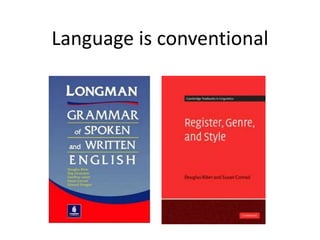
Language is conventional
What do we know
about spoken
interaction/conversation?
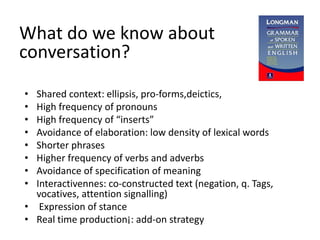
What do we know about
conversation?
• Shared context: ellipsis, pro-forms,deictics,
• High frequency of pronouns
• High frequency of “inserts”
• Avoidance of elaboration: low density of lexical words
• Shorter phrases
• Higher frequency of verbs and adverbs
• Avoidance of specification of meaning
• Interactivennes: co-constructed text (negation, q. Tags,
vocatives, attention signalling)
• Expression of stance
• Real time production¡: add-on strategy
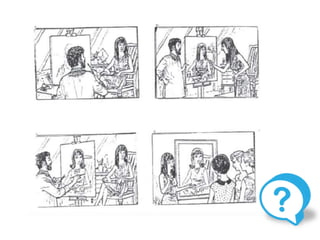
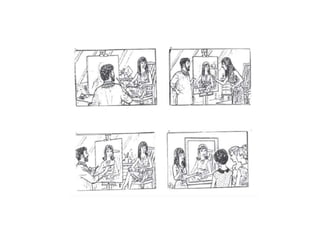
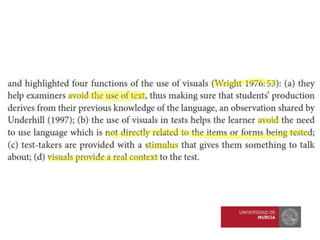
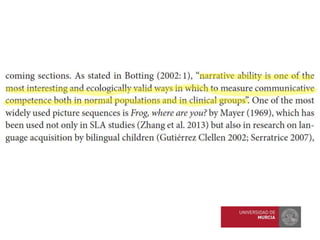
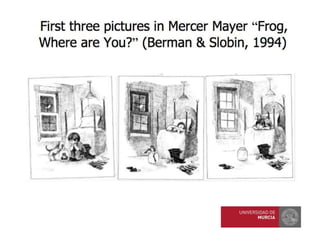
Pictures used as cues and
prompters
1. The OPI
Why is it interesting to find out
about registers from a linguistic
perspective?
1. The OPI
Why is it intresting to find out about
registers from a linguistic perspective?
A university education requires the ability to read and
understand academic prose, a variety that is extremely
different from face-to-face conversation. Further, students
must learn how to produce written texts from many […] One
of the main goals of a university education is to learn the
specialized register of a particular profession, whether
electrical engineering, chemistry, sociology, finance, or
English education. Success requires learning the particular
language patterns that are expected for particular
situations and communicative purposes.
Biber & Conrad (2009:3)
What kind of language do you
expect to find after this
prompt?
1. The OPI
Can we expect differences in the
NS & learner, NNS groups?
1. The OPI
Can we expect differences in the NS &
learner, NNS groups?
1. The OPI
Pérez-Paredes, P., & Sánchez Tornel, M. (2015). A
multidimensional analysis of learner language during story
reconstruction in interviews. In M. Callies & S. Götz (Eds.),
Learner Corpora in Language Testing and Assessment.
Amsterdam: John Benjamins.
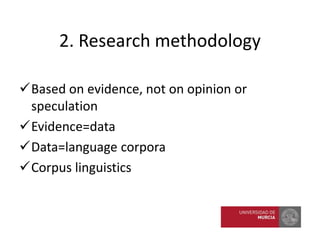
Based on evidence, not on opinion or
speculation
Evidence=data
Data=language corpora
Corpus linguistics
2. Research methodology
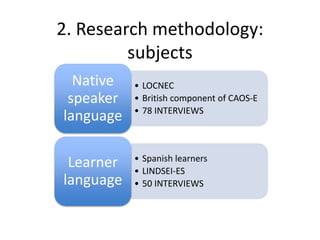
2. Research methodology:
subjects
• LOCNEC
• British component of CAOS-E
• 78 INTERVIEWS
Native
speaker
language
• Spanish learners
• LINDSEI-ES
• 50 INTERVIEWS
Learner
language
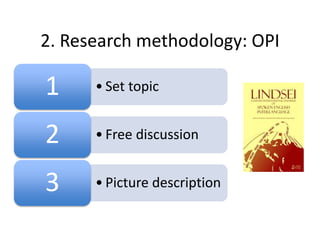
2. Research methodology: OPI
• Set topic1
• Free discussion2
• Picture description3
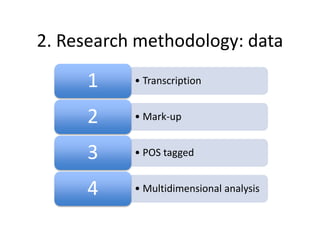
2. Research methodology: data
• Transcription1
• Mark-up2
• POS tagged3
• Multidimensional analysis4
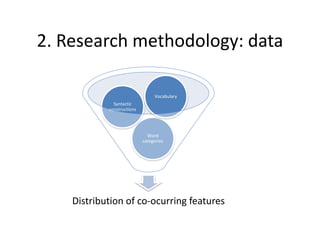
2. Research methodology: data
Distribution of co-ocurring features
Word
categories
Syntactic
constructions
Vocabulary
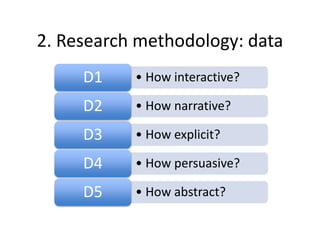
2. Research methodology: data
• How interactive?D1
• How narrative?D2
• How explicit?D3
• How persuasive?D4
• How abstract?D5
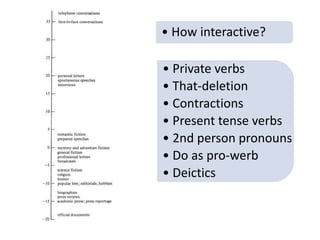
• How interactive?
• Private verbs
• That-deletion
• Contractions
• Present tense verbs
• 2nd person pronouns
• Do as pro-werb
• Deictics
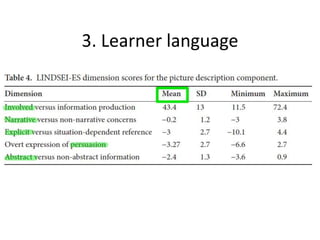
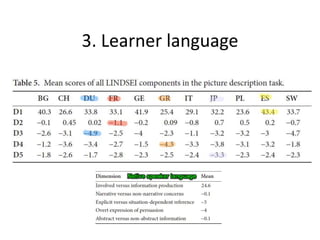
3. Learner language
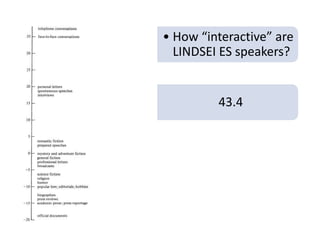
43.4
• How “interactive” are
LINDSEI ES speakers?
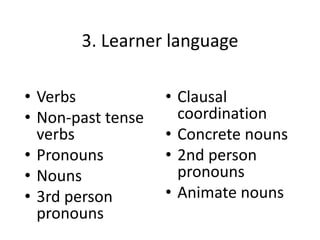
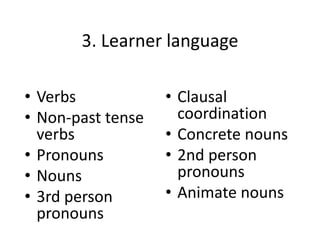
3. Learner language
• Verbs
• Non-past tense
verbs
• Pronouns
• Nouns
• 3rd person
pronouns
• Clausal
coordination
• Concrete nouns
• 2nd person
pronouns
• Animate nouns
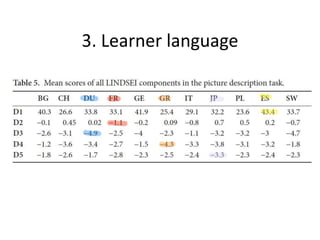
3. Learner language
3. Learner language
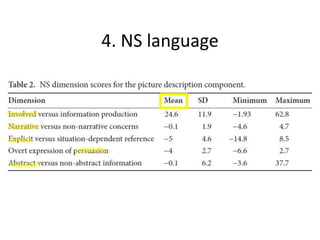
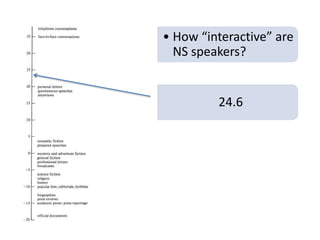
4. NS language
24.6
• How “interactive” are
NS speakers?
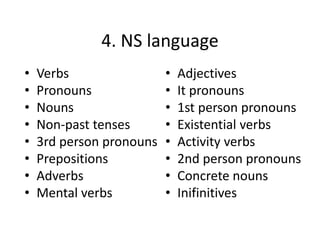
4. NS language
• Verbs
• Pronouns
• Nouns
• Non-past tenses
• 3rd person pronouns
• Prepositions
• Adverbs
• Mental verbs
• Adjectives
• It pronouns
• 1st person pronouns
• Existential verbs
• Activity verbs
• 2nd person pronouns
• Concrete nouns
• Inifinitives
3. Learner language
• Verbs
• Non-past tense
verbs
• Pronouns
• Nouns
• 3rd person
pronouns
• Clausal
coordination
• Concrete nouns
• 2nd person
pronouns
• Animate nouns
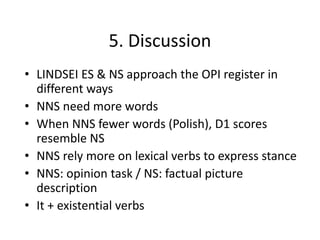
5. Discussion
• LINDSEI ES & NS approach the OPI register in
different ways
• NNS need more words
• When NNS fewer words (Polish), D1 scores
resemble NS
• NNS rely more on lexical verbs to express stance
• NNS: opinion task / NS: factual picture
description
• It + existential verbs
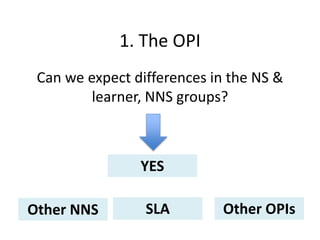
Can we expect differences in the NS &
learner, NNS groups?
1. The OPI
YES
Other NNS SLA Other OPIs
References
• Aguado, P., Pérez-Paredes, P. & Sánchez, P. 2012. Exploring
the use of multidimensional analysis of learner language to
promote register awareness. System 40(1): 90–103.
• Biber, D. 1988. Variation across Speech and Writing.
Cambridge: CUP.
• Gilquin, G., De Cock, S., Granger, S. 2010. The Louvain
International Database of Spoken English Interlanguage.
Handbook and CD-ROM. Louvain-la-Neuve: Presses
Universitaires de Louvain.
• Pérez-Paredes, P., & Sánchez Tornel, M. (2015). A
multidimensional analysis of learner language during story
reconstruction in interviews. In M. Callies & S. Götz (Eds.),
Learner Corpora in Language Testing and Assessment.
Amsterdam: John Benjamins.
Thanks for your attention
Pascual Pérez-Paredes
D. Filología Inglesa, U. Murcia
www.perezparedes.es

A contrastive analysis of native and non-native speaker interviews

  • 1.
    The structure ofspoken English: A contrastive analysis of native and non-native speaker interviews. Pascual Pérez-Paredes D. Filología Inglesa, U. Murcia www.perezparedes.es
  • 2.
    There has beena distinct shortage of information and evidence available to linguists, and this gives rise to a particular balance between speculation and fact in the way in which we talk about our subject. In linguistics up till now we have been relying very heavily on speculation. This is not a criticism; it is a fact of life. John Sinclair (2004:9)
  • 3.
    Follow this presentationon www.perezparedes.es
  • 4.
    The structure ofspoken English: A contrastive analysis of native and non-native speaker interviews. Discuss: pair/group work
  • 5.
    1. The OralProficiency Interview 2. Research methodology 3. Learner language 4. Native language 5. Moving from here The structure of spoken English: A contrastive analysis of native and non-native speaker interviews.
  • 6.
    How to tellthe difference between two different registers? Preliminary question
  • 7.
  • 8.
  • 9.
    What do youexpect from these different registers in terms of language characteristics?
  • 10.
  • 11.
  • 12.
    What do weknow about spoken interaction/conversation?
  • 13.
    What do weknow about conversation? • Shared context: ellipsis, pro-forms,deictics, • High frequency of pronouns • High frequency of “inserts” • Avoidance of elaboration: low density of lexical words • Shorter phrases • Higher frequency of verbs and adverbs • Avoidance of specification of meaning • Interactivennes: co-constructed text (negation, q. Tags, vocatives, attention signalling) • Expression of stance • Real time production¡: add-on strategy
  • 14.
    Pictures used ascues and prompters 1. The OPI
  • 18.
    Why is itinteresting to find out about registers from a linguistic perspective? 1. The OPI
  • 19.
    Why is itintresting to find out about registers from a linguistic perspective? A university education requires the ability to read and understand academic prose, a variety that is extremely different from face-to-face conversation. Further, students must learn how to produce written texts from many […] One of the main goals of a university education is to learn the specialized register of a particular profession, whether electrical engineering, chemistry, sociology, finance, or English education. Success requires learning the particular language patterns that are expected for particular situations and communicative purposes. Biber & Conrad (2009:3)
  • 20.
    What kind oflanguage do you expect to find after this prompt? 1. The OPI
  • 22.
    Can we expectdifferences in the NS & learner, NNS groups? 1. The OPI
  • 23.
    Can we expectdifferences in the NS & learner, NNS groups? 1. The OPI Pérez-Paredes, P., & Sánchez Tornel, M. (2015). A multidimensional analysis of learner language during story reconstruction in interviews. In M. Callies & S. Götz (Eds.), Learner Corpora in Language Testing and Assessment. Amsterdam: John Benjamins.
  • 24.
    Based on evidence,not on opinion or speculation Evidence=data Data=language corpora Corpus linguistics 2. Research methodology
  • 25.
    2. Research methodology: subjects •LOCNEC • British component of CAOS-E • 78 INTERVIEWS Native speaker language • Spanish learners • LINDSEI-ES • 50 INTERVIEWS Learner language
  • 26.
    2. Research methodology:OPI • Set topic1 • Free discussion2 • Picture description3
  • 27.
    2. Research methodology:data • Transcription1 • Mark-up2 • POS tagged3 • Multidimensional analysis4
  • 28.
    2. Research methodology:data Distribution of co-ocurring features Word categories Syntactic constructions Vocabulary
  • 29.
    2. Research methodology:data • How interactive?D1 • How narrative?D2 • How explicit?D3 • How persuasive?D4 • How abstract?D5
  • 30.
    • How interactive? •Private verbs • That-deletion • Contractions • Present tense verbs • 2nd person pronouns • Do as pro-werb • Deictics
  • 32.
  • 33.
    43.4 • How “interactive”are LINDSEI ES speakers?
  • 34.
    3. Learner language •Verbs • Non-past tense verbs • Pronouns • Nouns • 3rd person pronouns • Clausal coordination • Concrete nouns • 2nd person pronouns • Animate nouns
  • 35.
  • 36.
  • 37.
  • 38.
  • 39.
    4. NS language •Verbs • Pronouns • Nouns • Non-past tenses • 3rd person pronouns • Prepositions • Adverbs • Mental verbs • Adjectives • It pronouns • 1st person pronouns • Existential verbs • Activity verbs • 2nd person pronouns • Concrete nouns • Inifinitives
  • 40.
    3. Learner language •Verbs • Non-past tense verbs • Pronouns • Nouns • 3rd person pronouns • Clausal coordination • Concrete nouns • 2nd person pronouns • Animate nouns
  • 41.
    5. Discussion • LINDSEIES & NS approach the OPI register in different ways • NNS need more words • When NNS fewer words (Polish), D1 scores resemble NS • NNS rely more on lexical verbs to express stance • NNS: opinion task / NS: factual picture description • It + existential verbs
  • 42.
    Can we expectdifferences in the NS & learner, NNS groups? 1. The OPI YES Other NNS SLA Other OPIs
  • 43.
    References • Aguado, P.,Pérez-Paredes, P. & Sánchez, P. 2012. Exploring the use of multidimensional analysis of learner language to promote register awareness. System 40(1): 90–103. • Biber, D. 1988. Variation across Speech and Writing. Cambridge: CUP. • Gilquin, G., De Cock, S., Granger, S. 2010. The Louvain International Database of Spoken English Interlanguage. Handbook and CD-ROM. Louvain-la-Neuve: Presses Universitaires de Louvain. • Pérez-Paredes, P., & Sánchez Tornel, M. (2015). A multidimensional analysis of learner language during story reconstruction in interviews. In M. Callies & S. Götz (Eds.), Learner Corpora in Language Testing and Assessment. Amsterdam: John Benjamins.
  • 44.
    Thanks for yourattention Pascual Pérez-Paredes D. Filología Inglesa, U. Murcia www.perezparedes.es