Module One Language and Language Development Mark Rounds California Teachers of English Learners  (CTEL)
Knowledge, Skills, and Abilities (KSAs) See pages 3 – 7 Notice that each domain is cross-referenced to a page number in the participant guide Page 8 gives the test structure of the first three subtests Page 9: Rationale for Module 1
Domain 1:  Language Structure and Use 001–Phonology & Morphology 002–Syntax & Semantics 003–Language Functions & Variation 004–Discourse 005–Pragmatics
Domain 2:  First and Second Language Development (And their relationship to Academic Achievement) 006–Theories, Processes & Stages of Language Acquisition 007–Theories, Models, and Processes of Second-Language Acquisition 008–Cognitive, Linguistic, and Physical Factors Affecting Language Development 009–Affective Factors Affecting Language Development 010–Sociocultural and Political Factors Affecting Language Development
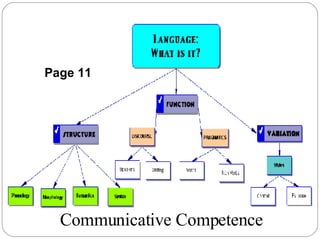
Rate Your Knowledge Complete page 10:  Rate your prior knowledge of the linguistic terminology we will encounter Look at page 11 and predict what the three major subheadings of the nature of language.
Page 11 Communicative Competence
Structure Four Linguistic subsystems that are necessary to understand how language is formed: Phonology Semantics Morphology Syntax
Function Two Major subheadings: Discourse Speaking and writing  only Pragmatics Verbal and non-verbal communication (everything non-discourse and non-structure)
Variation This is the different  styles/registers  we use to communicate depending on the  context  of a communicative act in terms of subject matter, audience, and occasion Purpose -Formal & Informal
Subsystems of Language Structure Phonology (page 12) CTEL  Ch1 13-20 Morphology (page 13) CTEL  Ch1 20-23 Syntax (page 14) CTEL  23-25 Semantics (page 15) CTEL  26-30 Pragmatics (17 - 27) CTEL  39-43
Phonology Phonology - It is the study of the sound system of a language; the way in which speech sounds form patterns.  A phoneme is the sound that makes up a langue, the smallest unit of sound. EX:  cat, /c/ /a/ /t/ has three phonemes. Intonation Patterns  are variations in the pronunciation of phrases or sentences that follow certain patterns, changes in the pitch of the voice, length, and speech rhythm
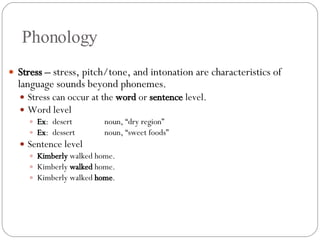
Phonology Stress –  stress, pitch/tone, and intonation are characteristics of language sounds beyond phonemes. Stress can occur at the  word  or  sentence  level. Word level Ex :  desert noun, “dry region” Ex :  dessert noun, “sweet foods” Sentence level Kimberly  walked home. Kimberly  walked  home. Kimberly walked  home .
Phonology Pitch  serves to distinguish meaning within a sentence.  It can have a high or low pitch depending on what the speaker is trying to convey.  You are going to school! Vs. You are going to school?  Prosody  – the underlying rhythm of the language (interaction of pitch and word stress) CTEL, pg17 Modulation  is the process that words, phrases, and sentences go through to change the tonal center from one place to another.  The purpose is to help give language structure, direction, and variety. (going down for authority, up for engagement/interest)
Phonology How Can Phonology Inhibit Communication ? When a student’s primary language sound system differs from the English Sound system: It’s difficult to transfer what is not in the system  When speaking and making different sounds to a word, meaning could change (short i, b/v, l/r, etc.)
Morphology Morphology –the study of meaning units (words) in a language. A morpheme is the smallest unit (in the word) in the building blocks of meaning. Ex:  dog=1 morpheme dogs (dog + s)=2 Two lexical morphemes are also called compound words.  The word is made from two free morphemes (basket + ball = basketball)
Morphology Inflectional Endings- all are suffixes (eight total): -s,-es, -s, -ing, -ed, -en, -er, -est Cognates are words in related languages that developed from the same ancestral root such as English “father” and Latin “pater”. How can morphology inhibit communication? When a plural is irregular, such as mouse (singular) and mice (plural), an EL will over generalize and say mouses, since s/he learned that houses is house in the plural form.
Syntax Syntax  is the study of the structure of sentences and the rules that govern the correctness of a sentence. Classes: Noun -names person, place, or thing Preposition -links pronouns and nouns to the rest of the sentence
Syntax Syntactic rules  are pattern relations that govern the way the words in a sentence come together Sentence patterns  are various ways of expressing a complete thought from simple sentences (S & V) to compound, complex sentences
Syntax Implication: Students need to be  exposed to different sentence patterns  from simple to complex in  oral and written form  in order to acquire the patterns.  They can be taught after the acquisition process in order for students to monitor their language development.
Semantics Semantics  is the study of meanings of individual words and of larger units such as phrases or sentences. Difficulties w/Semantics: Multiple Meanings  -words can have multiple meanings and connotations (tire, tire) False Cognates-  there can be false cognates (library, librer ía, embarrassed/embarazada) Idioms -are a group of words that have a single meaning and is not to be interpreted literally (It’s raining cats & dogs) Language   Ambiguities -are when words, phrases, or sentences have multiple meanings
Semantics Implications : What are some of ELs’ difficulties related to semantics? Transfer issues Cultural reflection in primary language (concepts of time  US: time is an object: time=$, speed=intelligence, don’t waste it, buy time, find time, spend time, etc. . .some cultures, time=objective experience) Understanding that there are universals in all languages Know that 70% of the vocabulary/terms used in science and math are derived from Greek or Latin
Lexicon Lexicon  is the sum total of the meanings that an individual holds.  It is knowledge of how to use the words correctly and how words are formed to create new meanings.  It entails different semantic properties such as synonyms, antonyms, homonymns, and idioms
Relationship Among Language Structures  See page 16 How does primary language affect acquisition of second language in each area of the chart? Importance of Contrastive Analysis!!!!
Contrastive Analysis Phonology No short vowel sounds in Spanish Morphology Los libros de Juan  éstan pesados.  There are no apostrophes to show possessives in Spanish. Syntax El gato negro.  The adjective follows the noun in Spanish Semantics Cognates:  profesor, professor False Cognates:  librer ía, library Read the poem:  The English Language
Social Functions of Language Importance of  PURPOSE :  we talk, listen, read and write when we have a purpose for doing it! To  amuse :  tell a joke, etc. To  inform :  read report To  control :  command “sit down now” To  persuade : telemarketer telling you how to vote
Academic Functions of Language – Academic language has a place in all content areas.  There are many purposes in using language in subject matter. Are there any other examples of language function(s) across content areas you can think of? Science : predictions Math : explain What are some of the differences between academic and social functions of language??
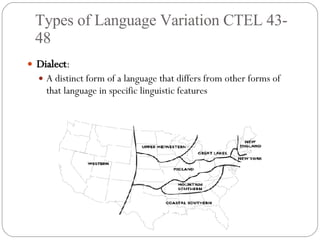
Types of Language Variation CTEL 43-48 Dialect : A distinct form of a language that differs from other forms of that language in specific linguistic features
Types of Language Variation Historical Variation : Historical records go back thousands of years and indicate that language changes across time and context Social Language Language varies in the social context with the purpose to communicate.
Types of Language Variation Academic Language : Language can be content-specific (academic areas, military, law, etc) Why does language variation  evolve ? Time Travel Economics/war
Factors that influence a speaker’s or writer’s choice of language… Imagine you are trying to  persuade  (orally, in person) an elderly woman to participate in a community center.  She came w/her son from a village in M éxico.  She has been a housewife and has taken care of her son’s child.  More Social or Academic Variation? Now, what would a written brochure look like that is attempting to persuade her?  How would it differ?  More Social or Academic change?
Factors that influence a speaker’s or writer’s choice of language… Now, select a purpose and setting, oral or written, to accomplish a mode of communication.  How do the factors change? What does this say about our ability to use language?
Analyzing Oral and Written Discourse Two volunteer read script please. Now, read the  written discourse  “Explanation of a math workshop” What are the differences and similarities between these samples of oral and written discourse? Conversations  are fluid,  text  is fixed Do our students tend to write like they talk?  If so, what are the implications for us? We need to  explicitly  teach appropriate discourse forms in writing!!!
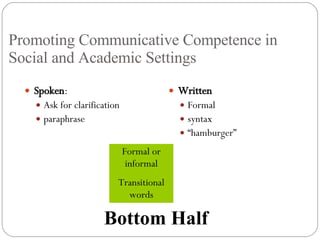
Promoting Communicative Competence in Social and Academic Settings Using the top-half of the Venn diagram, identify similarities and differences between language structures used in spoken and in written English. In the bottom-half, brainstorm strategies you can use to teach oral and written discourse in English (Imagine you are teaching non-native speakers of English; although, the strategies would apply to English-only too).
Promoting Communicative Competence in Social and Academic Settings Spoken : Sentence frame More informal More idiomatic Written Rule:  more linear Fewer use of idioms Guided by the topic, theme, idea Top Half
Promoting Communicative Competence in Social and Academic Settings Spoken : Ask for clarification paraphrase Written Formal syntax “ hamburger” Formal or informal Transitional words Bottom Half
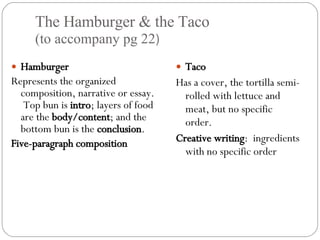
The Hamburger & the Taco (to accompany pg 22 ) Hamburger Represents the organized composition, narrative or essay.  Top bun is  intro ; layers of food are the  body/content ; and the bottom bun is the  conclusion . Five-paragraph composition Taco Has a cover, the tortilla semi-rolled with lettuce and meat, but no specific order. Creative writing :  ingredients with no specific order
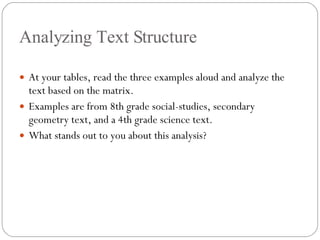
Analyzing Text Structure At your tables, read the three examples aloud and analyze the text based on the matrix. Examples are from 8th grade social-studies, secondary geometry text, and a 4th grade science text. What stands out to you about this analysis?
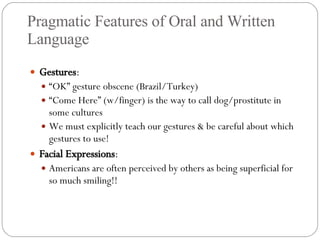
Pragmatic Features of Oral and Written Language Gestures : “ OK” gesture obscene (Brazil/Turkey) “ Come Here” (w/finger) is the way to call dog/prostitute in some cultures We must explicitly teach our gestures & be careful about which gestures to use! Facial Expressions :  Americans are often perceived by others as being superficial for so much smiling!!
Pragmatic Features of Oral and Written Language Eye Contact : Lack of eye contact = respect in some cultures In North America, it is a sign of disrespect/defiance Proxemics :  North America = arm’s length Latin America = much closer
Pragmatic Features of Oral and Written Language Touching : Very personal & intimate in some cultures, while in others it is commonplace.  Head patting is very taboo in many cultures. Styles/Registers :  How you talk depends on your audience . .boss, store clerk, students, etc. Students need to know how and when it is appropriate to switch registers
Pragmatic Features of Oral and Written Language Dialect : There is a variation among speakers of the same language.  “I’m stuffed” (US=I’m full) vs. (Australia=I’m pregnant!”) Speakers of certain dialects may be viewed differently (less intelligent, low SES, etc.) Figures of Speech :  “ Y’all come back now” (said to Japanese businessmen caused them to get off a bus!) Use fewer idioms with beginning level Els and ALWAYS explain them!
Pragmatic Features of Oral and Written Language Silence : Silence differs dramatically across cultures.  In the U.S., it is interpreted as expressing embarrassment, regret or sorrow.  In Asian cultures, it is a token of respect.
Quickwrite (page 26) Describe one discourse setting/context (classroom, social event, store, types of correspondence) and identify key features appropriate to the setting Share some ideas with the class
Factors that affect a speaker’s or writer’s choice of pragmatic features Cultural Norms : Student’s upbringing will influence how s/he responds and uses pragmatic features (touching, eye contact) Social : When engaged in communicating for social purposes, gestures, and facial expressions, will be more commonly used
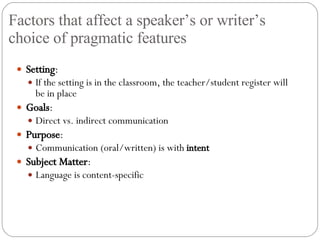
Factors that affect a speaker’s or writer’s choice of pragmatic features Setting : If the setting is in the classroom, the teacher/student register will be in place Goals : Direct vs. indirect communication Purpose : Communication (oral/written) is with  intent Subject Matter : Language is content-specific
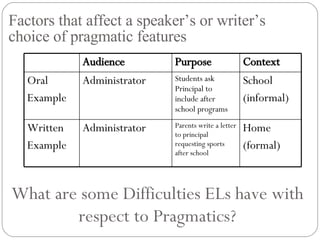
What are some Difficulties ELs have with respect to Pragmatics? Factors that affect a speaker’s or writer’s choice of pragmatic features Audience Purpose Context Oral Example Administrator Students ask Principal to include after school programs School (informal) Written Example Administrator Parents write a letter to principal requesting sports after school Home (formal)
Review of Linguistic Knowledge Return to page 10 and re-rate your knowledge of the linguistic terminology from this section.  Add any pertinent information on pages 28-30 Page 32 - Rubric to Evaluate ELD Program.  Evaluate Yourself Write evidence found in each item.  Remember to consider: listening, speaking, reading and writing.
Module 1, Domain 2 First and Second-Language Development and Their Relationship to Academic Achievement
Readings from CTEL Handbook Chapter 2: First- and Second-Language Development and Their Relationship to Academic Achievement Read Page 32 “Contemporary Theories (of Language Acquisition)” to familiarize yourselves with two major theories,  Constructivism  &  Cognitivism , and the other theories aligned with them.  Summarize  the theories on page 33 For this test, you will need to know  theories , not  theorists !!
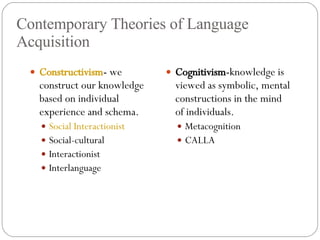
Contemporary Theories of Language Acquisition Constructivism -  we construct our knowledge based on individual experience and schema. Social Interactionist Social-cultural Interactionist Interlanguage Cognitivism- knowledge is viewed as symbolic, mental constructions in the mind of individuals. Metacognition CALLA
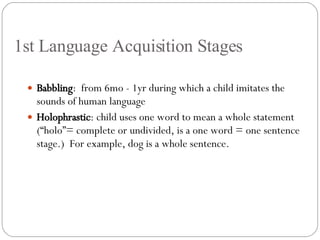
1st Language Acquisition Stages Babbling :  from 6mo - 1yr during which a child imitates the sounds of human language Holophrastic : child uses one word to mean a whole statement (“holo”= complete or undivided, is a one word = one sentence stage.)  For example, dog is a whole sentence.
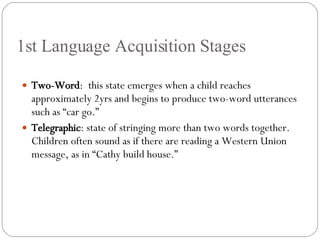
1st Language Acquisition Stages Two-Word :  this state emerges when a child reaches approximately 2yrs and begins to produce two-word utterances such as “car go.” Telegraphic : state of stringing more than two words together.  Children often sound as if there are reading a Western Union message, as in “Cathy build house.”
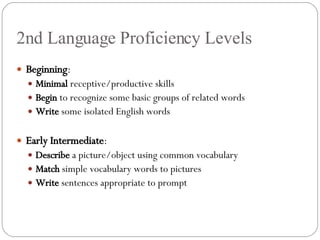
2nd Language Proficiency Levels Beginning : Minimal  receptive/productive skills Begin  to recognize some basic groups of related words Write  some isolated English words Early Intermediate : Describe  a picture/object using common vocabulary Match  simple vocabulary words to pictures Write  sentences appropriate to prompt
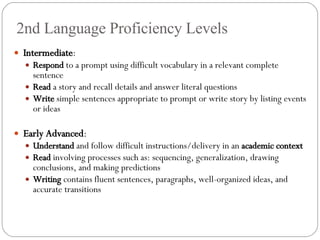
2nd Language Proficiency Levels Intermediate : Respond  to a prompt using difficult vocabulary in a relevant complete sentence Read  a story and recall details and answer literal questions Write  simple sentences appropriate to prompt or write story by listing events or ideas Early Advanced : Understand  and follow difficult instructions/delivery in an  academic context Read  involving processes such as: sequencing, generalization, drawing conclusions, and making predictions Writing  contains fluent sentences, paragraphs, well-organized ideas, and accurate transitions
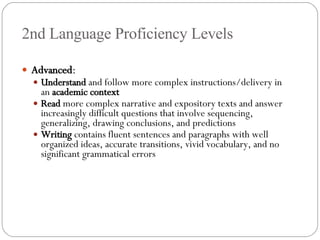
2nd Language Proficiency Levels Advanced : Understand  and follow more complex instructions/delivery in an  academic context Read  more complex narrative and expository texts and answer increasingly difficult questions that involve sequencing, generalizing, drawing conclusions, and predictions Writing  contains fluent sentences and paragraphs with well organized ideas, accurate transitions, vivid vocabulary, and no significant grammatical errors
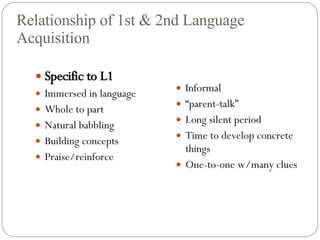
Relationship of 1st & 2nd Language Acquisition Specific to L1 Immersed in language Whole to part Natural babbling Building concepts Praise/reinforce Informal “ parent-talk” Long silent period  Time to develop concrete things One-to-one w/many clues
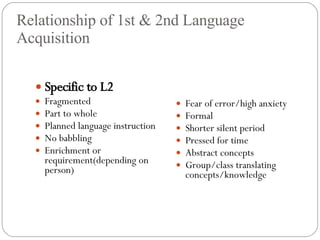
Relationship of 1st & 2nd Language Acquisition Specific to L2 Fragmented Part to whole Planned language instruction No babbling Enrichment or requirement(depending on person) Fear of error/high anxiety Formal Shorter silent period Pressed for time Abstract concepts Group/class translating concepts/knowledge
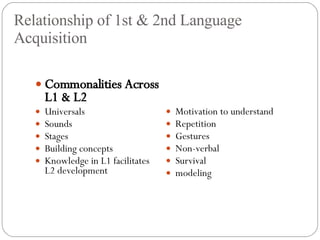
Relationship of 1st & 2nd Language Acquisition Commonalities Across L1 & L2 Universals Sounds Stages Building concepts Knowledge in L1 facilitates L2 development Motivation to understand Repetition Gestures Non-verbal Survival modeling
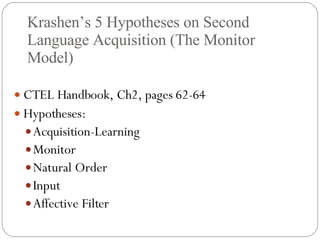
Krashen’s 5 Hypotheses on Second Language Acquisition (The Monitor Model) CTEL Handbook, Ch2, pages 62-64 Hypotheses: Acquisition-Learning  Monitor Natural Order Input Affective Filter
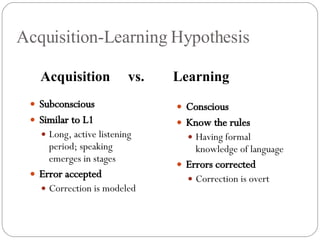
Acquisition-Learning Hypothesis Subconscious Similar to L1   Long, active listening period; speaking emerges in stages Error accepted Correction is modeled Conscious Know the rules Having formal knowledge of language Errors corrected Correction is overt Acquisition   vs.   Learning
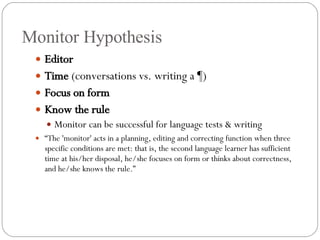
Monitor Hypothesis Editor Time  (conversations vs. writing a ¶) Focus on form   Know the rule Monitor can be successful for language tests & writing “ The 'monitor' acts in a planning, editing and correcting function when three specific conditions are met: that is, the second language learner has sufficient time at his/her disposal, he/she focuses on form or thinks about correctness, and he/she knows the rule.”
Natural Order Hypothesis We acquire grammatical structures in a fairly predictable order, but cannot teach to that order.  We must focus on meaningful messages.
Input Hypothesis We acquire language when we understand what is said to us i + 1   (known to the unknown, combine familiar with something new)
Affective Filter Hypothesis Self confidence Motivation Level of anxiety A high affective filter impedes the reception of comprehensible input
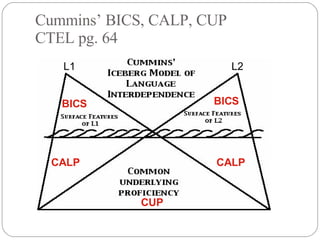
Cummins’ BICS, CALP, CUP CTEL pg. 64 L1 L2 BICS CALP CUP BICS CALP
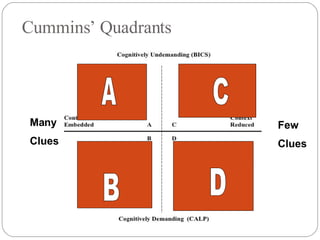
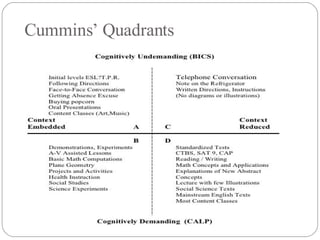
Cummins’ Quadrants A B C D Many Clues Few Clues
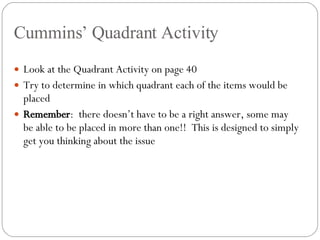
Cummins’ Quadrant Activity Look at the Quadrant Activity on page 40 Try to determine in which quadrant each of the items would be placed Remember :  there doesn’t have to be a right answer, some may be able to be placed in more than one!!  This is designed to simply get you thinking about the issue
Cummins’ Quadrants
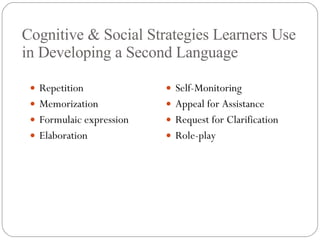
Cognitive & Social Strategies Learners Use in Developing a Second Language Repetition Memorization Formulaic expression Elaboration Self-Monitoring Appeal for Assistance Request for Clarification Role-play
ELD Lesson Intro The following is a sample ELD lesson intro “ Last week we finished learning about land transportation and today we are going to start our new lesson about air transportation.  What do we know about types of transportation that we see in the sky?” (Teacher  writes  students’  responses ) [expressive skills]
ELD Lesson Intro “ Let’s have someone volunteer to  read  what you told me and I wrote about the different types of transportation.” (A few students can read the list) “ Has anyone else remembered some more types of transportation?” (while students are  listening  to teacher’s questions, they may come up with additional answers) Teacher asks student(s) to approach chart paper and write it down.  [receptive skills]
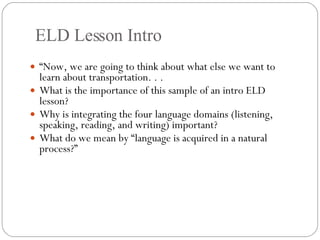
ELD Lesson Intro “ Now, we are going to think about what else we want to learn about transportation. . . What is the importance of this sample of an intro ELD lesson?  Why is integrating the four language domains (listening, speaking, reading, and writing) important? What do we mean by “language is acquired in a natural process?”
Schooling for Language Minority Students English Proficiency, Academic Achievement, Positive Self-Concept False BICS & CALP A: BICS  B:  CALP Social conversation, playground, everyday conversation, family talk, friend talk Higher order thinking, abstract thinking, academic language, test skill, problem solving
Schooling for Language Minority Students Use primary language to learn and support learning.  Comprehensible input and low affective filter. There are two separate “areas” where languages develop.  When one language is “emphasized” the other is reduced. SUP There is one “area” where languages develop and there is a relationship or connection between languages.  One supports the other in the form of transferability.  CUP
Schooling for Language Minority Students Yes, most of the skills transfer.  If you learn to think in one language, you do not need to learn to think in another language.  If you learn to read in one language, you only need to “break the code” in another language. Students receiving instruction in L1 did better in English than those students who only received instruction in English language development. Continue to communicate in primary language.  Home context is conducive to developing literacy in an authentic manner, not school-like manner. Use of realia, gestures, contextualization of lesson
Cognitive, Linguistic, and Physical Factors that Influence Language Acquisition CTEL ed 1: pages 70-74; 77-80 In table groups, read and complete page 44 of the study guide.
Cognitive, Linguistic, and Physical Factors that Influence Language Acquisition Synthesis/Summary The cognitive and constructive perspectives stress the importance of viewing the students as active processors of information from birth and throughout their lives.  These processes occur through social interaction and mental activity in which information is internalized and the learner then constructs meaning based n personal experience and  prior knowledge.
Cognitive, Linguistic, and Physical Factors that Influence Language Acquisition Pedagogical Implications Assessment Consider alternative assessment such as portfolios or performance-based assessment. Instruction Cooperative learning, contextualization
Affective Factors that Influence Language Acquisition CTEL: pages 74-77 In table groups, read and complete page 45 of the study guide.
Affective Factors that Influence Language Acquisition Synthesis/Summary There are several affective factors that impact student learning: self-esteem, motivation, and attitudes How the students feels about her/himself can affect either in a general, or specific to a task or situation.  As for motivation, it can be attributed to parents, friends, and teachers by creating a learning environment (not nec. Physical), which impacts the attitude of the student toward learning.  It is when anxiety continues to exist that creates a high affective filter preventing the student from learning.
Affective Factors that Influence Language Acquisition Pedagogical Implications Work to lower the affective filter A variety of groupings:  small, large, dyads, triads Use L1 to support core curriculum
Sociocultural and Political Factors that Influence Language Acquisition CTEL: pages 81-89 (read and know!!) In table groups, read and complete page 46 of the study guide.
Sociocultural and Political Factors that Influence Language Acquisition Synthesis/Summary : Culture is the explicit and implicit patterns for living, the dynamic system of commonly-agreed-upon symbols, meanings, knowledge, beliefs, morals, customs, traditions
Sociocultural and Political Factors that Influence Language Acquisition Synthesis/Summary : For students learning a second language, success is dependent on such  extra-linguistic factors  as:  the pattern of acculturation for their community;  the status and acceptance of their culture, which includes their language
Sociocultural and Political Factors that Influence Language Acquisition Synthesis/Summary : There are numerous  structures within schools  that affect student learning: tracking the curriculum Pedagogy the school’s physical structure and disciplinary policies the limited roles of both students and teachers limited parent and community involvement.
Sociocultural and Political Factors that Influence Language Acquisition Pedagogical Implications : The acculturation process is an additive approach L1 is accepted Parents are involved Assessment/evaluation takes the whole child into account
Language Acquisition Matching Game!! In table groups, match the description of the theories or perspectives to the appropriate term by numbering them

Ctel Module1

  • 1.
    Module One Languageand Language Development Mark Rounds California Teachers of English Learners (CTEL)
  • 2.
    Knowledge, Skills, andAbilities (KSAs) See pages 3 – 7 Notice that each domain is cross-referenced to a page number in the participant guide Page 8 gives the test structure of the first three subtests Page 9: Rationale for Module 1
  • 3.
    Domain 1: Language Structure and Use 001–Phonology & Morphology 002–Syntax & Semantics 003–Language Functions & Variation 004–Discourse 005–Pragmatics
  • 4.
    Domain 2: First and Second Language Development (And their relationship to Academic Achievement) 006–Theories, Processes & Stages of Language Acquisition 007–Theories, Models, and Processes of Second-Language Acquisition 008–Cognitive, Linguistic, and Physical Factors Affecting Language Development 009–Affective Factors Affecting Language Development 010–Sociocultural and Political Factors Affecting Language Development
  • 5.
    Rate Your KnowledgeComplete page 10: Rate your prior knowledge of the linguistic terminology we will encounter Look at page 11 and predict what the three major subheadings of the nature of language.
  • 6.
  • 7.
    Structure Four Linguisticsubsystems that are necessary to understand how language is formed: Phonology Semantics Morphology Syntax
  • 8.
    Function Two Majorsubheadings: Discourse Speaking and writing only Pragmatics Verbal and non-verbal communication (everything non-discourse and non-structure)
  • 9.
    Variation This isthe different styles/registers we use to communicate depending on the context of a communicative act in terms of subject matter, audience, and occasion Purpose -Formal & Informal
  • 10.
    Subsystems of LanguageStructure Phonology (page 12) CTEL Ch1 13-20 Morphology (page 13) CTEL Ch1 20-23 Syntax (page 14) CTEL 23-25 Semantics (page 15) CTEL 26-30 Pragmatics (17 - 27) CTEL 39-43
  • 11.
    Phonology Phonology -It is the study of the sound system of a language; the way in which speech sounds form patterns. A phoneme is the sound that makes up a langue, the smallest unit of sound. EX: cat, /c/ /a/ /t/ has three phonemes. Intonation Patterns are variations in the pronunciation of phrases or sentences that follow certain patterns, changes in the pitch of the voice, length, and speech rhythm
  • 12.
    Phonology Stress – stress, pitch/tone, and intonation are characteristics of language sounds beyond phonemes. Stress can occur at the word or sentence level. Word level Ex : desert noun, “dry region” Ex : dessert noun, “sweet foods” Sentence level Kimberly walked home. Kimberly walked home. Kimberly walked home .
  • 13.
    Phonology Pitch serves to distinguish meaning within a sentence. It can have a high or low pitch depending on what the speaker is trying to convey. You are going to school! Vs. You are going to school? Prosody – the underlying rhythm of the language (interaction of pitch and word stress) CTEL, pg17 Modulation is the process that words, phrases, and sentences go through to change the tonal center from one place to another. The purpose is to help give language structure, direction, and variety. (going down for authority, up for engagement/interest)
  • 14.
    Phonology How CanPhonology Inhibit Communication ? When a student’s primary language sound system differs from the English Sound system: It’s difficult to transfer what is not in the system When speaking and making different sounds to a word, meaning could change (short i, b/v, l/r, etc.)
  • 15.
    Morphology Morphology –thestudy of meaning units (words) in a language. A morpheme is the smallest unit (in the word) in the building blocks of meaning. Ex: dog=1 morpheme dogs (dog + s)=2 Two lexical morphemes are also called compound words. The word is made from two free morphemes (basket + ball = basketball)
  • 16.
    Morphology Inflectional Endings-all are suffixes (eight total): -s,-es, -s, -ing, -ed, -en, -er, -est Cognates are words in related languages that developed from the same ancestral root such as English “father” and Latin “pater”. How can morphology inhibit communication? When a plural is irregular, such as mouse (singular) and mice (plural), an EL will over generalize and say mouses, since s/he learned that houses is house in the plural form.
  • 17.
    Syntax Syntax is the study of the structure of sentences and the rules that govern the correctness of a sentence. Classes: Noun -names person, place, or thing Preposition -links pronouns and nouns to the rest of the sentence
  • 18.
    Syntax Syntactic rules are pattern relations that govern the way the words in a sentence come together Sentence patterns are various ways of expressing a complete thought from simple sentences (S & V) to compound, complex sentences
  • 19.
    Syntax Implication: Studentsneed to be exposed to different sentence patterns from simple to complex in oral and written form in order to acquire the patterns. They can be taught after the acquisition process in order for students to monitor their language development.
  • 20.
    Semantics Semantics is the study of meanings of individual words and of larger units such as phrases or sentences. Difficulties w/Semantics: Multiple Meanings -words can have multiple meanings and connotations (tire, tire) False Cognates- there can be false cognates (library, librer ía, embarrassed/embarazada) Idioms -are a group of words that have a single meaning and is not to be interpreted literally (It’s raining cats & dogs) Language Ambiguities -are when words, phrases, or sentences have multiple meanings
  • 21.
    Semantics Implications :What are some of ELs’ difficulties related to semantics? Transfer issues Cultural reflection in primary language (concepts of time US: time is an object: time=$, speed=intelligence, don’t waste it, buy time, find time, spend time, etc. . .some cultures, time=objective experience) Understanding that there are universals in all languages Know that 70% of the vocabulary/terms used in science and math are derived from Greek or Latin
  • 22.
    Lexicon Lexicon is the sum total of the meanings that an individual holds. It is knowledge of how to use the words correctly and how words are formed to create new meanings. It entails different semantic properties such as synonyms, antonyms, homonymns, and idioms
  • 23.
    Relationship Among LanguageStructures See page 16 How does primary language affect acquisition of second language in each area of the chart? Importance of Contrastive Analysis!!!!
  • 24.
    Contrastive Analysis PhonologyNo short vowel sounds in Spanish Morphology Los libros de Juan éstan pesados. There are no apostrophes to show possessives in Spanish. Syntax El gato negro. The adjective follows the noun in Spanish Semantics Cognates: profesor, professor False Cognates: librer ía, library Read the poem: The English Language
  • 25.
    Social Functions ofLanguage Importance of PURPOSE : we talk, listen, read and write when we have a purpose for doing it! To amuse : tell a joke, etc. To inform : read report To control : command “sit down now” To persuade : telemarketer telling you how to vote
  • 26.
    Academic Functions ofLanguage – Academic language has a place in all content areas. There are many purposes in using language in subject matter. Are there any other examples of language function(s) across content areas you can think of? Science : predictions Math : explain What are some of the differences between academic and social functions of language??
  • 27.
    Types of LanguageVariation CTEL 43-48 Dialect : A distinct form of a language that differs from other forms of that language in specific linguistic features
  • 28.
    Types of LanguageVariation Historical Variation : Historical records go back thousands of years and indicate that language changes across time and context Social Language Language varies in the social context with the purpose to communicate.
  • 29.
    Types of LanguageVariation Academic Language : Language can be content-specific (academic areas, military, law, etc) Why does language variation evolve ? Time Travel Economics/war
  • 30.
    Factors that influencea speaker’s or writer’s choice of language… Imagine you are trying to persuade (orally, in person) an elderly woman to participate in a community center. She came w/her son from a village in M éxico. She has been a housewife and has taken care of her son’s child. More Social or Academic Variation? Now, what would a written brochure look like that is attempting to persuade her? How would it differ? More Social or Academic change?
  • 31.
    Factors that influencea speaker’s or writer’s choice of language… Now, select a purpose and setting, oral or written, to accomplish a mode of communication. How do the factors change? What does this say about our ability to use language?
  • 32.
    Analyzing Oral andWritten Discourse Two volunteer read script please. Now, read the written discourse “Explanation of a math workshop” What are the differences and similarities between these samples of oral and written discourse? Conversations are fluid, text is fixed Do our students tend to write like they talk? If so, what are the implications for us? We need to explicitly teach appropriate discourse forms in writing!!!
  • 33.
    Promoting Communicative Competencein Social and Academic Settings Using the top-half of the Venn diagram, identify similarities and differences between language structures used in spoken and in written English. In the bottom-half, brainstorm strategies you can use to teach oral and written discourse in English (Imagine you are teaching non-native speakers of English; although, the strategies would apply to English-only too).
  • 34.
    Promoting Communicative Competencein Social and Academic Settings Spoken : Sentence frame More informal More idiomatic Written Rule: more linear Fewer use of idioms Guided by the topic, theme, idea Top Half
  • 35.
    Promoting Communicative Competencein Social and Academic Settings Spoken : Ask for clarification paraphrase Written Formal syntax “ hamburger” Formal or informal Transitional words Bottom Half
  • 36.
    The Hamburger &the Taco (to accompany pg 22 ) Hamburger Represents the organized composition, narrative or essay. Top bun is intro ; layers of food are the body/content ; and the bottom bun is the conclusion . Five-paragraph composition Taco Has a cover, the tortilla semi-rolled with lettuce and meat, but no specific order. Creative writing : ingredients with no specific order
  • 37.
    Analyzing Text StructureAt your tables, read the three examples aloud and analyze the text based on the matrix. Examples are from 8th grade social-studies, secondary geometry text, and a 4th grade science text. What stands out to you about this analysis?
  • 38.
    Pragmatic Features ofOral and Written Language Gestures : “ OK” gesture obscene (Brazil/Turkey) “ Come Here” (w/finger) is the way to call dog/prostitute in some cultures We must explicitly teach our gestures & be careful about which gestures to use! Facial Expressions : Americans are often perceived by others as being superficial for so much smiling!!
  • 39.
    Pragmatic Features ofOral and Written Language Eye Contact : Lack of eye contact = respect in some cultures In North America, it is a sign of disrespect/defiance Proxemics : North America = arm’s length Latin America = much closer
  • 40.
    Pragmatic Features ofOral and Written Language Touching : Very personal & intimate in some cultures, while in others it is commonplace. Head patting is very taboo in many cultures. Styles/Registers : How you talk depends on your audience . .boss, store clerk, students, etc. Students need to know how and when it is appropriate to switch registers
  • 41.
    Pragmatic Features ofOral and Written Language Dialect : There is a variation among speakers of the same language. “I’m stuffed” (US=I’m full) vs. (Australia=I’m pregnant!”) Speakers of certain dialects may be viewed differently (less intelligent, low SES, etc.) Figures of Speech : “ Y’all come back now” (said to Japanese businessmen caused them to get off a bus!) Use fewer idioms with beginning level Els and ALWAYS explain them!
  • 42.
    Pragmatic Features ofOral and Written Language Silence : Silence differs dramatically across cultures. In the U.S., it is interpreted as expressing embarrassment, regret or sorrow. In Asian cultures, it is a token of respect.
  • 43.
    Quickwrite (page 26)Describe one discourse setting/context (classroom, social event, store, types of correspondence) and identify key features appropriate to the setting Share some ideas with the class
  • 44.
    Factors that affecta speaker’s or writer’s choice of pragmatic features Cultural Norms : Student’s upbringing will influence how s/he responds and uses pragmatic features (touching, eye contact) Social : When engaged in communicating for social purposes, gestures, and facial expressions, will be more commonly used
  • 45.
    Factors that affecta speaker’s or writer’s choice of pragmatic features Setting : If the setting is in the classroom, the teacher/student register will be in place Goals : Direct vs. indirect communication Purpose : Communication (oral/written) is with intent Subject Matter : Language is content-specific
  • 46.
    What are someDifficulties ELs have with respect to Pragmatics? Factors that affect a speaker’s or writer’s choice of pragmatic features Audience Purpose Context Oral Example Administrator Students ask Principal to include after school programs School (informal) Written Example Administrator Parents write a letter to principal requesting sports after school Home (formal)
  • 47.
    Review of LinguisticKnowledge Return to page 10 and re-rate your knowledge of the linguistic terminology from this section. Add any pertinent information on pages 28-30 Page 32 - Rubric to Evaluate ELD Program. Evaluate Yourself Write evidence found in each item. Remember to consider: listening, speaking, reading and writing.
  • 48.
    Module 1, Domain2 First and Second-Language Development and Their Relationship to Academic Achievement
  • 49.
    Readings from CTELHandbook Chapter 2: First- and Second-Language Development and Their Relationship to Academic Achievement Read Page 32 “Contemporary Theories (of Language Acquisition)” to familiarize yourselves with two major theories, Constructivism & Cognitivism , and the other theories aligned with them. Summarize the theories on page 33 For this test, you will need to know theories , not theorists !!
  • 50.
    Contemporary Theories ofLanguage Acquisition Constructivism - we construct our knowledge based on individual experience and schema. Social Interactionist Social-cultural Interactionist Interlanguage Cognitivism- knowledge is viewed as symbolic, mental constructions in the mind of individuals. Metacognition CALLA
  • 51.
    1st Language AcquisitionStages Babbling : from 6mo - 1yr during which a child imitates the sounds of human language Holophrastic : child uses one word to mean a whole statement (“holo”= complete or undivided, is a one word = one sentence stage.) For example, dog is a whole sentence.
  • 52.
    1st Language AcquisitionStages Two-Word : this state emerges when a child reaches approximately 2yrs and begins to produce two-word utterances such as “car go.” Telegraphic : state of stringing more than two words together. Children often sound as if there are reading a Western Union message, as in “Cathy build house.”
  • 53.
    2nd Language ProficiencyLevels Beginning : Minimal receptive/productive skills Begin to recognize some basic groups of related words Write some isolated English words Early Intermediate : Describe a picture/object using common vocabulary Match simple vocabulary words to pictures Write sentences appropriate to prompt
  • 54.
    2nd Language ProficiencyLevels Intermediate : Respond to a prompt using difficult vocabulary in a relevant complete sentence Read a story and recall details and answer literal questions Write simple sentences appropriate to prompt or write story by listing events or ideas Early Advanced : Understand and follow difficult instructions/delivery in an academic context Read involving processes such as: sequencing, generalization, drawing conclusions, and making predictions Writing contains fluent sentences, paragraphs, well-organized ideas, and accurate transitions
  • 55.
    2nd Language ProficiencyLevels Advanced : Understand and follow more complex instructions/delivery in an academic context Read more complex narrative and expository texts and answer increasingly difficult questions that involve sequencing, generalizing, drawing conclusions, and predictions Writing contains fluent sentences and paragraphs with well organized ideas, accurate transitions, vivid vocabulary, and no significant grammatical errors
  • 56.
    Relationship of 1st& 2nd Language Acquisition Specific to L1 Immersed in language Whole to part Natural babbling Building concepts Praise/reinforce Informal “ parent-talk” Long silent period Time to develop concrete things One-to-one w/many clues
  • 57.
    Relationship of 1st& 2nd Language Acquisition Specific to L2 Fragmented Part to whole Planned language instruction No babbling Enrichment or requirement(depending on person) Fear of error/high anxiety Formal Shorter silent period Pressed for time Abstract concepts Group/class translating concepts/knowledge
  • 58.
    Relationship of 1st& 2nd Language Acquisition Commonalities Across L1 & L2 Universals Sounds Stages Building concepts Knowledge in L1 facilitates L2 development Motivation to understand Repetition Gestures Non-verbal Survival modeling
  • 59.
    Krashen’s 5 Hypotheseson Second Language Acquisition (The Monitor Model) CTEL Handbook, Ch2, pages 62-64 Hypotheses: Acquisition-Learning Monitor Natural Order Input Affective Filter
  • 60.
    Acquisition-Learning Hypothesis SubconsciousSimilar to L1 Long, active listening period; speaking emerges in stages Error accepted Correction is modeled Conscious Know the rules Having formal knowledge of language Errors corrected Correction is overt Acquisition vs. Learning
  • 61.
    Monitor Hypothesis EditorTime (conversations vs. writing a ¶) Focus on form Know the rule Monitor can be successful for language tests & writing “ The 'monitor' acts in a planning, editing and correcting function when three specific conditions are met: that is, the second language learner has sufficient time at his/her disposal, he/she focuses on form or thinks about correctness, and he/she knows the rule.”
  • 62.
    Natural Order HypothesisWe acquire grammatical structures in a fairly predictable order, but cannot teach to that order. We must focus on meaningful messages.
  • 63.
    Input Hypothesis Weacquire language when we understand what is said to us i + 1 (known to the unknown, combine familiar with something new)
  • 64.
    Affective Filter HypothesisSelf confidence Motivation Level of anxiety A high affective filter impedes the reception of comprehensible input
  • 65.
    Cummins’ BICS, CALP,CUP CTEL pg. 64 L1 L2 BICS CALP CUP BICS CALP
  • 66.
    Cummins’ Quadrants AB C D Many Clues Few Clues
  • 67.
    Cummins’ Quadrant ActivityLook at the Quadrant Activity on page 40 Try to determine in which quadrant each of the items would be placed Remember : there doesn’t have to be a right answer, some may be able to be placed in more than one!! This is designed to simply get you thinking about the issue
  • 68.
  • 69.
    Cognitive & SocialStrategies Learners Use in Developing a Second Language Repetition Memorization Formulaic expression Elaboration Self-Monitoring Appeal for Assistance Request for Clarification Role-play
  • 70.
    ELD Lesson IntroThe following is a sample ELD lesson intro “ Last week we finished learning about land transportation and today we are going to start our new lesson about air transportation. What do we know about types of transportation that we see in the sky?” (Teacher writes students’ responses ) [expressive skills]
  • 71.
    ELD Lesson Intro“ Let’s have someone volunteer to read what you told me and I wrote about the different types of transportation.” (A few students can read the list) “ Has anyone else remembered some more types of transportation?” (while students are listening to teacher’s questions, they may come up with additional answers) Teacher asks student(s) to approach chart paper and write it down. [receptive skills]
  • 72.
    ELD Lesson Intro“ Now, we are going to think about what else we want to learn about transportation. . . What is the importance of this sample of an intro ELD lesson? Why is integrating the four language domains (listening, speaking, reading, and writing) important? What do we mean by “language is acquired in a natural process?”
  • 73.
    Schooling for LanguageMinority Students English Proficiency, Academic Achievement, Positive Self-Concept False BICS & CALP A: BICS B: CALP Social conversation, playground, everyday conversation, family talk, friend talk Higher order thinking, abstract thinking, academic language, test skill, problem solving
  • 74.
    Schooling for LanguageMinority Students Use primary language to learn and support learning. Comprehensible input and low affective filter. There are two separate “areas” where languages develop. When one language is “emphasized” the other is reduced. SUP There is one “area” where languages develop and there is a relationship or connection between languages. One supports the other in the form of transferability. CUP
  • 75.
    Schooling for LanguageMinority Students Yes, most of the skills transfer. If you learn to think in one language, you do not need to learn to think in another language. If you learn to read in one language, you only need to “break the code” in another language. Students receiving instruction in L1 did better in English than those students who only received instruction in English language development. Continue to communicate in primary language. Home context is conducive to developing literacy in an authentic manner, not school-like manner. Use of realia, gestures, contextualization of lesson
  • 76.
    Cognitive, Linguistic, andPhysical Factors that Influence Language Acquisition CTEL ed 1: pages 70-74; 77-80 In table groups, read and complete page 44 of the study guide.
  • 77.
    Cognitive, Linguistic, andPhysical Factors that Influence Language Acquisition Synthesis/Summary The cognitive and constructive perspectives stress the importance of viewing the students as active processors of information from birth and throughout their lives. These processes occur through social interaction and mental activity in which information is internalized and the learner then constructs meaning based n personal experience and prior knowledge.
  • 78.
    Cognitive, Linguistic, andPhysical Factors that Influence Language Acquisition Pedagogical Implications Assessment Consider alternative assessment such as portfolios or performance-based assessment. Instruction Cooperative learning, contextualization
  • 79.
    Affective Factors thatInfluence Language Acquisition CTEL: pages 74-77 In table groups, read and complete page 45 of the study guide.
  • 80.
    Affective Factors thatInfluence Language Acquisition Synthesis/Summary There are several affective factors that impact student learning: self-esteem, motivation, and attitudes How the students feels about her/himself can affect either in a general, or specific to a task or situation. As for motivation, it can be attributed to parents, friends, and teachers by creating a learning environment (not nec. Physical), which impacts the attitude of the student toward learning. It is when anxiety continues to exist that creates a high affective filter preventing the student from learning.
  • 81.
    Affective Factors thatInfluence Language Acquisition Pedagogical Implications Work to lower the affective filter A variety of groupings: small, large, dyads, triads Use L1 to support core curriculum
  • 82.
    Sociocultural and PoliticalFactors that Influence Language Acquisition CTEL: pages 81-89 (read and know!!) In table groups, read and complete page 46 of the study guide.
  • 83.
    Sociocultural and PoliticalFactors that Influence Language Acquisition Synthesis/Summary : Culture is the explicit and implicit patterns for living, the dynamic system of commonly-agreed-upon symbols, meanings, knowledge, beliefs, morals, customs, traditions
  • 84.
    Sociocultural and PoliticalFactors that Influence Language Acquisition Synthesis/Summary : For students learning a second language, success is dependent on such extra-linguistic factors as: the pattern of acculturation for their community; the status and acceptance of their culture, which includes their language
  • 85.
    Sociocultural and PoliticalFactors that Influence Language Acquisition Synthesis/Summary : There are numerous structures within schools that affect student learning: tracking the curriculum Pedagogy the school’s physical structure and disciplinary policies the limited roles of both students and teachers limited parent and community involvement.
  • 86.
    Sociocultural and PoliticalFactors that Influence Language Acquisition Pedagogical Implications : The acculturation process is an additive approach L1 is accepted Parents are involved Assessment/evaluation takes the whole child into account
  • 87.
    Language Acquisition MatchingGame!! In table groups, match the description of the theories or perspectives to the appropriate term by numbering them