





Native or non-native:
who’s worth more?
Péter Medgyes
What’s a NEST?
As you can see, the definition itself gives the idea of home
Are you a NEST or a NNEST?
Native Speaker Teachers
Needed in Jakarta,
Indonesia 10/April/2012
What is the most important
for employers?
If to teach English you have to be from
an English speaking country…
So…what do you think?
Who is a native speaker of English?
“A Briton is. A Hungarian is not. An Australian is. A
French national is not. So far, so good. But what about
an Indian for whom English was the language of
school instruction and has been the language of
professional communication ever since?”.
(Medgyes 1991).
Who is a native speaker of English?
“Juan, for example, aged 9, who has been living in he United
States for five years. His father is a Mexican immigrant, his
mother comes from Norway. They both speak to Juan in their
own mother tongue. Which is his native language, English,
Spanish, or Norwegian? All of them? None of them?...
From a sociolinguistic perspective, then, the native/non-native
issue is controversial. It is equally debatable from a purely
linguistic point of view”.
(Medgyes 1991).
Who is a native speaker of English?
“Efforts to define native competence or native-like
proficiency have yielded inconclusive results at best.
This gives the progressively-minded applied linguist
one more reason to claim not only that native and
non-native speakers have equal rights in using (and
abusing) the English language, but also that there is
no use in setting up two separate categories”.
(Medgyes 1991).
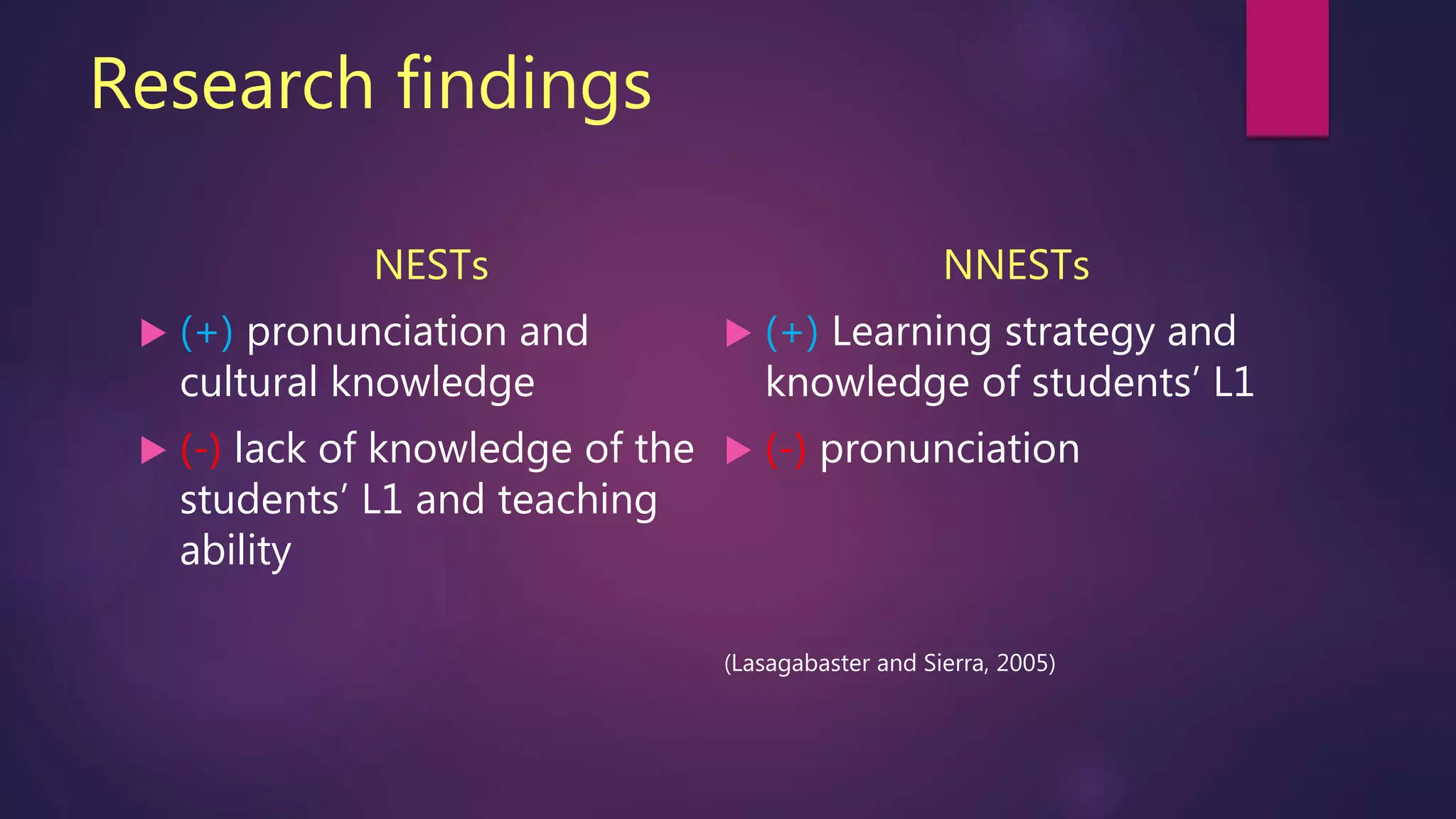
Research findings
NESTs
 (+) pronunciation and
cultural knowledge
 (-) lack of knowledge of the
students’ L1 and teaching
ability
NNESTs
 (+) Learning strategy and
knowledge of students’ L1
 (-) pronunciation
(Lasagabaster and Sierra, 2005)
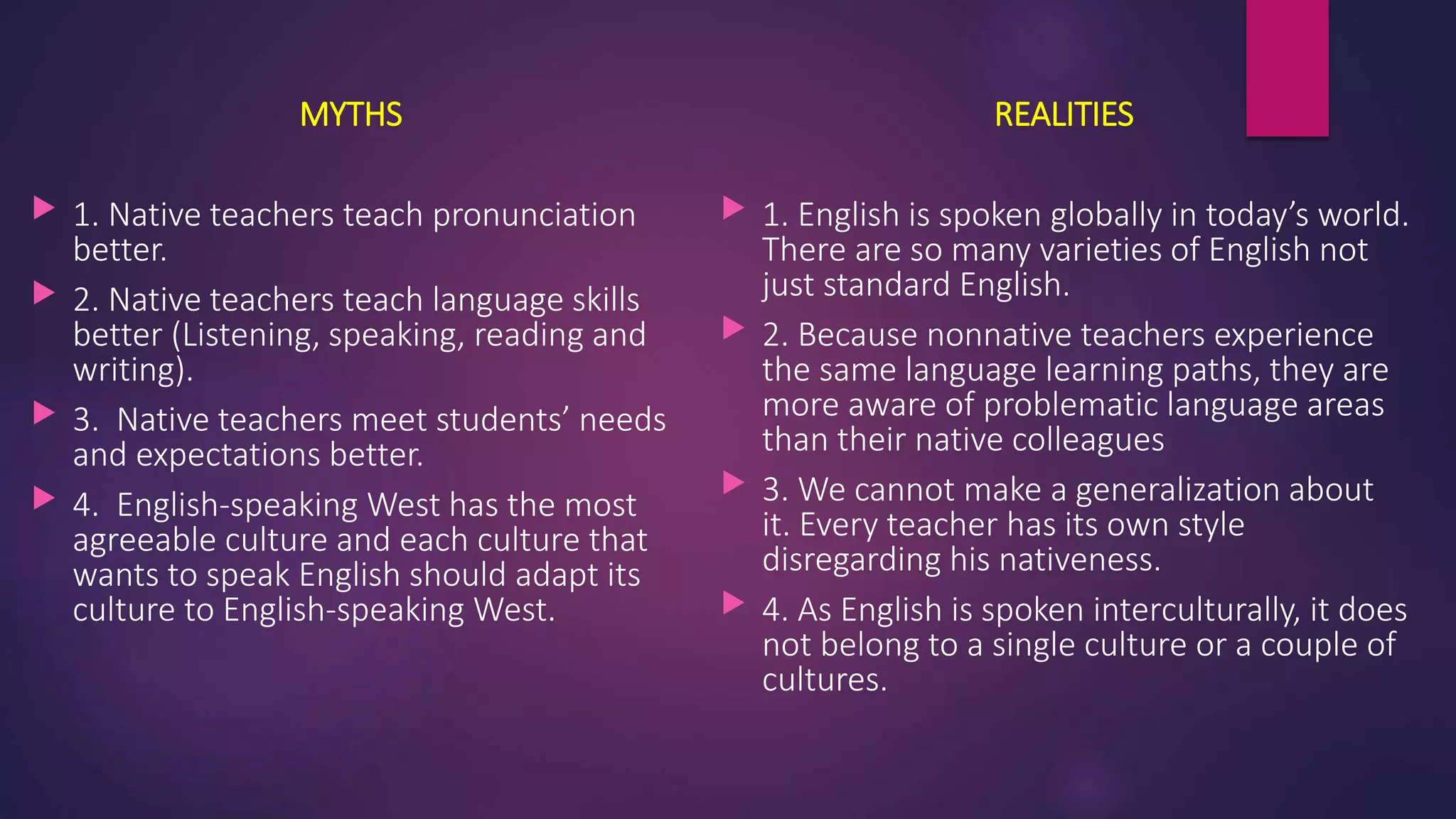
MYTHS
 1. Native teachers teach pronunciation
better.
 2. Native teachers teach language skills
better (Listening, speaking, reading and
writing).
 3. Native teachers meet students’ needs
and expectations better.
 4. English-speaking West has the most
agreeable culture and each culture that
wants to speak English should adapt its
culture to English-speaking West.
REALITIES
 1. English is spoken globally in today’s world.
There are so many varieties of English not
just standard English.
 2. Because nonnative teachers experience
the same language learning paths, they are
more aware of problematic language areas
than their native colleagues
 3. We cannot make a generalization about
it. Every teacher has its own style
disregarding his nativeness.
 4. As English is spoken interculturally, it does
not belong to a single culture or a couple of
cultures.
Recent research on the NEST and
NNEST dichotomy
 Students rate professional skills such as preparation and
motivating students as more important than language skills.
(Cheung, 2002)
 Students would prefer to have both NESTs and NNESTs
teaching them.
(Lasagabaster and Sierra, 2005)
 Students recognize that NESTs and NNESTs have different
strengths and weaknesses.
(Mahboob’s 2003, cited in Lipovsky and Mahboob 2010)
Who is teaching English around the world?
Food for thought
“Encourage collaboration
between NESTs and NNESTs”.
(Canagarajah, 1999).
References
 Canagarajah, S. (1999). Interrogating the “native speaker fallacy”: Non-linguistic roots, non-pedagogical results.
In G. Braine (Ed.), Non-native educators in English language teaching (pp. 77-92). Mahwah, NJ: Lawrence
Erlbaum Associates, Publishers.
 Lasagabaster, D. and Sierra, J. (2005). What do students think about the pros and cons of having a native
speaker teacher? In Llurda, E. (ed) Non-native language teachers: Perceptions, challenges and contributions to
the profession New York: Springer and Business Media
 Mahboob, A. and Lipovsky, C. (2010). Students’ appraisal of their native and non-native English-speaking
teachers WATESOL NNEST Caucus Annual review. Vol 1
 Medgyes P (1994) The Non-Native Teacher Macmillian Publishers
 Medgyes, P. and Benke, E. (2006). Differences in teaching behavious between native and non-native speaker
teachers:As seen by Learners in Llurda, E (ed) Non-native Language Teachers: Perceptions, Challenges and
Contributions to the Profession New York: Springer and Business Media
 Moussu, L. and Llurda, E. (2009). Non-native English-speaking English language teachers: History and research.
 Selvi, A.(2010) All Teachers are Equal, but some teachers are more equal than others: trend analysis of job
advertisements in English Language Teaching WATESOL NNEST Caucus Annual Review – Vol 1

Nest and nnest who's worth more

  • 1.
    Native or non-native: who’sworth more? Péter Medgyes
  • 2.
    What’s a NEST? Asyou can see, the definition itself gives the idea of home
  • 5.
    Are you aNEST or a NNEST?
  • 6.
    Native Speaker Teachers Neededin Jakarta, Indonesia 10/April/2012
  • 7.
    What is themost important for employers?
  • 8.
    If to teachEnglish you have to be from an English speaking country…
  • 9.
  • 10.
    Who is anative speaker of English? “A Briton is. A Hungarian is not. An Australian is. A French national is not. So far, so good. But what about an Indian for whom English was the language of school instruction and has been the language of professional communication ever since?”. (Medgyes 1991).
  • 11.
    Who is anative speaker of English? “Juan, for example, aged 9, who has been living in he United States for five years. His father is a Mexican immigrant, his mother comes from Norway. They both speak to Juan in their own mother tongue. Which is his native language, English, Spanish, or Norwegian? All of them? None of them?... From a sociolinguistic perspective, then, the native/non-native issue is controversial. It is equally debatable from a purely linguistic point of view”. (Medgyes 1991).
  • 12.
    Who is anative speaker of English? “Efforts to define native competence or native-like proficiency have yielded inconclusive results at best. This gives the progressively-minded applied linguist one more reason to claim not only that native and non-native speakers have equal rights in using (and abusing) the English language, but also that there is no use in setting up two separate categories”. (Medgyes 1991).
  • 13.
    Research findings NESTs  (+)pronunciation and cultural knowledge  (-) lack of knowledge of the students’ L1 and teaching ability NNESTs  (+) Learning strategy and knowledge of students’ L1  (-) pronunciation (Lasagabaster and Sierra, 2005)
  • 14.
    MYTHS  1. Nativeteachers teach pronunciation better.  2. Native teachers teach language skills better (Listening, speaking, reading and writing).  3. Native teachers meet students’ needs and expectations better.  4. English-speaking West has the most agreeable culture and each culture that wants to speak English should adapt its culture to English-speaking West. REALITIES  1. English is spoken globally in today’s world. There are so many varieties of English not just standard English.  2. Because nonnative teachers experience the same language learning paths, they are more aware of problematic language areas than their native colleagues  3. We cannot make a generalization about it. Every teacher has its own style disregarding his nativeness.  4. As English is spoken interculturally, it does not belong to a single culture or a couple of cultures.
  • 15.
    Recent research onthe NEST and NNEST dichotomy  Students rate professional skills such as preparation and motivating students as more important than language skills. (Cheung, 2002)  Students would prefer to have both NESTs and NNESTs teaching them. (Lasagabaster and Sierra, 2005)  Students recognize that NESTs and NNESTs have different strengths and weaknesses. (Mahboob’s 2003, cited in Lipovsky and Mahboob 2010)
  • 16.
    Who is teachingEnglish around the world?
  • 18.
    Food for thought “Encouragecollaboration between NESTs and NNESTs”. (Canagarajah, 1999).
  • 19.
    References  Canagarajah, S.(1999). Interrogating the “native speaker fallacy”: Non-linguistic roots, non-pedagogical results. In G. Braine (Ed.), Non-native educators in English language teaching (pp. 77-92). Mahwah, NJ: Lawrence Erlbaum Associates, Publishers.  Lasagabaster, D. and Sierra, J. (2005). What do students think about the pros and cons of having a native speaker teacher? In Llurda, E. (ed) Non-native language teachers: Perceptions, challenges and contributions to the profession New York: Springer and Business Media  Mahboob, A. and Lipovsky, C. (2010). Students’ appraisal of their native and non-native English-speaking teachers WATESOL NNEST Caucus Annual review. Vol 1  Medgyes P (1994) The Non-Native Teacher Macmillian Publishers  Medgyes, P. and Benke, E. (2006). Differences in teaching behavious between native and non-native speaker teachers:As seen by Learners in Llurda, E (ed) Non-native Language Teachers: Perceptions, Challenges and Contributions to the Profession New York: Springer and Business Media  Moussu, L. and Llurda, E. (2009). Non-native English-speaking English language teachers: History and research.  Selvi, A.(2010) All Teachers are Equal, but some teachers are more equal than others: trend analysis of job advertisements in English Language Teaching WATESOL NNEST Caucus Annual Review – Vol 1