Native vs Non-native
accent
Plan :
 I/ native accent
 A) definition
 B) Examples
 II/ Non-native accent :
 A) definition
 B) Examples
Data research
III/ Intelligibility and comprehensibility:
A) Intelligibility
B) Comprehensibility
C) Intelligibility and comprehensibility in
relation to accent
IV/ Effects of Non-native accent
A distinctive way of prononcing a
language, especially one
associated with a particular
country,area ,or social class .
• The accent can be affected by these features :
1) The position of lips,tongue and jaw.
2) the length and quality of the sound.
3) The choice of consonants and vowels .
4) Where you place the stress in a word .
5) The range of pitch and tone .
6) The way you join your syllabus together .
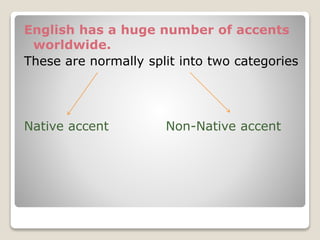
English has a huge number of accents
worldwide.
These are normally split into two categories
Native accent Non-Native accent
A person who speaks English as their
mother tongue will have a native accent.
In England, every region has a diffrent
accent .
For example :
1) Received Pronunciation
2) Cockney
*the closest the United Kingdom has ever
had to a “standard accent.”
*It is related to the upper-classes in
London and other areas of Southeast
England.
*It emerged from the 18th- and 19th-
Century upper classes, and has remained
the “gold standard” ever since.
Features :
1. Non-rhoticity
2. Trap-bath split
3. The vowels tend to be a bit more
conservative than other accents in
Southern England.
Cockney is probably the second most
famous British accent.
It originated in the East End of
London, but shares many features
with and influences other dialects in
that region.
Features:
1. Raised vowel in words.
2. Non-rhoticity.
3. Trap-bath split.
4. London vowel shift.
5. Glottal Stopping.
6. L-vocalization.
7. Th-Fronting.
what is a Non-native accent?
*Anybody who speaks English as a second
language may have a non-native accent.
*This is where sounds, mouth positions,
structures, rhythms, intonation and sound
selections are being used from that
person's mother tongue.
For example, many non-native speakers use
short vowels from their language in place of
the unusual long vowels in English.
- Difficulty with dentanl
fricatives /θ/ and /ð/ for speakers with
no native /θ/ and /ð/in their dialect's
phonemic inventory.
- Egyptian speakers tend to pronounce
the affricate /d͡ʒ/ as a [ʒ].
The folowing question was asked to students
who are specialized in :
• French
• Bio-medical
• Chemistry
• Translation
• German
• English
• Data science
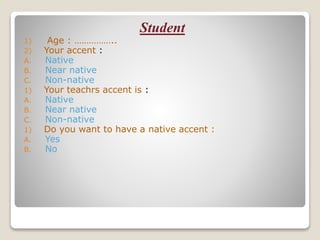
Student
1) Age : ……………..
2) Your accent :
A. Native
B. Near native
C. Non-native
1) Your teachrs accent is :
A. Native
B. Near native
C. Non-native
1) Do you want to have a native accent :
A. Yes
B. No
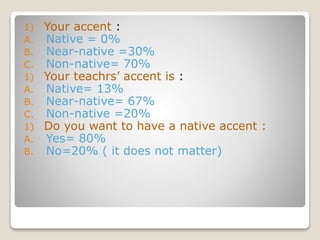
1) Your accent :
A. Native = 0%
B. Near-native =30%
C. Non-native= 70%
1) Your teachrs’ accent is :
A. Native= 13%
B. Near-native= 67%
C. Non-native =20%
1) Do you want to have a native accent :
A. Yes= 80%
B. No=20% ( it does not matter)
Accent, Intelligibility &
Comprehensibility
 Intelligibility: the "listener's actual
understanding of L2 speech" (Munro &
Derwing, 1999)
 Comprehensibility: the "listener's
subjective experience of the ease or
difficulty of understanding speech" (Munro
& Derwing, 1999)
Research
 Aim:
Differentiating between the linguistic
aspects of L2 speech which are mostly
related to accent and those related to
comprehensibility.
40 speech samples
19 measures
4 main categories:
1. Phonology
2. Fluency
3. Lexis and grammar
4. Discourse
Phonology
 Segmental errors
 Syllable structure errors
 Word stress errors
 Rhythm
 Pitch contour
 Pitch range
Fluency
 Overall number of filled pauses
 Total number of unfilled pauses
 Pause errors
 Repetitions and self-correction
 Articulation rate
 Mean length of run (MLR)
Accuracy of Lexis and Grammar
 Sum of words with at least one
morphosyntactic error
 Lexical errors
 Token frequency
 Type frequency
Discourse
 Story cohesion
 Story breadth
 Story depth
 Findings:
The results of the research showed that
accent is related to "pronunciation of
vowels and consonants" and "naturally
sounding rhythm" while comprehensibility
is related to grammatical and lexical
errors.
 Disentangling accent from
comprehensibility aims at:
1- enhancing the assessment of L2
speaking ability
2- recognizing the linguistic features that
lead to accent prejudice (Lippi-Green,
2011)
Effects of Accentedness
"When you hear somebody speaking in an
accent, it's almost like they are invading
your language while they are speaking to
you because if you hear someone speak
another language, you almost don't care.
But when they speak your language with
an accent, it feels like an invasion of
something that belongs to you. And,
immediately, we change." Trevor Noah
Effects of Accentedness
Phonological aspects that of prosody,
segment and syllable structure accuracy
are considered significant in rating L2
speech as they have a great impact on
Listener's comprehension.
Anderson-Hsieh, Johnson and Koehler
(1992)
incorrect stress placement can influence
listener's evaluating of L2 speech. Hahn
Lack of fluency (pausing, articulation rate,
etc.) on the part of L2 speakers can
influence comprehensibility
Derwing, Rossiter, Munro and Thomson
(2004)
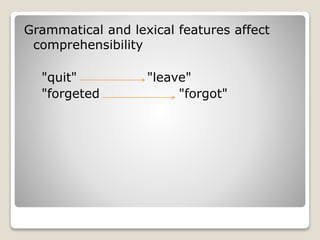
Grammatical and lexical features affect
comprehensibility
"quit" "leave"
"forgeted "forgot"
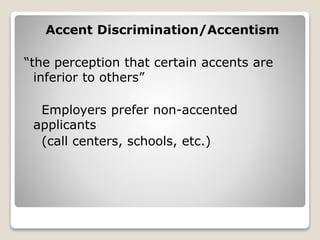
Accent Discrimination/Accentism
“the perception that certain accents are
inferior to others”
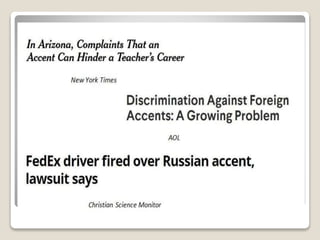
Employers prefer non-accented
applicants
(call centers, schools, etc.)
Guadalupe V. Aguayo. Joshua Lott for The New York Times
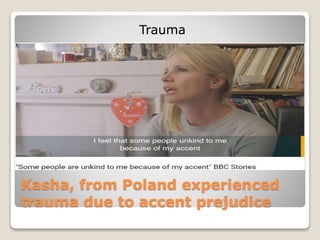
Kasha, from Poland experienced
trauma due to accent prejudice
Trauma
Accent Reduction
“systematic approach for learning or
adopting a new speech accent. It is the
process of learning the sound system (or
phonology) and melodic intonation of a
language so the non-native speaker can
communicate with clarity to be
understood by the general public of this
second language."
“To cultivate an English accent is already a
departure away from what you are.”
Sean Connery
 References
 Christensen, B. (September 13, 2017). "What Is Accent Reduction?". Accent
Freedom. (Accessed Feb. 5, 2018).
 Lacey, M. (2011). In Arizona, complaints that an accent can hinder a teacher's
career. The New York Times (September 25, 2011), p. A18 URL:
http://www.nytimes.com/2011/09/25/us/in-arizona-complaints-that-an-
accent-can-hinder-a-teachers-career.html (Accessed Feb. 5, 2018).
 McArthur, T. (1992). The Oxford Comapnion to the English Language. Oxford
University Press.
 Nordquist, R. (March 06, 2017). accent prejudice (accentism). ThoughtCo.
URL: https://www.thoughtco.com/accent-prejudice-accentism-1689053
(Accessed Feb. 5, 2018).
 Trofimovich, P. & Isaacs, T. (2012). Disentangling accent from
comprehensibility. Bilingualism: Language and Cognition, 15(4), 905-916.
 YouTube video "Some people are unkind to me because of my accent". BBC
Stories (September 25, 2017), URL:
https://www.youtube.com/watch?v=C5BT4Li2wEk (Accessed Feb. 5, 2018).
Native Vs Non-Native Accent

Native Vs Non-Native Accent

  • 1.
  • 2.
    Plan :  I/native accent  A) definition  B) Examples  II/ Non-native accent :  A) definition  B) Examples Data research III/ Intelligibility and comprehensibility: A) Intelligibility B) Comprehensibility C) Intelligibility and comprehensibility in relation to accent IV/ Effects of Non-native accent
  • 3.
    A distinctive wayof prononcing a language, especially one associated with a particular country,area ,or social class .
  • 4.
    • The accentcan be affected by these features : 1) The position of lips,tongue and jaw. 2) the length and quality of the sound. 3) The choice of consonants and vowels . 4) Where you place the stress in a word . 5) The range of pitch and tone . 6) The way you join your syllabus together .
  • 5.
    English has ahuge number of accents worldwide. These are normally split into two categories Native accent Non-Native accent
  • 6.
    A person whospeaks English as their mother tongue will have a native accent. In England, every region has a diffrent accent . For example : 1) Received Pronunciation 2) Cockney
  • 7.
    *the closest theUnited Kingdom has ever had to a “standard accent.” *It is related to the upper-classes in London and other areas of Southeast England. *It emerged from the 18th- and 19th- Century upper classes, and has remained the “gold standard” ever since.
  • 8.
    Features : 1. Non-rhoticity 2.Trap-bath split 3. The vowels tend to be a bit more conservative than other accents in Southern England.
  • 9.
    Cockney is probablythe second most famous British accent. It originated in the East End of London, but shares many features with and influences other dialects in that region.
  • 10.
    Features: 1. Raised vowelin words. 2. Non-rhoticity. 3. Trap-bath split. 4. London vowel shift. 5. Glottal Stopping. 6. L-vocalization. 7. Th-Fronting.
  • 11.
    what is aNon-native accent? *Anybody who speaks English as a second language may have a non-native accent. *This is where sounds, mouth positions, structures, rhythms, intonation and sound selections are being used from that person's mother tongue.
  • 12.
    For example, manynon-native speakers use short vowels from their language in place of the unusual long vowels in English. - Difficulty with dentanl fricatives /θ/ and /ð/ for speakers with no native /θ/ and /ð/in their dialect's phonemic inventory. - Egyptian speakers tend to pronounce the affricate /d͡ʒ/ as a [ʒ].
  • 13.
    The folowing questionwas asked to students who are specialized in : • French • Bio-medical • Chemistry • Translation • German • English • Data science
  • 14.
    Student 1) Age :…………….. 2) Your accent : A. Native B. Near native C. Non-native 1) Your teachrs accent is : A. Native B. Near native C. Non-native 1) Do you want to have a native accent : A. Yes B. No
  • 15.
    1) Your accent: A. Native = 0% B. Near-native =30% C. Non-native= 70% 1) Your teachrs’ accent is : A. Native= 13% B. Near-native= 67% C. Non-native =20% 1) Do you want to have a native accent : A. Yes= 80% B. No=20% ( it does not matter)
  • 16.
    Accent, Intelligibility & Comprehensibility Intelligibility: the "listener's actual understanding of L2 speech" (Munro & Derwing, 1999)  Comprehensibility: the "listener's subjective experience of the ease or difficulty of understanding speech" (Munro & Derwing, 1999)
  • 17.
    Research  Aim: Differentiating betweenthe linguistic aspects of L2 speech which are mostly related to accent and those related to comprehensibility.
  • 18.
    40 speech samples 19measures 4 main categories: 1. Phonology 2. Fluency 3. Lexis and grammar 4. Discourse
  • 19.
    Phonology  Segmental errors Syllable structure errors  Word stress errors  Rhythm  Pitch contour  Pitch range
  • 20.
    Fluency  Overall numberof filled pauses  Total number of unfilled pauses  Pause errors  Repetitions and self-correction  Articulation rate  Mean length of run (MLR)
  • 21.
    Accuracy of Lexisand Grammar  Sum of words with at least one morphosyntactic error  Lexical errors  Token frequency  Type frequency
  • 22.
    Discourse  Story cohesion Story breadth  Story depth
  • 23.
     Findings: The resultsof the research showed that accent is related to "pronunciation of vowels and consonants" and "naturally sounding rhythm" while comprehensibility is related to grammatical and lexical errors.
  • 24.
     Disentangling accentfrom comprehensibility aims at: 1- enhancing the assessment of L2 speaking ability 2- recognizing the linguistic features that lead to accent prejudice (Lippi-Green, 2011)
  • 25.
    Effects of Accentedness "Whenyou hear somebody speaking in an accent, it's almost like they are invading your language while they are speaking to you because if you hear someone speak another language, you almost don't care. But when they speak your language with an accent, it feels like an invasion of something that belongs to you. And, immediately, we change." Trevor Noah
  • 26.
    Effects of Accentedness Phonologicalaspects that of prosody, segment and syllable structure accuracy are considered significant in rating L2 speech as they have a great impact on Listener's comprehension. Anderson-Hsieh, Johnson and Koehler (1992) incorrect stress placement can influence listener's evaluating of L2 speech. Hahn
  • 27.
    Lack of fluency(pausing, articulation rate, etc.) on the part of L2 speakers can influence comprehensibility Derwing, Rossiter, Munro and Thomson (2004)
  • 28.
    Grammatical and lexicalfeatures affect comprehensibility "quit" "leave" "forgeted "forgot"
  • 29.
    Accent Discrimination/Accentism “the perceptionthat certain accents are inferior to others” Employers prefer non-accented applicants (call centers, schools, etc.)
  • 31.
    Guadalupe V. Aguayo.Joshua Lott for The New York Times
  • 32.
    Kasha, from Polandexperienced trauma due to accent prejudice Trauma
  • 33.
    Accent Reduction “systematic approachfor learning or adopting a new speech accent. It is the process of learning the sound system (or phonology) and melodic intonation of a language so the non-native speaker can communicate with clarity to be understood by the general public of this second language."
  • 34.
    “To cultivate anEnglish accent is already a departure away from what you are.” Sean Connery
  • 35.
     References  Christensen,B. (September 13, 2017). "What Is Accent Reduction?". Accent Freedom. (Accessed Feb. 5, 2018).  Lacey, M. (2011). In Arizona, complaints that an accent can hinder a teacher's career. The New York Times (September 25, 2011), p. A18 URL: http://www.nytimes.com/2011/09/25/us/in-arizona-complaints-that-an- accent-can-hinder-a-teachers-career.html (Accessed Feb. 5, 2018).  McArthur, T. (1992). The Oxford Comapnion to the English Language. Oxford University Press.  Nordquist, R. (March 06, 2017). accent prejudice (accentism). ThoughtCo. URL: https://www.thoughtco.com/accent-prejudice-accentism-1689053 (Accessed Feb. 5, 2018).  Trofimovich, P. & Isaacs, T. (2012). Disentangling accent from comprehensibility. Bilingualism: Language and Cognition, 15(4), 905-916.  YouTube video "Some people are unkind to me because of my accent". BBC Stories (September 25, 2017), URL: https://www.youtube.com/watch?v=C5BT4Li2wEk (Accessed Feb. 5, 2018).