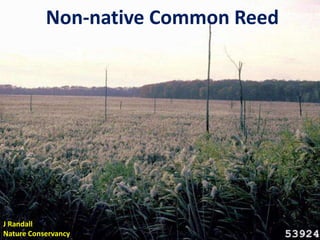
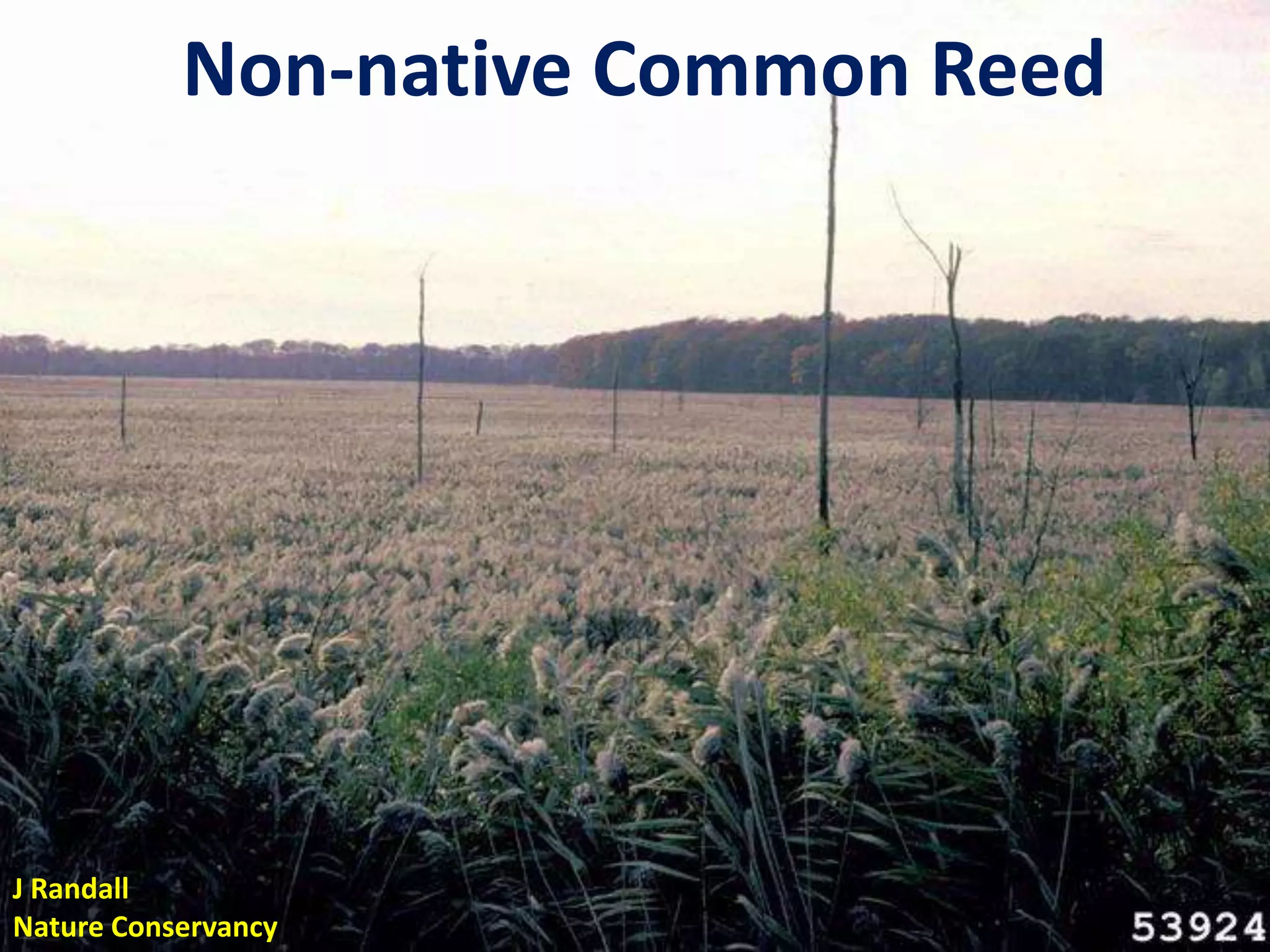
Non-native Common Reed


J Randall
Nature Conservancy
Literature Cited:

A Guide to the Control and Management. INVASIVE PHRAGMITES,
http://www.michigan.gov/documents/deq/deq-ogl-ais-guide-PhragBook-Email_212418_7.pdf

Phragmites: Common Reed, Morphological Differences (this text is at least partially authored
by Dr. Bernd Blossey, Cornell University)
http://www.invasiveplants.net/phragmites/phrag/morph.htm

Science Daily 2007. http://www.sciencedaily.com/releases/2007/10/071012084128.htm

Common Reed, Missouri Department of Conservation, Invasive Species Coordinator, P.O. Box
180, Jefferson City, MO 65102-0180

Swearingen, J. and K. Saltonstall. 2010. Phragmites Field Guide: Distinguishing Native and
Exotic Forms of Common Reed (Phragmites australis) in the United States. Plant Conservation
Alliance, Weeds Gone Wild. http://www.nps.gov/plants/alien/pubs/index.htm

Wisconsin Wetlands Association http://wisconsinwetlands.org/phragmites.htm#invasion
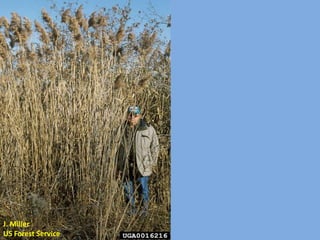
J. Miller
US Forest Service
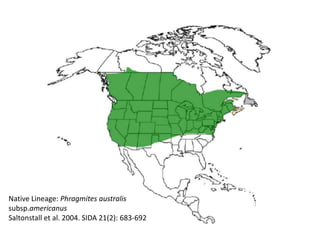
Native Lineage: Phragmites australis
subsp.americanus
Saltonstall et al. 2004. SIDA 21(2): 683-692
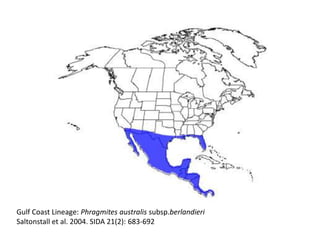
Gulf Coast Lineage: Phragmites australis subsp.berlandieri
Saltonstall et al. 2004. SIDA 21(2): 683-692
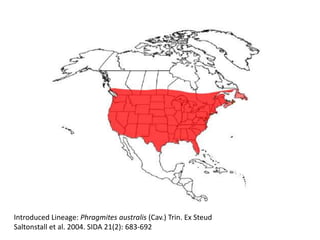
Introduced Lineage: Phragmites australis (Cav.) Trin. Ex Steud
Saltonstall et al. 2004. SIDA 21(2): 683-692
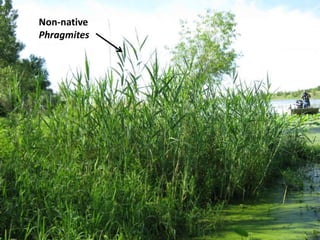
Non-native
Phragmites
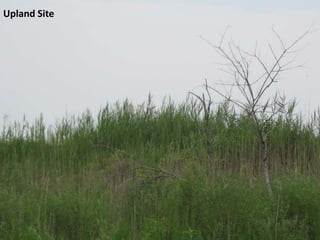
Upland Site
J. Randall
Nature Conservancy
Leslie J Mehrhoff
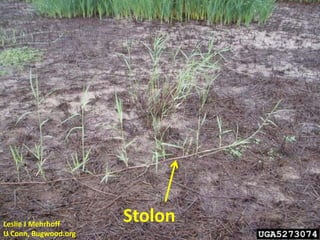
                      Stolon
U Conn, Bugwood.org
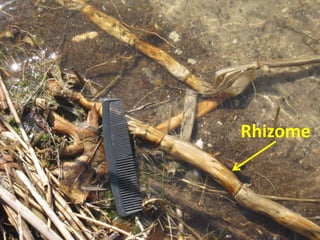
Rhizome
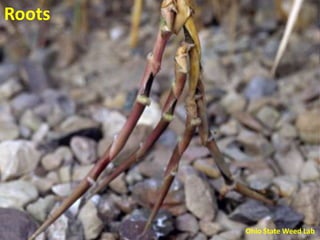
Roots


        Ohio State Weed Lab
Allelopathy – production of biochemical
substances that influence other organisms


• Common reed releases gallic acid
• Dissolves roots of nearby competitor plants
• Non-native form contains elevated levels
  compared to native form of Phragmites
• Competitive advantage
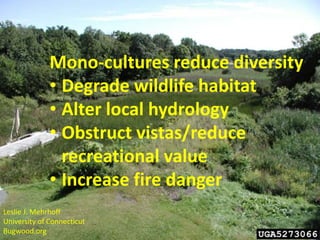
Mono-cultures reduce diversity
              • Degrade wildlife habitat
              • Alter local hydrology
              • Obstruct vistas/reduce
                recreational value
              • Increase fire danger
                  tt


Leslie J. Mehrhoff
University of Connecticut
Bugwood.org
Economic costs of non-native species
         introductions in the U.S.


• Damages and control of all species combined
  may be up to $219 billion/year (Pimentel 2011)
Plant Conservation Alliance
Alien Plant Working Group
Fact Sheet
Plant Conservation Alliance
Alien Plant Working Group
Fact Sheet
Seedhead in winter
Non-native


               Native
R.E. Meadows
Native   Non-Native

R.E. Meadows
Native                   Non-native


         R. E. Meadows
Sludge Disposal Beds
Vegetation Control
Methods to avoid
  •   Disking – can spread plant fragments
  •   Mowing – should not be used by itself, but may facilitate
      follow-up treatments after herbicides have killed the
      original stand. Use care so as not to spread seed or live
      stolon/rhizome fragments
  •   Flooding – use only as a follow-up to herbicides
  •   Traditional drawdowns (moist soil mgt.)– may increase
      non-native Phragmites
  •   Spring fire – encourages non-native Phragmites
Vegetation Control
Methods to use
  •    Herbicides – always follow the label and
       current laws regarding use.
      • Imazapyr - can be absorbed by tree
         roots if applied to overlying soil. Foliar
         app. mid-June-early October.
Vegetation Control
•   Glyphosate – Glyphosate- mid-August
    through early October. Application rates
    are 4-6 pints (64-96 oz.) per acre or use at
    1.5% solution. A methylated seed oil or
    non-ionic surfactant should be added at 1%
    v/v as a surfactant.

•   Imazapyr at 1.25% + glyphosate at 1.2%
    with 0.25-0.5% NIS v/v. Late June-October
Vegetation Control
• Imazamox at 1% v/v + glyphosate at 1%
  v/v + 1% MSO (info@cwc-chemical.com)
  Foliar apply August through early October.

     This would be a safer method to use
     where valuable landscape trees are
     present. However, this mix is still non-
     selective.
Vegetation Control
• For combinations of herbicide and fire see:
A Guide to the Control and Management.
INVASIVE PHRAGMITES

A common method is to use fire during July-
August one year after herbicide
treatment, followed up by additional
herbicide efforts as needed.
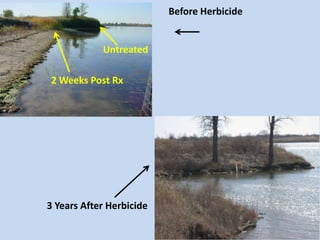
Before Herbicide


            Untreated

2 Weeks Post Rx


3 Years After Herbicide
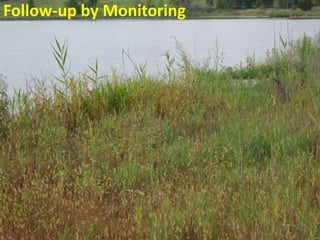
Follow-up by Monitoring
Questions???

Non-native Common Reed

  • 1.
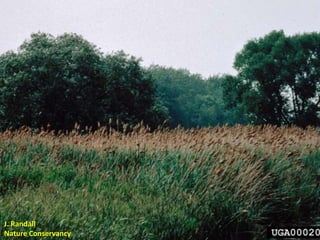
    Non-native Common Reed JRandall Nature Conservancy
  • 2.
    Literature Cited: A Guideto the Control and Management. INVASIVE PHRAGMITES, http://www.michigan.gov/documents/deq/deq-ogl-ais-guide-PhragBook-Email_212418_7.pdf Phragmites: Common Reed, Morphological Differences (this text is at least partially authored by Dr. Bernd Blossey, Cornell University) http://www.invasiveplants.net/phragmites/phrag/morph.htm Science Daily 2007. http://www.sciencedaily.com/releases/2007/10/071012084128.htm Common Reed, Missouri Department of Conservation, Invasive Species Coordinator, P.O. Box 180, Jefferson City, MO 65102-0180 Swearingen, J. and K. Saltonstall. 2010. Phragmites Field Guide: Distinguishing Native and Exotic Forms of Common Reed (Phragmites australis) in the United States. Plant Conservation Alliance, Weeds Gone Wild. http://www.nps.gov/plants/alien/pubs/index.htm Wisconsin Wetlands Association http://wisconsinwetlands.org/phragmites.htm#invasion
  • 3.
  • 4.
    Native Lineage: Phragmitesaustralis subsp.americanus Saltonstall et al. 2004. SIDA 21(2): 683-692
  • 5.
    Gulf Coast Lineage:Phragmites australis subsp.berlandieri Saltonstall et al. 2004. SIDA 21(2): 683-692
  • 6.
    Introduced Lineage: Phragmitesaustralis (Cav.) Trin. Ex Steud Saltonstall et al. 2004. SIDA 21(2): 683-692
  • 7.
  • 8.
  • 9.
  • 10.
    Leslie J Mehrhoff Stolon U Conn, Bugwood.org
  • 11.
  • 12.
    Roots Ohio State Weed Lab
  • 13.
    Allelopathy – productionof biochemical substances that influence other organisms • Common reed releases gallic acid • Dissolves roots of nearby competitor plants • Non-native form contains elevated levels compared to native form of Phragmites • Competitive advantage
  • 14.
    Mono-cultures reduce diversity • Degrade wildlife habitat • Alter local hydrology • Obstruct vistas/reduce recreational value • Increase fire danger tt Leslie J. Mehrhoff University of Connecticut Bugwood.org
  • 15.
    Economic costs ofnon-native species introductions in the U.S. • Damages and control of all species combined may be up to $219 billion/year (Pimentel 2011)
  • 16.
    Plant Conservation Alliance AlienPlant Working Group Fact Sheet
  • 17.
    Plant Conservation Alliance AlienPlant Working Group Fact Sheet
  • 18.
  • 19.
    Non-native Native R.E. Meadows
  • 20.
    Native Non-Native R.E. Meadows
  • 21.
    Native Non-native R. E. Meadows
  • 22.
  • 23.
    Vegetation Control Methods toavoid • Disking – can spread plant fragments • Mowing – should not be used by itself, but may facilitate follow-up treatments after herbicides have killed the original stand. Use care so as not to spread seed or live stolon/rhizome fragments • Flooding – use only as a follow-up to herbicides • Traditional drawdowns (moist soil mgt.)– may increase non-native Phragmites • Spring fire – encourages non-native Phragmites
  • 24.
    Vegetation Control Methods touse • Herbicides – always follow the label and current laws regarding use. • Imazapyr - can be absorbed by tree roots if applied to overlying soil. Foliar app. mid-June-early October.
  • 25.
    Vegetation Control • Glyphosate – Glyphosate- mid-August through early October. Application rates are 4-6 pints (64-96 oz.) per acre or use at 1.5% solution. A methylated seed oil or non-ionic surfactant should be added at 1% v/v as a surfactant. • Imazapyr at 1.25% + glyphosate at 1.2% with 0.25-0.5% NIS v/v. Late June-October
  • 26.
    Vegetation Control • Imazamoxat 1% v/v + glyphosate at 1% v/v + 1% MSO (info@cwc-chemical.com) Foliar apply August through early October. This would be a safer method to use where valuable landscape trees are present. However, this mix is still non- selective.
  • 27.
    Vegetation Control • Forcombinations of herbicide and fire see: A Guide to the Control and Management. INVASIVE PHRAGMITES A common method is to use fire during July- August one year after herbicide treatment, followed up by additional herbicide efforts as needed.
  • 28.
    Before Herbicide Untreated 2 Weeks Post Rx 3 Years After Herbicide
  • 29.
  • 30.

Editor's Notes

  • #2 The reason that we are discussing common reed is that a non-native variety continues to invade many areas in North America, crowding out native plants and forming mono-cultures. I will use the term non-native for the invasive form of Phragmites. The native form of Phragmites does not tend to form mono-cultures.
  • #3 Much of the information in this presentation was obtained from the publications shown here.
  • #4 Phragmites australis (Common Reed) is a perennial grass that may grow up to 15 feet tall. Three different lineages occur in the US and only one is known to be native.
  • #5 P. australisamericanus is the native variety that was found throughout Canada and most of the United States, except for the Southeast.
  • #6 P. australisbarlandieriis the second variety and is found primarily along the Gulf Coast, southern Arizona, California, Mexico and South America. It is uncertain if this variety is native to the Gulf Coast or has moved in from the south.
  • #7 P. australisaustralisis the third variety and is found throughout the US and into southern Canada. This variety is not native to the US and is thought to originate in Europe and the Middle East. The rest of this presentation will focus on this invasive variety. Most accounts indicate that the non-native common reed was introduced to North America in ballast material discarded from ships in the late 1700’s or early 1800’s. While not listed as a noxious weed in Missouri, it is a listed noxious weed in Nebraska, some western states, South Carolina and is on a restricted list in Michigan.
  • #8 Habitat – Both the native and non-native variety of common reed can inhabit similar habitats including wetlands andmoist soil areas. The non-native form is more tolerant of flooding, up to 2 feet deep.
  • #9 In addition, the non-native plants can thrive on fairly dry upland sites due to a deep taproot. Common reed is not very shade tolerant, so it will be absent or at lower stem densities where shading from trees is great. The non-native variety is more likely to be found in disturbed areas. Non-native common reed is becoming more common along borrow pits, roadside ditches and many other moist soil sites around the country.
  • #10 Biology – The non-native form of common reed will form dense stands of 12-15 foot tall plants. Stem density may reach 200/m2 . Notably, up to 80% of the plant biomass may be contained below ground in roots and rhizomes (Michigan pub. noted above). Phragmites may reproduce by seeds which can be transported by wind or water currents, but this is a minor method of reproduction and dispersal. Seed germination is prevented in water depths > 2 inches.
  • #11 The main method of reproduction is by growth and fragmentation of stolons and rhizomes. These structures can be up to 60 feet long along the ground and roots may extend 6 feet below the surface to reach adequate water. Rhizomes may grow 10 feet or more per year.Seeds and stolons may also be transported to new areas by mowing equipment or by persons constructing hunting blinds.
  • #12 As mentioned, more biomass may occur in roots and rhizomes below ground. The rhizomes are about as thick as corn stalks.
  • #13 The roots are located at frequent intervals at nodes along the stolons.
  • #14 Allelopathy - Research at the University of Delaware has discovered that the invasive form of common reed releases an acid that dissolves roots of nearby plants, allowing it to become the dominant plant species in the area. The native common reed also secretes this toxin, but at a much lower concentration. (University of Delaware (2007, October 15). Invasive Plant Secretes Acid to Kill Nearby Plants and Spread. ScienceDaily. Retreived January 31, 2008, from http;//www.sciencedaily.com/releases/2007/10/071012084128.htm
  • #15 Impacts - The non-native variety reduces plant diversity by forming dense mono-cultures due to its competitive ability. These stands can degrade wildlife habitat. Knezevic et al. (2008) stated that various wading birds, migrating waterfowl and some threatened bird species that require short-grass habitats are excluded from marshes dominated by non-native common reed.Another example of how wildlife species may be harmed by Phragmites was given in a Michigan DNR Publication by:Phyllis Higman & Suzan Campbell, Michigan Natural Features Inventory, P.O. Box 30444; Lansing, Michigan 48909-7944Report Number 2009-11, March 9, 2009Invertebrates such as midge larvae, water boatmen, Daphnia, backswimmers, and snails that are eaten by ducklings in their first few weeks of life are no longer abundant in the interior of Phragmites- dominated wetland. (http://www.michigan.gov/documents/dnr/Invasives_strategy_final_289799_7.pdf)These mono-cultures can also alter the area’s hydrology, increasing sedimentation, narrowing water channels and reducing water flow. This can also reduce water available for irrigation (Knezevic et al. (2008) Univ. of Nebraska Coop Ext. EC166), navigation and recreation. Large stands of common reed can obstruct shoreline vistas and reduce recreational value (and dollars) from hunting, fishing, and boating.Large stands of dead grass will increase hazards associated with wild fires.
  • #16 There are significant costs associated with non-native species introductions in the US.While no specific costs were listed for Phragmites, the article cited here listed the losses due to purple loosestrife at $45 million/year and aquatic weeds at $110 million/year.
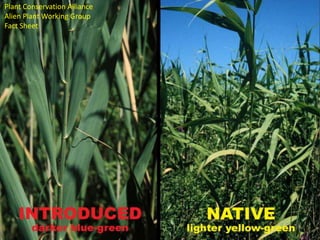
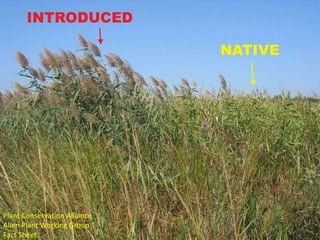
  • #17 IDENTIFICATIONProper identification prior to implementing a control program is critical to avoid killing stands of native common reed. It should be noted that the appearance of the plants may be influenced by site environmental conditions, so plants growing in dry climates may appear different than the same variety in a moister climate. Additional information concerning identification may be found at: http://invasiveplants.net/phragmites/phrag/morph.htmNative common reed is often a lighter yellow-green, while the non-native form is a darker blue-green.The stems are hollow, with lanceolate leaves 20-40 cm long and 1-4 cm wide.
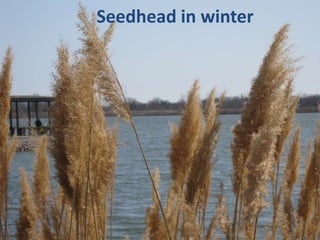
  • #18 Flowers are developed by mid-summer and are arranged in long, bushy panicles. Inflorescences of native plants are sparser than the non-native plants.Well established non-native common reed will occur in large, dense stands 10-15 feet tall and expand rapidly. The non-native variety grows well on fairly dry sites and also on continuously flooded sites up to 2 feet deep. In contrast, colonies of native common reed are of low stem density, restricted to moist soils and do not expand quickly. They do not tolerate flooding or very dry conditions.
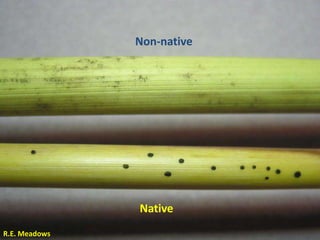
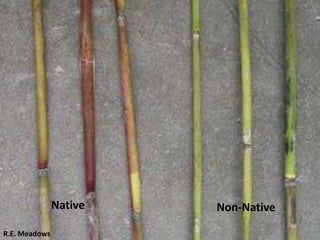
  • #20 Non-native common reed lacks distinct black spots on the stems, but may have a diffuse black mildew substance. http://www.nps.gov/plants/alien/pubs/index.htm
  • #21 The stems on native common reed will have a red-purple color and the non-native form is mostly green.
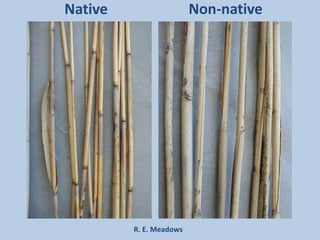
  • #22 The stem color for the native plants is light/brown/gray and a lighter tan on the non-natives. Leaf sheaths fall off or are easily removed from the native variety, but remain on and are difficult to remove from the non-native plants. Stems are smooth and shiny on the native plants and rough, dull and ribbed on the non-native plants. I recommend using the web sites previously mentioned to view additional character differences between the native and non-native plants.
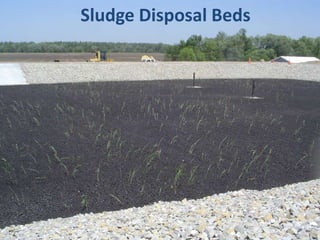
  • #23 Before I discuss vegetation control, I would like to mention that some municipalities around the country are using the non-native form of Phragmites to remove nutrients and metals from sewage waste and also to reduce sludge volume. These facilities have been built in Salem, ElDorado Springs, Blue Springs and Warrensburg. The reeds are then harvested in winter to reduce plant biomass and remove waste products. Obviously, colonization of areas outside of the constructed treatment facility is a concern of fish and wildlife personnel and should be of concern to the public, especially adjoining landowners.
  • #24 Once it has been determined that non-native common reed is present and control efforts are necessary, the procedures to use will need to be determined. The publication: A Guide to the Control and Management. INVASIVE PHRAGMITES, cited at the beginning of this presentation is a very good source of information regarding control methods. Due to time constraints, I will not review all of the potential combinations that have been listed as effective. Using a combination of methods in an integrative pest management (IPM) approach has proven to be more effective than single methods alone. Methods to avoid include disking, …. SEE SLIDE.
  • #25 Herbicides can be a very effective method of control. One effective herbicide is:Imazapyr – this is a non-selective, systemic herbicide and will kill any vegetation it is applied to, including trees. This herbicide can be absorbed by tree roots if applied to overlying soil, so be careful where it is used. It is very effective and may be applied from mid-June through late September or early October if the plants are still growing. Application rates are 4-6 pints (64-96 oz.) per acre or use at 1.5% solution. A methylated seed oil (MSO) or non-ionic surfactant (NIS) should be added at 1% v/v as a surfactant.
  • #26 Glyphosate may also be used and in my experience should not be used until mid-August through early October. Application rates are 4-6 pints (64-96 oz.) per acre or use at 1.5% solution. A methylated seed oil or non-ionic surfactant should be added at 1% v/v as a surfactant.Imazapyr at 1.25% + glyphosate at 1.2% with 0.25-0.5% NIS v/v. Late June-October.
  • #27 Imazamox at 1% v/v + glyphosate at 1% v/v + 1% MSO (info@cwc-chemical.com) Foliar apply August through early October. This would be a safer method to use where valuable landscape trees are present. However, this mix is still non-selective, so do not get it on green foliage or stems of desirable vegetation.
  • #28 One good method of improving control is to run a fire through the stand one year after the initial herbicide treatment. This should be done in July-August. Follow-up treatments should follow as needed.
  • #29 The results shown here were obtained using primarily Imazapyr between June-October.
  • #30 The important point to remember is that you cannot just treat an area for Phragmites and walk away or it will eventually return; so monitor, monitor and monitor some more. It is much easier to control by spot treating small stands, than achieving control of large stands.