SEMANTICS
UNIVERSIDAD NACIONAL DE LOJA
Names: María José Andrade
Silvana Correa
Date: June 1st, 2016
7th cycle
STUDYING THE LANGUAGE OF SECOND
LANGUAGE LEARNERS
Teachers determine whether students
have learned what has been taught
* Increase in errors indicates progress
Teachers and researchers must infer what
learners know by observing what they do
First language learners and second
language learnn¡ers do not learn
language simply through imitation and
practice
Children’s knowledge is built in
sequences
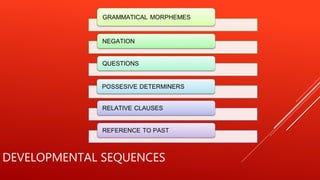
DEVELOPMENTAL SEQUENCES
NEGATION
• Stage 1
• The negative element usually “no or not”
• Stage 2
• “No and not” may alternate with don’t.
• Stage 3
• The negative elements are replaced by auxiliary verbs.
• Stage 4
• “Do” is marked for tense, person and number.
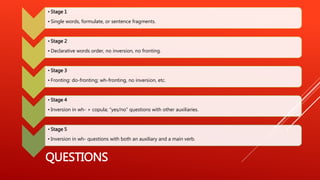
QUESTIONS
• Stage 1
• Single words, formulate, or sentence fragments.
• Stage 2
• Declarative words order, no inversion, no fronting.
• Stage 3
• Fronting: do-fronting; wh-fronting, no inversion, etc.
• Stage 4
• Inversion in wh- + copula; “yes/no” questions with other auxiliaries.
• Stage 5
• Inversion in wh- questions with both an auxiliary and a main verb.
MOVEMENT THROUGH DEVELOPMENTAL
SEQUENCES
It is important to emphasize that developmental
stages are not like closed rooms. So learners do
not leave one behind when they enter another. On
the contrary at a given point learners may use
sentences typical of several different stages.
More about first language influence
Contrastive analysis was closely associated with
behaviourist views of language acquisition.
Avoidance: It appeared by learners' perception that a feature in
the target language was so distant and different from their first
language that they preferred not to try it.
Interference: When two languages are closely related. So, many
caharacteristics seems to have led learners to take a chance that
a word or a sentence structure in a specific language would
have an equivalent in another language.
COMPONENTS OF COMMUNICATIVE
COMPETENCE
Vocabulary Vocabulary is one of the most active areas in second language acquisition
We can communicate by using words that are not placed in the proper order, pronounced perfectly, or
marked with the proper grammatical morphemes.
Every language has a large number of words
An educated adult speaker of English is believed to know at least 20,000 words
Every conversation requires something more like 2,000 words
In older children or adults, the words they are exposed to may also be more difficult, referring to meanings
that are not easily guessed from context.
Words taht look similar and have the same meaning in two languages are called cognates.
Students may have difficulty with words that look similar in the two languages but have different meanings.
The best source of vocabulary growth is reading for pleasure
Pragmatics
It is how language is used in context to express such things as
directness, politness and deference
Learners need ton acquire skills for interpreting requests, responding
politely to compliments or apologies, recognizing humour, and
managing conversations.
Also, learners need to learn to recognize the many meanings that
the same sentence can have in different situations.
The study of how second language learners develop the ability to
express their intentions and meanings through different speech acts
is referred to as interlanguage pragmatics.
Second language pragmatic should be taught but rather how it can
be best integrated into classroom instruction.
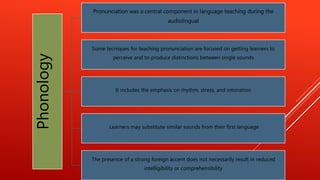
Phonology
Pronunciation was a central component in language teaching during the
audiolingual
Some tecniques for teaching pronunciation are focused on getting learners to
perceive and to produce distinctions between single sounds
It includes the emphasis on rhythm, stress, and intonation
Learners may substitute similar sounds from their first language
The presence of a strong foreign accent does not necessarily result in reduced
intelligibility or comprehensibility

Learner language ppt

  • 1.
    SEMANTICS UNIVERSIDAD NACIONAL DELOJA Names: María José Andrade Silvana Correa Date: June 1st, 2016 7th cycle
  • 2.
    STUDYING THE LANGUAGEOF SECOND LANGUAGE LEARNERS Teachers determine whether students have learned what has been taught * Increase in errors indicates progress Teachers and researchers must infer what learners know by observing what they do First language learners and second language learnn¡ers do not learn language simply through imitation and practice Children’s knowledge is built in sequences
  • 4.
  • 5.
    NEGATION • Stage 1 •The negative element usually “no or not” • Stage 2 • “No and not” may alternate with don’t. • Stage 3 • The negative elements are replaced by auxiliary verbs. • Stage 4 • “Do” is marked for tense, person and number.
  • 6.
    QUESTIONS • Stage 1 •Single words, formulate, or sentence fragments. • Stage 2 • Declarative words order, no inversion, no fronting. • Stage 3 • Fronting: do-fronting; wh-fronting, no inversion, etc. • Stage 4 • Inversion in wh- + copula; “yes/no” questions with other auxiliaries. • Stage 5 • Inversion in wh- questions with both an auxiliary and a main verb.
  • 7.
    MOVEMENT THROUGH DEVELOPMENTAL SEQUENCES Itis important to emphasize that developmental stages are not like closed rooms. So learners do not leave one behind when they enter another. On the contrary at a given point learners may use sentences typical of several different stages.
  • 8.
    More about firstlanguage influence Contrastive analysis was closely associated with behaviourist views of language acquisition. Avoidance: It appeared by learners' perception that a feature in the target language was so distant and different from their first language that they preferred not to try it. Interference: When two languages are closely related. So, many caharacteristics seems to have led learners to take a chance that a word or a sentence structure in a specific language would have an equivalent in another language.
  • 9.
  • 10.
    Vocabulary Vocabulary isone of the most active areas in second language acquisition We can communicate by using words that are not placed in the proper order, pronounced perfectly, or marked with the proper grammatical morphemes. Every language has a large number of words An educated adult speaker of English is believed to know at least 20,000 words Every conversation requires something more like 2,000 words In older children or adults, the words they are exposed to may also be more difficult, referring to meanings that are not easily guessed from context. Words taht look similar and have the same meaning in two languages are called cognates. Students may have difficulty with words that look similar in the two languages but have different meanings. The best source of vocabulary growth is reading for pleasure
  • 11.
    Pragmatics It is howlanguage is used in context to express such things as directness, politness and deference Learners need ton acquire skills for interpreting requests, responding politely to compliments or apologies, recognizing humour, and managing conversations. Also, learners need to learn to recognize the many meanings that the same sentence can have in different situations. The study of how second language learners develop the ability to express their intentions and meanings through different speech acts is referred to as interlanguage pragmatics. Second language pragmatic should be taught but rather how it can be best integrated into classroom instruction.
  • 12.
    Phonology Pronunciation was acentral component in language teaching during the audiolingual Some tecniques for teaching pronunciation are focused on getting learners to perceive and to produce distinctions between single sounds It includes the emphasis on rhythm, stress, and intonation Learners may substitute similar sounds from their first language The presence of a strong foreign accent does not necessarily result in reduced intelligibility or comprehensibility