Natural Language
Processing
What is natural language
processing?
• Process information contained in natural
language text or speech
• Also known as Computational Linguistics (CL),
Human Language Technology (HLT), Natural
Language Engineering (NLE)
COMPONENTS AND PROCESS
• Components of NLP
• Steps of NLP
3
Components of NLP
• Natural Language Understanding
• Taking some spoken/typed sentence and working out what it
means
• Natural Language Generation
• Taking some formal representation of what you want to say and
working out a way to express it in a natural (human) language
(e.g., English)
Components of NLP (cont.)
• Natural Language Understanding
• Mapping the given input in the natural language into a useful
representation
• Different level of analysis required:
• lexical analysis
• syntactic analysis
• semantic analysis
• pragmatic analysis
Components of NLP (cont.)
• Natural Language Generation
• Producing output in the natural language from some internal
representation
• NL Understanding is much harder than NL Generation.
But, still both of them are hard
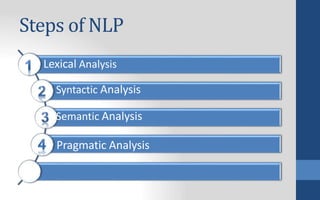
Steps of NLP
Lexical Analysis
Syntactic Analysis
Semantic Analysis
Pragmatic Analysis
Lexical Analysis
• The lexicon of a language is its vocabulary that includes its
words and expressions
• Morphology depicts analyzing, identifying and description of
structure of words
• Lexical analysis involves dividing a text into paragraphs, words
and the sentences
Syntactic Analysis
• Syntax concerns the proper ordering of words and its affect on
meaning
• This involves analysis of the words in a sentence to depict the
grammatical structure of the sentence
• The words are transformed into structure that shows how the
words are related to each other
• Eg. “the girl the go to the school”. This would definitely be
rejected by the English syntactic analyzer
Semantic Analysis
• Semantics concerns the (literal) meaning of words, phrases,
and sentences
• This abstracts the dictionary meaning or the exact meaning
from context
• E.g.. “colorless blue idea” .This would be rejected by the
analyzer as colorless blue do not make any sense together
Pragmatic Analysis
• Pragmatics concerns the overall communicative and social
context and its effect on interpretation
• It means abstracting or deriving the purposeful use of the
language in situations
• Importantly those aspects of language which require world
knowledge
• The main focus is on what was said is reinterpreted on what it
actually means
• E.g. “close the window?” should have been interpreted as a
request rather than an order
Natural Language Processing.pptx

Natural Language Processing.pptx

  • 1.
  • 2.
    What is naturallanguage processing? • Process information contained in natural language text or speech • Also known as Computational Linguistics (CL), Human Language Technology (HLT), Natural Language Engineering (NLE)
  • 3.
    COMPONENTS AND PROCESS •Components of NLP • Steps of NLP 3
  • 4.
    Components of NLP •Natural Language Understanding • Taking some spoken/typed sentence and working out what it means • Natural Language Generation • Taking some formal representation of what you want to say and working out a way to express it in a natural (human) language (e.g., English)
  • 5.
    Components of NLP(cont.) • Natural Language Understanding • Mapping the given input in the natural language into a useful representation • Different level of analysis required: • lexical analysis • syntactic analysis • semantic analysis • pragmatic analysis
  • 6.
    Components of NLP(cont.) • Natural Language Generation • Producing output in the natural language from some internal representation • NL Understanding is much harder than NL Generation. But, still both of them are hard
  • 7.
    Steps of NLP LexicalAnalysis Syntactic Analysis Semantic Analysis Pragmatic Analysis
  • 8.
    Lexical Analysis • Thelexicon of a language is its vocabulary that includes its words and expressions • Morphology depicts analyzing, identifying and description of structure of words • Lexical analysis involves dividing a text into paragraphs, words and the sentences
  • 9.
    Syntactic Analysis • Syntaxconcerns the proper ordering of words and its affect on meaning • This involves analysis of the words in a sentence to depict the grammatical structure of the sentence • The words are transformed into structure that shows how the words are related to each other • Eg. “the girl the go to the school”. This would definitely be rejected by the English syntactic analyzer
  • 10.
    Semantic Analysis • Semanticsconcerns the (literal) meaning of words, phrases, and sentences • This abstracts the dictionary meaning or the exact meaning from context • E.g.. “colorless blue idea” .This would be rejected by the analyzer as colorless blue do not make any sense together
  • 11.
    Pragmatic Analysis • Pragmaticsconcerns the overall communicative and social context and its effect on interpretation • It means abstracting or deriving the purposeful use of the language in situations • Importantly those aspects of language which require world knowledge • The main focus is on what was said is reinterpreted on what it actually means • E.g. “close the window?” should have been interpreted as a request rather than an order