Mod 5
Processing Information
Intersections
Curves & Hills
Passing
Processing InformationProcessing Information
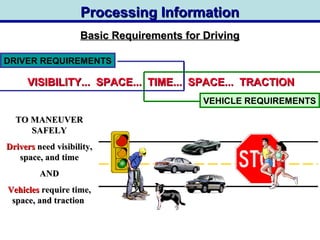
Basic Requirements for DrivingBasic Requirements for Driving
VISIBILITY... SPACE... TIME... SPACE... TRACTIONVISIBILITY... SPACE... TIME... SPACE... TRACTION
DRIVER REQUIREMENTS
VEHICLE REQUIREMENTS
TO MANEUVERTO MANEUVER
SAFELYSAFELY
DriversDrivers need visibility,need visibility,
space, and timespace, and time
ANDAND
VehiclesVehicles require time,require time,
space, and tractionspace, and traction
Good searching technique…
•How, When, Where &
What to search for
Field of VisionField of Vision
**90 percent of driving decisions are based**90 percent of driving decisions are based
on information gathered with the eyes.on information gathered with the eyes.
Area a Driver Can See While Looking Straight AheadArea a Driver Can See While Looking Straight Ahead
PeripheralPeripheral
VisionVision
Central VisionCentral Vision
Focus VisionFocus Vision
Motion & ColorMotion & Color
ChangesChanges
TargetingTargeting
(Reading Signs)(Reading Signs)
Viewing Path of TravelViewing Path of Travel
SearchingSearching
Position of VehiclePosition of Vehicle
Speed of VehicleSpeed of Vehicle
Looking for Clues from Other DriversLooking for Clues from Other Drivers
Actions of the DriverActions of the Driver
DistractionsDistractions
•Cell PhoneCell Phone
•PassengersPassengers
LostLost
ImpairedImpaired
Vehicle SignalsVehicle Signals
•TurningTurning
•BackingBacking
•Hazard LightsHazard Lights
•Hand SignalsHand Signals
HeadlightsHeadlights
HornHorn
Brake LightsBrake Lights
The brain
must be
programmed
as to what to
look for,
identifying
potential
hazards.
Managing Visual SearchesManaging Visual Searches
4- to 8-Second Search Area4- to 8-Second Search Area
• Immediate Path of Travel
• Direct Response Area
• Stopping Zone and Following Interval
20- to20- to
30-sec.30-sec.
12- to12- to
15-sec.15-sec.
4- to4- to
8-sec.8-sec.
1-2 Seconds is INADEQUATE!
Managing Visual SearchesManaging Visual Searches
Search for Closed or Changing Path of Travel
Identify an Alternate Path of Travel or a Safe Stopping Zone
Evaluate Open Zones to the Sides and Rear
12- to 15-Second Search Area12- to 15-Second Search Area
20- to20- to
30-sec.30-sec.
12- to12- to
15-sec.15-sec.
4- to 8-4- to 8-
sec.sec.
Managing Visual SearchesManaging Visual Searches
Search far ahead to identify potential conflictsSearch far ahead to identify potential conflicts
• Objects in Path of Travel
• Limitations to Line of Sight
20- to 30-Second Search Area20- to 30-Second Search Area
TargetTarget
AreaArea
20- to20- to
30-sec.30-sec.
12- to12- to
15-sec.15-sec.
4- to 8-4- to 8-
sec.sec.
IntersectionsIntersections
Processing Highway ConditionsProcessing Highway Conditions
RoadwayRoadway
StructureStructure
•Width
•Curbing
•Curves
•Slopes
RoadwayRoadway
SurfaceSurface
•Roughness
•Slick
•Wet Leaves
•Mud
•Sand
Roadway FeaturesRoadway Features
•Shoulders
•Affixed Objects
•Adjacent Buildings
AtmosphereAtmosphere
•Illumination
•Glare
•Precipitation
•Wind/Noise
HighwayHighway
ConditionsConditions
Processing TRAFFIC CONTROL DevicesProcessing TRAFFIC CONTROL Devices
SignsSigns
•Regulatory
•Warning
•Guide
•RR
SignalsSignals
•Stop/Go
•Lane Usage
•Flashing
InterchangesInterchanges
RoadwayRoadway
MarkingsMarkings
•Passing
•Traffic Flow
•Crosswalks
UnmarkedUnmarked
IntersectionsIntersections
SensorySensory
Input to theInput to the
BrainBrain
Motor VehiclesMotor Vehicles
Road HandlingRoad Handling
CharacteristicsCharacteristics
TypeType
•AutomobileAutomobile
•SUVSUV
•CamperCamper
•Pick-upPick-up
•Motor HomeMotor Home
•MotorcycleMotorcycle
•Farm MachinesFarm Machines
•Tractor-TrailerTractor-Trailer
Drivers mustDrivers must
understand theunderstand the
handlinghandling
characteristics ofcharacteristics of
other motor vehiclesother motor vehicles
sharing the roadway.sharing the roadway.
Non-MotorizedNon-Motorized Users…Users…
• KIND AND SIZE
• NUMBERS
• AGE OF RIDER
• ACTIVITY
• RIDER ABILITY
In-Line Skates,
Skateboards
Pedestrians
Bicycles
present special processing challengespresent special processing challenges
Animals
IntersectionsIntersections
Check left & right for
traffic & pedestrians.
Check ahead for
oncoming traffic turning
left.
Count to 3 to allow
other vehicles to clear.
Crossing a two lane
road takes about 6 sec.
Gaps in trafficGaps in traffic
If a vehicle is approaching at 30 MPH (45 FPS), you
will need a gap of 270 FT to safely cross the
intersection.
If a vehicle is approaching at 50 MPH (75 FPS), you
will need a gap of 450 FT to safely cross the
intersection
Understanding Lane MarkingsUnderstanding Lane Markings
Shared Left Turn LaneShared Left Turn Lane
Drivers traveling in eitherDrivers traveling in either
direction may use this lane fordirection may use this lane for
making left turns.making left turns.
Drivers may not travel furtherDrivers may not travel further
than 150 feet in this sharedthan 150 feet in this shared
lane.lane.
Driver may use the shared leftDriver may use the shared left
turn lane to enter a street fromturn lane to enter a street from
a driveway.a driveway.
Always turn from the lane
that you are in to the lane that
corresponds to that lane.
Inside to inside
Outside to outside
What’s wrong with this
picture?
Limited Line of Sight Through CurvesLimited Line of Sight Through Curves
Line of Sight Over HillLine of Sight Over Hill
 Line of Sight isLine of Sight is
Restricted Up andRestricted Up and
DownDown
 Car drifting overCar drifting over
the center line,the center line,
lane blockedlane blocked
 Lane position 3Lane position 3
provides the bestprovides the best
space cushionspace cushion
 No escape routesNo escape routes
Apex
Always slow down
before the curve!
Begin accelerating at
the APEX, which will
help bring car out of
the curve
Must know what is
behind you in case
you must brake
unexpectedly
Curves & Hills
Identifying a Safe and Legal Passing ZoneIdentifying a Safe and Legal Passing Zone
Determining Passing Time/Space NeedsDetermining Passing Time/Space Needs
2. the timetime you will need to pass safely
3.3. thethe spacespace you will need to safely pass the other vehicle
Before you pass, you must determine:Before you pass, you must determine:
TRAVEL TIME = SPACE
Formula – Speed + ½ speed = feet per second (fps) traveled
60 mph -- 60 + 30 = 90 fps
1.1. if you are in a legal passing zoneif you are in a legal passing zone
• broken line = pass withbroken line = pass with
cautioncaution
• solid line = no passingsolid line = no passing
• list other areas where passinglist other areas where passing
is prohibitedis prohibited
Determining Passing Time/Space NeedsDetermining Passing Time/Space Needs
2 Second Space 60
fps X 2 = 120 ft.
Total distance traveled: 13 sec. X 60 fps. = 780 ft.
2 sec. following distance = 120 ft.
1 car length = 15 ft.
1 sec. gap = 60 ft
Total additional distance
traveled = 195 ft.
Time needed to pass:
195 ft. /15 ft. = 13 sec.
Total distance traveled:
13 sec. X 60 fps. = 780 ft.
Distance traveled = speed + ½ speed in feet per second
Time to pass = distance traveled to complete pass,
divided by difference in distance traveled per second
by each vehicle
RED car traveling 40 mph = 60 fps
(40 mph X 1.5 fps = 60 fps)
BLUE car traveling 30 mph = 45 fps
(30 mph X 1.5 fps = 45 fps)
60 ft - 45 ft = 15 ft.
Red car is traveling 15 fps faster than Blue car
Judging Time and Space Needed to Pass SafelyJudging Time and Space Needed to Pass Safely
1 car length
= 15 feet
1 Second Space
60 fps x 1 = 60 ft
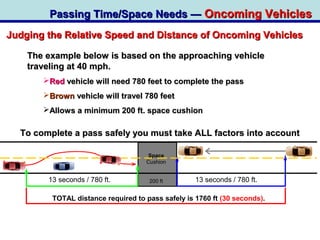
13 seconds / 780 ft. 13 seconds / 780 ft.
Space
Cushion
200 ft
TOTAL distance required to pass safely is 1760 ft (30 seconds).
To complete a pass safely you must take ALL factors into accountTo complete a pass safely you must take ALL factors into account
Judging the Relative Speed and Distance of Oncoming VehiclesJudging the Relative Speed and Distance of Oncoming Vehicles
Passing Time/Space Needs —Passing Time/Space Needs — Oncoming VehiclesOncoming Vehicles
The example below is based on the approaching vehicleThe example below is based on the approaching vehicle
traveling at 40 mph.traveling at 40 mph.
RedRed vehicle will need 780 feet to complete the passvehicle will need 780 feet to complete the pass
BrownBrown vehicle will travel 780 feetvehicle will travel 780 feet
Allows a minimum 200 ft. space cushionAllows a minimum 200 ft. space cushion
Passing Considerations —Passing Considerations — Larger VehiclesLarger Vehicles
Passing a 90-foot tractor trailerPassing a 90-foot tractor trailer
• Would require an additional 5 secondsWould require an additional 5 seconds
for thefor the RedRed vehiclevehicle
90-foot truck + 15-foot car = 75 feet additional90-foot truck + 15-foot car = 75 feet additional
distance traveled = 5 secondsdistance traveled = 5 seconds
• 18 seconds x 60 fps = 1080 feet18 seconds x 60 fps = 1080 feet
needed byneeded by RedRed vehiclevehicle
If there is an oncoming vehicleIf there is an oncoming vehicle
traveling 40 mph, the total cleartraveling 40 mph, the total clear
distance needed to pass safelydistance needed to pass safely
becomes 1360 feet (23 seconds)becomes 1360 feet (23 seconds)
1080 + 1080 + 200 (space cushion)1080 + 1080 + 200 (space cushion)
DaylightDaylight
Headlight UseHeadlight Use
Enhances SafetyEnhances Safety
• an approaching vehicle without
headlights becomes visible at
about 2,200 to 2,500 feet
• an approaching vehicle with
headlights becomes visible at
distances up to 4500 feet
Passing on Multi-lane
Roadways
• safer than on two lane roadways
• head-on crashes are rare
• will not feel rushed into returning
to the lane
• can safely pass larger vehicles
that require more time and
space to pass
Passing ProceduresPassing Procedures
2 – 3 Seconds
Prepare to Pass:Prepare to Pass:
• Position vehicle two
to three seconds
behind the vehicle
to be passed.
• Check mirrors, blind
spot and oncoming
traffic.
• Check ahead for
safe passing
distance.
• Signal intention.
Overtake the OngoingOvertake the Ongoing
Vehicle:Vehicle:
• Accelerate into passing
lane.
• Accelerate quickly to a
legal appropriate speed.
• Monitor the path ahead.
• Check the mirror for
following vehicles.
Return to Lane:Return to Lane:
• Check rear-view
mirror for the front
of the vehicle being
passed.
• Signal intention.
• Change lanes and
maintain speed.
• Cancel turn signal.
5 Places Passing is NOT Permitted
1.Hills
2.Curves
3.RR crossings
4.Intersections
5.Solid yellow lines
Daytime Running Lights
They increase the chance of
others seeing you—making your
car more visible
Safe to return to your lane after a pass?
When you can see the other
vehicles headlights or grill in your
rear view mirror.

Module 5 2009

  • 1.
  • 2.
    Processing InformationProcessing Information BasicRequirements for DrivingBasic Requirements for Driving VISIBILITY... SPACE... TIME... SPACE... TRACTIONVISIBILITY... SPACE... TIME... SPACE... TRACTION DRIVER REQUIREMENTS VEHICLE REQUIREMENTS TO MANEUVERTO MANEUVER SAFELYSAFELY DriversDrivers need visibility,need visibility, space, and timespace, and time ANDAND VehiclesVehicles require time,require time, space, and tractionspace, and traction
  • 3.
    Good searching technique… •How,When, Where & What to search for
  • 4.
    Field of VisionFieldof Vision **90 percent of driving decisions are based**90 percent of driving decisions are based on information gathered with the eyes.on information gathered with the eyes. Area a Driver Can See While Looking Straight AheadArea a Driver Can See While Looking Straight Ahead PeripheralPeripheral VisionVision Central VisionCentral Vision Focus VisionFocus Vision Motion & ColorMotion & Color ChangesChanges TargetingTargeting (Reading Signs)(Reading Signs) Viewing Path of TravelViewing Path of Travel
  • 5.
    SearchingSearching Position of VehiclePositionof Vehicle Speed of VehicleSpeed of Vehicle Looking for Clues from Other DriversLooking for Clues from Other Drivers Actions of the DriverActions of the Driver DistractionsDistractions •Cell PhoneCell Phone •PassengersPassengers LostLost ImpairedImpaired Vehicle SignalsVehicle Signals •TurningTurning •BackingBacking •Hazard LightsHazard Lights •Hand SignalsHand Signals HeadlightsHeadlights HornHorn Brake LightsBrake Lights The brain must be programmed as to what to look for, identifying potential hazards.
  • 6.
    Managing Visual SearchesManagingVisual Searches 4- to 8-Second Search Area4- to 8-Second Search Area • Immediate Path of Travel • Direct Response Area • Stopping Zone and Following Interval 20- to20- to 30-sec.30-sec. 12- to12- to 15-sec.15-sec. 4- to4- to 8-sec.8-sec. 1-2 Seconds is INADEQUATE!
  • 7.
    Managing Visual SearchesManagingVisual Searches Search for Closed or Changing Path of Travel Identify an Alternate Path of Travel or a Safe Stopping Zone Evaluate Open Zones to the Sides and Rear 12- to 15-Second Search Area12- to 15-Second Search Area 20- to20- to 30-sec.30-sec. 12- to12- to 15-sec.15-sec. 4- to 8-4- to 8- sec.sec.
  • 8.
    Managing Visual SearchesManagingVisual Searches Search far ahead to identify potential conflictsSearch far ahead to identify potential conflicts • Objects in Path of Travel • Limitations to Line of Sight 20- to 30-Second Search Area20- to 30-Second Search Area TargetTarget AreaArea 20- to20- to 30-sec.30-sec. 12- to12- to 15-sec.15-sec. 4- to 8-4- to 8- sec.sec.
  • 9.
    IntersectionsIntersections Processing Highway ConditionsProcessingHighway Conditions RoadwayRoadway StructureStructure •Width •Curbing •Curves •Slopes RoadwayRoadway SurfaceSurface •Roughness •Slick •Wet Leaves •Mud •Sand Roadway FeaturesRoadway Features •Shoulders •Affixed Objects •Adjacent Buildings AtmosphereAtmosphere •Illumination •Glare •Precipitation •Wind/Noise HighwayHighway ConditionsConditions
  • 10.
    Processing TRAFFIC CONTROLDevicesProcessing TRAFFIC CONTROL Devices SignsSigns •Regulatory •Warning •Guide •RR SignalsSignals •Stop/Go •Lane Usage •Flashing InterchangesInterchanges RoadwayRoadway MarkingsMarkings •Passing •Traffic Flow •Crosswalks UnmarkedUnmarked IntersectionsIntersections SensorySensory Input to theInput to the BrainBrain
  • 11.
    Motor VehiclesMotor Vehicles RoadHandlingRoad Handling CharacteristicsCharacteristics TypeType •AutomobileAutomobile •SUVSUV •CamperCamper •Pick-upPick-up •Motor HomeMotor Home •MotorcycleMotorcycle •Farm MachinesFarm Machines •Tractor-TrailerTractor-Trailer Drivers mustDrivers must understand theunderstand the handlinghandling characteristics ofcharacteristics of other motor vehiclesother motor vehicles sharing the roadway.sharing the roadway.
  • 12.
    Non-MotorizedNon-Motorized Users…Users… • KINDAND SIZE • NUMBERS • AGE OF RIDER • ACTIVITY • RIDER ABILITY In-Line Skates, Skateboards Pedestrians Bicycles present special processing challengespresent special processing challenges Animals
  • 13.
    IntersectionsIntersections Check left &right for traffic & pedestrians. Check ahead for oncoming traffic turning left. Count to 3 to allow other vehicles to clear. Crossing a two lane road takes about 6 sec.
  • 14.
    Gaps in trafficGapsin traffic If a vehicle is approaching at 30 MPH (45 FPS), you will need a gap of 270 FT to safely cross the intersection. If a vehicle is approaching at 50 MPH (75 FPS), you will need a gap of 450 FT to safely cross the intersection
  • 15.
    Understanding Lane MarkingsUnderstandingLane Markings Shared Left Turn LaneShared Left Turn Lane Shared Left Turn LaneShared Left Turn Lane Drivers traveling in eitherDrivers traveling in either direction may use this lane fordirection may use this lane for making left turns.making left turns. Drivers may not travel furtherDrivers may not travel further than 150 feet in this sharedthan 150 feet in this shared lane.lane. Driver may use the shared leftDriver may use the shared left turn lane to enter a street fromturn lane to enter a street from a driveway.a driveway.
  • 16.
    Always turn fromthe lane that you are in to the lane that corresponds to that lane. Inside to inside Outside to outside What’s wrong with this picture?
  • 17.
    Limited Line ofSight Through CurvesLimited Line of Sight Through Curves
  • 18.
    Line of SightOver HillLine of Sight Over Hill  Line of Sight isLine of Sight is Restricted Up andRestricted Up and DownDown  Car drifting overCar drifting over the center line,the center line, lane blockedlane blocked  Lane position 3Lane position 3 provides the bestprovides the best space cushionspace cushion  No escape routesNo escape routes
  • 19.
    Apex Always slow down beforethe curve! Begin accelerating at the APEX, which will help bring car out of the curve Must know what is behind you in case you must brake unexpectedly Curves & Hills
  • 20.
    Identifying a Safeand Legal Passing ZoneIdentifying a Safe and Legal Passing Zone Determining Passing Time/Space NeedsDetermining Passing Time/Space Needs 2. the timetime you will need to pass safely 3.3. thethe spacespace you will need to safely pass the other vehicle Before you pass, you must determine:Before you pass, you must determine: TRAVEL TIME = SPACE Formula – Speed + ½ speed = feet per second (fps) traveled 60 mph -- 60 + 30 = 90 fps 1.1. if you are in a legal passing zoneif you are in a legal passing zone • broken line = pass withbroken line = pass with cautioncaution • solid line = no passingsolid line = no passing • list other areas where passinglist other areas where passing is prohibitedis prohibited
  • 21.
    Determining Passing Time/SpaceNeedsDetermining Passing Time/Space Needs 2 Second Space 60 fps X 2 = 120 ft. Total distance traveled: 13 sec. X 60 fps. = 780 ft. 2 sec. following distance = 120 ft. 1 car length = 15 ft. 1 sec. gap = 60 ft Total additional distance traveled = 195 ft. Time needed to pass: 195 ft. /15 ft. = 13 sec. Total distance traveled: 13 sec. X 60 fps. = 780 ft. Distance traveled = speed + ½ speed in feet per second Time to pass = distance traveled to complete pass, divided by difference in distance traveled per second by each vehicle RED car traveling 40 mph = 60 fps (40 mph X 1.5 fps = 60 fps) BLUE car traveling 30 mph = 45 fps (30 mph X 1.5 fps = 45 fps) 60 ft - 45 ft = 15 ft. Red car is traveling 15 fps faster than Blue car Judging Time and Space Needed to Pass SafelyJudging Time and Space Needed to Pass Safely 1 car length = 15 feet 1 Second Space 60 fps x 1 = 60 ft
  • 22.
    13 seconds /780 ft. 13 seconds / 780 ft. Space Cushion 200 ft TOTAL distance required to pass safely is 1760 ft (30 seconds). To complete a pass safely you must take ALL factors into accountTo complete a pass safely you must take ALL factors into account Judging the Relative Speed and Distance of Oncoming VehiclesJudging the Relative Speed and Distance of Oncoming Vehicles Passing Time/Space Needs —Passing Time/Space Needs — Oncoming VehiclesOncoming Vehicles The example below is based on the approaching vehicleThe example below is based on the approaching vehicle traveling at 40 mph.traveling at 40 mph. RedRed vehicle will need 780 feet to complete the passvehicle will need 780 feet to complete the pass BrownBrown vehicle will travel 780 feetvehicle will travel 780 feet Allows a minimum 200 ft. space cushionAllows a minimum 200 ft. space cushion
  • 23.
    Passing Considerations —PassingConsiderations — Larger VehiclesLarger Vehicles Passing a 90-foot tractor trailerPassing a 90-foot tractor trailer • Would require an additional 5 secondsWould require an additional 5 seconds for thefor the RedRed vehiclevehicle 90-foot truck + 15-foot car = 75 feet additional90-foot truck + 15-foot car = 75 feet additional distance traveled = 5 secondsdistance traveled = 5 seconds • 18 seconds x 60 fps = 1080 feet18 seconds x 60 fps = 1080 feet needed byneeded by RedRed vehiclevehicle If there is an oncoming vehicleIf there is an oncoming vehicle traveling 40 mph, the total cleartraveling 40 mph, the total clear distance needed to pass safelydistance needed to pass safely becomes 1360 feet (23 seconds)becomes 1360 feet (23 seconds) 1080 + 1080 + 200 (space cushion)1080 + 1080 + 200 (space cushion) DaylightDaylight Headlight UseHeadlight Use Enhances SafetyEnhances Safety • an approaching vehicle without headlights becomes visible at about 2,200 to 2,500 feet • an approaching vehicle with headlights becomes visible at distances up to 4500 feet Passing on Multi-lane Roadways • safer than on two lane roadways • head-on crashes are rare • will not feel rushed into returning to the lane • can safely pass larger vehicles that require more time and space to pass
  • 24.
    Passing ProceduresPassing Procedures 2– 3 Seconds Prepare to Pass:Prepare to Pass: • Position vehicle two to three seconds behind the vehicle to be passed. • Check mirrors, blind spot and oncoming traffic. • Check ahead for safe passing distance. • Signal intention. Overtake the OngoingOvertake the Ongoing Vehicle:Vehicle: • Accelerate into passing lane. • Accelerate quickly to a legal appropriate speed. • Monitor the path ahead. • Check the mirror for following vehicles. Return to Lane:Return to Lane: • Check rear-view mirror for the front of the vehicle being passed. • Signal intention. • Change lanes and maintain speed. • Cancel turn signal.
  • 25.
    5 Places Passingis NOT Permitted 1.Hills 2.Curves 3.RR crossings 4.Intersections 5.Solid yellow lines
  • 26.
    Daytime Running Lights Theyincrease the chance of others seeing you—making your car more visible
  • 27.
    Safe to returnto your lane after a pass? When you can see the other vehicles headlights or grill in your rear view mirror.