DEPARTMENT OF CIVIL ENGINEERING
FACULTY OF ENGINEERING AND TECHNOLOGY
TRAFFIC SIGNALS
MUHAMMAD YASEEN 32-FET/BSCE/F14
MUHAMMAD JUNAID 35-FET/BSCE/F14
TRAFFIC SIGNALS:
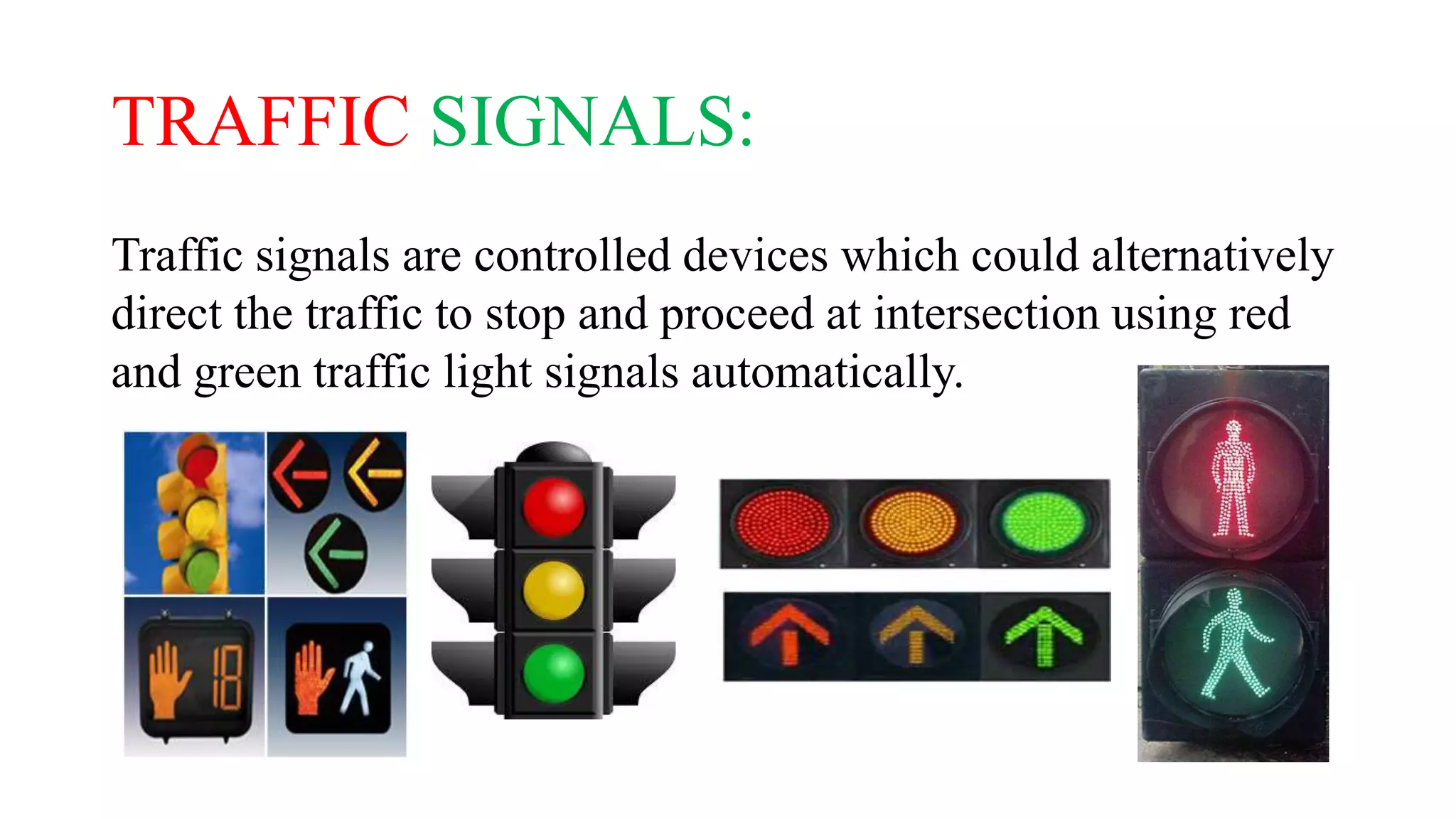
Traffic signals are controlled devices which could alternatively
direct the traffic to stop and proceed at intersection using red
and green traffic light signals automatically.
Purpose of Traffic Signals
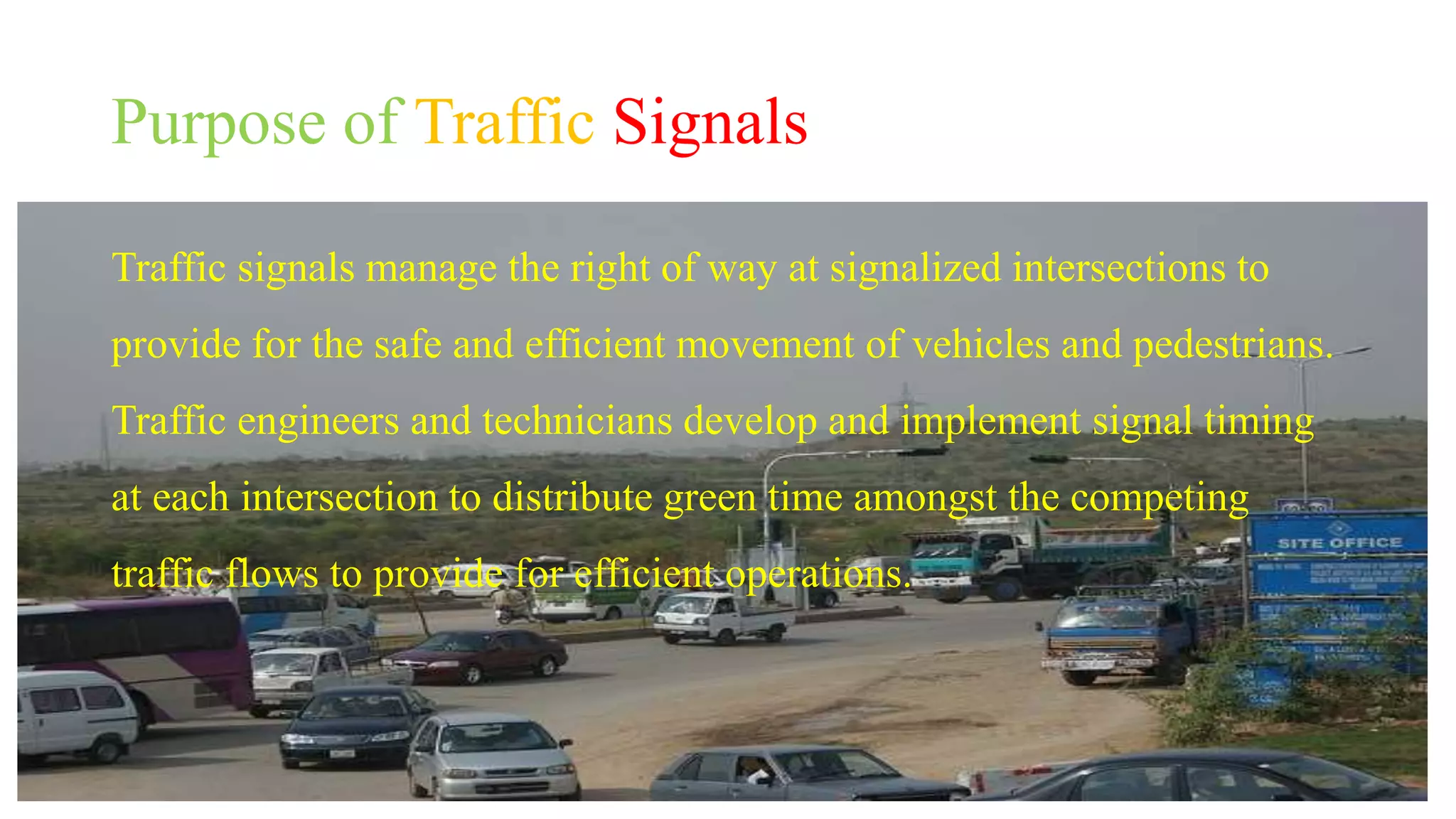
Traffic signals manage the right of way at signalized intersections to
provide for the safe and efficient movement of vehicles and pedestrians.
Traffic engineers and technicians develop and implement signal timing
at each intersection to distribute green time amongst the competing
traffic flows to provide for efficient operations.
NEED OF TRAFFIC SIGNALS
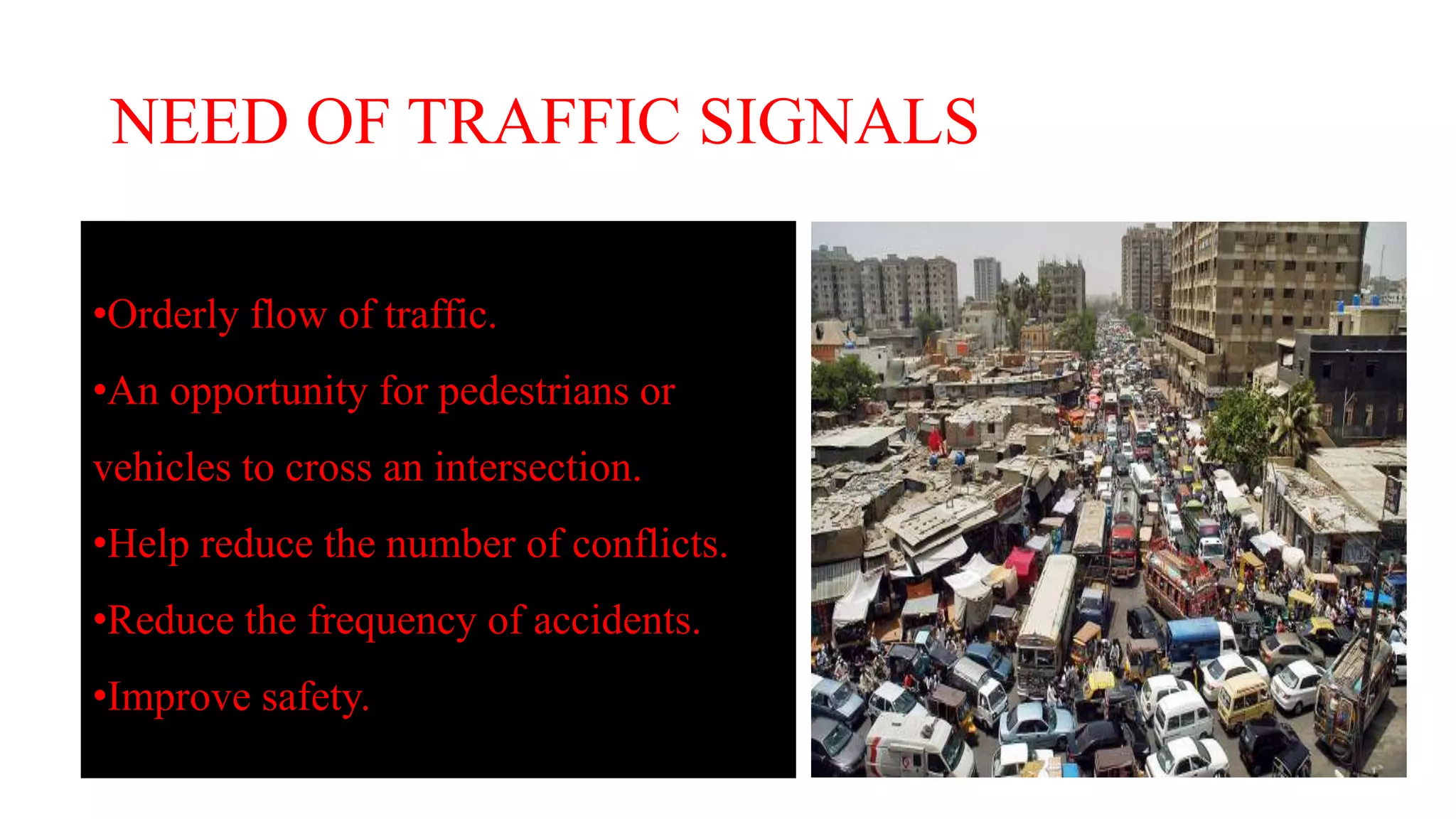
•Orderly flow of traffic.
•An opportunity for pedestrians or
vehicles to cross an intersection.
•Help reduce the number of conflicts.
•Reduce the frequency of accidents.
•Improve safety.
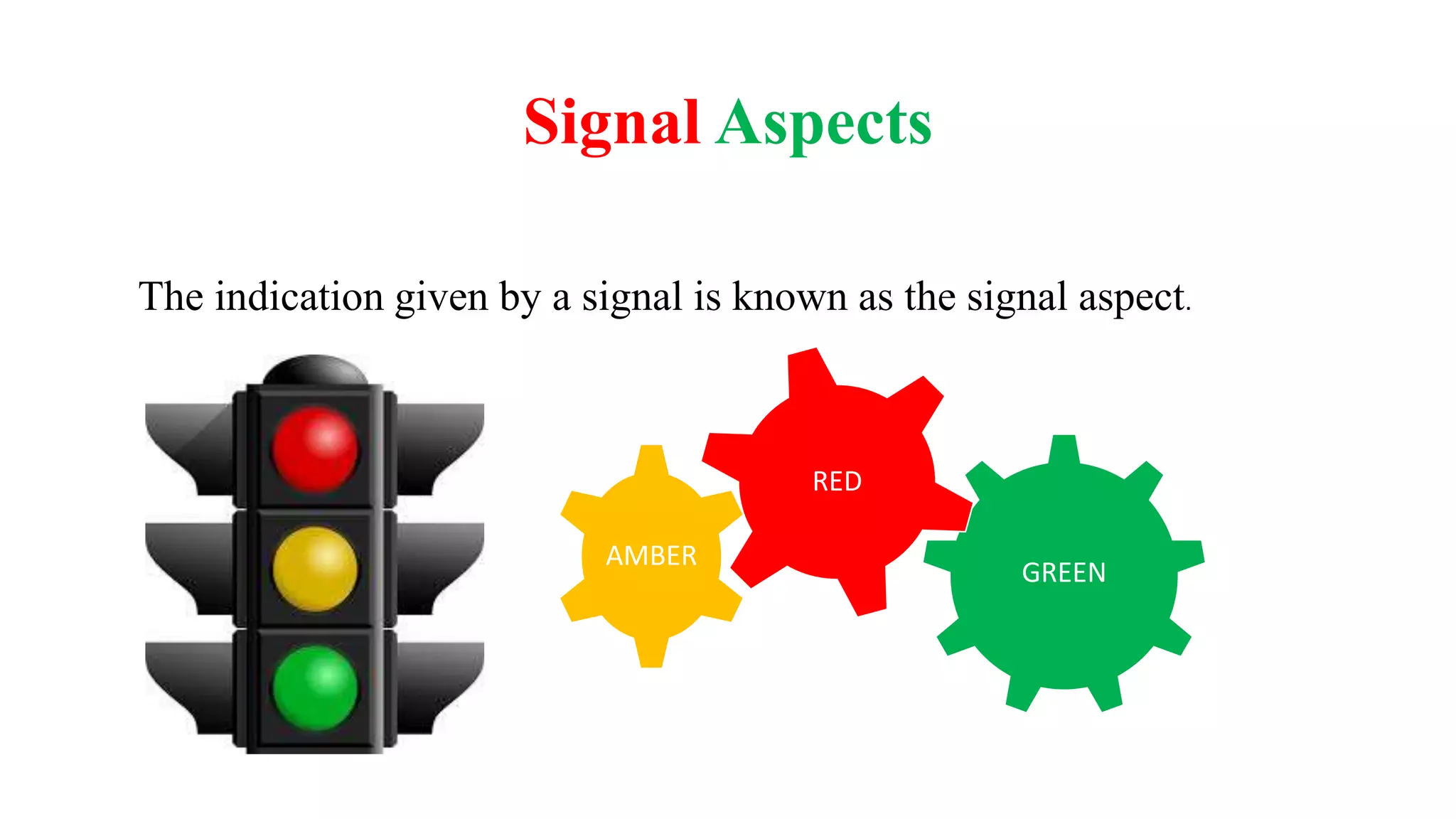
Signal Aspects
GREEN
AMBER
RED
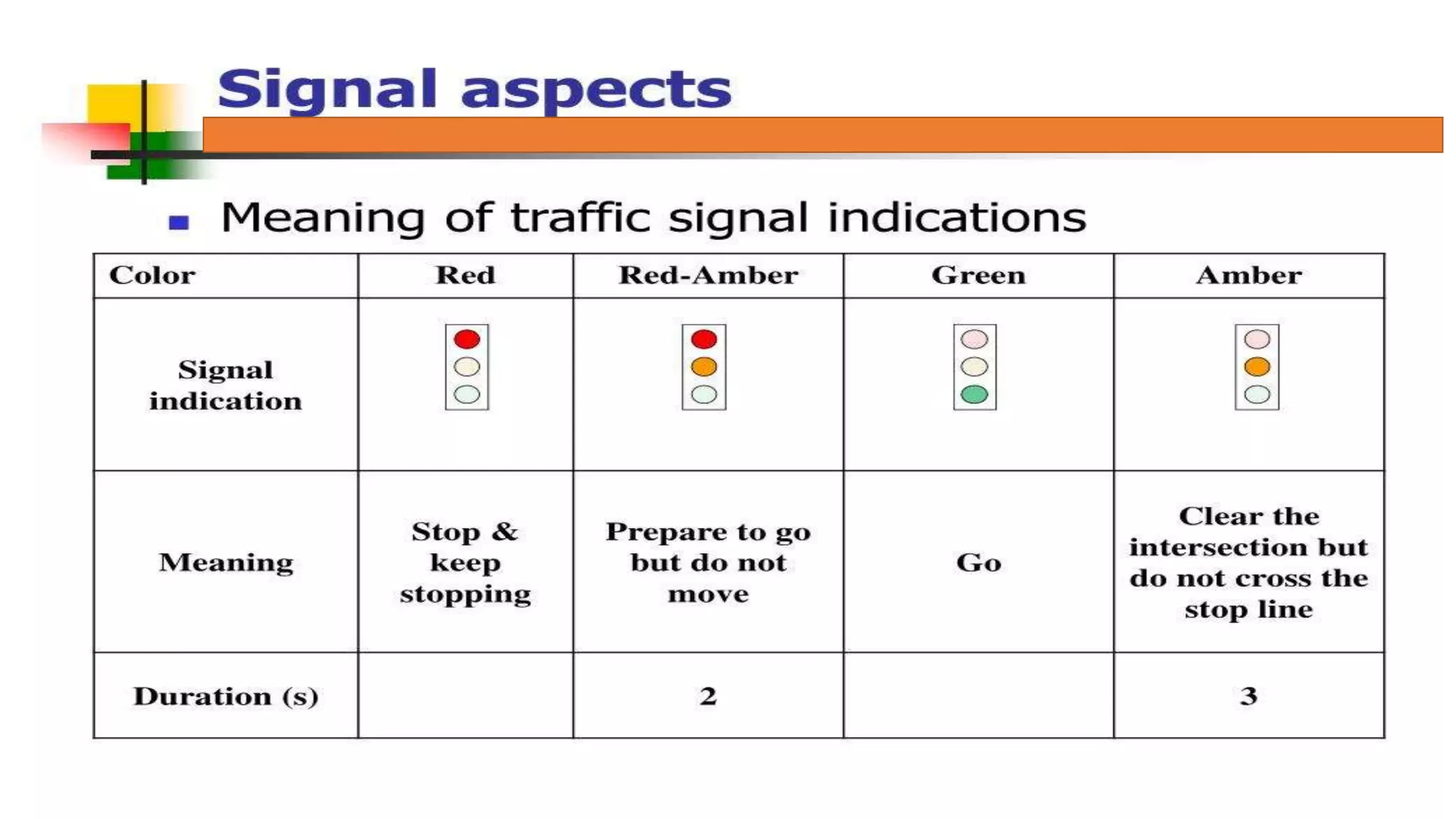
The indication given by a signal is known as the signal aspect.
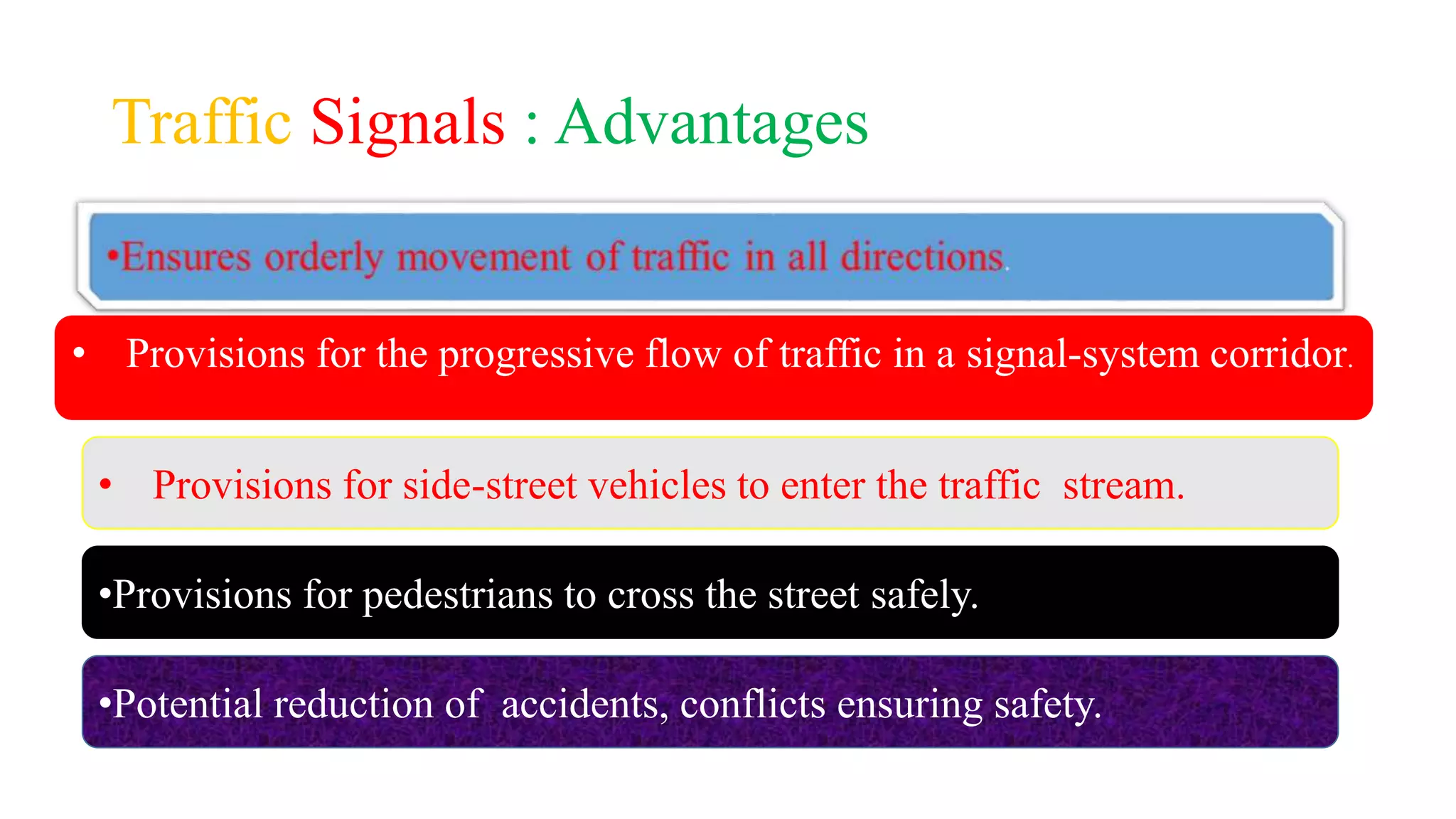
Traffic Signals : Advantages
• Provisions for side-street vehicles to enter the traffic stream.
• Provisions for the progressive flow of traffic in a signal-system corridor.
•Provisions for pedestrians to cross the street safely.
•Potential reduction of accidents, conflicts ensuring safety.
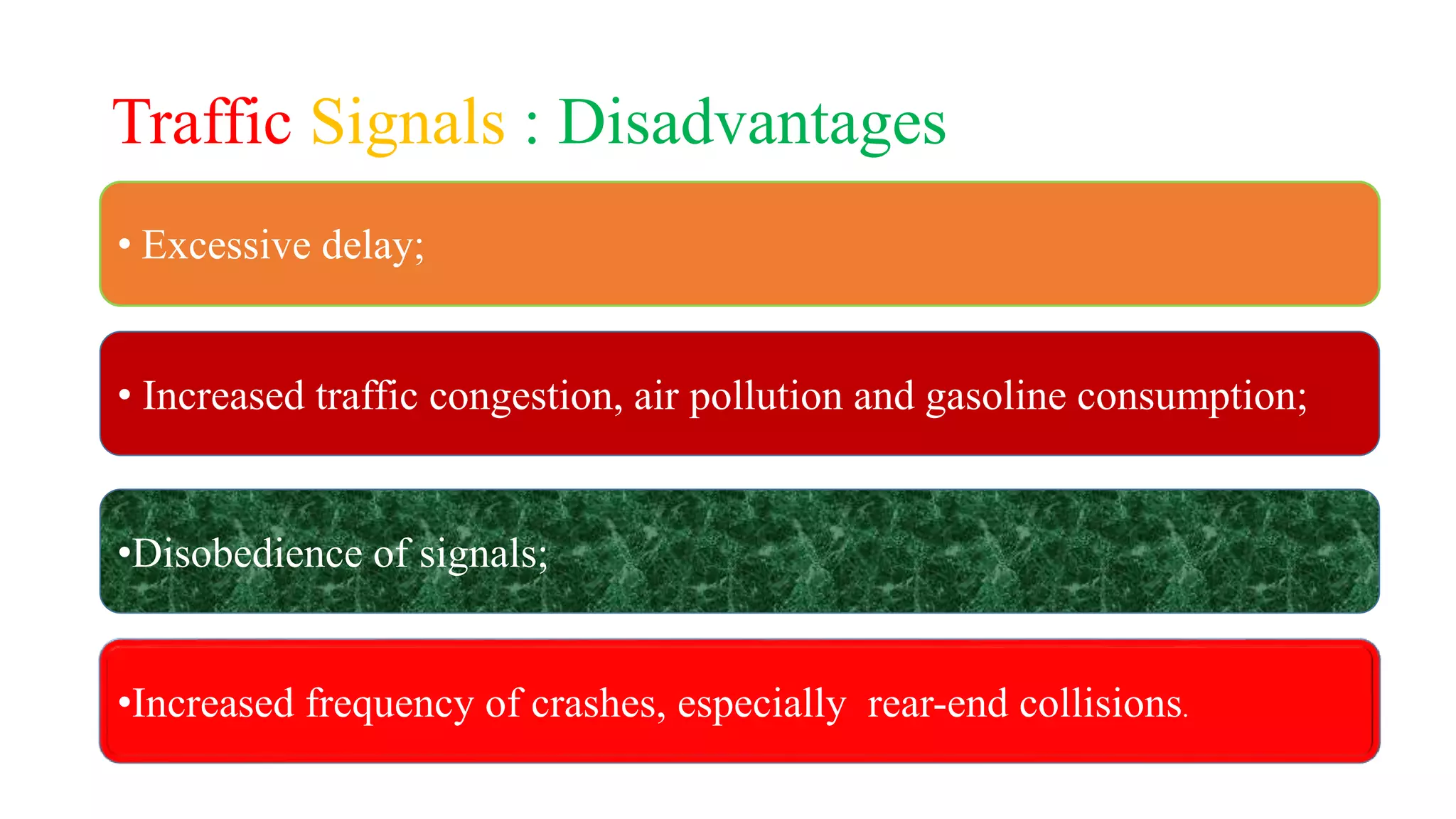
Traffic Signals : Disadvantages
• Excessive delay;
• Increased traffic congestion, air pollution and gasoline consumption;
•Disobedience of signals;
•Increased frequency of crashes, especially rear-end collisions.
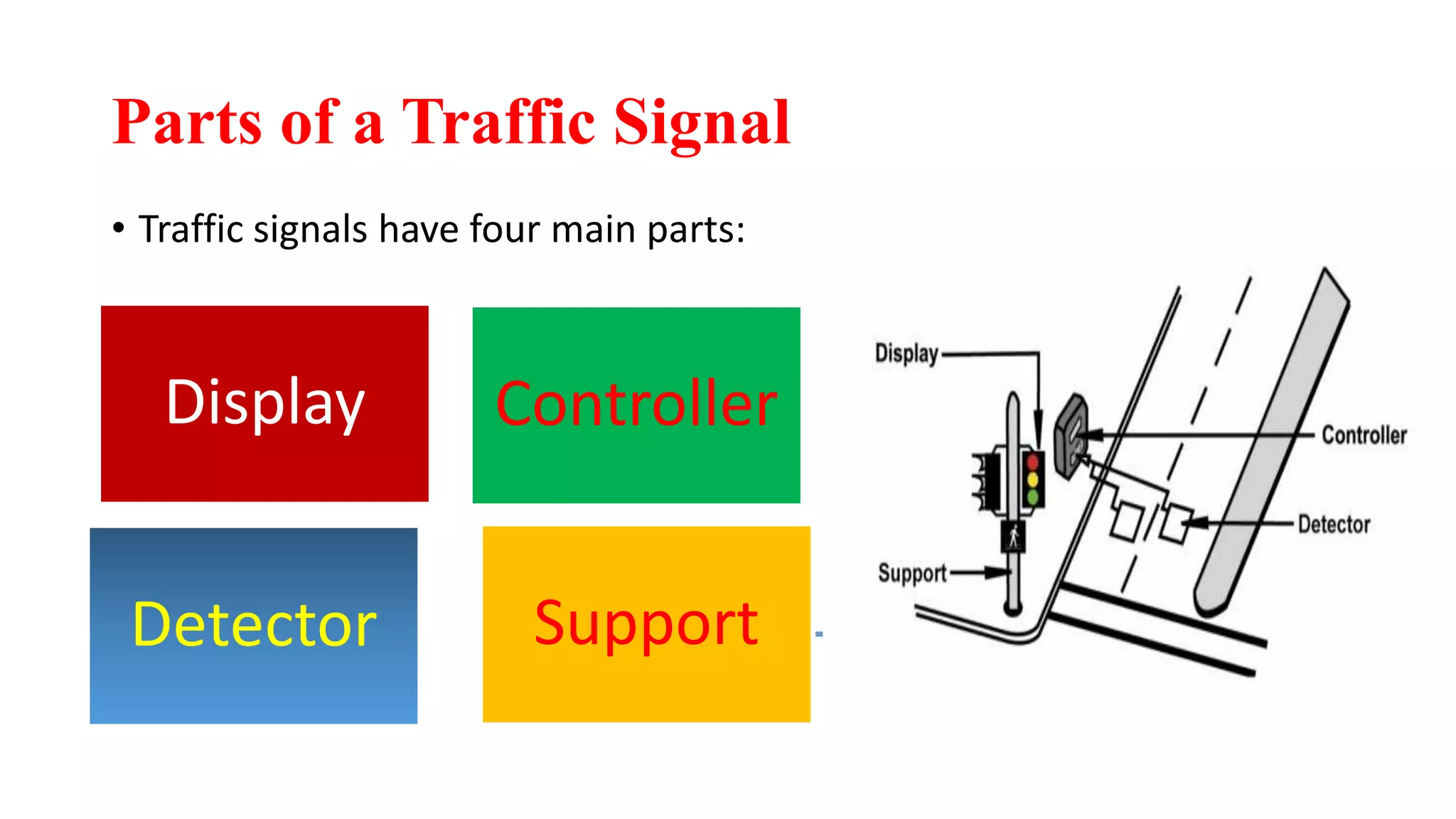
Parts of a Traffic Signal
• Traffic signals have four main parts:
Display Controller
Detector Support
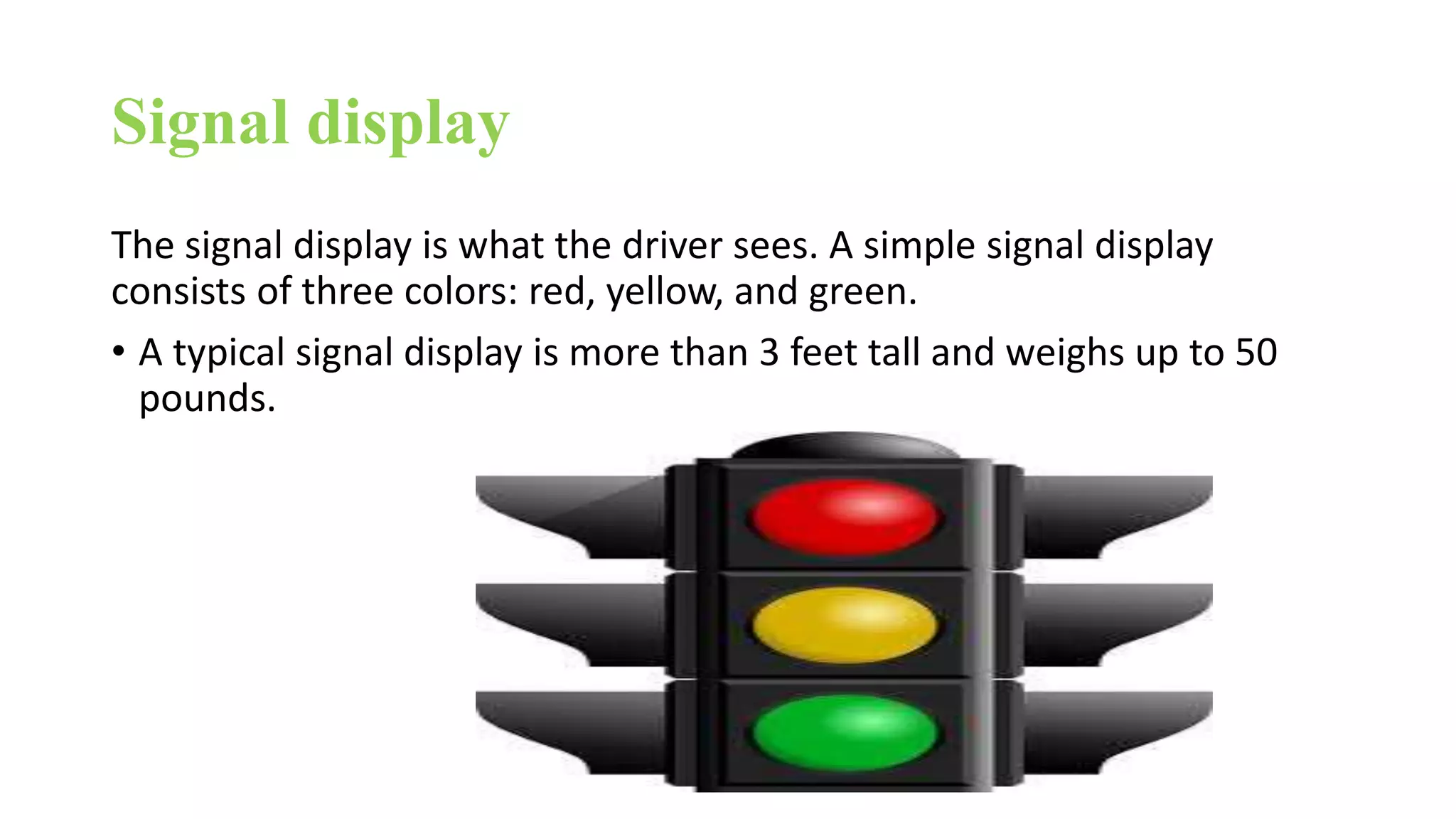
Signal display
The signal display is what the driver sees. A simple signal display
consists of three colors: red, yellow, and green.
• A typical signal display is more than 3 feet tall and weighs up to 50
pounds.
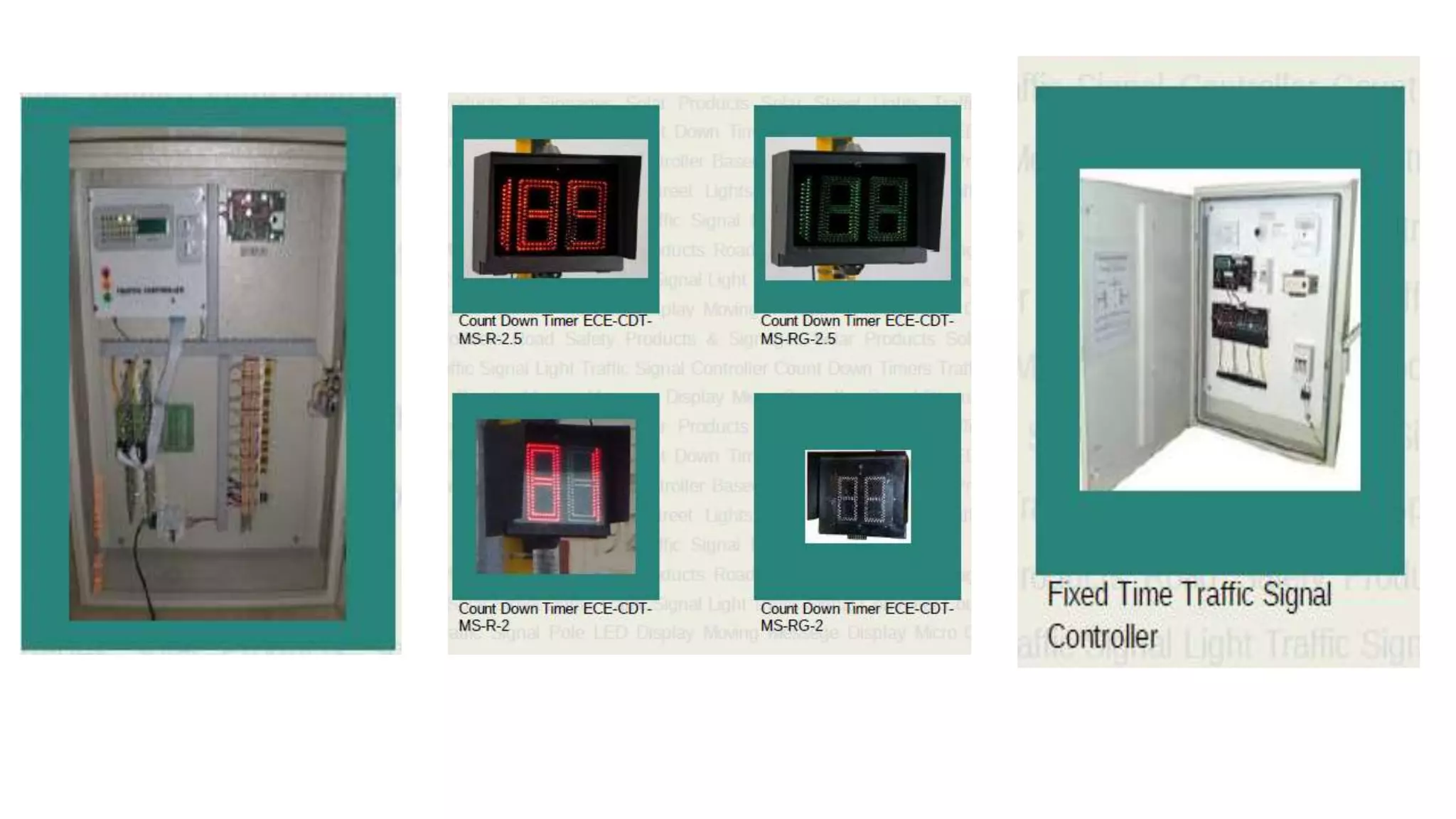
Signal Controller
The traffic signal controller is the “brain” at an intersection that tells each
signal display when to change colors. Years ago, traffic signals were
controlled by a simple electric mechanism that made the display change every
so many seconds, like a clock. These simple mechanisms were not able to
adjust when traffic changed during the day.
Later in the pre-computer era, electromechanical controllers were developed
that could be adjusted for the time of day. These controllers were much like
the switch timers in the local hardware store that have green and red pins to
set lights to go on and off on a predetermined schedule.
CONTINUE…………
Now, computerized traffic signal controllers get real-time information
about the presence of vehicles from sensors in the roadway and on
poles. Controllers adjust the amount of green time for different
movements based on sensor information. The most sophisticated
controllers and software programs allow for the coordination of signals
along a roadway, so that vehicles can travel through a succession of
intersections without having to stop.
DETECTORS
Detectors are used to identify the presence of a vehicle, so that the controller knows
how to adjust the amount of green time to provide. There are many types of
detectors. One type is known as the loop detector. The square black lines you may
see in the roadway as you approach an intersection are the visible part of the loop
detector, which is a thin wire buried in the roadway. When a vehicle drives over the
loop, it sends a message to the signal controller. The signal controller's software
evaluates the messages from all the loops at the intersection and changes the signal
timing appropriately. Small TV cameras can also be used to detect vehicles.
DETECTORS
Types of Signal Operation
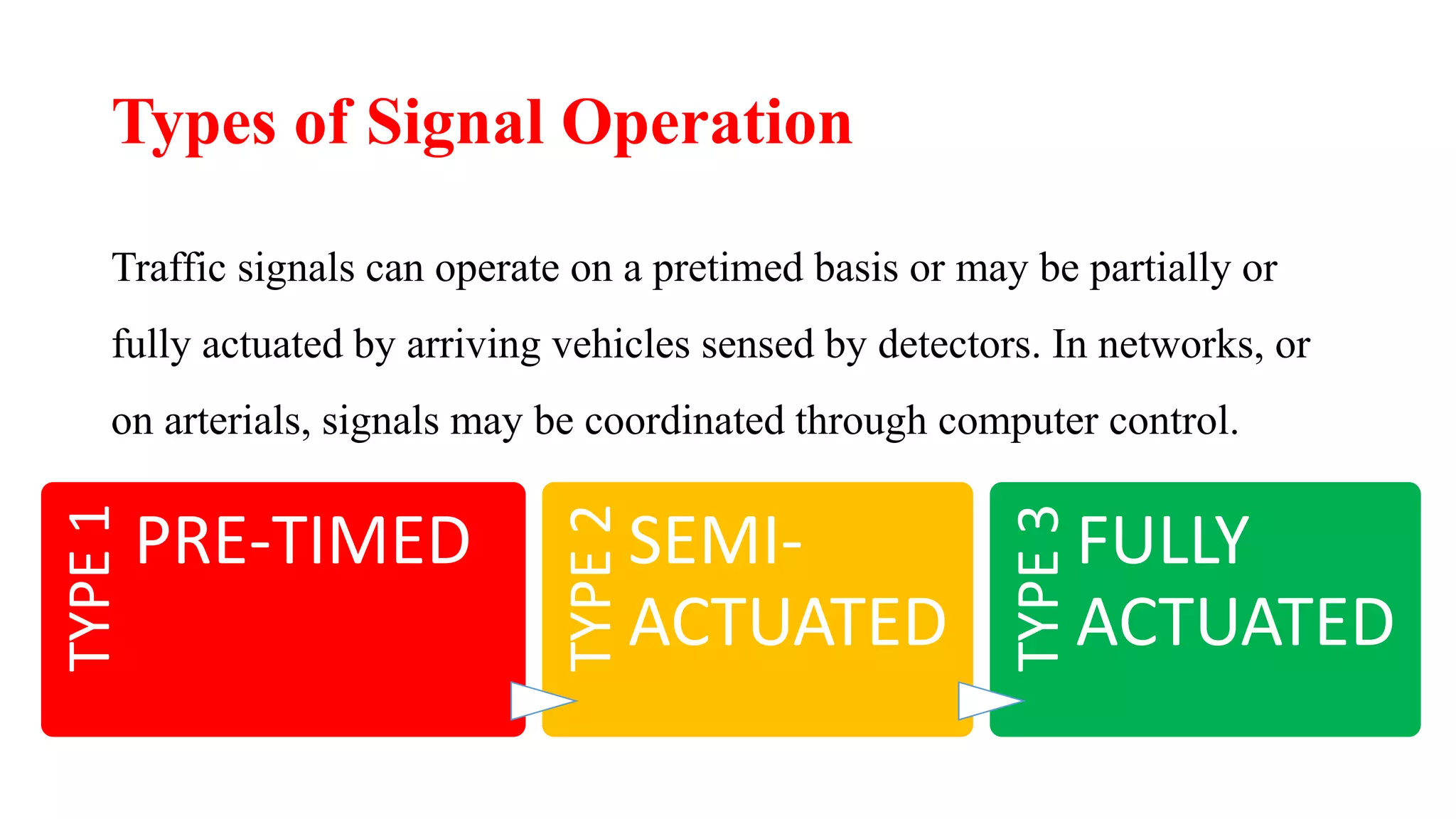
Traffic signals can operate on a pretimed basis or may be partially or
fully actuated by arriving vehicles sensed by detectors. In networks, or
on arterials, signals may be coordinated through computer control.
TYPE1
PRE-TIMED
TYPE2
SEMI-
ACTUATED
TYPE3
FULLY
ACTUATED
Types of Signal Operation
PRE TIMED OPERATION
 A signal whose timing(cycle length,green time etc) is fixed over
specified time period and does not change in response to changes in
traffic flow at the intersection.
No vehicle detection is necessary at this mode of operation.
Pretimed Operation:
In pretimed operation, the cycle length, phase sequence, and timing of
each interval are constant. Each cycle of the signal follows the same
predetermined plan. “Multi-dial” controllers will allow different
pretimed settings to be established. An internal clock is used to activate
the appropriate timing. in such cases, it is typical to have at least an AM
peak, a PM peak, and an off-peak signal timing.
SEMI-ACTUATED OPERATION
 A signal whose timing(cycle length ,green time etc) is affected when
vehicle are detected(by video,inductance loop detecters,embeded-
pavement etc) on some but not all approaches is called semi-
actuated signal.
This mode of operation is found where a low volume road intersect a
high volume road.
Semi-actuated Operation
In semi-actuated operation, detectors are placed on the minor approach(es)
to the intersection; there are no detectors on the major street. The light is
green for the major street at all times except when a “call” or actuation is
noted on one of the minor approaches. Then, subject to limitations such as a
minimum major-street green, the green is transferred to the minor street.
CONTINUE………
The green returns to the major street when the maximum minor
street green is reached or when the detector senses that there is no
further demand on the minor street. Semi-actuated operation is often
used where the primary reason for signalization is ‘‘interruption of
continuous traffic,”
Fully Actuated
• A signal whose timing(cycle length,green time etc) is completely
influenced by the traffic volumes,when detected,on all of the
approaches.
Fully actuated signals are most commonly used at intersections of
two major streets where substantial variation exist in all approach
traffic volumes over the course of a day.
Full Actuated Operation
In full actuated operation, every lane of every approach must be
monitored by a detector. Green time is allocated in accordance with
information from detectors and programmed “rules” established in the
controller for capturing and retaining the green. In full actuated
operation, the cycle length, sequence of phases, and green time split
may vary from cycle to cycle.
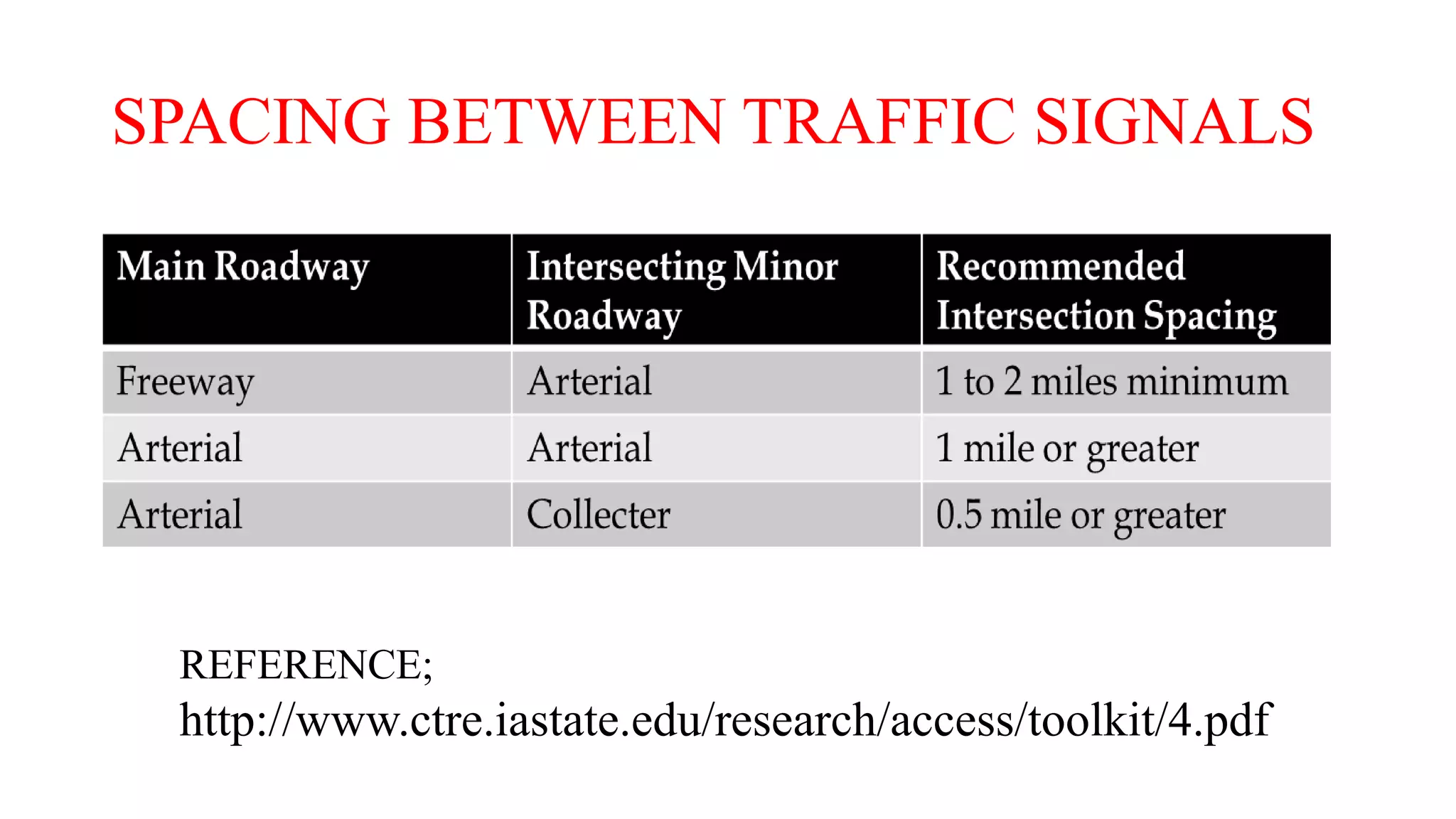
SPACING BETWEEN TRAFFIC SIGNALS
REFERENCE;
http://www.ctre.iastate.edu/research/access/toolkit/4.pdf
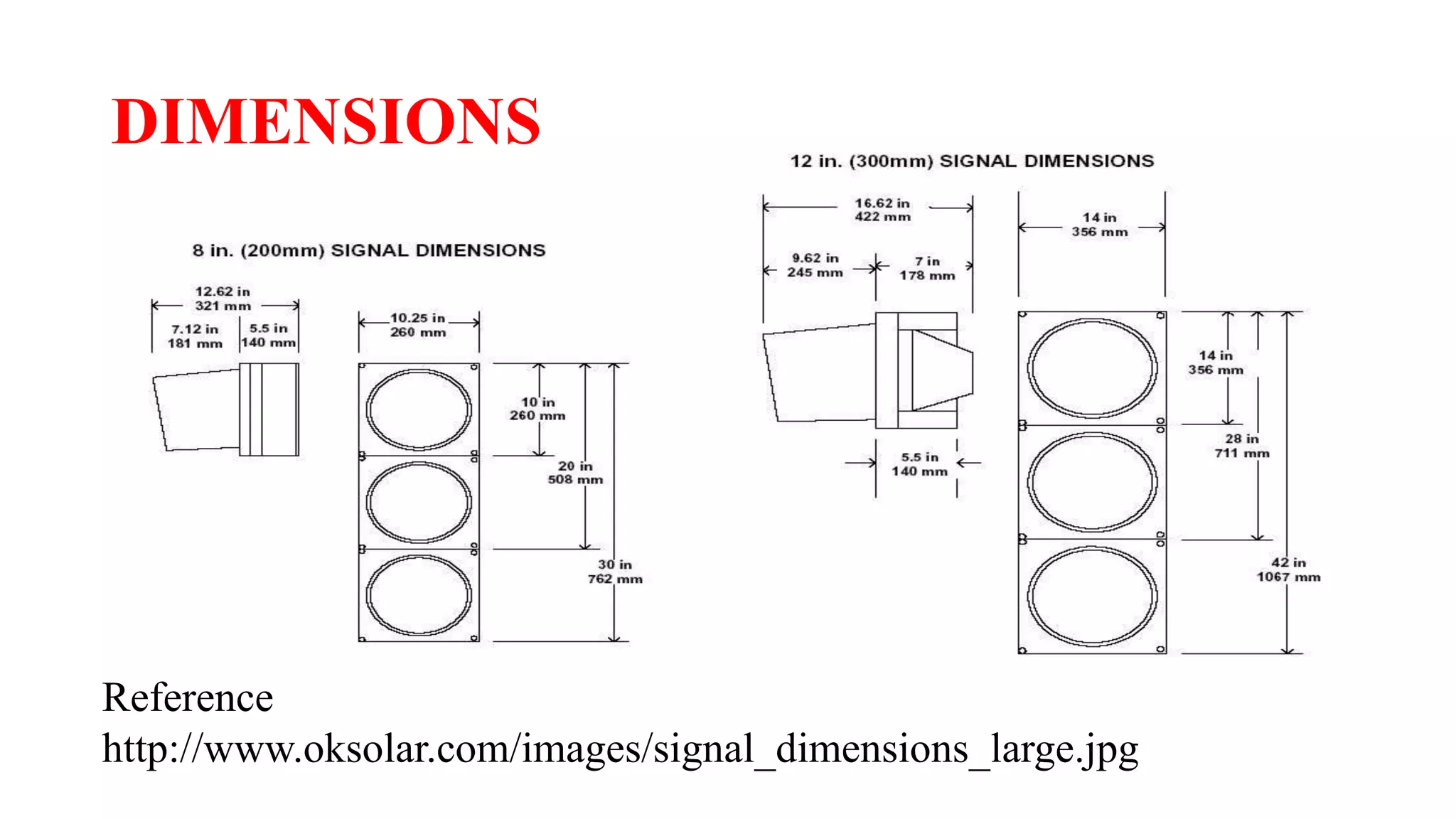
DIMENSIONS
Reference
http://www.oksolar.com/images/signal_dimensions_large.jpg
HEIGHT
Reference;
http://lincoln.ne.gov/city/pworks/engine/dconst/gpp/gppdisc/sigshop/images/height.gif
Pedestrian Signals
Reference;
http://ichef1.bbci.co.uk/news/660/media/images/82931000/jpg/_82931048_trafficlights_
reuters.jpg
CONTINUE………….
BEACONS
• Beacons are generally used to identify a hazard or call attention to a
critical control device, such as a speed and continuously in accordance
with the programmed signal –timing.
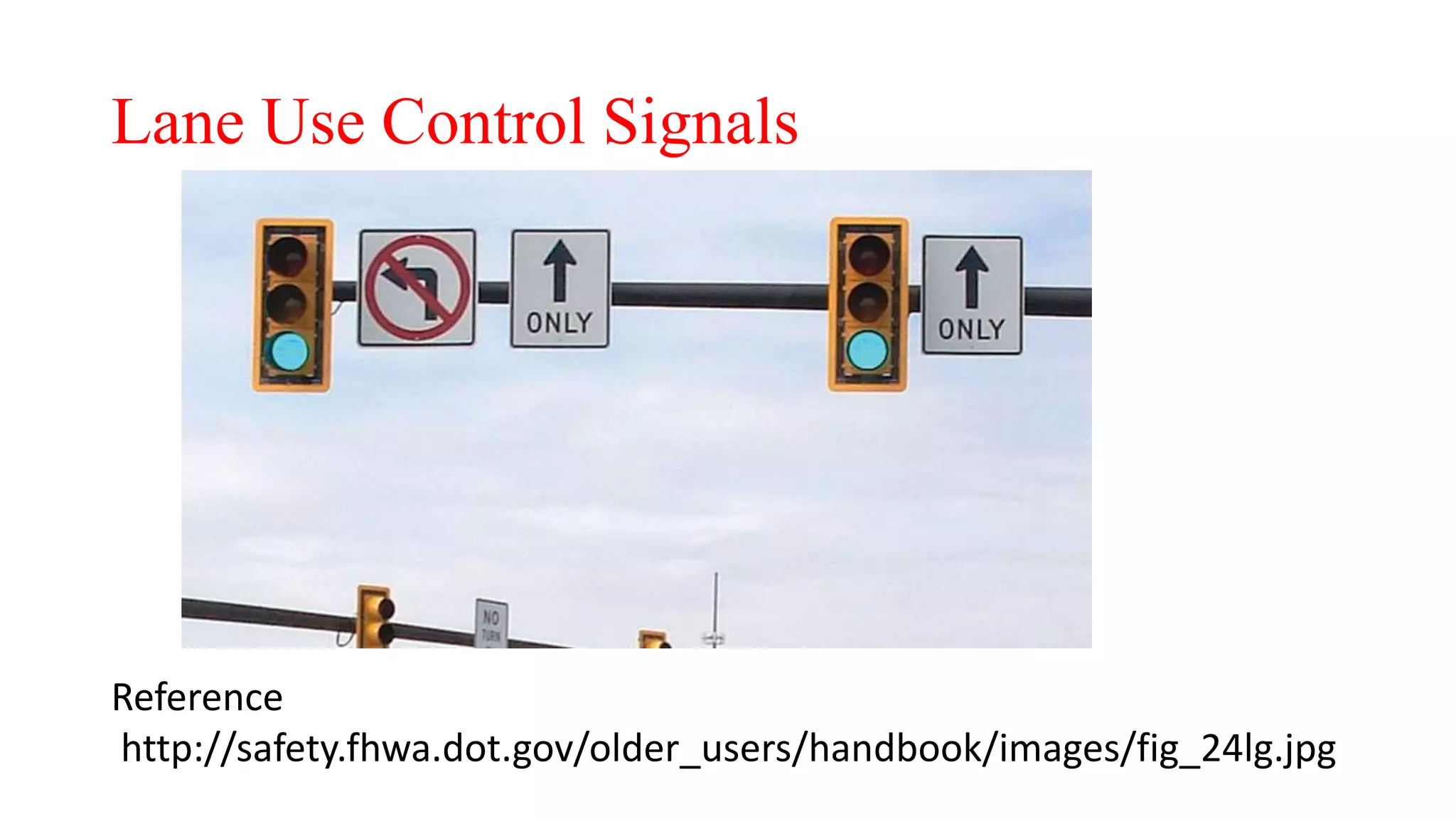
Lane Use Control Signals
Reference
http://safety.fhwa.dot.gov/older_users/handbook/images/fig_24lg.jpg
REFERENCES:
TRAFFIC ENGINEERING BY WILLIAM R. MCSHANE
http://safety.fhwa.dot.gov/older_users/handbook/images/fig_24lg.jpg
http://ichef1.bbci.co.uk/news/660/media/images/82931000/jpg/_82931048_trafficlights_reuters.jpg
http://www.ctre.iastate.edu/research/access/toolkit/4.pdf
THE END
END
THANK YOU

Traffic signal 32&35:DCE:FET:IIUI

  • 1.
    DEPARTMENT OF CIVILENGINEERING FACULTY OF ENGINEERING AND TECHNOLOGY TRAFFIC SIGNALS MUHAMMAD YASEEN 32-FET/BSCE/F14 MUHAMMAD JUNAID 35-FET/BSCE/F14
  • 2.
    TRAFFIC SIGNALS: Traffic signalsare controlled devices which could alternatively direct the traffic to stop and proceed at intersection using red and green traffic light signals automatically.
  • 3.
    Purpose of TrafficSignals Traffic signals manage the right of way at signalized intersections to provide for the safe and efficient movement of vehicles and pedestrians. Traffic engineers and technicians develop and implement signal timing at each intersection to distribute green time amongst the competing traffic flows to provide for efficient operations.
  • 4.
    NEED OF TRAFFICSIGNALS •Orderly flow of traffic. •An opportunity for pedestrians or vehicles to cross an intersection. •Help reduce the number of conflicts. •Reduce the frequency of accidents. •Improve safety.
  • 5.
    Signal Aspects GREEN AMBER RED The indicationgiven by a signal is known as the signal aspect.
  • 7.
    Traffic Signals :Advantages • Provisions for side-street vehicles to enter the traffic stream. • Provisions for the progressive flow of traffic in a signal-system corridor. •Provisions for pedestrians to cross the street safely. •Potential reduction of accidents, conflicts ensuring safety.
  • 8.
    Traffic Signals :Disadvantages • Excessive delay; • Increased traffic congestion, air pollution and gasoline consumption; •Disobedience of signals; •Increased frequency of crashes, especially rear-end collisions.
  • 9.
    Parts of aTraffic Signal • Traffic signals have four main parts: Display Controller Detector Support
  • 10.
    Signal display The signaldisplay is what the driver sees. A simple signal display consists of three colors: red, yellow, and green. • A typical signal display is more than 3 feet tall and weighs up to 50 pounds.
  • 11.
    Signal Controller The trafficsignal controller is the “brain” at an intersection that tells each signal display when to change colors. Years ago, traffic signals were controlled by a simple electric mechanism that made the display change every so many seconds, like a clock. These simple mechanisms were not able to adjust when traffic changed during the day. Later in the pre-computer era, electromechanical controllers were developed that could be adjusted for the time of day. These controllers were much like the switch timers in the local hardware store that have green and red pins to set lights to go on and off on a predetermined schedule.
  • 12.
    CONTINUE………… Now, computerized trafficsignal controllers get real-time information about the presence of vehicles from sensors in the roadway and on poles. Controllers adjust the amount of green time for different movements based on sensor information. The most sophisticated controllers and software programs allow for the coordination of signals along a roadway, so that vehicles can travel through a succession of intersections without having to stop.
  • 14.
    DETECTORS Detectors are usedto identify the presence of a vehicle, so that the controller knows how to adjust the amount of green time to provide. There are many types of detectors. One type is known as the loop detector. The square black lines you may see in the roadway as you approach an intersection are the visible part of the loop detector, which is a thin wire buried in the roadway. When a vehicle drives over the loop, it sends a message to the signal controller. The signal controller's software evaluates the messages from all the loops at the intersection and changes the signal timing appropriately. Small TV cameras can also be used to detect vehicles.
  • 16.
  • 17.
    Types of SignalOperation Traffic signals can operate on a pretimed basis or may be partially or fully actuated by arriving vehicles sensed by detectors. In networks, or on arterials, signals may be coordinated through computer control. TYPE1 PRE-TIMED TYPE2 SEMI- ACTUATED TYPE3 FULLY ACTUATED
  • 18.
    Types of SignalOperation
  • 19.
    PRE TIMED OPERATION A signal whose timing(cycle length,green time etc) is fixed over specified time period and does not change in response to changes in traffic flow at the intersection. No vehicle detection is necessary at this mode of operation.
  • 20.
    Pretimed Operation: In pretimedoperation, the cycle length, phase sequence, and timing of each interval are constant. Each cycle of the signal follows the same predetermined plan. “Multi-dial” controllers will allow different pretimed settings to be established. An internal clock is used to activate the appropriate timing. in such cases, it is typical to have at least an AM peak, a PM peak, and an off-peak signal timing.
  • 21.
    SEMI-ACTUATED OPERATION  Asignal whose timing(cycle length ,green time etc) is affected when vehicle are detected(by video,inductance loop detecters,embeded- pavement etc) on some but not all approaches is called semi- actuated signal. This mode of operation is found where a low volume road intersect a high volume road.
  • 22.
    Semi-actuated Operation In semi-actuatedoperation, detectors are placed on the minor approach(es) to the intersection; there are no detectors on the major street. The light is green for the major street at all times except when a “call” or actuation is noted on one of the minor approaches. Then, subject to limitations such as a minimum major-street green, the green is transferred to the minor street.
  • 23.
    CONTINUE……… The green returnsto the major street when the maximum minor street green is reached or when the detector senses that there is no further demand on the minor street. Semi-actuated operation is often used where the primary reason for signalization is ‘‘interruption of continuous traffic,”
  • 24.
    Fully Actuated • Asignal whose timing(cycle length,green time etc) is completely influenced by the traffic volumes,when detected,on all of the approaches. Fully actuated signals are most commonly used at intersections of two major streets where substantial variation exist in all approach traffic volumes over the course of a day.
  • 25.
    Full Actuated Operation Infull actuated operation, every lane of every approach must be monitored by a detector. Green time is allocated in accordance with information from detectors and programmed “rules” established in the controller for capturing and retaining the green. In full actuated operation, the cycle length, sequence of phases, and green time split may vary from cycle to cycle.
  • 26.
    SPACING BETWEEN TRAFFICSIGNALS REFERENCE; http://www.ctre.iastate.edu/research/access/toolkit/4.pdf
  • 27.
  • 28.
  • 29.
  • 30.
  • 31.
    BEACONS • Beacons aregenerally used to identify a hazard or call attention to a critical control device, such as a speed and continuously in accordance with the programmed signal –timing.
  • 32.
    Lane Use ControlSignals Reference http://safety.fhwa.dot.gov/older_users/handbook/images/fig_24lg.jpg
  • 33.
    REFERENCES: TRAFFIC ENGINEERING BYWILLIAM R. MCSHANE http://safety.fhwa.dot.gov/older_users/handbook/images/fig_24lg.jpg http://ichef1.bbci.co.uk/news/660/media/images/82931000/jpg/_82931048_trafficlights_reuters.jpg http://www.ctre.iastate.edu/research/access/toolkit/4.pdf
  • 34.