The Physics of Driving  By: Group A
Factors Affecting Reaction Time  The time taken to respond to a situation is called  reaction time. You have a slower reaction time when you are distracted. In both situations, your reaction was probably quicker than your reaction time would be while driving, because you knew that you were expected to respond. Alcohol and drugs can significantly slow a person’s reaction time.
Every state in the United States has different laws and measures to prevent the influence of drugs or alcohol while driving. This is because these factors can slow down your reaction time Other factors can affect your reaction time: age, gender, practice, fatigue, exercise, attentiveness, and even personality are some of the factors that can increase reaction time
Distractions Affect Your Reaction Time Distractions are something or some event that draws your attention from a pressing matter For instance, if a billboard catches your attention, it is a distraction, therefore, not allowing you to pay proper attention to the roads. As an effect, this could lead to accident/ collision due to the distraction. Distractions slow your reaction time, and dull your senses.
In extension: Most teenagers have a higher cost of insurance than older drivers, most of the habits that ail teenage drivers (stereotypically) are :  Texting, chatting, peer pressure of other passengers in the car, drugs, alcohol, and being more attentive to the group than the road.
Driving With Measurement And Accuracy
The Speed Limit Like with all measurements, there is no way to know that one is driving at exactly the speed limit, because of  random errors  ( errors that can’t be fixed by calculation) Ex: a slippery road, or driving over a rock) That is why a driver must  estimate , or make a educated guess as to how fast he  should be driving.  The driver should be try to be as  accurate , or  as close to the speed limit, as possible.  For example, if the speed limit is 60 miles per hour, and I was driving 61.2 miles an hour I would most likely not get pulled over by the police , because this is a  accurate estimation of the speed limit.  But,  if I was driving 100.9  miles  per hour in the sahme place, I would either get into an accident or get a ticket, because this speed is not an accurate estimation of the speed limit.
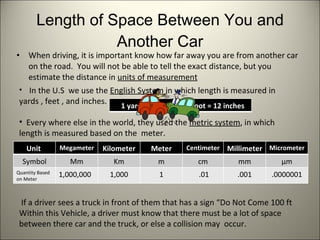
Length of Space Between You and Another Car When driving, it is important know how far away you are from another car on the road.  You will not be able to tell the exact distance, but you estimate the distance in  units of measurement   In the U.S  we use the  English System  in which length is measured in yards , feet , and inches.  Every where else in the world, they used the  metric system , in which length is measured based on the  meter.  If a driver sees a truck in front of them that has a sign “Do Not Come 100 ft  Within this Vehicle, a driver must know that there must be a lot of space between there car and the truck, or else a collision may  occur.  1 yard = 3 feet  1 foot = 12 inches  Unit  Megameter Kilometer Meter Centimeter Millimeter Micrometer Symbol Mm Km m cm mm μ m Quantity Based on Meter 1,000,000 1,000 1 .01 .001 .0000001
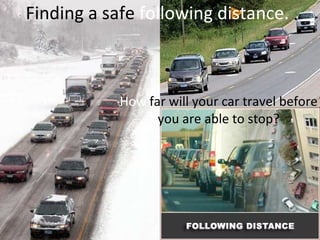
Finding a safe  following distance.  How  far will your car travel before you are able to stop?
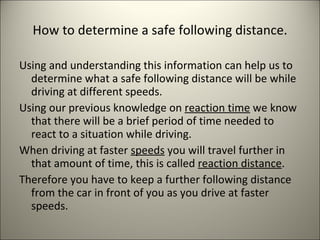
How to determine a safe following distance. Using and understanding this information can help us to determine what a safe following distance will be while driving at different speeds. Using our previous knowledge on  reaction time  we know that there will be a brief period of time needed to react to a situation while driving. When driving at faster  speeds  you will travel further in that amount of time, this is called  reaction distance . Therefore you have to keep a further following distance from the car in front of you as you drive at faster speeds.
The Speed Limit In addition to all of this we also learn that it is safer to drive at a slower  speeds.   So that you have more time to react before an accident occurs. If we don’t drive the speed limit then a police officer could detect our speed using a radar gun that detects the change in pitch of our car that occurs from the  Doppler effect.
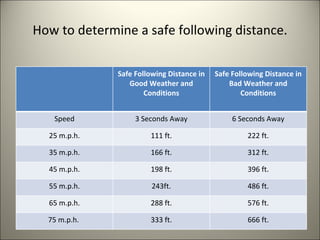
How to determine a safe following distance. Safe Following Distance in Good Weather and Conditions Safe Following Distance in Bad Weather and Conditions Speed 3 Seconds Away 6 Seconds Away 25 m.p.h. 111 ft. 222 ft. 35 m.p.h. 166 ft. 312 ft. 45 m.p.h. 198 ft. 396 ft. 55 m.p.h. 243ft. 486 ft. 65 m.p.h. 288 ft. 576 ft. 75 m.p.h.  333 ft. 666 ft.
Changing Speeds In order to understand how your car will be able to change speed you need to know your car’s  acceleration , its  positive acceleration  and its brakes,  its negative acceleration . Your cars acceleration is the change in velocity with respect to a change in time.  Your cars positive acceleration is how it can increase its velocity with respect to time. A car’s negative acceleration is its decrease in velocity with respect to time.
Changing Speeds Through this we can understand that you can have constant acceleration and not a constant velocity. Also you can have a velocity with no acceleration.
Stopping A Car
Negative Acceleration  When a driver breaks to stop their car, the car goes through  negative acceleration ,  which in this case means  a change in velocity where the object slows down .  This can be expressed through the equation :  0- v i  / t  Since the car will come to a complete stop,  the final velocity (v f  )  is zero  If a car is going  -90 m/s^2 , that does not mean that the car is accelerating at a negative speed; it is impossible to drive at a speed less than 0m/s.  The negative sign shows that the object is slowing down, not speeding up.
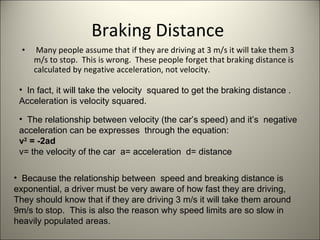
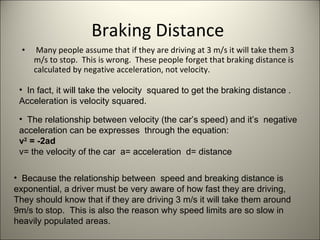
Braking Distance  Many people assume that if they are driving at 3 m/s it will take them 3 m/s to stop.  This is wrong.  These people forget that braking distance is calculated by negative acceleration, not velocity.  In fact, it will take the velocity  squared to get the braking distance .  Acceleration is velocity squared.  The relationship between velocity (the car’s speed) and it’s  negative acceleration can be expresses  through the equation:  v 2  = -2ad  v= the velocity of the car  a= acceleration  d= distance Because the relationship between  speed and breaking distance is exponential, a driver must be very aware of how fast they are driving, They should know that if they are driving 3 m/s it will take them around 9m/s to stop.  This is also the reason why speed limits are so slow in heavily populated areas.
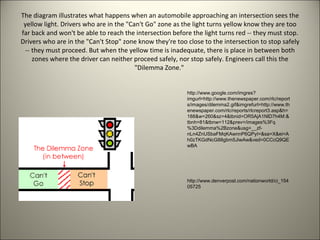
Section 6 Using Models: Intersections with a Yellow Light able to make it through the intersection before the light turns red. It is in the GO Zone. able to come to a safe stop when the light turns red because it is in the STOP Zone. In this zone, automobiles can stop safely before they reach the intersection.  When approaching a signalized intersection at high speeds and the light turns yellow, the dilemma zone is the space from the intersection to the point on the road where it may be difficult for the driver to discern whether they should run the yellow light or brake to be safe.  Yellow Light Dilemma
The diagram illustrates what happens when an automobile approaching an intersection sees the yellow light. Drivers who are in the "Can't Go" zone as the light turns yellow know they are too far back and won't be able to reach the intersection before the light turns red -- they must stop. Drivers who are in the "Can't Stop" zone know they're too close to the intersection to stop safely -- they must proceed. But when the yellow time is inadequate, there is place in between both zones where the driver can neither proceed safely, nor stop safely. Engineers call this the "Dilemma Zone."  http://www.google.com/imgres?imgurl=http://www.thenewspaper.com/rlc/reports/images/dilemma2.gif&imgrefurl=http://www.thenewspaper.com/rlc/reports/rlcreport3.asp&h=188&w=260&sz=4&tbnid=OR5AjA1NlD7h4M:&tbnh=81&tbnw=112&prev=/images%3Fq%3Ddilemma%2Bzone&usg=__zf-nLn4ZnUSbaFMqKAwnnP6QPyI=&sa=X&ei=Ah0zTKGdNcG88gbm5JiwAw&ved=0CCcQ9QEwBA http://www.denverpost.com/nationworld/ci_15405725
Forces of the Road Forces are a push or a pull that affect the motion of   an object. There are four forces: friction, gravity, normal, and tension.  Equation for Force:  F=m*a  (force= mass *acceleration) Force is Expressed in Newtons= N Friction is the force that works between the tires of a car and the road.  Coefficient of Friction: qualifies the interaction between two surfaces , and is represented by the sign  μ Equation for  Friction:  friction =  μ * mg  (mg is weight, mass times acceleration due to gravity)
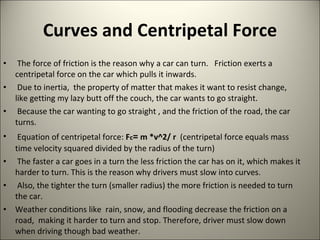
Curves and Centripetal Force The force of friction is the reason why a car can turn.  Friction exerts a centripetal force on the car which pulls it inwards. Due to inertia,  the property of matter that makes it want to resist change, like getting my lazy butt off the couch, the car wants to go straight.  Because the car wanting to go straight , and the friction of the road, the car turns.  Equation of centripetal force:  F c =  m *v^2/ r  (centripetal force equals mass time velocity squared divided by the radius of the turn) The faster a car goes in a turn the less friction the car has on it, which makes it harder to turn. This is the reason why drivers must slow into curves.  Also, the tighter the turn (smaller radius) the more friction is needed to turn the car. Weather conditions like  rain, snow, and flooding decrease the friction on a road,  making it harder to turn and stop. Therefore, driver must slow down when driving though bad weather.

The physics of drivng

  • 1.
    The Physics ofDriving By: Group A
  • 2.
    Factors Affecting ReactionTime The time taken to respond to a situation is called reaction time. You have a slower reaction time when you are distracted. In both situations, your reaction was probably quicker than your reaction time would be while driving, because you knew that you were expected to respond. Alcohol and drugs can significantly slow a person’s reaction time.
  • 3.
    Every state inthe United States has different laws and measures to prevent the influence of drugs or alcohol while driving. This is because these factors can slow down your reaction time Other factors can affect your reaction time: age, gender, practice, fatigue, exercise, attentiveness, and even personality are some of the factors that can increase reaction time
  • 4.
    Distractions Affect YourReaction Time Distractions are something or some event that draws your attention from a pressing matter For instance, if a billboard catches your attention, it is a distraction, therefore, not allowing you to pay proper attention to the roads. As an effect, this could lead to accident/ collision due to the distraction. Distractions slow your reaction time, and dull your senses.
  • 5.
    In extension: Mostteenagers have a higher cost of insurance than older drivers, most of the habits that ail teenage drivers (stereotypically) are : Texting, chatting, peer pressure of other passengers in the car, drugs, alcohol, and being more attentive to the group than the road.
  • 6.
  • 7.
    The Speed LimitLike with all measurements, there is no way to know that one is driving at exactly the speed limit, because of random errors ( errors that can’t be fixed by calculation) Ex: a slippery road, or driving over a rock) That is why a driver must estimate , or make a educated guess as to how fast he should be driving. The driver should be try to be as accurate , or as close to the speed limit, as possible. For example, if the speed limit is 60 miles per hour, and I was driving 61.2 miles an hour I would most likely not get pulled over by the police , because this is a accurate estimation of the speed limit. But, if I was driving 100.9 miles per hour in the sahme place, I would either get into an accident or get a ticket, because this speed is not an accurate estimation of the speed limit.
  • 8.
    Length of SpaceBetween You and Another Car When driving, it is important know how far away you are from another car on the road. You will not be able to tell the exact distance, but you estimate the distance in units of measurement In the U.S we use the English System in which length is measured in yards , feet , and inches. Every where else in the world, they used the metric system , in which length is measured based on the meter. If a driver sees a truck in front of them that has a sign “Do Not Come 100 ft Within this Vehicle, a driver must know that there must be a lot of space between there car and the truck, or else a collision may occur. 1 yard = 3 feet 1 foot = 12 inches Unit Megameter Kilometer Meter Centimeter Millimeter Micrometer Symbol Mm Km m cm mm μ m Quantity Based on Meter 1,000,000 1,000 1 .01 .001 .0000001
  • 9.
    Finding a safe following distance. How far will your car travel before you are able to stop?
  • 10.
    How to determinea safe following distance. Using and understanding this information can help us to determine what a safe following distance will be while driving at different speeds. Using our previous knowledge on reaction time we know that there will be a brief period of time needed to react to a situation while driving. When driving at faster speeds you will travel further in that amount of time, this is called reaction distance . Therefore you have to keep a further following distance from the car in front of you as you drive at faster speeds.
  • 11.
    The Speed LimitIn addition to all of this we also learn that it is safer to drive at a slower speeds. So that you have more time to react before an accident occurs. If we don’t drive the speed limit then a police officer could detect our speed using a radar gun that detects the change in pitch of our car that occurs from the Doppler effect.
  • 12.
    How to determinea safe following distance. Safe Following Distance in Good Weather and Conditions Safe Following Distance in Bad Weather and Conditions Speed 3 Seconds Away 6 Seconds Away 25 m.p.h. 111 ft. 222 ft. 35 m.p.h. 166 ft. 312 ft. 45 m.p.h. 198 ft. 396 ft. 55 m.p.h. 243ft. 486 ft. 65 m.p.h. 288 ft. 576 ft. 75 m.p.h. 333 ft. 666 ft.
  • 13.
    Changing Speeds Inorder to understand how your car will be able to change speed you need to know your car’s acceleration , its positive acceleration and its brakes, its negative acceleration . Your cars acceleration is the change in velocity with respect to a change in time. Your cars positive acceleration is how it can increase its velocity with respect to time. A car’s negative acceleration is its decrease in velocity with respect to time.
  • 14.
    Changing Speeds Throughthis we can understand that you can have constant acceleration and not a constant velocity. Also you can have a velocity with no acceleration.
  • 15.
  • 16.
    Negative Acceleration When a driver breaks to stop their car, the car goes through negative acceleration , which in this case means a change in velocity where the object slows down . This can be expressed through the equation : 0- v i / t Since the car will come to a complete stop, the final velocity (v f ) is zero If a car is going -90 m/s^2 , that does not mean that the car is accelerating at a negative speed; it is impossible to drive at a speed less than 0m/s. The negative sign shows that the object is slowing down, not speeding up.
  • 17.
    Braking Distance Many people assume that if they are driving at 3 m/s it will take them 3 m/s to stop. This is wrong. These people forget that braking distance is calculated by negative acceleration, not velocity. In fact, it will take the velocity squared to get the braking distance . Acceleration is velocity squared. The relationship between velocity (the car’s speed) and it’s negative acceleration can be expresses through the equation: v 2 = -2ad v= the velocity of the car a= acceleration d= distance Because the relationship between speed and breaking distance is exponential, a driver must be very aware of how fast they are driving, They should know that if they are driving 3 m/s it will take them around 9m/s to stop. This is also the reason why speed limits are so slow in heavily populated areas.
  • 18.
    Braking Distance Many people assume that if they are driving at 3 m/s it will take them 3 m/s to stop. This is wrong. These people forget that braking distance is calculated by negative acceleration, not velocity. In fact, it will take the velocity squared to get the braking distance . Acceleration is velocity squared. The relationship between velocity (the car’s speed) and it’s negative acceleration can be expresses through the equation: v 2 = -2ad v= the velocity of the car a= acceleration d= distance Because the relationship between speed and breaking distance is exponential, a driver must be very aware of how fast they are driving, They should know that if they are driving 3 m/s it will take them around 9m/s to stop. This is also the reason why speed limits are so slow in heavily populated areas.
  • 19.
    Section 6 UsingModels: Intersections with a Yellow Light able to make it through the intersection before the light turns red. It is in the GO Zone. able to come to a safe stop when the light turns red because it is in the STOP Zone. In this zone, automobiles can stop safely before they reach the intersection. When approaching a signalized intersection at high speeds and the light turns yellow, the dilemma zone is the space from the intersection to the point on the road where it may be difficult for the driver to discern whether they should run the yellow light or brake to be safe. Yellow Light Dilemma
  • 20.
    The diagram illustrateswhat happens when an automobile approaching an intersection sees the yellow light. Drivers who are in the "Can't Go" zone as the light turns yellow know they are too far back and won't be able to reach the intersection before the light turns red -- they must stop. Drivers who are in the "Can't Stop" zone know they're too close to the intersection to stop safely -- they must proceed. But when the yellow time is inadequate, there is place in between both zones where the driver can neither proceed safely, nor stop safely. Engineers call this the "Dilemma Zone." http://www.google.com/imgres?imgurl=http://www.thenewspaper.com/rlc/reports/images/dilemma2.gif&imgrefurl=http://www.thenewspaper.com/rlc/reports/rlcreport3.asp&h=188&w=260&sz=4&tbnid=OR5AjA1NlD7h4M:&tbnh=81&tbnw=112&prev=/images%3Fq%3Ddilemma%2Bzone&usg=__zf-nLn4ZnUSbaFMqKAwnnP6QPyI=&sa=X&ei=Ah0zTKGdNcG88gbm5JiwAw&ved=0CCcQ9QEwBA http://www.denverpost.com/nationworld/ci_15405725
  • 21.
    Forces of theRoad Forces are a push or a pull that affect the motion of an object. There are four forces: friction, gravity, normal, and tension. Equation for Force: F=m*a (force= mass *acceleration) Force is Expressed in Newtons= N Friction is the force that works between the tires of a car and the road. Coefficient of Friction: qualifies the interaction between two surfaces , and is represented by the sign μ Equation for Friction: friction = μ * mg (mg is weight, mass times acceleration due to gravity)
  • 22.
    Curves and CentripetalForce The force of friction is the reason why a car can turn. Friction exerts a centripetal force on the car which pulls it inwards. Due to inertia, the property of matter that makes it want to resist change, like getting my lazy butt off the couch, the car wants to go straight. Because the car wanting to go straight , and the friction of the road, the car turns. Equation of centripetal force: F c = m *v^2/ r (centripetal force equals mass time velocity squared divided by the radius of the turn) The faster a car goes in a turn the less friction the car has on it, which makes it harder to turn. This is the reason why drivers must slow into curves. Also, the tighter the turn (smaller radius) the more friction is needed to turn the car. Weather conditions like rain, snow, and flooding decrease the friction on a road, making it harder to turn and stop. Therefore, driver must slow down when driving though bad weather.