Mod 4 Topics 1-4
Risk Assessment
Space management
Turning/Lane changes
Turnabouts/ Parking
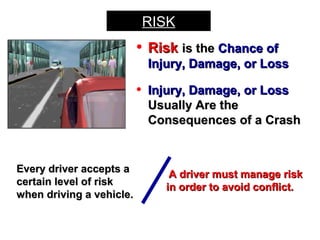
• RiskRisk is theis the Chance ofChance of
Injury, Damage, or LossInjury, Damage, or Loss
• Injury, Damage, or LossInjury, Damage, or Loss
Usually Are theUsually Are the
Consequences of a CrashConsequences of a Crash
Every driver accepts aEvery driver accepts a
certain level of riskcertain level of risk
when driving a vehicle.when driving a vehicle.
A driver must manage riskA driver must manage risk
in order to avoid conflict.in order to avoid conflict.
RISK
Chance
• The probability or
likelihood of a crash
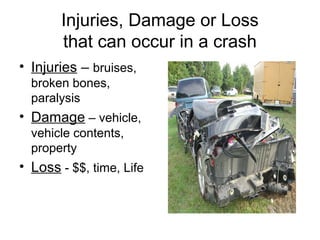
Injuries, Damage or Loss
that can occur in a crash
• Injuries – bruises,
broken bones,
paralysis
• Damage – vehicle,
vehicle contents,
property
• Loss - $$, time, Life
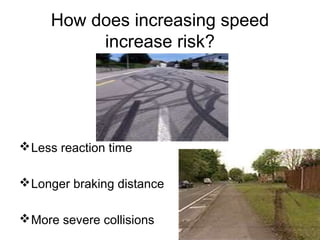
How does increasing speed
increase risk?
Less reaction time
Longer braking distance
More severe collisions
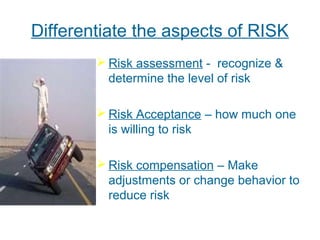
Differentiate the aspects of RISK
 Risk assessment - recognize &
determine the level of risk
 Risk Acceptance – how much one
is willing to risk
 Risk compensation – Make
adjustments or change behavior to
reduce risk
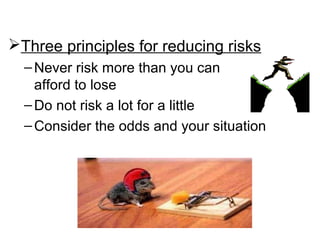
Three principles for reducing risks
–Never risk more than you can
afford to lose
–Do not risk a lot for a little
–Consider the odds and your situation
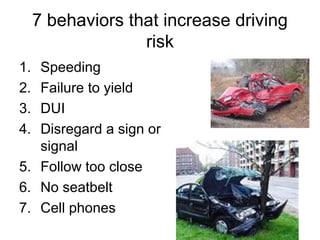
7 behaviors that increase driving
risk
1. Speeding
2. Failure to yield
3. DUI
4. Disregard a sign or
signal
5. Follow too close
6. No seatbelt
7. Cell phones
Good ways to reduce risk
• Develop sound habits &
judgments
• Use SEEiT
• Make good decisions
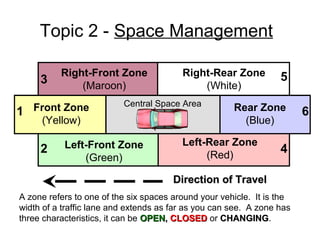
Topic 2 - Space Management
Central Space Area
Direction of TravelDirection of Travel
Right-Front Zone
(Maroon)
Right-Rear Zone
(White)
Front Zone
(Yellow)
Rear Zone
(Blue)
Left-Front Zone
(Green)
Left-Rear Zone
(Red)
1
2
3
4
5
6
A zone refers to one of the six spaces around your vehicle. It is the
width of a traffic lane and extends as far as you can see. A zone has
three characteristics, it can be OPENOPEN,, CLOSEDCLOSED or CHANGINGCHANGING.
Direction of TravelDirection of Travel
Move HereMove Here
Changing ZONEChanging ZONE
Closed
ZONE
Check RearCheck Rear
Check SideCheck Side
Central Space Area
Open
ZONE
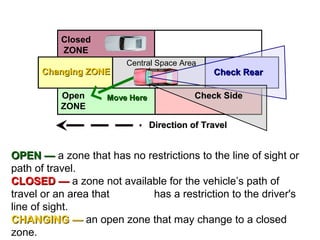
OPEN —OPEN — a zone that has no restrictions to the line of sight or
path of travel.
CLOSED —CLOSED — a zone not available for the vehicle’s path of
travel or an area that has a restriction to the driver's
line of sight.
CHANGING —CHANGING — an open zone that may change to a closed
zone.
Open, Closed, or Changing ZonesOpen, Closed, or Changing Zones
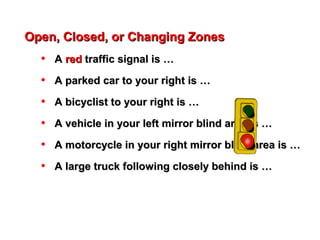
• AA redred traffic signal is …traffic signal is …
• A parked car to your right is …A parked car to your right is …
• A bicyclist to your right is …A bicyclist to your right is …
• A vehicle in your left mirror blind area is …A vehicle in your left mirror blind area is …
• A motorcycle in your right mirror blind area is …A motorcycle in your right mirror blind area is …
• A large truck following closely behind is …A large truck following closely behind is …
Path of TravelPath of Travel
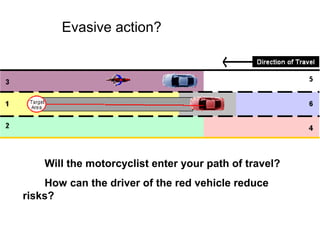
Will the motorcyclist enter your path of travel?
How can the driver of the red vehicle reduce
risks?
Evasive action?
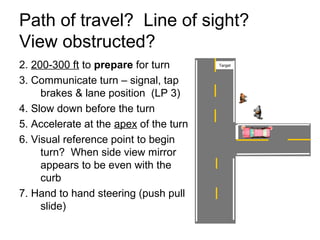
Target
Path of travel? Line of sight?
View obstructed?
2. 200-300 ft to prepare for turn
3. Communicate turn – signal, tap
brakes & lane position (LP 3)
4. Slow down before the turn
5. Accelerate at the apex of the turn
6. Visual reference point to begin
turn? When side view mirror
appears to be even with the
curb
7. Hand to hand steering (push pull
slide)
Lane Changes
8. What areas must be checked before
beginning a left lane change? Rear, Left
rear & left front
9. Two reasons for making the lane change?
Traffic moving slow (pass), must turn
ahead, lane ends
10. How can you communicate the lane
change? Signal, lane position
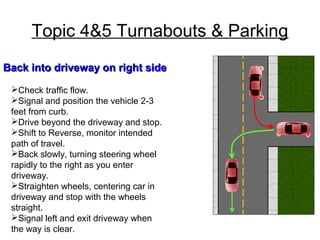
Topic 4&5 Turnabouts & Parking
Check traffic flow.
Signal and position the vehicle 2-3
feet from curb.
Drive beyond the driveway and stop.
Shift to Reverse, monitor intended
path of travel.
Back slowly, turning steering wheel
rapidly to the right as you enter
driveway.
Straighten wheels, centering car in
driveway and stop with the wheels
straight.
Signal left and exit driveway when
the way is clear.
Back into driveway on right sideBack into driveway on right side
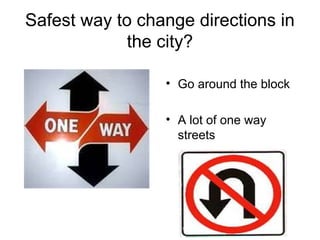
Safest way to change directions in
the city?
• Go around the block
• A lot of one way
streets
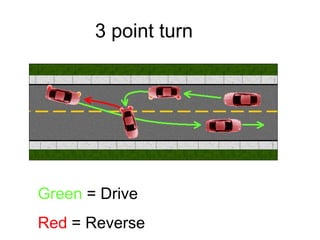
3 point turn
Green = Drive
Red = Reverse
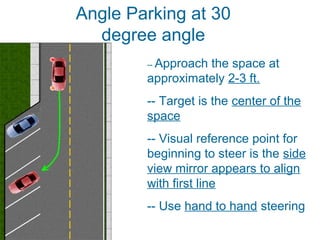
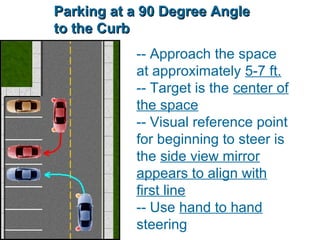
-- Approach the space at
approximately 2-3 ft.
-- Target is the center of the
space
-- Visual reference point for
beginning to steer is the side
view mirror appears to align
with first line
-- Use hand to hand steering
Angle Parking at 30
degree angle
-- Approach the space
at approximately 5-7 ft.
-- Target is the center of
the space
-- Visual reference point
for beginning to steer is
the side view mirror
appears to align with
first line
-- Use hand to hand
steering
Parking at a 90 Degree AngleParking at a 90 Degree Angle
to the Curbto the Curb
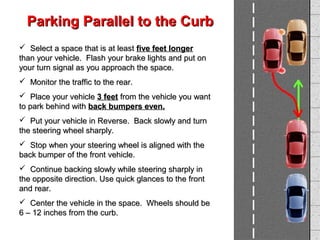
 Select a space that is at leastSelect a space that is at least five feet longerfive feet longer
than your vehicle. Flash your brake lights and put onthan your vehicle. Flash your brake lights and put on
your turn signal as you approach the space.your turn signal as you approach the space.
 Monitor the traffic to the rear.Monitor the traffic to the rear.
 Place your vehiclePlace your vehicle 3 feet3 feet from the vehicle you wantfrom the vehicle you want
to park behind withto park behind with back bumpers even.back bumpers even.
 Put your vehicle in Reverse. Back slowly and turnPut your vehicle in Reverse. Back slowly and turn
the steering wheel sharply.the steering wheel sharply.
 Stop when your steering wheel is aligned with theStop when your steering wheel is aligned with the
back bumper of the front vehicle.back bumper of the front vehicle.
 Continue backing slowly while steering sharply inContinue backing slowly while steering sharply in
the opposite direction. Use quick glances to the frontthe opposite direction. Use quick glances to the front
and rear.and rear.
 Center the vehicle in the space. Wheels should beCenter the vehicle in the space. Wheels should be
6 – 12 inches from the curb.6 – 12 inches from the curb.
Parking Parallel to the CurbParking Parallel to the Curb
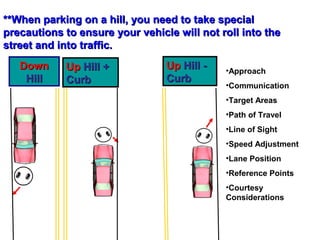
DownDown
HillHill
**When parking on a hill, you need to take special**When parking on a hill, you need to take special
precautions to ensure your vehicle will not roll into theprecautions to ensure your vehicle will not roll into the
street and into traffic.street and into traffic.
UpUp Hill +Hill +
CurbCurb
UpUp Hill -Hill -
CurbCurb
•Approach
•Communication
•Target Areas
•Path of Travel
•Line of Sight
•Speed Adjustment
•Lane Position
•Reference Points
•Courtesy
Considerations

Module 4 2009

  • 1.
    Mod 4 Topics1-4 Risk Assessment Space management Turning/Lane changes Turnabouts/ Parking
  • 2.
    • RiskRisk istheis the Chance ofChance of Injury, Damage, or LossInjury, Damage, or Loss • Injury, Damage, or LossInjury, Damage, or Loss Usually Are theUsually Are the Consequences of a CrashConsequences of a Crash Every driver accepts aEvery driver accepts a certain level of riskcertain level of risk when driving a vehicle.when driving a vehicle. A driver must manage riskA driver must manage risk in order to avoid conflict.in order to avoid conflict. RISK
  • 3.
    Chance • The probabilityor likelihood of a crash
  • 4.
    Injuries, Damage orLoss that can occur in a crash • Injuries – bruises, broken bones, paralysis • Damage – vehicle, vehicle contents, property • Loss - $$, time, Life
  • 5.
    How does increasingspeed increase risk? Less reaction time Longer braking distance More severe collisions
  • 6.
    Differentiate the aspectsof RISK  Risk assessment - recognize & determine the level of risk  Risk Acceptance – how much one is willing to risk  Risk compensation – Make adjustments or change behavior to reduce risk
  • 7.
    Three principles forreducing risks –Never risk more than you can afford to lose –Do not risk a lot for a little –Consider the odds and your situation
  • 8.
    7 behaviors thatincrease driving risk 1. Speeding 2. Failure to yield 3. DUI 4. Disregard a sign or signal 5. Follow too close 6. No seatbelt 7. Cell phones
  • 9.
    Good ways toreduce risk • Develop sound habits & judgments • Use SEEiT • Make good decisions
  • 10.
    Topic 2 -Space Management Central Space Area Direction of TravelDirection of Travel Right-Front Zone (Maroon) Right-Rear Zone (White) Front Zone (Yellow) Rear Zone (Blue) Left-Front Zone (Green) Left-Rear Zone (Red) 1 2 3 4 5 6 A zone refers to one of the six spaces around your vehicle. It is the width of a traffic lane and extends as far as you can see. A zone has three characteristics, it can be OPENOPEN,, CLOSEDCLOSED or CHANGINGCHANGING.
  • 11.
    Direction of TravelDirectionof Travel Move HereMove Here Changing ZONEChanging ZONE Closed ZONE Check RearCheck Rear Check SideCheck Side Central Space Area Open ZONE OPEN —OPEN — a zone that has no restrictions to the line of sight or path of travel. CLOSED —CLOSED — a zone not available for the vehicle’s path of travel or an area that has a restriction to the driver's line of sight. CHANGING —CHANGING — an open zone that may change to a closed zone.
  • 12.
    Open, Closed, orChanging ZonesOpen, Closed, or Changing Zones • AA redred traffic signal is …traffic signal is … • A parked car to your right is …A parked car to your right is … • A bicyclist to your right is …A bicyclist to your right is … • A vehicle in your left mirror blind area is …A vehicle in your left mirror blind area is … • A motorcycle in your right mirror blind area is …A motorcycle in your right mirror blind area is … • A large truck following closely behind is …A large truck following closely behind is …
  • 13.
    Path of TravelPathof Travel Will the motorcyclist enter your path of travel? How can the driver of the red vehicle reduce risks? Evasive action?
  • 14.
    Target Path of travel?Line of sight? View obstructed? 2. 200-300 ft to prepare for turn 3. Communicate turn – signal, tap brakes & lane position (LP 3) 4. Slow down before the turn 5. Accelerate at the apex of the turn 6. Visual reference point to begin turn? When side view mirror appears to be even with the curb 7. Hand to hand steering (push pull slide)
  • 15.
    Lane Changes 8. Whatareas must be checked before beginning a left lane change? Rear, Left rear & left front 9. Two reasons for making the lane change? Traffic moving slow (pass), must turn ahead, lane ends 10. How can you communicate the lane change? Signal, lane position
  • 16.
    Topic 4&5 Turnabouts& Parking Check traffic flow. Signal and position the vehicle 2-3 feet from curb. Drive beyond the driveway and stop. Shift to Reverse, monitor intended path of travel. Back slowly, turning steering wheel rapidly to the right as you enter driveway. Straighten wheels, centering car in driveway and stop with the wheels straight. Signal left and exit driveway when the way is clear. Back into driveway on right sideBack into driveway on right side
  • 17.
    Safest way tochange directions in the city? • Go around the block • A lot of one way streets
  • 18.
    3 point turn Green= Drive Red = Reverse
  • 19.
    -- Approach thespace at approximately 2-3 ft. -- Target is the center of the space -- Visual reference point for beginning to steer is the side view mirror appears to align with first line -- Use hand to hand steering Angle Parking at 30 degree angle
  • 20.
    -- Approach thespace at approximately 5-7 ft. -- Target is the center of the space -- Visual reference point for beginning to steer is the side view mirror appears to align with first line -- Use hand to hand steering Parking at a 90 Degree AngleParking at a 90 Degree Angle to the Curbto the Curb
  • 21.
     Select aspace that is at leastSelect a space that is at least five feet longerfive feet longer than your vehicle. Flash your brake lights and put onthan your vehicle. Flash your brake lights and put on your turn signal as you approach the space.your turn signal as you approach the space.  Monitor the traffic to the rear.Monitor the traffic to the rear.  Place your vehiclePlace your vehicle 3 feet3 feet from the vehicle you wantfrom the vehicle you want to park behind withto park behind with back bumpers even.back bumpers even.  Put your vehicle in Reverse. Back slowly and turnPut your vehicle in Reverse. Back slowly and turn the steering wheel sharply.the steering wheel sharply.  Stop when your steering wheel is aligned with theStop when your steering wheel is aligned with the back bumper of the front vehicle.back bumper of the front vehicle.  Continue backing slowly while steering sharply inContinue backing slowly while steering sharply in the opposite direction. Use quick glances to the frontthe opposite direction. Use quick glances to the front and rear.and rear.  Center the vehicle in the space. Wheels should beCenter the vehicle in the space. Wheels should be 6 – 12 inches from the curb.6 – 12 inches from the curb. Parking Parallel to the CurbParking Parallel to the Curb
  • 22.
    DownDown HillHill **When parking ona hill, you need to take special**When parking on a hill, you need to take special precautions to ensure your vehicle will not roll into theprecautions to ensure your vehicle will not roll into the street and into traffic.street and into traffic. UpUp Hill +Hill + CurbCurb UpUp Hill -Hill - CurbCurb •Approach •Communication •Target Areas •Path of Travel •Line of Sight •Speed Adjustment •Lane Position •Reference Points •Courtesy Considerations