Driver Performance: Personal FactorsDriver Performance: Personal Factors
Topic 1 --Topic 1 -- Introduction to Alcohol – Saying NoIntroduction to Alcohol – Saying No
Topic 2 --Topic 2 -- Nature of Alcohol-Related Crash ProblemsNature of Alcohol-Related Crash Problems
Topic 3 --Topic 3 -- Physiological and Psychological Effects of AlcoholPhysiological and Psychological Effects of Alcohol
Topic 4 --Topic 4 -- Effects of Alcohol and Other Drugs on the DrivingEffects of Alcohol and Other Drugs on the Driving
TaskTask
Topic 5 --Topic 5 -- Dealing with Driver FatigueDealing with Driver Fatigue
Topic 6 --Topic 6 -- Preventing Road RagePreventing Road Rage
Module Seven TransparenciesModule Seven Transparencies
VirginiaVirginia Department of EducationDepartment of Education
Provided in cooperation with the Virginia Department of Motor VehiclesProvided in cooperation with the Virginia Department of Motor Vehicles
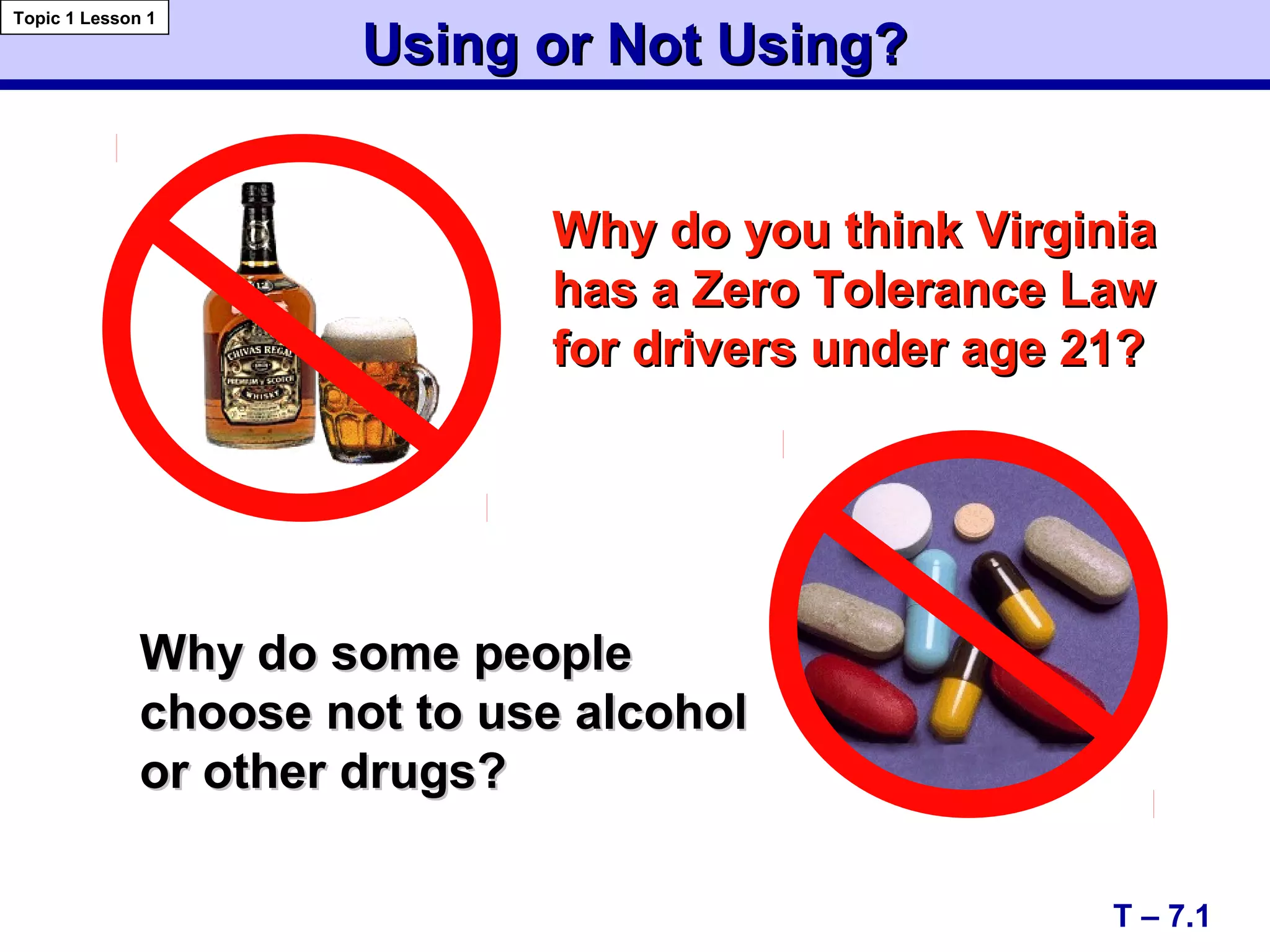
Why do you think VirginiaWhy do you think Virginia
has a Zero Tolerance Lawhas a Zero Tolerance Law
for drivers under age 21?for drivers under age 21?
Why do some peopleWhy do some people
choose not to use alcoholchoose not to use alcohol
or other drugs?or other drugs?
Using or Not Using?Using or Not Using?
T – 7.1
Topic 1 Lesson 1
Your Choices and ResponsibilitiesYour Choices and Responsibilities
Topic 1 Lesson 1
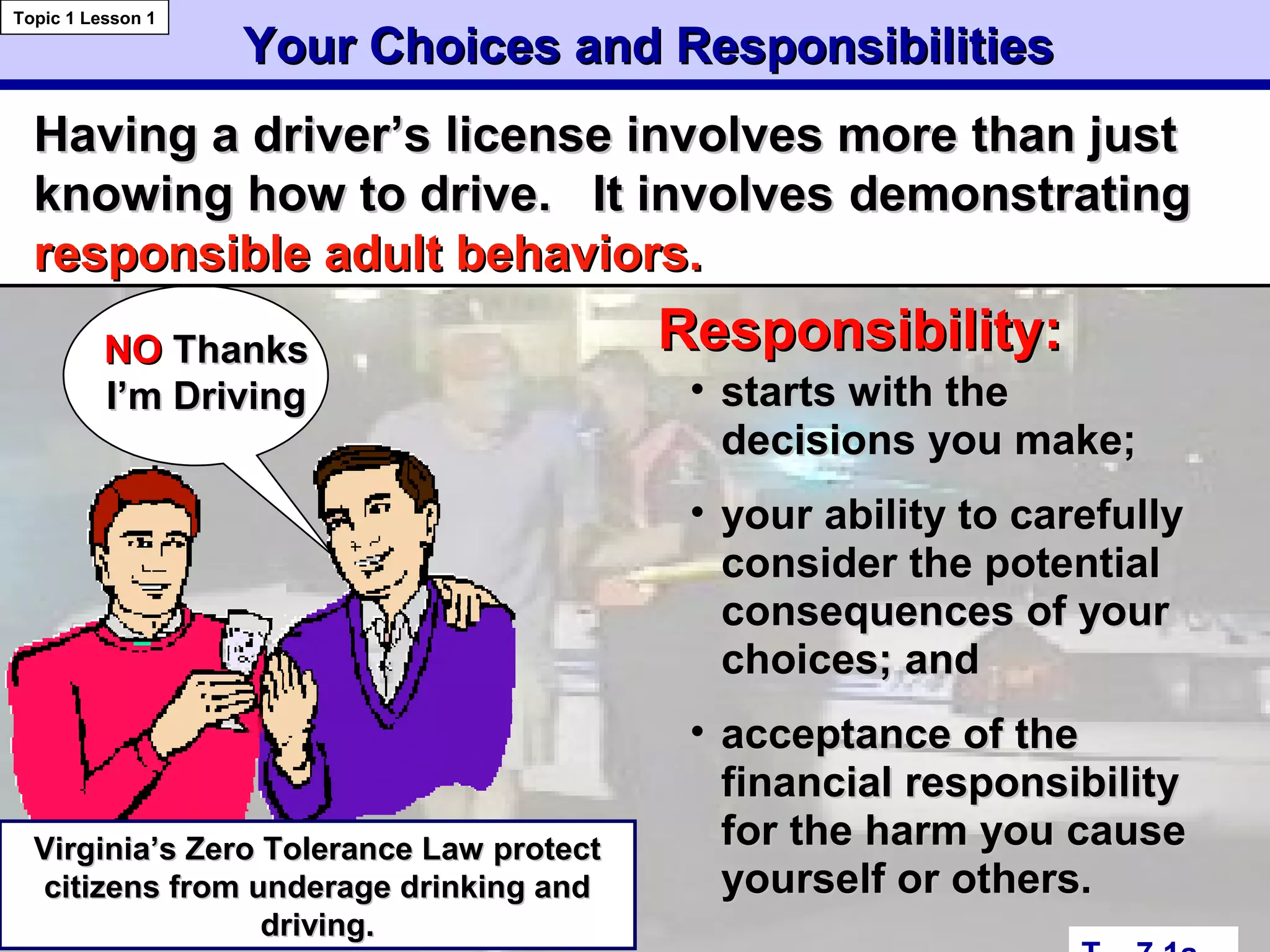
Having a driver’s license involves more than justHaving a driver’s license involves more than just
knowing how to drive. It involvesknowing how to drive. It involves demonstratingdemonstrating
responsible adult behaviors.responsible adult behaviors.
NONO ThanksThanks
I’m DrivingI’m Driving
Responsibility:Responsibility:
• starts with thestarts with the
decisions you make;decisions you make;
• your ability to carefullyyour ability to carefully
consider the potentialconsider the potential
consequences of yourconsequences of your
choices; andchoices; and
• acceptance of theacceptance of the
financial responsibilityfinancial responsibility
for the harm you causefor the harm you cause
yourself or others.yourself or others.
Virginia’s Zero Tolerance Law protectVirginia’s Zero Tolerance Law protect
citizens from underage drinking andcitizens from underage drinking and
driving.driving.
Your Choices and ResponsibilitiesYour Choices and Responsibilities
T – 7.2
Topic 1 Lesson 1
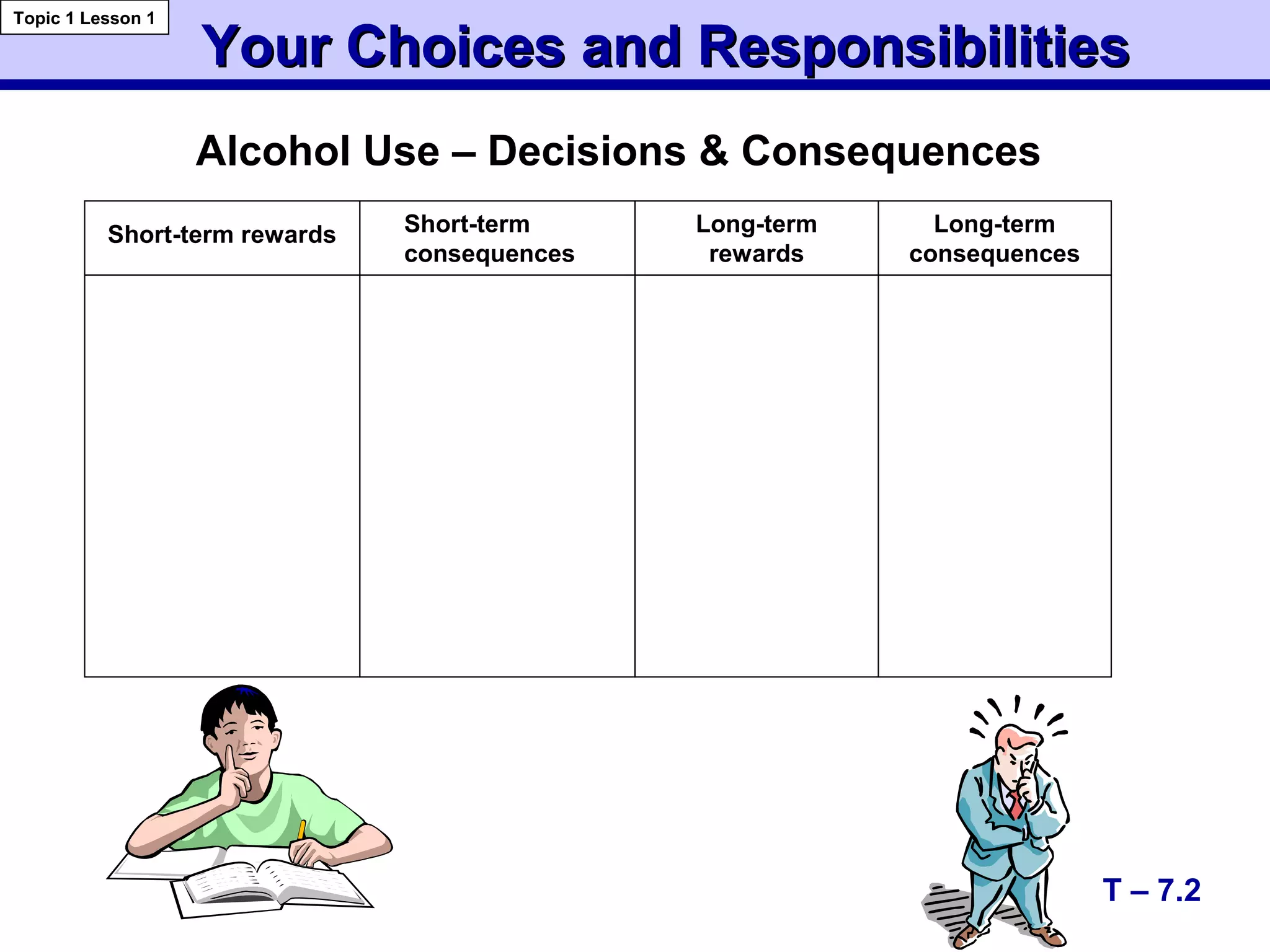
Alcohol Use – Decisions & Consequences
Short-term rewards Short-term
consequences
Long-term
rewards
Long-term
consequences
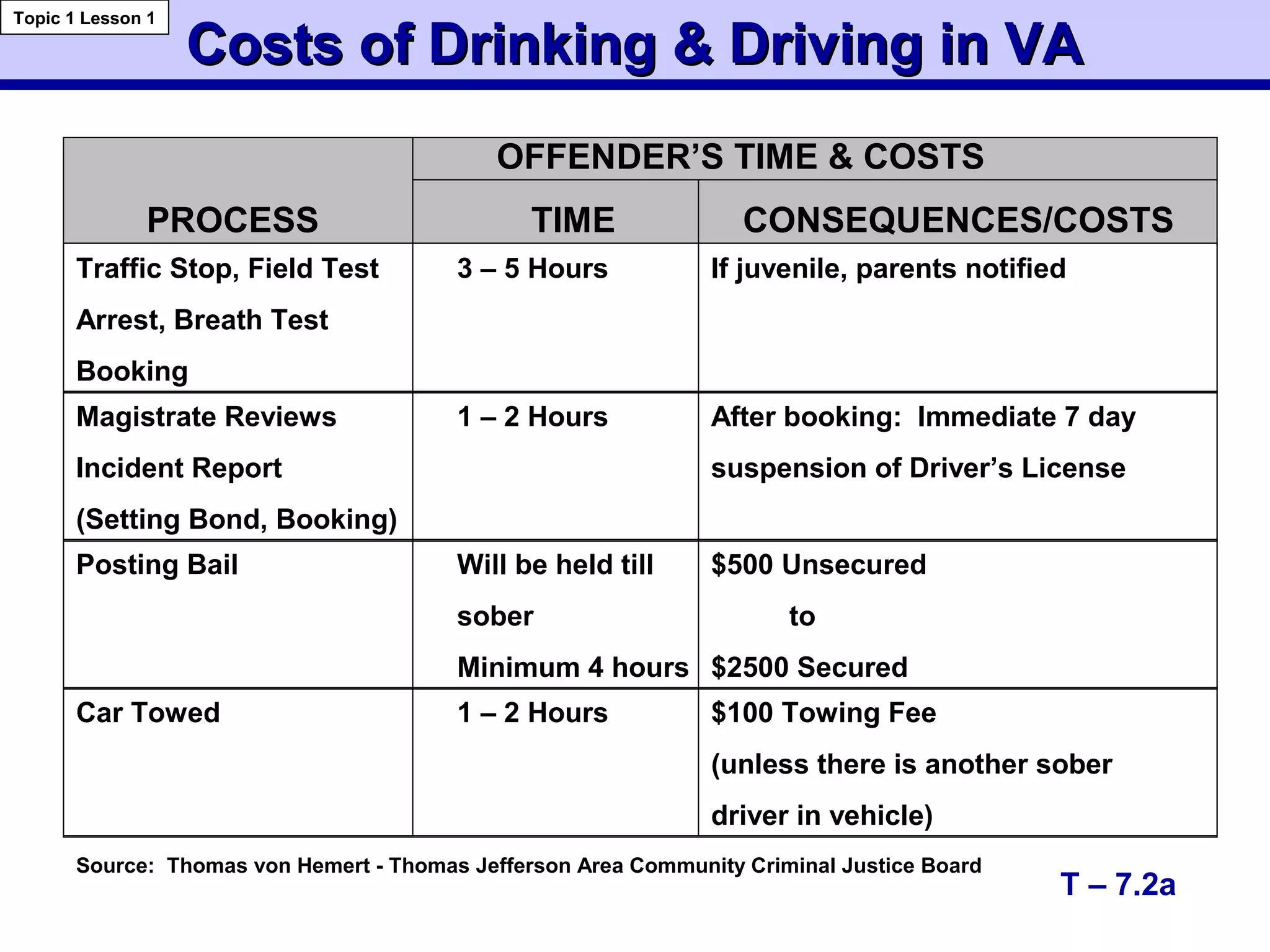
Costs of Drinking & Driving in VACosts of Drinking & Driving in VA
Topic 1 Lesson 1
T – 7.2a
PROCESS
OFFENDER’S TIME & COSTS
TIME CONSEQUENCES/COSTS
Traffic Stop, Field Test 3 – 5 Hours If juvenile, parents notified
Arrest, Breath Test
Booking
Magistrate Reviews 1 – 2 Hours After booking: Immediate 7 day
Incident Report suspension of Driver’s License
(Setting Bond, Booking)
Posting Bail Will be held till $500 Unsecured
sober to
Minimum 4 hours $2500 Secured
Car Towed 1 – 2 Hours $100 Towing Fee
(unless there is another sober
driver in vehicle)
Source: Thomas von Hemert - Thomas Jefferson Area Community Criminal Justice Board
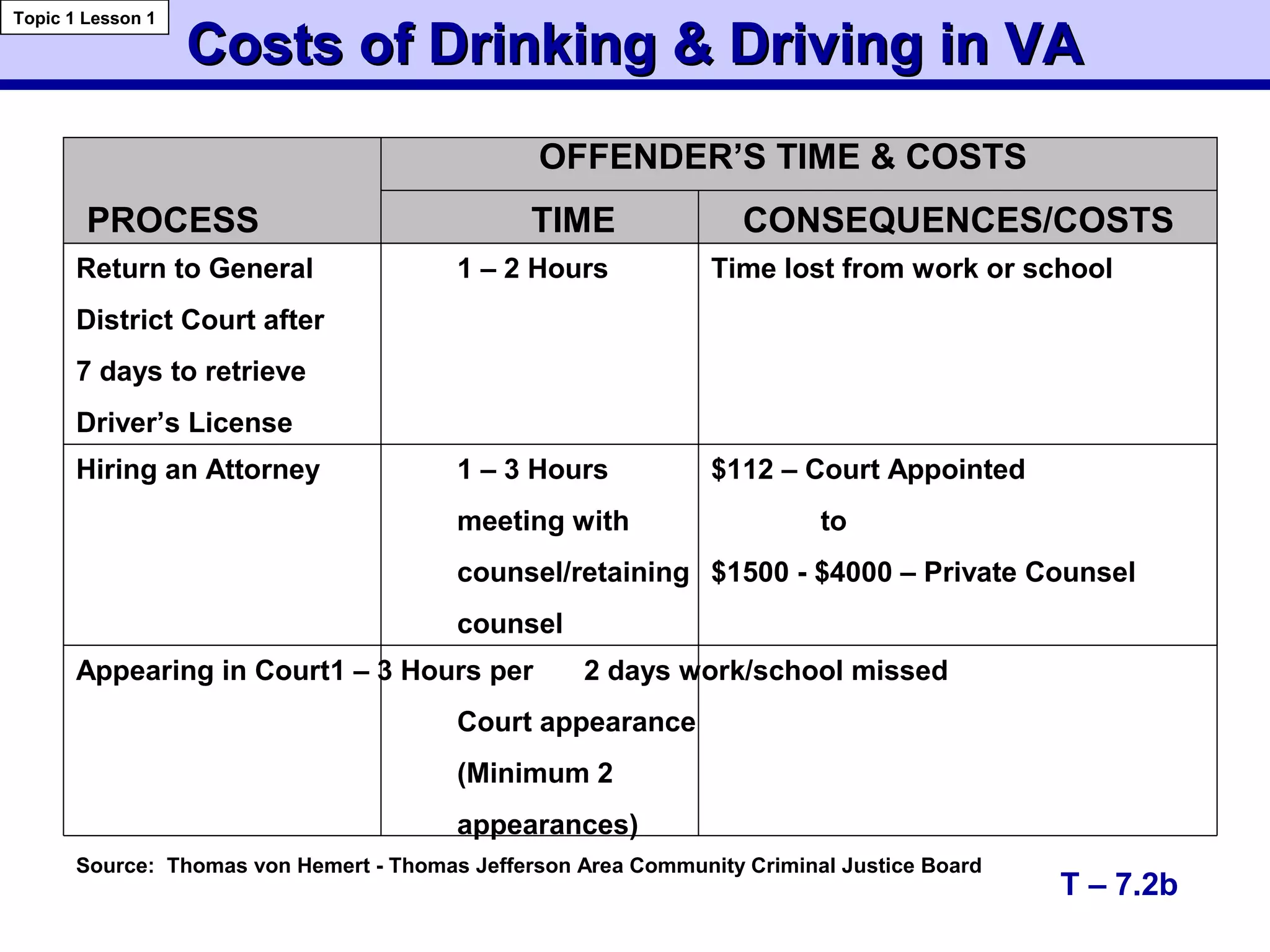
Costs of Drinking & Driving in VACosts of Drinking & Driving in VA
Topic 1 Lesson 1
T – 7.2b
PROCESS TIME CONSEQUENCES/COSTS
OFFENDER’S TIME & COSTS
Return to General 1 – 2 Hours Time lost from work or school
District Court after
7 days to retrieve
Driver’s License
Hiring an Attorney 1 – 3 Hours $112 – Court Appointed
meeting with to
counsel/retaining $1500 - $4000 – Private Counsel
counsel
Appearing in Court1 – 3 Hours per 2 days work/school missed
Court appearance
(Minimum 2
appearances)
Source: Thomas von Hemert - Thomas Jefferson Area Community Criminal Justice Board
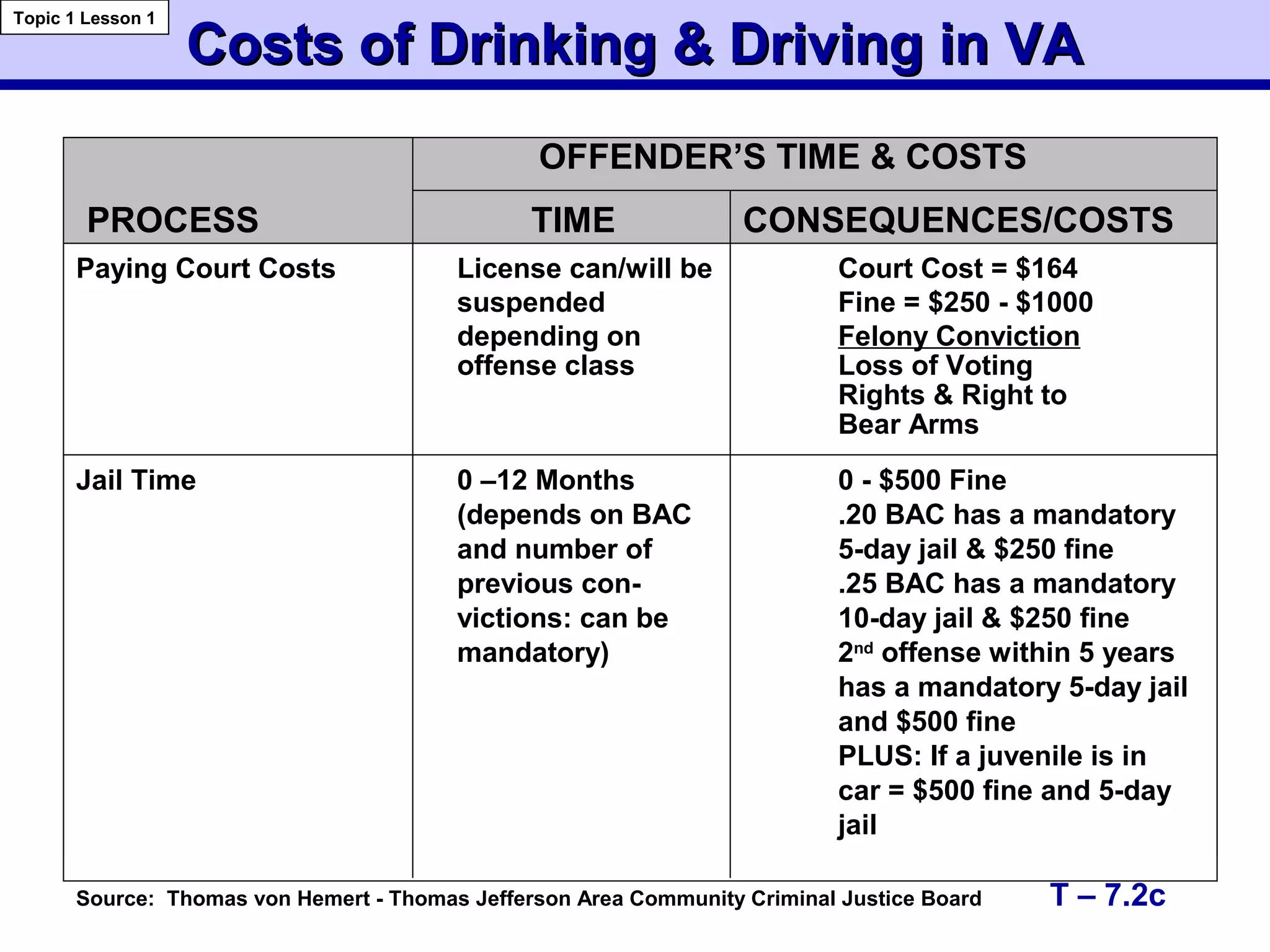
Costs of Drinking & Driving in VACosts of Drinking & Driving in VA
Topic 1 Lesson 1
T – 7.2c
PROCESS TIME CONSEQUENCES/COSTS
OFFENDER’S TIME & COSTS
Paying Court Costs License can/will be Court Cost = $164
suspended Fine = $250 - $1000
depending on Felony Conviction
offense class Loss of Voting
Rights & Right to
Bear Arms
Jail Time 0 –12 Months 0 - $500 Fine
(depends on BAC .20 BAC has a mandatory
and number of 5-day jail & $250 fine
previous con- .25 BAC has a mandatory
victions: can be 10-day jail & $250 fine
mandatory) 2nd
offense within 5 years
has a mandatory 5-day jail
and $500 fine
PLUS: If a juvenile is in
car = $500 fine and 5-day
jail
Source: Thomas von Hemert - Thomas Jefferson Area Community Criminal Justice Board
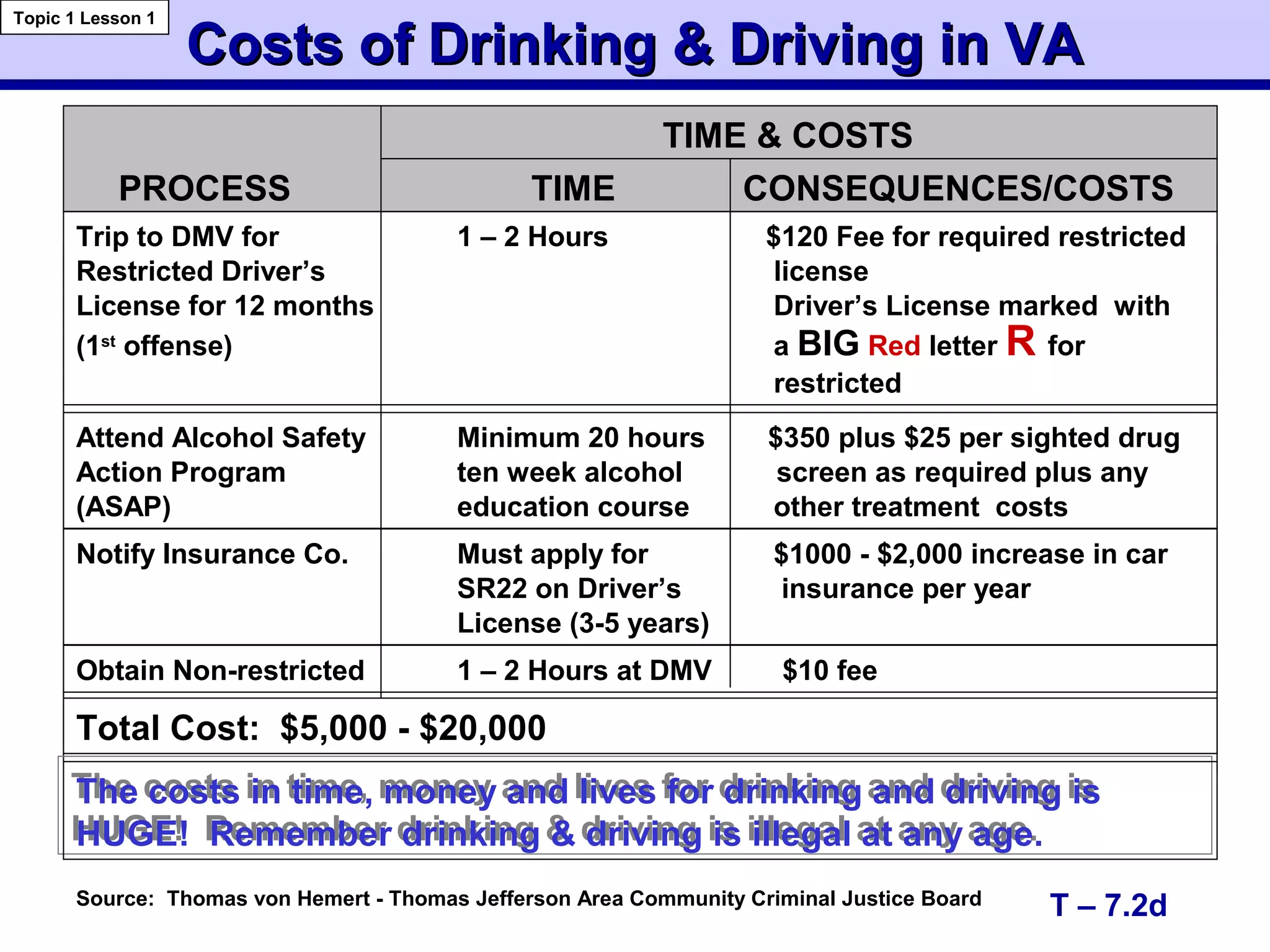
Costs of Drinking & Driving in VACosts of Drinking & Driving in VA
Topic 1 Lesson 1
PROCESS
TIME & COSTS
TIME CONSEQUENCES/COSTS
T – 7.2d
Trip to DMV for 1 – 2 Hours $120 Fee for required restricted
Restricted Driver’s license
License for 12 months Driver’s License marked with
(1st
offense) a BIG Red letter R for
restricted
Attend Alcohol Safety Minimum 20 hours $350 plus $25 per sighted drug
Action Program ten week alcohol screen as required plus any
(ASAP) education course other treatment costs
Notify Insurance Co. Must apply for $1000 - $2,000 increase in car
SR22 on Driver’s insurance per year
License (3-5 years)
Obtain Non-restricted 1 – 2 Hours at DMV $10 fee
Total Cost: $5,000 - $20,000
The costs in time, money and lives for drinking and driving is
HUGE! Remember drinking & driving is illegal at any age.
The costs in time, money and lives for drinking and driving is
HUGE! Remember drinking & driving is illegal at any age.
Source: Thomas von Hemert - Thomas Jefferson Area Community Criminal Justice Board
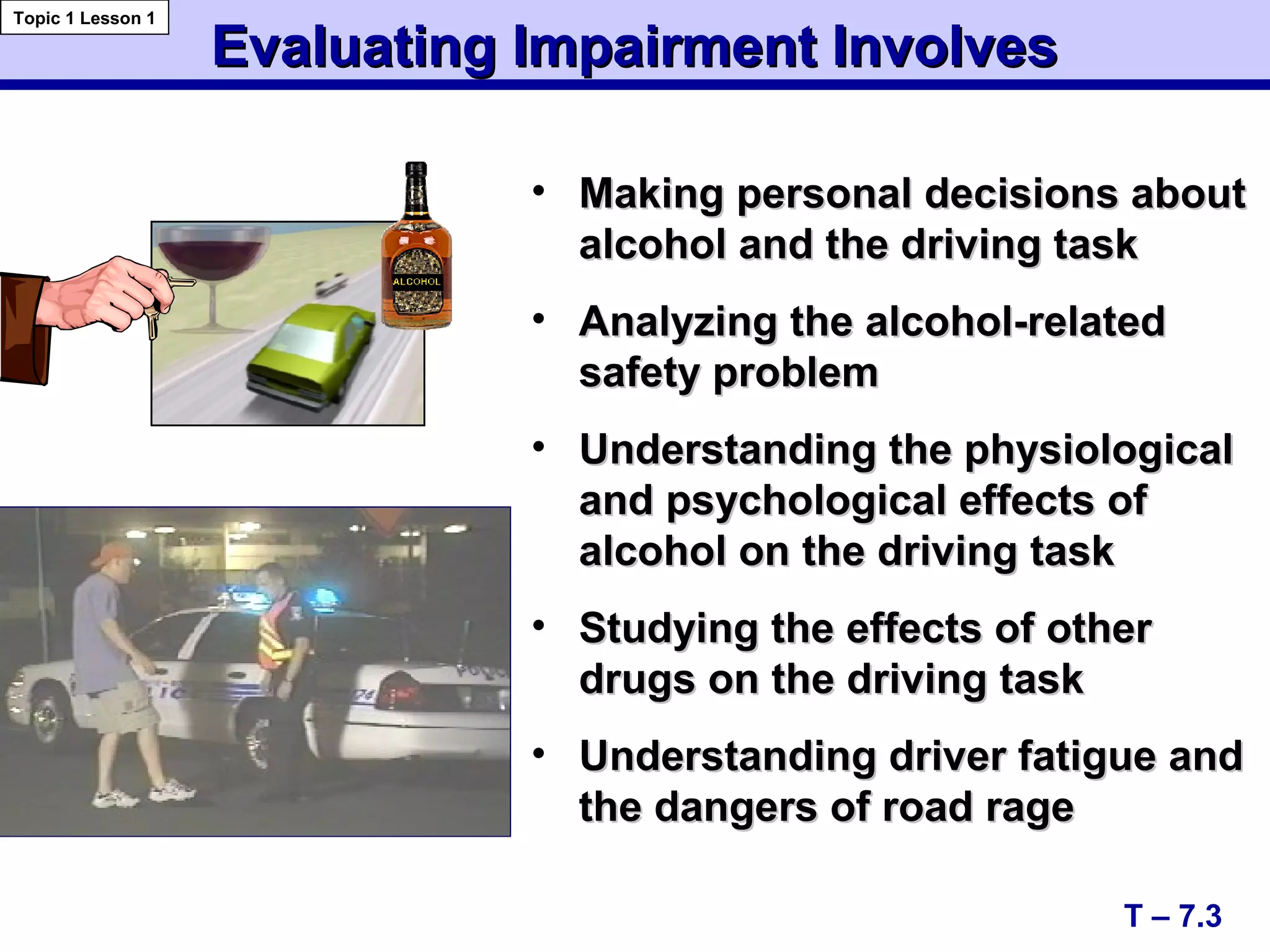
Evaluating Impairment InvolvesEvaluating Impairment Involves
• Making personal decisions aboutMaking personal decisions about
alcohol and the driving taskalcohol and the driving task
• Analyzing the alcohol-relatedAnalyzing the alcohol-related
safety problemsafety problem
• Understanding the physiologicalUnderstanding the physiological
and psychological effects ofand psychological effects of
alcohol on the driving taskalcohol on the driving task
• Studying the effects of otherStudying the effects of other
drugs on the driving taskdrugs on the driving task
• Understanding driver fatigue andUnderstanding driver fatigue and
the dangers of road ragethe dangers of road rage
T – 7.3
Topic 1 Lesson 1
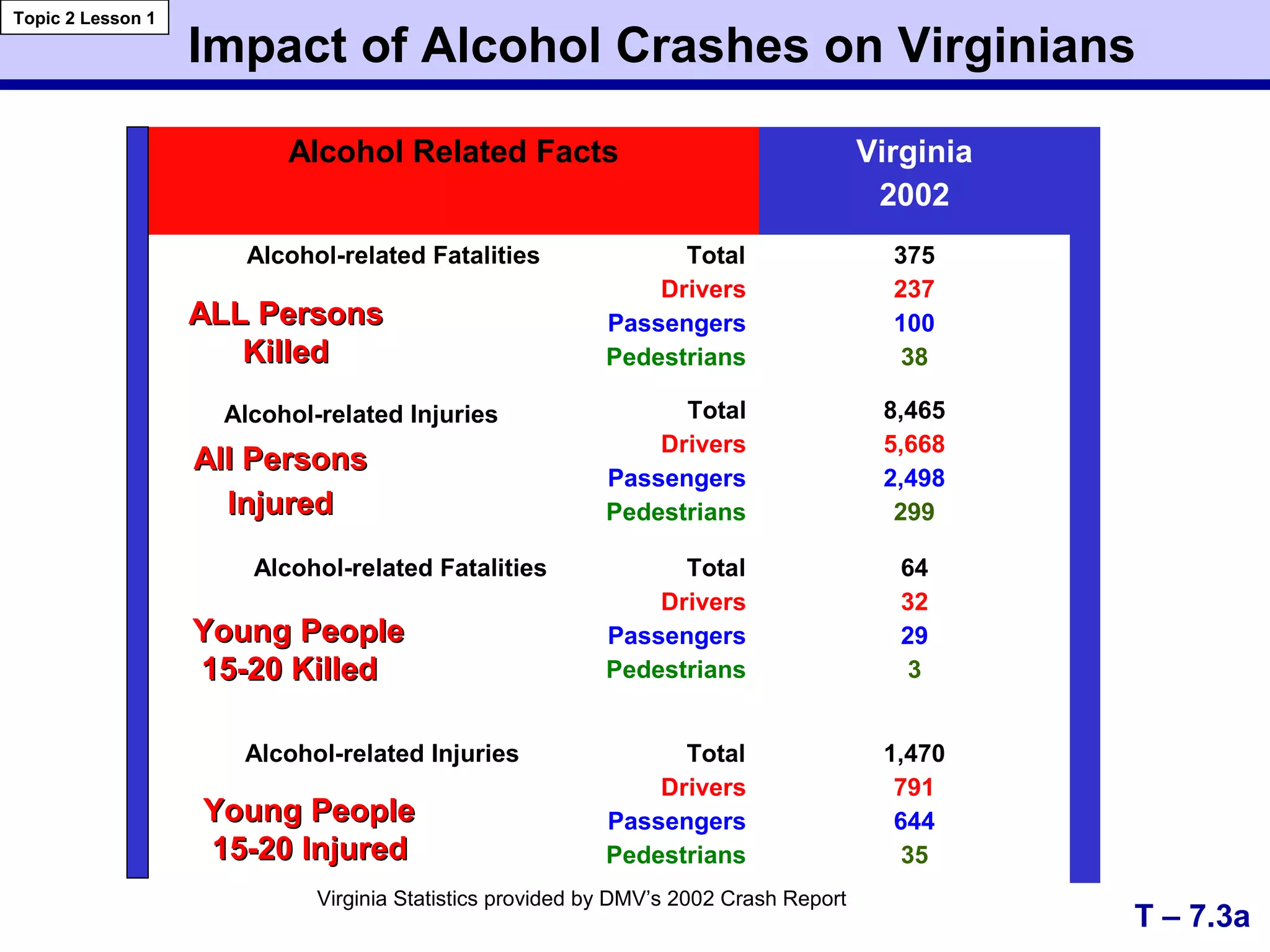
Impact of Alcohol Crashes on Virginians
T – 7.3a
Topic 2 Lesson 1
Alcohol Related Facts Virginia
2002
Alcohol-related Fatalities Total
Drivers
Passengers
Pedestrians
375
237
100
38
Total
Drivers
Passengers
Pedestrians
8,465
5,668
2,498
299
Alcohol-related Fatalities Total
Drivers
Passengers
Pedestrians
64
32
29
3
Alcohol-related Injuries Total
Drivers
Passengers
Pedestrians
1,470
791
644
35
ALL PersonsALL Persons
KilledKilled
Young PeopleYoung People
15-20 Injured15-20 Injured
Young PeopleYoung People
15-20 Killed15-20 Killed
Virginia Statistics provided by DMV’s 2002 Crash Report
All PersonsAll Persons
InjuredInjured
Alcohol-related Injuries
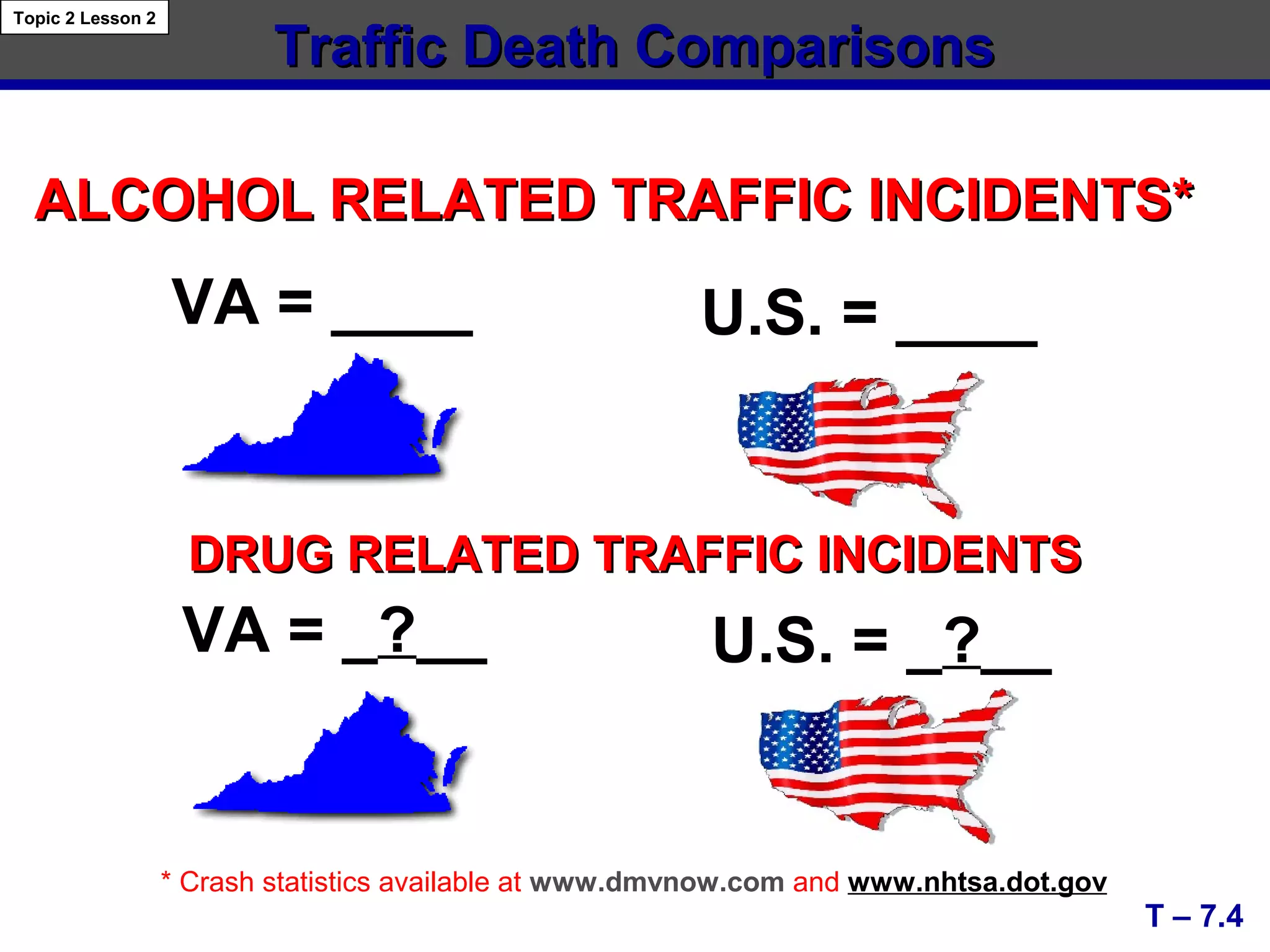
ALCOHOL RELATED TRAFFIC INCIDENTS*ALCOHOL RELATED TRAFFIC INCIDENTS*
Traffic Death ComparisonsTraffic Death Comparisons
T – 7.4
Topic 2 Lesson 2
DRUG RELATED TRAFFIC INCIDENTSDRUG RELATED TRAFFIC INCIDENTS
VA = _?__ U.S. = _?__
VA = ____ U.S. = ____
* Crash statistics available at www.dmvnow.com and www.nhtsa.dot.gov
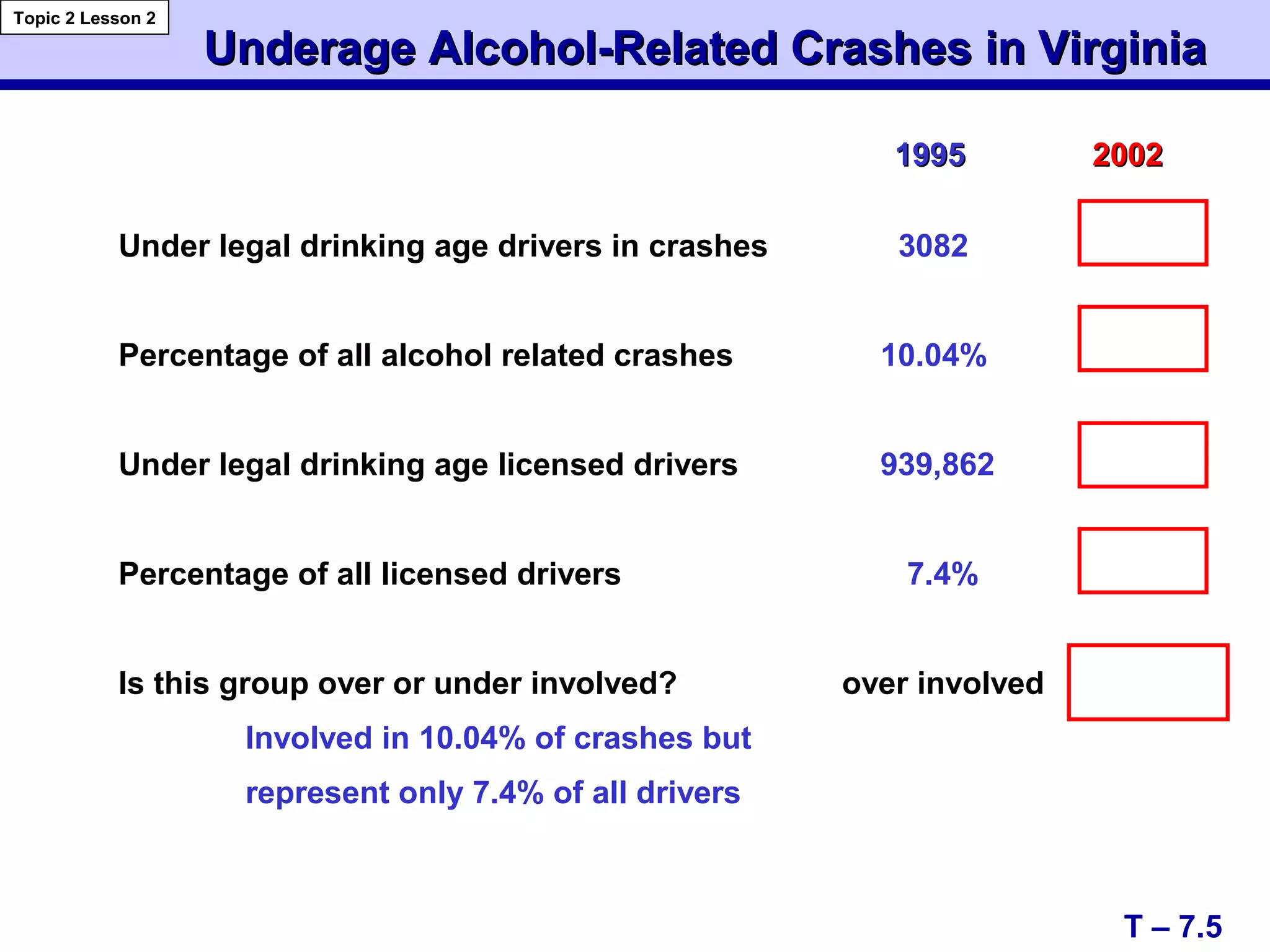
Under legal drinking age drivers in crashes 3082
Percentage of all alcohol related crashes 10.04%
Under legal drinking age licensed drivers 939,862
Percentage of all licensed drivers 7.4%
Is this group over or under involved? over involved
Involved in 10.04% of crashes but
represent only 7.4% of all drivers
Underage Alcohol-Related Crashes in VirginiaUnderage Alcohol-Related Crashes in Virginia
19951995 20022002
T – 7.5
Topic 2 Lesson 2
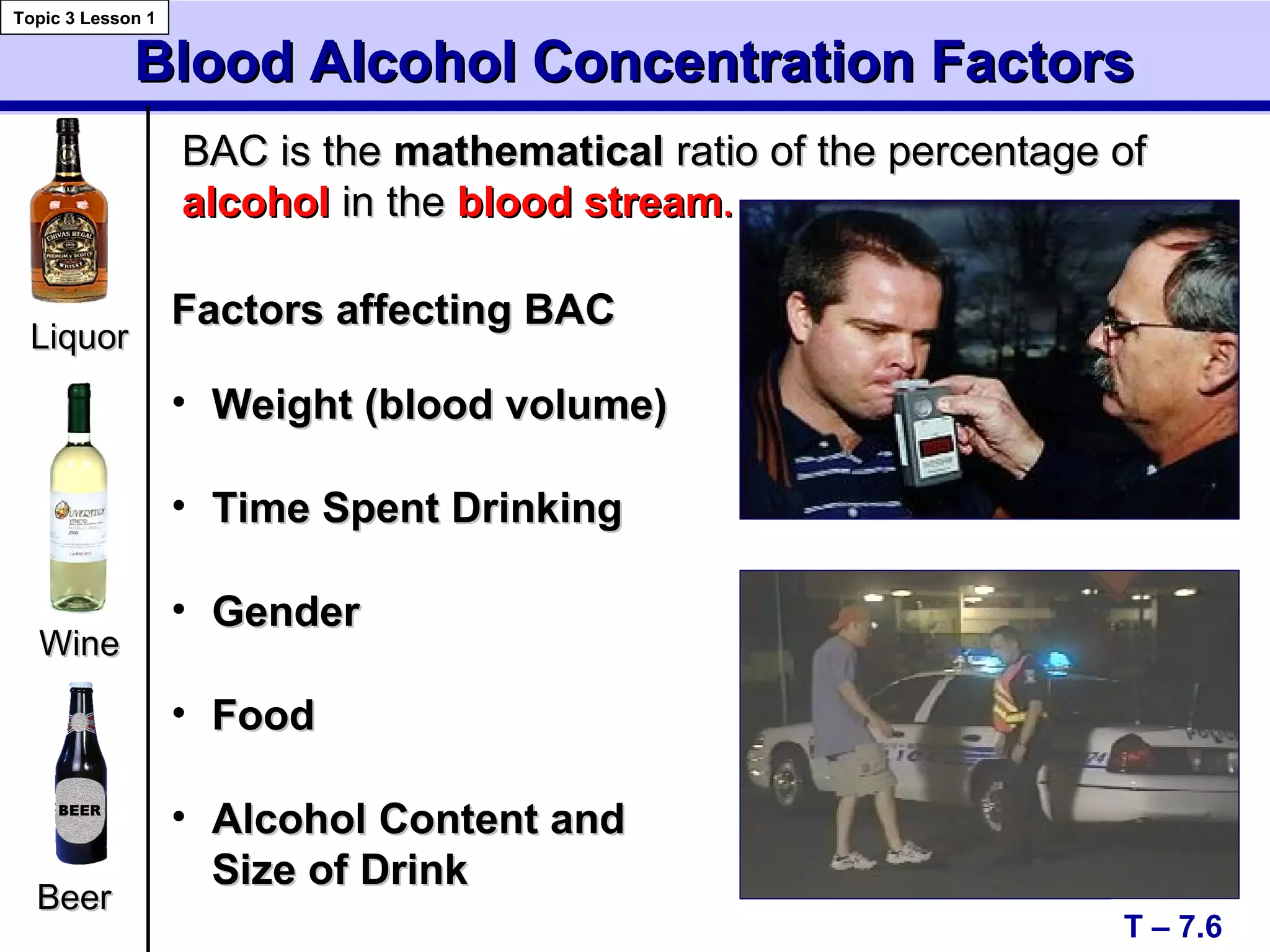
Blood Alcohol Concentration FactorsBlood Alcohol Concentration Factors
T – 7.6
Topic 3 Lesson 1
LiquorLiquor
BeerBeer
• Weight (blood volume)Weight (blood volume)
• Time Spent DrinkingTime Spent Drinking
• GenderGender
• FoodFood
• Alcohol Content andAlcohol Content and
Size of DrinkSize of Drink
WineWine
BAC is theBAC is the mathematicalmathematical ratio of the percentage ofratio of the percentage of
alcoholalcohol in thein the blood streamblood stream..
Factors affecting BACFactors affecting BAC
BAC FactorsBAC Factors
T – 7.6a
Topic 3 Lesson 1
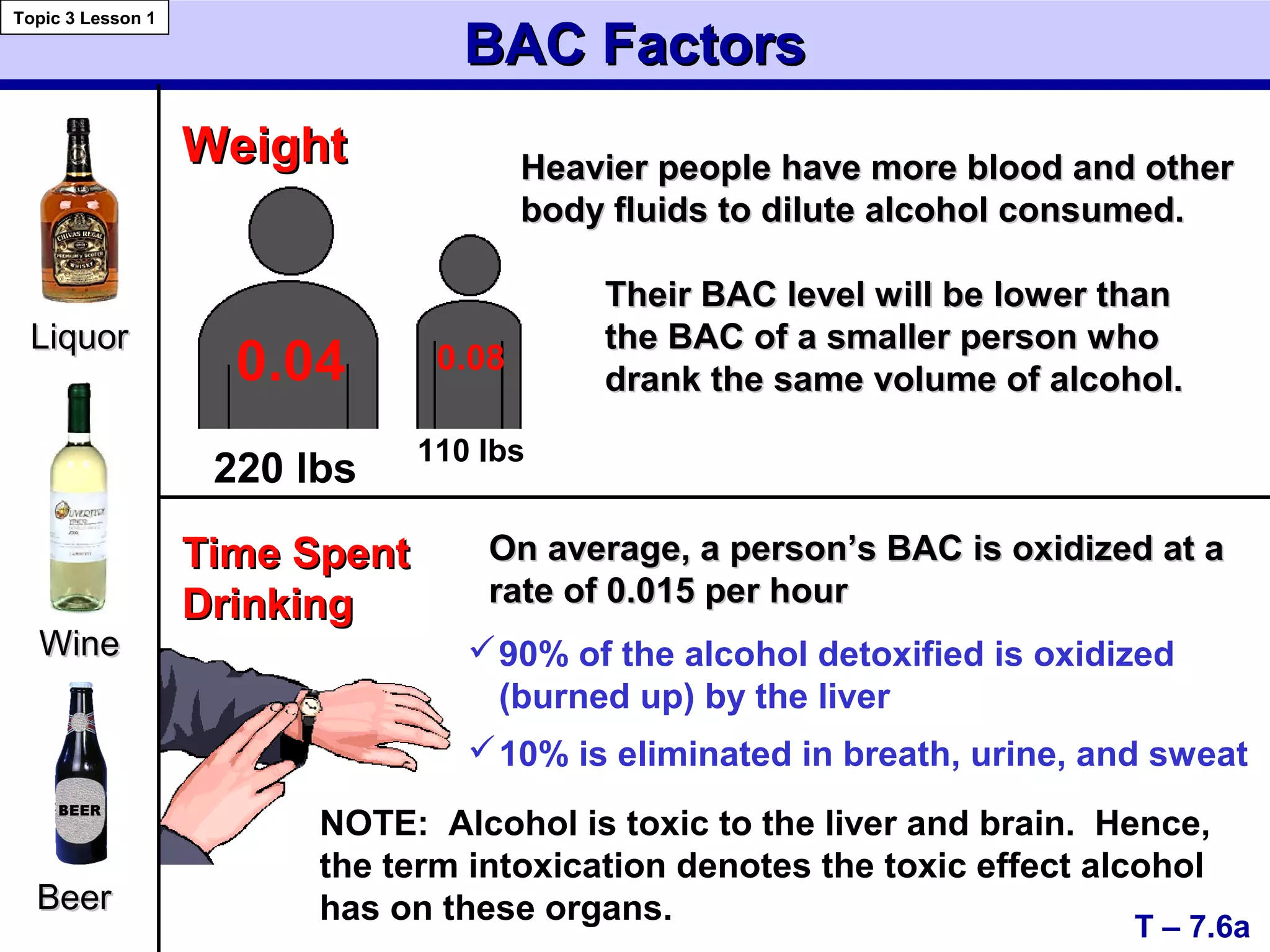
WeightWeight Heavier people have more blood and otherHeavier people have more blood and other
body fluids to dilute alcohol consumed.body fluids to dilute alcohol consumed.
0.04 0.08
220 lbs
110 lbs
WineWine
LiquorLiquor
Time SpentTime Spent
DrinkingDrinking
90% of the alcohol detoxified is oxidized
(burned up) by the liver
10% is eliminated in breath, urine, and sweat
BeerBeer
Their BAC level will be lower thanTheir BAC level will be lower than
the BAC of a smaller person whothe BAC of a smaller person who
drank the same volume of alcohol.drank the same volume of alcohol.
On average, a person’s BAC is oxidized at aOn average, a person’s BAC is oxidized at a
rate of 0.015 per hourrate of 0.015 per hour
NOTE: Alcohol is toxic to the liver and brain. Hence,
the term intoxication denotes the toxic effect alcohol
has on these organs.
BAC FactorsBAC Factors
T – 7.6b
Topic 3 Lesson 1
LiquorLiquor
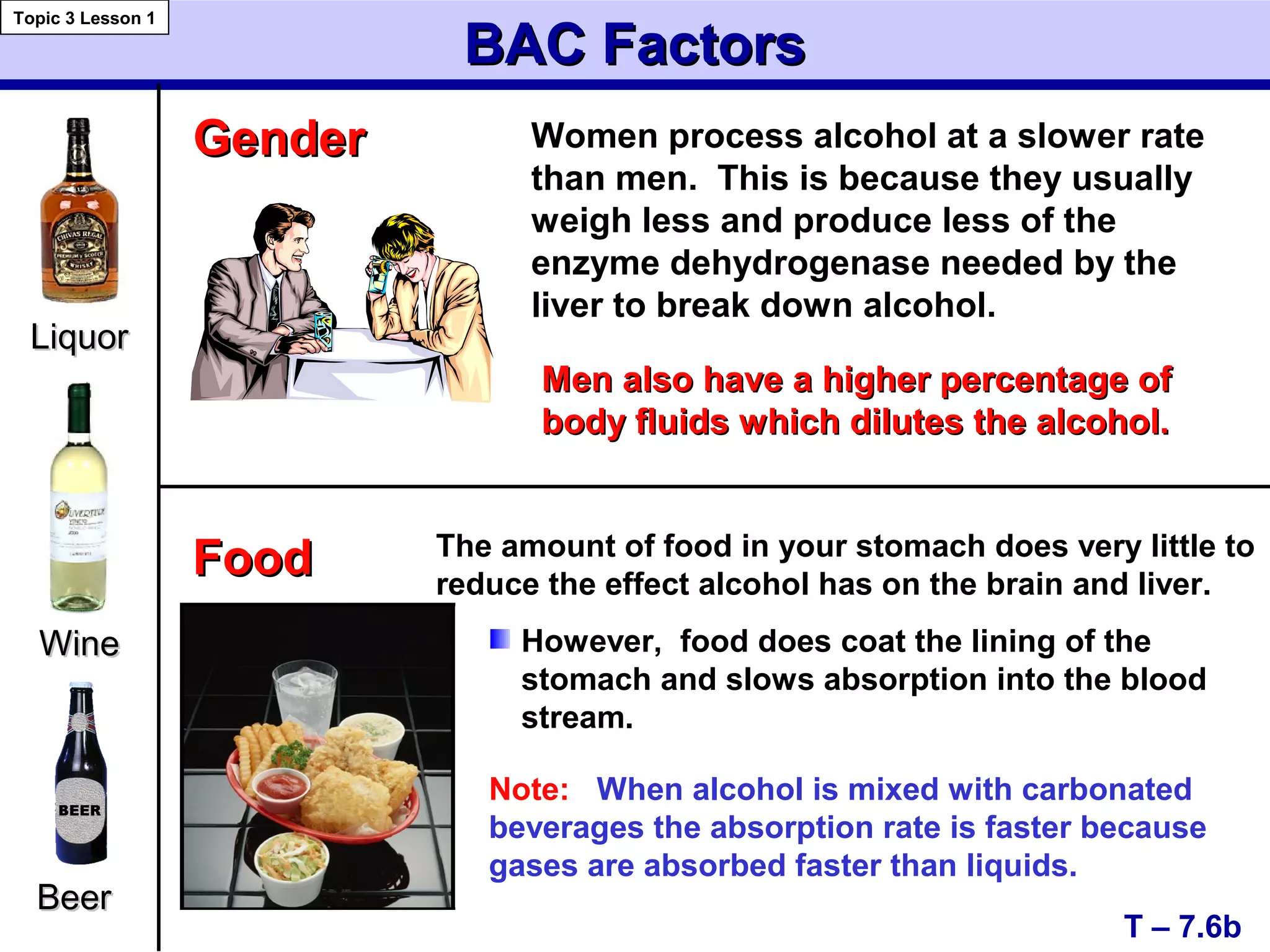
GenderGender Women process alcohol at a slower rate
than men. This is because they usually
weigh less and produce less of the
enzyme dehydrogenase needed by the
liver to break down alcohol.
Men also have a higher percentage ofMen also have a higher percentage of
body fluids which dilutes the alcohol.body fluids which dilutes the alcohol.
FoodFood
BeerBeer
The amount of food in your stomach does very little to
reduce the effect alcohol has on the brain and liver.
However, food does coat the lining of the
stomach and slows absorption into the blood
stream.
Note: When alcohol is mixed with carbonated
beverages the absorption rate is faster because
gases are absorbed faster than liquids.
WineWine
Are They The SameAre They The Same ??
Topic 3 Lesson 1
LiquorLiquor
• BeerBeer
• WhiskeyWhiskey
• WineWine
• CoolerCooler
• MargaritaMargarita
T – 7.7BeerBeer
WineWine
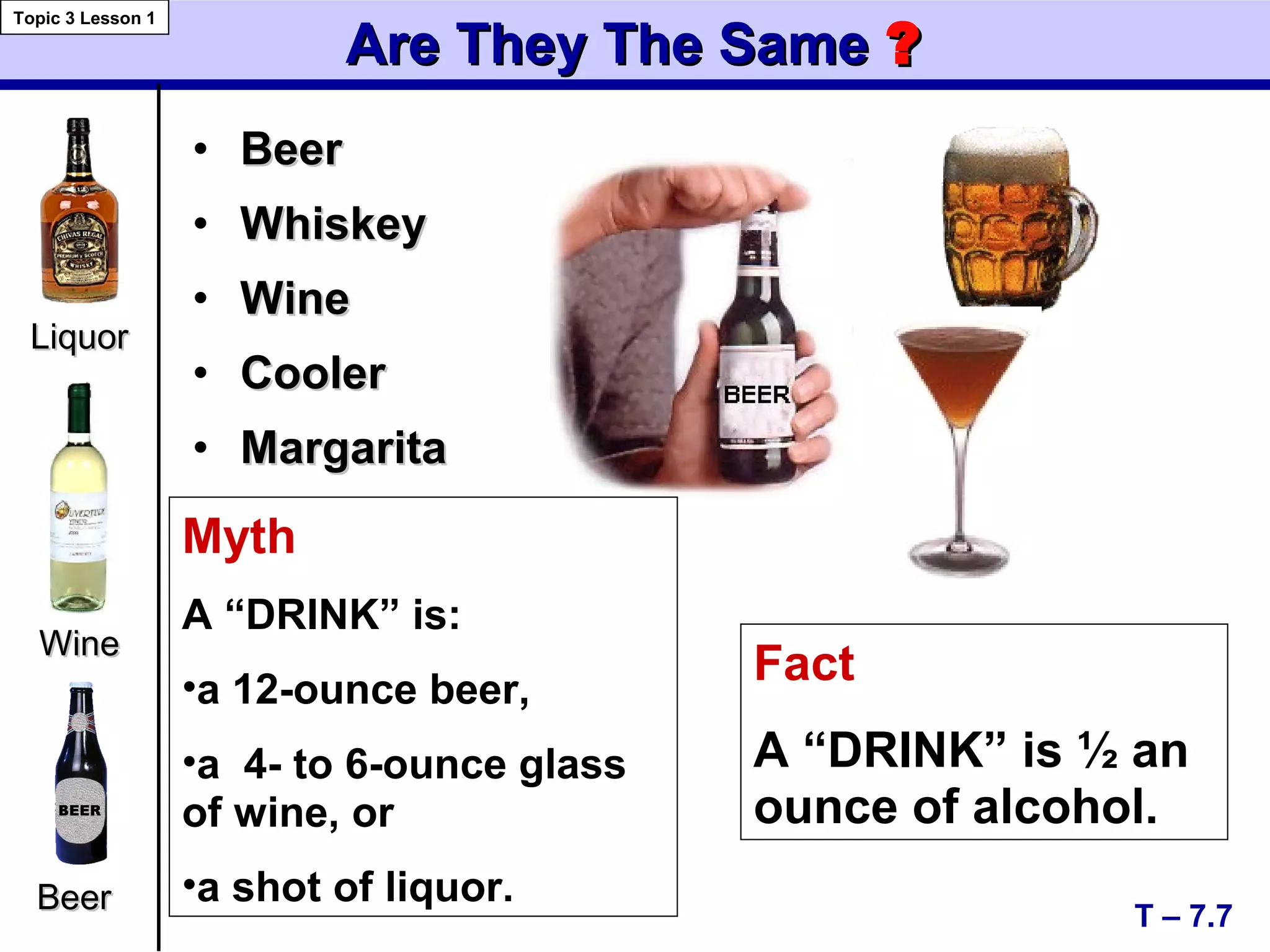
Myth
A “DRINK” is:
•a 12-ounce beer,
•a 4- to 6-ounce glass
of wine, or
•a shot of liquor.
Fact
A “DRINK” is ½ an
ounce of alcohol.
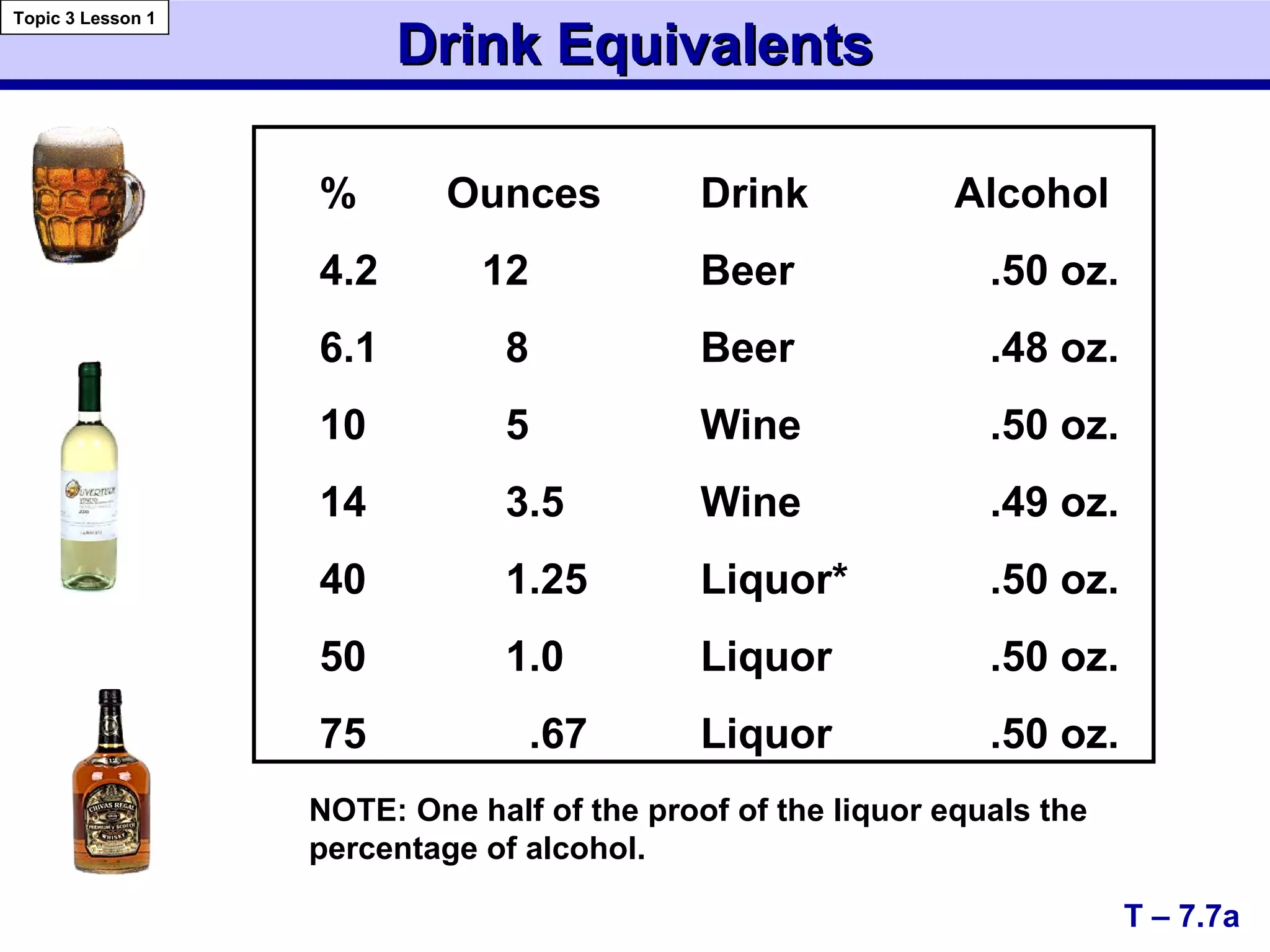
Drink EquivalentsDrink Equivalents
T – 7.7a
Topic 3 Lesson 1
% Ounces Drink Alcohol
4.2 12 Beer .50 oz.
6.1 8 Beer .48 oz.
10 5 Wine .50 oz.
14 3.5 Wine .49 oz.
40 1.25 Liquor* .50 oz.
50 1.0 Liquor .50 oz.
75 .67 Liquor .50 oz.
NOTE: One half of the proof of the liquor equals the
percentage of alcohol.
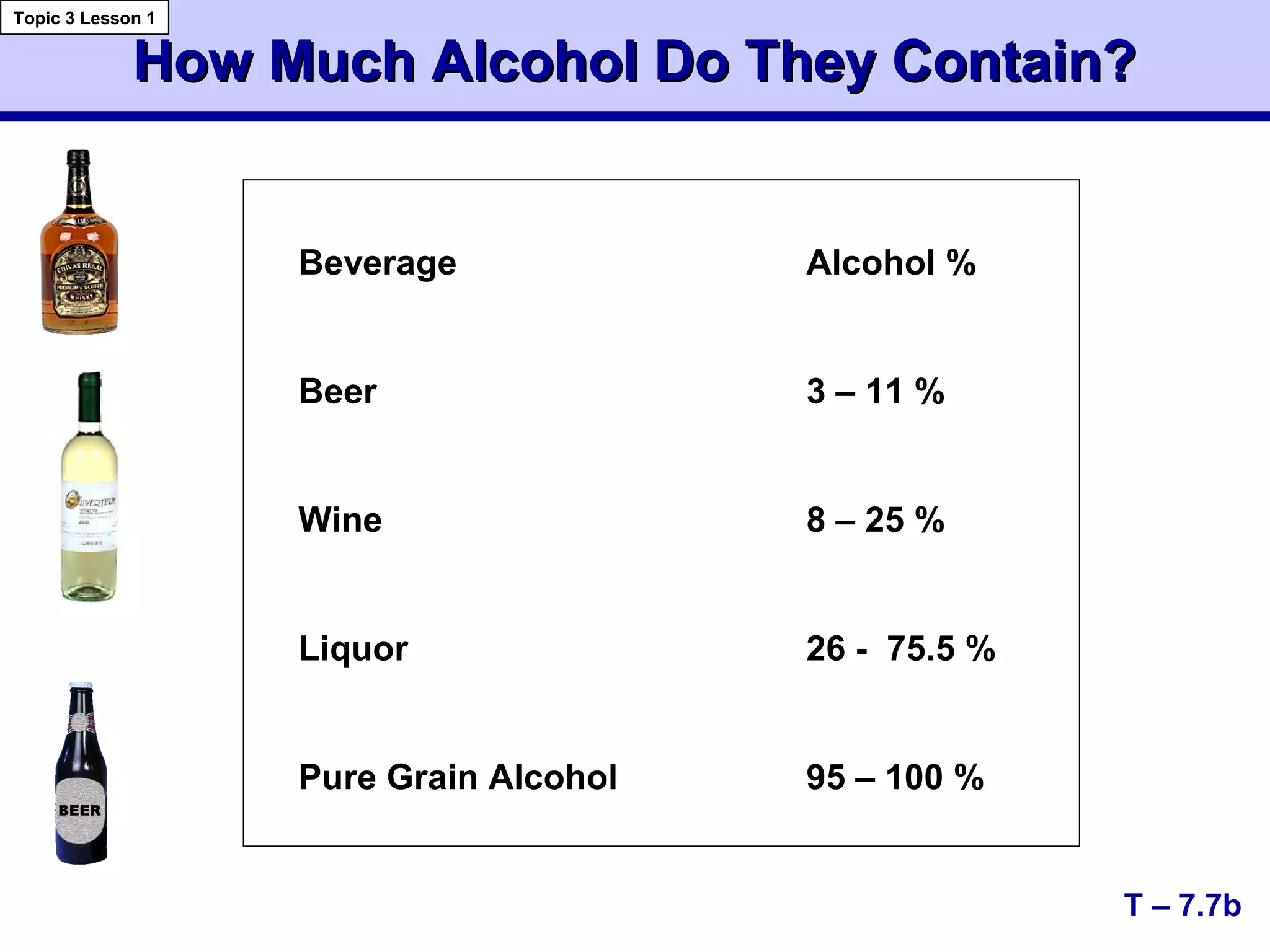
How Much Alcohol Do They Contain?How Much Alcohol Do They Contain?
Topic 3 Lesson 1
T – 7.7b
Beverage Alcohol %
Beer 3 – 11 %
Wine 8 – 25 %
Liquor 26 - 75.5 %
Pure Grain Alcohol 95 – 100 %
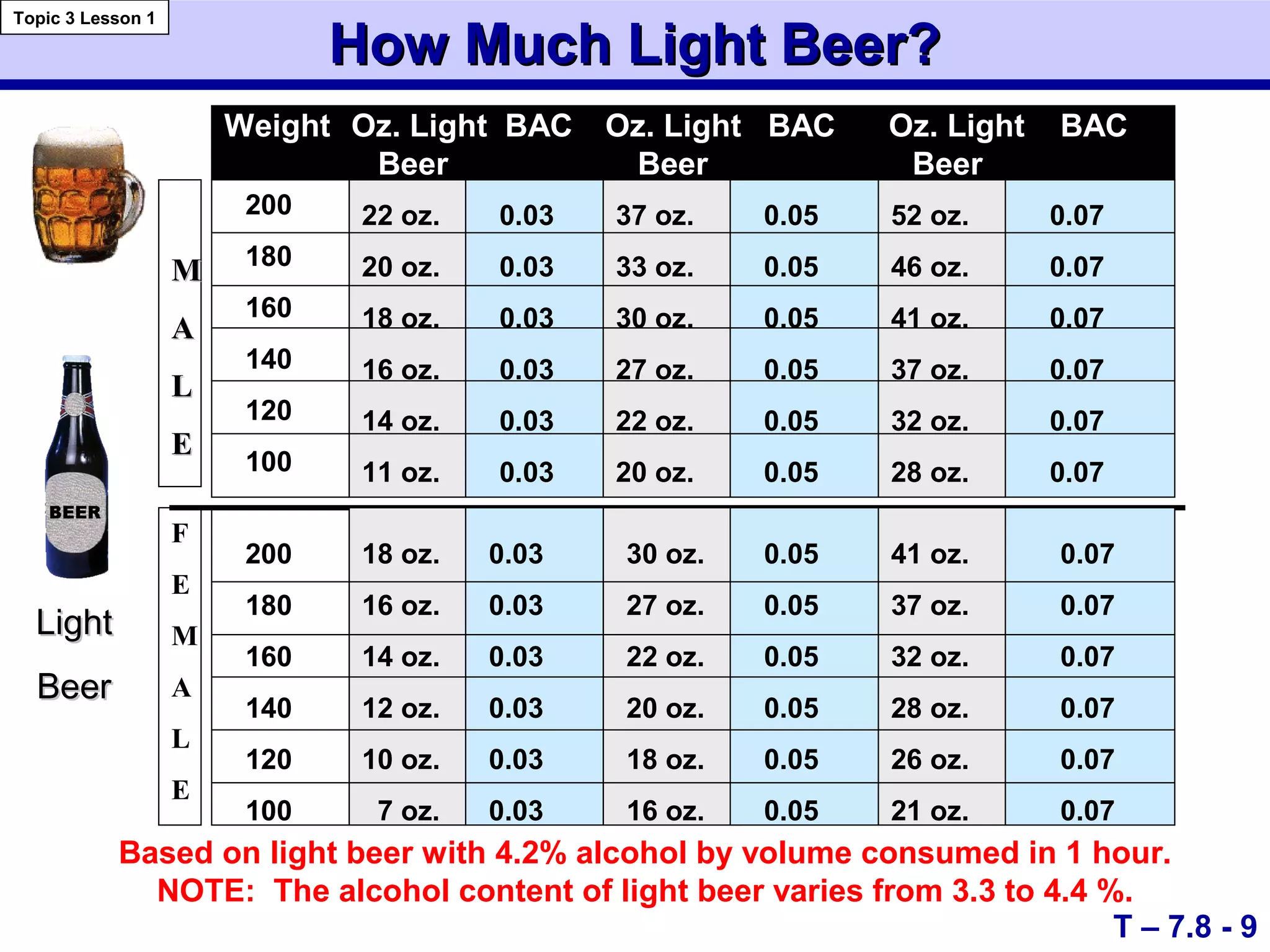
How Much Light Beer?How Much Light Beer?
Based on light beer with 4.2% alcohol by volume consumed in 1 hour.
NOTE: The alcohol content of light beer varies from 3.3 to 4.4 %.
T – 7.8 - 9
Topic 3 Lesson 1
LightLight
BeerBeer
Weight Oz. Light BAC Oz. Light BAC Oz. Light BAC
Beer Beer Beer
200
180
160
140
120
100
0.03
0.03
0.03
0.03
0.03
0.03
22 oz.
20 oz.
18 oz.
16 oz.
14 oz.
11 oz.
0.05
0.05
0.05
0.05
0.05
0.05
37 oz.
33 oz.
30 oz.
27 oz.
22 oz.
20 oz.
0.07
0.07
0.07
0.07
0.07
0.07
52 oz.
46 oz.
41 oz.
37 oz.
32 oz.
28 oz.
MM
AA
LL
EE
200
180
160
140
120
100
18 oz.
16 oz.
14 oz.
12 oz.
10 oz.
7 oz.
30 oz.
27 oz.
22 oz.
20 oz.
18 oz.
16 oz.
41 oz.
37 oz.
32 oz.
28 oz.
26 oz.
21 oz.
F
E
M
A
L
E
0.03
0.03
0.03
0.03
0.03
0.03
0.05
0.05
0.05
0.05
0.05
0.05
0.07
0.07
0.07
0.07
0.07
0.07
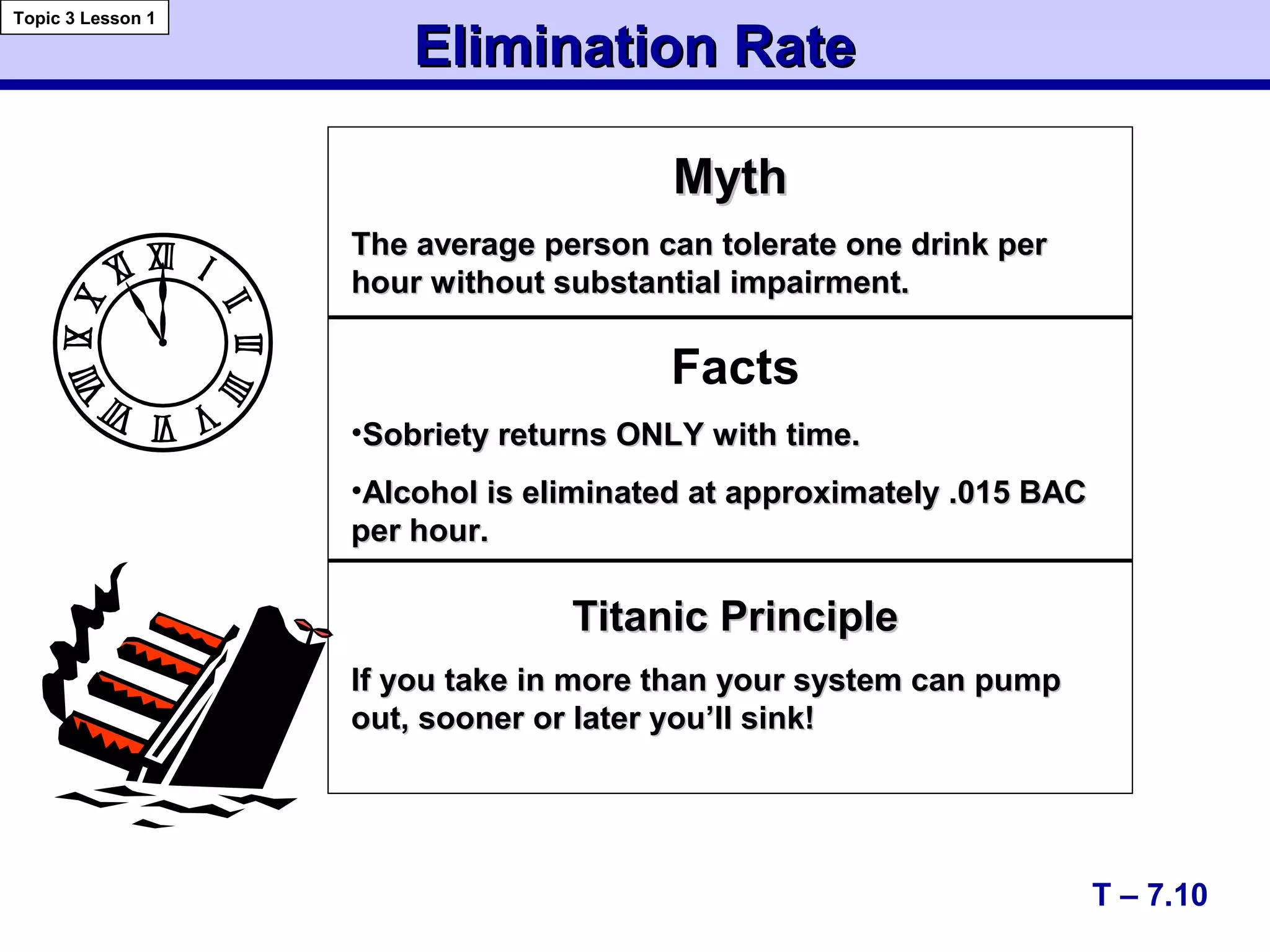
Elimination RateElimination Rate
Topic 3 Lesson 1
T – 7.10
MythMyth
The average person can tolerate one drink perThe average person can tolerate one drink per
hour without substantial impairment.hour without substantial impairment.
Facts
•Sobriety returns ONLY with time.Sobriety returns ONLY with time.
•Alcohol is eliminated at approximately .015 BACAlcohol is eliminated at approximately .015 BAC
per hour.per hour.
Titanic PrincipleTitanic Principle
If you take in more than your system can pumpIf you take in more than your system can pump
out, sooner or later you’ll sink!out, sooner or later you’ll sink!
Elimination RateElimination Rate
Topic 3 Lesson 1
T – 7.10a
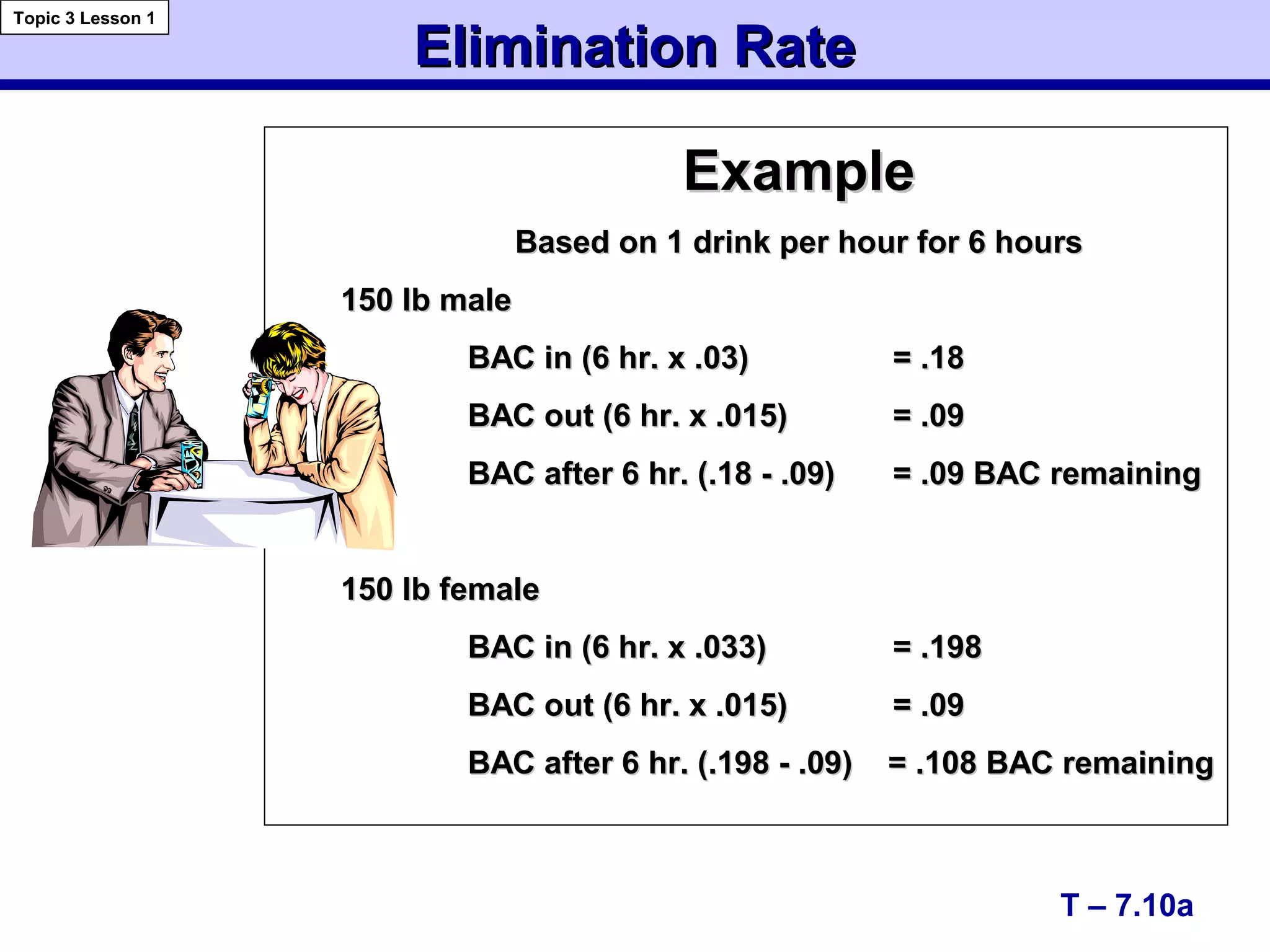
ExampleExample
Based on 1 drink per hour for 6 hoursBased on 1 drink per hour for 6 hours
150 lb male150 lb male
BAC in (6 hr. x .03)BAC in (6 hr. x .03) = .18= .18
BAC out (6 hr. x .015)BAC out (6 hr. x .015) = .09= .09
BAC after 6 hr. (.18 - .09)BAC after 6 hr. (.18 - .09) = .09 BAC remaining= .09 BAC remaining
150 lb female150 lb female
BAC in (6 hr. x .033)BAC in (6 hr. x .033) = .198= .198
BAC out (6 hr. x .015)BAC out (6 hr. x .015) = .09= .09
BAC after 6 hr. (.198 - .09) = .108 BAC remainingBAC after 6 hr. (.198 - .09) = .108 BAC remaining
Elimination of AlcoholElimination of Alcohol
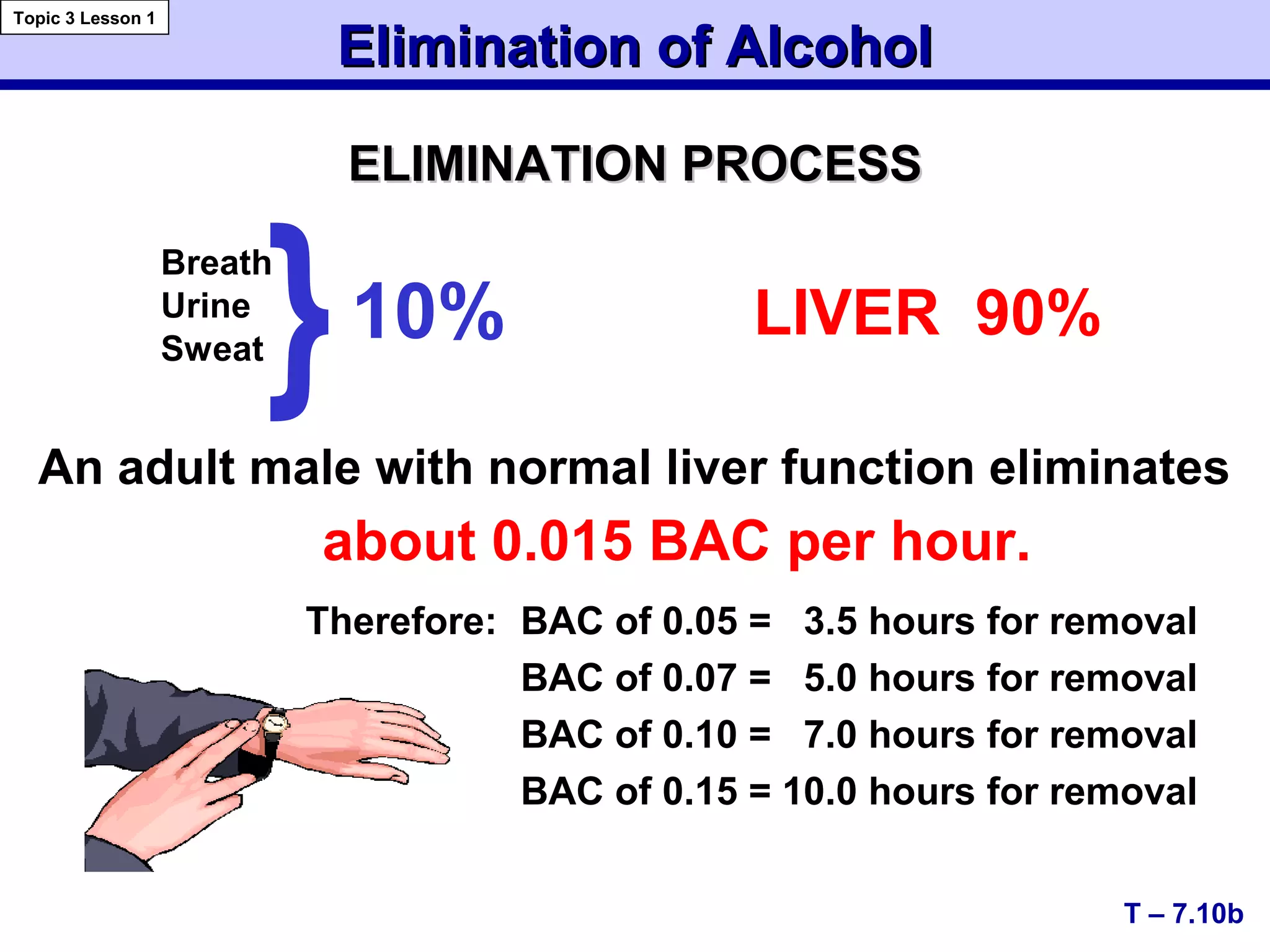
ELIMINATION PROCESSELIMINATION PROCESS
An adult male with normal liver function eliminates
Breath
Urine
Sweat}10% LIVER 90%
about 0.015 BAC per hour.
Therefore: BAC of 0.05 = 3.5 hours for removal
BAC of 0.07 = 5.0 hours for removal
BAC of 0.10 = 7.0 hours for removal
BAC of 0.15 = 10.0 hours for removal
T – 7.10b
Topic 3 Lesson 1
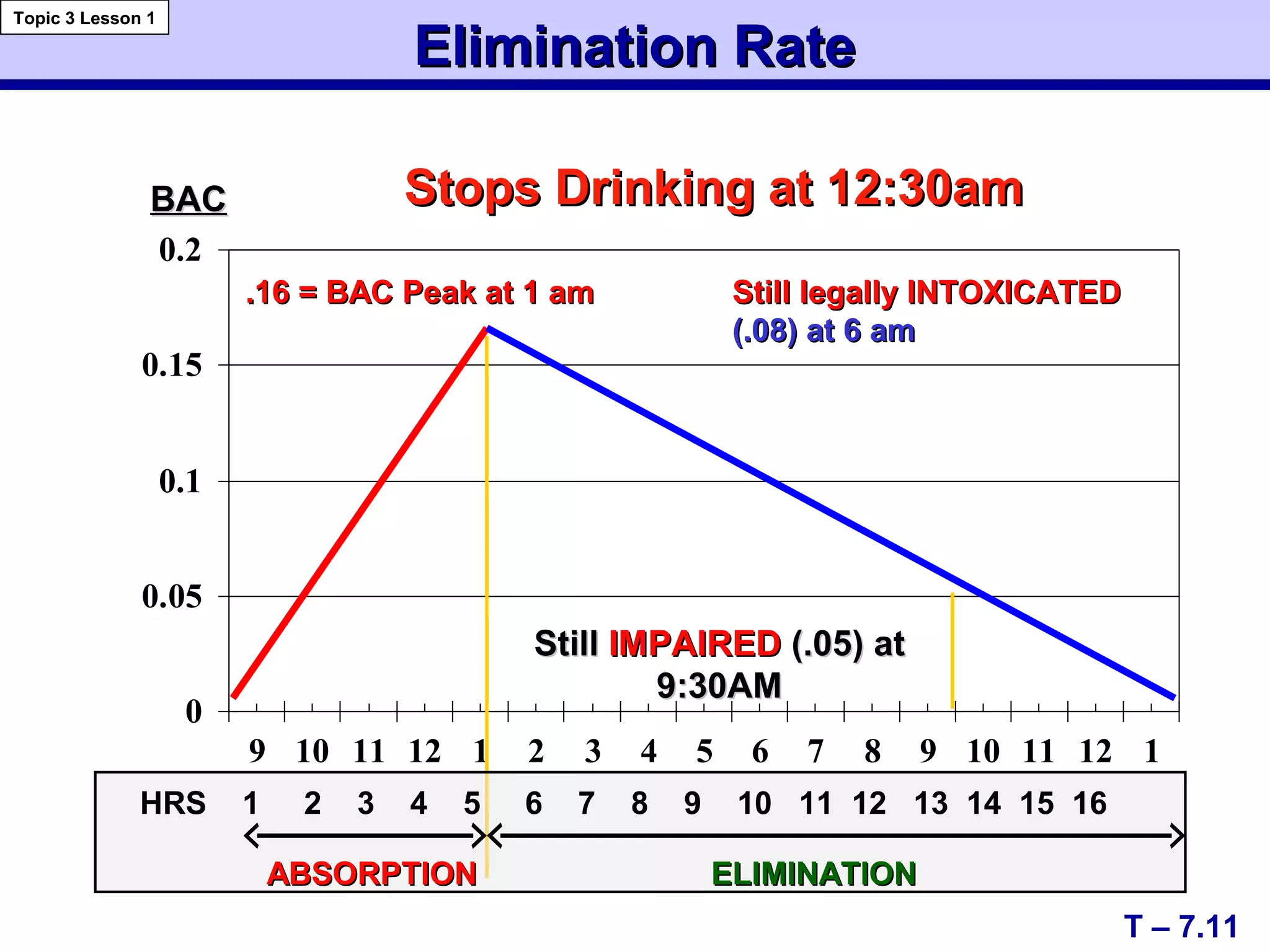
0
0.05
0.1
0.15
0.2
9 10 11 12 1 2 3 4 5 6 7 8 9 10 11 12 1
HRS 1 2 3 4 5 6 7 8 9 10 11 12 13 14 15 16
Elimination RateElimination Rate
Stops Drinking at 12:30amStops Drinking at 12:30am
.16 = BAC Peak at 1 am.16 = BAC Peak at 1 am Still legally INTOXICATEDStill legally INTOXICATED
(.08) at 6 am(.08) at 6 am
StillStill IMPAIREDIMPAIRED (.05) at(.05) at
9:30AM9:30AM
ABSORPTIONABSORPTION ELIMINATIONELIMINATION
BACBAC
T – 7.11
Topic 3 Lesson 1
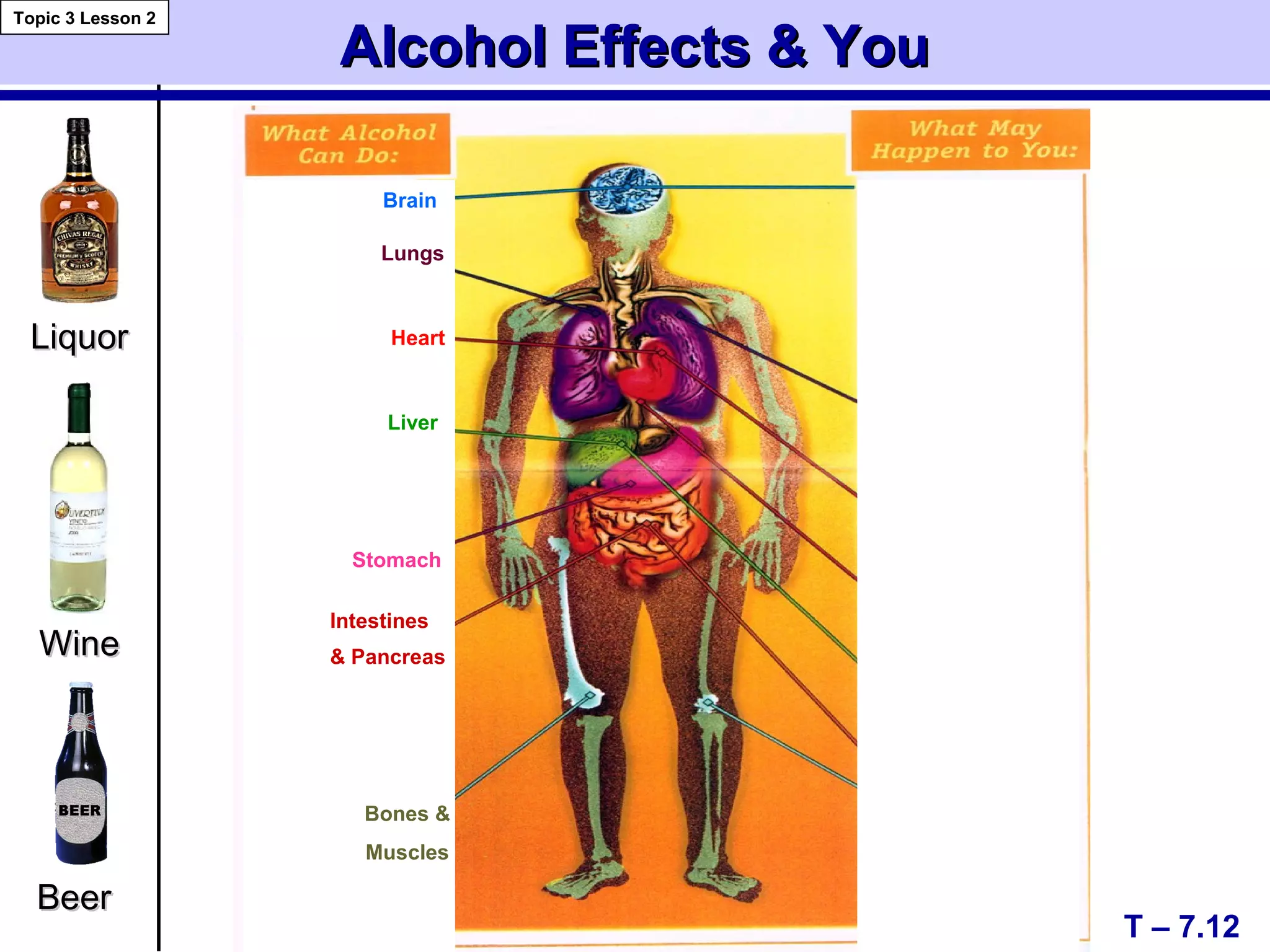
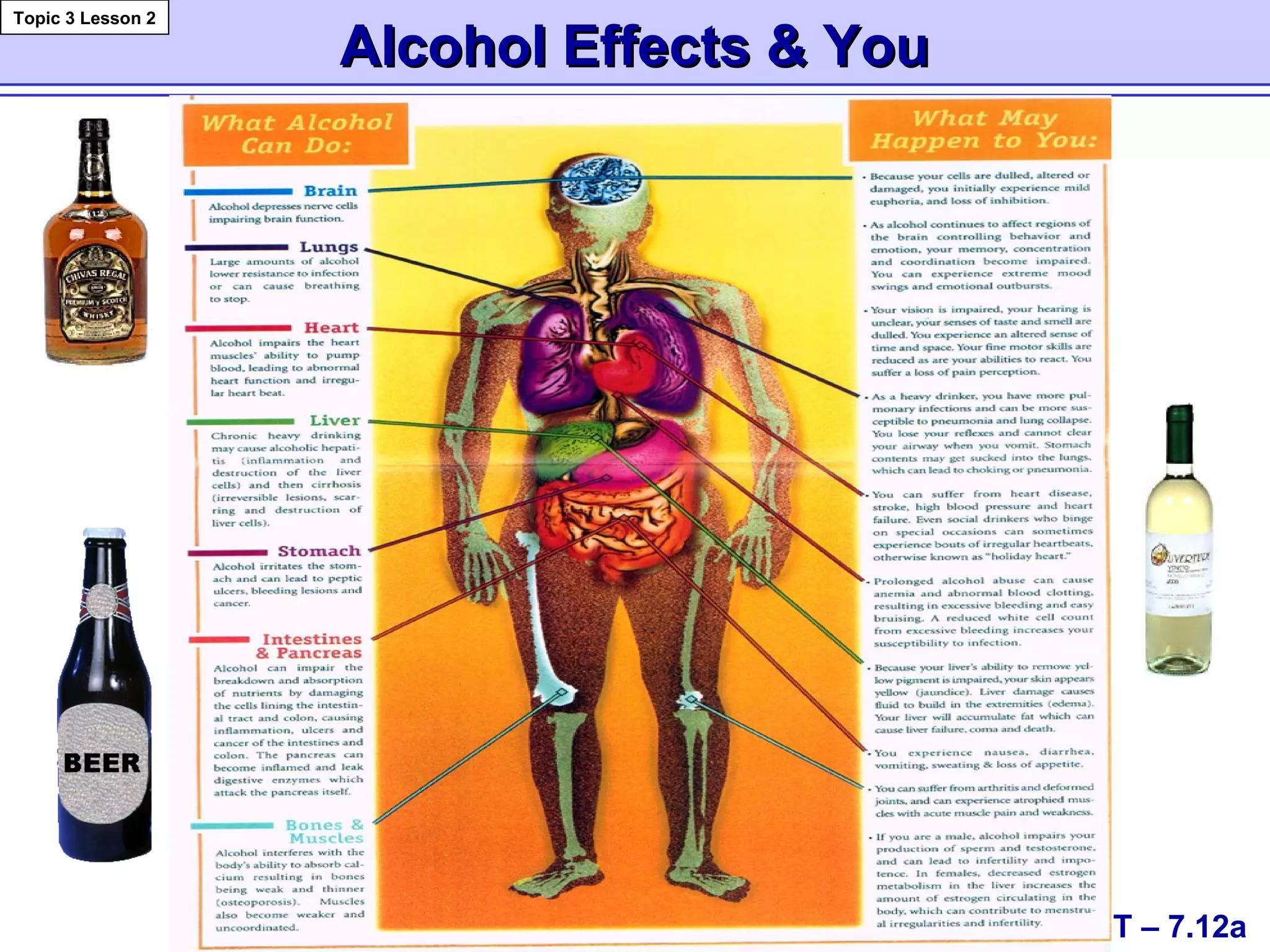
Alcohol Effects & YouAlcohol Effects & You
T – 7.12
Topic 3 Lesson 2
LiquorLiquor
WineWine
BeerBeer
Brain
Lungs
Heart
Liver
Stomach
Intestines
& Pancreas
Bones &
Muscles
Alcohol Effects & YouAlcohol Effects & You
Topic 3 Lesson 2
T – 7.12a
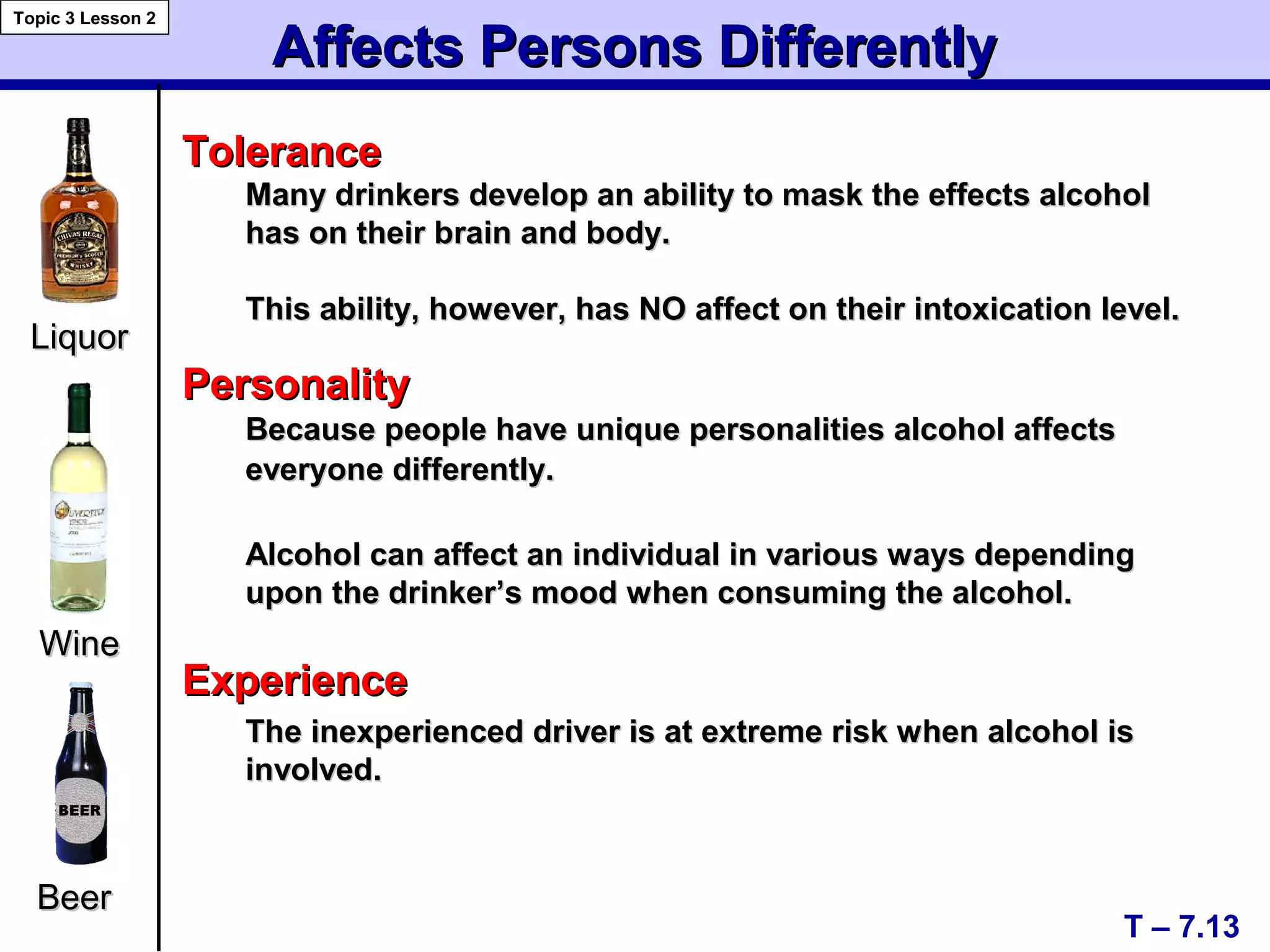
Affects Persons DifferentlyAffects Persons Differently
T – 7.13
Topic 3 Lesson 2
PersonalityPersonality
Because people have unique personalities alcohol affectsBecause people have unique personalities alcohol affects
everyone differently.everyone differently.
Alcohol can affect an individual in various ways dependingAlcohol can affect an individual in various ways depending
upon the drinker’s mood when consuming the alcohol.upon the drinker’s mood when consuming the alcohol.
ExperienceExperience
The inexperienced driver is at extreme risk when alcohol isThe inexperienced driver is at extreme risk when alcohol is
involved.involved.
ToleranceTolerance
Many drinkers develop an ability to mask the effects alcoholMany drinkers develop an ability to mask the effects alcohol
has on their brain and body.has on their brain and body.
This ability, however, has NO affect on their intoxication level.This ability, however, has NO affect on their intoxication level.
LiquorLiquor
WineWine
BeerBeer
Affects Persons DifferentlyAffects Persons Differently
T – 7.13a
Topic 3 Lesson 2
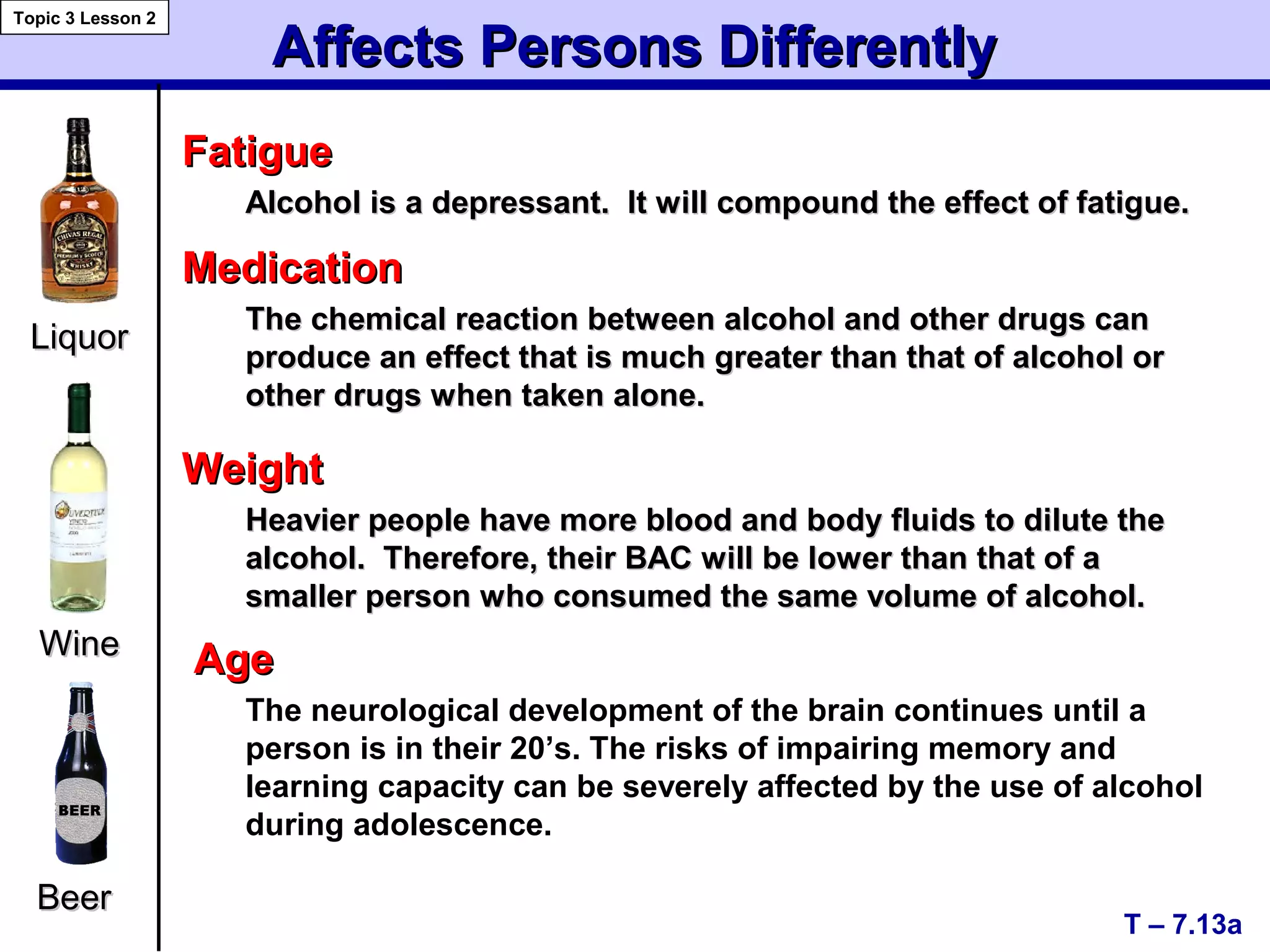
MedicationMedication
The chemical reaction between alcohol and other drugs canThe chemical reaction between alcohol and other drugs can
produce an effect that is much greater than that of alcohol orproduce an effect that is much greater than that of alcohol or
other drugs when taken alone.other drugs when taken alone.
WeightWeight
Heavier people have more blood and body fluids to dilute theHeavier people have more blood and body fluids to dilute the
alcohol. Therefore, their BAC will be lower than that of aalcohol. Therefore, their BAC will be lower than that of a
smaller person who consumed the same volume of alcohol.smaller person who consumed the same volume of alcohol.
AgeAge
The neurological development of the brain continues until a
person is in their 20’s. The risks of impairing memory and
learning capacity can be severely affected by the use of alcohol
during adolescence.
FatigueFatigue
Alcohol is a depressant. It will compound the effect of fatigue.Alcohol is a depressant. It will compound the effect of fatigue.
LiquorLiquor
WineWine
BeerBeer
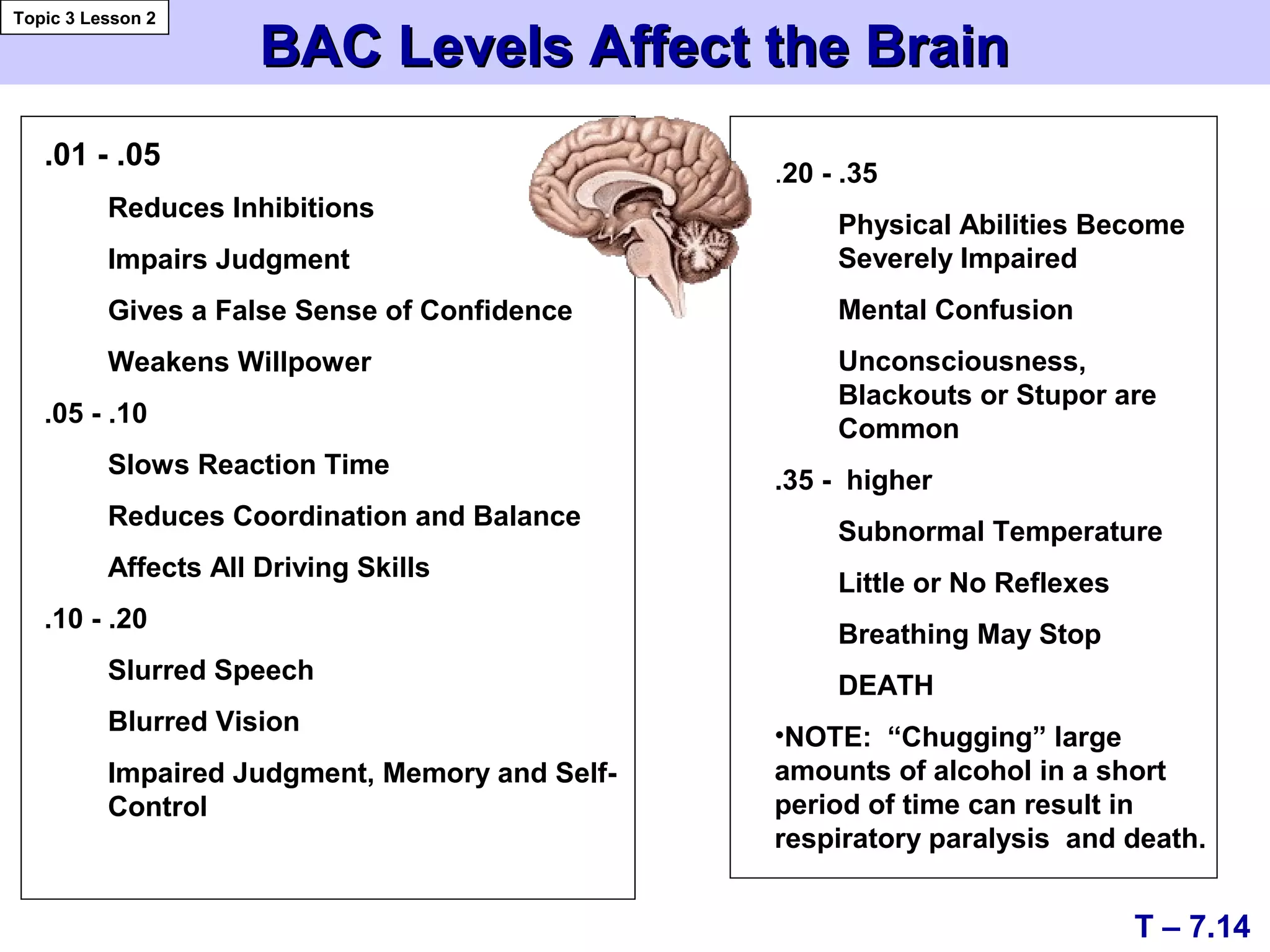
BAC Levels Affect the BrainBAC Levels Affect the Brain
Topic 3 Lesson 2
T – 7.14
.01 - .05
Reduces Inhibitions
Impairs Judgment
Gives a False Sense of Confidence
Weakens Willpower
.05 - .10
Slows Reaction Time
Reduces Coordination and Balance
Affects All Driving Skills
.10 - .20
Slurred Speech
Blurred Vision
Impaired Judgment, Memory and Self-
Control
.20 - .35
Physical Abilities Become
Severely Impaired
Mental Confusion
Unconsciousness,
Blackouts or Stupor are
Common
.35 - higher
Subnormal Temperature
Little or No Reflexes
Breathing May Stop
DEATH
•NOTE: “Chugging” large
amounts of alcohol in a short
period of time can result in
respiratory paralysis and death.
Alcohol and Space ManagementAlcohol and Space Management
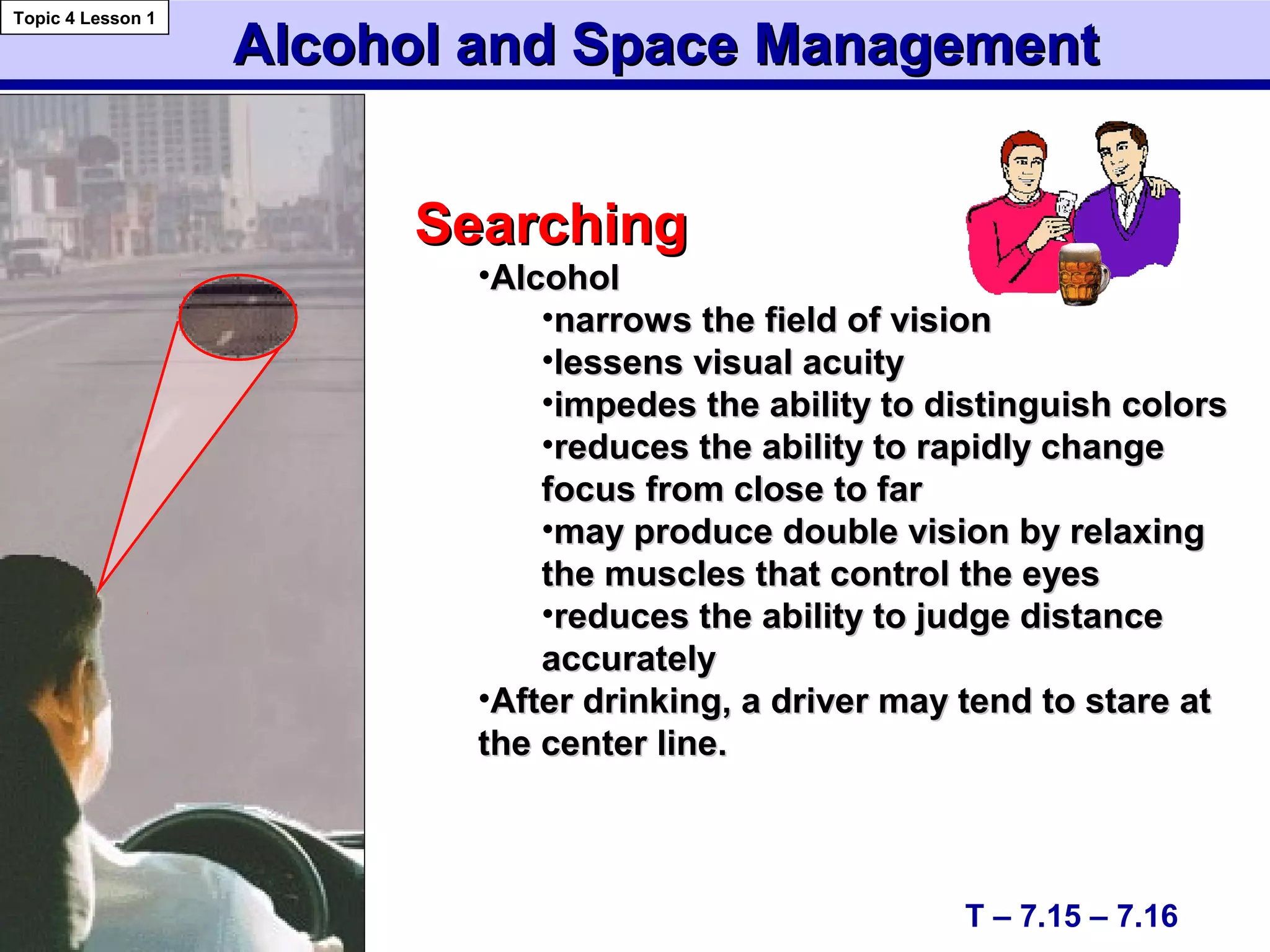
SearchingSearching
•AlcoholAlcohol
•narrows the field of visionnarrows the field of vision
•lessens visual acuitylessens visual acuity
•impedes the ability to distinguish colorsimpedes the ability to distinguish colors
•reduces the ability to rapidly changereduces the ability to rapidly change
focus from close to farfocus from close to far
•may produce double vision by relaxingmay produce double vision by relaxing
the muscles that control the eyesthe muscles that control the eyes
•reduces the ability to judge distancereduces the ability to judge distance
accuratelyaccurately
•After drinking, a driver may tend to stare atAfter drinking, a driver may tend to stare at
the center line.the center line.
T – 7.15 – 7.16
Topic 4 Lesson 1
Alcohol and Space ManagementAlcohol and Space Management
T – 7.17
Topic 4 Lesson 2
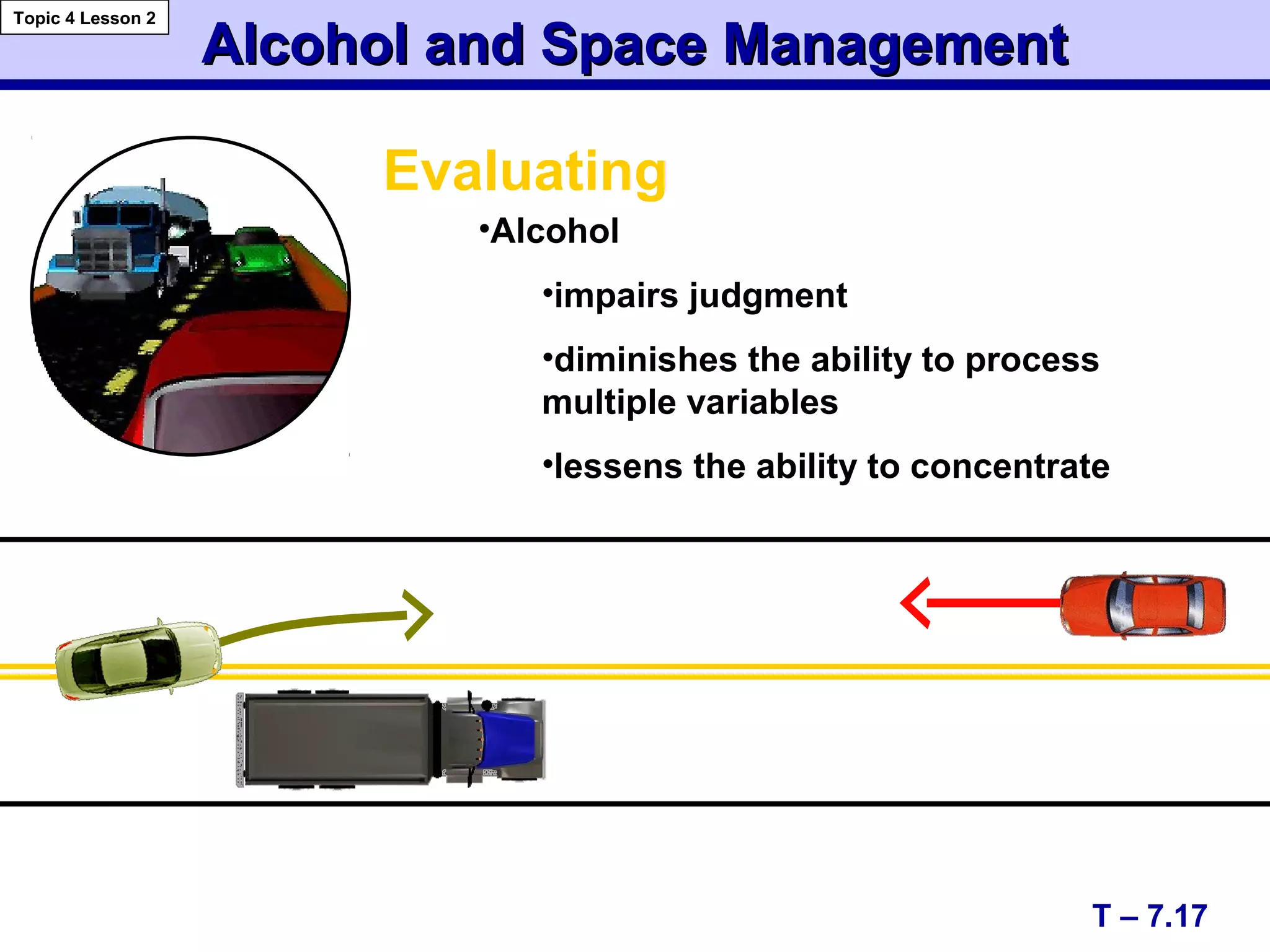
Evaluating
•Alcohol
•impairs judgment
•diminishes the ability to process
multiple variables
•lessens the ability to concentrate
Alcohol and Space ManagementAlcohol and Space Management
Topic 4 Lesson 2
T – 7.18
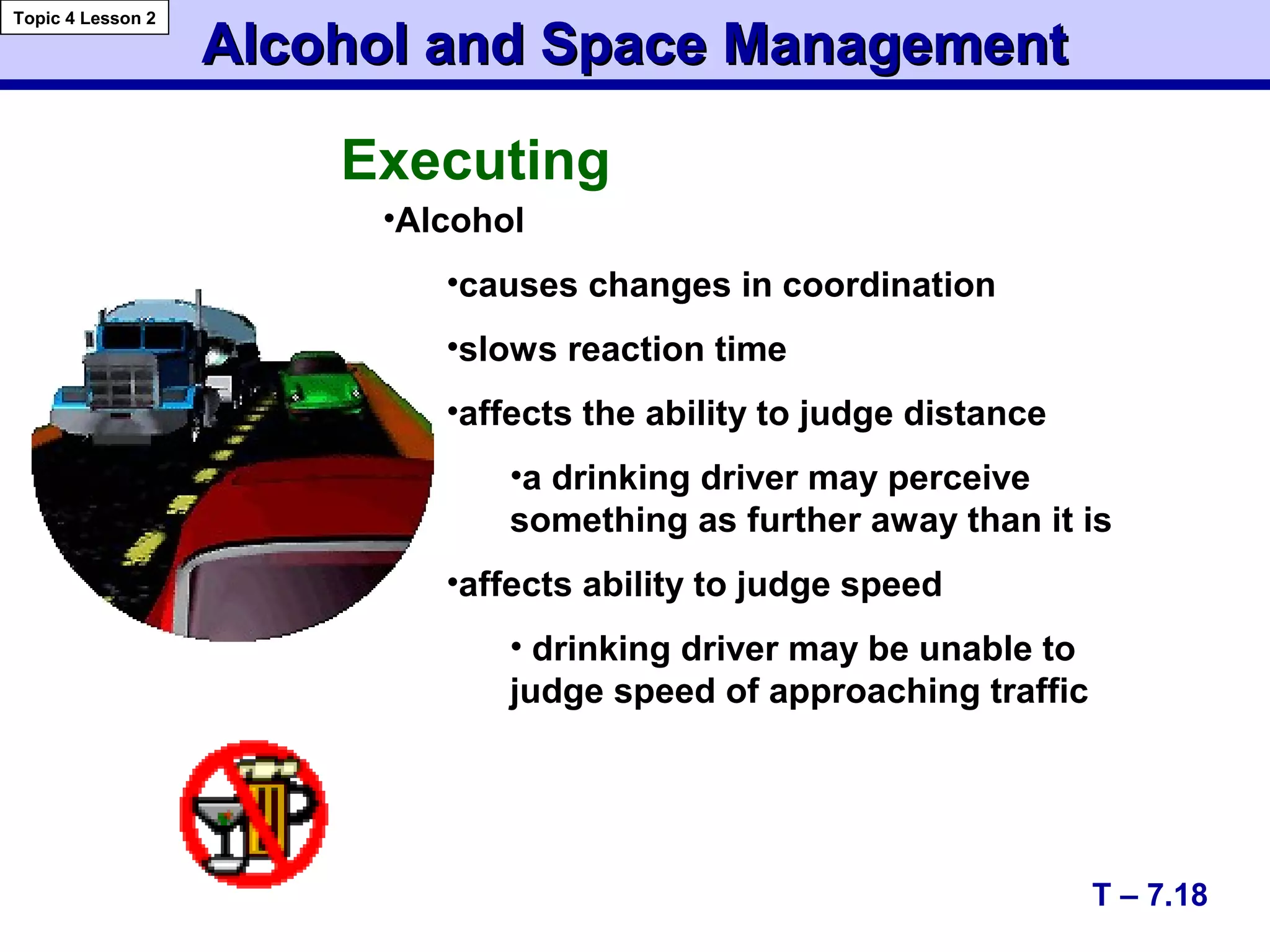
Executing
•Alcohol
•causes changes in coordination
•slows reaction time
•affects the ability to judge distance
•a drinking driver may perceive
something as further away than it is
•affects ability to judge speed
• drinking driver may be unable to
judge speed of approaching traffic
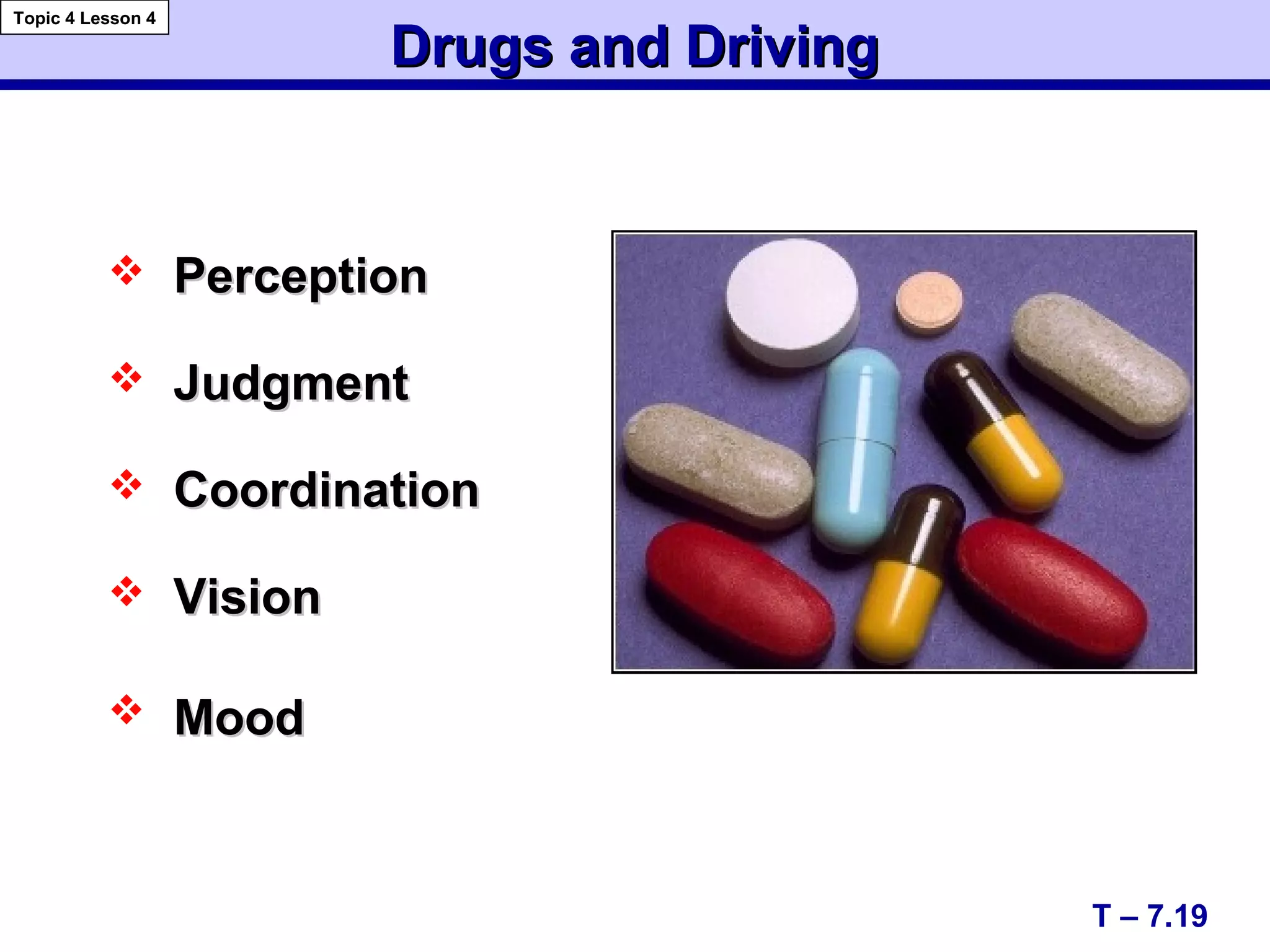
Drugs and DrivingDrugs and Driving
 PerceptionPerception
 JudgmentJudgment
 CoordinationCoordination
 VisionVision
 MoodMood
T – 7.19
Topic 4 Lesson 4
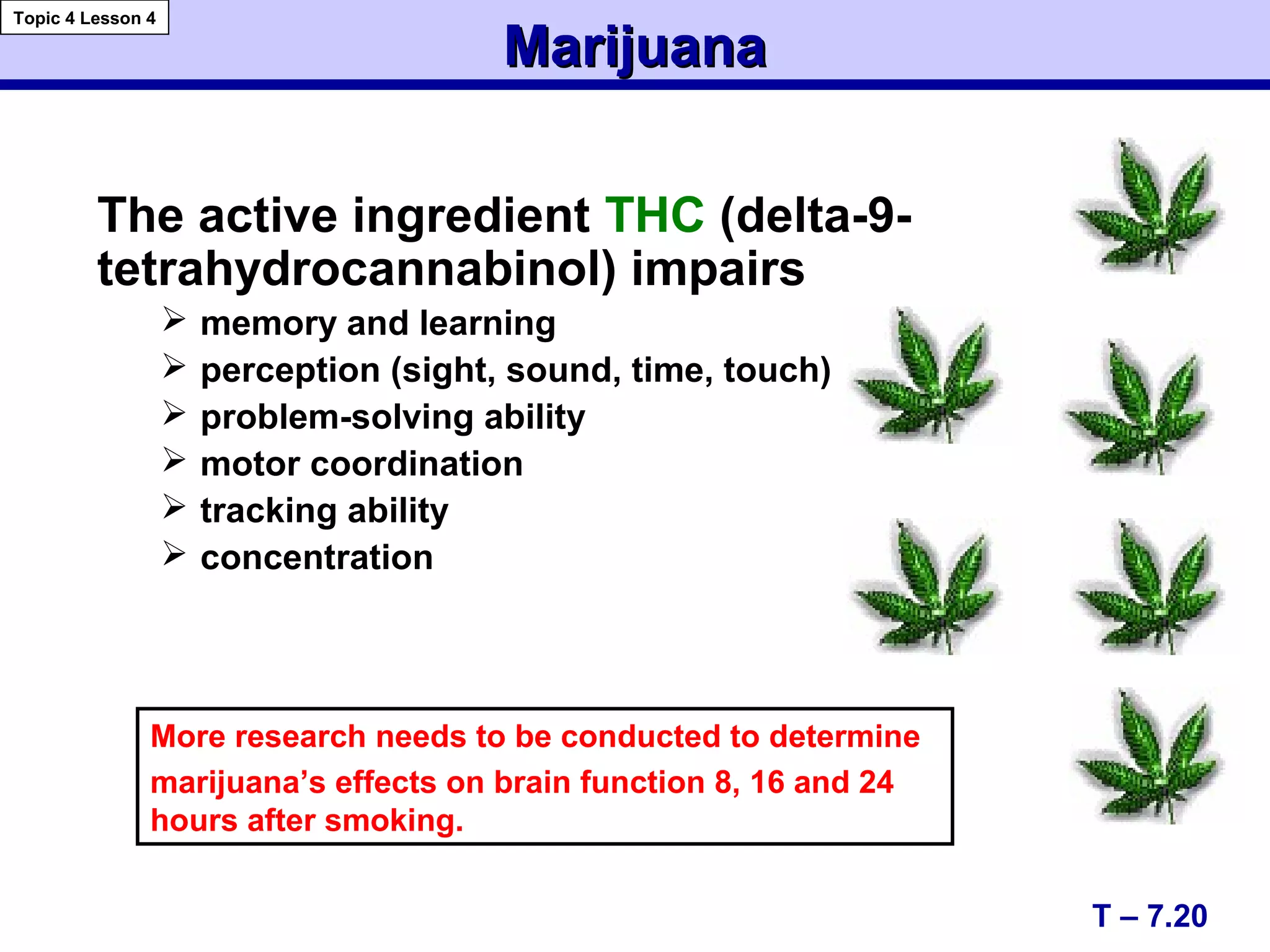
MarijuanaMarijuana
The active ingredient THC (delta-9-
tetrahydrocannabinol) impairs
 memory and learning
 perception (sight, sound, time, touch)
 problem-solving ability
 motor coordination
 tracking ability
 concentration
More research needs to be conducted to determine
marijuana’s effects on brain function 8, 16 and 24
hours after smoking.
T – 7.20
Topic 4 Lesson 4
Marijuana and DrivingMarijuana and Driving
Topic 4 Lesson 4
T – 7.20a
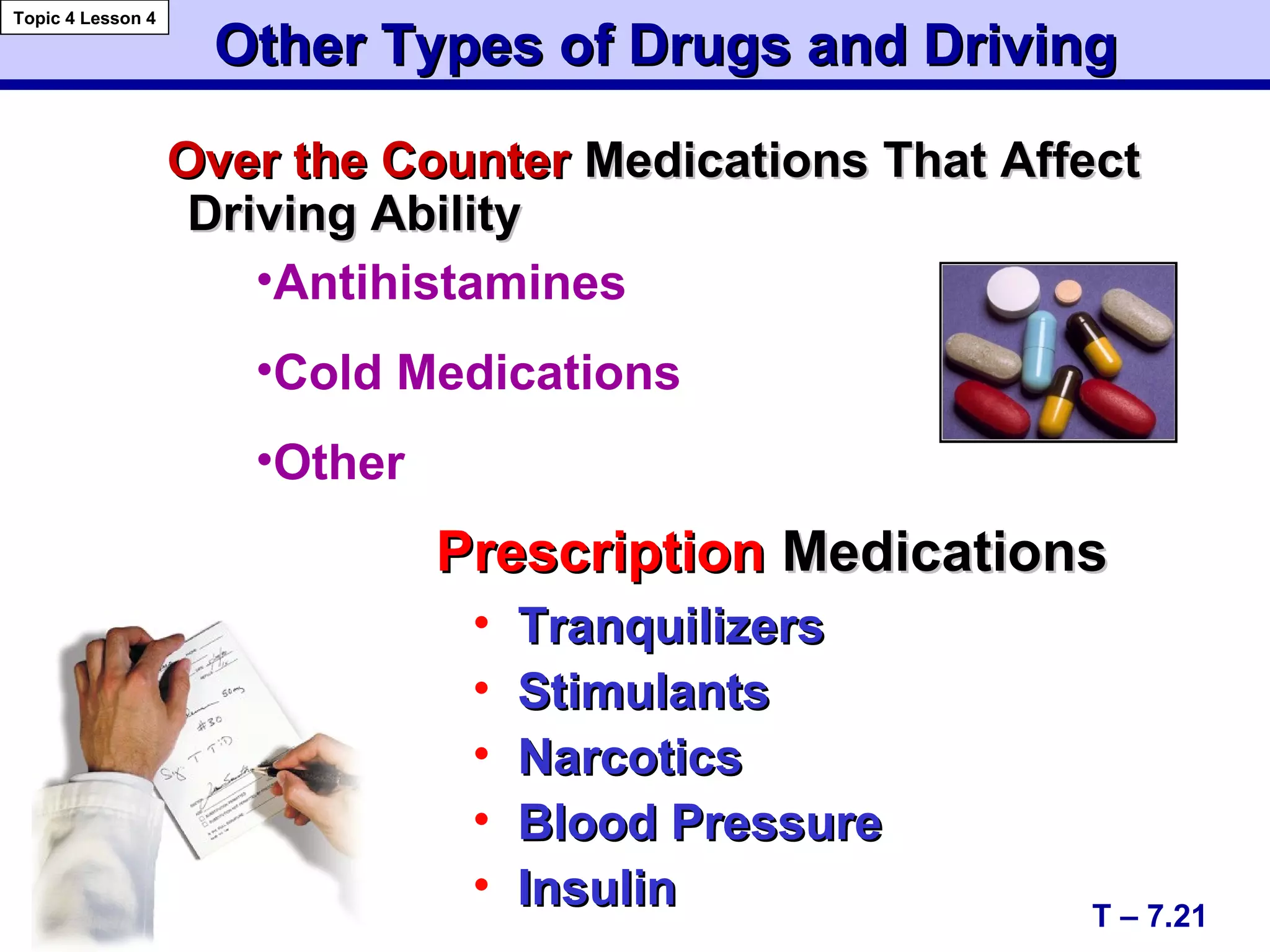
Other Types of Drugs and DrivingOther Types of Drugs and Driving
Over the CounterOver the Counter Medications That AffectMedications That Affect
Driving AbilityDriving Ability
• TranquilizersTranquilizers
• StimulantsStimulants
• NarcoticsNarcotics
• Blood PressureBlood Pressure
• InsulinInsulin
PrescriptionPrescription MedicationsMedications
T – 7.21
Topic 4 Lesson 4
•Antihistamines
•Cold Medications
•Other
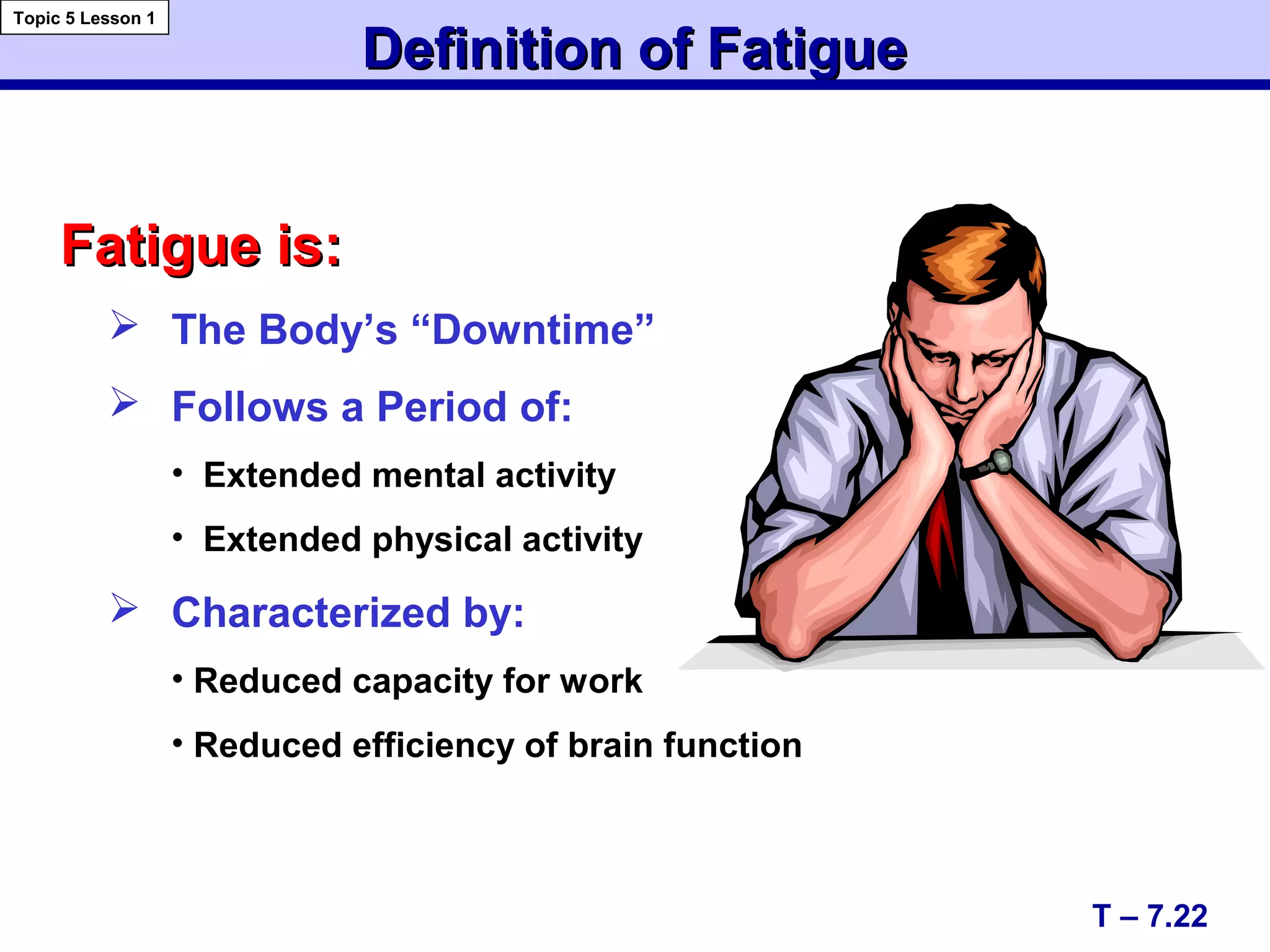
Fatigue is:Fatigue is:
 The Body’s “Downtime”
 Follows a Period of:
• Extended mental activity
• Extended physical activity
 Characterized by:
• Reduced capacity for work
• Reduced efficiency of brain function
Definition of FatigueDefinition of Fatigue
T – 7.22
Topic 5 Lesson 1
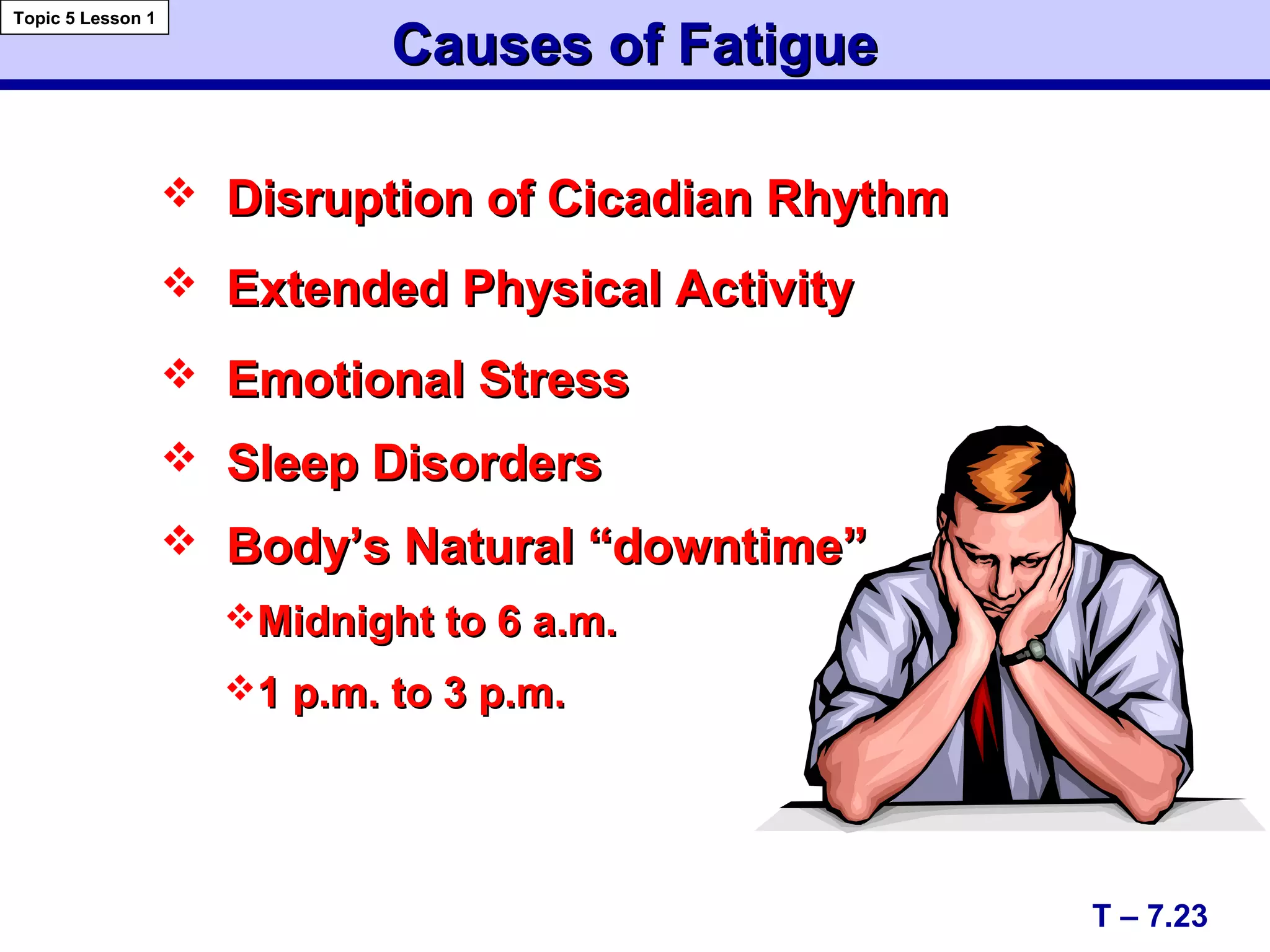
Causes of FatigueCauses of Fatigue
 Emotional StressEmotional Stress
 Sleep DisordersSleep Disorders
 Body’s Natural “downtime”Body’s Natural “downtime”
Midnight to 6 a.m.Midnight to 6 a.m.
1 p.m. to 3 p.m.1 p.m. to 3 p.m.
 Disruption of Cicadian RhythmDisruption of Cicadian Rhythm
 Extended Physical ActivityExtended Physical Activity
T – 7.23
Topic 5 Lesson 1
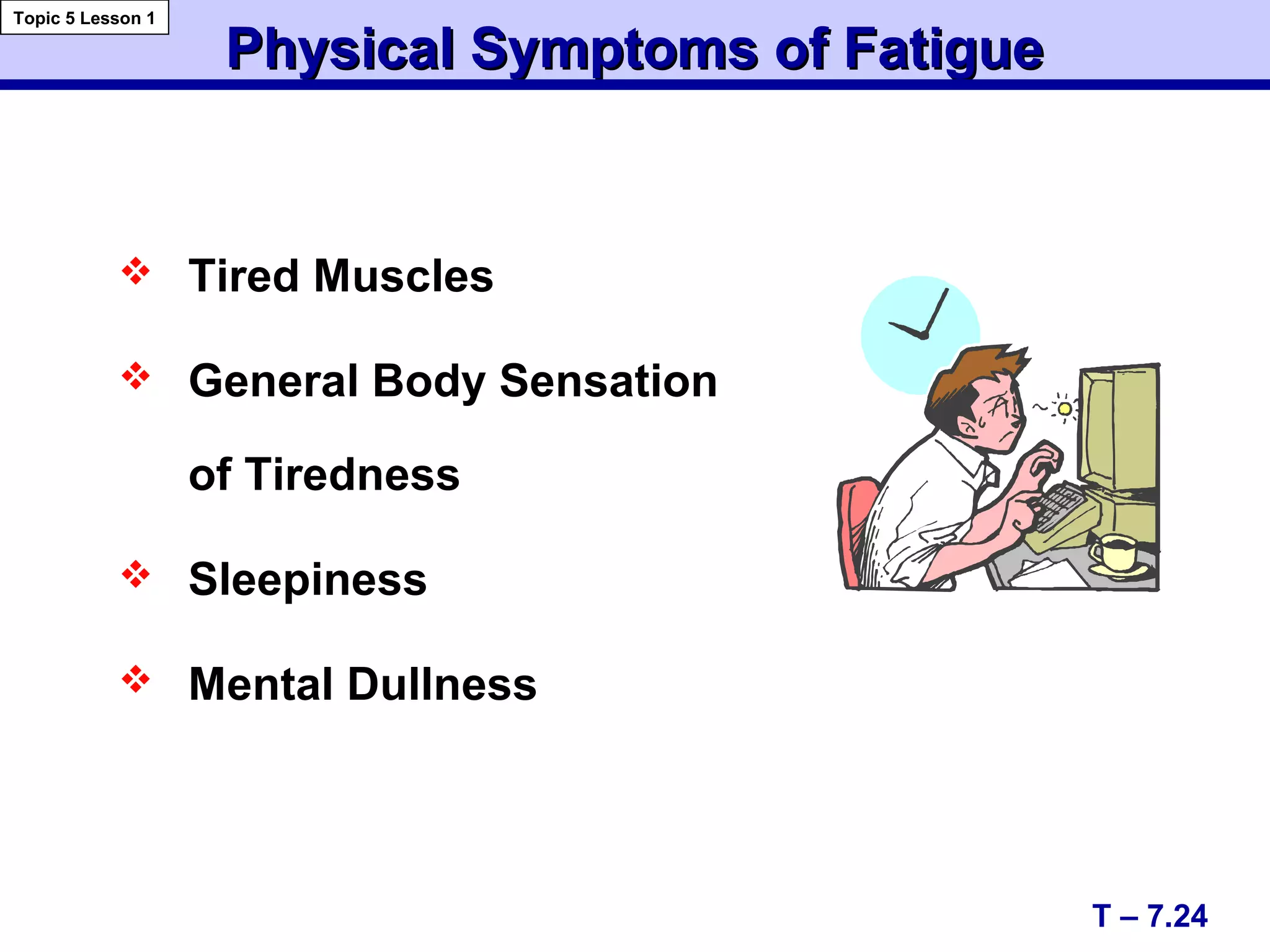
Physical Symptoms of FatiguePhysical Symptoms of Fatigue
 Tired Muscles
 General Body Sensation
of Tiredness
 Sleepiness
 Mental Dullness
T – 7.24
Topic 5 Lesson 1
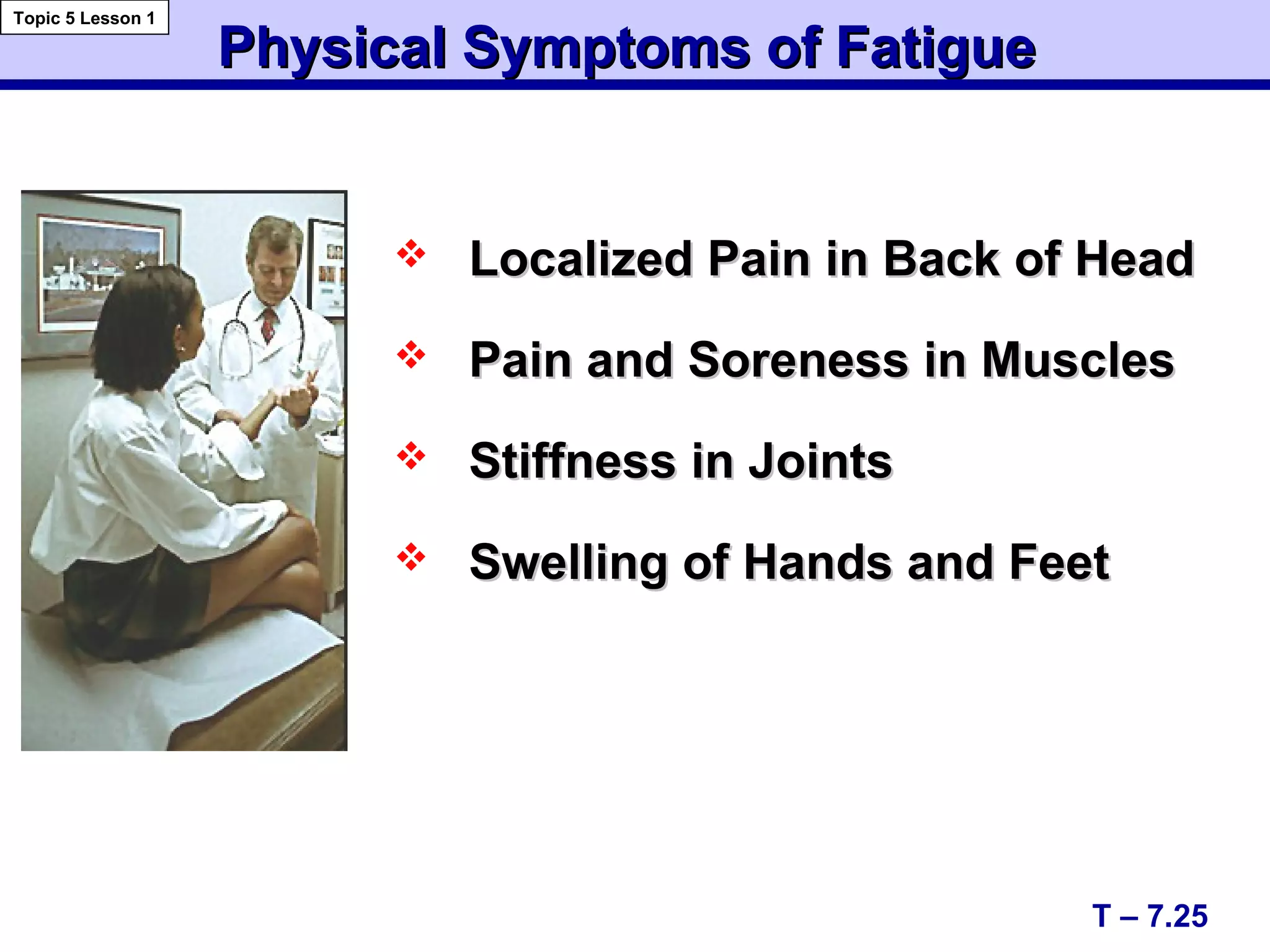
Physical Symptoms of FatiguePhysical Symptoms of Fatigue
 Localized Pain in Back of HeadLocalized Pain in Back of Head
 Pain and Soreness in MusclesPain and Soreness in Muscles
 Stiffness in JointsStiffness in Joints
 Swelling of Hands and FeetSwelling of Hands and Feet
T – 7.25
Topic 5 Lesson 1
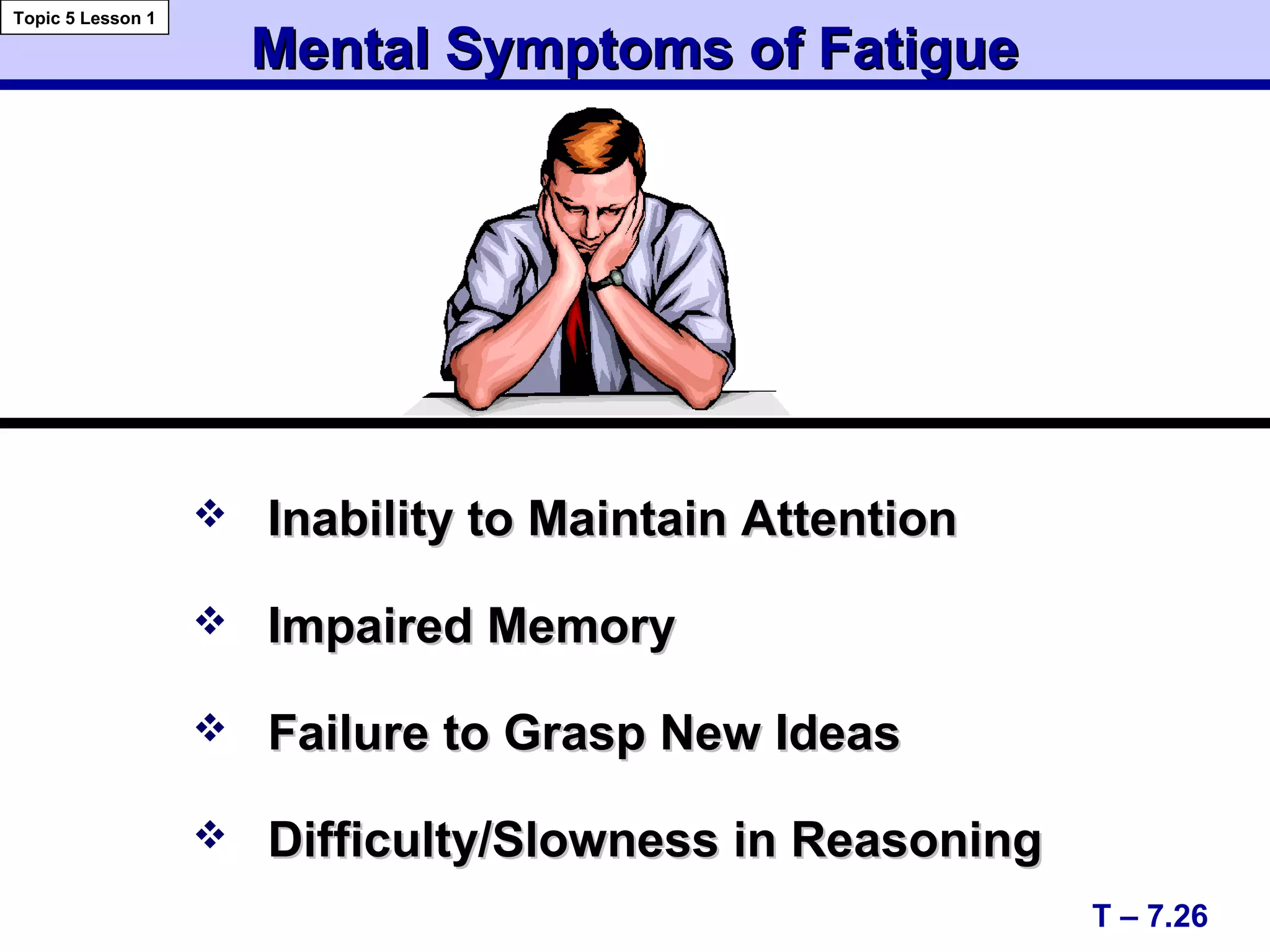
Mental Symptoms of FatigueMental Symptoms of Fatigue
 Inability to Maintain AttentionInability to Maintain Attention
 Impaired MemoryImpaired Memory
 Failure to Grasp New IdeasFailure to Grasp New Ideas
 Difficulty/Slowness in ReasoningDifficulty/Slowness in Reasoning
T – 7.26
Topic 5 Lesson 1
Delaying Fatigue OnsetDelaying Fatigue Onset
 AvoidAvoid Long DrivesLong Drives
 AvoidAvoid Leaning Forward or BackwardLeaning Forward or Backward
 Keep Your Eyes MovingKeep Your Eyes Moving
 Get Plenty of Fresh AirGet Plenty of Fresh Air
T – 7.27
Topic 5 Lesson 1
Delaying Fatigue SymptomsDelaying Fatigue Symptoms
• Change Drivers at Regular IntervalsChange Drivers at Regular Intervals
• Wear Your Safety BeltWear Your Safety Belt
• Avoid Getting AngryAvoid Getting Angry
• Adjust HVAC ProperlyAdjust HVAC Properly
T – 7.28
Topic 5 Lesson 1
Aggressive Driving/Road RageAggressive Driving/Road Rage
T – 7.29
Topic 6 Lesson 1
MostMost CrashesCrashes are NOTare NOT AccidentsAccidents
•They are often the result of drivers whoThey are often the result of drivers who
•speed;speed;
•tailgate;tailgate;
•run red lights;run red lights;
•weave in and out of traffic; orweave in and out of traffic; or
•vent frustrations or emotions in thevent frustrations or emotions in the
vehicle.vehicle.
Topic 6 Lesson 1
T – 7.29a
Factors Leading toFactors Leading to Aggressive DrivingAggressive Driving//RoadRoad
RageRage
•More CarsMore Cars
•More Traffic CongestionMore Traffic Congestion
•More FrustrationMore Frustration
•More StressMore Stress
•More HostilityMore Hostility
•More ViolenceMore Violence
Topic 6 Lesson 1
T – 7.29b
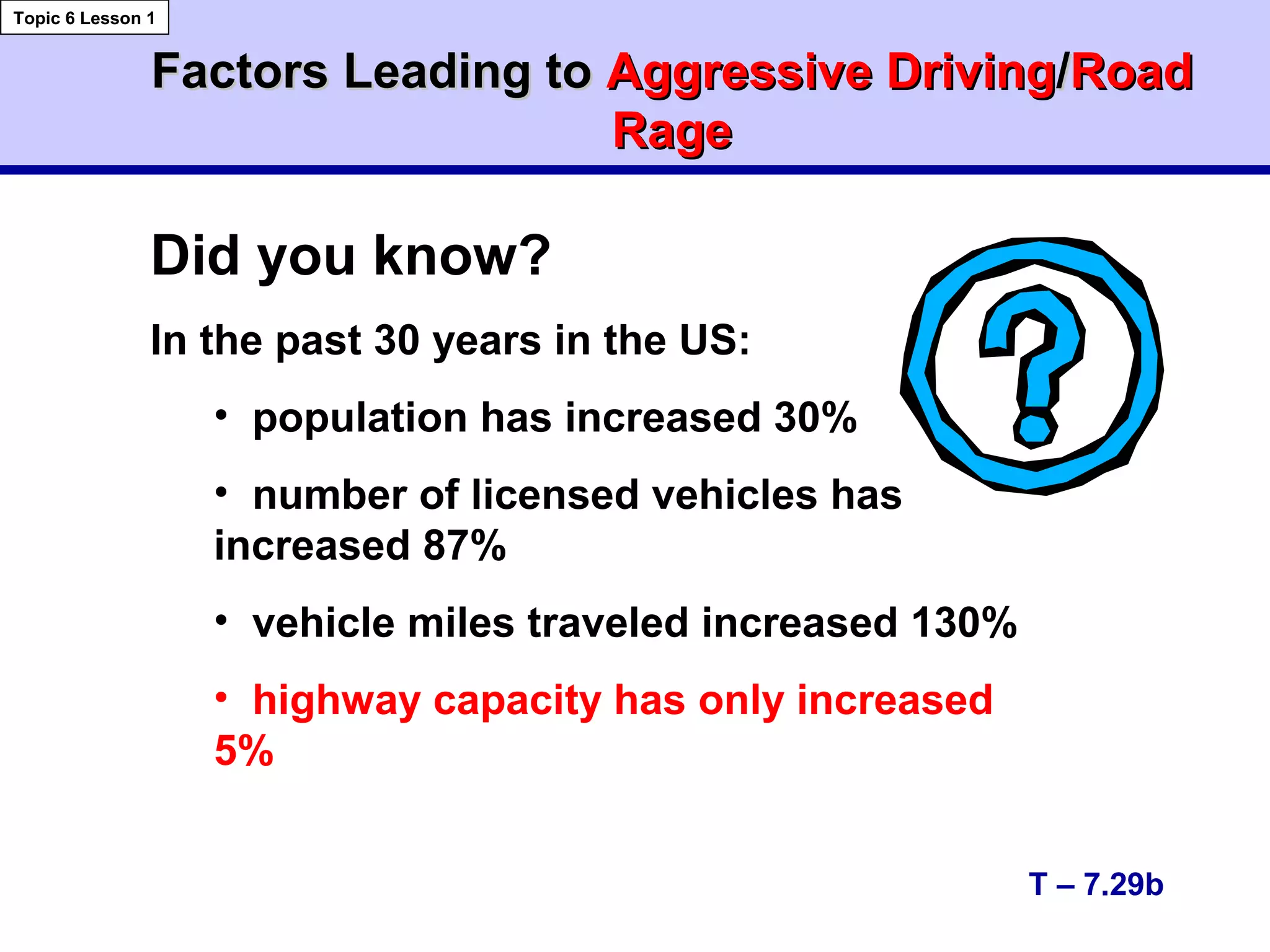
Did you know?
In the past 30 years in the US:
• population has increased 30%
• number of licensed vehicles has
increased 87%
• vehicle miles traveled increased 130%
• highway capacity has only increased
5%
Factors Leading toFactors Leading to Aggressive DrivingAggressive Driving//RoadRoad
RageRage
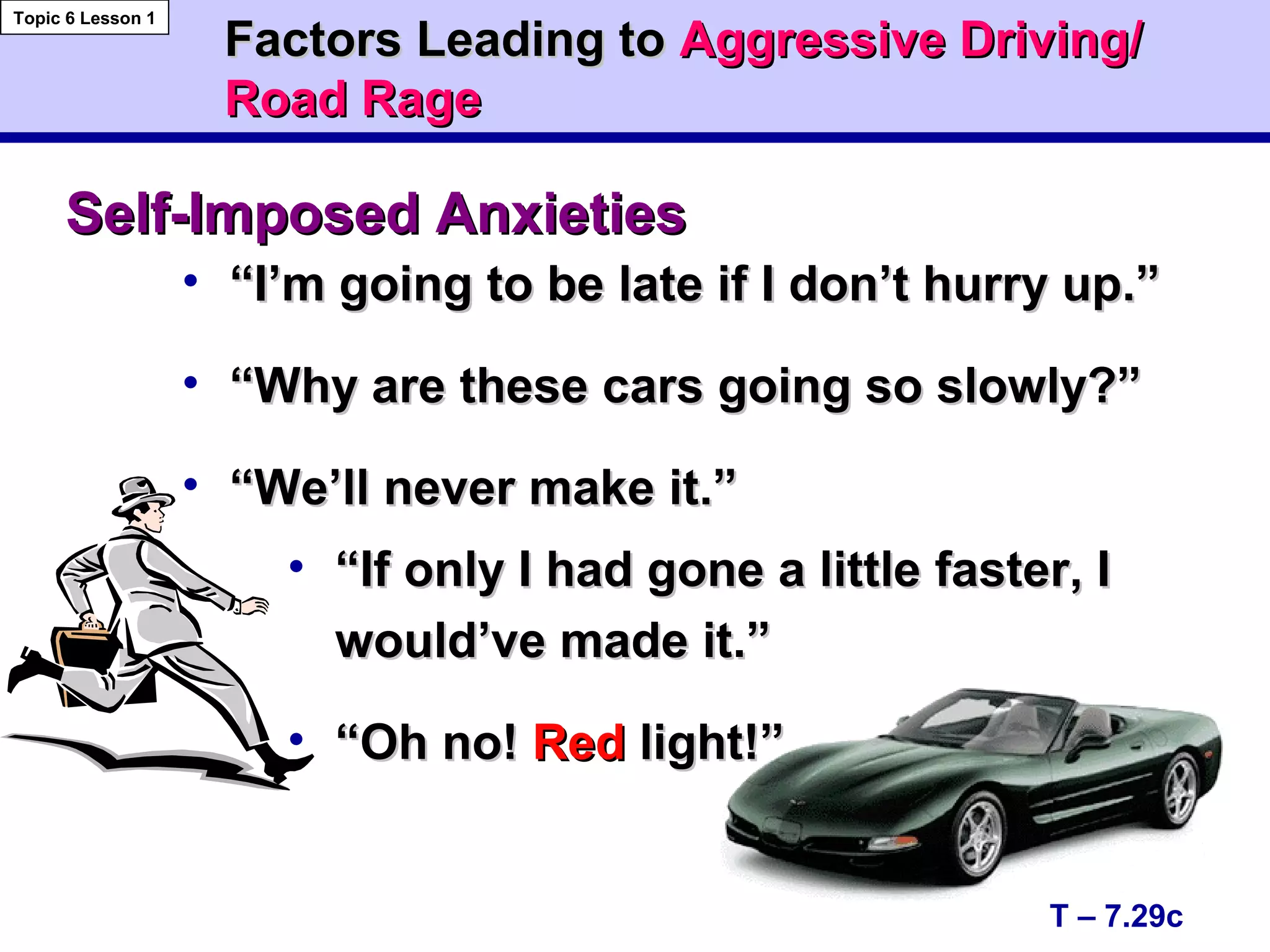
• ““I’m going to be late if I don’t hurry up.”I’m going to be late if I don’t hurry up.”
• ““Why are these cars going so slowly?”Why are these cars going so slowly?”
• ““We’ll never make it.”We’ll never make it.”
• ““If only I had gone a little faster, IIf only I had gone a little faster, I
would’ve made it.”would’ve made it.”
• ““Oh no!Oh no! RedRed light!”light!”
T – 7.29c
Topic 6 Lesson 1
Self-Imposed AnxietiesSelf-Imposed Anxieties
Factors Leading toFactors Leading to Aggressive Driving/Aggressive Driving/
Road RageRoad Rage
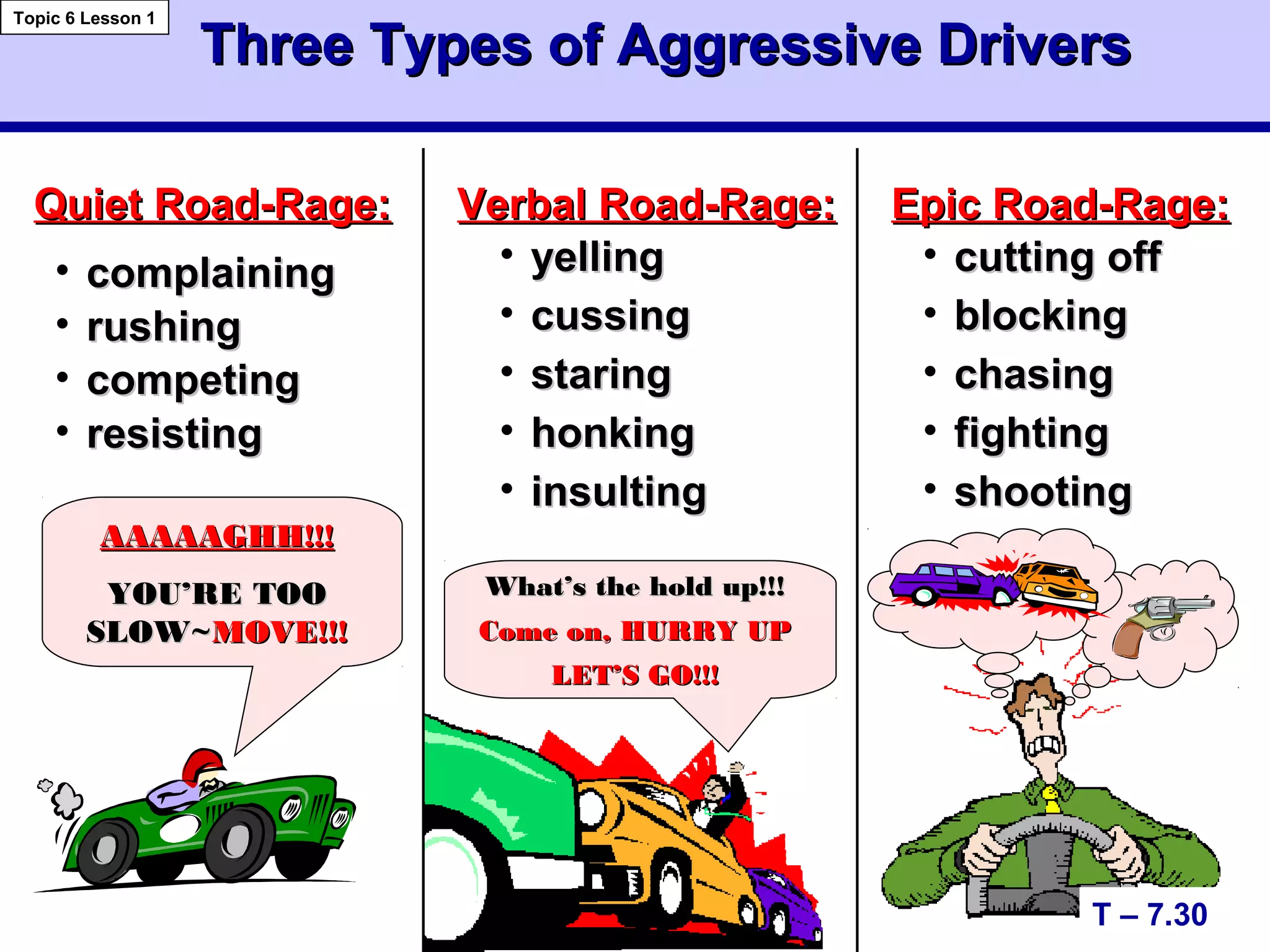
Three Types of Aggressive DriversThree Types of Aggressive Drivers
• complainingcomplaining
• rushingrushing
• competingcompeting
• resistingresisting
• yellingyelling
• cussingcussing
• staringstaring
• honkinghonking
• insultinginsulting
• cutting offcutting off
• blockingblocking
• chasingchasing
• fightingfighting
• shootingshooting
T – 7.30
Topic 6 Lesson 1
Quiet Road-Rage:Quiet Road-Rage: Verbal Road-Rage:Verbal Road-Rage: Epic Road-Rage:Epic Road-Rage:
AAAAAGHH!!!AAAAAGHH!!!
YOU’RE TOOYOU’RE TOO
SLOW~SLOW~MOVE!!!MOVE!!!
What’s the hold up!!!What’s the hold up!!!
Come on, HURRY UPCome on, HURRY UP
LET’S GO!!!LET’S GO!!!
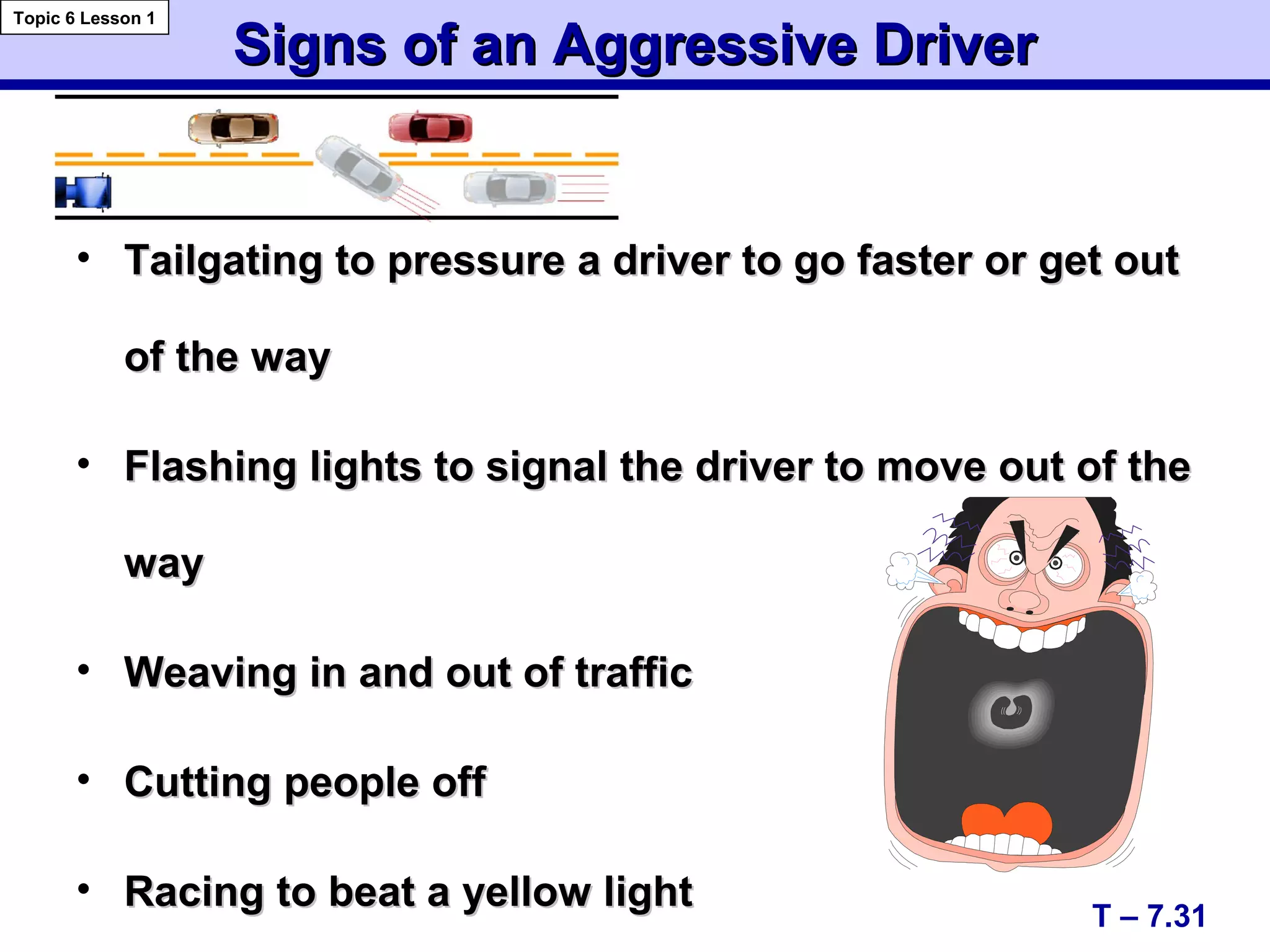
Signs of an Aggressive DriverSigns of an Aggressive Driver
• Tailgating to pressure a driver to go faster or get outTailgating to pressure a driver to go faster or get out
of the wayof the way
• Flashing lights to signal the driver to move out of theFlashing lights to signal the driver to move out of the
wayway
• Weaving in and out of trafficWeaving in and out of traffic
• Cutting people offCutting people off
• Racing to beat a yellow lightRacing to beat a yellow light T – 7.31
Topic 6 Lesson 1
Signs of an Aggressive DriverSigns of an Aggressive Driver
T – 7.32
Topic 6 Lesson 1
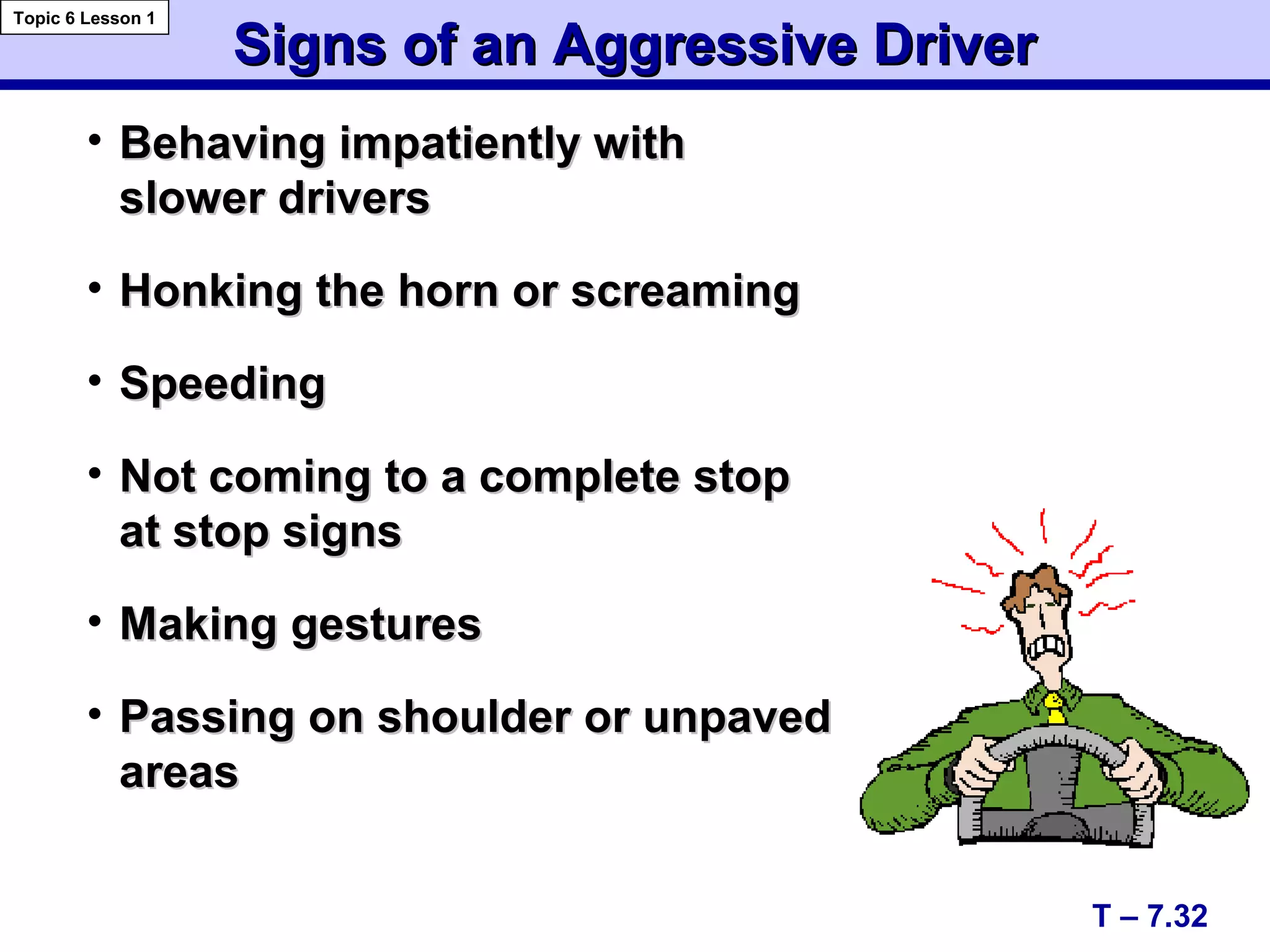
• Behaving impatiently withBehaving impatiently with
slower driversslower drivers
• Honking the horn or screamingHonking the horn or screaming
• SpeedingSpeeding
• Not coming to a complete stopNot coming to a complete stop
at stop signsat stop signs
• Making gesturesMaking gestures
• Passing on shoulder or unpavedPassing on shoulder or unpaved
areasareas
Other Signs May Include...Other Signs May Include...
T – 7.33
Topic 6 Lesson 1
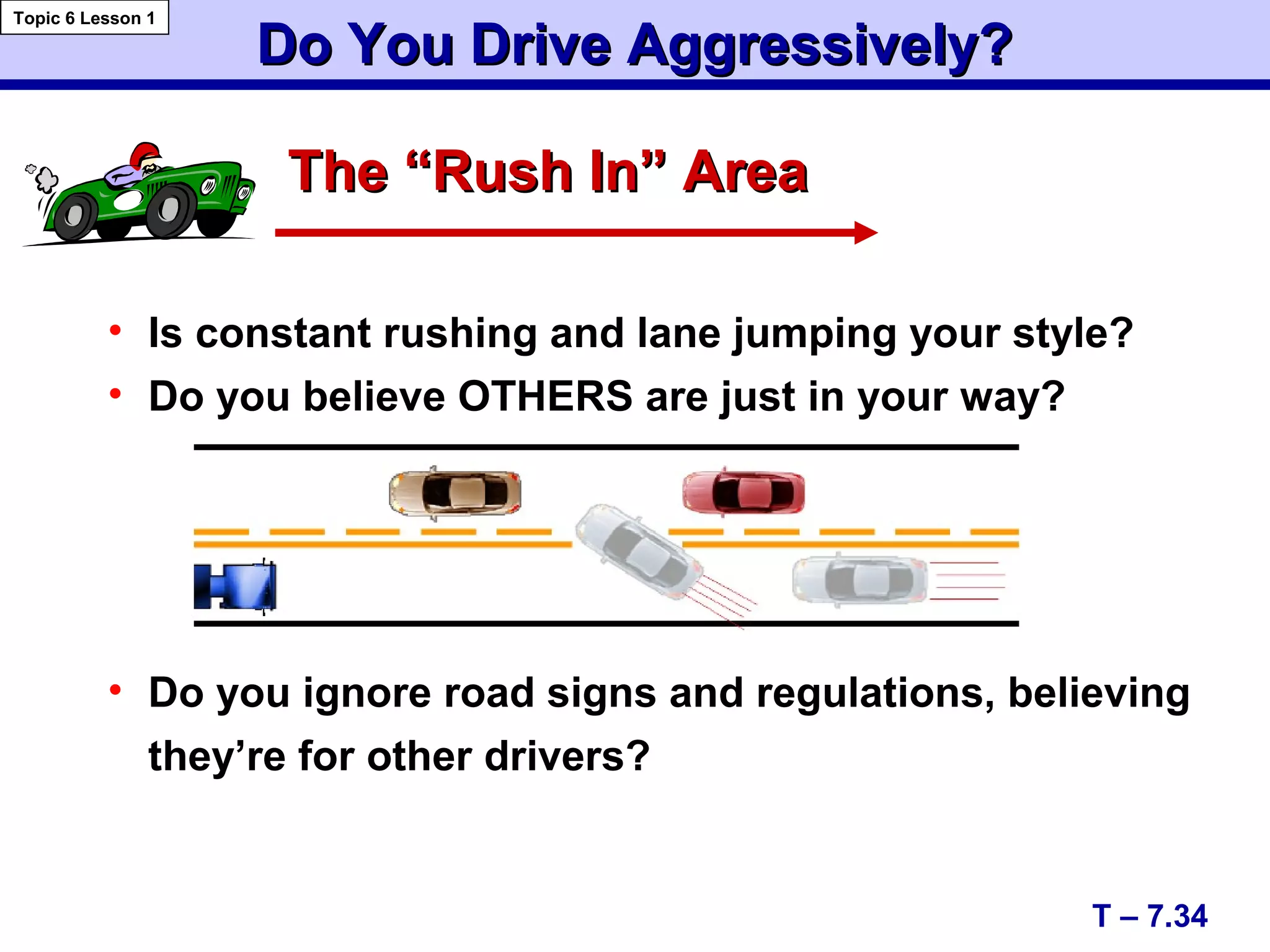
Do You Drive Aggressively?Do You Drive Aggressively?
• Is constant rushing and lane jumping your style?
• Do you believe OTHERS are just in your way?
• Do you ignore road signs and regulations, believing
they’re for other drivers?
T – 7.34
Topic 6 Lesson 1
The “Rush In” AreaThe “Rush In” Area
Do You Drive Aggressively?Do You Drive Aggressively?
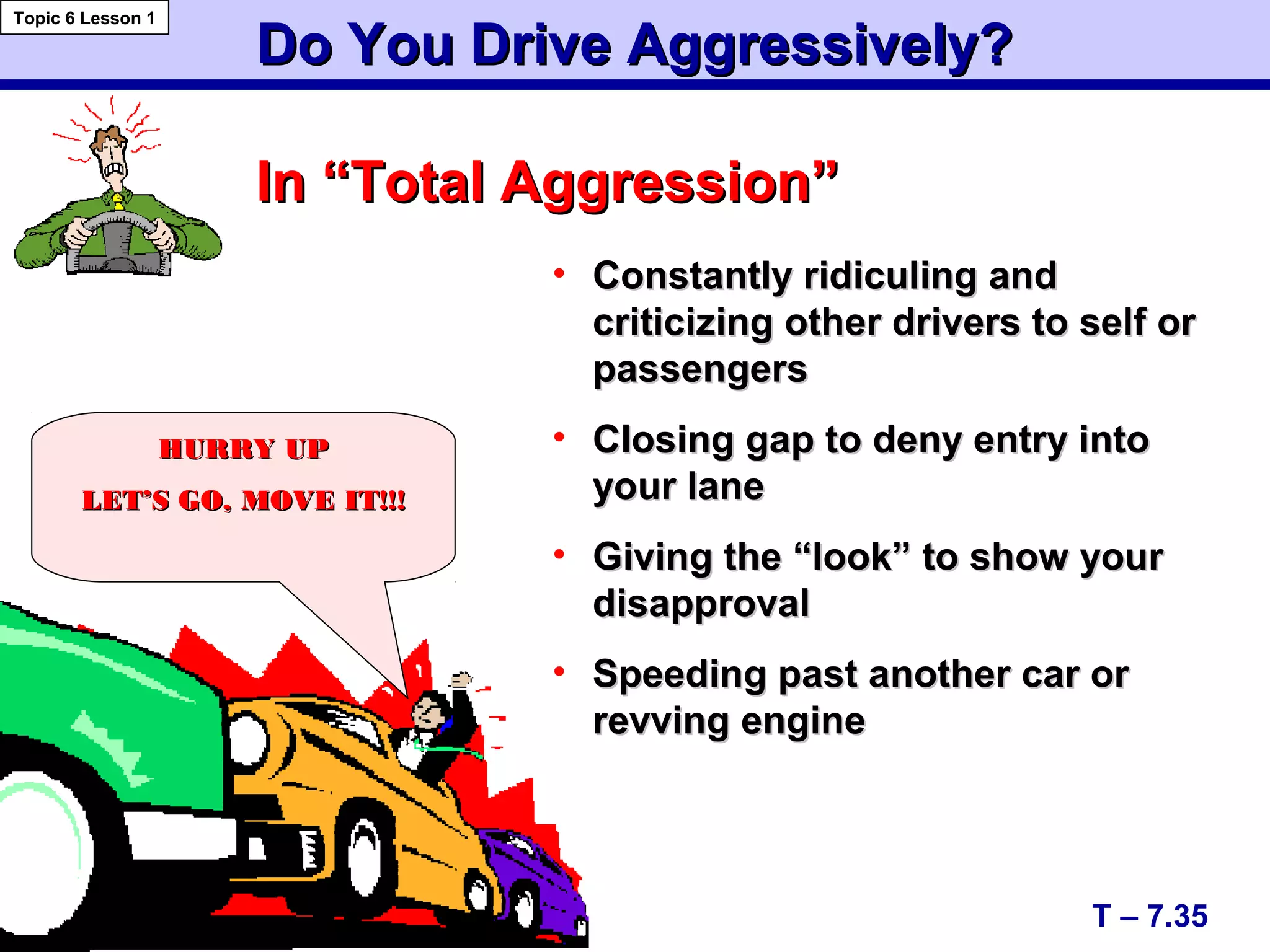
In “Total Aggression”In “Total Aggression”
• Constantly ridiculing andConstantly ridiculing and
criticizing other drivers to self orcriticizing other drivers to self or
passengerspassengers
• Closing gap to deny entry intoClosing gap to deny entry into
your laneyour lane
• Giving the “look” to show yourGiving the “look” to show your
disapprovaldisapproval
• Speeding past another car orSpeeding past another car or
revving enginerevving engine
T – 7.35
Topic 6 Lesson 1
HURRY UPHURRY UP
LET’S GO, MOVE IT!!!LET’S GO, MOVE IT!!!
Do You Drive Aggressively?Do You Drive Aggressively?
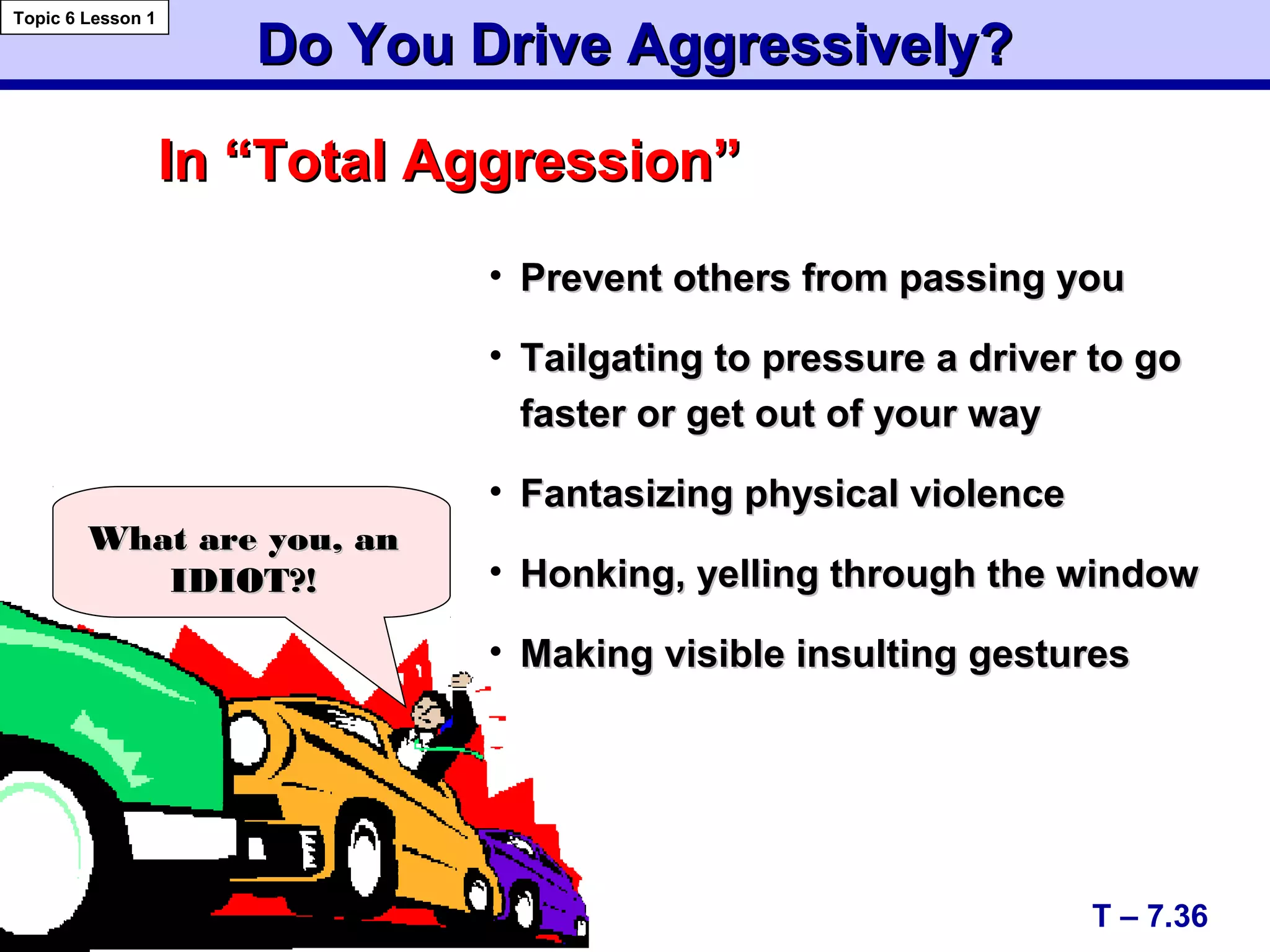
In “Total Aggression”In “Total Aggression”
• Prevent others from passing youPrevent others from passing you
• Tailgating to pressure a driver to goTailgating to pressure a driver to go
faster or get out of your wayfaster or get out of your way
• Fantasizing physical violenceFantasizing physical violence
• Honking, yelling through the windowHonking, yelling through the window
• Making visible insulting gesturesMaking visible insulting gestures
T – 7.36
Topic 6 Lesson 1
What are you, anWhat are you, an
IDIOT?!IDIOT?!
Do You Drive Aggressively?Do You Drive Aggressively?
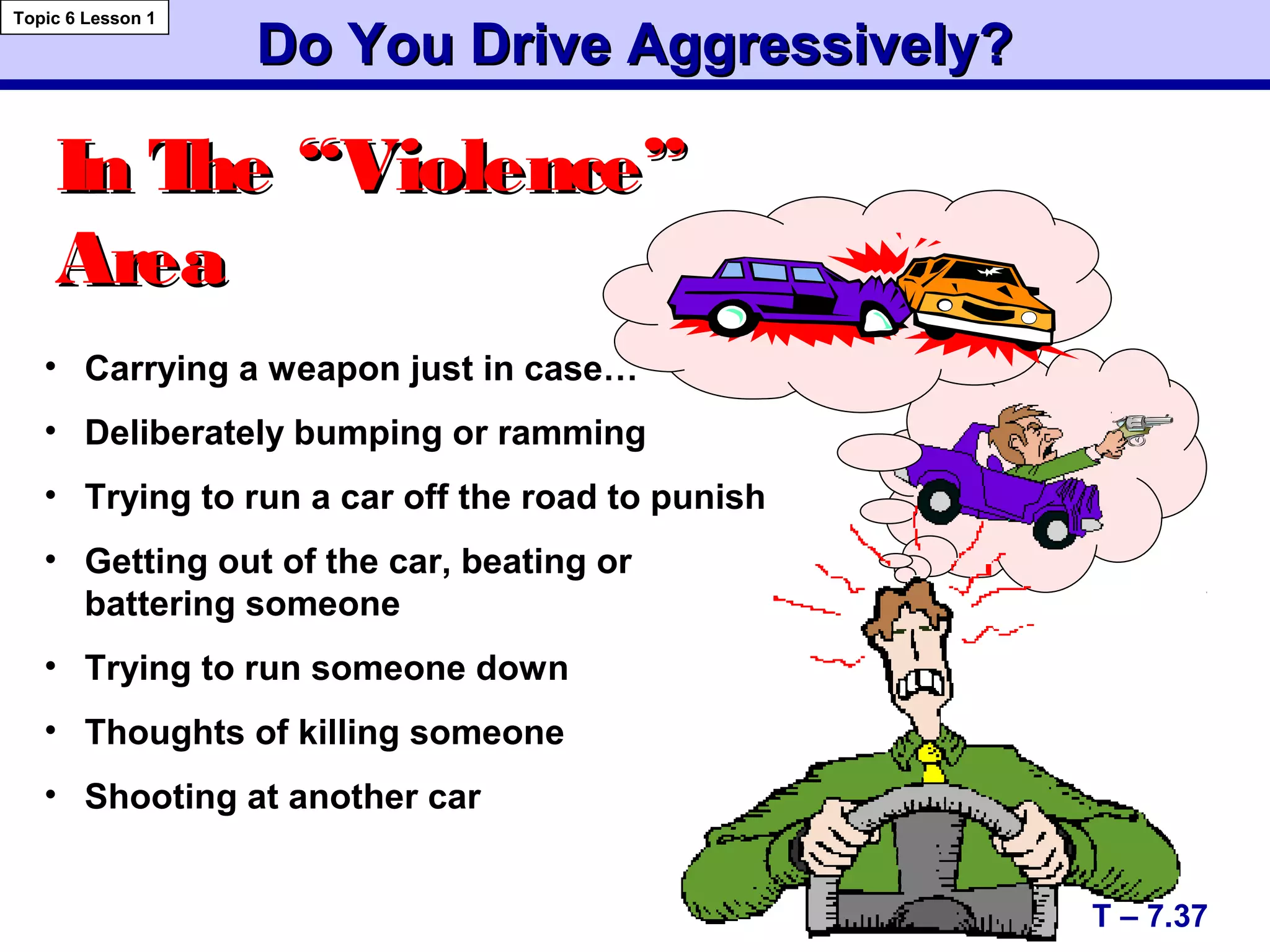
In The “Violence”In The “Violence”
AreaArea
• Carrying a weapon just in case…
• Deliberately bumping or ramming
• Trying to run a car off the road to punish
• Getting out of the car, beating or
battering someone
• Trying to run someone down
• Thoughts of killing someone
• Shooting at another car
T – 7.37
Topic 6 Lesson 1
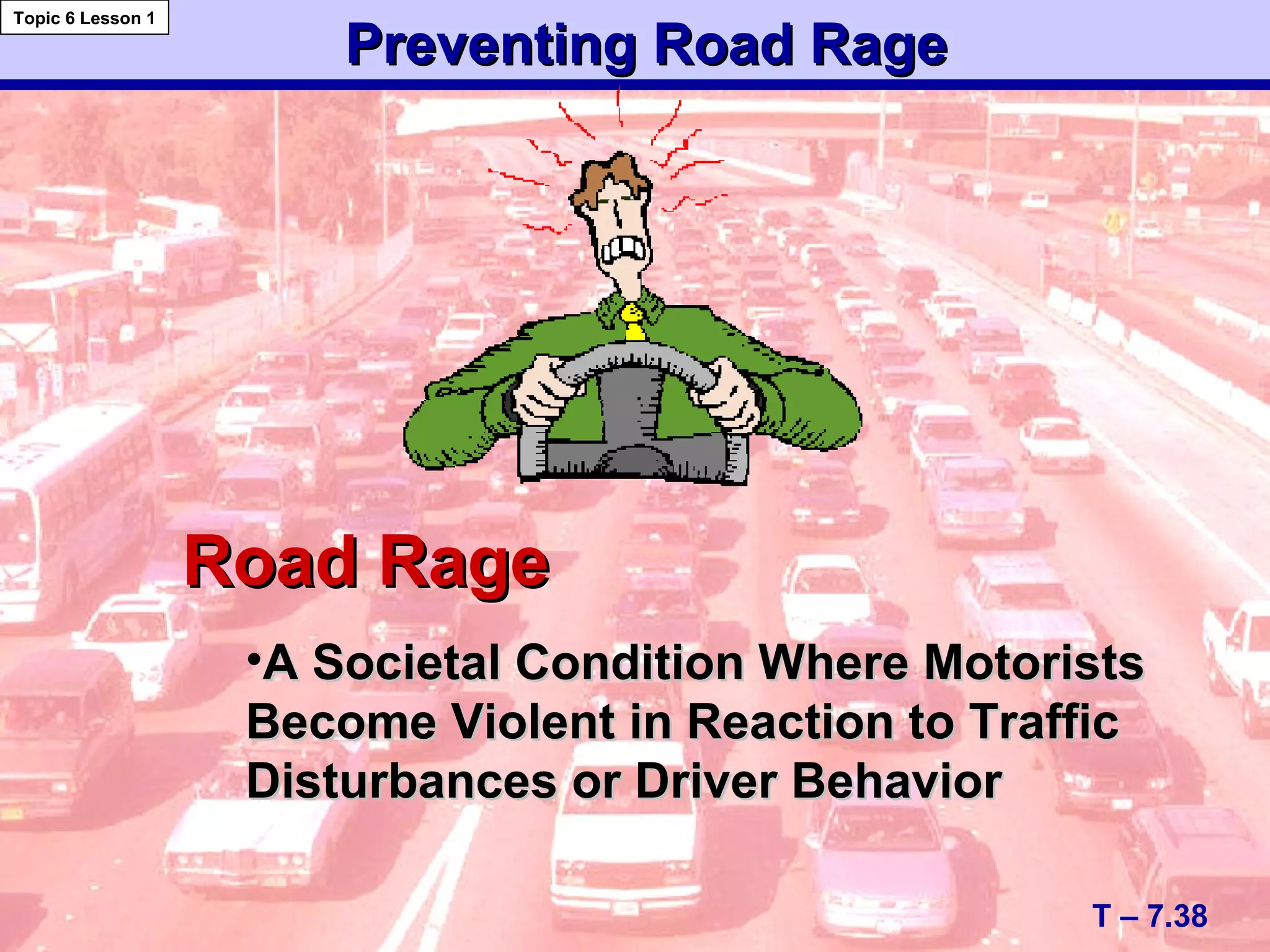
Preventing Road RagePreventing Road Rage
T – 7.38
Topic 6 Lesson 1
Road RageRoad Rage
•A Societal Condition Where MotoristsA Societal Condition Where Motorists
Become Violent in Reaction to TrafficBecome Violent in Reaction to Traffic
Disturbances or Driver BehaviorDisturbances or Driver Behavior
Preventing Road RagePreventing Road Rage
Topic 6 Lesson 1
T – 7.39
If Confronted by an Aggressive DriverIf Confronted by an Aggressive Driver
•Avoid horn useAvoid horn use
•Don’t block the passing laneDon’t block the passing lane
•Don’t tailgateDon’t tailgate
•Keep music at a reasonable levelKeep music at a reasonable level
•Avoid eye contactAvoid eye contact
•Try to get out of the wayTry to get out of the way
•Put your pride in the back seatPut your pride in the back seat
•Ignore gestures and refuse to return themIgnore gestures and refuse to return them
Preventing Road RagePreventing Road Rage
T – 7.40
Topic 6 Lesson 1
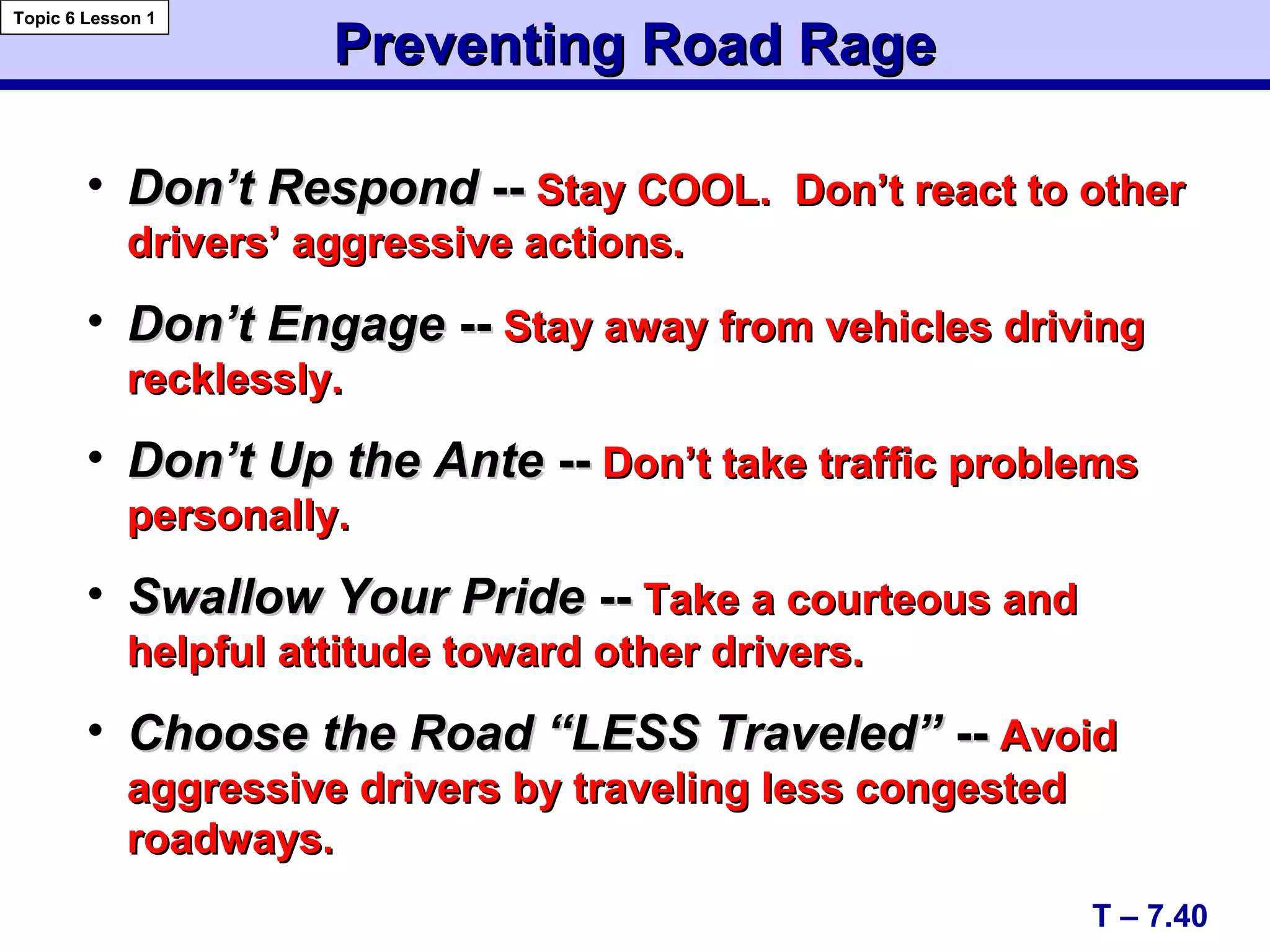
• Don’t RespondDon’t Respond ---- Stay COOL. Don’t react to otherStay COOL. Don’t react to other
drivers’ aggressive actions.drivers’ aggressive actions.
• Don’t EngageDon’t Engage ---- Stay away from vehicles drivingStay away from vehicles driving
recklessly.recklessly.
• Don’t Up the AnteDon’t Up the Ante ---- Don’t take traffic problemsDon’t take traffic problems
personally.personally.
• Swallow Your PrideSwallow Your Pride ---- Take a courteous andTake a courteous and
helpful attitude toward other drivers.helpful attitude toward other drivers.
• Choose the Road “LESS Traveled”Choose the Road “LESS Traveled” ---- AvoidAvoid
aggressive drivers by traveling less congestedaggressive drivers by traveling less congested
roadways.roadways.
Preventing Road RagePreventing Road Rage
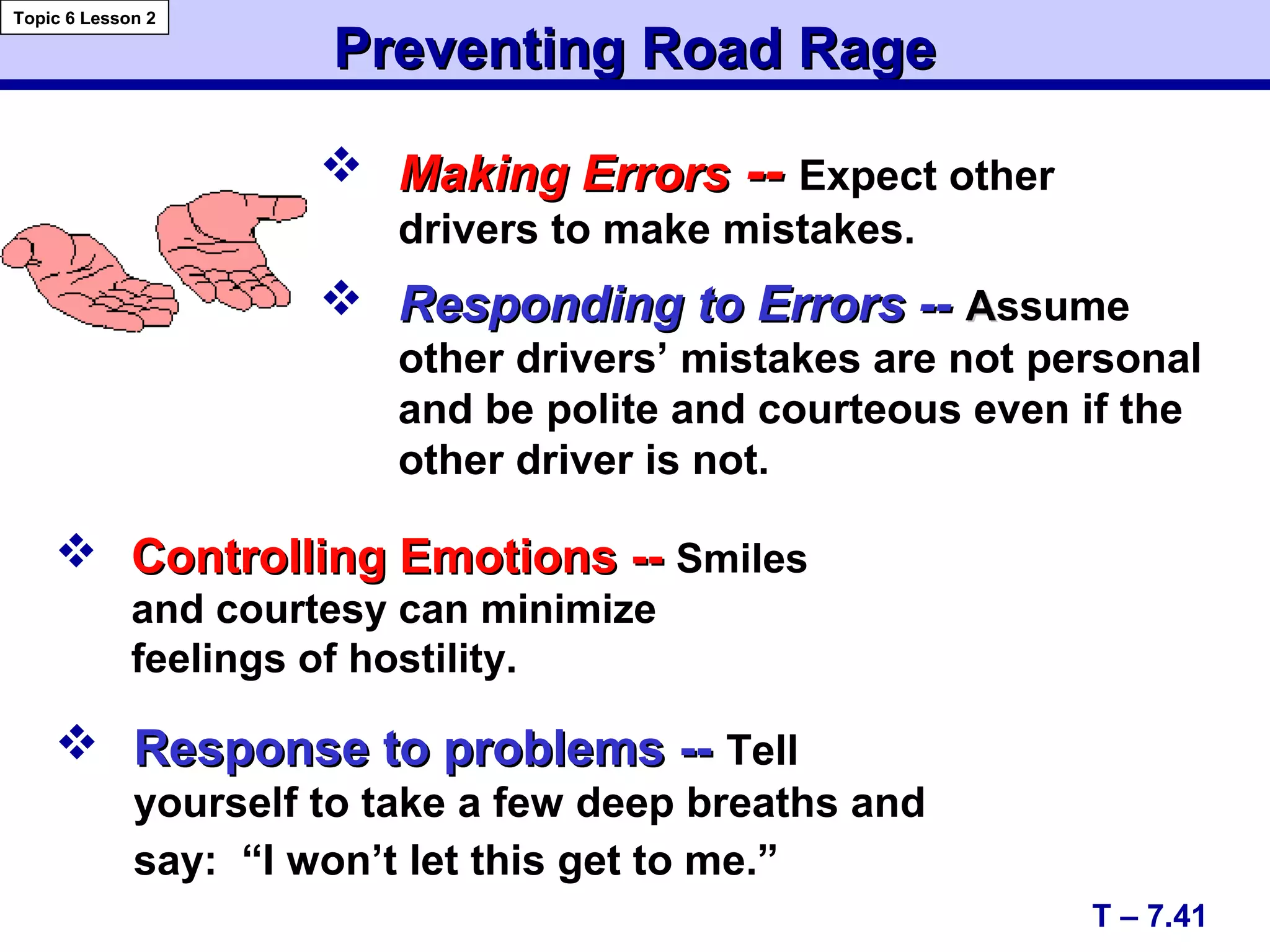
 Controlling Emotions --Controlling Emotions -- Smiles
and courtesy can minimize
feelings of hostility.
T – 7.41
Topic 6 Lesson 2
 Responding to Errors --Responding to Errors -- AAssume
other drivers’ mistakes are not personal
and be polite and courteous even if the
other driver is not.
 Making ErrorsMaking Errors ---- Expect other
drivers to make mistakes.
 Response to problems --Response to problems -- Tell
yourself to take a few deep breaths and
say: “I won’t let this get to me.”
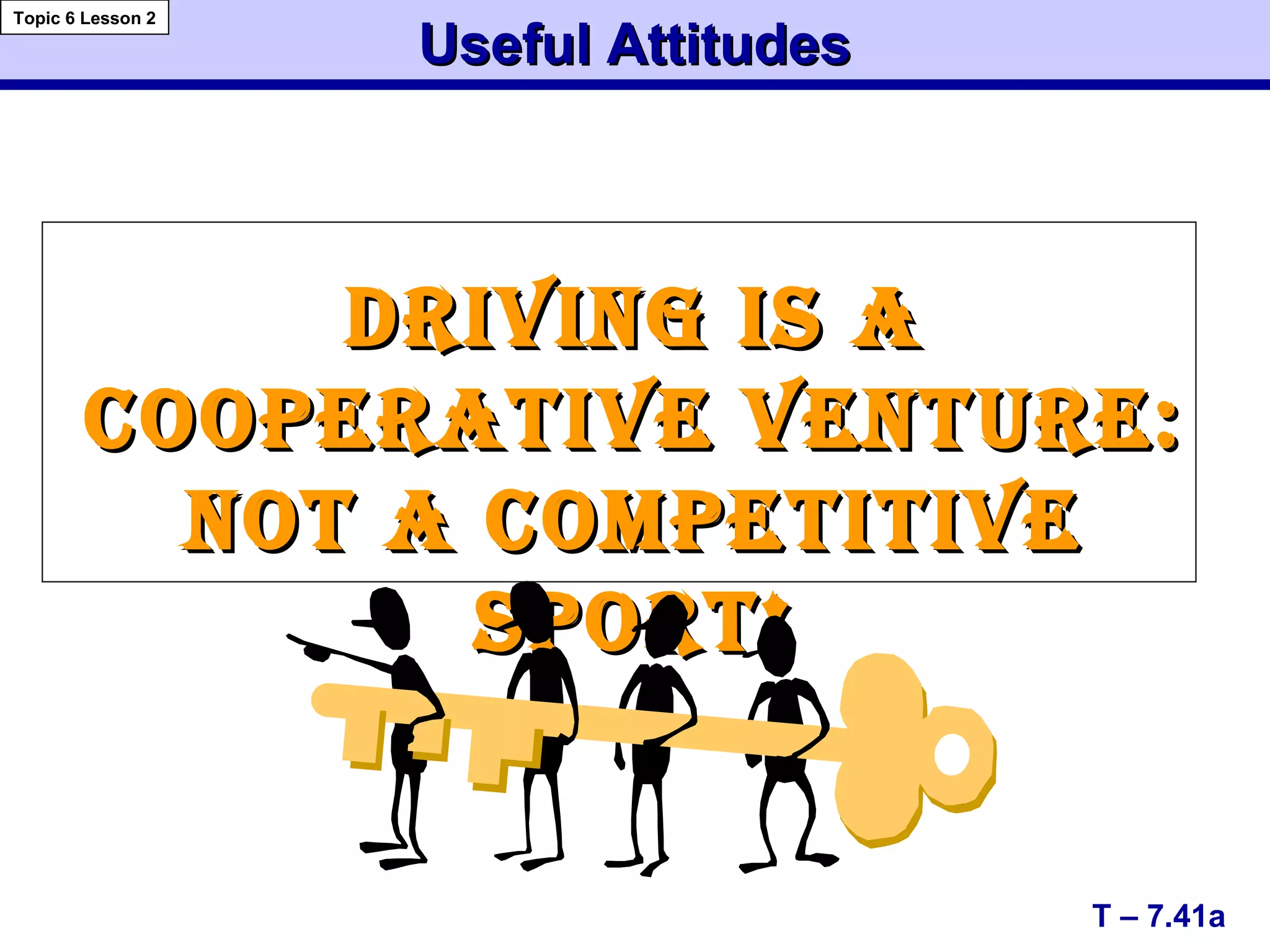
Useful AttitudesUseful Attitudes
T – 7.41a
Topic 6 Lesson 2
DRIVING IS ADRIVING IS A
COOPERATIVE VENTURE:COOPERATIVE VENTURE:
NOT A COMPETITIVENOT A COMPETITIVE
SPORT!SPORT!
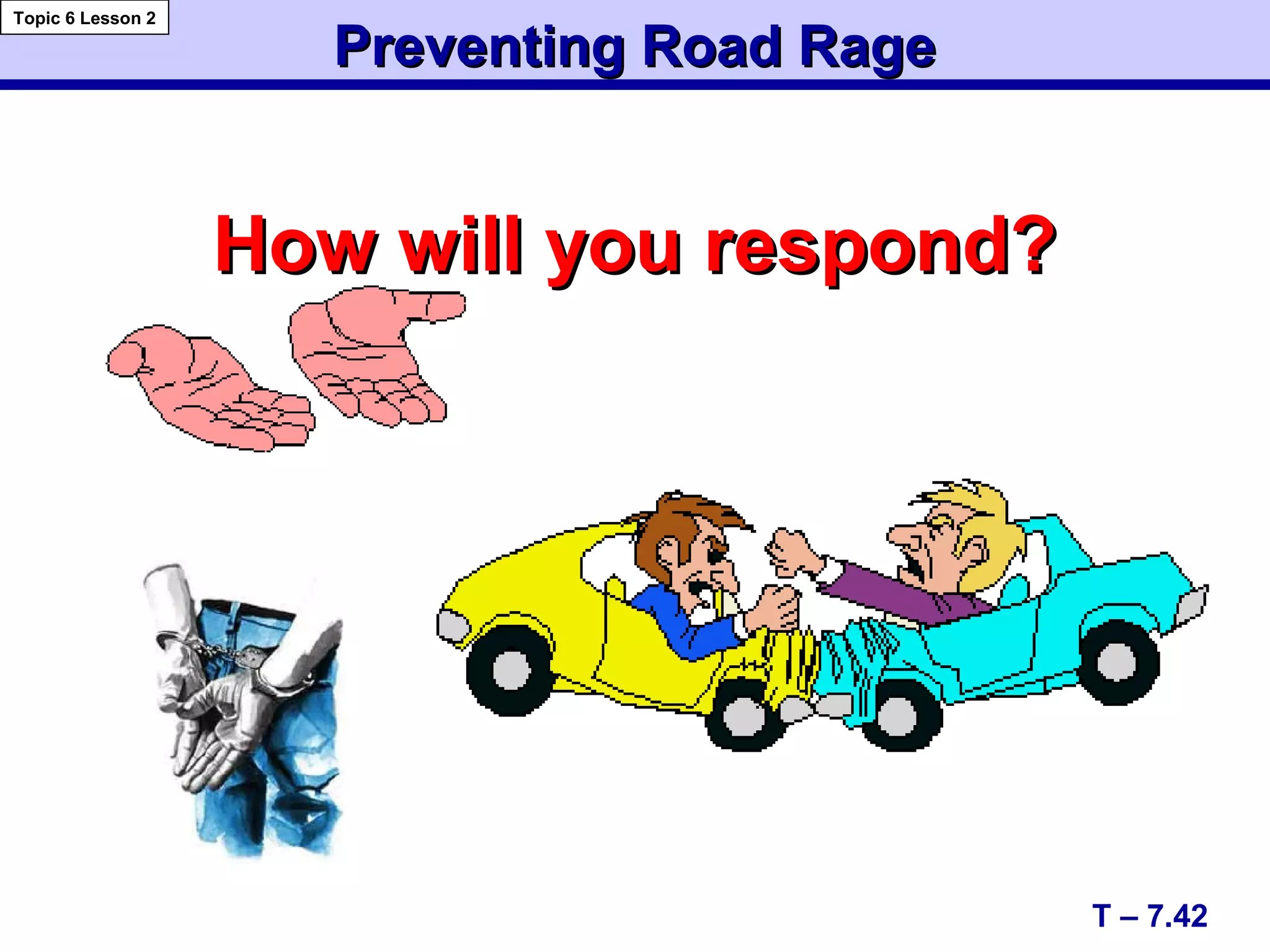
Preventing Road RagePreventing Road Rage
How will you respond?How will you respond?
T – 7.42
Topic 6 Lesson 2
Positive AttitudesPositive Attitudes
T – 7.43
Topic 6 Lesson 2
REMEMbER ThAT yOU
CANNOT CONTROl
TRAffIC, ONly yOUR
REACTION TO IT!

Module 07 2004

  • 1.
    Driver Performance: PersonalFactorsDriver Performance: Personal Factors Topic 1 --Topic 1 -- Introduction to Alcohol – Saying NoIntroduction to Alcohol – Saying No Topic 2 --Topic 2 -- Nature of Alcohol-Related Crash ProblemsNature of Alcohol-Related Crash Problems Topic 3 --Topic 3 -- Physiological and Psychological Effects of AlcoholPhysiological and Psychological Effects of Alcohol Topic 4 --Topic 4 -- Effects of Alcohol and Other Drugs on the DrivingEffects of Alcohol and Other Drugs on the Driving TaskTask Topic 5 --Topic 5 -- Dealing with Driver FatigueDealing with Driver Fatigue Topic 6 --Topic 6 -- Preventing Road RagePreventing Road Rage Module Seven TransparenciesModule Seven Transparencies VirginiaVirginia Department of EducationDepartment of Education Provided in cooperation with the Virginia Department of Motor VehiclesProvided in cooperation with the Virginia Department of Motor Vehicles
  • 2.
    Why do youthink VirginiaWhy do you think Virginia has a Zero Tolerance Lawhas a Zero Tolerance Law for drivers under age 21?for drivers under age 21? Why do some peopleWhy do some people choose not to use alcoholchoose not to use alcohol or other drugs?or other drugs? Using or Not Using?Using or Not Using? T – 7.1 Topic 1 Lesson 1
  • 3.
    Your Choices andResponsibilitiesYour Choices and Responsibilities Topic 1 Lesson 1 Having a driver’s license involves more than justHaving a driver’s license involves more than just knowing how to drive. It involvesknowing how to drive. It involves demonstratingdemonstrating responsible adult behaviors.responsible adult behaviors. NONO ThanksThanks I’m DrivingI’m Driving Responsibility:Responsibility: • starts with thestarts with the decisions you make;decisions you make; • your ability to carefullyyour ability to carefully consider the potentialconsider the potential consequences of yourconsequences of your choices; andchoices; and • acceptance of theacceptance of the financial responsibilityfinancial responsibility for the harm you causefor the harm you cause yourself or others.yourself or others. Virginia’s Zero Tolerance Law protectVirginia’s Zero Tolerance Law protect citizens from underage drinking andcitizens from underage drinking and driving.driving.
  • 4.
    Your Choices andResponsibilitiesYour Choices and Responsibilities T – 7.2 Topic 1 Lesson 1 Alcohol Use – Decisions & Consequences Short-term rewards Short-term consequences Long-term rewards Long-term consequences
  • 5.
    Costs of Drinking& Driving in VACosts of Drinking & Driving in VA Topic 1 Lesson 1 T – 7.2a PROCESS OFFENDER’S TIME & COSTS TIME CONSEQUENCES/COSTS Traffic Stop, Field Test 3 – 5 Hours If juvenile, parents notified Arrest, Breath Test Booking Magistrate Reviews 1 – 2 Hours After booking: Immediate 7 day Incident Report suspension of Driver’s License (Setting Bond, Booking) Posting Bail Will be held till $500 Unsecured sober to Minimum 4 hours $2500 Secured Car Towed 1 – 2 Hours $100 Towing Fee (unless there is another sober driver in vehicle) Source: Thomas von Hemert - Thomas Jefferson Area Community Criminal Justice Board
  • 6.
    Costs of Drinking& Driving in VACosts of Drinking & Driving in VA Topic 1 Lesson 1 T – 7.2b PROCESS TIME CONSEQUENCES/COSTS OFFENDER’S TIME & COSTS Return to General 1 – 2 Hours Time lost from work or school District Court after 7 days to retrieve Driver’s License Hiring an Attorney 1 – 3 Hours $112 – Court Appointed meeting with to counsel/retaining $1500 - $4000 – Private Counsel counsel Appearing in Court1 – 3 Hours per 2 days work/school missed Court appearance (Minimum 2 appearances) Source: Thomas von Hemert - Thomas Jefferson Area Community Criminal Justice Board
  • 7.
    Costs of Drinking& Driving in VACosts of Drinking & Driving in VA Topic 1 Lesson 1 T – 7.2c PROCESS TIME CONSEQUENCES/COSTS OFFENDER’S TIME & COSTS Paying Court Costs License can/will be Court Cost = $164 suspended Fine = $250 - $1000 depending on Felony Conviction offense class Loss of Voting Rights & Right to Bear Arms Jail Time 0 –12 Months 0 - $500 Fine (depends on BAC .20 BAC has a mandatory and number of 5-day jail & $250 fine previous con- .25 BAC has a mandatory victions: can be 10-day jail & $250 fine mandatory) 2nd offense within 5 years has a mandatory 5-day jail and $500 fine PLUS: If a juvenile is in car = $500 fine and 5-day jail Source: Thomas von Hemert - Thomas Jefferson Area Community Criminal Justice Board
  • 8.
    Costs of Drinking& Driving in VACosts of Drinking & Driving in VA Topic 1 Lesson 1 PROCESS TIME & COSTS TIME CONSEQUENCES/COSTS T – 7.2d Trip to DMV for 1 – 2 Hours $120 Fee for required restricted Restricted Driver’s license License for 12 months Driver’s License marked with (1st offense) a BIG Red letter R for restricted Attend Alcohol Safety Minimum 20 hours $350 plus $25 per sighted drug Action Program ten week alcohol screen as required plus any (ASAP) education course other treatment costs Notify Insurance Co. Must apply for $1000 - $2,000 increase in car SR22 on Driver’s insurance per year License (3-5 years) Obtain Non-restricted 1 – 2 Hours at DMV $10 fee Total Cost: $5,000 - $20,000 The costs in time, money and lives for drinking and driving is HUGE! Remember drinking & driving is illegal at any age. The costs in time, money and lives for drinking and driving is HUGE! Remember drinking & driving is illegal at any age. Source: Thomas von Hemert - Thomas Jefferson Area Community Criminal Justice Board
  • 9.
    Evaluating Impairment InvolvesEvaluatingImpairment Involves • Making personal decisions aboutMaking personal decisions about alcohol and the driving taskalcohol and the driving task • Analyzing the alcohol-relatedAnalyzing the alcohol-related safety problemsafety problem • Understanding the physiologicalUnderstanding the physiological and psychological effects ofand psychological effects of alcohol on the driving taskalcohol on the driving task • Studying the effects of otherStudying the effects of other drugs on the driving taskdrugs on the driving task • Understanding driver fatigue andUnderstanding driver fatigue and the dangers of road ragethe dangers of road rage T – 7.3 Topic 1 Lesson 1
  • 10.
    Impact of AlcoholCrashes on Virginians T – 7.3a Topic 2 Lesson 1 Alcohol Related Facts Virginia 2002 Alcohol-related Fatalities Total Drivers Passengers Pedestrians 375 237 100 38 Total Drivers Passengers Pedestrians 8,465 5,668 2,498 299 Alcohol-related Fatalities Total Drivers Passengers Pedestrians 64 32 29 3 Alcohol-related Injuries Total Drivers Passengers Pedestrians 1,470 791 644 35 ALL PersonsALL Persons KilledKilled Young PeopleYoung People 15-20 Injured15-20 Injured Young PeopleYoung People 15-20 Killed15-20 Killed Virginia Statistics provided by DMV’s 2002 Crash Report All PersonsAll Persons InjuredInjured Alcohol-related Injuries
  • 11.
    ALCOHOL RELATED TRAFFICINCIDENTS*ALCOHOL RELATED TRAFFIC INCIDENTS* Traffic Death ComparisonsTraffic Death Comparisons T – 7.4 Topic 2 Lesson 2 DRUG RELATED TRAFFIC INCIDENTSDRUG RELATED TRAFFIC INCIDENTS VA = _?__ U.S. = _?__ VA = ____ U.S. = ____ * Crash statistics available at www.dmvnow.com and www.nhtsa.dot.gov
  • 12.
    Under legal drinkingage drivers in crashes 3082 Percentage of all alcohol related crashes 10.04% Under legal drinking age licensed drivers 939,862 Percentage of all licensed drivers 7.4% Is this group over or under involved? over involved Involved in 10.04% of crashes but represent only 7.4% of all drivers Underage Alcohol-Related Crashes in VirginiaUnderage Alcohol-Related Crashes in Virginia 19951995 20022002 T – 7.5 Topic 2 Lesson 2
  • 13.
    Blood Alcohol ConcentrationFactorsBlood Alcohol Concentration Factors T – 7.6 Topic 3 Lesson 1 LiquorLiquor BeerBeer • Weight (blood volume)Weight (blood volume) • Time Spent DrinkingTime Spent Drinking • GenderGender • FoodFood • Alcohol Content andAlcohol Content and Size of DrinkSize of Drink WineWine BAC is theBAC is the mathematicalmathematical ratio of the percentage ofratio of the percentage of alcoholalcohol in thein the blood streamblood stream.. Factors affecting BACFactors affecting BAC
  • 14.
    BAC FactorsBAC Factors T– 7.6a Topic 3 Lesson 1 WeightWeight Heavier people have more blood and otherHeavier people have more blood and other body fluids to dilute alcohol consumed.body fluids to dilute alcohol consumed. 0.04 0.08 220 lbs 110 lbs WineWine LiquorLiquor Time SpentTime Spent DrinkingDrinking 90% of the alcohol detoxified is oxidized (burned up) by the liver 10% is eliminated in breath, urine, and sweat BeerBeer Their BAC level will be lower thanTheir BAC level will be lower than the BAC of a smaller person whothe BAC of a smaller person who drank the same volume of alcohol.drank the same volume of alcohol. On average, a person’s BAC is oxidized at aOn average, a person’s BAC is oxidized at a rate of 0.015 per hourrate of 0.015 per hour NOTE: Alcohol is toxic to the liver and brain. Hence, the term intoxication denotes the toxic effect alcohol has on these organs.
  • 15.
    BAC FactorsBAC Factors T– 7.6b Topic 3 Lesson 1 LiquorLiquor GenderGender Women process alcohol at a slower rate than men. This is because they usually weigh less and produce less of the enzyme dehydrogenase needed by the liver to break down alcohol. Men also have a higher percentage ofMen also have a higher percentage of body fluids which dilutes the alcohol.body fluids which dilutes the alcohol. FoodFood BeerBeer The amount of food in your stomach does very little to reduce the effect alcohol has on the brain and liver. However, food does coat the lining of the stomach and slows absorption into the blood stream. Note: When alcohol is mixed with carbonated beverages the absorption rate is faster because gases are absorbed faster than liquids. WineWine
  • 16.
    Are They TheSameAre They The Same ?? Topic 3 Lesson 1 LiquorLiquor • BeerBeer • WhiskeyWhiskey • WineWine • CoolerCooler • MargaritaMargarita T – 7.7BeerBeer WineWine Myth A “DRINK” is: •a 12-ounce beer, •a 4- to 6-ounce glass of wine, or •a shot of liquor. Fact A “DRINK” is ½ an ounce of alcohol.
  • 17.
    Drink EquivalentsDrink Equivalents T– 7.7a Topic 3 Lesson 1 % Ounces Drink Alcohol 4.2 12 Beer .50 oz. 6.1 8 Beer .48 oz. 10 5 Wine .50 oz. 14 3.5 Wine .49 oz. 40 1.25 Liquor* .50 oz. 50 1.0 Liquor .50 oz. 75 .67 Liquor .50 oz. NOTE: One half of the proof of the liquor equals the percentage of alcohol.
  • 18.
    How Much AlcoholDo They Contain?How Much Alcohol Do They Contain? Topic 3 Lesson 1 T – 7.7b Beverage Alcohol % Beer 3 – 11 % Wine 8 – 25 % Liquor 26 - 75.5 % Pure Grain Alcohol 95 – 100 %
  • 19.
    How Much LightBeer?How Much Light Beer? Based on light beer with 4.2% alcohol by volume consumed in 1 hour. NOTE: The alcohol content of light beer varies from 3.3 to 4.4 %. T – 7.8 - 9 Topic 3 Lesson 1 LightLight BeerBeer Weight Oz. Light BAC Oz. Light BAC Oz. Light BAC Beer Beer Beer 200 180 160 140 120 100 0.03 0.03 0.03 0.03 0.03 0.03 22 oz. 20 oz. 18 oz. 16 oz. 14 oz. 11 oz. 0.05 0.05 0.05 0.05 0.05 0.05 37 oz. 33 oz. 30 oz. 27 oz. 22 oz. 20 oz. 0.07 0.07 0.07 0.07 0.07 0.07 52 oz. 46 oz. 41 oz. 37 oz. 32 oz. 28 oz. MM AA LL EE 200 180 160 140 120 100 18 oz. 16 oz. 14 oz. 12 oz. 10 oz. 7 oz. 30 oz. 27 oz. 22 oz. 20 oz. 18 oz. 16 oz. 41 oz. 37 oz. 32 oz. 28 oz. 26 oz. 21 oz. F E M A L E 0.03 0.03 0.03 0.03 0.03 0.03 0.05 0.05 0.05 0.05 0.05 0.05 0.07 0.07 0.07 0.07 0.07 0.07
  • 20.
    Elimination RateElimination Rate Topic3 Lesson 1 T – 7.10 MythMyth The average person can tolerate one drink perThe average person can tolerate one drink per hour without substantial impairment.hour without substantial impairment. Facts •Sobriety returns ONLY with time.Sobriety returns ONLY with time. •Alcohol is eliminated at approximately .015 BACAlcohol is eliminated at approximately .015 BAC per hour.per hour. Titanic PrincipleTitanic Principle If you take in more than your system can pumpIf you take in more than your system can pump out, sooner or later you’ll sink!out, sooner or later you’ll sink!
  • 21.
    Elimination RateElimination Rate Topic3 Lesson 1 T – 7.10a ExampleExample Based on 1 drink per hour for 6 hoursBased on 1 drink per hour for 6 hours 150 lb male150 lb male BAC in (6 hr. x .03)BAC in (6 hr. x .03) = .18= .18 BAC out (6 hr. x .015)BAC out (6 hr. x .015) = .09= .09 BAC after 6 hr. (.18 - .09)BAC after 6 hr. (.18 - .09) = .09 BAC remaining= .09 BAC remaining 150 lb female150 lb female BAC in (6 hr. x .033)BAC in (6 hr. x .033) = .198= .198 BAC out (6 hr. x .015)BAC out (6 hr. x .015) = .09= .09 BAC after 6 hr. (.198 - .09) = .108 BAC remainingBAC after 6 hr. (.198 - .09) = .108 BAC remaining
  • 22.
    Elimination of AlcoholEliminationof Alcohol ELIMINATION PROCESSELIMINATION PROCESS An adult male with normal liver function eliminates Breath Urine Sweat}10% LIVER 90% about 0.015 BAC per hour. Therefore: BAC of 0.05 = 3.5 hours for removal BAC of 0.07 = 5.0 hours for removal BAC of 0.10 = 7.0 hours for removal BAC of 0.15 = 10.0 hours for removal T – 7.10b Topic 3 Lesson 1
  • 23.
    0 0.05 0.1 0.15 0.2 9 10 1112 1 2 3 4 5 6 7 8 9 10 11 12 1 HRS 1 2 3 4 5 6 7 8 9 10 11 12 13 14 15 16 Elimination RateElimination Rate Stops Drinking at 12:30amStops Drinking at 12:30am .16 = BAC Peak at 1 am.16 = BAC Peak at 1 am Still legally INTOXICATEDStill legally INTOXICATED (.08) at 6 am(.08) at 6 am StillStill IMPAIREDIMPAIRED (.05) at(.05) at 9:30AM9:30AM ABSORPTIONABSORPTION ELIMINATIONELIMINATION BACBAC T – 7.11 Topic 3 Lesson 1
  • 24.
    Alcohol Effects &YouAlcohol Effects & You T – 7.12 Topic 3 Lesson 2 LiquorLiquor WineWine BeerBeer Brain Lungs Heart Liver Stomach Intestines & Pancreas Bones & Muscles
  • 25.
    Alcohol Effects &YouAlcohol Effects & You Topic 3 Lesson 2 T – 7.12a
  • 26.
    Affects Persons DifferentlyAffectsPersons Differently T – 7.13 Topic 3 Lesson 2 PersonalityPersonality Because people have unique personalities alcohol affectsBecause people have unique personalities alcohol affects everyone differently.everyone differently. Alcohol can affect an individual in various ways dependingAlcohol can affect an individual in various ways depending upon the drinker’s mood when consuming the alcohol.upon the drinker’s mood when consuming the alcohol. ExperienceExperience The inexperienced driver is at extreme risk when alcohol isThe inexperienced driver is at extreme risk when alcohol is involved.involved. ToleranceTolerance Many drinkers develop an ability to mask the effects alcoholMany drinkers develop an ability to mask the effects alcohol has on their brain and body.has on their brain and body. This ability, however, has NO affect on their intoxication level.This ability, however, has NO affect on their intoxication level. LiquorLiquor WineWine BeerBeer
  • 27.
    Affects Persons DifferentlyAffectsPersons Differently T – 7.13a Topic 3 Lesson 2 MedicationMedication The chemical reaction between alcohol and other drugs canThe chemical reaction between alcohol and other drugs can produce an effect that is much greater than that of alcohol orproduce an effect that is much greater than that of alcohol or other drugs when taken alone.other drugs when taken alone. WeightWeight Heavier people have more blood and body fluids to dilute theHeavier people have more blood and body fluids to dilute the alcohol. Therefore, their BAC will be lower than that of aalcohol. Therefore, their BAC will be lower than that of a smaller person who consumed the same volume of alcohol.smaller person who consumed the same volume of alcohol. AgeAge The neurological development of the brain continues until a person is in their 20’s. The risks of impairing memory and learning capacity can be severely affected by the use of alcohol during adolescence. FatigueFatigue Alcohol is a depressant. It will compound the effect of fatigue.Alcohol is a depressant. It will compound the effect of fatigue. LiquorLiquor WineWine BeerBeer
  • 28.
    BAC Levels Affectthe BrainBAC Levels Affect the Brain Topic 3 Lesson 2 T – 7.14 .01 - .05 Reduces Inhibitions Impairs Judgment Gives a False Sense of Confidence Weakens Willpower .05 - .10 Slows Reaction Time Reduces Coordination and Balance Affects All Driving Skills .10 - .20 Slurred Speech Blurred Vision Impaired Judgment, Memory and Self- Control .20 - .35 Physical Abilities Become Severely Impaired Mental Confusion Unconsciousness, Blackouts or Stupor are Common .35 - higher Subnormal Temperature Little or No Reflexes Breathing May Stop DEATH •NOTE: “Chugging” large amounts of alcohol in a short period of time can result in respiratory paralysis and death.
  • 29.
    Alcohol and SpaceManagementAlcohol and Space Management SearchingSearching •AlcoholAlcohol •narrows the field of visionnarrows the field of vision •lessens visual acuitylessens visual acuity •impedes the ability to distinguish colorsimpedes the ability to distinguish colors •reduces the ability to rapidly changereduces the ability to rapidly change focus from close to farfocus from close to far •may produce double vision by relaxingmay produce double vision by relaxing the muscles that control the eyesthe muscles that control the eyes •reduces the ability to judge distancereduces the ability to judge distance accuratelyaccurately •After drinking, a driver may tend to stare atAfter drinking, a driver may tend to stare at the center line.the center line. T – 7.15 – 7.16 Topic 4 Lesson 1
  • 30.
    Alcohol and SpaceManagementAlcohol and Space Management T – 7.17 Topic 4 Lesson 2 Evaluating •Alcohol •impairs judgment •diminishes the ability to process multiple variables •lessens the ability to concentrate
  • 31.
    Alcohol and SpaceManagementAlcohol and Space Management Topic 4 Lesson 2 T – 7.18 Executing •Alcohol •causes changes in coordination •slows reaction time •affects the ability to judge distance •a drinking driver may perceive something as further away than it is •affects ability to judge speed • drinking driver may be unable to judge speed of approaching traffic
  • 32.
    Drugs and DrivingDrugsand Driving  PerceptionPerception  JudgmentJudgment  CoordinationCoordination  VisionVision  MoodMood T – 7.19 Topic 4 Lesson 4
  • 33.
    MarijuanaMarijuana The active ingredientTHC (delta-9- tetrahydrocannabinol) impairs  memory and learning  perception (sight, sound, time, touch)  problem-solving ability  motor coordination  tracking ability  concentration More research needs to be conducted to determine marijuana’s effects on brain function 8, 16 and 24 hours after smoking. T – 7.20 Topic 4 Lesson 4
  • 34.
    Marijuana and DrivingMarijuanaand Driving Topic 4 Lesson 4 T – 7.20a
  • 35.
    Other Types ofDrugs and DrivingOther Types of Drugs and Driving Over the CounterOver the Counter Medications That AffectMedications That Affect Driving AbilityDriving Ability • TranquilizersTranquilizers • StimulantsStimulants • NarcoticsNarcotics • Blood PressureBlood Pressure • InsulinInsulin PrescriptionPrescription MedicationsMedications T – 7.21 Topic 4 Lesson 4 •Antihistamines •Cold Medications •Other
  • 36.
    Fatigue is:Fatigue is: The Body’s “Downtime”  Follows a Period of: • Extended mental activity • Extended physical activity  Characterized by: • Reduced capacity for work • Reduced efficiency of brain function Definition of FatigueDefinition of Fatigue T – 7.22 Topic 5 Lesson 1
  • 37.
    Causes of FatigueCausesof Fatigue  Emotional StressEmotional Stress  Sleep DisordersSleep Disorders  Body’s Natural “downtime”Body’s Natural “downtime” Midnight to 6 a.m.Midnight to 6 a.m. 1 p.m. to 3 p.m.1 p.m. to 3 p.m.  Disruption of Cicadian RhythmDisruption of Cicadian Rhythm  Extended Physical ActivityExtended Physical Activity T – 7.23 Topic 5 Lesson 1
  • 38.
    Physical Symptoms ofFatiguePhysical Symptoms of Fatigue  Tired Muscles  General Body Sensation of Tiredness  Sleepiness  Mental Dullness T – 7.24 Topic 5 Lesson 1
  • 39.
    Physical Symptoms ofFatiguePhysical Symptoms of Fatigue  Localized Pain in Back of HeadLocalized Pain in Back of Head  Pain and Soreness in MusclesPain and Soreness in Muscles  Stiffness in JointsStiffness in Joints  Swelling of Hands and FeetSwelling of Hands and Feet T – 7.25 Topic 5 Lesson 1
  • 40.
    Mental Symptoms ofFatigueMental Symptoms of Fatigue  Inability to Maintain AttentionInability to Maintain Attention  Impaired MemoryImpaired Memory  Failure to Grasp New IdeasFailure to Grasp New Ideas  Difficulty/Slowness in ReasoningDifficulty/Slowness in Reasoning T – 7.26 Topic 5 Lesson 1
  • 41.
    Delaying Fatigue OnsetDelayingFatigue Onset  AvoidAvoid Long DrivesLong Drives  AvoidAvoid Leaning Forward or BackwardLeaning Forward or Backward  Keep Your Eyes MovingKeep Your Eyes Moving  Get Plenty of Fresh AirGet Plenty of Fresh Air T – 7.27 Topic 5 Lesson 1
  • 42.
    Delaying Fatigue SymptomsDelayingFatigue Symptoms • Change Drivers at Regular IntervalsChange Drivers at Regular Intervals • Wear Your Safety BeltWear Your Safety Belt • Avoid Getting AngryAvoid Getting Angry • Adjust HVAC ProperlyAdjust HVAC Properly T – 7.28 Topic 5 Lesson 1
  • 43.
    Aggressive Driving/Road RageAggressiveDriving/Road Rage T – 7.29 Topic 6 Lesson 1 MostMost CrashesCrashes are NOTare NOT AccidentsAccidents •They are often the result of drivers whoThey are often the result of drivers who •speed;speed; •tailgate;tailgate; •run red lights;run red lights; •weave in and out of traffic; orweave in and out of traffic; or •vent frustrations or emotions in thevent frustrations or emotions in the vehicle.vehicle.
  • 44.
    Topic 6 Lesson1 T – 7.29a Factors Leading toFactors Leading to Aggressive DrivingAggressive Driving//RoadRoad RageRage •More CarsMore Cars •More Traffic CongestionMore Traffic Congestion •More FrustrationMore Frustration •More StressMore Stress •More HostilityMore Hostility •More ViolenceMore Violence
  • 45.
    Topic 6 Lesson1 T – 7.29b Did you know? In the past 30 years in the US: • population has increased 30% • number of licensed vehicles has increased 87% • vehicle miles traveled increased 130% • highway capacity has only increased 5% Factors Leading toFactors Leading to Aggressive DrivingAggressive Driving//RoadRoad RageRage
  • 46.
    • ““I’m goingto be late if I don’t hurry up.”I’m going to be late if I don’t hurry up.” • ““Why are these cars going so slowly?”Why are these cars going so slowly?” • ““We’ll never make it.”We’ll never make it.” • ““If only I had gone a little faster, IIf only I had gone a little faster, I would’ve made it.”would’ve made it.” • ““Oh no!Oh no! RedRed light!”light!” T – 7.29c Topic 6 Lesson 1 Self-Imposed AnxietiesSelf-Imposed Anxieties Factors Leading toFactors Leading to Aggressive Driving/Aggressive Driving/ Road RageRoad Rage
  • 47.
    Three Types ofAggressive DriversThree Types of Aggressive Drivers • complainingcomplaining • rushingrushing • competingcompeting • resistingresisting • yellingyelling • cussingcussing • staringstaring • honkinghonking • insultinginsulting • cutting offcutting off • blockingblocking • chasingchasing • fightingfighting • shootingshooting T – 7.30 Topic 6 Lesson 1 Quiet Road-Rage:Quiet Road-Rage: Verbal Road-Rage:Verbal Road-Rage: Epic Road-Rage:Epic Road-Rage: AAAAAGHH!!!AAAAAGHH!!! YOU’RE TOOYOU’RE TOO SLOW~SLOW~MOVE!!!MOVE!!! What’s the hold up!!!What’s the hold up!!! Come on, HURRY UPCome on, HURRY UP LET’S GO!!!LET’S GO!!!
  • 48.
    Signs of anAggressive DriverSigns of an Aggressive Driver • Tailgating to pressure a driver to go faster or get outTailgating to pressure a driver to go faster or get out of the wayof the way • Flashing lights to signal the driver to move out of theFlashing lights to signal the driver to move out of the wayway • Weaving in and out of trafficWeaving in and out of traffic • Cutting people offCutting people off • Racing to beat a yellow lightRacing to beat a yellow light T – 7.31 Topic 6 Lesson 1
  • 49.
    Signs of anAggressive DriverSigns of an Aggressive Driver T – 7.32 Topic 6 Lesson 1 • Behaving impatiently withBehaving impatiently with slower driversslower drivers • Honking the horn or screamingHonking the horn or screaming • SpeedingSpeeding • Not coming to a complete stopNot coming to a complete stop at stop signsat stop signs • Making gesturesMaking gestures • Passing on shoulder or unpavedPassing on shoulder or unpaved areasareas
  • 50.
    Other Signs MayInclude...Other Signs May Include... T – 7.33 Topic 6 Lesson 1
  • 51.
    Do You DriveAggressively?Do You Drive Aggressively? • Is constant rushing and lane jumping your style? • Do you believe OTHERS are just in your way? • Do you ignore road signs and regulations, believing they’re for other drivers? T – 7.34 Topic 6 Lesson 1 The “Rush In” AreaThe “Rush In” Area
  • 52.
    Do You DriveAggressively?Do You Drive Aggressively? In “Total Aggression”In “Total Aggression” • Constantly ridiculing andConstantly ridiculing and criticizing other drivers to self orcriticizing other drivers to self or passengerspassengers • Closing gap to deny entry intoClosing gap to deny entry into your laneyour lane • Giving the “look” to show yourGiving the “look” to show your disapprovaldisapproval • Speeding past another car orSpeeding past another car or revving enginerevving engine T – 7.35 Topic 6 Lesson 1 HURRY UPHURRY UP LET’S GO, MOVE IT!!!LET’S GO, MOVE IT!!!
  • 53.
    Do You DriveAggressively?Do You Drive Aggressively? In “Total Aggression”In “Total Aggression” • Prevent others from passing youPrevent others from passing you • Tailgating to pressure a driver to goTailgating to pressure a driver to go faster or get out of your wayfaster or get out of your way • Fantasizing physical violenceFantasizing physical violence • Honking, yelling through the windowHonking, yelling through the window • Making visible insulting gesturesMaking visible insulting gestures T – 7.36 Topic 6 Lesson 1 What are you, anWhat are you, an IDIOT?!IDIOT?!
  • 54.
    Do You DriveAggressively?Do You Drive Aggressively? In The “Violence”In The “Violence” AreaArea • Carrying a weapon just in case… • Deliberately bumping or ramming • Trying to run a car off the road to punish • Getting out of the car, beating or battering someone • Trying to run someone down • Thoughts of killing someone • Shooting at another car T – 7.37 Topic 6 Lesson 1
  • 55.
    Preventing Road RagePreventingRoad Rage T – 7.38 Topic 6 Lesson 1 Road RageRoad Rage •A Societal Condition Where MotoristsA Societal Condition Where Motorists Become Violent in Reaction to TrafficBecome Violent in Reaction to Traffic Disturbances or Driver BehaviorDisturbances or Driver Behavior
  • 56.
    Preventing Road RagePreventingRoad Rage Topic 6 Lesson 1 T – 7.39 If Confronted by an Aggressive DriverIf Confronted by an Aggressive Driver •Avoid horn useAvoid horn use •Don’t block the passing laneDon’t block the passing lane •Don’t tailgateDon’t tailgate •Keep music at a reasonable levelKeep music at a reasonable level •Avoid eye contactAvoid eye contact •Try to get out of the wayTry to get out of the way •Put your pride in the back seatPut your pride in the back seat •Ignore gestures and refuse to return themIgnore gestures and refuse to return them
  • 57.
    Preventing Road RagePreventingRoad Rage T – 7.40 Topic 6 Lesson 1 • Don’t RespondDon’t Respond ---- Stay COOL. Don’t react to otherStay COOL. Don’t react to other drivers’ aggressive actions.drivers’ aggressive actions. • Don’t EngageDon’t Engage ---- Stay away from vehicles drivingStay away from vehicles driving recklessly.recklessly. • Don’t Up the AnteDon’t Up the Ante ---- Don’t take traffic problemsDon’t take traffic problems personally.personally. • Swallow Your PrideSwallow Your Pride ---- Take a courteous andTake a courteous and helpful attitude toward other drivers.helpful attitude toward other drivers. • Choose the Road “LESS Traveled”Choose the Road “LESS Traveled” ---- AvoidAvoid aggressive drivers by traveling less congestedaggressive drivers by traveling less congested roadways.roadways.
  • 58.
    Preventing Road RagePreventingRoad Rage  Controlling Emotions --Controlling Emotions -- Smiles and courtesy can minimize feelings of hostility. T – 7.41 Topic 6 Lesson 2  Responding to Errors --Responding to Errors -- AAssume other drivers’ mistakes are not personal and be polite and courteous even if the other driver is not.  Making ErrorsMaking Errors ---- Expect other drivers to make mistakes.  Response to problems --Response to problems -- Tell yourself to take a few deep breaths and say: “I won’t let this get to me.”
  • 59.
    Useful AttitudesUseful Attitudes T– 7.41a Topic 6 Lesson 2 DRIVING IS ADRIVING IS A COOPERATIVE VENTURE:COOPERATIVE VENTURE: NOT A COMPETITIVENOT A COMPETITIVE SPORT!SPORT!
  • 60.
    Preventing Road RagePreventingRoad Rage How will you respond?How will you respond? T – 7.42 Topic 6 Lesson 2
  • 61.
    Positive AttitudesPositive Attitudes T– 7.43 Topic 6 Lesson 2 REMEMbER ThAT yOU CANNOT CONTROl TRAffIC, ONly yOUR REACTION TO IT!