By
Ronald
Pr athamesh
Vishal Tejas
Ganesh

Job
Dissatisfaction
Meaning & Definition of Job
Satisfaction-Dissatisfaction


Job satisfaction refers to the general
attitude of employees towards their
jobs.



When the attitude of an employee
towards his or her job is positive ,
there exists job satisfaction.
Dissatisfaction exists when the
attitude is negative.
Measuring Job Satisfaction


Job is more than just the obvious activities.



It requires interacting with co-workers and
bosses, higher-lower subordinates, it should
be following organizational rules and
policies, meeting performance standards,
living with working conditions.



Determinants of job- nature of the work,
supervision, present pay, promotion
opportunities and relations with coworkers.



Happy workers are productive workers.
Determinants of job
dissatisfaction
Organizational Factors
Salaries and Wages
Promotion Chances
Equitable Rewards
Personal Factors
Age
Level of Education
Work Environmental Factors
Supervisions
Work Groups
Working conditions
How to recognize if you
are job dissatisfied?










Dread Mondays or coming to work
Can’t wait for Friday
Are often bored at work or Feel tired
Avoid your boss and dread meetings
Have no enthusiasm or sense of self-worth
Feel like you are getting nowhere in your
job
Take work stress home
Question your choice of industry or
occupation
Can’t think of a way out
Dissatisfaction among
employees in different
sectors
My Pay Is Too Low!
I Do It All!
We Have No Benefits!
I’m Always Working!
I Never Get Overtime
I Can’t Work With Her!
I Hate My Boss!
What Am I Supposed to Do?
What Are Our Goals?
I Feel Like I’m In Jail!
Real Cost is Not
Accountable in BPO






The concept of real costs is an all
encompassing idea. From an economic
point of view, real costs refers to the cost
of producing a good or service, including
the cost of all resources used such as all
necessary equipments, labor, material etc
Cost as measured by the physical labor
and materials consumed in production
Real costs are the pains and
inconveniences experienced by labor to
produce a commodity. These costs are
not taken in the costing of a commodity
by the firm.
Causes of Employee
Demotivation specific to
BPO


Odd Working Hrs:
Most of the BPOs in India support overseas
operations and majority of professionals have night
shifts. In majority of cases Indian BPO jobs mostly
have odd hours.



Family Life:
This is somewhat associated with odd working
hours. Evenings are the best time to spend quality
time with your spouse and children and those are
actually your working hours. Your life as a BPO
employee can be very lonely and frustrating at
times.



Lack of Appreciation: An employee feels
unappreciated for his efforts.


Too much Work :
An employee feels overburdened with a
disproportionate chunk of work which renders him
unable to perform his duties well and punctually.



Health Issues :
Sleep disorders, heart disease, eyesight problems
and depression are just a few issues surrounding
the BPO jobs. People also tend to gain weight as
most of the time they are sitting in their small
cubicle.



AGE Factor :
Since BPO jobs are quite stressful, especially after
a few months working in this industry many
individuals quit and change their profession, often
to a lower paying job. If you able to make your
way up to the managerial level or the higher
corporate ladder, life is much better, otherwise the
daily monotonous work starts to really frustrate


Favoritism : These refer to unfair practices that
favor one worker over another.



Mistrust : This deals with an employee resorting
to micromanaging everything, displaying mistrust
in a coworker’s capabilities.



Miscommunication : Free flow of information is
withheld or information is provided only on a
“need-to-know” basis. This can be demotivating as
it proves that the boss or organization does not
fully trust its employees to share all available
information on a project.



Night Shifts : BPO jobs are not recognized to be
career oriented
Responses To BPO Job
Dissatisfaction
HOW EMPLOYEES CAN
EXPRESS
DISSATISFACTION


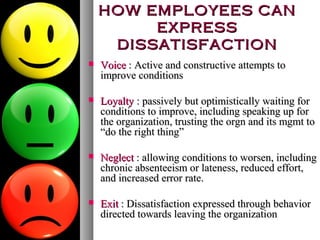
Voice : Active and constructive attempts to
improve conditions



Loyalty : passively but optimistically waiting for
conditions to improve, including speaking up for
the organization, trusting the orgn and its mgmt to
“do the right thing”



Neglect : allowing conditions to worsen, including
chronic absenteeism or lateness, reduced effort,
and increased error rate.



Exit : Dissatisfaction expressed through behavior
directed towards leaving the organization
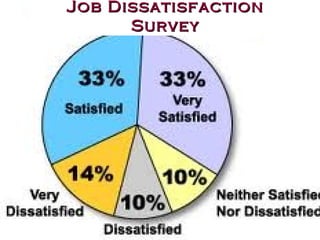
Job Dissatisfaction
Survey
Conclusion
Hence we conclude, we have to say
that job satisfaction is a very important
aspect of a worker's life. The factors
discussed above can provide it to some
level. While the concept of job
satisfaction is prevalent in the
developed countries, there is still very
little scope for expectation in the
developing countries.
Job Dissatisfaction

Job Dissatisfaction

  • 1.
  • 2.
    Meaning & Definitionof Job Satisfaction-Dissatisfaction  Job satisfaction refers to the general attitude of employees towards their jobs.  When the attitude of an employee towards his or her job is positive , there exists job satisfaction. Dissatisfaction exists when the attitude is negative.
  • 3.
    Measuring Job Satisfaction  Jobis more than just the obvious activities.  It requires interacting with co-workers and bosses, higher-lower subordinates, it should be following organizational rules and policies, meeting performance standards, living with working conditions.  Determinants of job- nature of the work, supervision, present pay, promotion opportunities and relations with coworkers.  Happy workers are productive workers.
  • 4.
    Determinants of job dissatisfaction OrganizationalFactors Salaries and Wages Promotion Chances Equitable Rewards Personal Factors Age Level of Education Work Environmental Factors Supervisions Work Groups Working conditions
  • 5.
    How to recognizeif you are job dissatisfied?          Dread Mondays or coming to work Can’t wait for Friday Are often bored at work or Feel tired Avoid your boss and dread meetings Have no enthusiasm or sense of self-worth Feel like you are getting nowhere in your job Take work stress home Question your choice of industry or occupation Can’t think of a way out
  • 6.
    Dissatisfaction among employees indifferent sectors My Pay Is Too Low! I Do It All! We Have No Benefits! I’m Always Working! I Never Get Overtime I Can’t Work With Her! I Hate My Boss! What Am I Supposed to Do? What Are Our Goals? I Feel Like I’m In Jail!
  • 7.
    Real Cost isNot Accountable in BPO    The concept of real costs is an all encompassing idea. From an economic point of view, real costs refers to the cost of producing a good or service, including the cost of all resources used such as all necessary equipments, labor, material etc Cost as measured by the physical labor and materials consumed in production Real costs are the pains and inconveniences experienced by labor to produce a commodity. These costs are not taken in the costing of a commodity by the firm.
  • 8.
    Causes of Employee Demotivationspecific to BPO  Odd Working Hrs: Most of the BPOs in India support overseas operations and majority of professionals have night shifts. In majority of cases Indian BPO jobs mostly have odd hours.  Family Life: This is somewhat associated with odd working hours. Evenings are the best time to spend quality time with your spouse and children and those are actually your working hours. Your life as a BPO employee can be very lonely and frustrating at times.  Lack of Appreciation: An employee feels unappreciated for his efforts.
  • 9.
     Too much Work: An employee feels overburdened with a disproportionate chunk of work which renders him unable to perform his duties well and punctually.  Health Issues : Sleep disorders, heart disease, eyesight problems and depression are just a few issues surrounding the BPO jobs. People also tend to gain weight as most of the time they are sitting in their small cubicle.  AGE Factor : Since BPO jobs are quite stressful, especially after a few months working in this industry many individuals quit and change their profession, often to a lower paying job. If you able to make your way up to the managerial level or the higher corporate ladder, life is much better, otherwise the daily monotonous work starts to really frustrate
  • 10.
     Favoritism : Theserefer to unfair practices that favor one worker over another.  Mistrust : This deals with an employee resorting to micromanaging everything, displaying mistrust in a coworker’s capabilities.  Miscommunication : Free flow of information is withheld or information is provided only on a “need-to-know” basis. This can be demotivating as it proves that the boss or organization does not fully trust its employees to share all available information on a project.  Night Shifts : BPO jobs are not recognized to be career oriented
  • 11.
    Responses To BPOJob Dissatisfaction
  • 12.
    HOW EMPLOYEES CAN EXPRESS DISSATISFACTION  Voice: Active and constructive attempts to improve conditions  Loyalty : passively but optimistically waiting for conditions to improve, including speaking up for the organization, trusting the orgn and its mgmt to “do the right thing”  Neglect : allowing conditions to worsen, including chronic absenteeism or lateness, reduced effort, and increased error rate.  Exit : Dissatisfaction expressed through behavior directed towards leaving the organization
  • 13.
  • 14.
    Conclusion Hence we conclude,we have to say that job satisfaction is a very important aspect of a worker's life. The factors discussed above can provide it to some level. While the concept of job satisfaction is prevalent in the developed countries, there is still very little scope for expectation in the developing countries.