The syndromes appearing under
this include
•Sudeck's atrophy,
•Sympathetic dystrophy,
•algodystophy,
•shoulder-hand syndrome,
•causalgia.
What do they have inWhat do they have in
common?common?
• Vasomotor instability
• Trophic skin changes
• Regional osteoporosis
• Pain, OUT OF PROPORTION to the
inciting cause.
• Functional impairment
Definition?Definition?
• “CRPS is a multi-symptom, multi-
system, syndrome usually affecting
one or more extremities, but may
affect virtually any part of the
body.”-International Research Foundation
For RSD/CRPS.
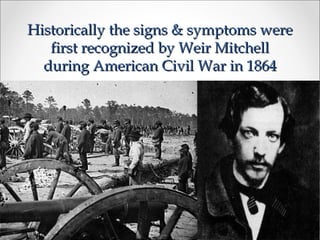
Historically the signs & symptoms wereHistorically the signs & symptoms were
first recognized by Weir Mitchellfirst recognized by Weir Mitchell
during American Civil War in 1864during American Civil War in 1864
EtiologyEtiology
A number of precipitating factors have
been associated with RSD / CRPS including:
•Trauma (often minor) like fractures
•Ischemic heart disease and myocardial
infarction
•Spinal cord disorders
•Cerebral lesions
•Infections
•Surgery
•However, in some patients a definite
precipitating event can not be identified
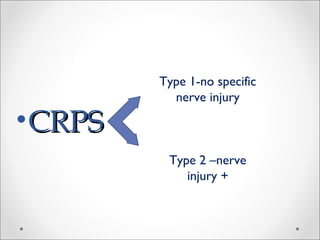
•CRPSCRPS
Type 1-no specific
nerve injury
Type 2 –nerve
injury +
PathophysiologyPathophysiology
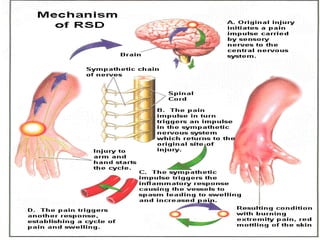
•Argued over since it was first described a
hundred years ago.
•It was usually regarded as type of sympathetic
overactivity ,hence the earlier name-Reflex
Sympathetic Dystrophy.
•Now recognised that multiple mechanisms are
involved,,, abnormal cytokine
release,neurogenic inflammation,sympathetic
mediated enhancement of pain responses and
cortical reactions to noxious stimuli..
Clinical featuresClinical features
.
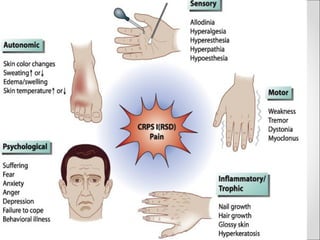
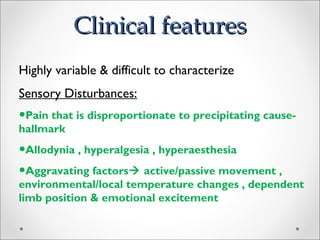
Highly variable & difficult to characterize
Sensory Disturbances:
•Pain that is disproportionate to precipitating cause-
hallmark
•Allodynia , hyperalgesia , hyperaesthesia
•Aggravating factors active/passive movement ,
environmental/local temperature changes , dependent
limb position & emotional excitement
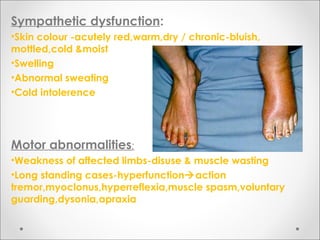
Sympathetic dysfunction:
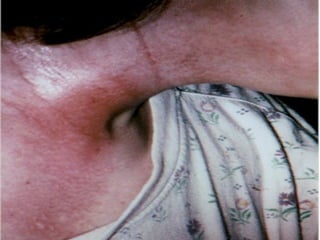
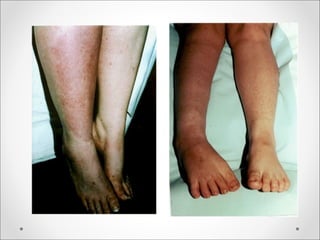
•Skin colour -acutely red,warm,dry / chronic-bluish,
mottled,cold &moist
•Swelling
•Abnormal sweating
•Cold intolerence
Motor abnormalities:
•Weakness of affected limbs-disuse & muscle wasting
•Long standing cases-hyperfunctionaction
tremor,myoclonus,hyperreflexia,muscle spasm,voluntary
guarding,dysonia,apraxia
Trophic changes:
•Thinning of skin,
• Atrophy of s/c fat
• Brittle nails,
•Tendon atrophy
•The classic finding of periarticular
osteoporosis- Sudeck’s atrophy
•c/c joint stiffness  Fixed contractures
Psychological issues:
•Fear , Anxiety , Anger , Suffering
•Depression , Failure to Cope
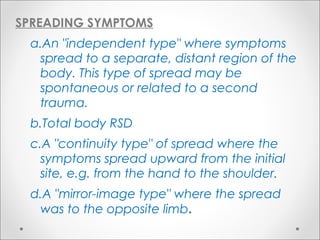
SPREADING SYMPTOMS
a.An "independent type" where symptoms
spread to a separate, distant region of the
body. This type of spread may be
spontaneous or related to a second
trauma.
b.Total body RSD
c.A "continuity type" of spread where the
symptoms spread upward from the initial
site, e.g. from the hand to the shoulder.
d.A "mirror-image type" where the spread
was to the opposite limb.
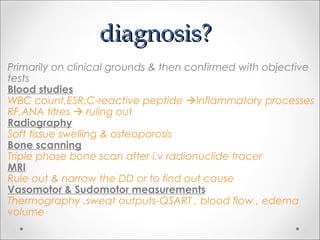
diagnosis?diagnosis?
Primarily on clinical grounds & then confirmed with objective
tests
Blood studies
WBC count,ESR,C-reactive peptide Inflammatory processes
RF,ANA titres  ruling out
Radiography
Soft tissue swelling & osteoporosis
Bone scanning
Triple phase bone scan after i.v radionuclide tracer
MRI
Rule out & narrow the DD or to find out cause
Vasomotor & Sudomotor measurements
Thermography ,sweat outputs-QSART , blood flow , edema
volume
Paravertebral Sympathetic Ganglion
Blockade
Most effective & “GOLD STANDARD” in diagnosis of
SMP
Phentolamine Testing
Non-specific alpha antagonist
Safe,simple,less adverse effects
Most practical when more than one limb is affected
Regional intravenous sympathetic
blockade
Common agent--Guanithidine
ManagementManagement
Patient education & information
Physical therapy-mainstay of treatment,,,counselling,gain
confidence, motivation,
desensitization&mobilization,strengthening of muscles
Symptomatic relief
For constant pain associated with
inflammation:Nonsteroidal anti-inflammatory agents (e.g.
aspirin, ibuprofen, naproxen, indomethacin, etc).
•Corticosteroids(e.g. methyl prednisolone)
•Calcium channel blockers-pain reduction especially during cold
weather,relaxes smooth muscles ( eg; nifedipine)
For constant pain not caused by inflammation:
• Agents acting on the central nervous system by an atypical
mechanism (e.g. tramadol)
For constant pain and sleep disturbances:
o Anti-depressants (e.g. amitriptyline, doxepin,
nortriptyline, trazodone, etc)
For muscle cramps (spasms and dystonia):
o Klonopin (clonazepam)
o Baclofen
Protectives to bone:
o Calcitonin.bisphosphonates,vitamin C
Psychotheray:
o To prevent depression,anxiety & sleep
deprivation
Sympatholysis:
o Topical clonidine-alpha receptor agonist that
inhibit presynaptic release of
norepinephrine,reduces localise
dhyperalgesia
o Oral sympatholysis-alpha blockers
(eg:prazosin,terazoin)
SurgicalSurgical
Paravetebral Sympathetic chain ganglion
Blockade:
•Stellate ganglion blockade-upper
•Lumbar ganglion blockade-lower
Surgical sympathectomy:
•Open / Percutaneous chemical ablation /
radiofrequency / Enodscopic.
Regional Block: (Guanethidine)
Spinal cord stimulation:
•Transcutaneous electrical nerve stimulation for pain
management.
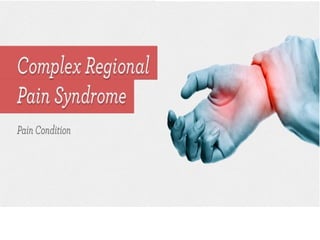
Crps

Crps

  • 2.
    The syndromes appearingunder this include •Sudeck's atrophy, •Sympathetic dystrophy, •algodystophy, •shoulder-hand syndrome, •causalgia.
  • 3.
    What do theyhave inWhat do they have in common?common? • Vasomotor instability • Trophic skin changes • Regional osteoporosis • Pain, OUT OF PROPORTION to the inciting cause. • Functional impairment
  • 4.
    Definition?Definition? • “CRPS isa multi-symptom, multi- system, syndrome usually affecting one or more extremities, but may affect virtually any part of the body.”-International Research Foundation For RSD/CRPS.
  • 5.
    Historically the signs& symptoms wereHistorically the signs & symptoms were first recognized by Weir Mitchellfirst recognized by Weir Mitchell during American Civil War in 1864during American Civil War in 1864
  • 6.
    EtiologyEtiology A number ofprecipitating factors have been associated with RSD / CRPS including: •Trauma (often minor) like fractures •Ischemic heart disease and myocardial infarction •Spinal cord disorders •Cerebral lesions •Infections •Surgery •However, in some patients a definite precipitating event can not be identified
  • 7.
    •CRPSCRPS Type 1-no specific nerveinjury Type 2 –nerve injury +
  • 8.
    PathophysiologyPathophysiology •Argued over sinceit was first described a hundred years ago. •It was usually regarded as type of sympathetic overactivity ,hence the earlier name-Reflex Sympathetic Dystrophy. •Now recognised that multiple mechanisms are involved,,, abnormal cytokine release,neurogenic inflammation,sympathetic mediated enhancement of pain responses and cortical reactions to noxious stimuli..
  • 11.
    Clinical featuresClinical features . Highlyvariable & difficult to characterize Sensory Disturbances: •Pain that is disproportionate to precipitating cause- hallmark •Allodynia , hyperalgesia , hyperaesthesia •Aggravating factors active/passive movement , environmental/local temperature changes , dependent limb position & emotional excitement
  • 12.
    Sympathetic dysfunction: •Skin colour-acutely red,warm,dry / chronic-bluish, mottled,cold &moist •Swelling •Abnormal sweating •Cold intolerence Motor abnormalities: •Weakness of affected limbs-disuse & muscle wasting •Long standing cases-hyperfunctionaction tremor,myoclonus,hyperreflexia,muscle spasm,voluntary guarding,dysonia,apraxia
  • 13.
    Trophic changes: •Thinning ofskin, • Atrophy of s/c fat • Brittle nails, •Tendon atrophy •The classic finding of periarticular osteoporosis- Sudeck’s atrophy •c/c joint stiffness  Fixed contractures Psychological issues: •Fear , Anxiety , Anger , Suffering •Depression , Failure to Cope
  • 16.
    SPREADING SYMPTOMS a.An "independenttype" where symptoms spread to a separate, distant region of the body. This type of spread may be spontaneous or related to a second trauma. b.Total body RSD c.A "continuity type" of spread where the symptoms spread upward from the initial site, e.g. from the hand to the shoulder. d.A "mirror-image type" where the spread was to the opposite limb.
  • 17.
    diagnosis?diagnosis? Primarily on clinicalgrounds & then confirmed with objective tests Blood studies WBC count,ESR,C-reactive peptide Inflammatory processes RF,ANA titres  ruling out Radiography Soft tissue swelling & osteoporosis Bone scanning Triple phase bone scan after i.v radionuclide tracer MRI Rule out & narrow the DD or to find out cause Vasomotor & Sudomotor measurements Thermography ,sweat outputs-QSART , blood flow , edema volume
  • 18.
    Paravertebral Sympathetic Ganglion Blockade Mosteffective & “GOLD STANDARD” in diagnosis of SMP Phentolamine Testing Non-specific alpha antagonist Safe,simple,less adverse effects Most practical when more than one limb is affected Regional intravenous sympathetic blockade Common agent--Guanithidine
  • 19.
    ManagementManagement Patient education &information Physical therapy-mainstay of treatment,,,counselling,gain confidence, motivation, desensitization&mobilization,strengthening of muscles Symptomatic relief For constant pain associated with inflammation:Nonsteroidal anti-inflammatory agents (e.g. aspirin, ibuprofen, naproxen, indomethacin, etc). •Corticosteroids(e.g. methyl prednisolone) •Calcium channel blockers-pain reduction especially during cold weather,relaxes smooth muscles ( eg; nifedipine) For constant pain not caused by inflammation: • Agents acting on the central nervous system by an atypical mechanism (e.g. tramadol)
  • 20.
    For constant painand sleep disturbances: o Anti-depressants (e.g. amitriptyline, doxepin, nortriptyline, trazodone, etc) For muscle cramps (spasms and dystonia): o Klonopin (clonazepam) o Baclofen Protectives to bone: o Calcitonin.bisphosphonates,vitamin C Psychotheray: o To prevent depression,anxiety & sleep deprivation Sympatholysis: o Topical clonidine-alpha receptor agonist that inhibit presynaptic release of norepinephrine,reduces localise dhyperalgesia o Oral sympatholysis-alpha blockers (eg:prazosin,terazoin)
  • 21.
    SurgicalSurgical Paravetebral Sympathetic chainganglion Blockade: •Stellate ganglion blockade-upper •Lumbar ganglion blockade-lower Surgical sympathectomy: •Open / Percutaneous chemical ablation / radiofrequency / Enodscopic. Regional Block: (Guanethidine) Spinal cord stimulation: •Transcutaneous electrical nerve stimulation for pain management.