Seminar
on
Solubilization
BY
GAJANAN V NAIK
M PHARM IST YEAR ( IIND SEM )
PHARMACEUTICS
Swami Ramanand teerth Marathwada University, Nanded.
School of Pharmacy
Contents
 What is solubility & solubility expressions ?
 Importance of solubility & Problems with poor solubility.
 What is solubilization?
 Process of solubilization.
 Methods of increasing solubility.
What is solubility & solubility
expressions ?
 Solubility :-
 In quantitative terms - as the concentration of solute
in a saturated solution at a certain temperature.
 In a qualitative way, it can be defined as the
spontaneous interaction of two or more substances
to form a homogeneous molecular dispersion.
 Solubility expressions:-
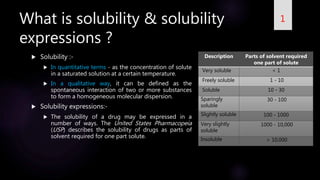
 The solubility of a drug may be expressed in a
number of ways. The United States Pharmacopeia
(USP) describes the solubility of drugs as parts of
solvent required for one part solute.
Description Parts of solvent required
one part of solute
Very soluble < 1
Freely soluble 1 - 10
Soluble 10 - 30
Sparingly
soluble
30 - 100
Slightly soluble 100 - 1000
Very slightly
soluble
1000 - 10,000
Insoluble > 10,000
1
Importance of solubility &
Problems with poor solubility?
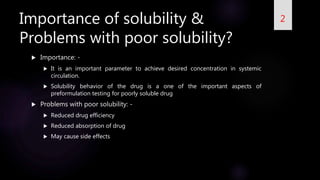
 Importance: -
 It is an important parameter to achieve desired concentration in systemic
circulation.
 Solubility behavior of the drug is a one of the important aspects of
preformulation testing for poorly soluble drug
 Problems with poor solubility: -
 Reduced drug efficiency
 Reduced absorption of drug
 May cause side effects
2
What is solubilization?
 Solubilization:
 It can be defined as the preparation of a thermodynamically stable isotropic
solution of a substance normally insoluble or very slightly soluble in a given
solvent by the addition of component or components or by any suitable
methods.
 Eg.
3
Process of solubilization 4
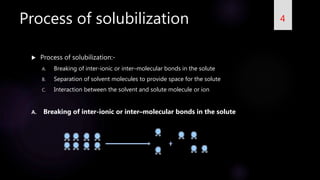
 Process of solubilization:-
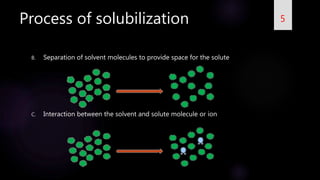
A. Breaking of inter-ionic or inter–molecular bonds in the solute
B. Separation of solvent molecules to provide space for the solute
C. Interaction between the solvent and solute molecule or ion
A. Breaking of inter-ionic or inter–molecular bonds in the solute
Process of solubilization
B. Separation of solvent molecules to provide space for the solute
C. Interaction between the solvent and solute molecule or ion
5
Methods of increasing solubility.
 Methods of solubilization.
 Addition of co-solvent
 pH change method
 Reduction of particle size
 Temperature change method
 Hydro-trophy
 Addition of Surfactant
 Complexation
 Solid dispersion
 Polymorphism
 Other techniques
6
Methods of increasing solubility.
 Addition of co-solvent
 Substances like weak electrolytes and non-polar molecules are poorly soluble in
water.
 The solubility of these substances can be enhanced by the addition of water
miscible solvents in which the drug has good solubility. This process of
improving solubility is called as co-solvency and the solvents used are known as
co-solvents.
 This technique is mainly used in the formulation of parenterals.
 Commonly used co-solvents are Ethanol, Sorbitol, Glycerin, Polyethylene glycol,
propylene glycol etc.
 E.g. solubility of diazepam can be increased by using 10%ethanol and 40%
propylene glycol.
7
 pH change method
 Most of drugs are weak acids or weak bases i.e. weak electrolytes.
 In aqueous medium they dissociate poorly and un-dissociated portion is
insoluble.
 So, solubility of the un-dissociated portion is improved by pH control.
 For weak acidic drug (Phenytoin, ethosuximide ):- increase pH, solubility is
increase.
 For weak base drug (caffeine, theophylline ) :- decrease pH, increase
8Methods of increasing solubility.
 Reduction of particle size
 Reduction in Particle size improve solubility of drug.
 Basically reduction in particle size increase contact surface area of the particle, there
ultimately it increase rate of solubility of drug.
 Temperature change method
 When a mole of solute is dissolved in a large quantity of solvent, then heat is
exchanged with surrounding such exchange is termed as Heat of solution.
 Most of the substances are endothermic, absorbing heat in the process of
For these substances, an increase in temperature results in an increase in solubility.
 Exothermic substances give off heat in the process of dissolution. The solubility of
substances would decrease with increase in temperature
9Methods of increasing solubility.
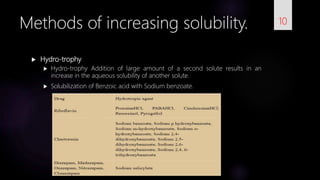
 Hydro-trophy
 Hydro-trophy Addition of large amount of a second solute results in an
increase in the aqueous solubility of another solute.
 Solubilization of Benzoic acid with Sodium benzoate.
10Methods of increasing solubility.
 Addition of Surfactant
 Surfactants are molecules with well defined polar and non-polar region that
allow them to aggregate in solution to form micelles.
 Micelles are formed at CMC.
 Surfactants act by reducing the surface tension.
 Ability of a surfactant solution to dissolve or solubilise water insoluble
starts at CMC and with increase in conc. of micelles increases solubility.
11Methods of increasing solubility.
 Complexation
 For the Complexation occur both drug and ligand molecule should be able to
or accept electrons.
 The solubility of compound is the sum of solubility of the compound and its
 It is reversible association of a substrate and ligand molecule.
 The most common complexing ligands are cyclodextrins, caffeine, urea.
 cyclodextrins are unique since they increase the water solubility of poorly soluble
by fitting them into the hydrophobic cavity of the cyclodextrins molecule.
 These cyclodextrins have the ability to form molecular inclusion complexes with
hydrophobic drugs having poor aqueous solubility.
12Methods of increasing solubility.
 Solid dispersion
 Solid dispersion technique It is the dispersion of one or more active ingredients in an
inert carrier or matrix in solid state prepared by fusion or melting-solvent method. It
the dispersion of a drug or drugs in solid diluent or diluents.
 Solid dispersions may also be called ā€œ solid state dispersionsā€.
 Various systems of solid dispersions:
 Simple eutectic mixtures
 Solid solutions
 Glass solution and glass suspension
 Amorphous precipitation of drug in crystalline carrier
 Compound or complex formation between drug and carrier
 Any combination among the above
13Methods of increasing solubility.
 Polymorphism
 It is the ability of the compound to crystallize as more than one distinct crystalline
species with different internal lattice.
 Different crystalline forms are called polymorphs.
 Polymorphs are of 2 types:-
1. Enatiotropic:- e.g. Sulphur 2. Monotropic:- e.g. Glyceryl stearate
 Polymorph differ from each other with respect to their physical property such as
14
 Solubility
 Melting point
 Density
 Hardness
 Compression
characteristic
Methods of increasing solubility.
 Other techniques
 Salt formation
 Precipitation
 Micronization
 Nanonization
 Supercritical Fluid Recrystallization
 Evaporative precipitation into aqueous solution
 Use of precipitation inhibitors
 Solvent Deposition
 Drug derivatization
15Methods of increasing solubility.
References
 The theory & practice of industrial pharmacy by Leon Lachman, Herbert A.
Lieberman, Joseph L. kenig, 3rd edition, published by Varghese Publishing
house, page no:- 171-196.
 Martin’s Physical pharmacy & Pharmaceutical science, 6th edition by
Patrick J. Sinco, Published by Lippincott williams & wilkins, page no:- 182-
183.
16
19

Solubilization

  • 1.
    Seminar on Solubilization BY GAJANAN V NAIK MPHARM IST YEAR ( IIND SEM ) PHARMACEUTICS Swami Ramanand teerth Marathwada University, Nanded. School of Pharmacy
  • 2.
    Contents  What issolubility & solubility expressions ?  Importance of solubility & Problems with poor solubility.  What is solubilization?  Process of solubilization.  Methods of increasing solubility.
  • 3.
    What is solubility& solubility expressions ?  Solubility :-  In quantitative terms - as the concentration of solute in a saturated solution at a certain temperature.  In a qualitative way, it can be defined as the spontaneous interaction of two or more substances to form a homogeneous molecular dispersion.  Solubility expressions:-  The solubility of a drug may be expressed in a number of ways. The United States Pharmacopeia (USP) describes the solubility of drugs as parts of solvent required for one part solute. Description Parts of solvent required one part of solute Very soluble < 1 Freely soluble 1 - 10 Soluble 10 - 30 Sparingly soluble 30 - 100 Slightly soluble 100 - 1000 Very slightly soluble 1000 - 10,000 Insoluble > 10,000 1
  • 4.
    Importance of solubility& Problems with poor solubility?  Importance: -  It is an important parameter to achieve desired concentration in systemic circulation.  Solubility behavior of the drug is a one of the important aspects of preformulation testing for poorly soluble drug  Problems with poor solubility: -  Reduced drug efficiency  Reduced absorption of drug  May cause side effects 2
  • 5.
    What is solubilization? Solubilization:  It can be defined as the preparation of a thermodynamically stable isotropic solution of a substance normally insoluble or very slightly soluble in a given solvent by the addition of component or components or by any suitable methods.  Eg. 3
  • 6.
    Process of solubilization4  Process of solubilization:- A. Breaking of inter-ionic or inter–molecular bonds in the solute B. Separation of solvent molecules to provide space for the solute C. Interaction between the solvent and solute molecule or ion A. Breaking of inter-ionic or inter–molecular bonds in the solute
  • 7.
    Process of solubilization B.Separation of solvent molecules to provide space for the solute C. Interaction between the solvent and solute molecule or ion 5
  • 8.
    Methods of increasingsolubility.  Methods of solubilization.  Addition of co-solvent  pH change method  Reduction of particle size  Temperature change method  Hydro-trophy  Addition of Surfactant  Complexation  Solid dispersion  Polymorphism  Other techniques 6
  • 9.
    Methods of increasingsolubility.  Addition of co-solvent  Substances like weak electrolytes and non-polar molecules are poorly soluble in water.  The solubility of these substances can be enhanced by the addition of water miscible solvents in which the drug has good solubility. This process of improving solubility is called as co-solvency and the solvents used are known as co-solvents.  This technique is mainly used in the formulation of parenterals.  Commonly used co-solvents are Ethanol, Sorbitol, Glycerin, Polyethylene glycol, propylene glycol etc.  E.g. solubility of diazepam can be increased by using 10%ethanol and 40% propylene glycol. 7
  • 10.
     pH changemethod  Most of drugs are weak acids or weak bases i.e. weak electrolytes.  In aqueous medium they dissociate poorly and un-dissociated portion is insoluble.  So, solubility of the un-dissociated portion is improved by pH control.  For weak acidic drug (Phenytoin, ethosuximide ):- increase pH, solubility is increase.  For weak base drug (caffeine, theophylline ) :- decrease pH, increase 8Methods of increasing solubility.
  • 11.
     Reduction ofparticle size  Reduction in Particle size improve solubility of drug.  Basically reduction in particle size increase contact surface area of the particle, there ultimately it increase rate of solubility of drug.  Temperature change method  When a mole of solute is dissolved in a large quantity of solvent, then heat is exchanged with surrounding such exchange is termed as Heat of solution.  Most of the substances are endothermic, absorbing heat in the process of For these substances, an increase in temperature results in an increase in solubility.  Exothermic substances give off heat in the process of dissolution. The solubility of substances would decrease with increase in temperature 9Methods of increasing solubility.
  • 12.
     Hydro-trophy  Hydro-trophyAddition of large amount of a second solute results in an increase in the aqueous solubility of another solute.  Solubilization of Benzoic acid with Sodium benzoate. 10Methods of increasing solubility.
  • 13.
     Addition ofSurfactant  Surfactants are molecules with well defined polar and non-polar region that allow them to aggregate in solution to form micelles.  Micelles are formed at CMC.  Surfactants act by reducing the surface tension.  Ability of a surfactant solution to dissolve or solubilise water insoluble starts at CMC and with increase in conc. of micelles increases solubility. 11Methods of increasing solubility.
  • 14.
     Complexation  Forthe Complexation occur both drug and ligand molecule should be able to or accept electrons.  The solubility of compound is the sum of solubility of the compound and its  It is reversible association of a substrate and ligand molecule.  The most common complexing ligands are cyclodextrins, caffeine, urea.  cyclodextrins are unique since they increase the water solubility of poorly soluble by fitting them into the hydrophobic cavity of the cyclodextrins molecule.  These cyclodextrins have the ability to form molecular inclusion complexes with hydrophobic drugs having poor aqueous solubility. 12Methods of increasing solubility.
  • 15.
     Solid dispersion Solid dispersion technique It is the dispersion of one or more active ingredients in an inert carrier or matrix in solid state prepared by fusion or melting-solvent method. It the dispersion of a drug or drugs in solid diluent or diluents.  Solid dispersions may also be called ā€œ solid state dispersionsā€.  Various systems of solid dispersions:  Simple eutectic mixtures  Solid solutions  Glass solution and glass suspension  Amorphous precipitation of drug in crystalline carrier  Compound or complex formation between drug and carrier  Any combination among the above 13Methods of increasing solubility.
  • 16.
     Polymorphism  Itis the ability of the compound to crystallize as more than one distinct crystalline species with different internal lattice.  Different crystalline forms are called polymorphs.  Polymorphs are of 2 types:- 1. Enatiotropic:- e.g. Sulphur 2. Monotropic:- e.g. Glyceryl stearate  Polymorph differ from each other with respect to their physical property such as 14  Solubility  Melting point  Density  Hardness  Compression characteristic Methods of increasing solubility.
  • 17.
     Other techniques Salt formation  Precipitation  Micronization  Nanonization  Supercritical Fluid Recrystallization  Evaporative precipitation into aqueous solution  Use of precipitation inhibitors  Solvent Deposition  Drug derivatization 15Methods of increasing solubility.
  • 18.
    References  The theory& practice of industrial pharmacy by Leon Lachman, Herbert A. Lieberman, Joseph L. kenig, 3rd edition, published by Varghese Publishing house, page no:- 171-196.  Martin’s Physical pharmacy & Pharmaceutical science, 6th edition by Patrick J. Sinco, Published by Lippincott williams & wilkins, page no:- 182- 183. 16
  • 19.