Matrix Inverses and Solving Systems
                Warm Up
                Lesson Presentation
                Lesson Quiz
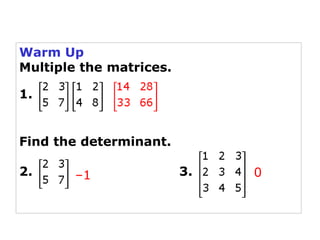
Warm Up
Multiple the matrices.

1.


Find the determinant.

2.      –1               3.   0
Objectives
Determine whether a matrix has an
inverse.
Solve systems of equations using
inverse matrices.
Vocabulary
multiplicative inverse matrix
matrix equation
variable matrix
constant matrix
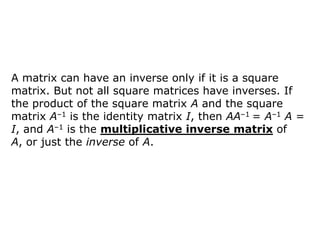
A matrix can have an inverse only if it is a square
matrix. But not all square matrices have inverses. If
the product of the square matrix A and the square
matrix A–1 is the identity matrix I, then AA–1 = A–1 A =
I, and A–1 is the multiplicative inverse matrix of
A, or just the inverse of A.
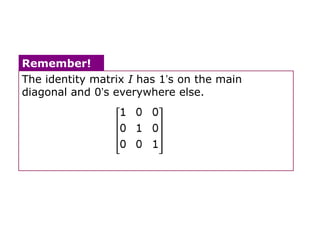
Remember!
The identity matrix I has 1’s on the main
diagonal and 0’s everywhere else.
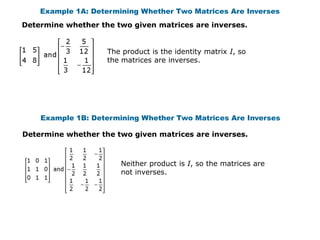
Example 1A: Determining Whether Two Matrices Are Inverses
Determine whether the two given matrices are inverses.


                    The product is the identity matrix I, so
                    the matrices are inverses.


    Example 1B: Determining Whether Two Matrices Are Inverses

Determine whether the two given matrices are inverses.


                       Neither product is I, so the matrices are
                       not inverses.
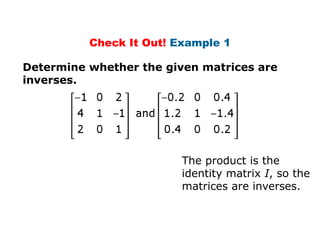
Check It Out! Example 1

Determine whether the given matrices are
inverses.


                         The product is the
                         identity matrix I, so the
                         matrices are inverses.
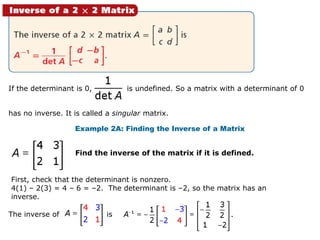
If the determinant is 0,          is undefined. So a matrix with a determinant of 0


has no inverse. It is called a singular matrix.

                   Example 2A: Finding the Inverse of a Matrix


                   Find the inverse of the matrix if it is defined.


First, check that the determinant is nonzero.
4(1) – 2(3) = 4 – 6 = –2. The determinant is –2, so the matrix has an
inverse.

The inverse of              is
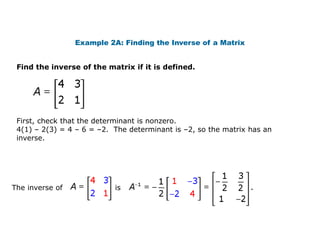
Example 2A: Finding the Inverse of a Matrix


 Find the inverse of the matrix if it is defined.


 First, check that the determinant is nonzero.
 4(1) – 2(3) = 4 – 6 = –2. The determinant is –2, so the matrix has an
 inverse.


The inverse of             is
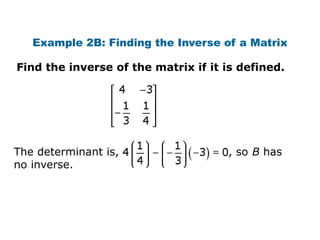
Example 2B: Finding the Inverse of a Matrix

Find the inverse of the matrix if it is defined.


The determinant is,                  , so B has
no inverse.
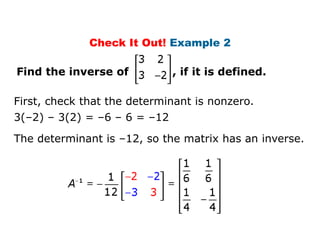
Check It Out! Example 2

Find the inverse of           , if it is defined.

First, check that the determinant is nonzero.
3(–2) – 3(2) = –6 – 6 = –12
The determinant is –12, so the matrix has an inverse.
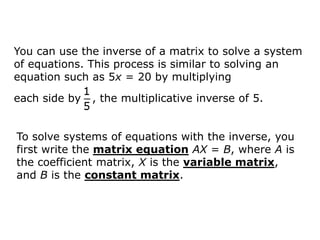
You can use the inverse of a matrix to solve a system
of equations. This process is similar to solving an
equation such as 5x = 20 by multiplying
each side by   , the multiplicative inverse of 5.


To solve systems of equations with the inverse, you
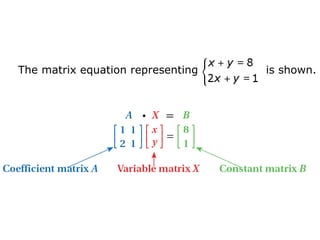
first write the matrix equation AX = B, where A is
the coefficient matrix, X is the variable matrix,
and B is the constant matrix.
The matrix equation representing   is shown.
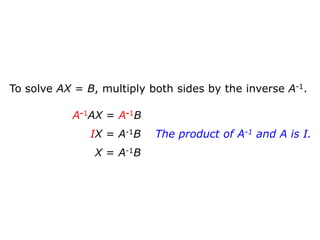
To solve AX = B, multiply both sides by the inverse A-1.

           A-1AX = A-1B
               IX = A-1B   The product of A-1 and A is I.
                X = A-1B
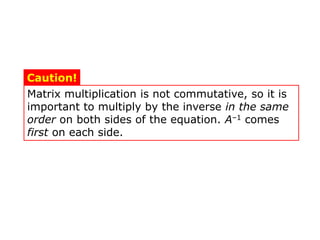
Caution!
Matrix multiplication is not commutative, so it is
important to multiply by the inverse in the same
order on both sides of the equation. A–1 comes
first on each side.
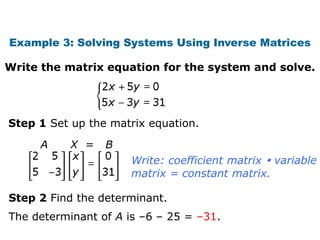
Example 3: Solving Systems Using Inverse Matrices

Write the matrix equation for the system and solve.


Step 1 Set up the matrix equation.

     A     X =   B
                     Write: coefficient matrix  variable
                     matrix = constant matrix.

Step 2 Find the determinant.
The determinant of A is –6 – 25 = –31.
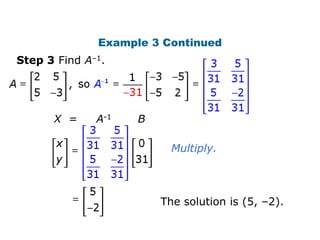
Example 3 Continued
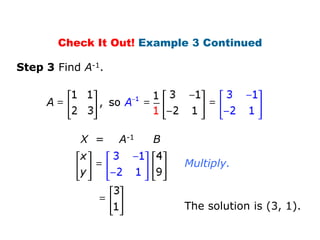
Step 3 Find A–1.


      X =     A-1       B

                              Multiply.
                    .


                            The solution is (5, –2).
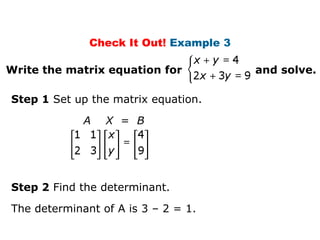
Check It Out! Example 3

Write the matrix equation for           and solve.

Step 1 Set up the matrix equation.

             A   X = B


Step 2 Find the determinant.
The determinant of A is 3 – 2 = 1.
Check It Out! Example 3 Continued

Step 3 Find A-1.


           X =     A-1   B

                             Multiply.


                             The solution is (3, 1).
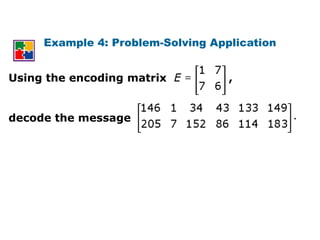
Example 4: Problem-Solving Application


Using the encoding matrix          ,


decode the message
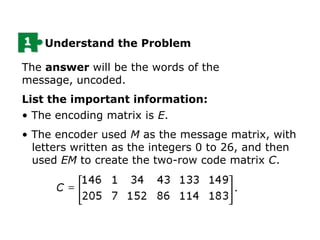
1   Understand the Problem

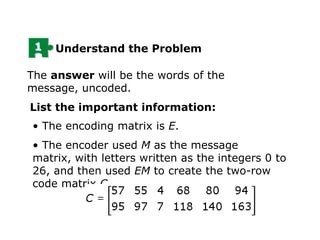
The answer will be the words of the
message, uncoded.
List the important information:
• The encoding matrix is E.
• The encoder used M as the message matrix, with
  letters written as the integers 0 to 26, and then
  used EM to create the two-row code matrix C.
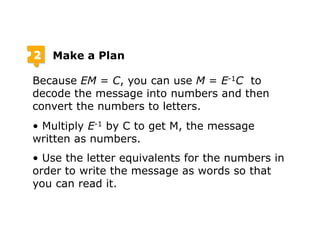
2   Make a Plan

Because EM = C, you can use M = E-1C to
decode the message into numbers and then
convert the numbers to letters.
• Multiply E-1 by C to get M, the message
  written as numbers.
• Use the letter equivalents for the numbers
  in order to write the message as words so
  that you can read it.
3   Solve

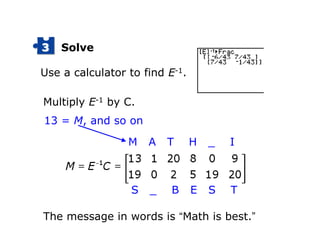
Use a calculator to find E-1.

Multiply E-1 by C.
13 = M, and so on

                 M    A   T     H   _   I


                  S   _   B     E   S   T

The message in words is “Math is best.”
4   Look Back

You can verify by multiplying E by M to see
that the decoding was correct. If the math
had been done incorrectly, getting a
different message that made sense would
have been very unlikely.
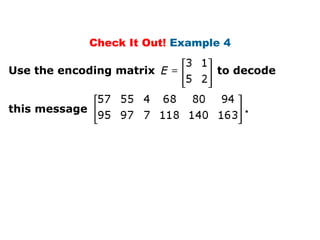
Check It Out! Example 4

Use the encoding matrix            to decode


this message                             .
1   Understand the Problem

The answer will be the words of the
message, uncoded.
List the important information:
• The encoding matrix is E.
• The encoder used M as the message
matrix, with letters written as the integers 0 to
26, and then used EM to create the two-row
code matrix C.
2   Make a Plan

Because EM = C, you can use M = E-1C to
decode the message into numbers and then
convert the numbers to letters.
• Multiply E-1 by C to get M, the message
written as numbers.
• Use the letter equivalents for the numbers in
order to write the message as words so that
you can read it.
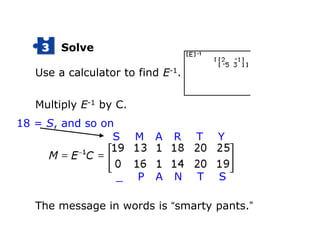
3   Solve

   Use a calculator to find E-1.


   Multiply E-1 by C.
18 = S, and so on
                 S      M   A   R   T   Y


                   _    P   A   N   T   S

   The message in words is “smarty pants.”
Lesson Quiz: Part I


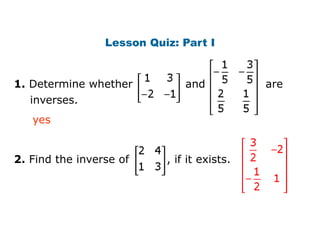
1. Determine whether           and           are
   inverses.
   yes


2. Find the inverse of     , if it exists.
Lesson Quiz: Part II

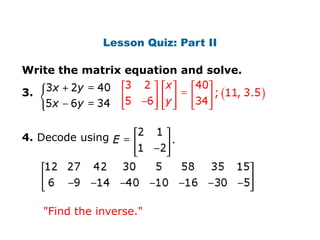
Write the matrix equation and solve.

3.


4. Decode using            .


     "Find the inverse."

Matrix inverse

  • 1.
    Matrix Inverses andSolving Systems Warm Up Lesson Presentation Lesson Quiz
  • 2.
    Warm Up Multiple thematrices. 1. Find the determinant. 2. –1 3. 0
  • 3.
    Objectives Determine whether amatrix has an inverse. Solve systems of equations using inverse matrices.
  • 4.
    Vocabulary multiplicative inverse matrix matrixequation variable matrix constant matrix
  • 5.
    A matrix canhave an inverse only if it is a square matrix. But not all square matrices have inverses. If the product of the square matrix A and the square matrix A–1 is the identity matrix I, then AA–1 = A–1 A = I, and A–1 is the multiplicative inverse matrix of A, or just the inverse of A.
  • 6.
    Remember! The identity matrixI has 1’s on the main diagonal and 0’s everywhere else.
  • 7.
    Example 1A: DeterminingWhether Two Matrices Are Inverses Determine whether the two given matrices are inverses. The product is the identity matrix I, so the matrices are inverses. Example 1B: Determining Whether Two Matrices Are Inverses Determine whether the two given matrices are inverses. Neither product is I, so the matrices are not inverses.
  • 8.
    Check It Out!Example 1 Determine whether the given matrices are inverses. The product is the identity matrix I, so the matrices are inverses.
  • 9.
    If the determinantis 0, is undefined. So a matrix with a determinant of 0 has no inverse. It is called a singular matrix. Example 2A: Finding the Inverse of a Matrix Find the inverse of the matrix if it is defined. First, check that the determinant is nonzero. 4(1) – 2(3) = 4 – 6 = –2. The determinant is –2, so the matrix has an inverse. The inverse of is
  • 10.
    Example 2A: Findingthe Inverse of a Matrix Find the inverse of the matrix if it is defined. First, check that the determinant is nonzero. 4(1) – 2(3) = 4 – 6 = –2. The determinant is –2, so the matrix has an inverse. The inverse of is
  • 11.
    Example 2B: Findingthe Inverse of a Matrix Find the inverse of the matrix if it is defined. The determinant is, , so B has no inverse.
  • 12.
    Check It Out!Example 2 Find the inverse of , if it is defined. First, check that the determinant is nonzero. 3(–2) – 3(2) = –6 – 6 = –12 The determinant is –12, so the matrix has an inverse.
  • 13.
    You can usethe inverse of a matrix to solve a system of equations. This process is similar to solving an equation such as 5x = 20 by multiplying each side by , the multiplicative inverse of 5. To solve systems of equations with the inverse, you first write the matrix equation AX = B, where A is the coefficient matrix, X is the variable matrix, and B is the constant matrix.
  • 14.
    The matrix equationrepresenting is shown.
  • 15.
    To solve AX= B, multiply both sides by the inverse A-1. A-1AX = A-1B IX = A-1B The product of A-1 and A is I. X = A-1B
  • 16.
    Caution! Matrix multiplication isnot commutative, so it is important to multiply by the inverse in the same order on both sides of the equation. A–1 comes first on each side.
  • 17.
    Example 3: SolvingSystems Using Inverse Matrices Write the matrix equation for the system and solve. Step 1 Set up the matrix equation. A X = B Write: coefficient matrix  variable matrix = constant matrix. Step 2 Find the determinant. The determinant of A is –6 – 25 = –31.
  • 18.
    Example 3 Continued Step3 Find A–1. X = A-1 B Multiply. . The solution is (5, –2).
  • 19.
    Check It Out!Example 3 Write the matrix equation for and solve. Step 1 Set up the matrix equation. A X = B Step 2 Find the determinant. The determinant of A is 3 – 2 = 1.
  • 20.
    Check It Out!Example 3 Continued Step 3 Find A-1. X = A-1 B Multiply. The solution is (3, 1).
  • 21.
    Example 4: Problem-SolvingApplication Using the encoding matrix , decode the message
  • 22.
    1 Understand the Problem The answer will be the words of the message, uncoded. List the important information: • The encoding matrix is E. • The encoder used M as the message matrix, with letters written as the integers 0 to 26, and then used EM to create the two-row code matrix C.
  • 23.
    2 Make a Plan Because EM = C, you can use M = E-1C to decode the message into numbers and then convert the numbers to letters. • Multiply E-1 by C to get M, the message written as numbers. • Use the letter equivalents for the numbers in order to write the message as words so that you can read it.
  • 24.
    3 Solve Use a calculator to find E-1. Multiply E-1 by C. 13 = M, and so on M A T H _ I S _ B E S T The message in words is “Math is best.”
  • 25.
    4 Look Back You can verify by multiplying E by M to see that the decoding was correct. If the math had been done incorrectly, getting a different message that made sense would have been very unlikely.
  • 26.
    Check It Out!Example 4 Use the encoding matrix to decode this message .
  • 27.
    1 Understand the Problem The answer will be the words of the message, uncoded. List the important information: • The encoding matrix is E. • The encoder used M as the message matrix, with letters written as the integers 0 to 26, and then used EM to create the two-row code matrix C.
  • 28.
    2 Make a Plan Because EM = C, you can use M = E-1C to decode the message into numbers and then convert the numbers to letters. • Multiply E-1 by C to get M, the message written as numbers. • Use the letter equivalents for the numbers in order to write the message as words so that you can read it.
  • 29.
    3 Solve Use a calculator to find E-1. Multiply E-1 by C. 18 = S, and so on S M A R T Y _ P A N T S The message in words is “smarty pants.”
  • 30.
    Lesson Quiz: PartI 1. Determine whether and are inverses. yes 2. Find the inverse of , if it exists.
  • 31.
    Lesson Quiz: PartII Write the matrix equation and solve. 3. 4. Decode using . "Find the inverse."