Determinants
Matrices
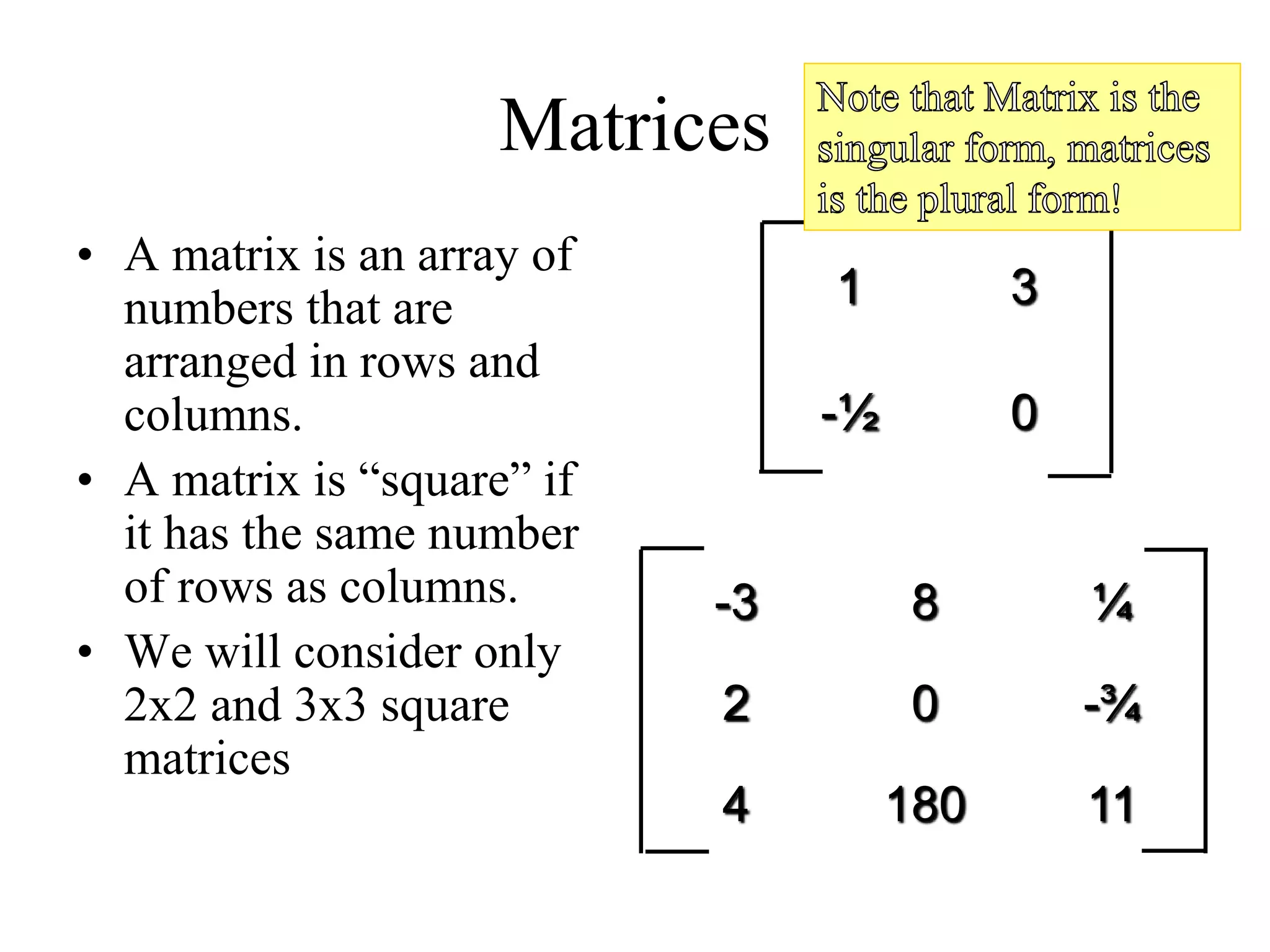
• A matrix is an array of
numbers that are
arranged in rows and
columns.
• A matrix is “square” if
it has the same number
of rows as columns.
• We will consider only
2x2 and 3x3 square
matrices
0
-½
3
1
11
180
4
-¾
0
2
¼
8
-3
Determinants
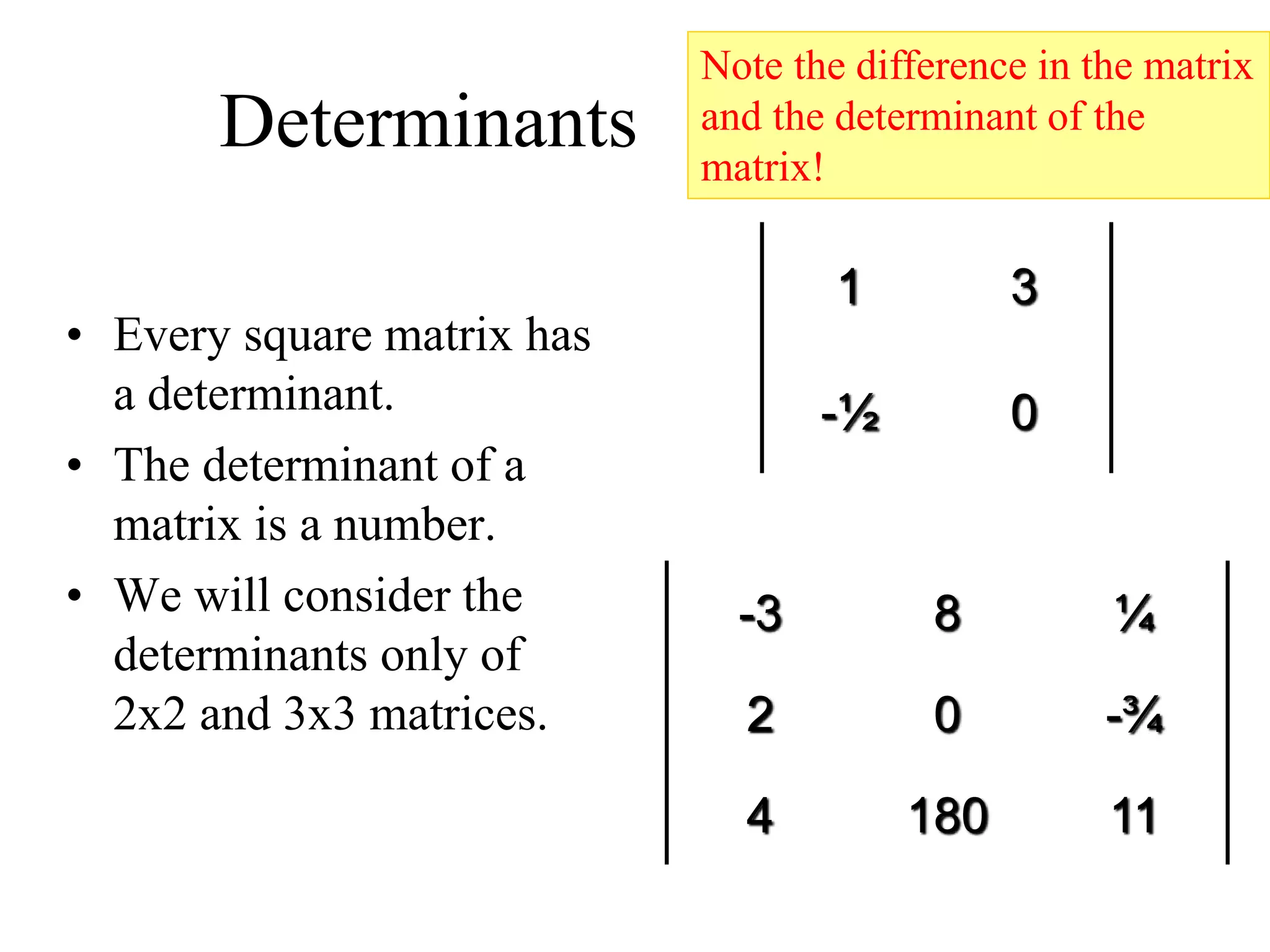
• Every square matrix has
a determinant.
• The determinant of a
matrix is a number.
• We will consider the
determinants only of
2x2 and 3x3 matrices.
1 3
-½ 0
-3 8 ¼
2 0 -¾
4 180 11
Note the difference in the matrix
and the determinant of the
matrix!
Why do we need the determinant
• It is used to help us
calculate the inverse
of a matrix and it is
used when finding
the area of a triangle
4
5
2
3

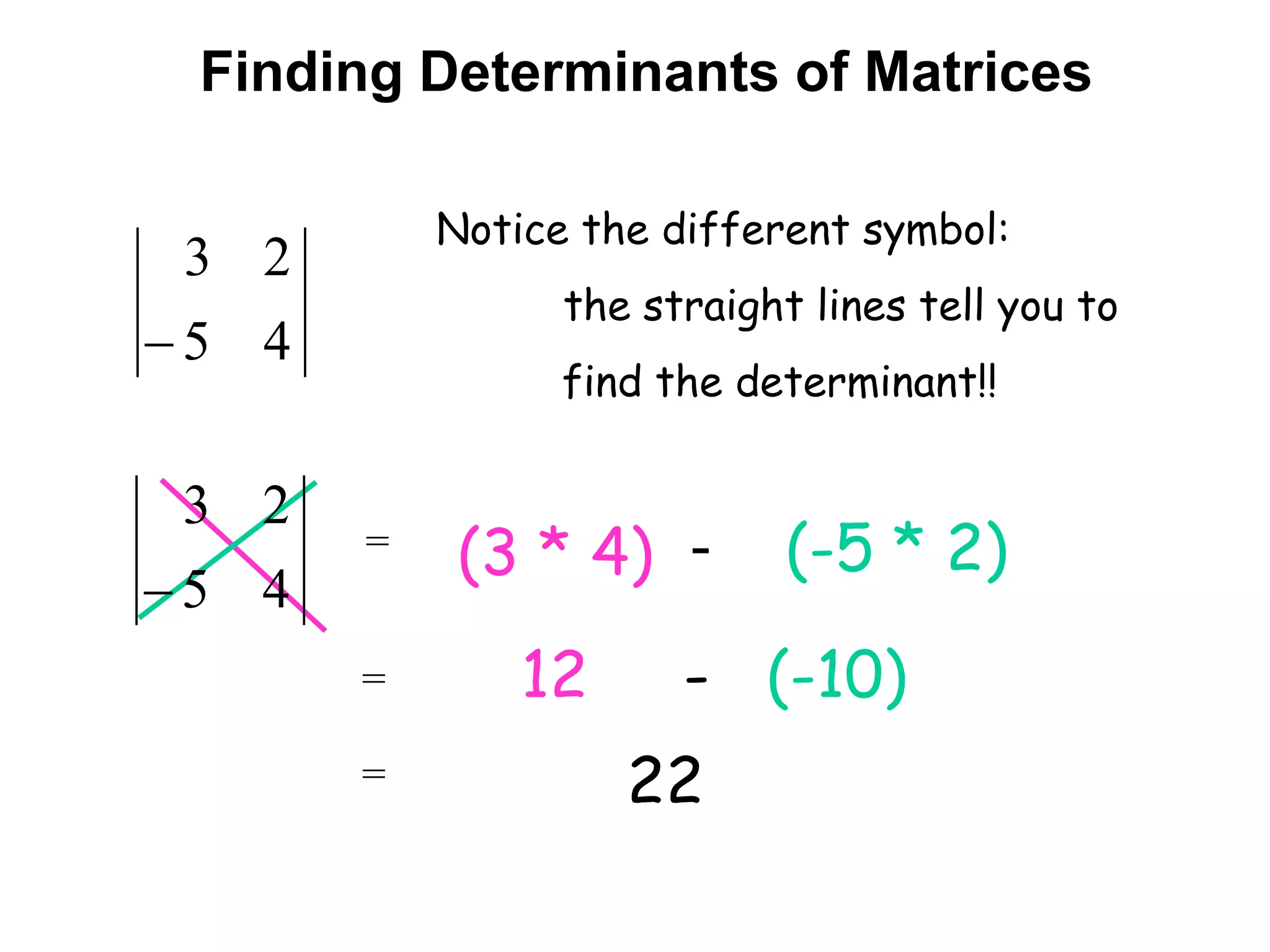
Notice the different symbol:
the straight lines tell you to
find the determinant!!
(3 * 4) - (-5 * 2)
12 - (-10)
22
=
4
5
2
3

Finding Determinants of Matrices
=
=
2
4
1
5
2
1
3
0
2


2
1
-1
0
-2
4
= [(2)(-2)(2) + (0)(5)(-1) + (3)(1)(4)]
[(3)(-2)(-1) + (2)(5)(4) + (0)(1)(2)]
[-8 + 0 +12]
-
- [6 + 40 + 0]
4 – 6 - 40
Finding Determinants of Matrices
=
= = -42






1
0
0
1
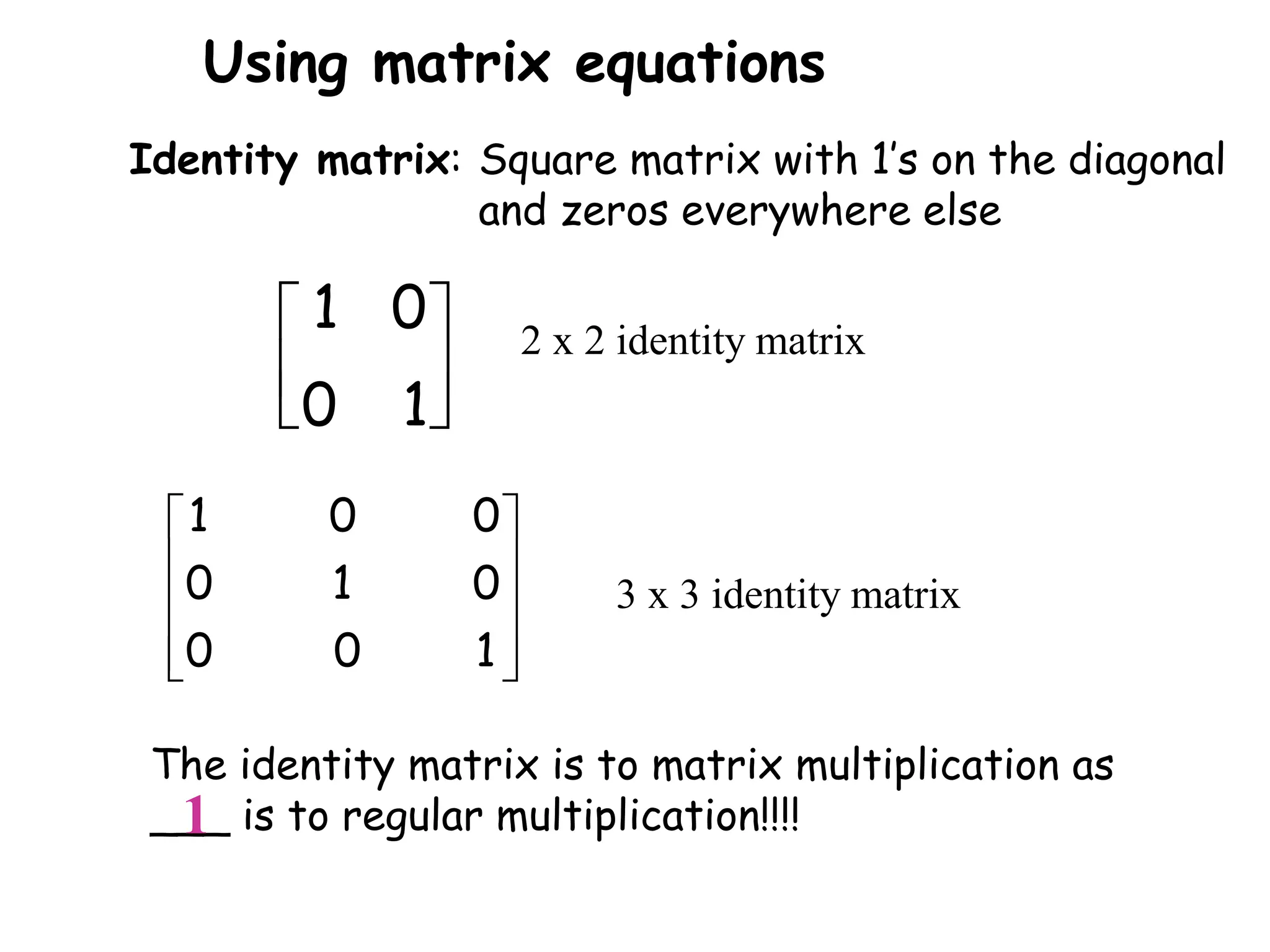
Identity matrix: Square matrix with 1’s on the diagonal
and zeros everywhere else
2 x 2 identity matrix










1
0
0
0
1
0
0
0
1
3 x 3 identity matrix
The identity matrix is to matrix multiplication as
___ is to regular multiplication!!!!
1
Using matrix equations
Multiply:






1
0
0
1





 
4
3
2
5
= 




 
4
3
2
5






1
0
0
1





 
4
3
2
5
= 




 
4
3
2
5
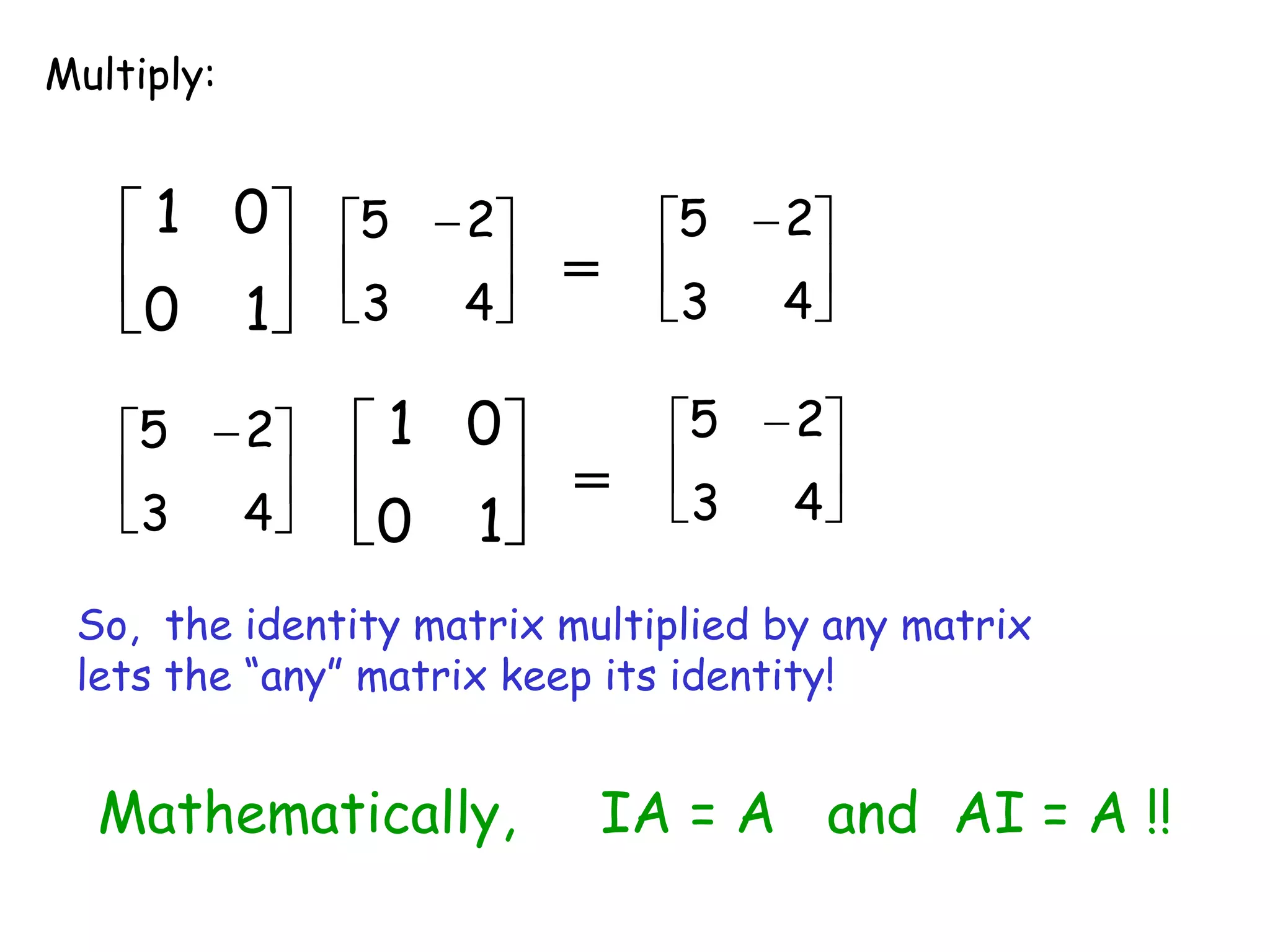
So, the identity matrix multiplied by any matrix
lets the “any” matrix keep its identity!
Mathematically, IA = A and AI = A !!
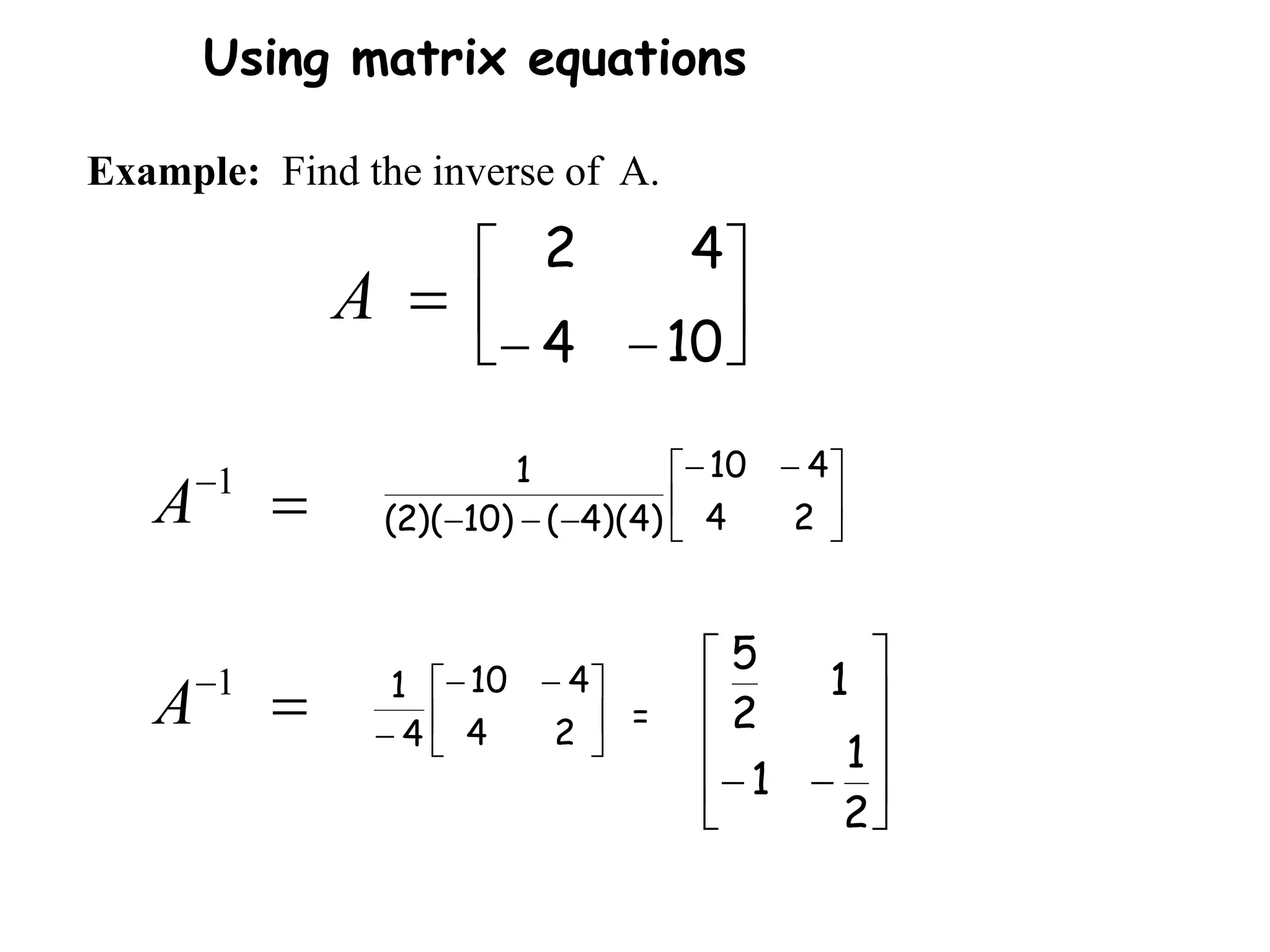
Inverse Matrix:
Using matrix equations
2 x 2






d
c
b
a
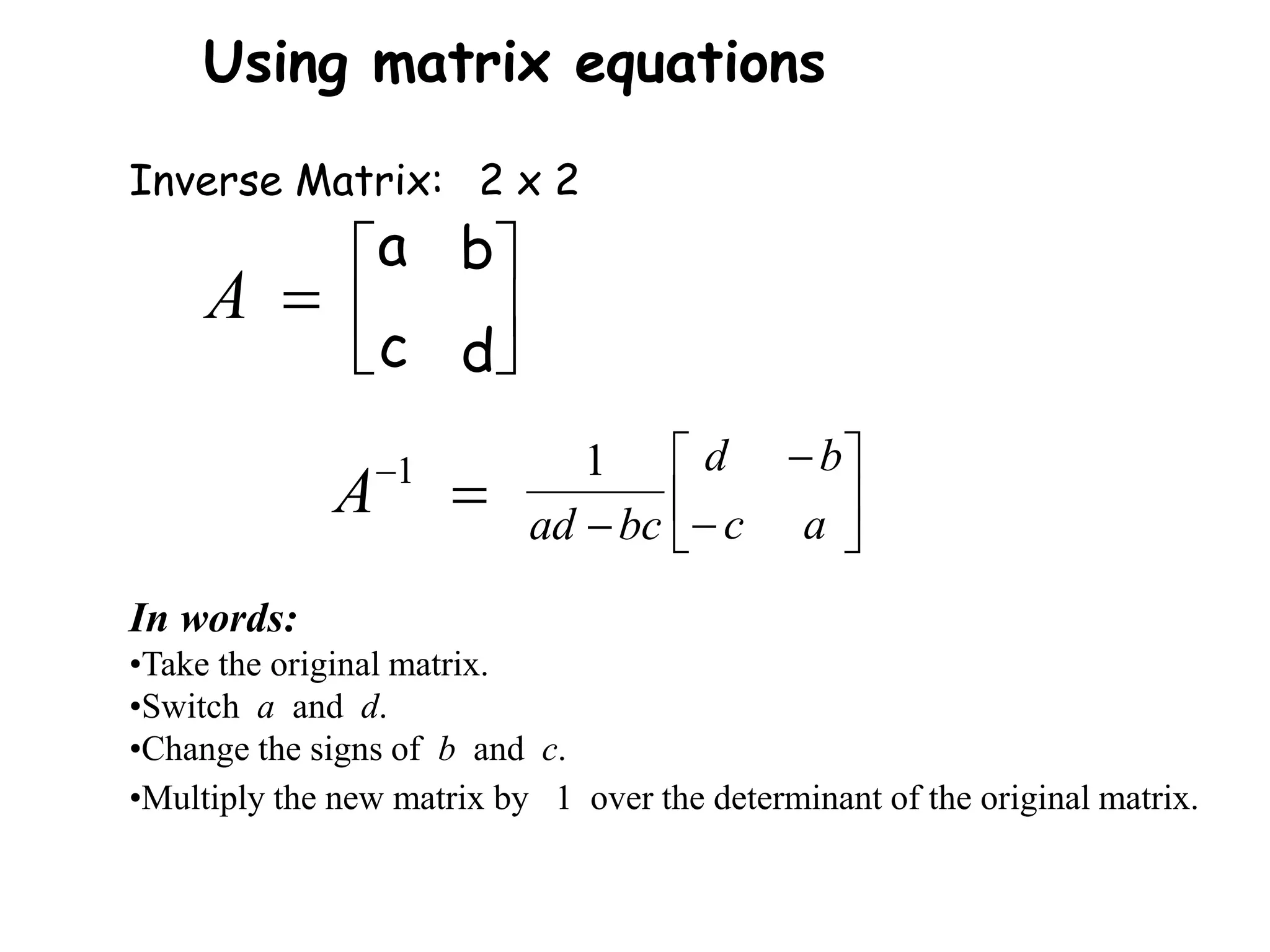
In words:
•Take the original matrix.
•Switch a and d.
•Change the signs of b and c.
•Multiply the new matrix by 1 over the determinant of the original matrix.








 a
c
b
d
bc
ad
1

1
A

A





 



 2
4
4
10
)
4
)(
4
(
)
10
)(
2
(
1





 

 2
4
4
10
4
1
=












2
1
1
1
2
5
Using matrix equations
Example: Find the inverse of A.







 10
4
4
2

A

1
A

1
A
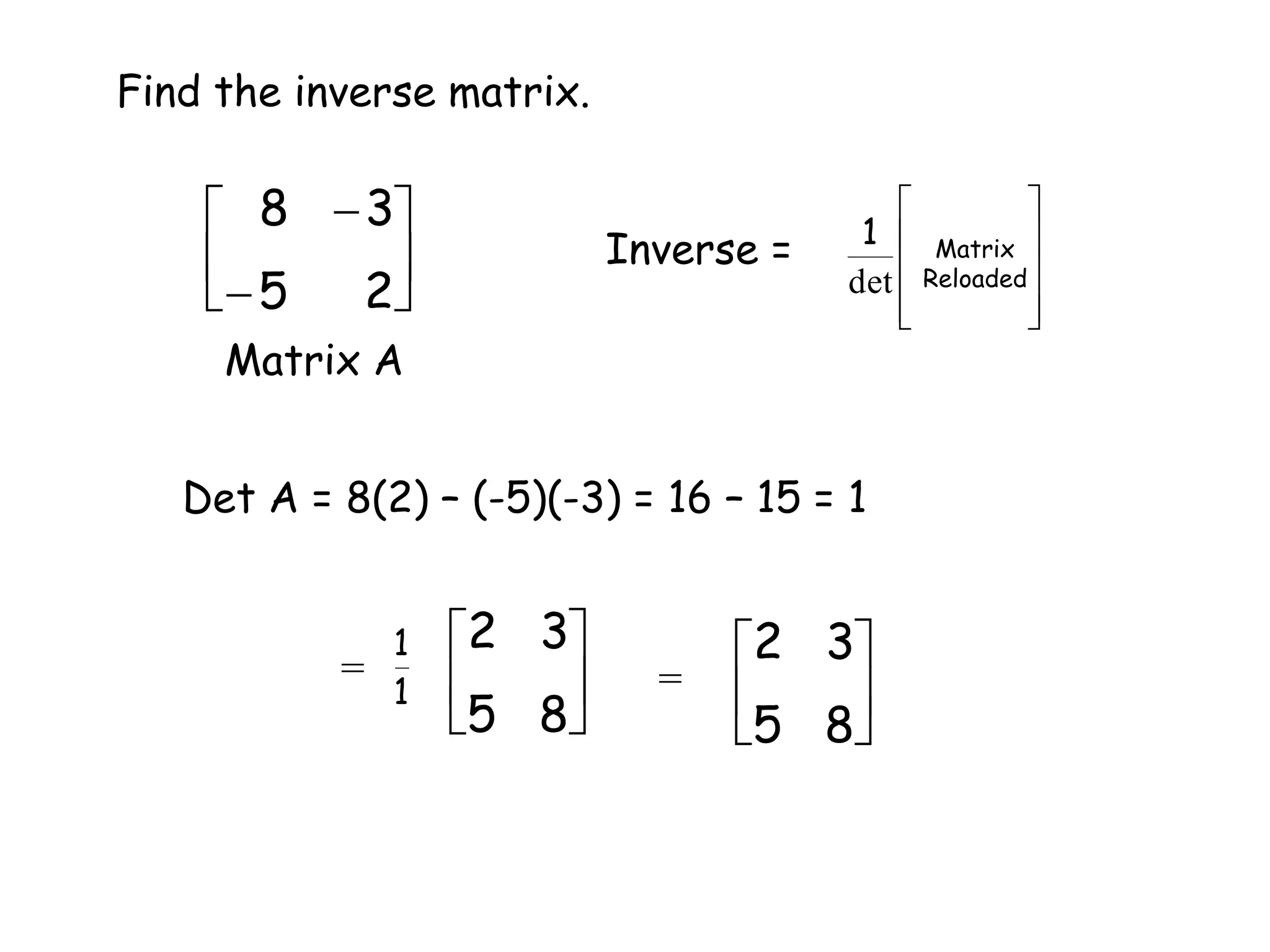
Find the inverse matrix.








2
5
3
8
Det A = 8(2) – (-5)(-3) = 16 – 15 = 1
Matrix A
Inverse =










det
1 Matrix
Reloaded






8
5
3
2
1
1
= = 





8
5
3
2
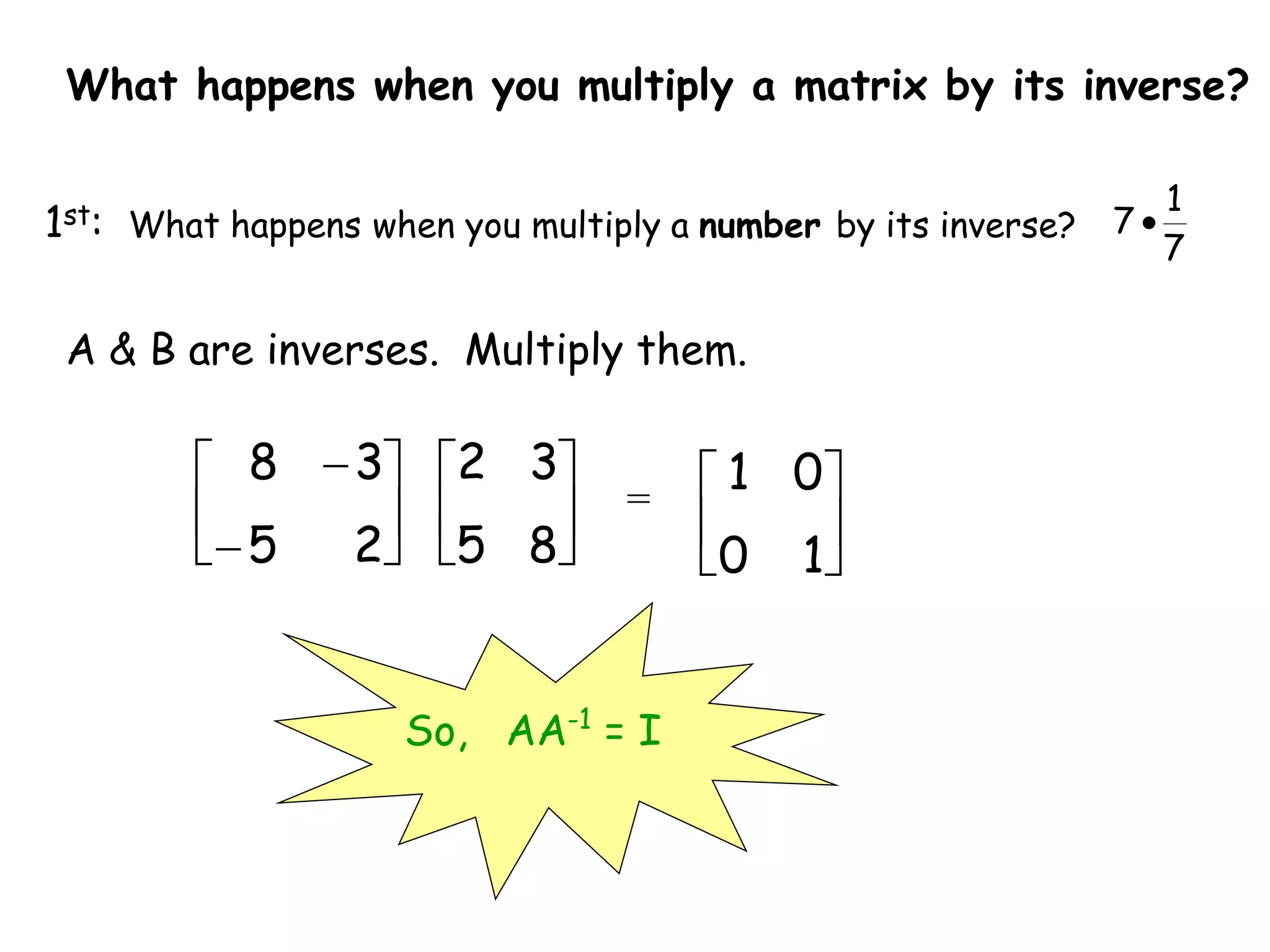
What happens when you multiply a matrix by its inverse?
1st: What happens when you multiply a number by its inverse?
7
1
7 
A & B are inverses. Multiply them.






8
5
3
2
=








2
5
3
8






1
0
0
1
So, AA-1
= I
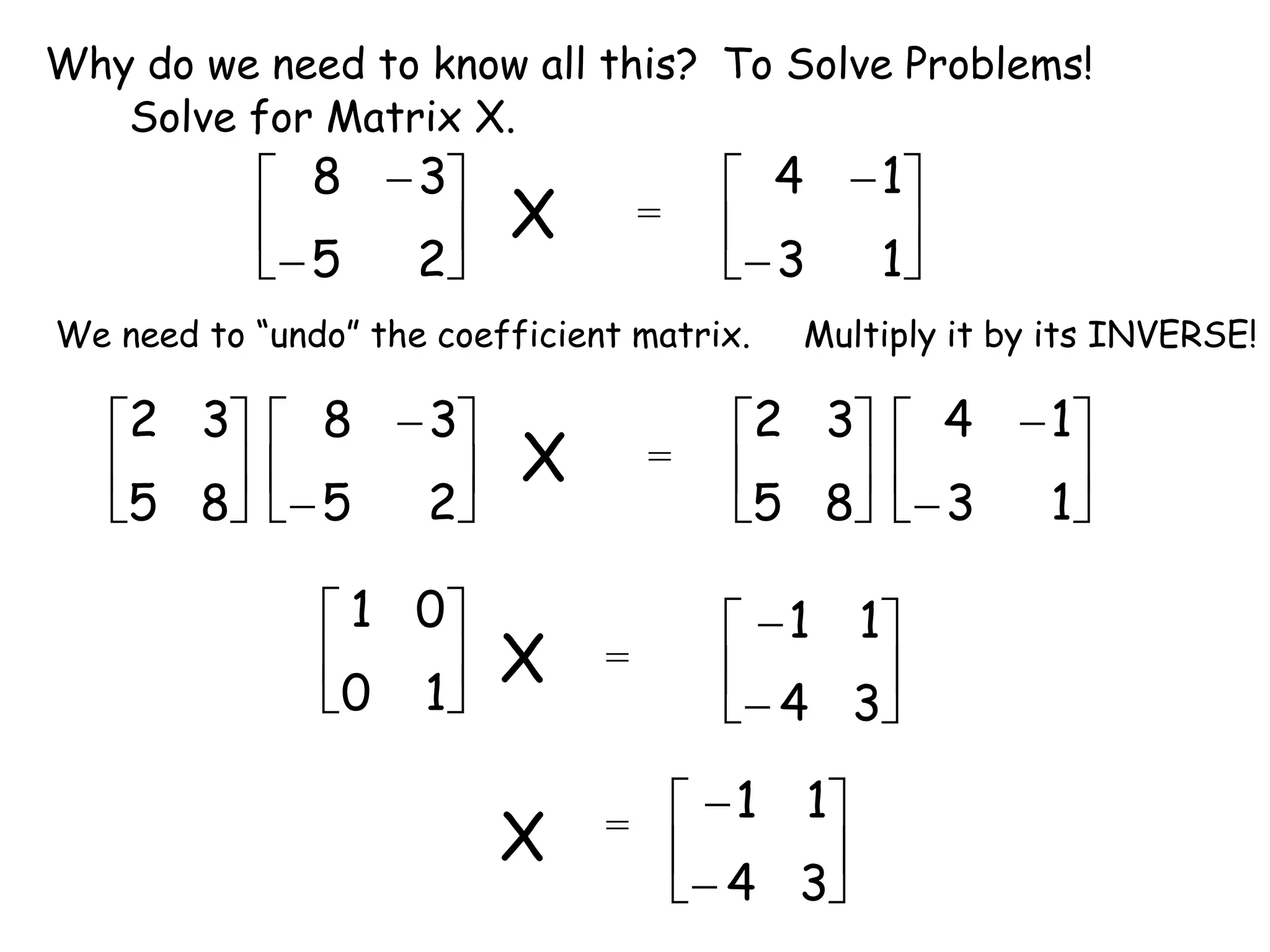
Why do we need to know all this? To Solve Problems!
Solve for Matrix X.
=








2
5
3
8
X 







1
3
1
4
We need to “undo” the coefficient matrix. Multiply it by its INVERSE!






8
5
3
2
=








2
5
3
8
X 





8
5
3
2








1
3
1
4






1
0
0
1
X = 







3
4
1
1
X =








3
4
1
1
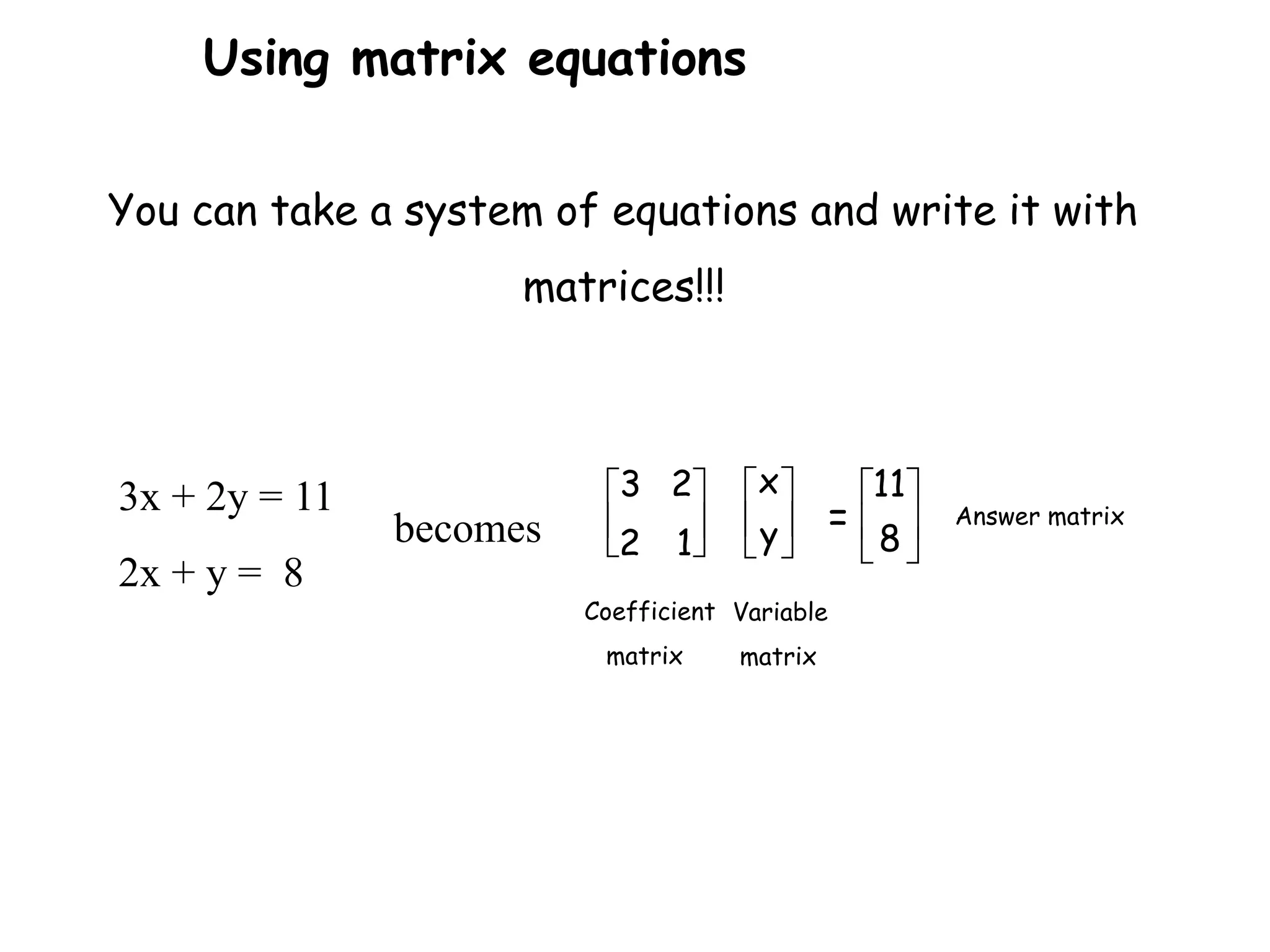
You can take a system of equations and write it with
matrices!!!
3x + 2y = 11
2x + y = 8
becomes 





1
2
2
3






y
x
= 





8
11
Coefficient
matrix
Variable
matrix
Answer matrix
Using matrix equations
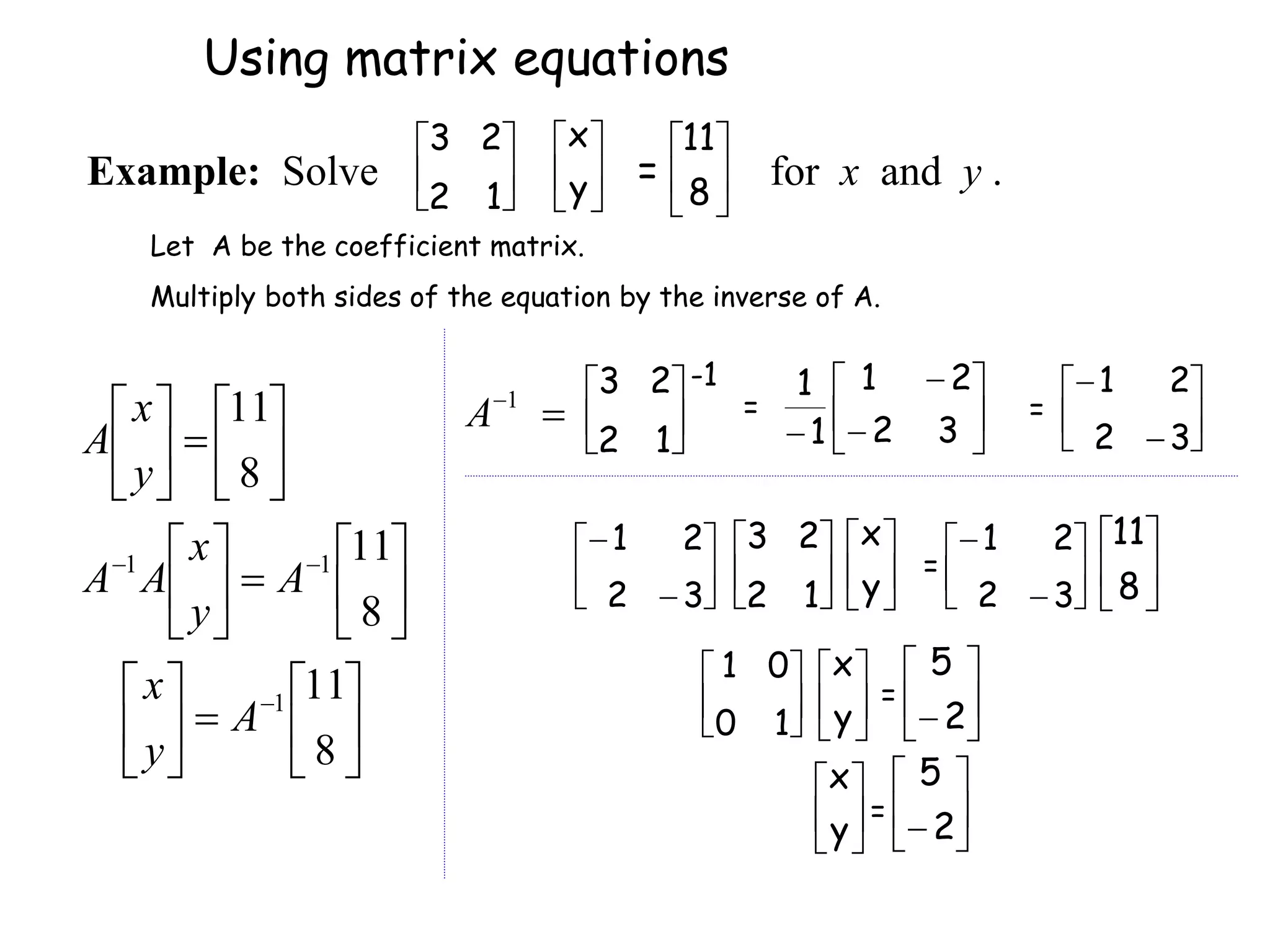
Let A be the coefficient matrix.
Multiply both sides of the equation by the inverse of A.










































8
11
8
11
8
11
1
1
1
A
y
x
A
y
x
A
A
y
x
A 





1
2
2
3 -1
= 







 3
2
2
1
1
1
= 







3
2
2
1








3
2
2
1






1
2
2
3






y
x
= 







3
2
2
1






8
11






1
0
0
1






y
x
= 





 2
5






y
x
= 





 2
5
Using matrix equations






1
2
2
3






y
x
= 





8
11
Example: Solve for x and y .

1
A
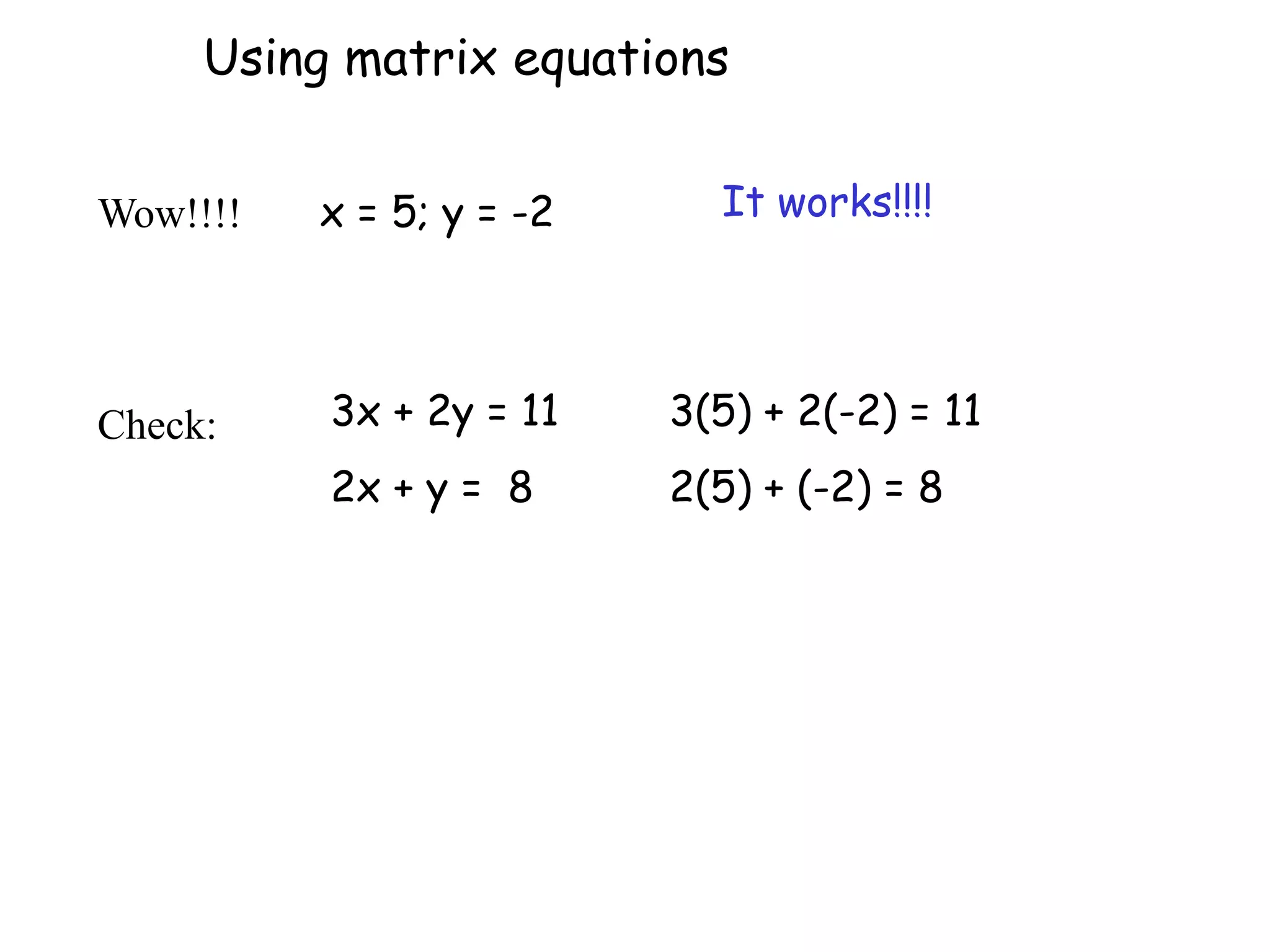
Wow!!!!
3x + 2y = 11
2x + y = 8
x = 5; y = -2
3(5) + 2(-2) = 11
2(5) + (-2) = 8
It works!!!!
Using matrix equations
Check:
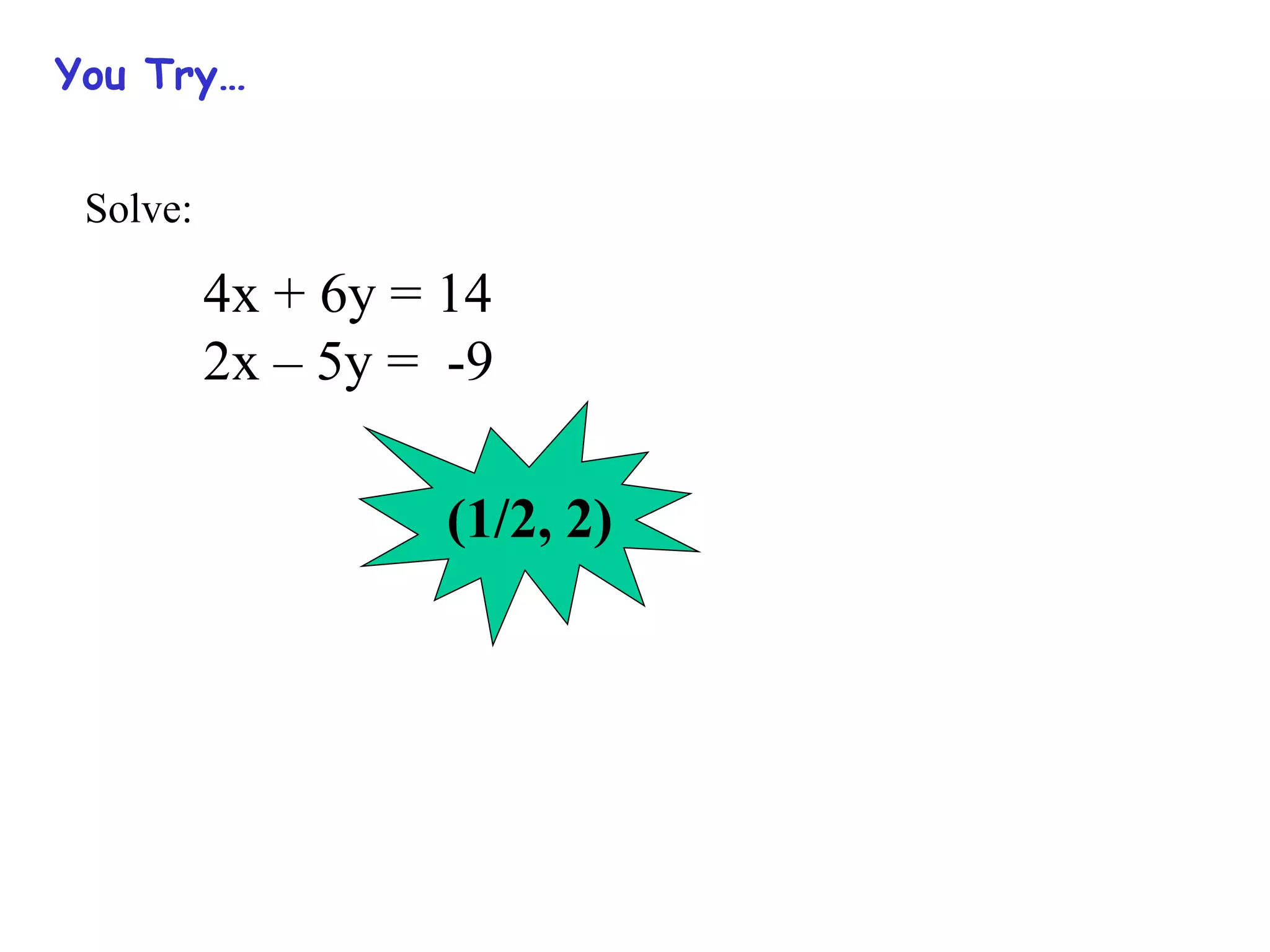
You Try…
Solve:
4x + 6y = 14
2x – 5y = -9
(1/2, 2)
You Try…
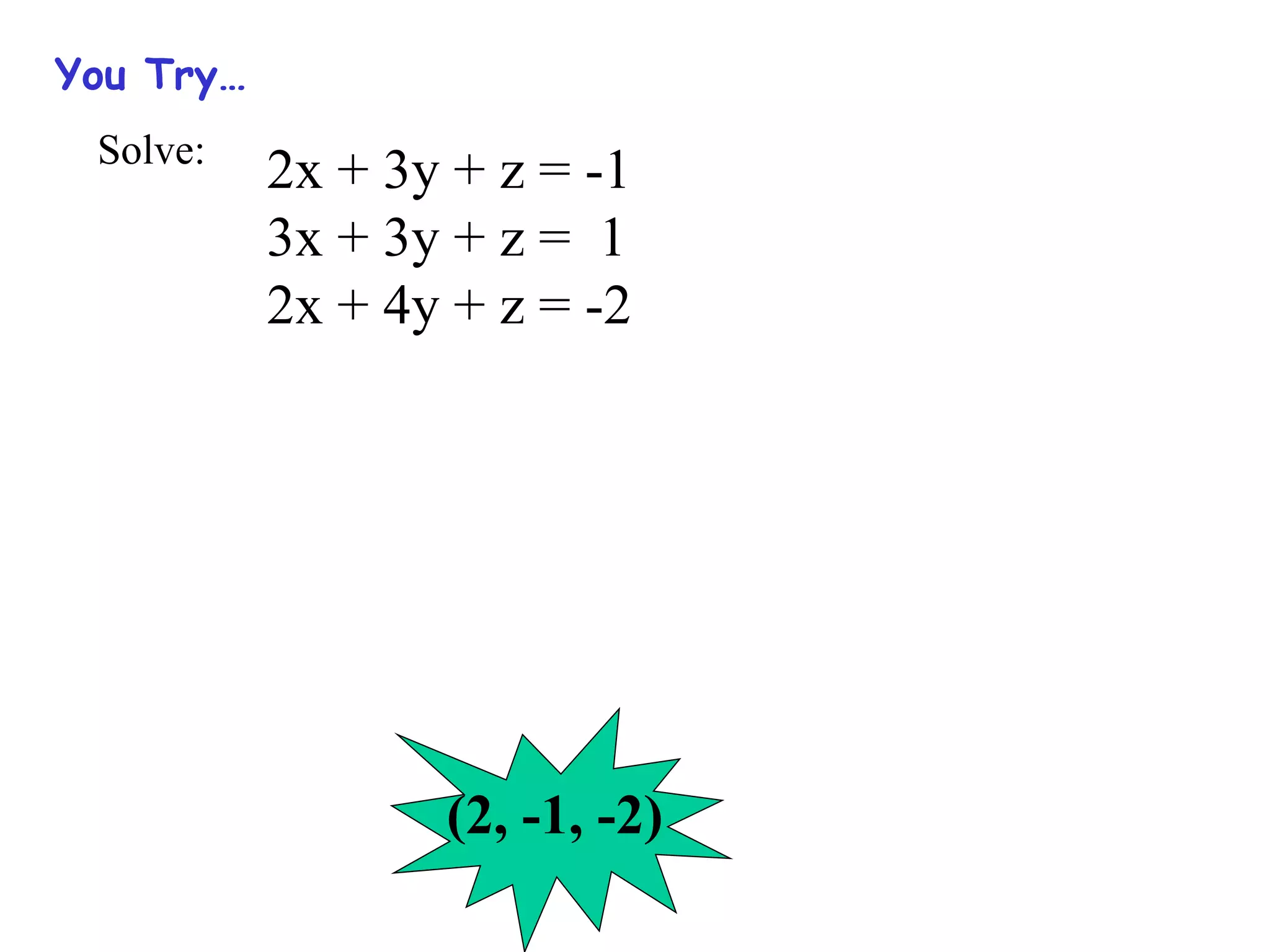
Solve:
2x + 3y + z = -1
3x + 3y + z = 1
2x + 4y + z = -2
(2, -1, -2)
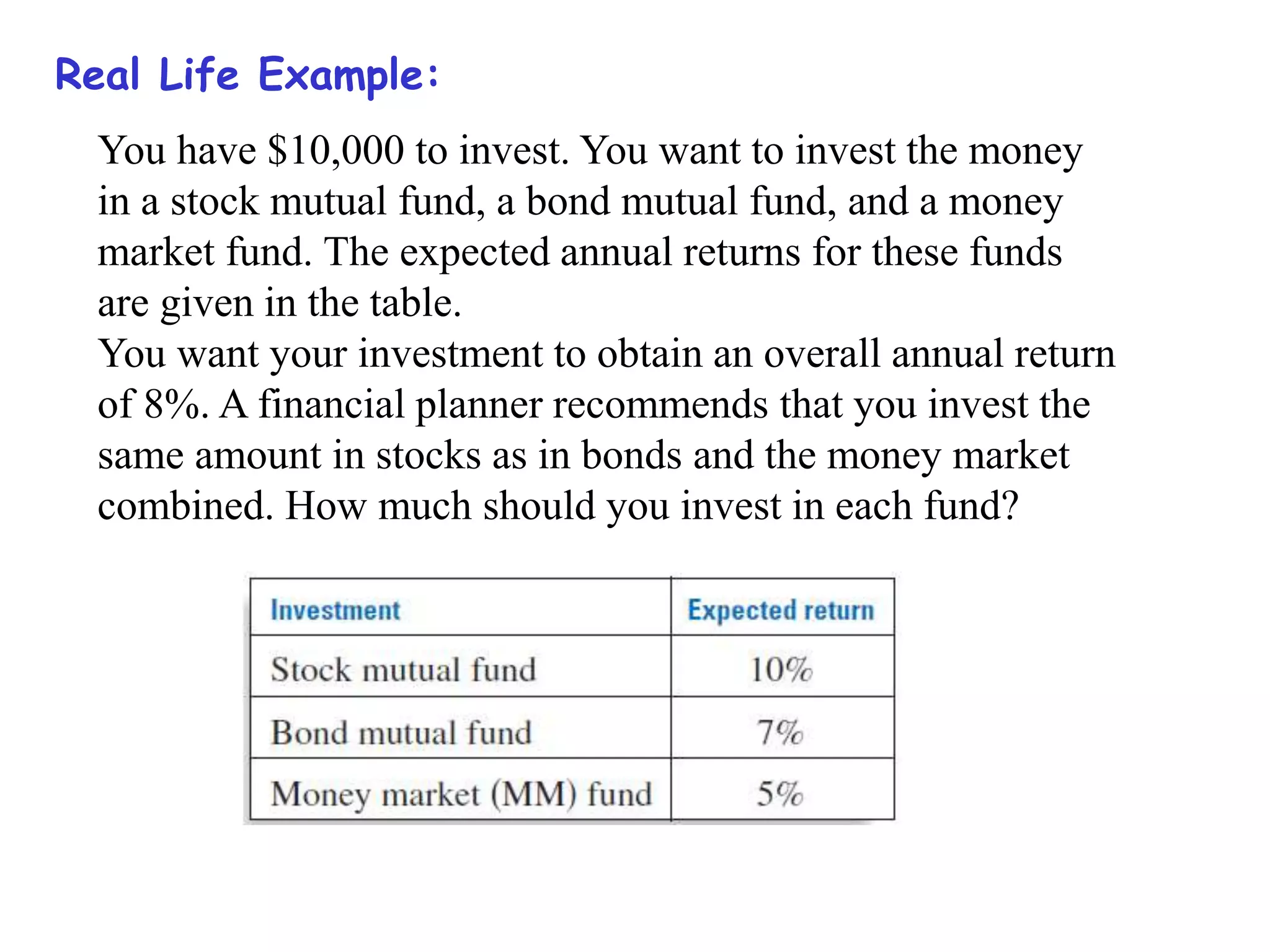
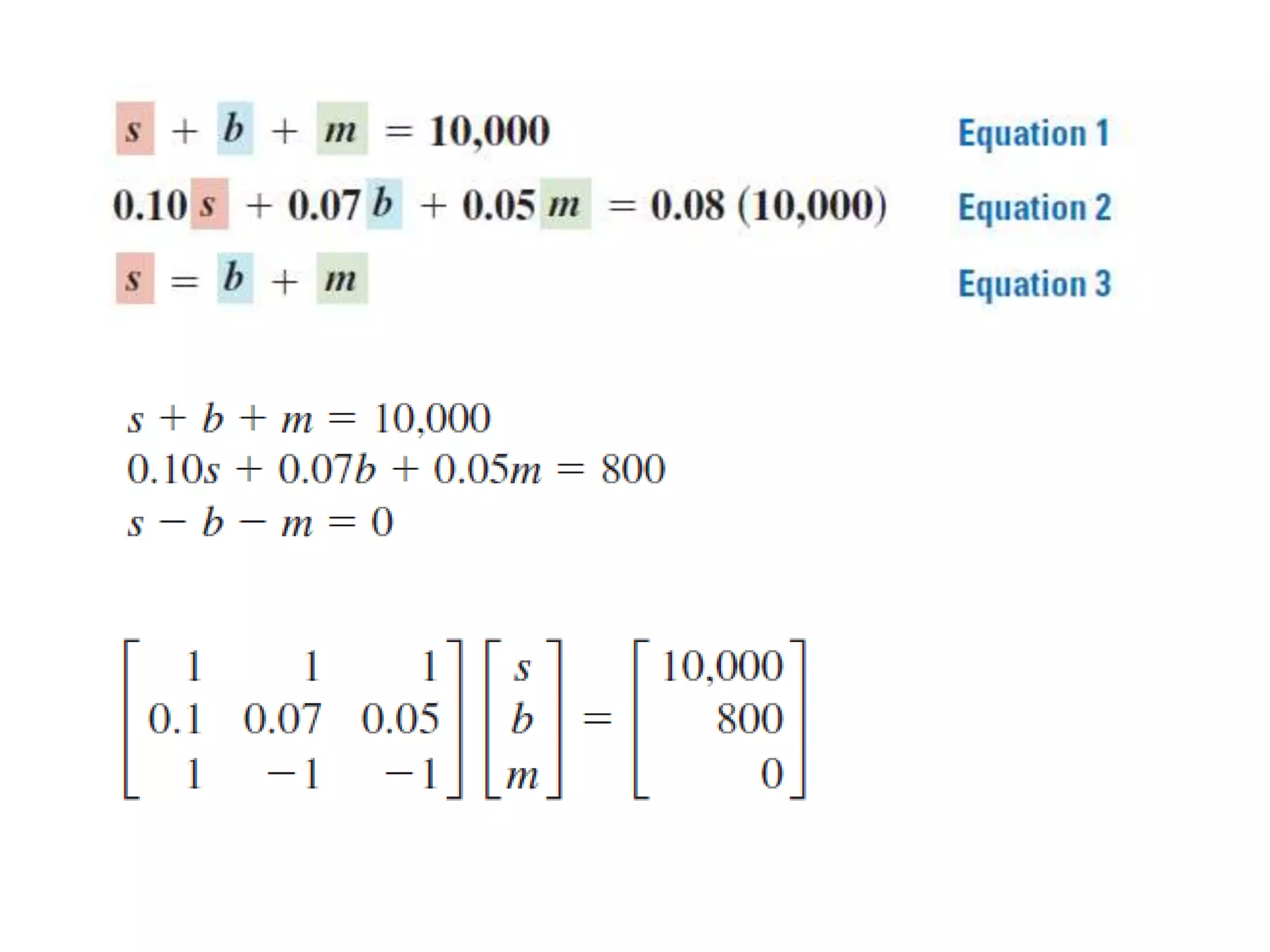
Real Life Example:
You have $10,000 to invest. You want to invest the money
in a stock mutual fund, a bond mutual fund, and a money
market fund. The expected annual returns for these funds
are given in the table.
You want your investment to obtain an overall annual return
of 8%. A financial planner recommends that you invest the
same amount in stocks as in bonds and the money market
combined. How much should you invest in each fund?
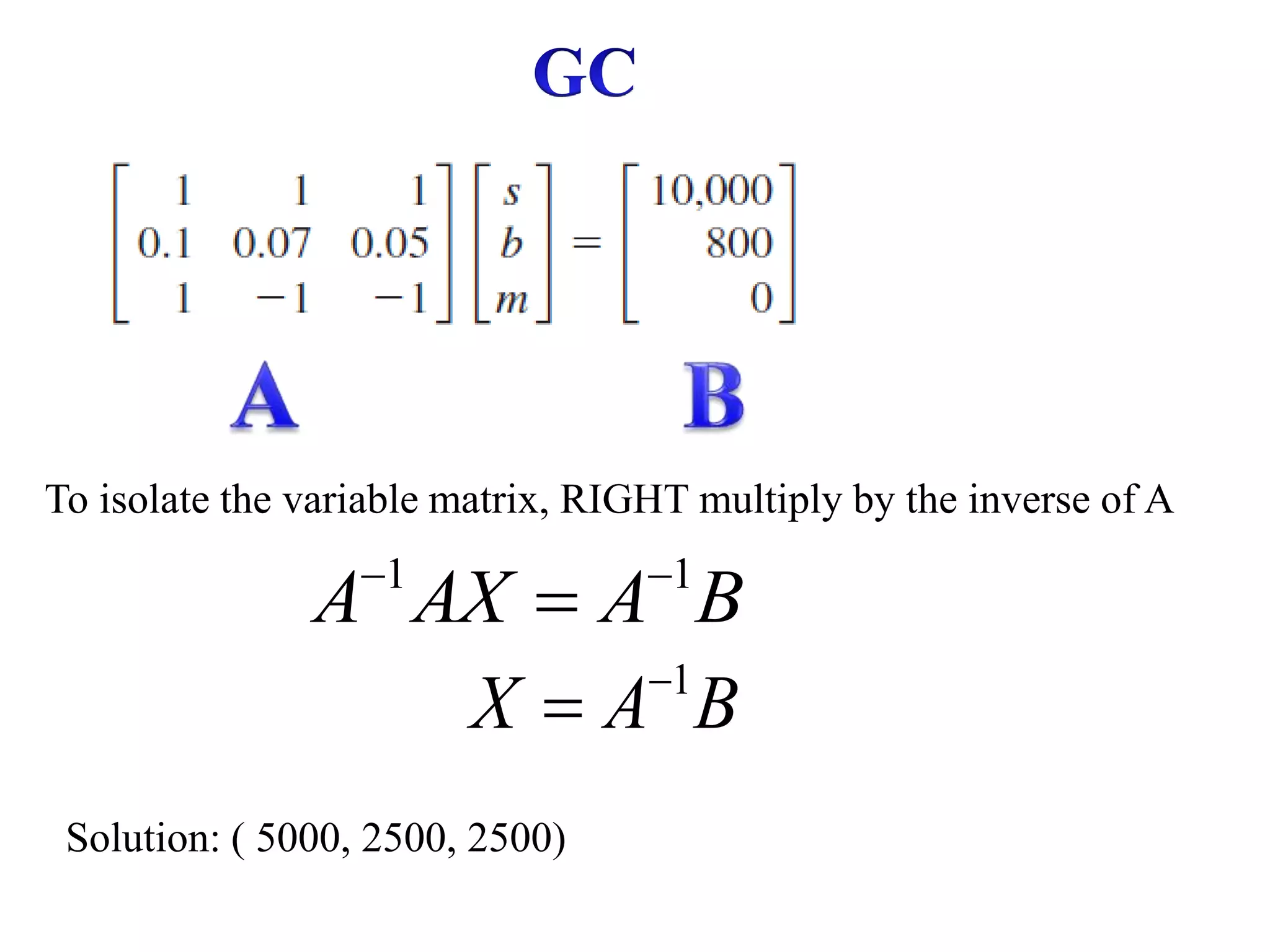
To isolate the variable matrix, RIGHT multiply by the inverse of A
1 1
A AX A B
 

1
X A B


Solution: ( 5000, 2500, 2500)

determinants.ppt

  • 1.
  • 2.
    Matrices • A matrixis an array of numbers that are arranged in rows and columns. • A matrix is “square” if it has the same number of rows as columns. • We will consider only 2x2 and 3x3 square matrices 0 -½ 3 1 11 180 4 -¾ 0 2 ¼ 8 -3
  • 3.
    Determinants • Every squarematrix has a determinant. • The determinant of a matrix is a number. • We will consider the determinants only of 2x2 and 3x3 matrices. 1 3 -½ 0 -3 8 ¼ 2 0 -¾ 4 180 11 Note the difference in the matrix and the determinant of the matrix!
  • 4.
    Why do weneed the determinant • It is used to help us calculate the inverse of a matrix and it is used when finding the area of a triangle
  • 5.
    4 5 2 3  Notice the differentsymbol: the straight lines tell you to find the determinant!! (3 * 4) - (-5 * 2) 12 - (-10) 22 = 4 5 2 3  Finding Determinants of Matrices = =
  • 6.
    2 4 1 5 2 1 3 0 2   2 1 -1 0 -2 4 = [(2)(-2)(2) +(0)(5)(-1) + (3)(1)(4)] [(3)(-2)(-1) + (2)(5)(4) + (0)(1)(2)] [-8 + 0 +12] - - [6 + 40 + 0] 4 – 6 - 40 Finding Determinants of Matrices = = = -42
  • 7.
          1 0 0 1 Identity matrix: Squarematrix with 1’s on the diagonal and zeros everywhere else 2 x 2 identity matrix           1 0 0 0 1 0 0 0 1 3 x 3 identity matrix The identity matrix is to matrix multiplication as ___ is to regular multiplication!!!! 1 Using matrix equations
  • 8.
    Multiply:       1 0 0 1        4 3 2 5 =       4 3 2 5       1 0 0 1        4 3 2 5 =        4 3 2 5 So, the identity matrix multiplied by any matrix lets the “any” matrix keep its identity! Mathematically, IA = A and AI = A !!
  • 9.
    Inverse Matrix: Using matrixequations 2 x 2       d c b a In words: •Take the original matrix. •Switch a and d. •Change the signs of b and c. •Multiply the new matrix by 1 over the determinant of the original matrix.          a c b d bc ad 1  1 A  A
  • 10.
               2 4 4 10 ) 4 )( 4 ( ) 10 )( 2 ( 1         2 4 4 10 4 1 =             2 1 1 1 2 5 Using matrix equations Example: Find the inverse of A.         10 4 4 2  A  1 A  1 A
  • 11.
    Find the inversematrix.         2 5 3 8 Det A = 8(2) – (-5)(-3) = 16 – 15 = 1 Matrix A Inverse =           det 1 Matrix Reloaded       8 5 3 2 1 1 = =       8 5 3 2
  • 12.
    What happens whenyou multiply a matrix by its inverse? 1st: What happens when you multiply a number by its inverse? 7 1 7  A & B are inverses. Multiply them.       8 5 3 2 =         2 5 3 8       1 0 0 1 So, AA-1 = I
  • 13.
    Why do weneed to know all this? To Solve Problems! Solve for Matrix X. =         2 5 3 8 X         1 3 1 4 We need to “undo” the coefficient matrix. Multiply it by its INVERSE!       8 5 3 2 =         2 5 3 8 X       8 5 3 2         1 3 1 4       1 0 0 1 X =         3 4 1 1 X =         3 4 1 1
  • 14.
    You can takea system of equations and write it with matrices!!! 3x + 2y = 11 2x + y = 8 becomes       1 2 2 3       y x =       8 11 Coefficient matrix Variable matrix Answer matrix Using matrix equations
  • 15.
    Let A bethe coefficient matrix. Multiply both sides of the equation by the inverse of A.                                           8 11 8 11 8 11 1 1 1 A y x A y x A A y x A       1 2 2 3 -1 =          3 2 2 1 1 1 =         3 2 2 1         3 2 2 1       1 2 2 3       y x =         3 2 2 1       8 11       1 0 0 1       y x =        2 5       y x =        2 5 Using matrix equations       1 2 2 3       y x =       8 11 Example: Solve for x and y .  1 A
  • 16.
    Wow!!!! 3x + 2y= 11 2x + y = 8 x = 5; y = -2 3(5) + 2(-2) = 11 2(5) + (-2) = 8 It works!!!! Using matrix equations Check:
  • 17.
    You Try… Solve: 4x +6y = 14 2x – 5y = -9 (1/2, 2)
  • 18.
    You Try… Solve: 2x +3y + z = -1 3x + 3y + z = 1 2x + 4y + z = -2 (2, -1, -2)
  • 19.
    Real Life Example: Youhave $10,000 to invest. You want to invest the money in a stock mutual fund, a bond mutual fund, and a money market fund. The expected annual returns for these funds are given in the table. You want your investment to obtain an overall annual return of 8%. A financial planner recommends that you invest the same amount in stocks as in bonds and the money market combined. How much should you invest in each fund?
  • 21.
    To isolate thevariable matrix, RIGHT multiply by the inverse of A 1 1 A AX A B    1 X A B   Solution: ( 5000, 2500, 2500)