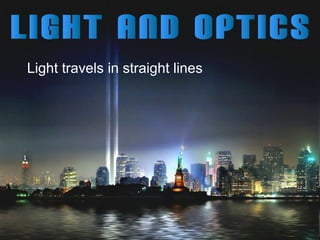
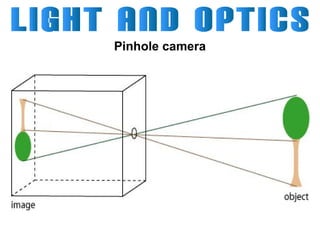
Light travels in straight lines
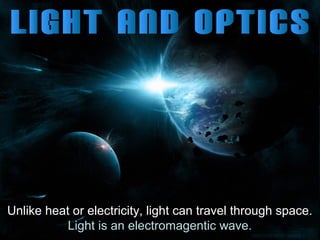
Unlike heat or electricity, light can travel through space.
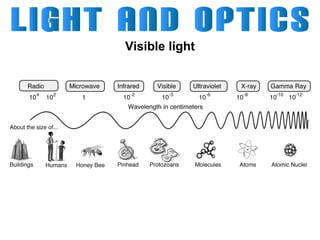
Light is an electromagentic wave.
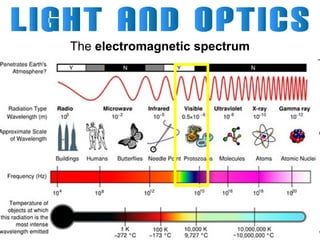
The electromagnetic spectrum
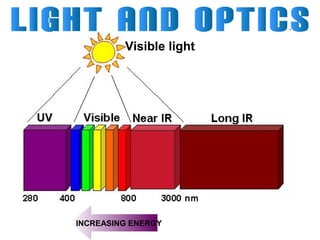
Visible light
Visible light

INCREASING ENERGY
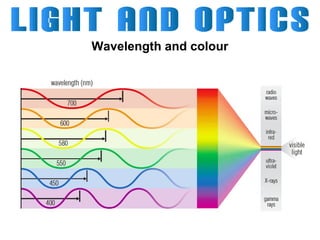
Wavelength and colour
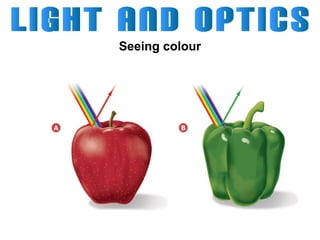
Seeing colour
Pinhole camera
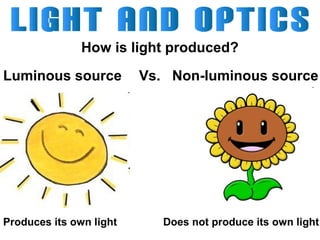
How is light produced?
Luminous source

Produces its own light

Vs. Non-luminous source

Does not produce its own light
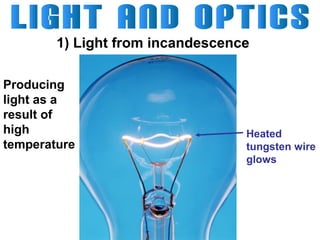
1) Light from incandescence
Producing
light as a
result of
high
temperature

Heated
tungsten wire
glows
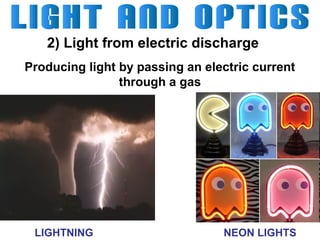
2) Light from electric discharge
Producing light by passing an electric current
through a gas

LIGHTNING

NEON LIGHTS
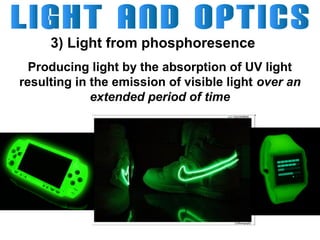
3) Light from phosphoresence
Producing light by the absorption of UV light
resulting in the emission of visible light over an
extended period of time
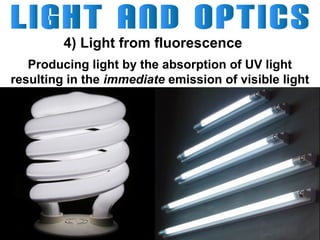
4) Light from fluorescence
Producing light by the absorption of UV light
resulting in the immediate emission of visible light
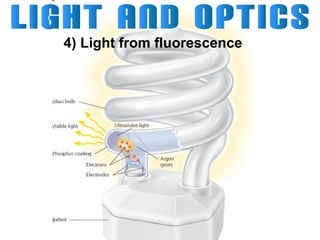
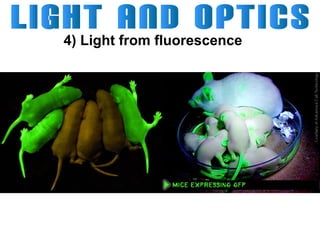
4) Light from fluorescence
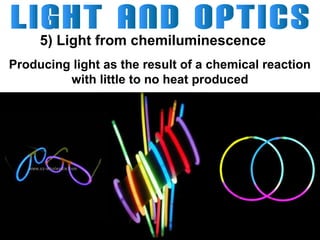
5) Light from chemiluminescence
Producing light as the result of a chemical reaction
with little to no heat produced
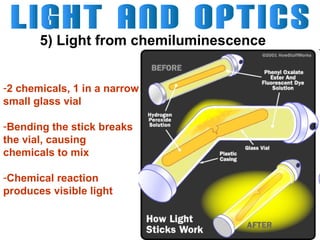
5) Light from chemiluminescence
-2 chemicals, 1 in a narrow
small glass vial
-Bending the stick breaks
the vial, causing
chemicals to mix
-Chemical reaction
produces visible light
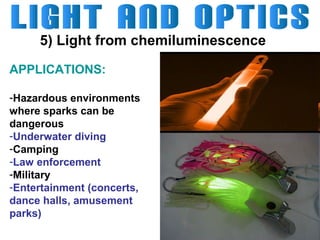
5) Light from chemiluminescence
APPLICATIONS:
-Hazardous environments
where sparks can be
dangerous
-Underwater diving
-Camping
-Law enforcement
-Military
-Entertainment (concerts,
dance halls, amusement
parks)
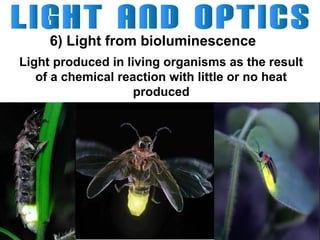
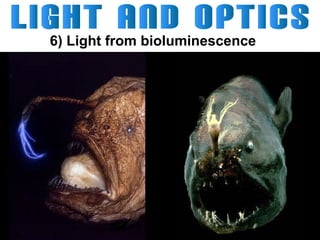
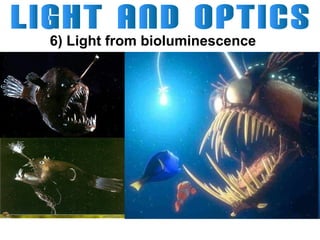
6) Light from bioluminescence
Light produced in living organisms as the result
of a chemical reaction with little or no heat
produced
6) Light from bioluminescence
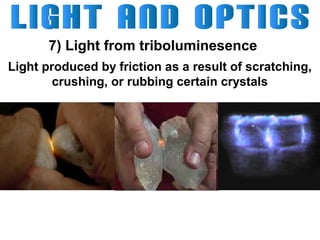
7) Light from triboluminesence
Light produced by friction as a result of scratching,
crushing, or rubbing certain crystals
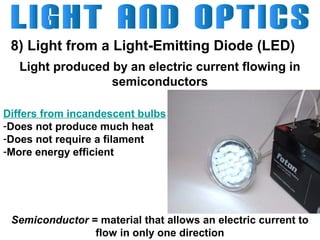
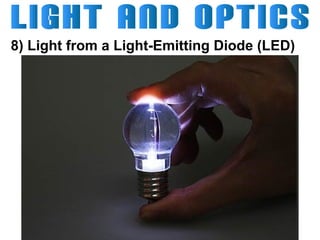
8) Light from a Light-Emitting Diode (LED)
Light produced by an electric current flowing in
semiconductors
Differs from incandescent bulbs
-Does not produce much heat
-Does not require a filament
-More energy efficient

Semiconductor = material that allows an electric current to
flow in only one direction
8) Light from a Light-Emitting Diode (LED)
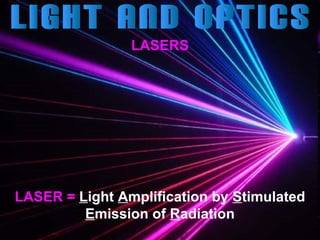
LASERS

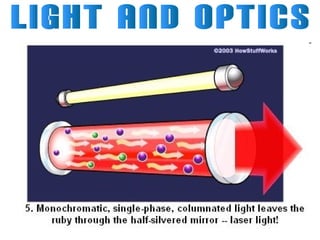
LASER = Light Amplification by Stimulated
Emission of Radiation
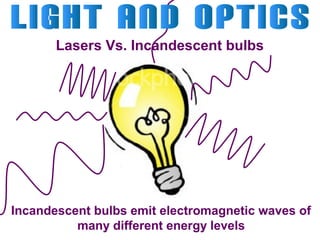
Lasers Vs. Incandescent bulbs

Incandescent bulbs emit electromagnetic waves of
many different energy levels
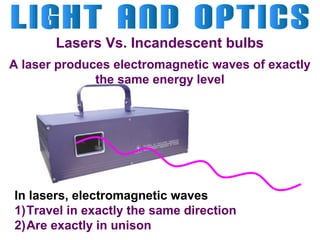
Lasers Vs. Incandescent bulbs
A laser produces electromagnetic waves of exactly
the same energy level

In lasers, electromagnetic waves
1)Travel in exactly the same direction
2)Are exactly in unison
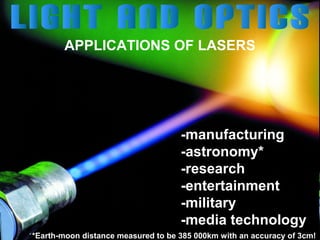
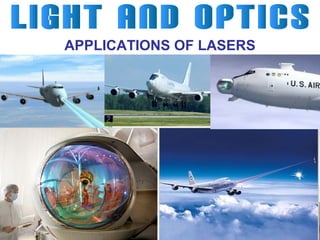
APPLICATIONS OF LASERS

-manufacturing
-astronomy*
-research
-entertainment
-military
-media technology
*Earth-moon distance measured to be 385 000km with an accuracy of 3cm!
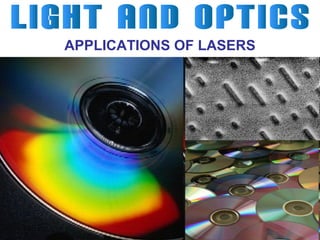
APPLICATIONS OF LASERS
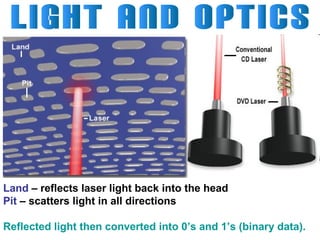
Land – reflects laser light back into the head
Pit – scatters light in all directions
Reflected light then converted into 0’s and 1’s (binary data).
02 light and optics

02 light and optics

  • 2.
    Light travels instraight lines
  • 3.
    Unlike heat orelectricity, light can travel through space. Light is an electromagentic wave.
  • 4.
  • 5.
  • 6.
  • 7.
  • 8.
  • 9.
  • 10.
    How is lightproduced? Luminous source Produces its own light Vs. Non-luminous source Does not produce its own light
  • 11.
    1) Light fromincandescence Producing light as a result of high temperature Heated tungsten wire glows
  • 12.
    2) Light fromelectric discharge Producing light by passing an electric current through a gas LIGHTNING NEON LIGHTS
  • 13.
    3) Light fromphosphoresence Producing light by the absorption of UV light resulting in the emission of visible light over an extended period of time
  • 14.
    4) Light fromfluorescence Producing light by the absorption of UV light resulting in the immediate emission of visible light
  • 15.
    4) Light fromfluorescence
  • 16.
    4) Light fromfluorescence
  • 17.
    5) Light fromchemiluminescence Producing light as the result of a chemical reaction with little to no heat produced
  • 18.
    5) Light fromchemiluminescence -2 chemicals, 1 in a narrow small glass vial -Bending the stick breaks the vial, causing chemicals to mix -Chemical reaction produces visible light
  • 19.
    5) Light fromchemiluminescence APPLICATIONS: -Hazardous environments where sparks can be dangerous -Underwater diving -Camping -Law enforcement -Military -Entertainment (concerts, dance halls, amusement parks)
  • 20.
    6) Light frombioluminescence Light produced in living organisms as the result of a chemical reaction with little or no heat produced
  • 21.
    6) Light frombioluminescence
  • 22.
    6) Light frombioluminescence
  • 23.
    7) Light fromtriboluminesence Light produced by friction as a result of scratching, crushing, or rubbing certain crystals
  • 24.
    8) Light froma Light-Emitting Diode (LED) Light produced by an electric current flowing in semiconductors Differs from incandescent bulbs -Does not produce much heat -Does not require a filament -More energy efficient Semiconductor = material that allows an electric current to flow in only one direction
  • 25.
    8) Light froma Light-Emitting Diode (LED)
  • 26.
    LASERS LASER = LightAmplification by Stimulated Emission of Radiation
  • 27.
    Lasers Vs. Incandescentbulbs Incandescent bulbs emit electromagnetic waves of many different energy levels
  • 28.
    Lasers Vs. Incandescentbulbs A laser produces electromagnetic waves of exactly the same energy level In lasers, electromagnetic waves 1)Travel in exactly the same direction 2)Are exactly in unison
  • 30.
    APPLICATIONS OF LASERS -manufacturing -astronomy* -research -entertainment -military -mediatechnology *Earth-moon distance measured to be 385 000km with an accuracy of 3cm!
  • 31.
  • 32.
  • 33.
    Land – reflectslaser light back into the head Pit – scatters light in all directions Reflected light then converted into 0’s and 1’s (binary data).

Editor's Notes

  • #2 http://www.youtube.com/watch?v=KvOs_RBjLOk&feature=PlayList&p=34CAF189A5C0F7B9&playnext_from=PL&index=0&playnext=1 http://www.youtube.com/watch?v=bPyWooEpwXw&feature=PlayList&p=34CAF189A5C0F7B9&playnext_from=PL&playnext=1&index=1 http://www.youtube.com/watch?v=LjMvgPAyuqo&feature=PlayList&p=34CAF189A5C0F7B9&playnext_from=PL&playnext=2&index=2
  • #15 http://www.youtube.com/watch?v=rS5LC2aH0c4
  • #16 Sometimes there is mercury vapour inside the glass tube
  • #17 Sometimes there is mercury vapour inside the glass tube
  • #18 Sometimes there is mercury vapour inside the glass tube
  • #19 Sometimes there is mercury vapour inside the glass tube
  • #31 http://www.youtube.com/watch?v=gkNJurvXraY (laser cutting) http://www.youtube.com/watch?v=IaAiYIYXbIA&feature=related http://www.youtube.com/watch?v=bcdCRwfILQs http://www.youtube.com/watch?v=5pEXdMsl6SA&feature=related http://www.youtube.com/watch?v=KRDbpQjP4Vk&feature=PlayList&p=047A42CB2CC0A211&playnext_from=PL&index=10&playnext=3
  • #32 http://www.youtube.com/watch?v=3fRPDdYSc7M&NR=1 (boeing laser)
  • #33 http://www.youtube.com/watch?v=po3MMIRs6ws&feature=related
  • #34 http://www.youtube.com/watch?v=po3MMIRs6ws&feature=related
  • #35 http://www.youtube.com/watch?v=po3MMIRs6ws&feature=related Answer pg 469 Q #1, 5, 9, 10